The following was written by Curator of Books and Maps Eric Ensley
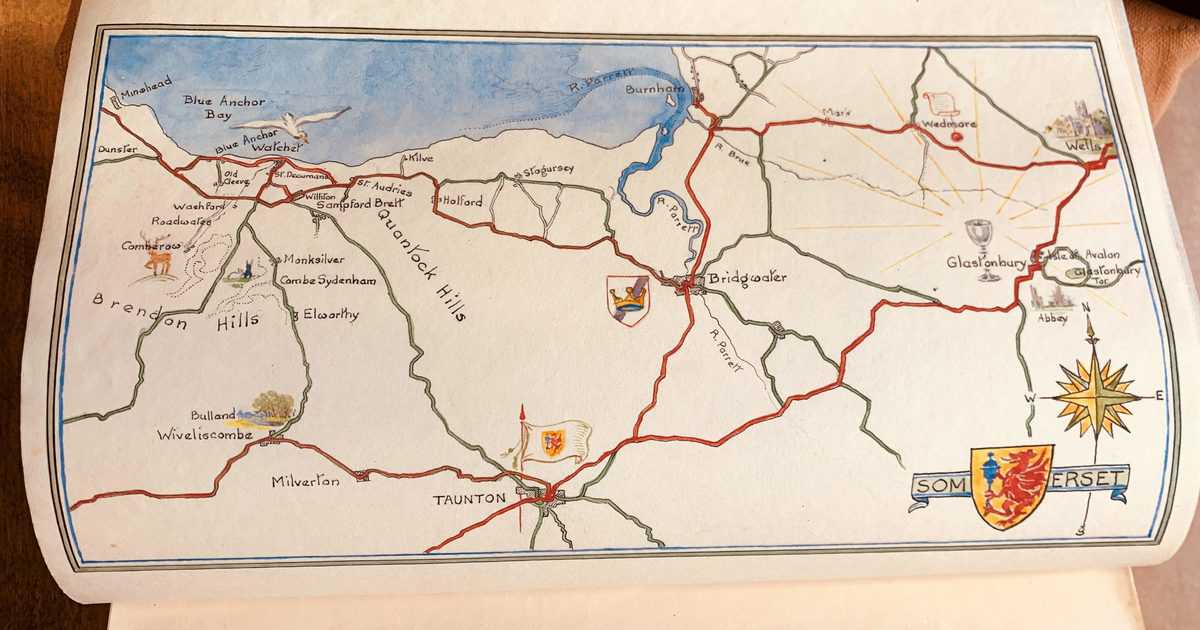
Hand drawn map from The Loiterers
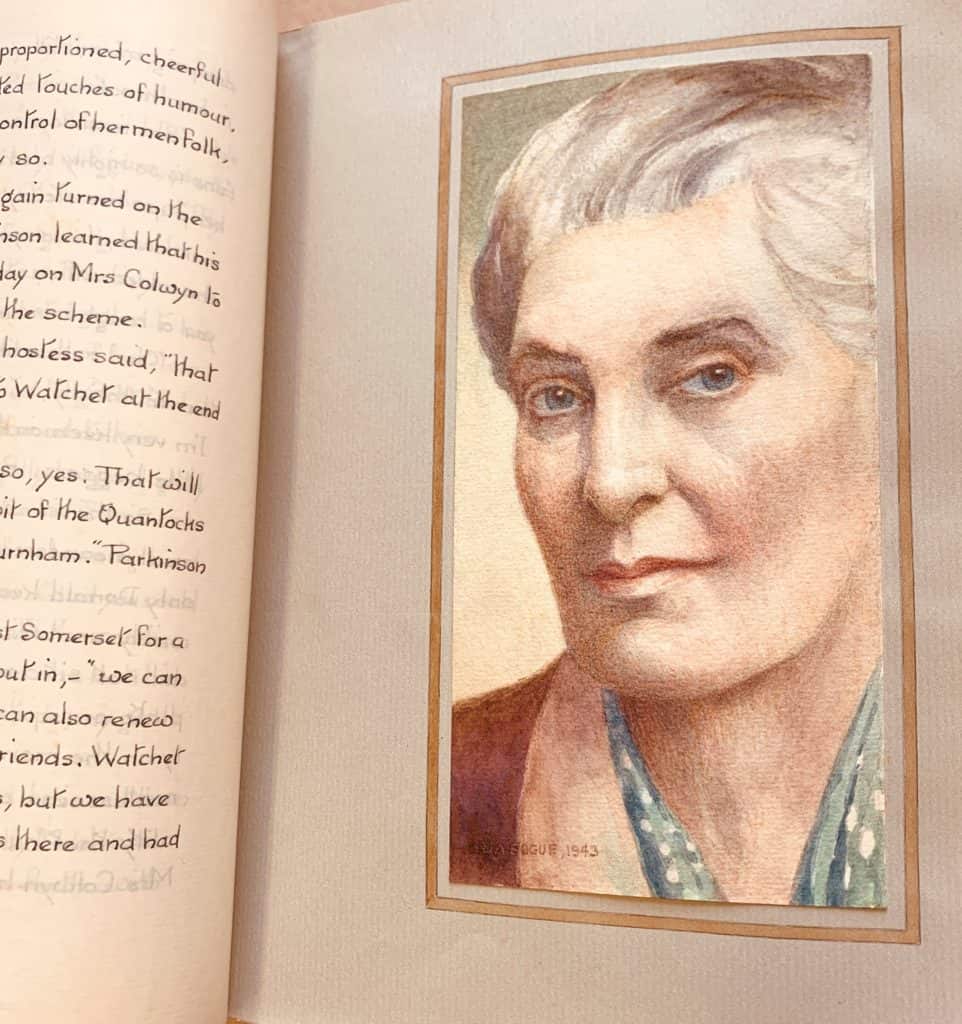
As the snow begins to melt away in Iowa City, happily we begin to think of nature and adventures along the hills and riverbanks of the countryside. This desire for spring is felt all the more as we live through times of loss and global catastrophe. I suggest that it is this same yearning for bucolic settings that drove English author and artist Ida Bogue to make our newest edition to the collection, The Loiterers, at the height of World War II.
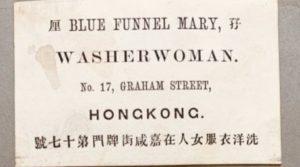
19th century service card from Hong Kong found in the pages of the book
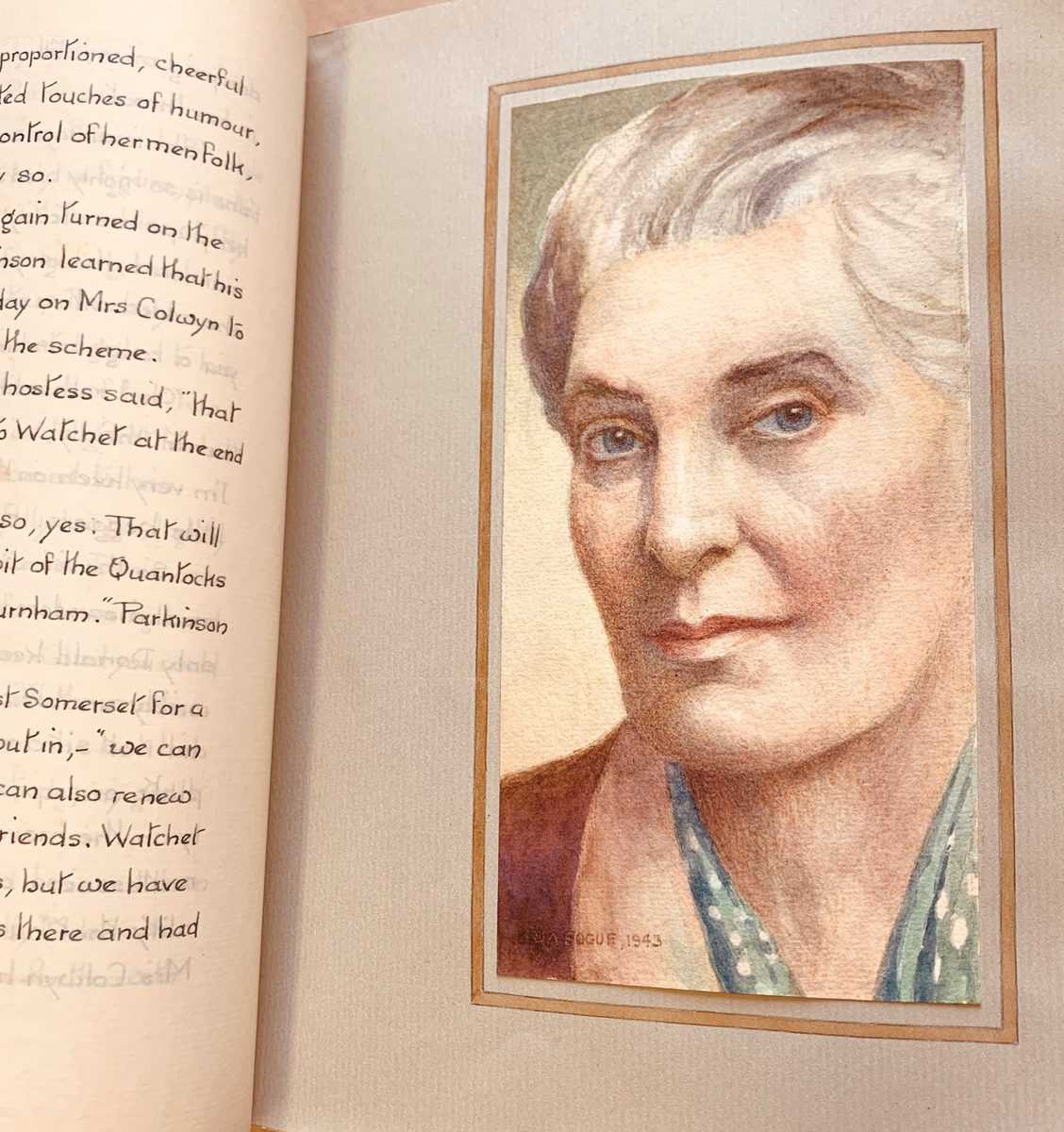
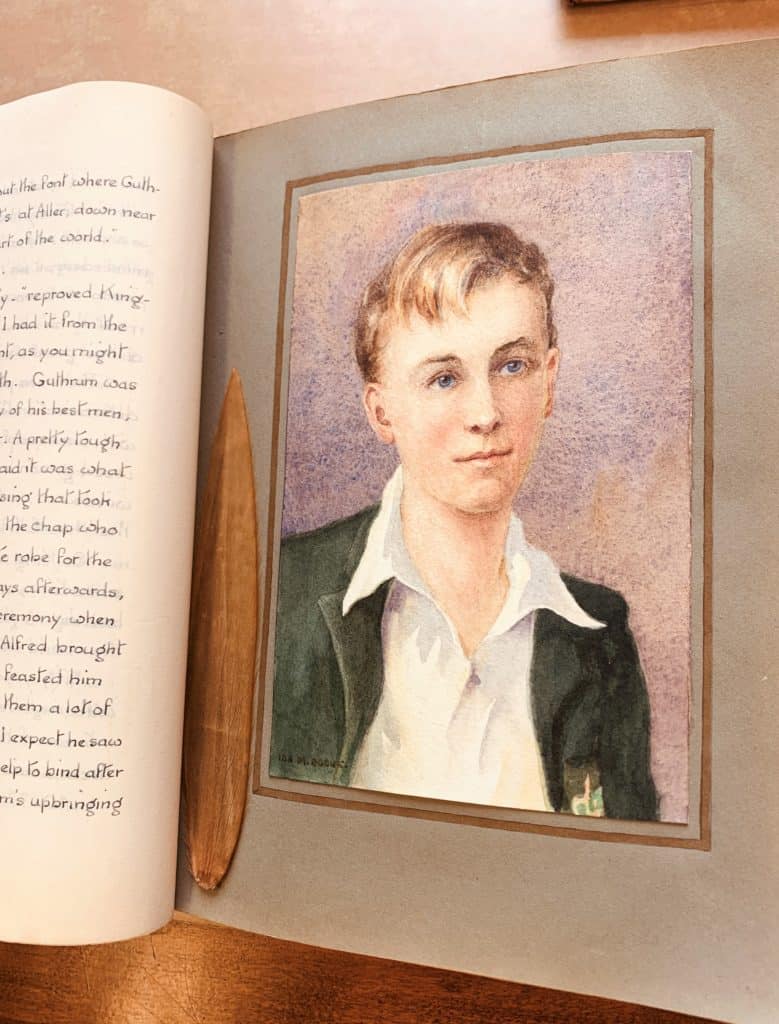
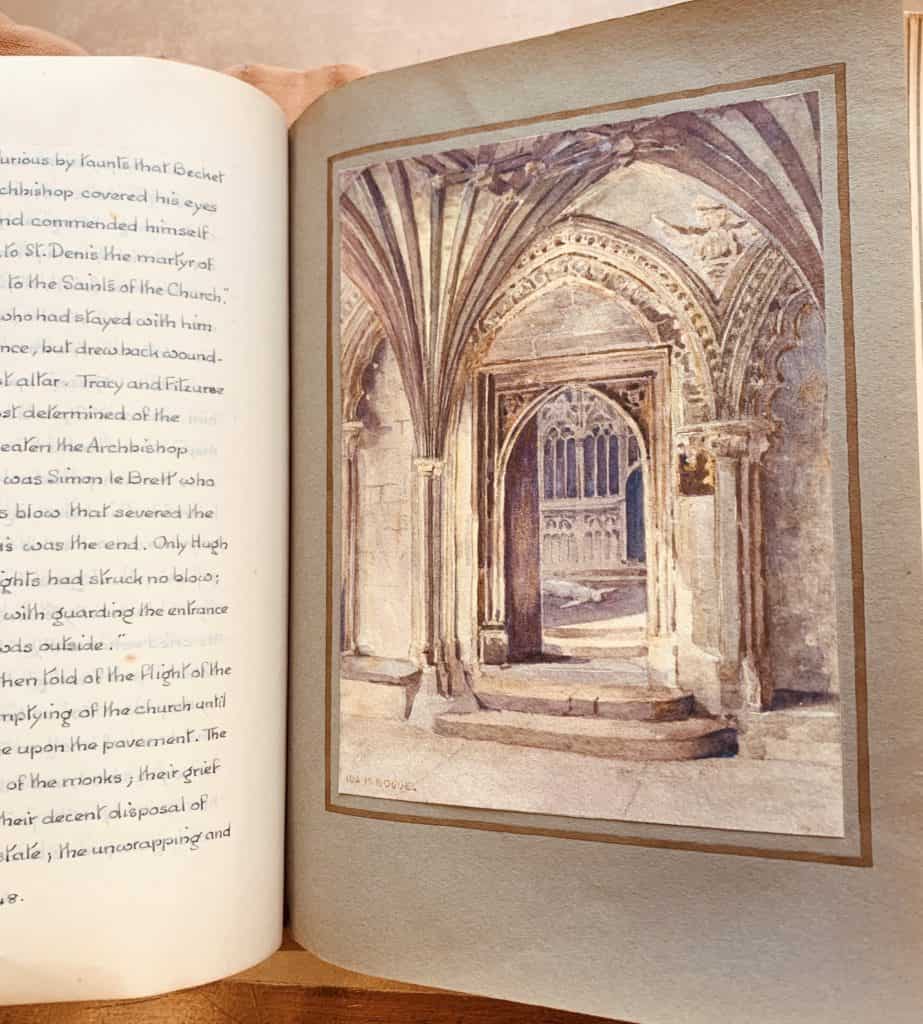
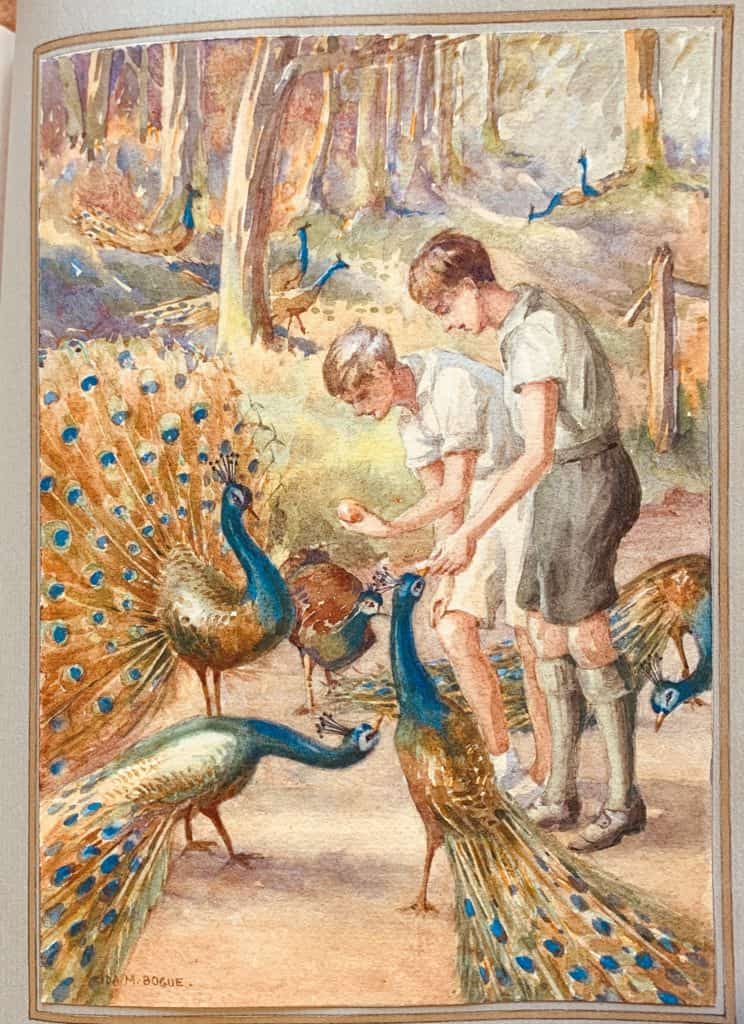
I should first say that no words I can write can quite do this manuscript justice—it is a stunning work of art, from its over 800 handwritten pages, 30 handmade watercolors, and the decorative binding made by Bogue herself. The book tells the story of two young boys who go on adventures through the English countryside and meet a cast of characters, many of whom are illustrated in the watercolors. Also included are a number of objects pertinent to the story tucked into the binding, including a leaf and several nineteenth-century washing service cards from Hong Kong and Shanghai.
Bogue may have intended the book as a gift for her young nephews, no doubt suffering through the war. It’s difficult to say, however, as Bogue was a reclusive figure, having never reached authorial fame, having no children of her own, or any sustained relationships as far as can be see. In her lifetime she apparently wrote six different manuscripts stories like this. One, a fairy story called Child-Hazel, is still owned by the family and appeared on an episode of Antiques Roadshow in the early 2000s. It is likely that Bogue’s family also has another one of these manuscripts stories as well. A third story was sent by Bogue as a gift for the young princesses Margaret and Elizabeth at Buckingham Palace. The other three were assumed lost—though our manuscript is believed to be one of these three.
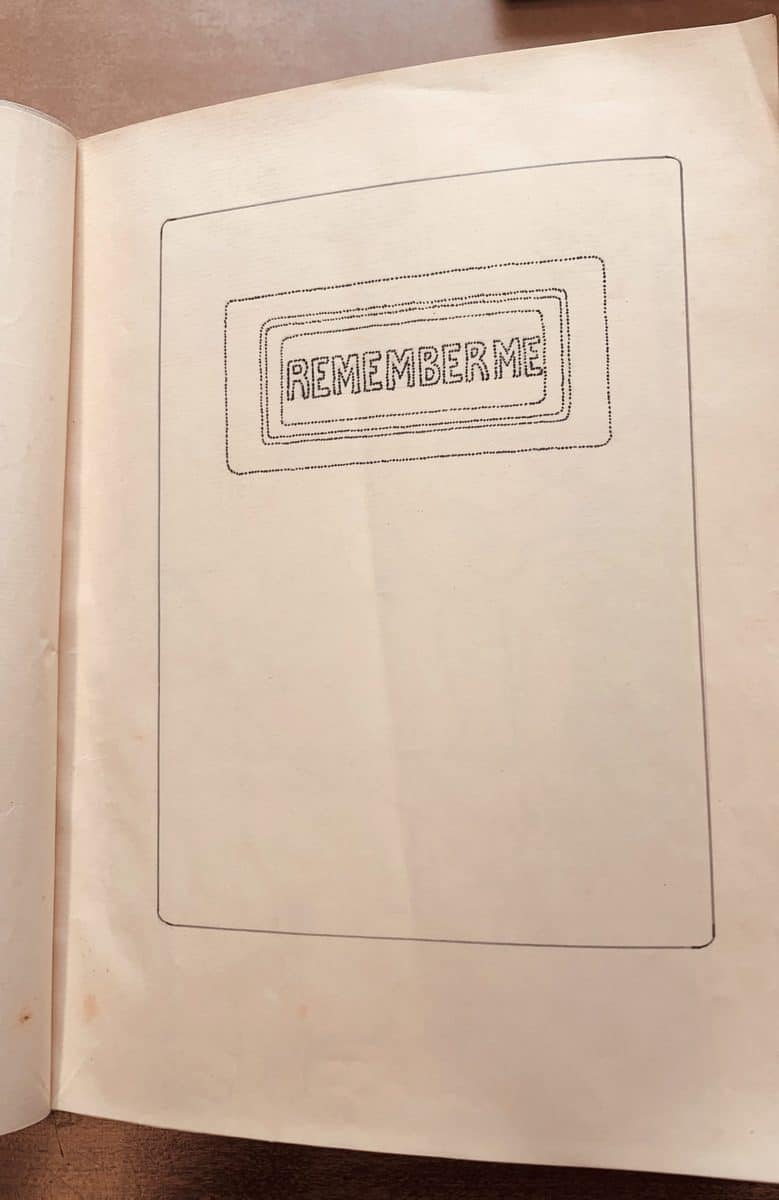
“Remember Me” written at the beginning of the story
Bogue’s life is difficult to research, and she no doubt did not achieve the acclaim she deserved in her lifetime. One of the pages of her book is inscribed with a haunting command: “Remember Me.”
Though it comes too late, we invite you to witness Bogue’s masterful art and remember her among the numerous women whose art has gone unwitnessed and undiscussed.
We hope to have this work digitized so that all may enjoy Bogue’s craft and will notify our readers when we do. If you have any information that might aid in reaching the family of Ida Bogue, please contact the curator of rare books, Eric Ensley: eric-ensley@uiowa.edu
The following is written by Olson Graduate Research Assistant, Rich Dana
In the 1970s, a remarkable woman from Argentina was an underground art sensation.
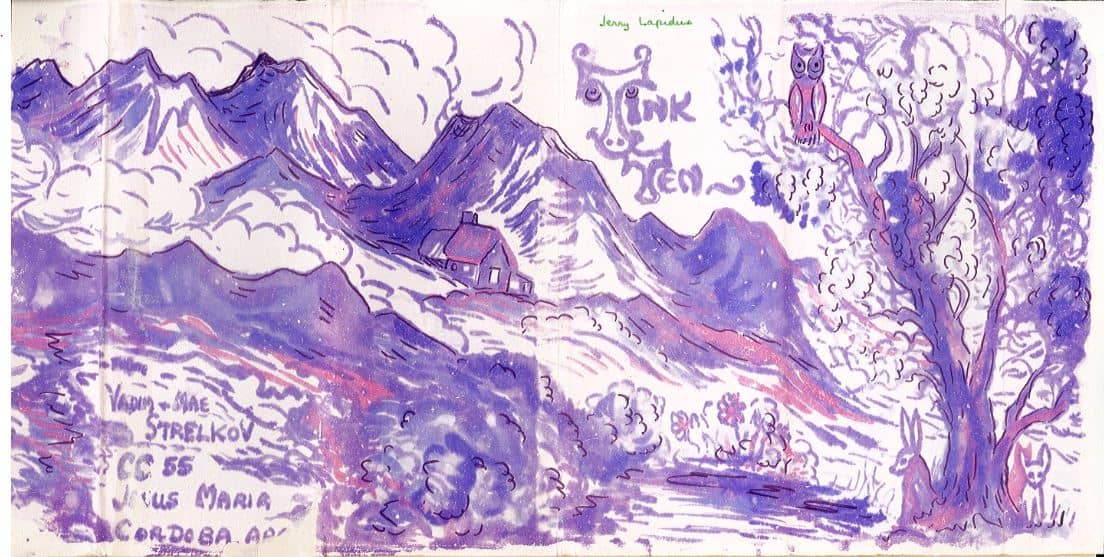
While researching the forgotten art of hectographic printing, I discovered the work of Mae Strelkov, a little-known visionary artist from Argentina. This discovery was the sort of experience that illustrates precisely why those of us who frequent special collections libraries love them so much; when I followed the finding aid (M. Horvat Science Fiction Fanzines Collection, MsC0791) and opened the folder, the contents were not just a reproduction or a digital scan of some of her creations, but a nearly-complete collection of her hand-made zines, including post-marked, hand-made envelops and personal notes.
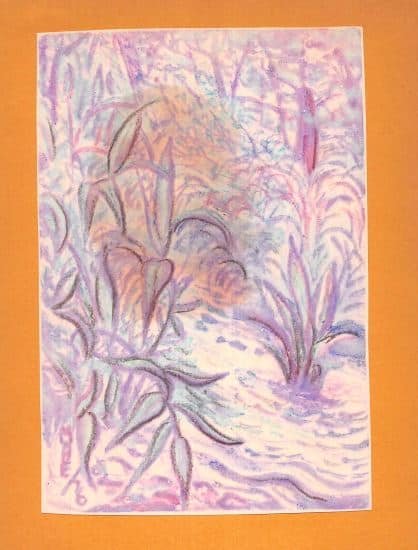
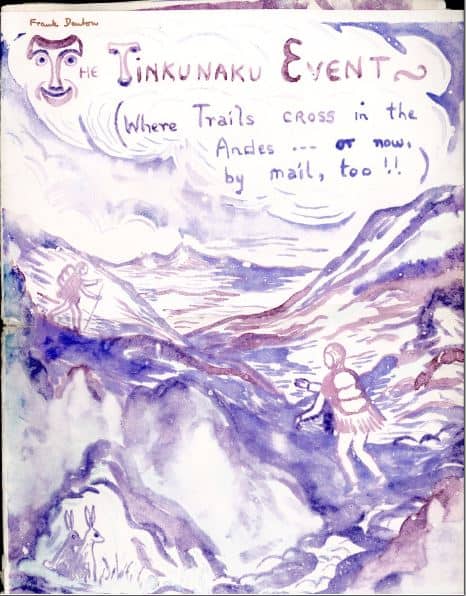
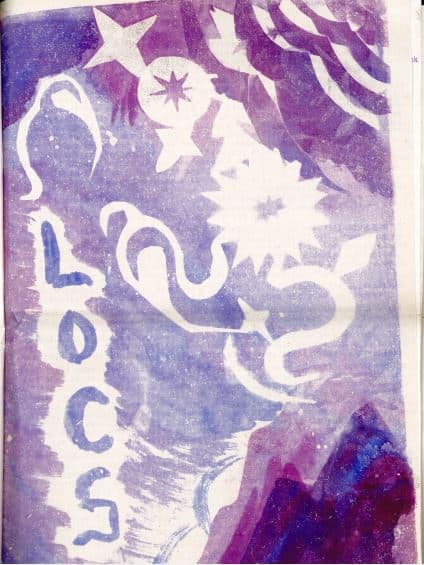
Example of Mae Strelkov’s purple-hued landscapes
Some readers may have never heard of a hectograph. Hectography is a technique for duplicating documents using inks made from aniline dye rather than pigments. The ink is transferred to paper via a rubbery copy pad made of gelatin and glycerine, yielding up to 40 prints before becoming depleted. The hectograph was the precursor to the spirit duplicator, commonly known as a “ditto machine,” remembered for the bright purple text and sweet methyl-ester smell it produced. “Hecto” was used widely by school teachers and churches and in the production of early science fiction fanzines. It fell out of favor as newer copiers became available after WWII, making Mae Strelkov one of a handful of artists still using hectography in the 1970s.
I began to search for more information on Mae Strelkov, and found several articles written by SF fans in the early 1970s. I was also very fortunate to speak with her son, Tony Strelkov, from his home in Argentina via Zoom. Tony explained that his motherwas born and raised in China, the child of English missionaries. As a teenager she methis father, Vadim Strelkov, who had fled Russia after the revolution. They married when Mae was 18 and were immediately forced to flee China to escape the Japanese invasion in 1937.
The young refugee couple found a new home in Chile, and then Argentina. In Buenos Aires, Mae worked as a translator and secretary. In 1960, Vadim was hired to manage an estancia (estate and cattle ranch) in the Cordoba hill-country of Argentina. In these beautiful surroundings, Mae raised their children, wrote and created art. Mae was an avid reader of science fiction and fantasy, and despite the isolation of ranch life, or perhaps in response to it, she became an amateur publisher, trading her zines by mail with other fans in the US, UK, Canada, and Australia. She became close friends with Donald A. Wolheim, the legendary science fiction publisher and founder of DAW books. Tony described to me the boxes, packed full of science fiction novels and fanzines, that would regularly arrive from her American friend, Wolheim.
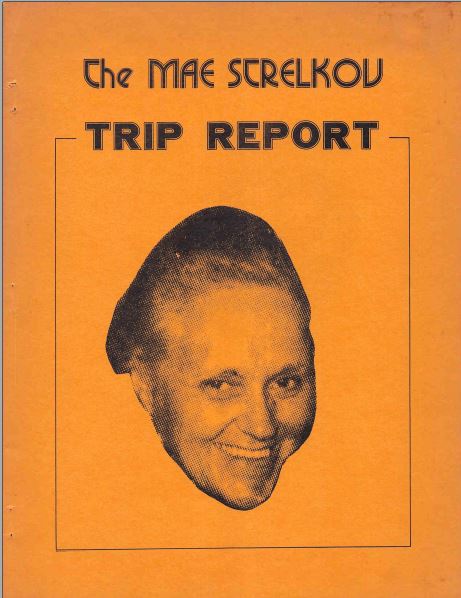
From “The Mae Strelkov Trip Report,” 1975 From the 1973 fanzine, “The Tinkunaku Event” From Mae’s fanzine “Tong”
For Mae, printing options were limited for creating her publications. She settled on the hectograph, making her own printing pads (a fan legend that Tony confirmed) by boiling cow bones to extract the gelatin. Because of the limited ink colors available, her idyllic landscapes are rendered in pinks, purples, and blues, giving them a psychedelic quality. Her writings reflect on her missionary parents’ spiritual traditions, those of her childhood home in rural China, and the Andes’ indigenous people. Her landscapes are fantastical, and her accounts of everyday life on the ranch are infused with a mystical quality. Her missives are also full of observations on linguistics. She created symbols for what she considered universal human sounds– a far-out idea at the time, but one that is now widely studied among language scholars.
In 1973, Susan Wood (Glicksohn), a Canadian literary scholar/feminist/environmentalist (and SF fan) wrote in her fanzine Aspidistra:
“SF conventions, for me, exist mainly as places to meet other fannish people whom I only know on paper, people whom I have never met, who are my friends. One of those friends is Mae Strelkov…Mae has lived most of her life in Argentina, where she and her husband Vadim share a ranch with children, cattle, crazy goats, pumas—a whole world she’ll create for you with skill and zest. A talented author and an artist too, Mae is equally at home, and equally fascinating, writing about her lively family—or the world’s problems; about linguistics, and the strange pattern of words and symbols she finds repeating themselves through the oriental, western and Amerindian cultures she knows so well—or the antics of her pet skunk; about the Catholic Church, and its effects on the world as she sees it—or your latest fanzine.”
From “The Mae Strelkov Trip Report,” 1975
Susan Wood and Ohio fan Joan Bower mounted a successful “fan fund” (commonly used in fandom to subsidize travel for fans who cannot otherwise afford it) to fly Mae from Argentina to the US, where she would attend the 1974 World Science Fiction Convention in Washington DC (DISCON II) and DeepSouth Con in Atlanta. According to Con reports, the grandmotherly 57-year-old Strelkov made a splash with the young Americancon-goers. She also purchased a Greyhound Bus Ameripass and zig-zagged from coast to coast and back, visiting fans, pen-pals, and distant relatives on an epic solo adventure, all of which she recounted in The Mae Strelkov Trip Report. The 35-page report was mimeograph-printed and distributed by one of her biggest fans, NASA engineer and fanzine publisherNed Brooks.
No description of Mae Strelkov’s writing and artwork can fully impart the actual documents’ utter uniqueness and magical quality. Unlike the vast majority of fanzines, Mae’s were produced almost entirely outside of the direct influence of American pop culture and fannish activities. For American SF fans in 1974, she must have appeared much like the character Valentine Michael Smith, a fascinatingstranger in a strange land.
We lost an important voice in the art and archival world last month.
Estera Milman, art historian, curator, and researcher of the avant-garde, died January 27, 2021 in Boston. Milman received her MFA at the University of Iowa in Photography/Photomedia, Historical Criticism and Theory. She then went on to be a curator for the Stanley Museum of Art and teach in the School of Art and Art History.
In 1982, Milman founded Alternative Traditions in the Contemporary Arts (ATCA) at the University of Iowa. Now housed in Special Collections, ATCA was dedicated to collecting and preserving the works and papers of contemporary artists and to the facilitation and dissemination of research related to the post-World War II avant-garde. Artists and critics whose works and papers are represented in the ATCA collection include Vito Acconci, Laurie Anderson, Ay-O, Gregory Battcock, George Brecht, John Cage, Giuseppe Chiari, Buster Cleveland, Robert Filliou, Ken Friedman, Klaus Groh, Al Hansen, Dick Higgins, Alice Hutchins, Ray Johnson, Shigeko Kubota, George Maciunas, Robert Morris, Claes Oldenburg, Yoko Ono, Benjamin Patterson, Dieter Rot, Andre Tomkins, Endre Tot, Wolf Vostell, and Robert Watts, among a host of others.
Under Milman’s leadership for 18 years, ATCA allowed a space for people to grapple with and embrace the challenging ideas brought forth by artists outside of the “mainstream” of popularly celebrated art. As stated in Milman’s obituary, “At a time when few museums were ready to show—let alone collect—ephemera, performance relics, artifacts, and related artist papers, Milman dedicated her professional career to establishing the institutional framework to support art that challenges the market, dares to expand our sensibilities, and demands a just world. She was deeply committed to ideals of human equality and to art as a political mechanism for challenging complacency and elitism.”
Apart from publishing widely and receiving numerous awards and grants, Milman also proved ahead of her time in exploring how the internet could push ideas of art and space beyond the museum walls, as demonstrated on her “Estera Milman inter/arts” webpage.
Her visionary look at what the art and archival world has left a mark on those who knew her as well as the ATCA collection here at Special Collections. Tim Shipe, curator of the International Dada Archive, reflects about his time with Milman during a 1989 conference below:
“My initial encounters with Estera Milman occurred in the early 1980s, during meetings of the Board of Directors of what was then called the ‘Dada Archive and Research Center,’ when we charted the possible futures of this project that was still in its infancy. But I believe I first began to grasp the scope of Estera’s thinking about art and archives during a 1989 conference that she organized and on whose published proceedings we collaborated. The title was Art Networks and Information Systems, and I can best describe it by borrowing liberally from my 1990 review in Art Documentation, written when the impact of the event was fresh in my mind:
An astonishingly diverse assortment of artists, librarians, entrepreneurs, and other arts and information specialists from a variety of institutions, large and small, gathered in Coralville, Iowa for an unusual planning conference cosponsored by New York’s Franklin Furnace Archive and the University of Iowa’s Alternative Traditions in the Contemporary Arts. It was the particular vision of this conference to bring together practicing avant-garde artists, librarians from some of the nation’s most influential institutions, curators of small archives and special collections far from the mainstream, and a variety of other people active in various areas of the contemporary arts as well as the information professions, harnessing the potential of their diverse areas of expertise in order to examine the problems of sharing information about contemporary artists’ materials and, if possible, to begin developing a plan to link a variety of alternative collections in some sort of electronic network. Facing one another in a cozy conference space were artists who had never heard of MARC or AACR2, librarians who had never dreamed of Fluxus or Neo-Dada, and a surprising number of people who were familiar with both the contemporary arts scene and the more arcane areas of library and information science. This unlikely assortment of attendees came with open minds and a genuine desire to learn from one another, to listen, and to seek common solutions.
I won’t claim that Estera Milman invented the World Wide Web at that conference, but the art information system that she proposed during the concluding session certainly seems, in retrospect, to anticipate what in just a few years we would know by that name. Such was Estera’s vision.
In the years following the conference, Estera and I had a number of fruitful exchanges, often concerning the best way to catalog some of the artists’ books from the Alternative Traditions collection. We had fewer interactions in later years, and it is always that 1989 conference that comes to mind when I consider Estera’s role as a thinker about the interrelations between artistic practice, art theory, art history, and art documentation.”
The following comes from Book and Maps Curator, Eric Ensley
Poissy Processional
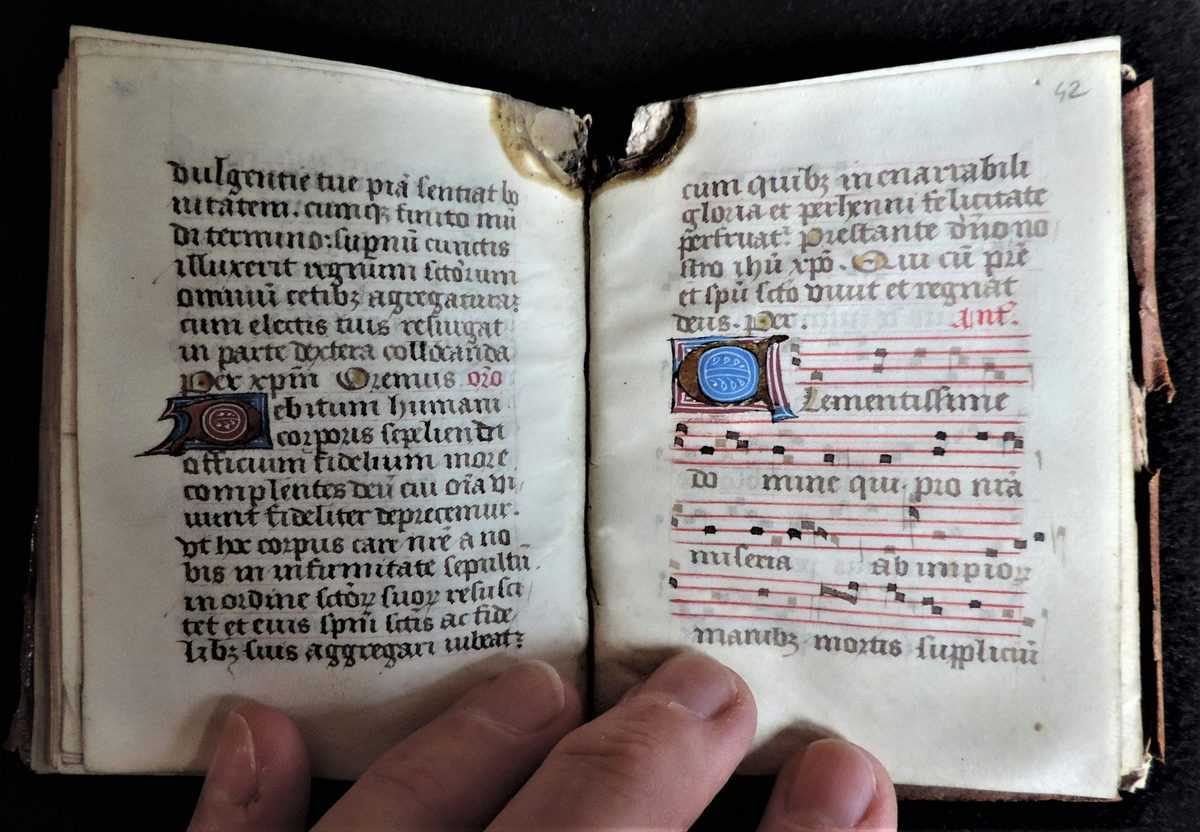
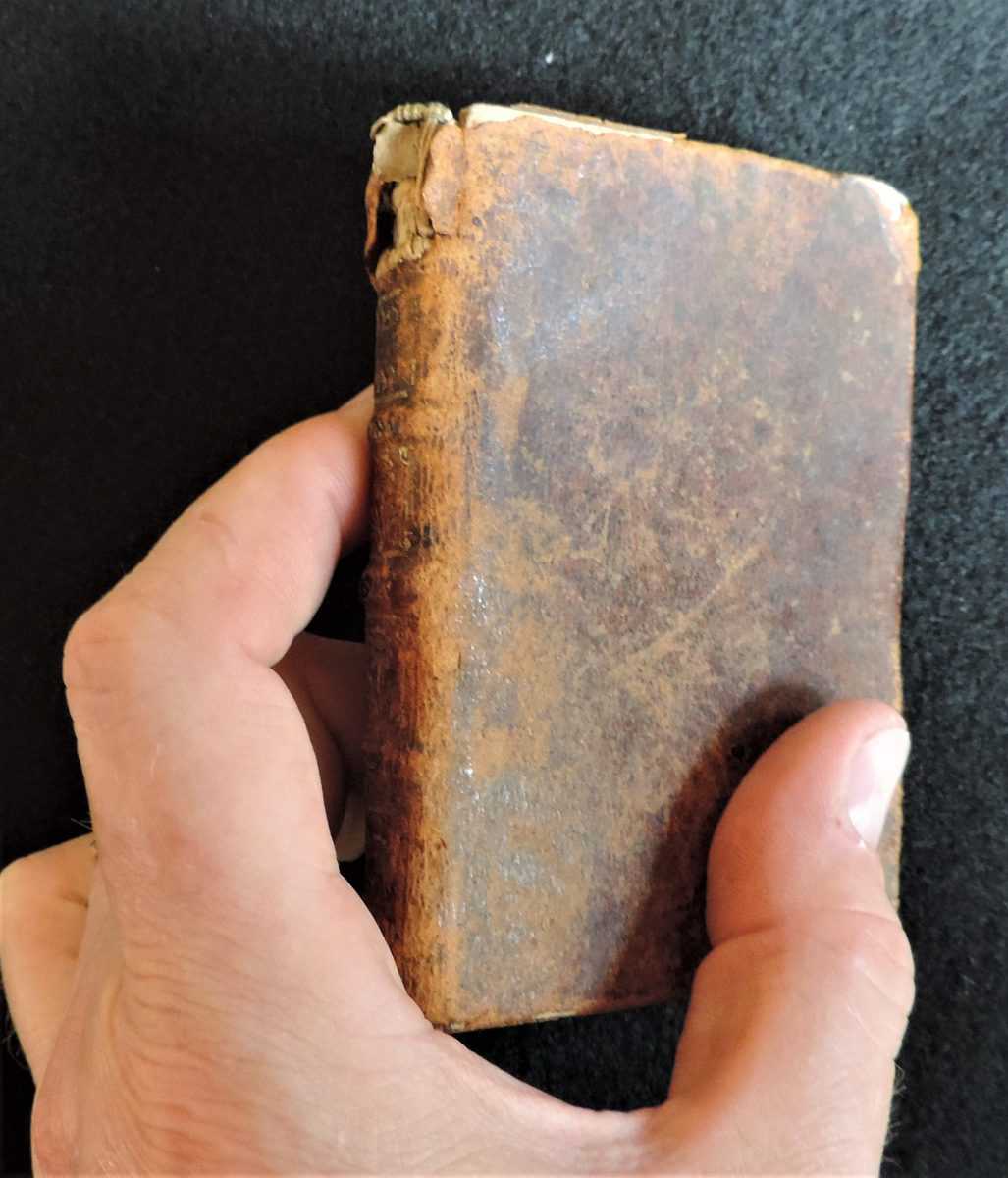
A perennial question for students of the Middle Ages is how and what did women read. The newest addition to our collection of medieval manuscripts answers this question at least in one place and moment. This diminutive book from the first half of the sixteenth century was designed to be carried by the nuns of the royal and aristocratic Dominican Abbey of Poissy, just outside of Paris. Small books of music and prayer like this comprise a genre known as the “Poissy Processional,” of which around thirty are known to exist. University of Iowa’s volume is a previously unknown addition to these thirty.
Small book that fits in the palm of your hand
Processionals are a type of book that contain the music and words necessary to chant the complicated and varying processions that accompany the Catholic Mass and the repeating daily prayers known as the Office. The nuns of Poissy would have need for books like these as a large portion of their day was given over to prayer—nearly around the clock as the Matins prayers occurred at around 2am and Lauds around dawn. Nuns would make processions with these books, singing from them as they went. Each sister had her own book and it is perhaps unsurprising then that they would be passed down to family members and friends as heirlooms.
The Abbey of Poissy was built starting in 1304 on the birthplace of the king and saint, King Louis IX. It was originally opened to only aristocratic families, allowing the abbey to enjoy strong connections with the royal court and become one of the wealthiest abbeys in France. Life for the nuns at Poissy, however, was austere and sheltered, living entirely in the walled abbey where their daily schedule consisted of prayer, silence, more prayer and more silence. Despite the seclusion, the abbey still captured the literary imagination of authors. Famed medieval poet Christine de Pizan placed her daughter in the abbey and even wrote a major poem about it, Le Dit de Poissy. The abbey’s library and books remained intact until the French Revolution, when the group was disbanded and the books sold off or stolen.
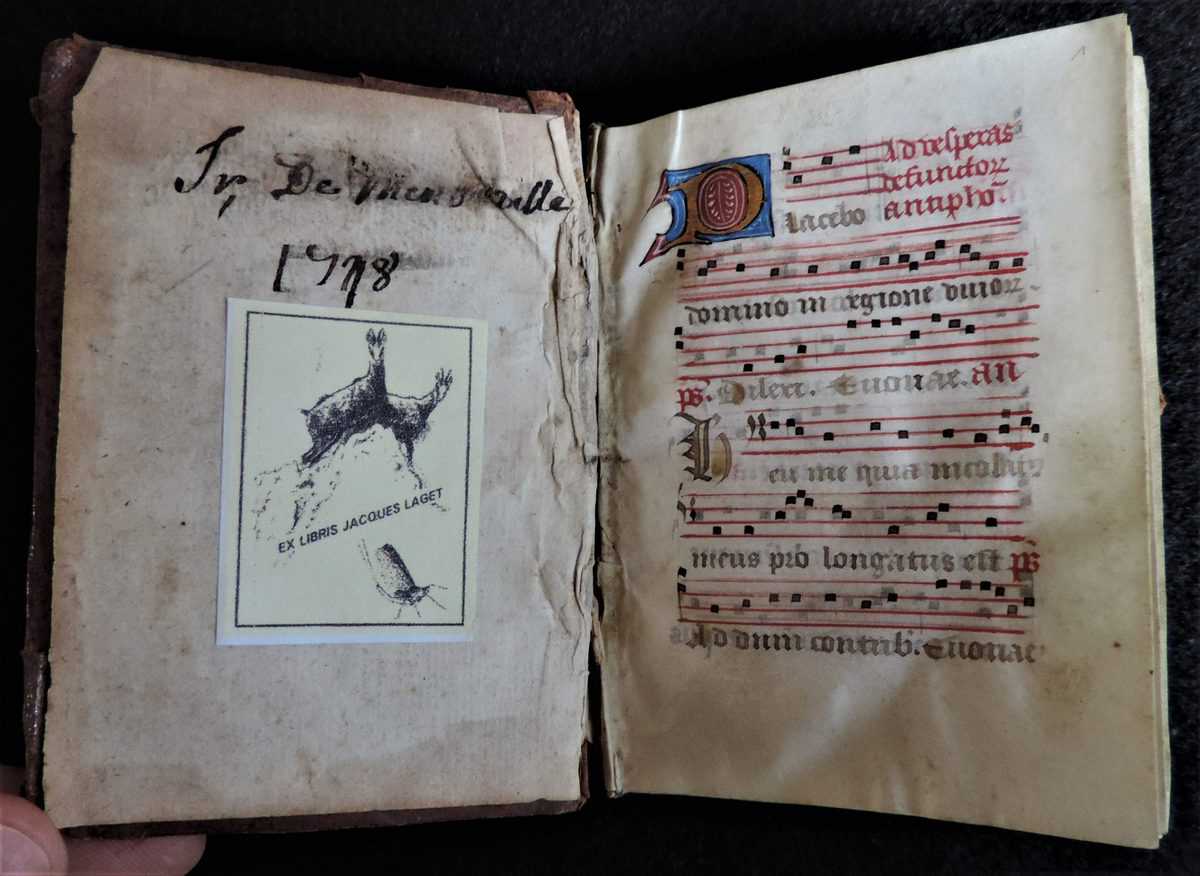
University of Iowa’s Processional is fascinating on several levels beyond that it escaped inclusion in Joan Naughton’s 1995 dissertation on the books, which is held at the authoritative source on the topic. This copy went unnoticed likely because the great majority of the thirty other copies are in institutional hands, while ours appears to have come from the library of Jacques Laget, a well-known French bibliophile who retired in the 2000s.
Books were not cheap in the later Middle Ages and even into the early modern period, but the abbey’s connection to France’s wealthier families allowed their library to grow. The book easily fools a viewer with its medieval appearance. Even in the early 1500s, the makers of these books were copying exemplar manuscripts that retained the appearance of fourteenth century books—a real throwback! Some have even argued that the nuns themselves made their own books for the abbey, though this argument is contentious since the books have a look similar to those produced in Paris workshops. Indeed, our little volume includes attractive initials in gold leaf with interior decoration in red and blue pigment and more elaborate penwork initials throughout.
Book plate of Jacques Laget
Somewhat unusually, our Processional includes many of the texts and offices that center around the death of a nun and the proper care of soul and body as the end approaches, including: the Office of the Dead, Anointing of the Sick for a Nun, Litany for the Dying, the Office for Burial, and the Commendation for the Dying. Many of the texts include gendered Latin endings suggesting the book should be used by a woman. Likewise, many include rubrics or instructions on what one should do and think while dying or while burying the body of a sister.
We hope the Iowa Processional inspires you to contemplation or singing in the classroom or reading room…quietly. It will be available soon for use under the call number: MSC0542, xMMS.Po1.
The following comes from Archives Assistant Denise Anderson
With the presidential election and Inauguration over, there has been a lot of talk about voting rights in the news. With Raphael Warnock’s win, Georgia’s first Black senator, we are reminded that the struggles and work of the Civil Rights Movement was not distant history.
This coincides with a recent discovery in the Darwin Turner Papers. While exploring the collection, we learned that the late U. S. Representative John Robert Lewis spoke at the University of Iowa in Shambaugh Auditorium on Friday night, June 16, 1978, about “Black Liberation and Political Action.” This was at the invitation of Darwin T. Turner, head of the Afro-American Studies Program here at University of Iowa. Turner organized 19 speakers for a two-week 1978 summer institute, the tenth at the University of Iowa, for teachers of Black history and culture from around the country. The 1978 theme was “Black Culture in the Second Renaissance: A Study of Afro-American Thought and Experience, 1954-1970.”
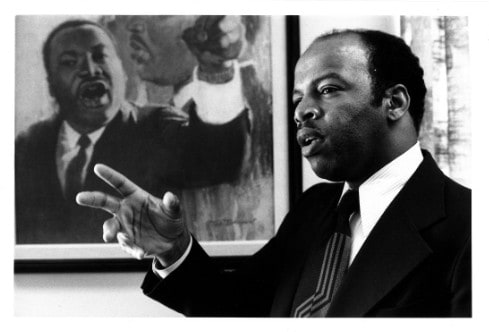
Image John Lewis sent of himself to Darwin Turner
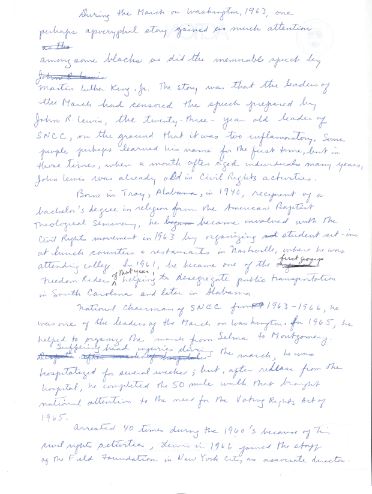
John Lewis had typed a brief acceptance letter in reply to Turner’s invitation, and then he turned the paper over and wrote a personal note on the back about the speech he had presented in 1963 at the March on Washington. He included with the letter a recent photograph of himself. Lewis was introduced in Iowa City as the former director of the Voter Education Project in Georgia and the associate director for domestic operations at ACTION, a volunteer service in Washington, D. C., within the Office of Public Affairs. In 1963, Lewis was also chairman of the Student Nonviolent Coordinating Committee (SNCC), an organization you can learn more about through the papers of Eric Morton. Darwin Turner said of Lewis– along with James Farmer, Larry Neal, Ed Bullins, and James Turner who were also there to speak–helped shape the culture of the era.
The note on back of Lewis’s acceptance letter to Turner about the March on Washington
Another of the 19 speakers at the 1978 institute was Jibreel Khazan, born Ezell Blair, Jr. In his lecturer application, Khazan submitted a Bowsprit newspaper article that relates his experience as one of the Greensboro Four. On February 1, 1960, Blair (as he was known then), along with fellow Black college students Joseph McNeil, David Richmond and Franklin McCain, seated themselves at the Woolworth’s lunch counter in Greensboro, North Carolina, and asked to be served. They told the waitress they preferred to sit after she directed them to the standing counter Woolworth’s had designated for Black patrons. She called a nearby police officer, who did not act, so the store closed early after the students had been sitting for about 15 or 20 minutes. These four students stated they felt different when they walked out of Woolworth’s. The following day, 24 Black students joined them at the lunch counter and the waitress just let them sit there. On the third day, the New York Times reported that the students would continue the sit-in until they were served, prompting sympathetic white students to join the hundreds of Black students. On the fourth day, the Ku Klux Klan arrived. As things became threatening, Black football players protected the students. Another store with a lunch counter, S. H. Kress, was also experiencing sit-ins. On the sixth day, the 3,500-student body voted to continue the sit-ins, followed by the arrival of thousands of demonstrators from area schools. Woolworth’s closed after receiving bomb threats. The next week, Greensboro students halted the sit-in during negotiations. However, sit-ins spread to other towns that week and the next. By the end of that February, Montgomery, Birmingham and Tuskegee were experiencing sit-ins. North Carolina, Virginia, Florida, South Carolina and Tennessee, as well. In May, Blair was arrested, charged with trespassing and fined. Finally, on July 25, Woolworth’s and Kress provided access to everyone at their lunch counters.
Following the death of Representative Lewis on July 17, 2020, a push to update the Voting Rights Act of 1965 has been renewed. In December, Senator Patrick Leahy’s website explained “the John Lewis Voting Rights Advancement Act establishes a targeted process for reviewing voting changes in jurisdictions nationwide, focused on measures that have historically been used to discriminate against voters.” His legacy also lives in the work of the new senators coming to Washington D.C. After winning the election, Raphael Warnock tweeted “John Lewis was a mentor, friend and parishioner. I’m honored to fight alongside my brother [John Ossoff] to carry on his legacy.”
*Jibreel Khazan’s presentation, “The Advent of Divine Justice: Attitudes for Freedom,” was filmed, and will be placed in the Iowa Digital Library.
The University of Iowa Libraries is pleased to announce that Aiden M. Bettine will join the Department of Special Collections and University Archives as Community and Student Life Archivist effective January 4, 2021, a newly-created position in the Libraries’ Residency Librarian Program*. Bettine established the Transgender Oral History Project of Iowa in 2018 and is a Ph.D. candidate in the UI Department of History. He completed his M.A. in Library and Information Science at the University of Iowa in May 2020. He is also establishing a new lending library and community archives in Iowa City, the LGBTQ Iowa Archives & Library, which will open in January.
“I am excited for the opportunity to preserve underrepresented histories on our campus and in our community,” says Bettine. “As the Community and Student Life Archivist, I plan to prioritize archiving the materials of students of color and queer students on our campus including personal collections, oral histories, and working closely with student organizations. One of my primary goals is to actively collect materials from each cultural house on campus, knowing how critical these spaces are for supporting students and creating a community space at the university for both LGBTQ students and students of color.”
In his spare time, Bettine is an avid supporter of the United States Postal Service, making sure to send out mail at least once a week. He enjoys riding his bicycle and camping as well. Currently, Bettine is on a mission to visit all 83 of Iowa’s state parks and recreation areas.
*The UI Libraries offers early-career librarians or librarians new to research libraries, the opportunity for their first professional-level experience in academic librarianship via its Residency Librarian Program. The three-year appointment is designed to provide an immersion into academic librarianship, an opportunity to focus on areas of interest, and funding to support professional engagement at the national level.
On December 28th, 2020, Dr. Eric Ensley will join Special Collections as Curator of Books and Maps. Ensley earned his MSLS from UNC before going on to earn an MA in English from NCSU, then an MA, M.Phil., and PhD in English from Yale. While at Yale, he worked in the Beinecke Library as a Curatorial Assistant to the Curator of Early Books and as a Medieval Manuscripts Cataloging Assistant from 2016-2020, served as Program Director for the Digital Editing & the Medieval Manuscript TEI/XML Workshop starting in 2017, and in addition to other classes, served as Instructor of Record for “What is a book?”. His research interests cover the History of the Book, Librarianship, Manuscript Studies, Early Modern Print Culture, Digital Humanities, and Appalachian Studies.
“I’m most looking forward to welcoming students from a variety of backgrounds to work with our special collections,” says Ensley. “I believe that we can tell powerful stories about who we are through the history of books and manuscripts, and I look forward to hearing what stories students, faculty, and colleagues will tell with our collections. I’m particularly thrilled to learn how our collections speak to the lived experiences and histories of students from Iowa and further afield. Our collections allow us to talk about and even touch history, from pre-modern materials to our contemporary moment, and I can’t wait to help to make these collections accessible.”
In his spare time you can find him in the kitchen cooking or baking. “I grew up working alongside my grandmother in the kitchen, and she taught me the foundations of Appalachian cooking, which has sparked a lifelong love of food.” Just wait till he gets a hold of the Szathmary Culinary Collection here at the University of Iowa. This is Ensley’s first time living in the Midwest and he has expressed excitement in learning more about the local foodways and recipe traditions in Iowa.*
*His new coworkers are wondering how long to wait before they tell him all about the Butter Cow and the wonders of the Iowa State Fair.
The following is written by International Dada Curator Timothy Shipe.
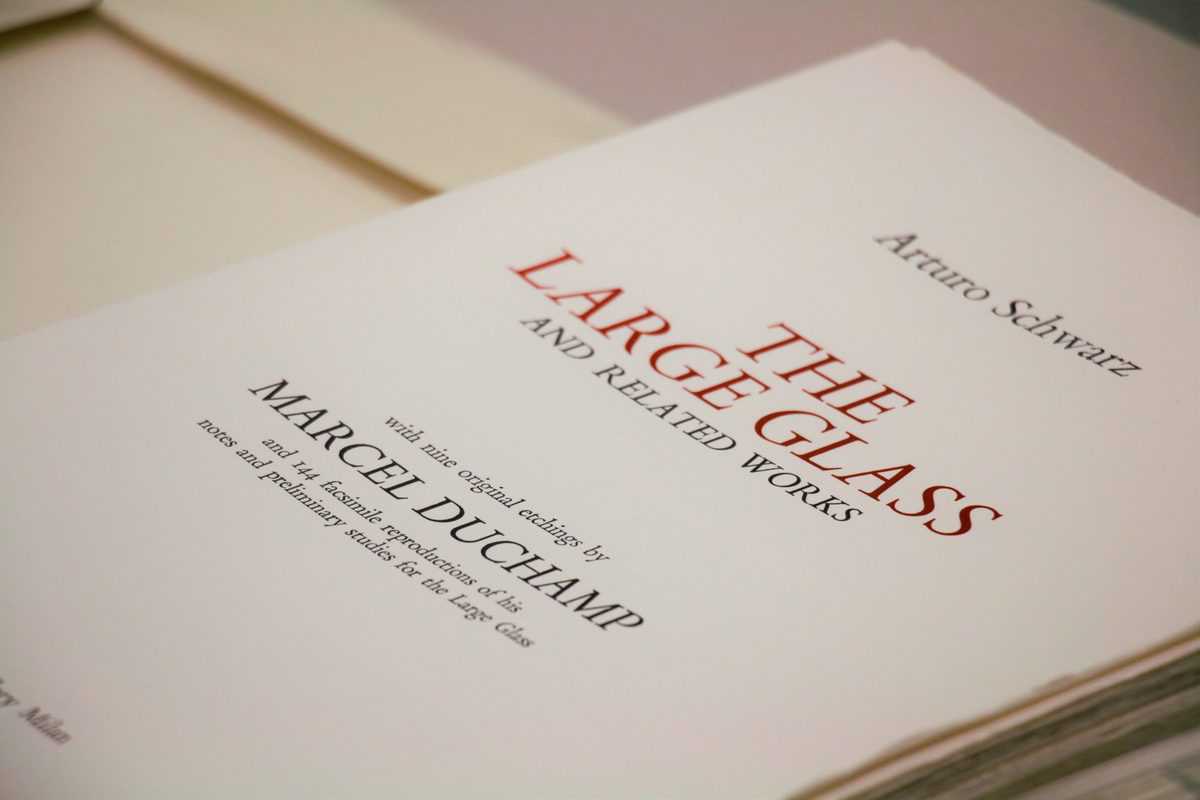
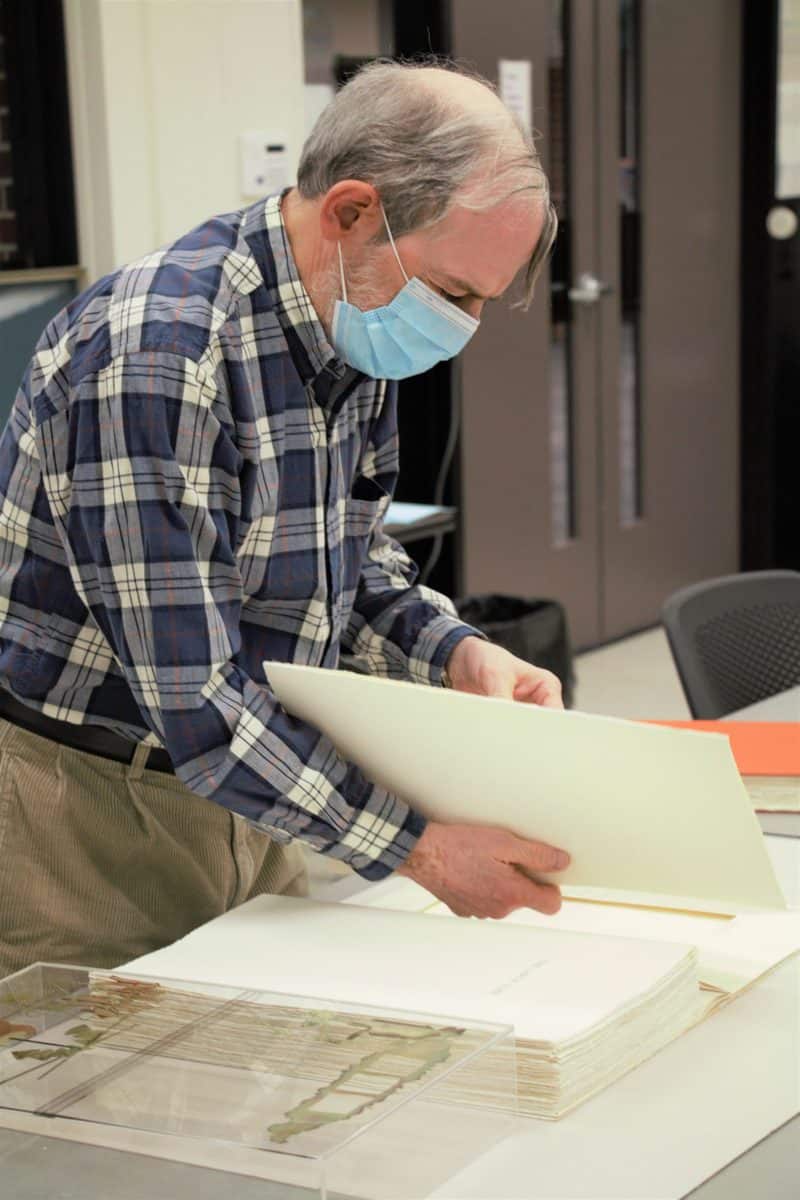
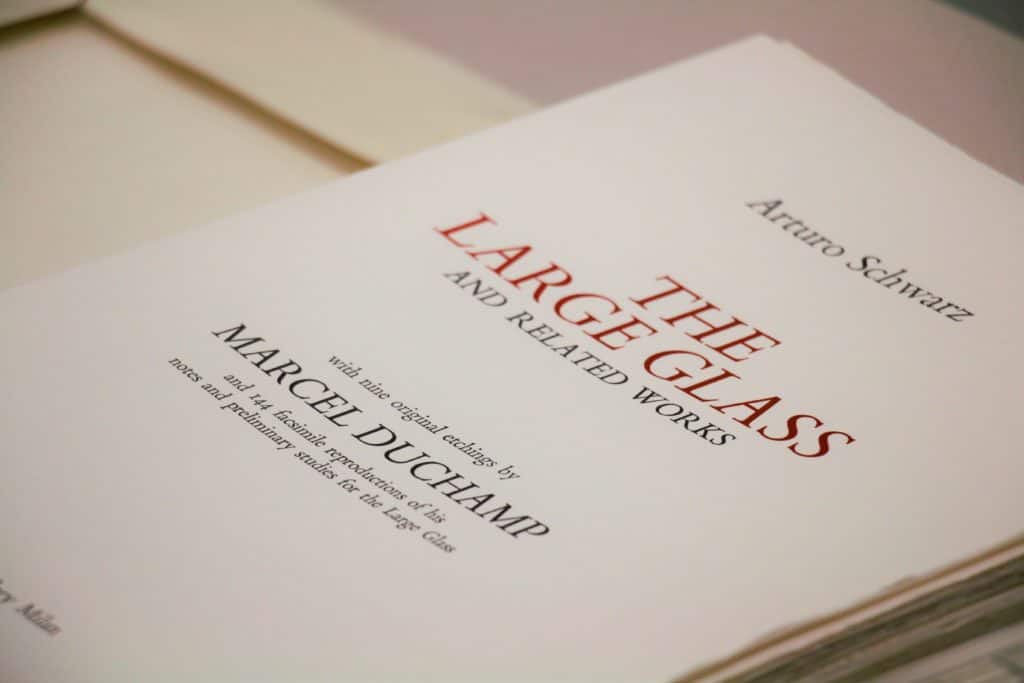
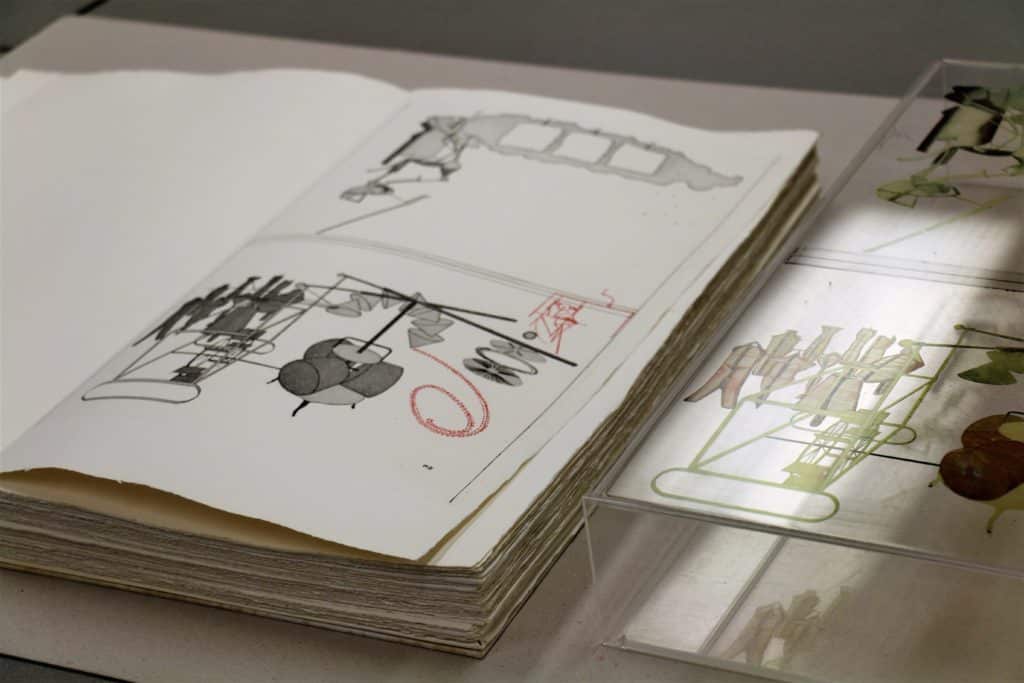
Curator Tim Shipe opens up The Large Glass and Related Works for the first time
The latest major acquisition for the International Dada Archive is The Large Glass and Related Works (1967-1968), an impressive collaboration between artist Marcel Duchamp and the Egyptian-born Italian writer and gallery owner Arturo Schwarz. The magnificent set of two large portfolios contains a monograph by Schwarz on Duchamp’s unfinished masterpiece, The Bride Stripped Bare by Her Bachelors, Even (known as the “Large Glass”), housed in the Philadelphia Museum of Art. It is accompanied by an extensive set of facsimiles of Duchamp’s preparatory notes for the “Large Glass,” one of several similar sets of notes the artist published during his lifetime (including the famous “Green Box,” the most precious treasure of the Dada Archive).
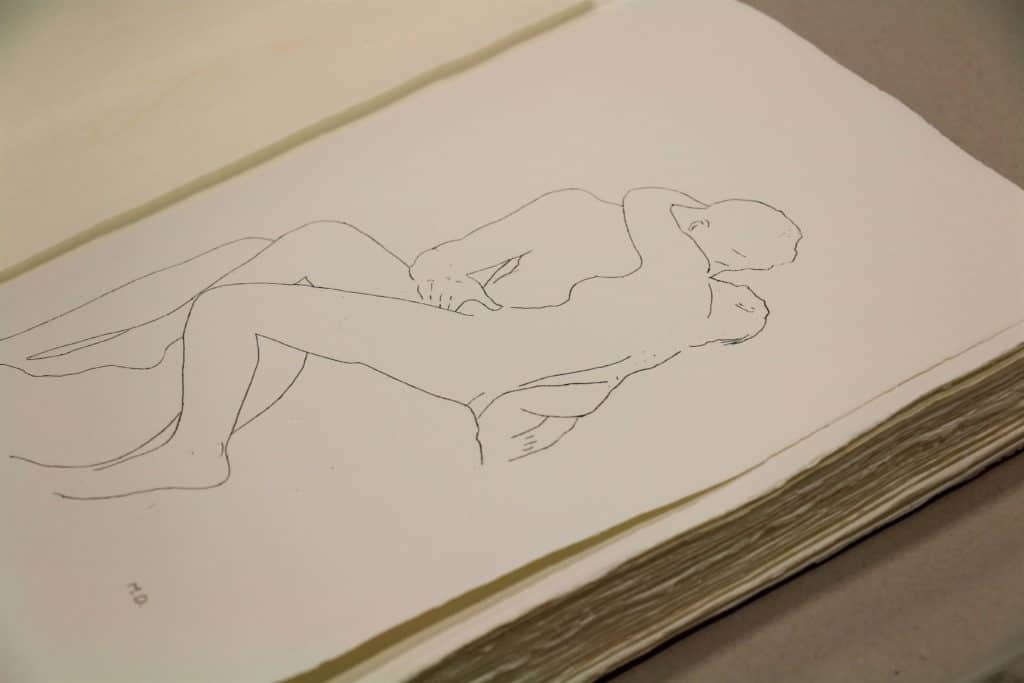
But what makes The Large Glass and Related Works most special is the two sets of nine original etchings by Duchamp designed especially for this edition. These are among the last art works by Duchamp, who died in 1968. The first set, titled simply “The Large Glass,” consists mainly of depictions of individual elements taken from that complex work, along with a diagram of what the Glass would have looked like had it been completed.
Facsimiles of Duchamp’s notes
The second set of etchings, titled “The Lovers,” is a set of erotic drawings largely based on classic works of art. According to Schwarz, these were intended as a sort of sequel to the “Large Glass,” depicting the consummation of the frustrated love affair between the “bachelors” and the “bride.” One of these, based on Lucas Cranach’s famous depiction of Adam and Eve, is, in a sense, a self-portrait of Duchamp, since it replicates a well-known Man Ray photograph of a 1924 stage performance in which a nude Duchamp and Brogna Perlmutter imitate the scene in Cranach’s painting.
The Large Glass and Related Works was formerly part of the Ruth and Marvin Sackner Archive of Concrete and Visual Poetry but was deaccessioned before that collection came to Iowa. We were fortunate to have the opportunity to purchase this important work for the Dada Archive, where it will complement the other major Duchamp items that are frequently used in classes in Art History and other fields.
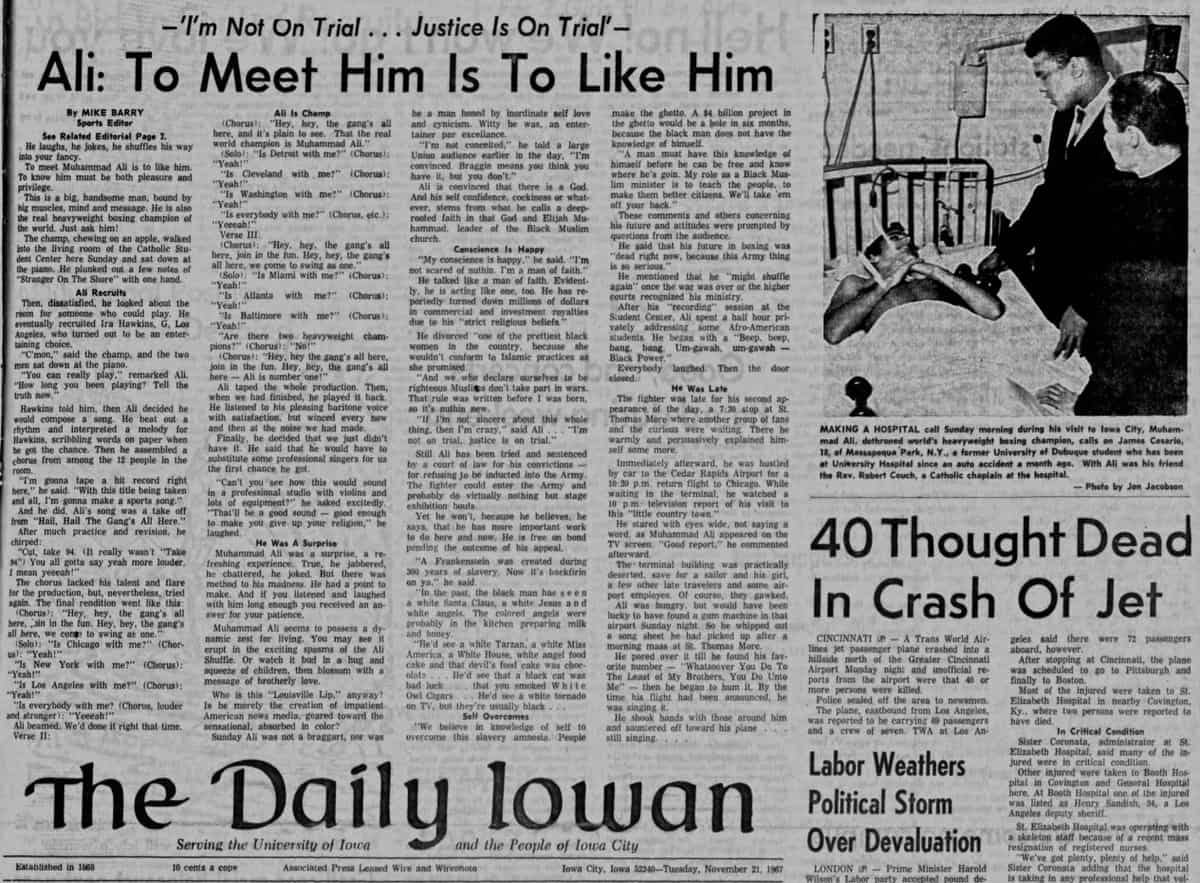
It’s been over fifty-three years since Muhammad Ali spoke to a full house in the Iowa Memorial Union on the University of Iowa campus, but thanks to the Darwin Turner Audio Collection (and a grant to digitize this collection), anyone today can take a moment to listen to Ali’s words and advice to Hawkeye students back in 1967 on the digital exhibit Uptight and Laidback: Iowa City in the 1960s.
On November 20, 1967, Ali, who changed his name from Cassius Clay in 1964 after joining the Nation of Islam, came to the University as part of a series on Afro-American culture. The series, hosted by the Department of English and the Afro-American Studies Program, was to help provide a background for the course on Afro-American literature being offered at the University.
This recording is part of the Darwin Turner Audio Collection, a collection recently acquired by the University Archives. Darwin Turner became the chair of the newly formed Afro-American Studies Department in 1972, and held that position for nearly two decades. You can read more about his substantial contribution to the department and the study of African American culture in an Old Gold article written by University Archivist David McCartney. With the help of a recent grant from the Iowa Department of Cultural Affairs, the University of Iowa Libraries has been working to digitize the over 400 recordings of speakers talking about African American culture.
This talk from Muhammad Ali demonstrates the mental strategy of this champion boxer. As the Daily Iowan article above states, “Muhammad Ali was a surprise, a refreshing experience. True, he jabbered, he chattered, he joked. But there was method to his madness. He had a point to make. And if you listened and laughed with him long enough you received an answer for your patience.”
His talk, which relied heavily on questions from the audience, involved a wide range of topics, including interactions with white TV personalities, his religion and the controversy around his stance on Vietnam, and the reason for using the term “Black” to describe a group of people.
This audio clip provides a rare glimpse into a time on Iowa’s campus. Since Muhammad Ali went to the audience almost straight away for questions, not only do you hear his stories and experiences, but you get a sense of what is on the mind of the students and community members who found themselves standing on the precipice of great change.
Our Archives Assistant Denise Anderson explored the Szathmary collection to create the perfect cherry pie. Below is the recipe, along with Denise’s step-by-step guide on what she did to create what is sure to be the best dessert at your next Thanksgiving.
Cover of Betty Crocker PamphletFruit pie recipe
Time to make a Betty Crocker fresh fruit (in this case cherry) pie recipe, found on page 10 in All About Pie from the Szathmary Recipe Pamphlets collection.
The original recipe, pictured above calls for the following ingredients for a 9″ pie:
*1 to 1 1/2 cups sugar
*1/3 cup GOLD MEDAL Flour
*1/2 tsp. cinnamon
*4 cups fresh fruit (cherries)
*1 tbsp. butter
*Pastry for 9″ two-crust Pie
Taking this base recipe, I have made a few adjustments to make the perfect pie (which you see below).
I like the look of an ample pie, so I used a nine-inch, glass, deep-dish pie pan and I increased the 4 cups of fruit called for to 6 1/2 cups, which then required adjustments to the other ingredients; adjustments provided below.
Frozen tart cherries are also available, but if you use fresh cherries, which are ripe around the Fourth of July, you will wash, sort out blemishes and remove the stones. Preserve the juice in a separate measuring cup.
In a pan on the stovetop, combine 3/4 cup cherry juice, 5 T. small pearl tapioca, 2 1/2 cups sugar, 2 T. water, 1 T. fresh lemon juice, 1/2 t. almond extract. Cook and stir this on medium-low heat until it thickens, and then boil it for one minute. Remove from heat and set it aside for 15 minutes. Tapioca can be difficult to locate on grocer’s shelves. You might have better luck finding quick cooking tapioca granules at a natural grocers.
My grandmother Sylvia taught me to make pie crust using the Crisco Single Crust recipe printed on the label. This recipe is included in Crisco’s American Pie Celebration, from the Szathmary Recipe Pamphletscollection. Because I have a penchant for oversized pies, I tripled the recipe and cut the dough in half for top and bottom crusts, ensuring there was no difficulty rolling the dough to fit.
From Crisco’s American Pie Celebration
Crisco Single Crust recipe:
Combine 1 1/3 cups flour and 1/2 t. salt.
With a pastry cutter, work 1/2 cup Crisco into the mix evenly.
Sprinkle in 3 T. water, not all in one spot, and mix it in.
Roll the dough into a ball and then evenly flatten it a bit in your hands until it is a thick disk. Sprinkle flour onto your countertop or pastry cloth and smooth it around in a circle with your palm. Gradually roll the dough into a circle using a rolling pin, working from the center outward in different directions until you reach a size that is two inches larger than your pie pan if it were placed on top of the dough upside down. As you roll, sprinkle more flour onto the dough if it begins to stick. Gently drape one half of the dough circle over the other half, and then again (quartered) so it may be easily picked up and positioned in the pie pan. Now follow these steps with the top crust, and when it is draped into a quarter, cut slits through the crust for ventilation. Set the quartered top crust aside for a moment, still folded.
Pour the cherries into the bottom crust, and then pour in the thickened cherry juice. Dot the top of the cherries with 2 T. of butter cut into small pieces. With a coffee cup of water next to the pie, dip your fingers into the water and run them along the rim of the bottom crust until you have dampened the entire rim, leaving the excess dough hanging over the sides. This moisture will help seal the two crusts together. Place the quartered top crust in place, and gently unfold it to cover half, and then the whole pie. Excess crust from both the top and the bottom are draped over the rim. With your thumb and index finger, work around the rim, pinching the dough slightly to build up the rim and make an interesting design. Use a knife to trim off the excess dough, cutting below the fluted edge.
Cut 3 or 4 strips of aluminum foil to wrap loosely around the rim of the pie, so it won’t burn. Overlap the pieces of foil and crimp them together a bit with your fingers to hold them together, without pressing into the dough. Line the bottom of the oven with aluminum foil before preheating to 425 degrees. Bake for one hour on the center rack, removing the foil strips after 45 minutes.