Skip to content
Skip to main content

An Artistic Test from Norman Meier

By Denise Anderson

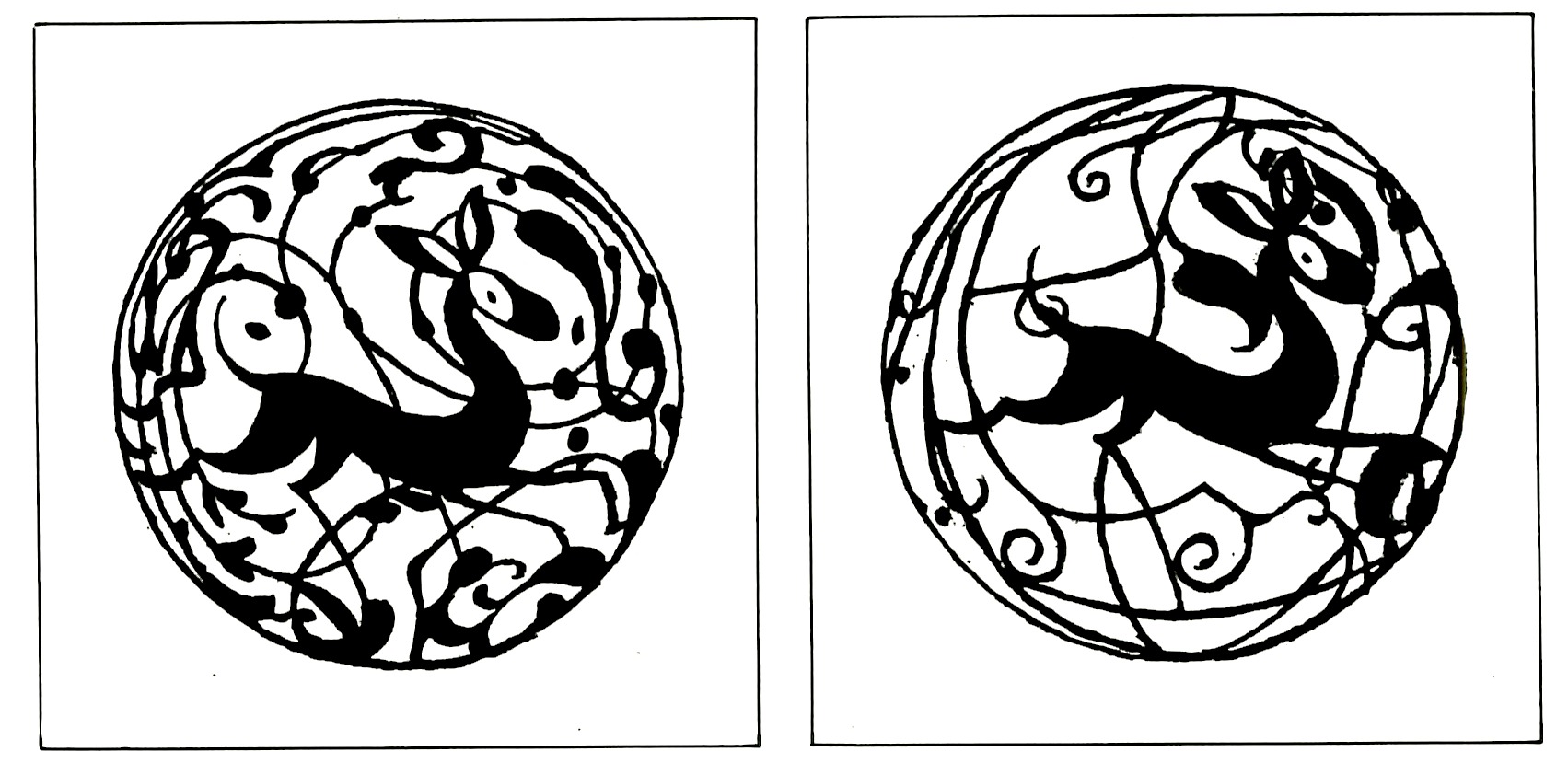
During this week of final exams, perhaps a more enjoyable test to engage in might be one that measures your artistic ability?  Professor Norman C. Meier, of the UI Department of Psychology, developed the Meier Art Tests, which evolved from his Ph.D. dissertation at Iowa in 1926, “The Use of Aesthetic Judgment in the Measurement of Art Talent.”

Meier became well known for the tests he designed for assessing artistic aptitude. These were devised, in part, through his study of 100 artists from eight countries. His areas of research were psychology of art, and social and political behavior. Meier’s research in the latter field resulted in methods of measuring audience response to theatre and broadcast programs. He also studied mob behavior and crowd control.  George Gallup was a student of Dr. Meier, who later developed a successful public polling organization, and his papers also recently came to the University of Iowa.

 An example question “Meier Art Tests: I. Art Judgment ” (1940) is presented below.  Which seems like the better image to you?


The University of Iowa was a primary contributor to the development of aptitude testing in the early 20th century. The Iowa Testing Programs led to Meier and Gallup’s work as well as the widely used American College Testing Program (ACT). You can read more about this time in The Iowa Testing Programs: The First Fifty Years, by Julia J. Peterson, which describes the birth of a testing program within the University of Iowa College of Education in 1928. Norman Meier’s Papers are part of Special Collections & University Archives (RG 99.0163) and you can view the Collection Guide here: http://www.lib.uiowa.edu/spec-coll/archives/guides/RG99.0163.html.  George Gallup’s Papers are currently being processed so watch for updates soon.

New Acquisition to the University Archives – George Ludwig Papers

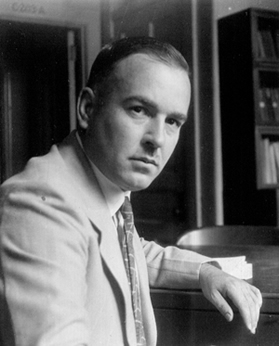
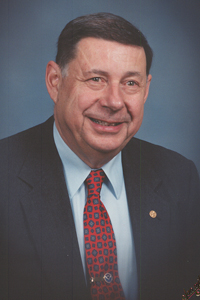
Portrait of George LudwigWe depend on weather satellite images daily for our forecasts and travel plans. Without the groundwork laid by the National Earth Satellite Service beginning in 1972, though, these images would not be possible today. A distinguished UI alumnus, George H. Ludwig (BA ’56, MS -59, Ph.D. ’60) was a founding director of NESS and led its operations throughout the 1970s. It is part of Mr. Ludwig’s long and significant career in physics and environmental research, now documented in his papers recently donated to the University Archives.

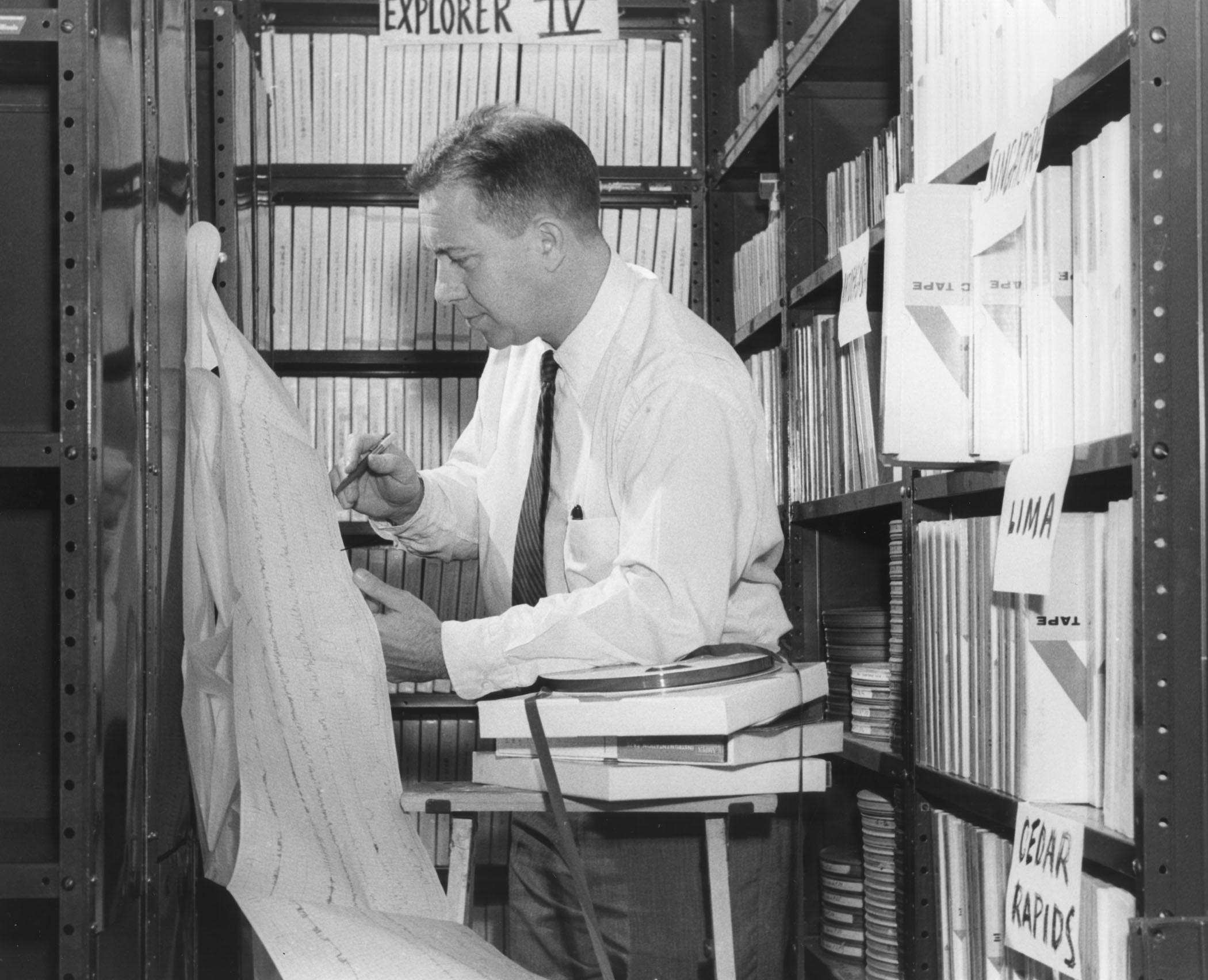
Mr. Ludwig, a native of rural Johnson County, Iowa, was a graduate student under James Van Allen during the pioneering Explorer space exploration missions in the late 1950s. He was the principal developer of the cosmic ray and radiation belt instruments for the successfully launched Explorers I, III, IV, and VII. He was also a research engineer at the Jet Propulsion Laboratory in Pasadena, California for a five month period following the 1957 launch of Sputnik I by the Soviet Union.

His papers chronicle his research in physics as a doctoral candidate at UI as well as the many projects he supervised or consulted while with NASA, the National Oceanic and Atmospheric Administration, and other organizations throughout his 40-plus year career. The guide to his papers is at http://www.lib.uiowa.edu/spec-coll/archives/guides/RG99.0004.html; the guide does not yet account for the most recent materials received by the Archives.

George Ludwig’s contributions to space exploration and environmental research are invaluable, and the University Archives is honored to document his achievements.


You can see a remarkable image of George Ludwig with his Cosmic Ray detector on NASA’s Jet Propulsion Lab web site:  http://www.jpl.nasa.gov/missions/details.php?id=5873#3

Happy Thanksgiving!

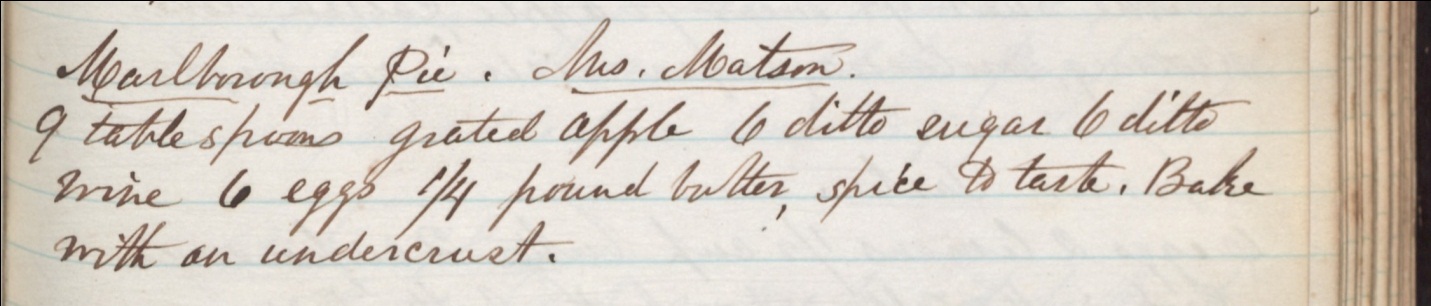
This morning I was a guest on Iowa Public Radio’s Talk of Iowa program, where we discussed Thanksgiving recipes, cookbooks, and traditions. You can listen to an archived version of the program here. Below are links to some of the items from Special Collections that were discussed on the show.

Szathmary Culinary Manuscripts: http://digital.lib.uiowa.edu/cookbooks

DIY History: http://diyhistory.lib.uiowa.edu

Mary Shelton, Dec. 7, 1865 (1865-12-07): http://digital.lib.uiowa.edu/cdm/ref/collection/cwd/id/4275

Thomas Rescum Sterns from a letter home dated Nov. 28, 1862: http://digital.lib.uiowa.edu/cdm/ref/collection/cwd/id/15325


Below are a few other Thanksgiving-food related images from the Szathmary collection:

The Thanksgiving table , from the Pennsylvania Cookbook: http://diyhistory.lib.uiowa.edu/transcribe/scripto/transcribe/120/7344

Turkey, from the Pennsylvania cookbook, 1889:  http://diyhistory.lib.uiowa.edu/transcribe/scripto/transcribe/120/7352

James Doak cookbook: The Art of Cookery, circa 1760s, Turkey recipe: http://diyhistory.lib.uiowa.edu/transcribe/scripto/transcribe/116/7052

James Doak cookbook: The Art of Cookery, circa 1760s, Sauce for a Boild Turkey: http://diyhistory.lib.uiowa.edu/transcribe/scripto/transcribe/116/7074

Ginger Cakes, 1840s (page 24): http://digital.lib.uiowa.edu/cdm/ref/collection/cookbooks/id/2865

Of course carving the fowl is often one of the most challenging steps of the Thanksgiving meal. Look no further than this copy of Pierre Petit’s carving manual of 1647, which has been extensively modified with manuscript additions and drawings:


The Glenn Voting Machine

by Shawn R. Conley –  student worker in Special Collections

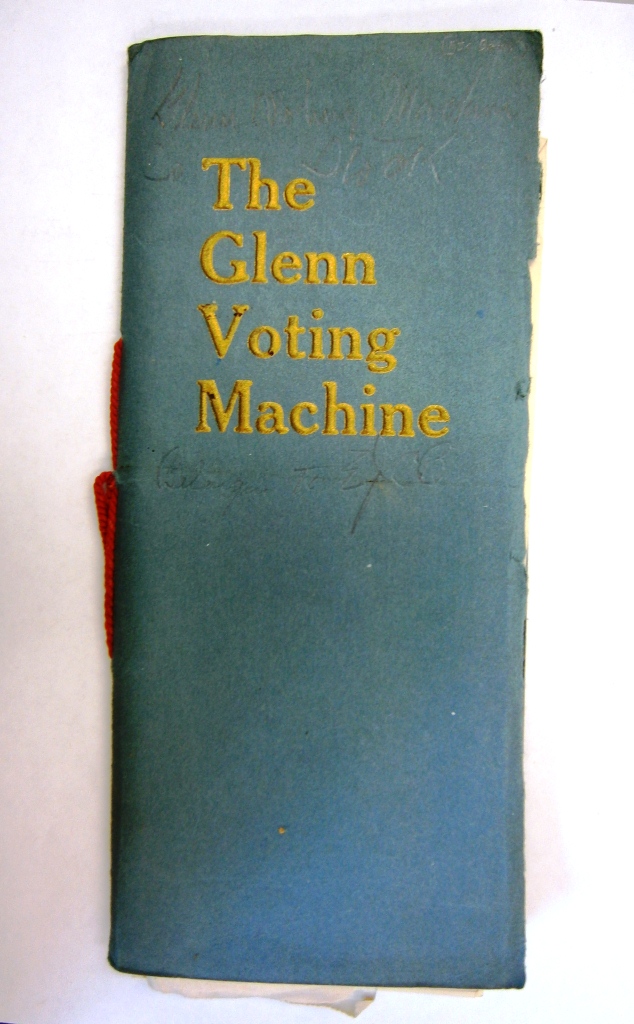
Cover of The Glenn Voting MachineWith the election year in full swing and Election Day looming, most of us will be making our way to that legendary voting booth with the fancy curtains to cast our vote and take part in yet another one of our civic duties. Most of all, and assuredly most rewarding, is having the liberty to have taken part in a Presidential election that was established in our country nearly two-and-a-half centuries ago. Delusions of Americana aside, many of us are just glad to get that sought-after “I Voted” sticker one we’ve finished.

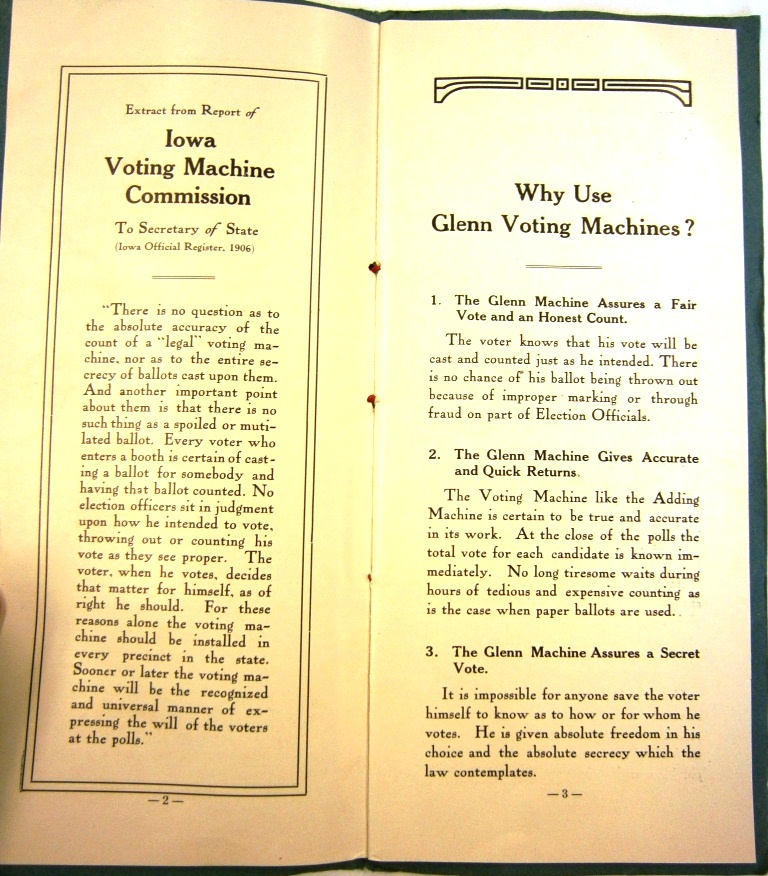
Why use Glenn Voting Machines?As millions of men and women flood the voting booths across the nation, the arduous task remains: how does one count these millions of votes? The task of an accurate and speedy vote count is something our forefathers have been tackling since our country was founded. During the 19th century, a flurry of new ideas and machines arose to combat this problem. One of these companies attempting to deliver “…a fair vote and an honest count” according to their brochure from over a century ago, was the Glenn Voting Machine Company of Cedar Rapids, Iowa.

While sorting and cataloguing my way through a collection of papers and letters from E.J.C. Bealer, a very prominent businessman and stone quarry magnate from Cedar Rapids, I came across a large number of stock certificates from as far back as 1898 from long defunct companies like the Tykoon Mining Company and the American Gold Production Company. Tucked between these certificates was a little blue book with gold letters titled, “The Glenn Voting Machine.” Mr. Bealer had quite an investment in this company through the many stock certificates I found.

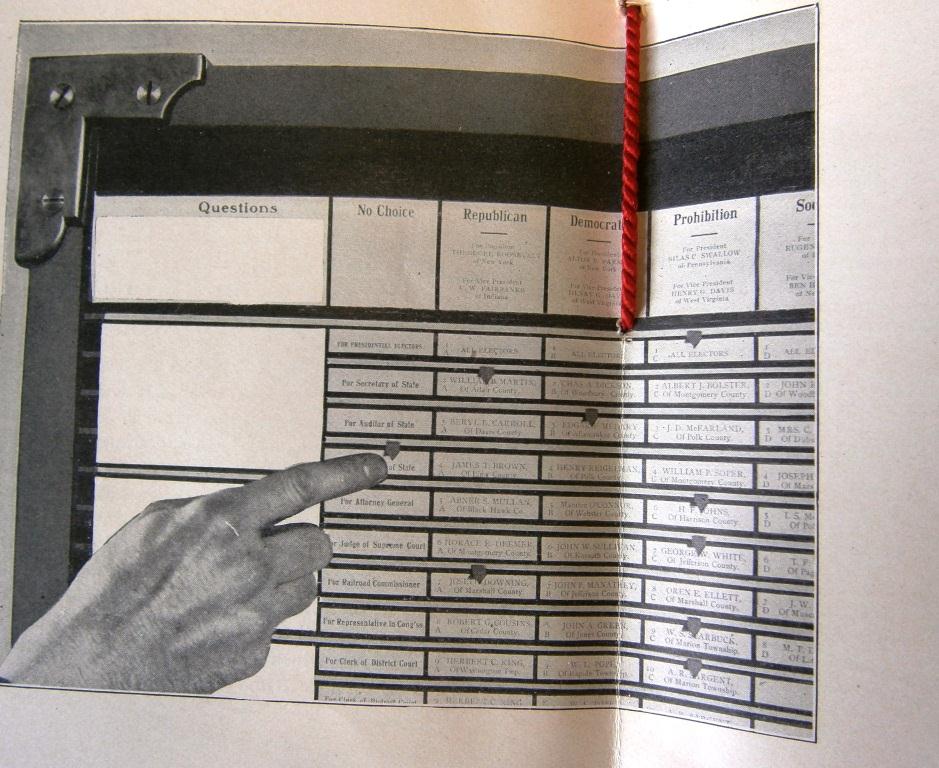
“Why use Glenn Voting Machines?” asks the third page of the brochure. During this time in American history, the entire logistical process of voting was changing directions. Through the evidence exhibited by this brochure, one can see how appealing casting a vote by machine would be. All one must do according to page nine is to “place the pointers on the names of the candidates of your choice — walk out.” Not only would the mechanical voting machine make voting much simpler, but it might even make voting fun or appealing which is something political scientists try to figure out to this day.         

Image of voting machineTaking a look at the illustrations of the machine, one can make out the presidential candidates of the 1904 election: Theodore Roosevelt and Alton B. Parker. The simplicity of the machine is hinted throughout the brochure, ensuring that every gentleman’s vote is precise. Sorry ladies, your time hasn’t arrived just yet…give it a few more years. Towards the end of the brochure are many newspaper articles and clippings, exhibiting how the Glenn Voting Machine promises “Fast Returns!” and “desirability” of a mechanical voting machine as compared to old-fashioned paper ballots.

So when you finally do make your way to the voting booth, pull those fancy curtains shut, and cast your vote for President of the United States, remember that it was through the inventions of companies like the Glenn Voting Machine Company of Cedar Rapids, Iowa that allow us to ever so conveniently cast our votes on LED screens and receive “Fast Returns!”