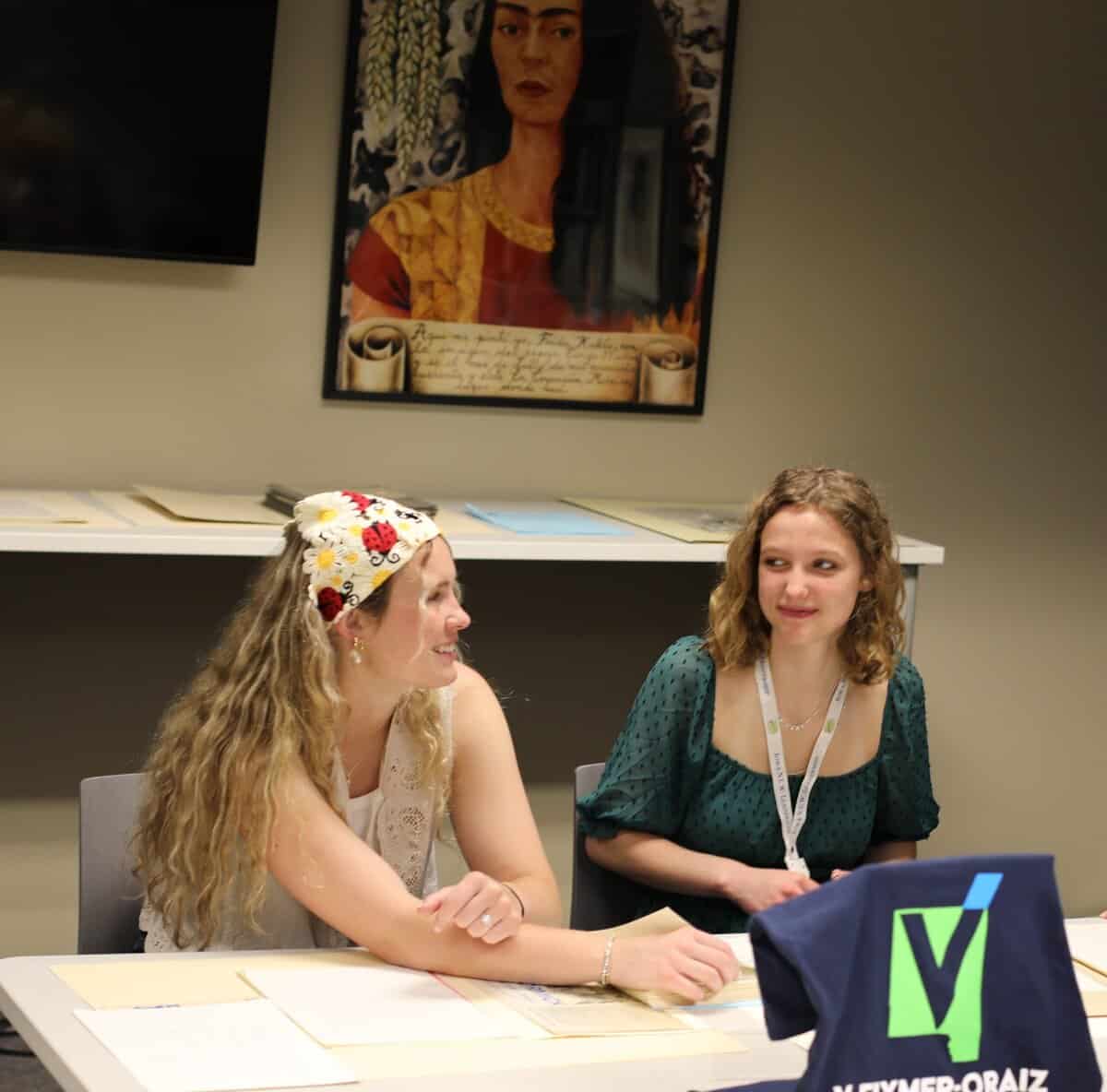
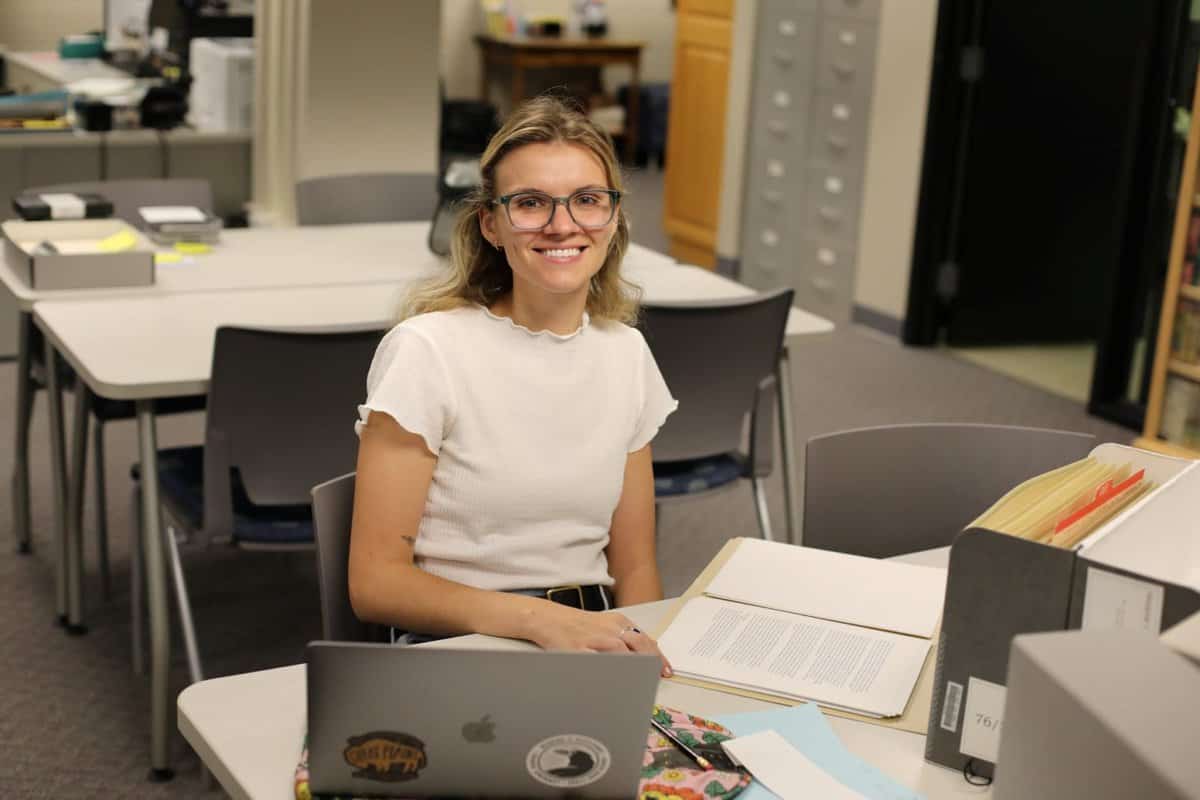
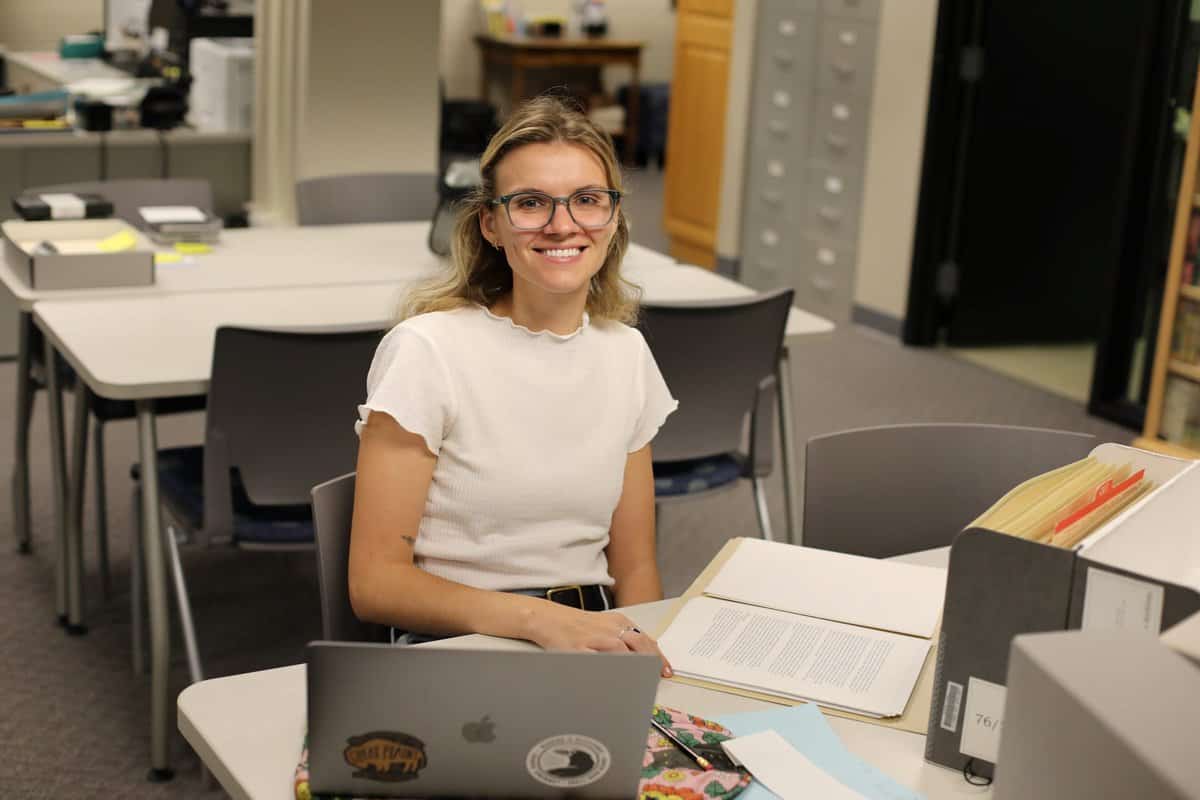
Divyansh Agarwal first learned about Iowa’s place in medicine from his mentor Dr. Carol Scott-Conner, UI professor emeritus, but ultimately Iowa’s rich history would draw him to visit the state. This fall, Dr. Agarwal came to the Iowa Women’s Archives hoping the papers of 19th and early 20th-century doctors would have something to teach him about women and the history of surgery.
Dr. Agarwal is this year’s Kerber Travel Grant recipient, and the first medical doctor to win the award. He studied molecular biology and journalism at Yale and later earned an MD and PhD from the University of Pennsylvania. Dr. Agarwal currently holds a position as chief resident in general surgery at Massachusetts General Hospital. But he still uses his journalism background to “take science and medicine to the public” by writing short articles about medical history based on his archival research.
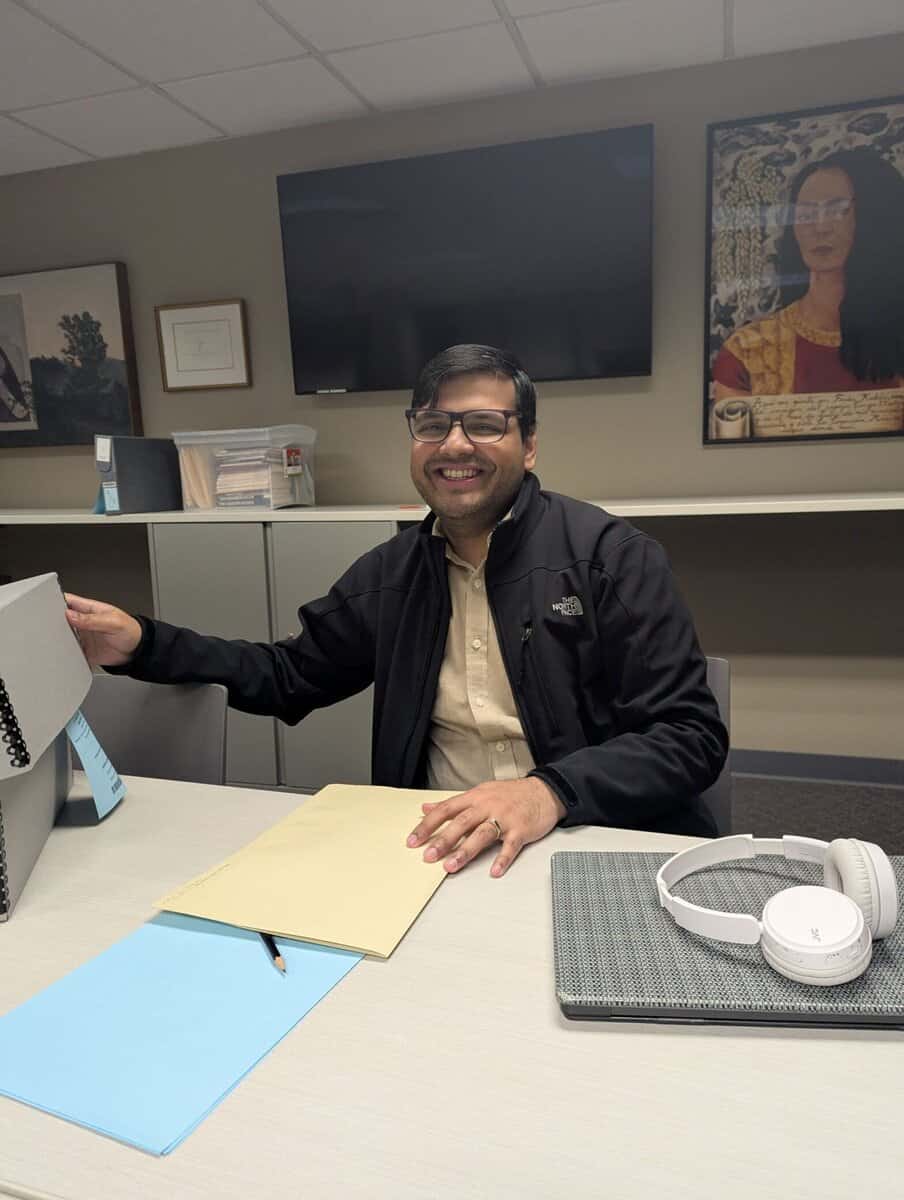
Divyansh Agarwal spent a week researching women in medicine at the Iowa Women’s Archives thanks to the Kerber Travel Fund.
Agarwal’s current project focuses on women doctors in the 19th century who worked across borders and engaged in cross-country exchanges of practices and ideas. The Iowa Women’s Archives had three promising collections: the papers of Adele Fuchs, Myrtle Hinkhouse, and Stella Mason.
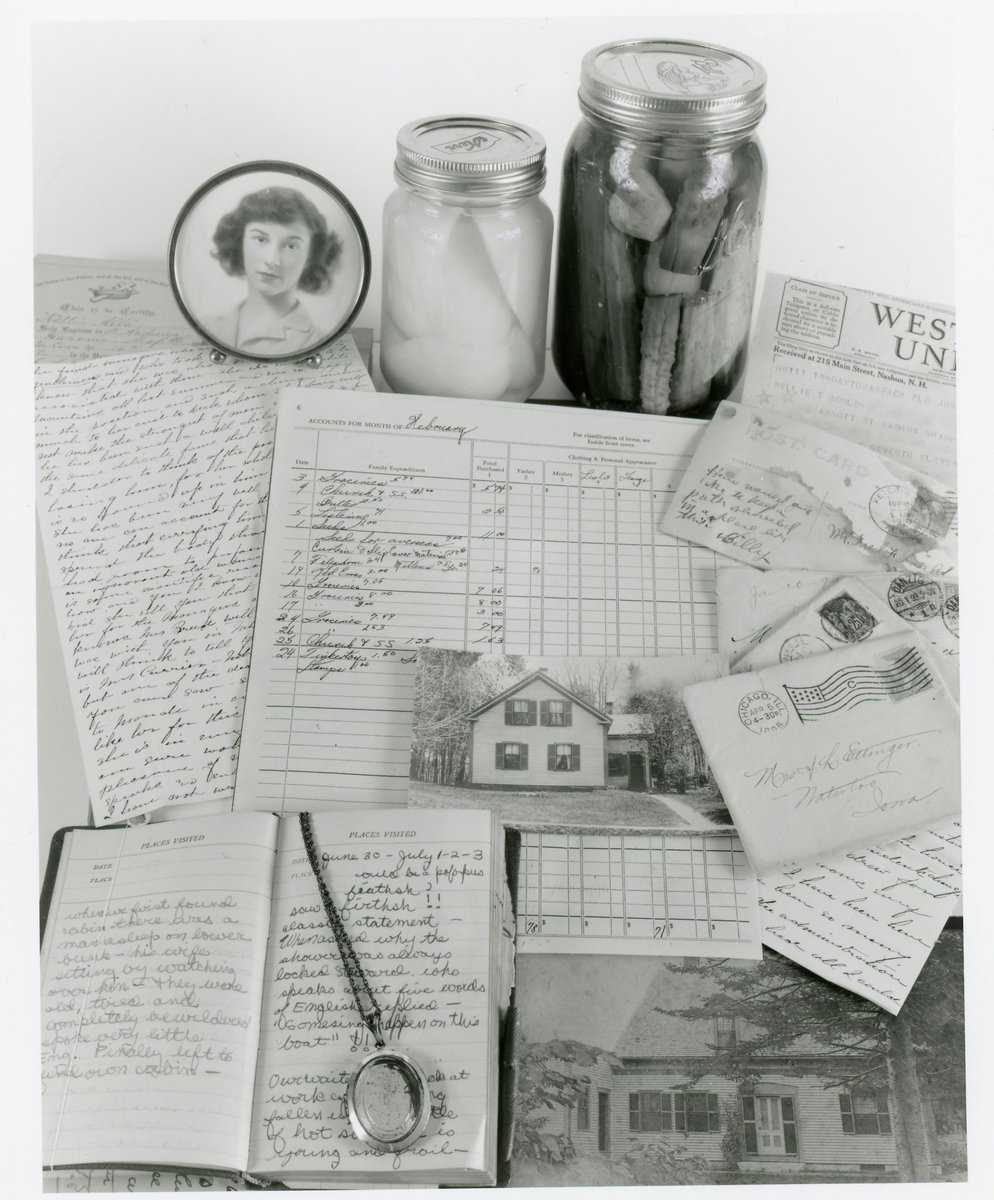
Adele Fuchs was born in 1862 to German American parents and traveled back and forth from Germany for much of her life. She studied medicine at the University of Iowa from 1893 to 1897 and practiced medicine in Iowa City until 1905 when she began teaching German in Des Moines. Her unusual career and many travels are referred to in her diaries, although her primary years in medical school and as a practicing doctor are omitted.
Dr. Myrtle Hinkhouse, originally from West Liberty, Iowa, spent most of her medical career in Chinese hospitals, working as a Methodist missionary and doctor from 1916 to 1943. Dr. Agarwal hoped to find primary source evidence of her working conditions and how she and other medical missionaries communicated about their experiences in medical journals and missionary reports scattered throughout the collection.
During his time in the archives, Dr. Agarwal’s most curious finds were surgical instruments in the Stella M. Mason collection. Mason received an MD from Hahnemann Medical College in 1893 and practiced medicine in Mason City, Iowa, until 1943. However, medical artifacts are the main evidence of her decades-long career. Dr. Agarwal says the medical instruments included in her papers are suited for reconstructive and vascular surgery that seem ahead of their time.
Dr. Agarwal is grateful for the Linda and Richard Kerber Travel Fund which made his trip possible. The fund was founded by Professor Emerita of History Linda Kerber and her husband, cardiologist Richard Kerber. Each year it is awarded to a scholar whose work would benefit from an extended visit to the Iowa Women’s Archives and who resides more than 100 miles from Iowa City. Dr. Agarwal said that his time in the archives brought up more questions than answers, but nonetheless he’s confident that the research he’s done here will be featured in his future work as a science communicator. We can’t wait to read all about it!
Are you interested in applying for the Linda and Richard Kerber Travel Fund? We accept applications every year. You can keep tabs on the deadline and learn more on our website.
Every year, the Iowa Women’s Archives (IWA) awards the Linda and Richard Kerber Travel Grant to a scholar whose work would benefit from an extended visit to the archives and who resides more than 100 miles from the IWA. Katharina Rietzler, PhD travelled a lot further than 100 miles; she came all the way from the United Kingdom. Rietzler is an American history professor at the University of Sussex whose work focuses on international relations, and women as international thinkers. She is the co-editor of the 2021 volume Women’s International Thought: A New History, and her article “U.S. Foreign Policy Think Tanks and Women’s Intellectual Labor, 1920 – 1950” won the 2023 Arthur Miller Institute Article Prize from the British Association for American Studies. Now, Rietzler has embarked on a book project, tentatively entitled Women’s International Thought in U.S. Public Culture: A Divided History.
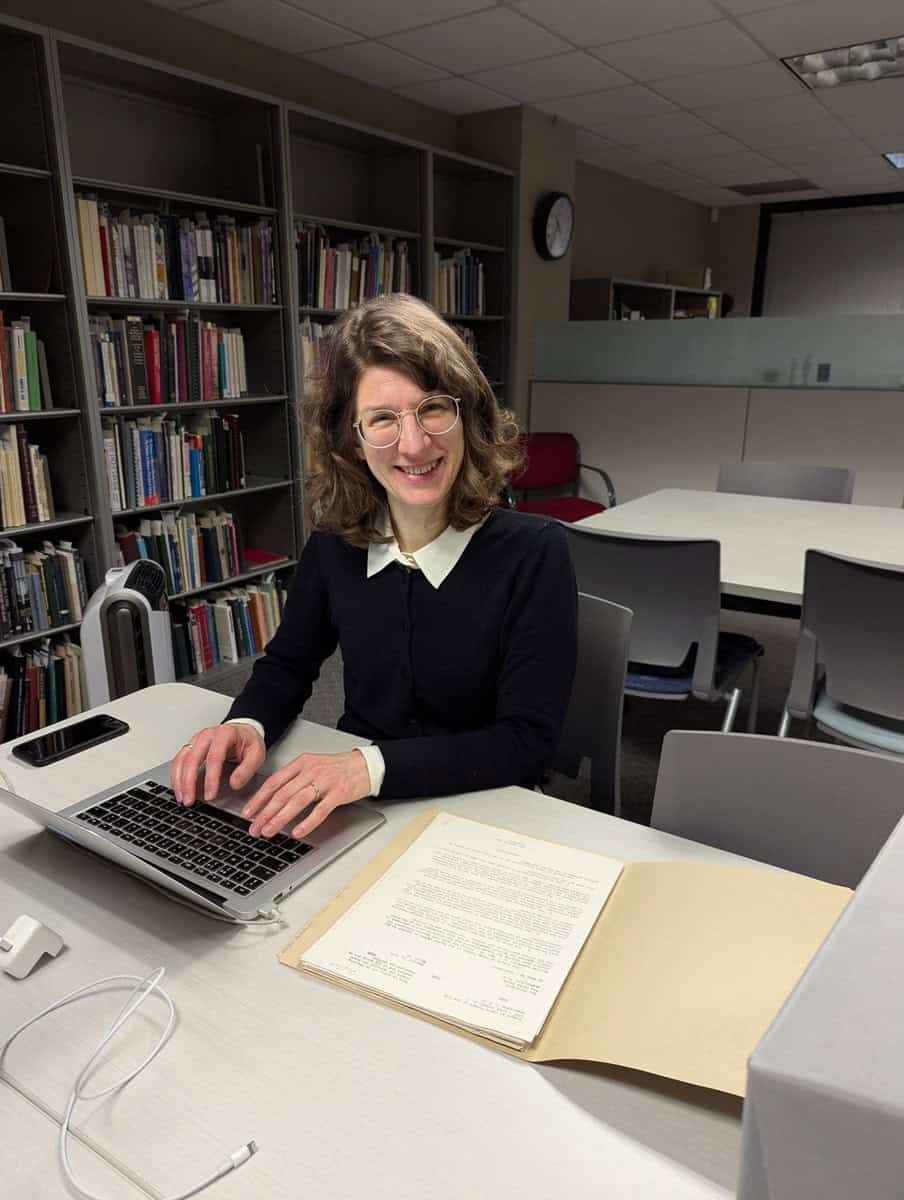
Katharina Rietzler, PhD, of Sussex University, researched in the Iowa Women’s Archives for a week thanks to the Kerber Travel Grant.
Rietzler believes that women’s thinking on foreign policy issues such as international trade, anti-communism and the U.S. President’s treaty-making powers were a dividing line between centrist-liberal and conservative women in 20th-century America. In an initial visit to the University of Iowa’s Special Collections and Archives she focused on the publications of far-Right and conservative women such as Phyllis Schlafly in the Social Documents collection. Once here, she realized that the IWA had enough collections to require another international trip and applied for the Kerber Grant. For this visit, Rietzler was particularly interested in how the foreign policy divide she identified manifested in women’s civic culture and non-partisan organizations such as local and regional chapters of the League of Women Voters (LWV).
Although voters today might not think of foreign policy as a top concern, Rietzler contends that in the mid-20th-century U.S., there was a culture of interest in international affairs present in women’s civic life. The mass-circulation Ladies’ Home Journal had a regular column on the subject and the national LWV organization featured foreign policy prominently in their publications. LWV quizzes such as “Am I an isolationist?” helped women in chapters across the U.S. define where they stood on foreign policy issues.
Rietzler spent most of her visit researching the papers of Dorothy Schramm, a political activist and Republican Party member from Burlington, Iowa. Schramm had been educated at New York City’s Barnard College, a women’s college with a strong internationalist ethos that Schramm conveyed to her midwestern audience. In Iowa, she was a founding member of Burlington’s chapter of the LWV and a prominent advocate for the United Nations (U.N.). In Schramm, Rietzler found “a historical actor who lived the ideal of a ‘woman world citizen,’ and who represented a valuable example of internationalism in the region. She characterized Schramm as “a good example of a typical type of woman activist… she’s very close to the world of policy and politics though she doesn’t have a formal office herself. She knows how these things work.”
Rietzler argued that Schramm’s successful planning of the 1955 U.N. Day celebration in Burlington, Iowa, exemplified her abilities. Rietzler was surprised to find U.N. Day marked in Iowa and celebrated so vigorously, contradicting the isolationist reputation of the region. In part thanks to Schramm’s steadfast advocacy and political skill, former First Lady Eleanor Roosevelt kicked off her midwestern speaking tour on behalf of the U.N. in Burlington. The event attracted a crowd of over 3,000 people. Images of the event, preserved in Schramm’s papers, were among Rietzler’s favorite finds from the research trip.
Dorothy Schramm, a political activist in Burlington, Iowa, brought former First Lady Eleanor Roosevelt (pictured lower left) to town for 1955’s U.N. Day. The event attracted over 3000 attendees.
At the IWA, Rietzler encountered the experiences of everyday women that she hadn’t found in national archives she had already visited. The examples of women like Schramm and others represented in collections like the League of Women Voters of Johnson County complicated the Midwest’s reputation as an isolationist stronghold. As she scopes out her book, Rietzler is still thinking through the implications of what she’s found. To what extent is Iowa an example of larger regional trends and experiences, and to what extent is it unique? We at IWA cannot wait to read her conclusions!
Are you interested in applying for the Linda and Richard Kerber Fund for Research in the Iowa Women’s Archives? We accept applications every spring. You can keep tabs on the deadline and learn more on our website.
This post was written by Iowa Women’s Archives Graduate Assistant Beatrice Kearns.
Going to the dentist is a common childhood fear, but dental hygienists have always worked to make the dentist’s office a more welcoming place for patients. Community service and outreach played a major part in the dental hygiene profession, and the University of Iowa Dental Hygiene (UIDH) program was no exception. “Outreach programs in dental hygiene began in 1953—the same year the dental hygiene program was established,” as stated in the introduction to the Community Health course syllabus. Community service and public outreach were baked into the curriculum at UIDH. Students took classes on oral pathology, dental anatomy, and pharmacology, but senior hygiene students also look classes on community health. These classes required students to create projects and initiatives to serve and support different groups, often focusing on things outside of the traditional in-clinic experiences. Hygiene students went to nursing homes and schools, but also into institutions such as the Iowa Secure Medical Facility, Mental Health Institute at Independence, and the Pediatric Psychiatric Unit at what was then known as the University of Iowa Hospitals & Clinics. Students found these experiences valuable; it opened their eyes to a wider scope of practice.
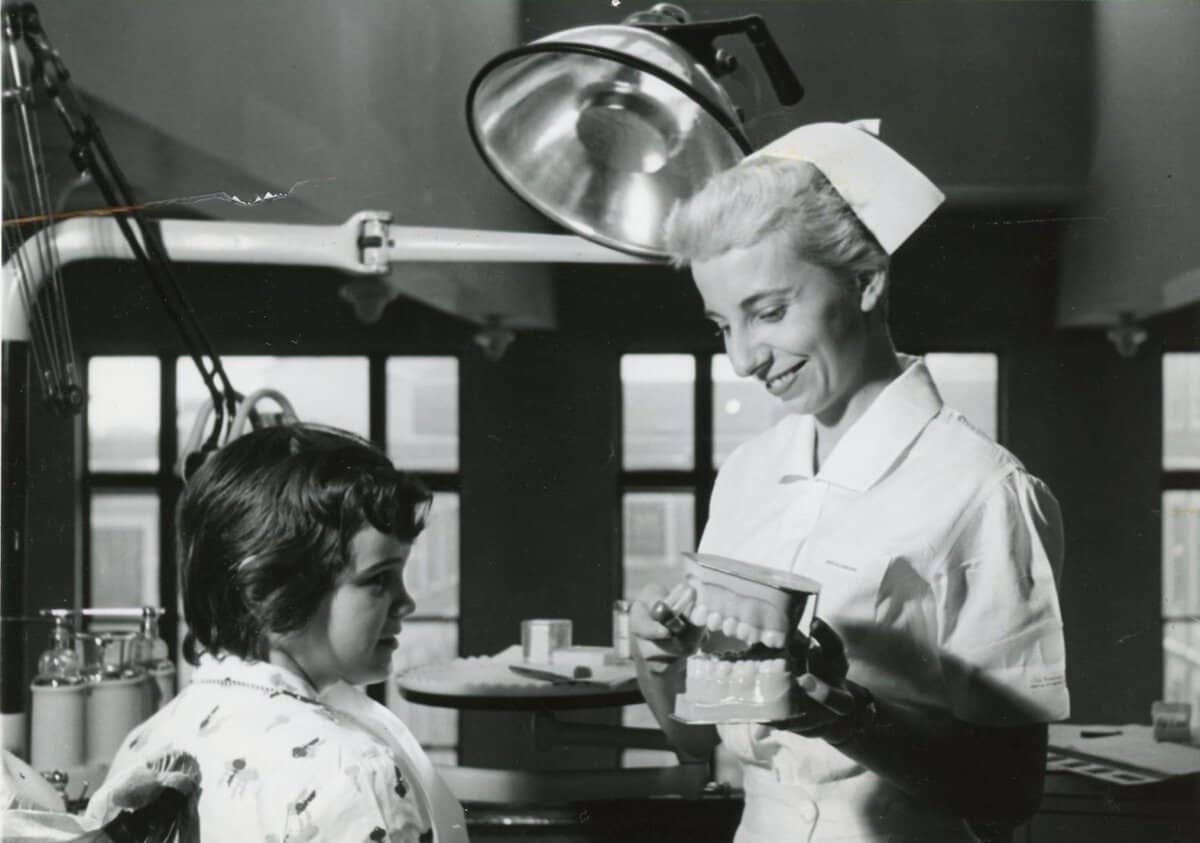
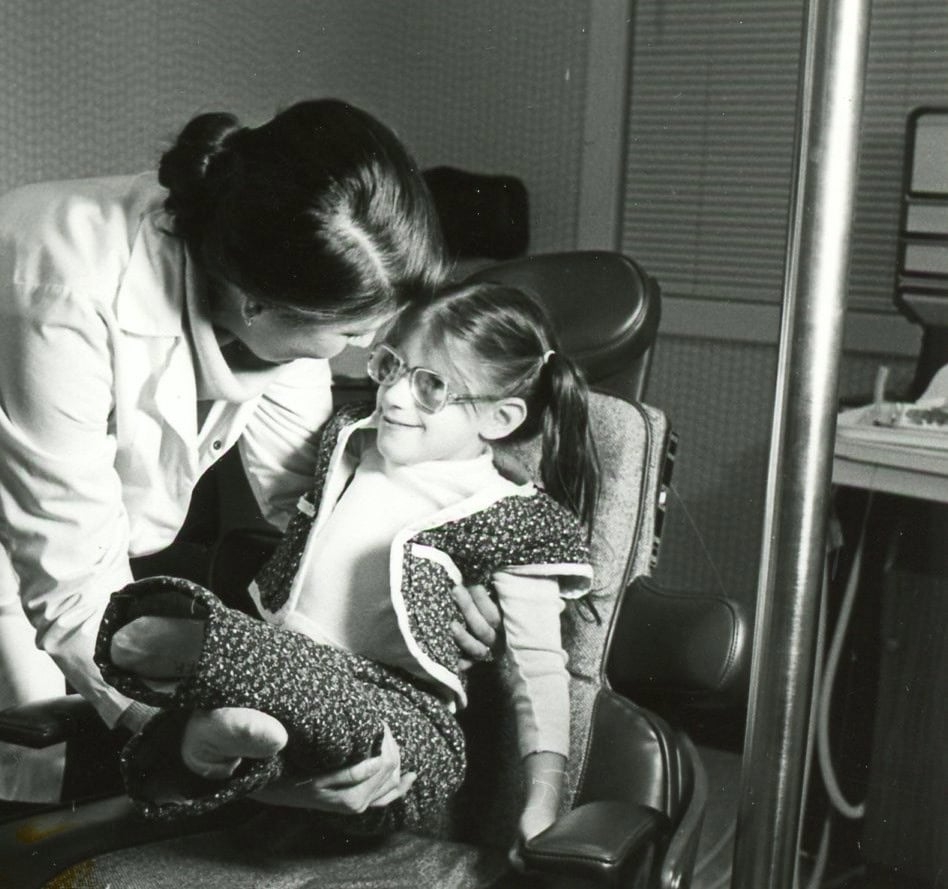
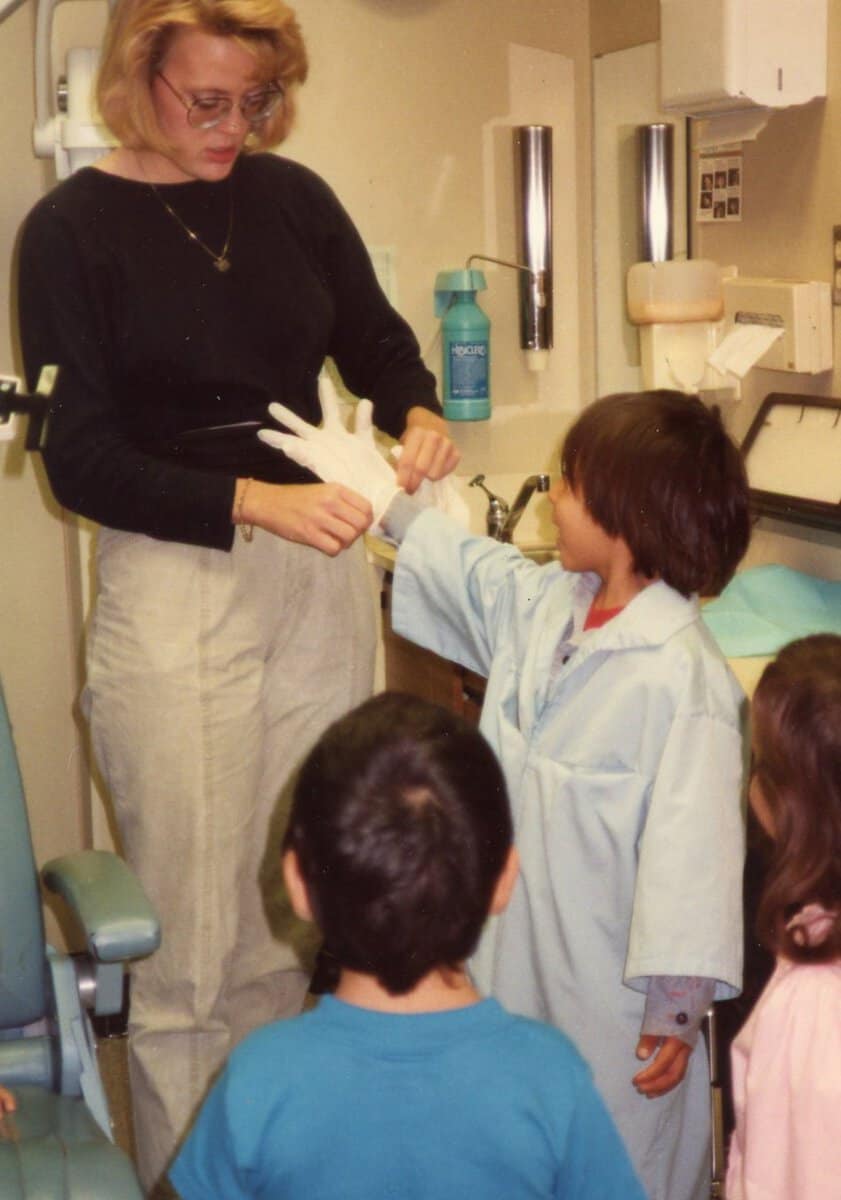
Hygienist providing chairside instruction to a young patient, ca. 1950s. Box 44, folder “Photographs, 1950s”.Hygiene student providing care at the University of Iowa Hospital school, 1980s. Box 44 folder “Photographs, 1986-1989”.
Dental hygiene outreach often overlapped with public health initiatives, with monies from the Federal Maternal and Child Heath fund coming through the Iowa Department of Public Health supporting projects. UIDH students were expected to create their own lessons, visual aids, activities, and handouts to keep children engaged. Pre- and post-tests taken by the kids regularly found that there was a statistically significant improvement in the children’s knowledge of oral health and hygiene. These outreach projects in elementary schools continued throughout the tenure of the dental hygiene program, from the 1950s to the 1990s, and were well-received by teachers and principals across Iowa.
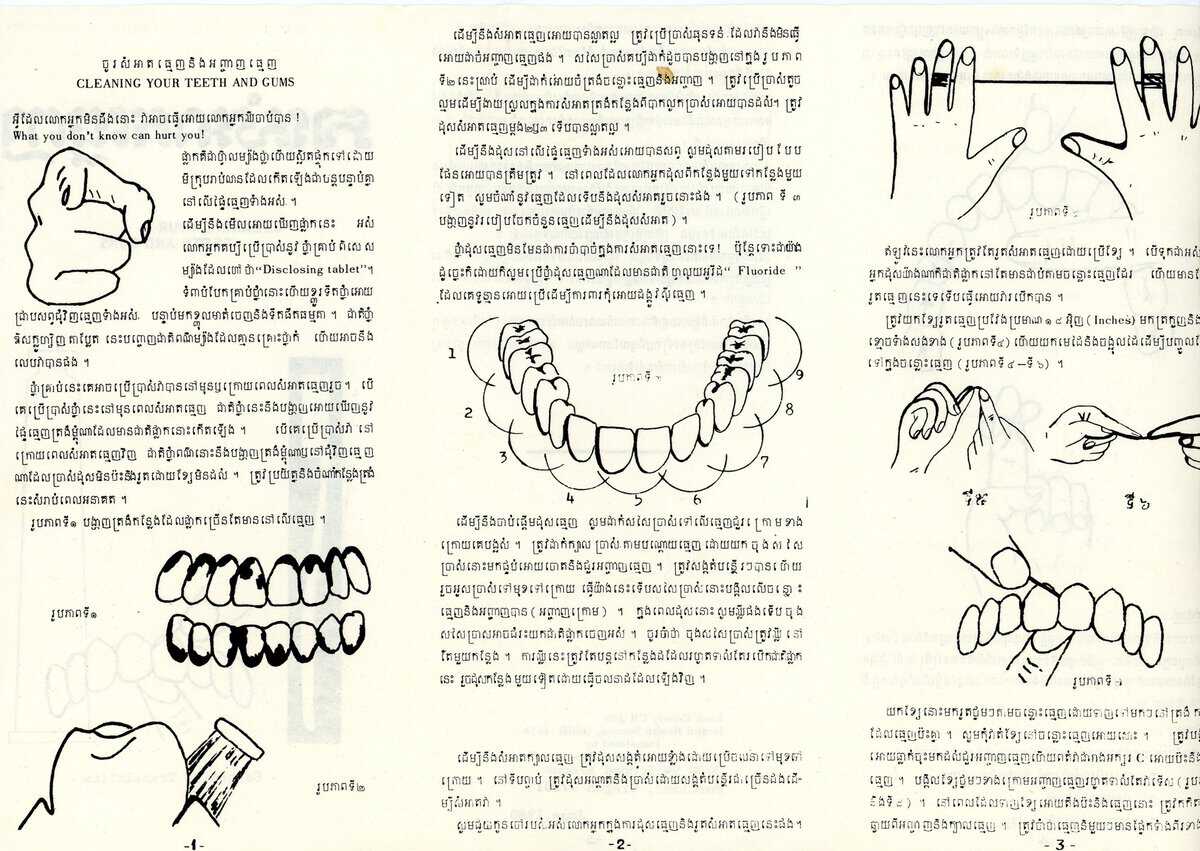
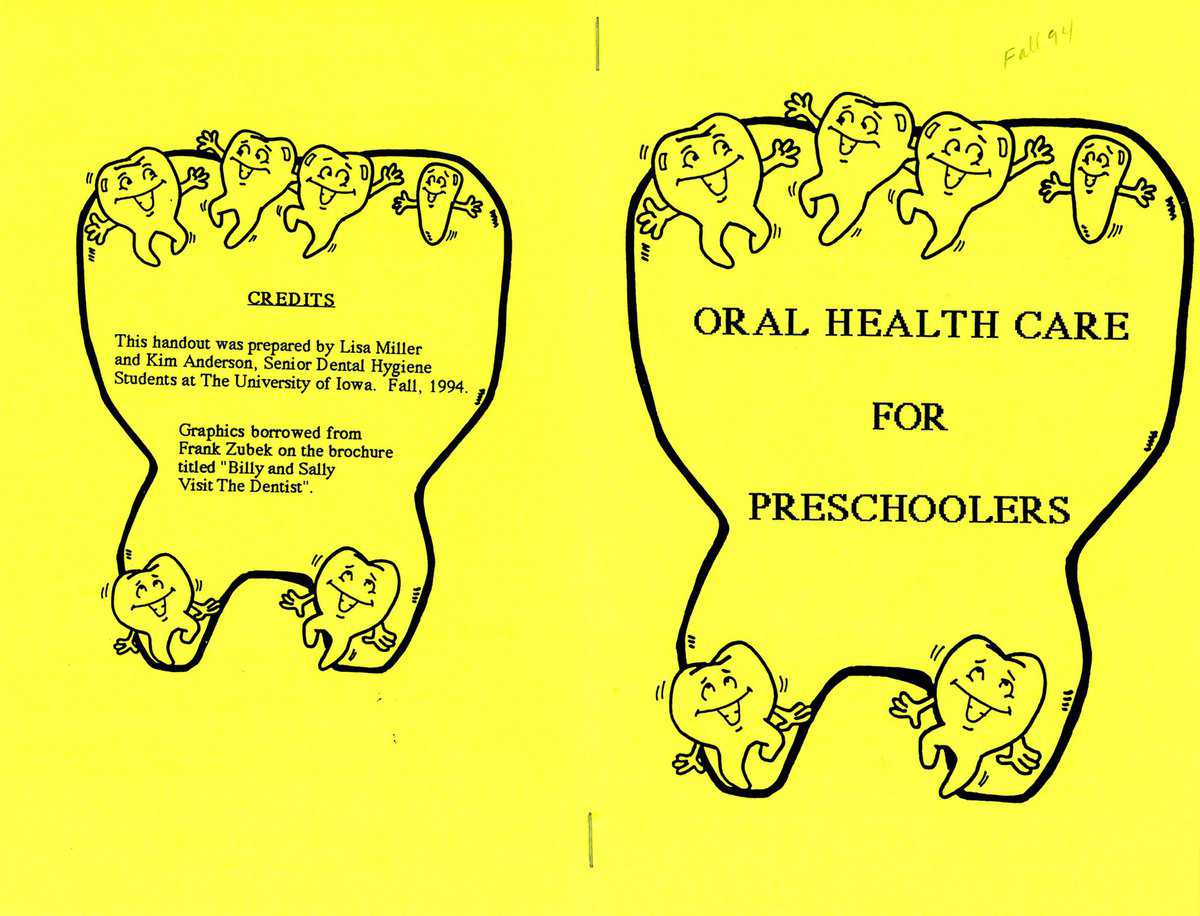
Cambodian translation of “Cleaning your Teeth and Gums”. Box 24 folder “Community health: service to groups, 1974-1995”.Pamphlet about oral health for young kids made by hygiene students in 1994. Box 25 folder “Community health: service to groups, 1974-1995”.
UIDH was not only concerned with oral health but worked to understand the bigger picture around dental health care. Courses on social factors and oral health took an interdisciplinary approach to understanding the barriers to receiving care. This historical, sociological, and political understanding of issues preventing people from getting dental care made the hygiene students better equipped to serve their communities and often led to more impactful outreach projects. For example, students worked with the Iowa Refugee Center to translate informational pamphlets into Vietnamese, Laotian, and Cambodian to reach the growing refugee populations speaking these languages. The College of Dentistry’s mobile clinic worked with organizations such as the Muscatine Migrant Committee to provide tooth cleanings for migrant farm workers because there were not enough dentists in the Muscatine area to care for all of the patients. Doctoral dental students and hygienists worked together in the mobile clinic to provide care. UIDH students worked with inmates at the Anamosa State Reformatory to improve their dental health and create sustainable habits for reentry into society. The warden said that this project was particularly successful because dental issues were something that nearly all inmates struggled with, and their confidence would improve so much with better oral hygiene. Fluoride mouth rinses were taken to rural areas and mobile home parks that did not have fluorinated water supplies. This rinse added an extra layer of protection for tooth enamel.
UIDH faculty and students understood that providing the best care meant connecting to the community they were serving. This intersectional view and approach to care influenced students even after their graduation from the program. Alumni Sara Kozeluk worked as a community dental hygienist for the Lac du Flambeau Band of Lake Superior Chippewa tribe, providing dental care to indigenous people. Kozeluk highlighted the importance of knowing who she was serving and understanding their cultural practices. In 1992, students and faculty from UIDH got to travel to the Indian Health Services in Minocqua, Wisconsin, to learn about dental care for indigenous groups.
Dental hygiene student works with children during the visit to the Indian Health Services, 1992. Box 45, folder “Photographs, 1991-1992”.
To learn more about the dental hygiene program and its services, visit the exhibit in the Iowa Women’s Archives’ reading room on display in spring 2025.
This piece was written by IWA Student Assistant Kelly Kemp.
In 1977, Joan Bunke, film critic and book and arts editor at the Des Moines Register, attended a Gateway Dance Theatre performance. She disliked what she saw, and published a column in the paper criticizing the “ruination of line” and “lack of body discipline” displayed by the dancers. A few weeks later, prominent Des Moines, Iowa, civil rights activist, Edna Griffin, published a strongly worded response to Bunke’s criticisms. Griffin suggested that the Gateway Dance Theatre shattered Bunke’s “too-narrow view of dance as an art form,” a view which Griffin described as “limited exclusively to ballet and the western world.”
This exchange begs the question: why would a dance theatre inspire such a response from a civil rights activist?
To understand the Gateway Dance Theatre, it’s important to know about its founder, Penny Furgerson, whose papers are now available in the Iowa Women’s Archives. Furgerson was born Penny Rosemary Thomas in 1936 in Karachi, Pakistan. She attended school in Bombay, India. Furgerson had interest in both the sciences and the arts. She was trained in South Indian classical dance (Bharatanatyam) from an early age, and she graduated from the University of Bombay with honors in chemistry. She then moved to Des Moines, Iowa, where she received a full tuition scholarship to study pharmacy at Drake University. While in Des Moines, she met Lee B. Furgerson, Jr., and they would go on to marry in 1961 and raise three sons. About 10 years later, the couple founded the Gateway Dance Theatre.
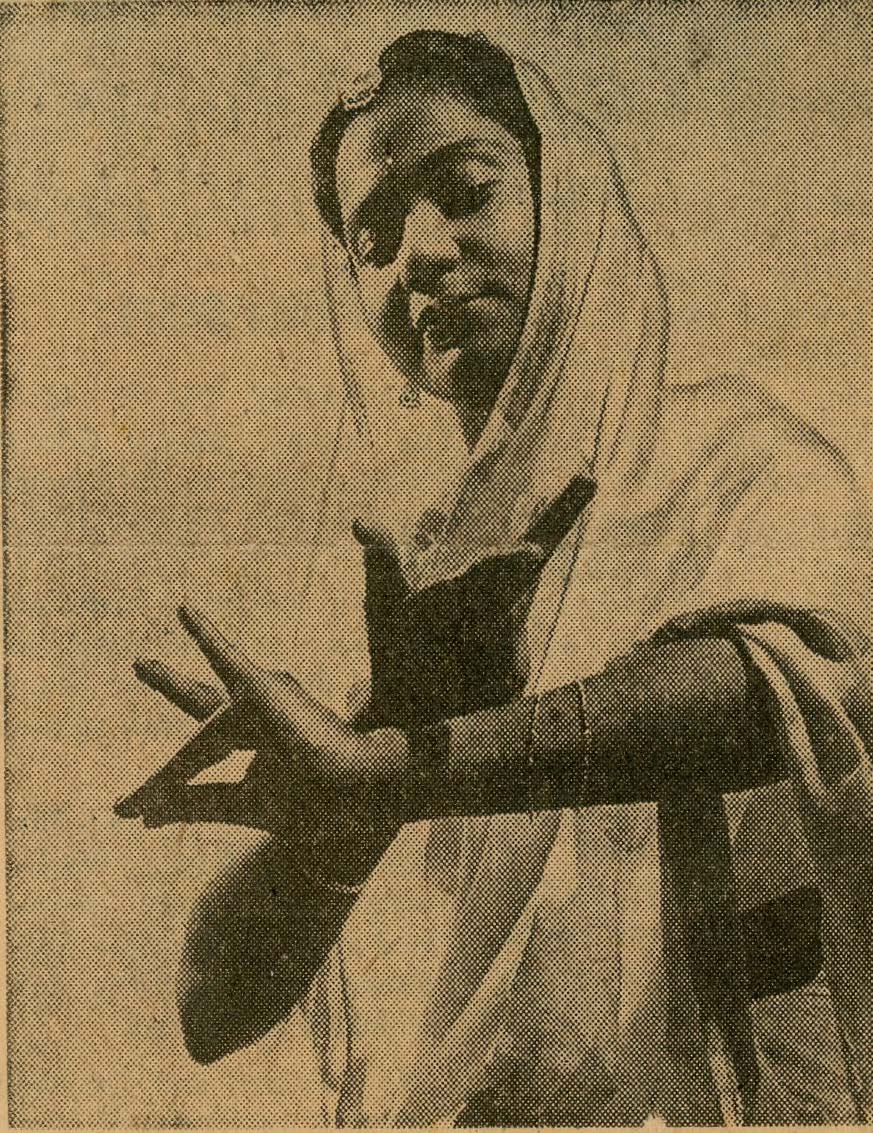
Penny Furgerson, undated.
Lee Furgerson’s family was locally prominent in Des Moines, known for their activism and community involvement. Three of his four sisters’ papers are held at the Iowa Women’s Archives: the Betty Jean Furgerson papers (IWA0111), the Lileah Harris papers (IWA0256), and the Martha Nash papers (IWA0235).
The Furgerson family of Des Moines, Iowa. Left to right: Betty Jean Furgerson, Martha Nash, Lily Furgerson, Lee B. Furgerson Jr., Lileah Harris, undated.
In an article in the New Iowa Bystander, a newspaper by and for Black Iowans, Furgerson explained what inspired and prompted her to begin her own dance theatre. In 1971, she attended a performance put on by the Dance Theatre of Harlem. She recounted this experience and how it shocked her. She realized that there was a gap in the dance opportunities for the Des Moines community, and an almost complete lack of accessible, non-western, multi-ethnic dance opportunities. The Gateway Dance Theatre would offer a positive, creative outlet for disadvantaged, high risk community groups. In news articles from the early 1970s, Furgerson describes how formal training is not a prerequisite for her dancers, and that there are not fees for attending her classes. She emphasizes that all are welcome, and no individual’s talent is turned away based on economic status. In an application for a Community Development Block Grant, Furgerson states, “The Gateway Dance Theatre… provides the City of Des Moines with cultural entertainment for the community at large, purposeful activity for youth in targeted areas, and elevates the self-esteem of the minority communities involved by giving them positive visibility.”
For many years, there were few other options for multiethnic dance opportunities in Iowa. One of these options was the Dieman-Bennett Dance Theatre of the Hemispheres in Cedar Rapids. This dance theatre was co-founded by Edna Dieman and Julia Bennett in 1951. Dieman was born and raised in Iowa, and Bennett was born in Chittagong, India, to English parents. The Dieman-Bennett Dance Theatre of the Hemispheres provided instruction (at a cost) and performances that reflected many cultural influences. The Dance Theatre of the Hemispheres closed its doors in 1997, and its papers are also held at the Iowa Women’s Archives (IWA0265).
In the past 52 years, the Gateway Dance Theatre has gone above and beyond in fulfilling the mission and goals set in 1972. In the Penny Furgerson papers, the positive impact of the Gateway Dance Theatre is clearly evident in photos of the smiling faces of those attending workshops, and in the thank-you notes handwritten by elementary school students who attended classes. Furgerson brought the opportunity for a positive creative outlet to all members of the community, breaking down barriers to access.
Penny Furgerson teaching a Gateway Dance Theatre class, undated.
The work done by Furgerson has been remarkable, and has not gone unappreciated by the community. To return to Griffin’s column written five years after Gateway was founded, the Des Moines civil rights activist says, “The Gateway Dance Theatre represents part of a national effort to bring the arts closer to the people as well as providing opportunities for participation. The process is known as a cultural enrichment… Many people in our city take pride in and concern for Gateway—a small miracle in our midst.” The Gateway Dance Theatre has been an integral part of Des Moines’ arts and culture for more than 50 years, consistently offering opportunities without barriers to community members of all backgrounds, ages, and socioeconomic statuses.
Gateway Dance Theatre performance in the Iowa News, 1986.
Every year, the Iowa Women’s Archives (IWA) awards the Linda and Richard Kerber Travel Grant to a researcher whose work would benefit from using collections in the Archive and who resides outside a 100-mile radius of Iowa City, Iowa, with preference given to graduate students. The grant’s 2024 recipient was Lillian Nagengast.
Lillian Nagengast experienced a Midwestern upbringing in Bloomfield, Nebraska, a town with a population that over around just 1,000. For college she headed east and attained a BA from Boston College and then an MA in English from Georgetown University. Nagengast is now pursuing a PhD in American Studies at the University of Texas at Austin, and her scholarship has led her back to her roots. Her dissertation prospectus will focus on the Midwest, particularly woman and LGBTQ individuals who forged community, belonging, and progressive coalitions in the region from the 1960s to the present day.
Lillian Nagengast, the 2024 Kerber Grant recipient, used the award to travel to Iowa City and find resources for her dissertation prospectus.
While researching the rural Midwest, Nagengast encountered works including On Behalf of the Family Farm: Iowa Farm Women’s Activism since 1945by Jenny Barker Devine and When a Dream Dies: Agriculture, Iowa and the Farm Crisis of the 1980s by Pamela Riney-Kehrberg. Both built their arguments using the voices of rural women as recorded in diaries, letters, and oral histories. Nagengast found herself wondering where these academics gathered this wealth of primary sources. The search led her to the IWA, which both historians had visited, and its rich collections documenting everyday rural life in 20th century Iowa. Thanks to the Linda and Richard Kerber Travel Grant, Nagengast was able to visit the IWA and see some of these sources for herself.
While perusing the Archives, Nagengast searched for evidence of grassroots organizing by women and queer people in rural Iowa by consulting collections including the Voices from the Land Oral History Project, the Mujeres Latinas Oral History Project, and the Anita Crawford papers, among others. These collections, she believes, speak to each other in surprising ways across time periods, locations and ethnic backgrounds.
The Voices from the Land Oral History Project, which Nagengast used, compared preserving food with preserving history in its promotional materials. The Project took place from 2000 to 2001 and eventually included dozens of interviews with rural women across Iowa. Image from Voices from the Land: An Oral History Project in Iowa, Iowa Women’s Archives, University of Iowa Libraries.
For instance, while the second wave feminist movement was blooming in more urban areas, the women in these oral histories worked outside of mainstream feminist organizations. Women like Anita Crawford, a farmer and volunteer for the Buchanan County Farm Bureau, engaged with the Iowa Women’s Political Caucus over the issue of inheritance taxes, which affected women farmers, rather than over the social issues more commonly associated with the feminist movement of her time. One woman who stuck out to Nagengast was Barbara Grabner, who worked with PrairieFire Rural Action, a non-profit focused on grass-roots efforts to address the 1980s Farm Crisis, in which many Iowans lost their family farms. Grabner was a leader in advocating for women on family farms, but noted in her oral history that “You don’t use the word feminist around a lot of these people, which they really were, but you wouldn’t call them that.” Nagengast hopes that these archival insights into how women did objectively feminist work outside of the feminist label will make up the bulk of her first chapter.
Women like Anita Crawford (center) didn’t leave political activism to men, as demonstrated through their work in local farm bureaus. But Nagengast found that they may not have identified as feminists either. Image from the Anita Crawford papers, Iowa Women’s Archives, University of Iowa Libraries.
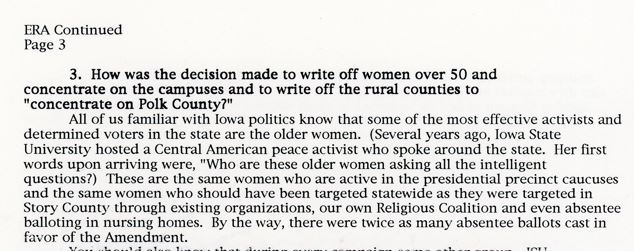
Again and again Nagengast found evidence of fractures in feminist coalition building, particularly among national (often urban) and local (particularly rural) organizations. This was typified by her favorite document in the Archives, a four-page letter from the Story County Equal Rights Amendment Coalition, a local organization, to the national Fund for the Feminist Majority, written in the aftermath of the ERA’s 1992 defeat in Iowa. The letter enumerated the ways in which the Coalition believed the Fund’s tactics contributed to the loss, claiming the Fund’s representatives refused to collaborate with locals, made rude comments about them, and decided to “write off women over 50 and concentrate on the campuses and to write off the rural counties to ‘concentrate on Polk County.'” The letter is detailed and unsparing, and was copied to feminist luminaries at Ms Magazine and Iowa NOW. Nagengast thought she had struck gold. “I’d like it framed in my office,” she joked.
An excerpt from Nagnengast’s favorite document from her trip to IWA, a 1992 letter from the Story County Equal Rights Amendment Coalition that took the Fund for the Feminist Majority to task for the ERA’s loss in Iowa the previous November. Image from the Johnson County ERA Coalition records, Iowa Women’s Archives, University of Iowa Libraries
Now that she’s back home, Nagengast plans to write her prospectus and then begin writing her dissertation itself. She has high hopes for the project, including drafting a conference paper, writing a book, and hopefully coming back to IWA for future research.
This post was written by Iowa Women’s Archives Graduate Assistant Beatrice Kearns.
What do an eagle, a donkey, an elephant, and a chicken have in common? They can all be found in the political collections of the Iowa Women’s Archives!
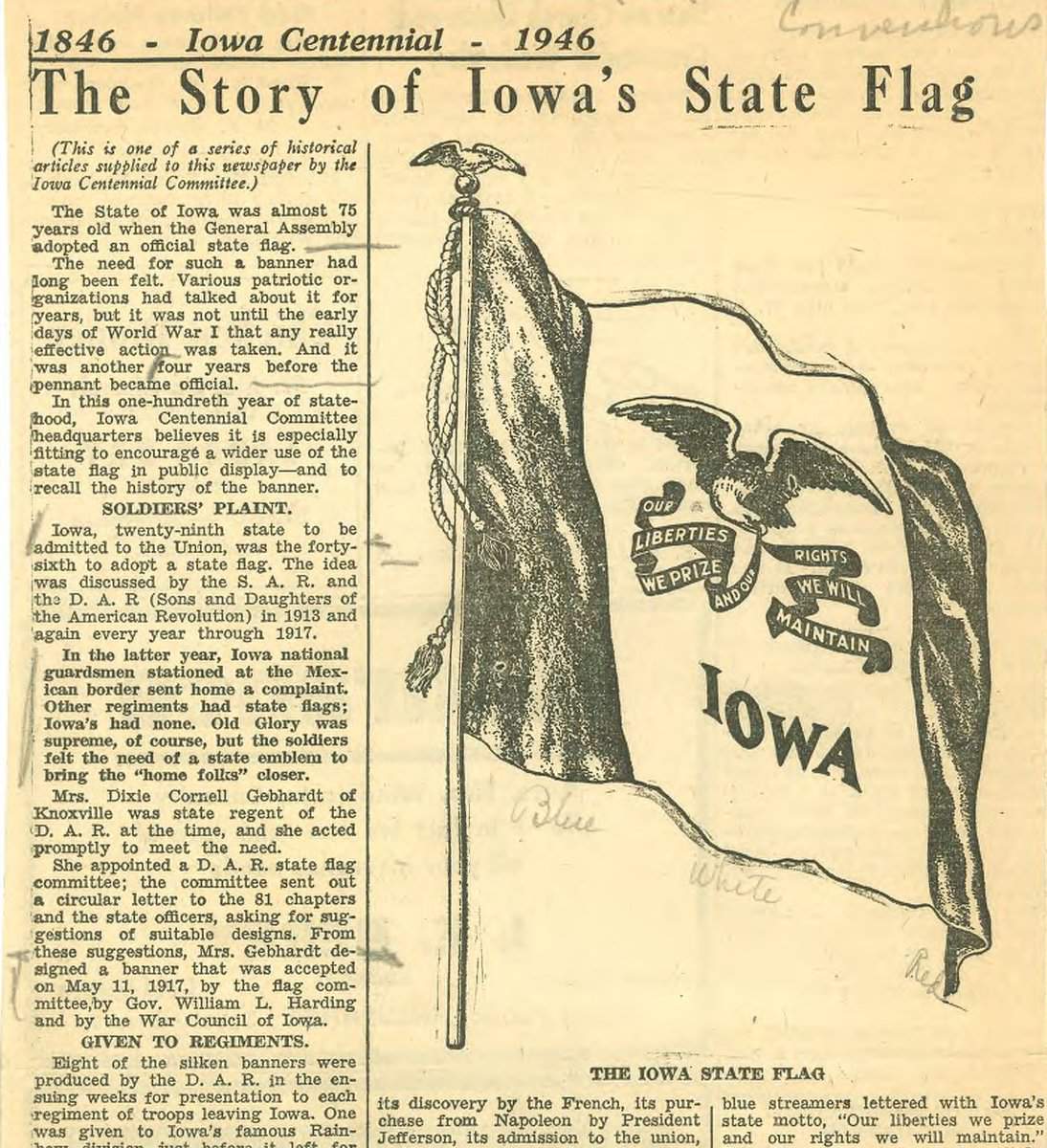
Animals are used as symbols in campaign materials, political cartoons, logos, clothing, accessories, and the state flag and seal of Iowa. The flag, pictured here, was designed by Knoxville, Iowa, local Dixie Cornell Gebhart when the state guardsmen serving on the Mexican border during World War I needed a regimental flag. Gebhart utilized the eagle within the flag to symbolize the state’s connection to the nation, linking it to principles of freedom and democracy.
Newspaper clipping about the creation and design of Iowa’s state flag. Dixie Cornell Gebhart papers, Iowa Women’s Archives, University of Iowa Libraries.
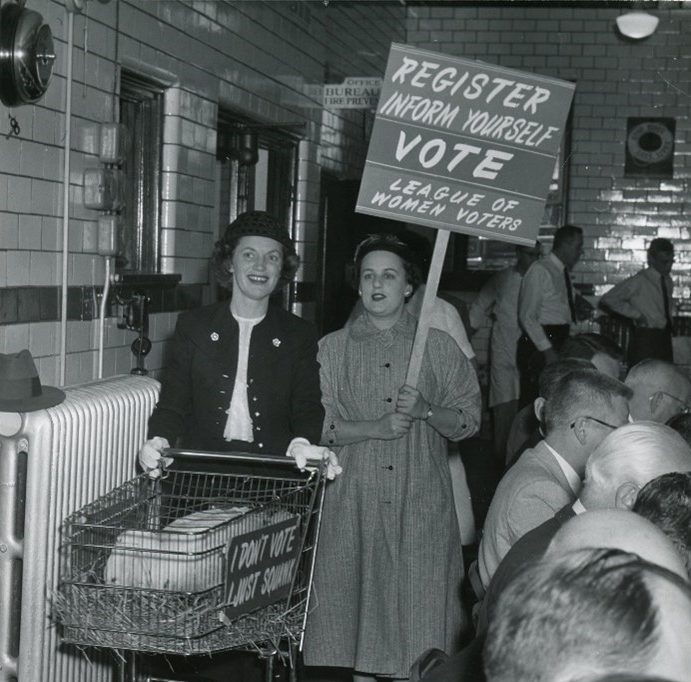
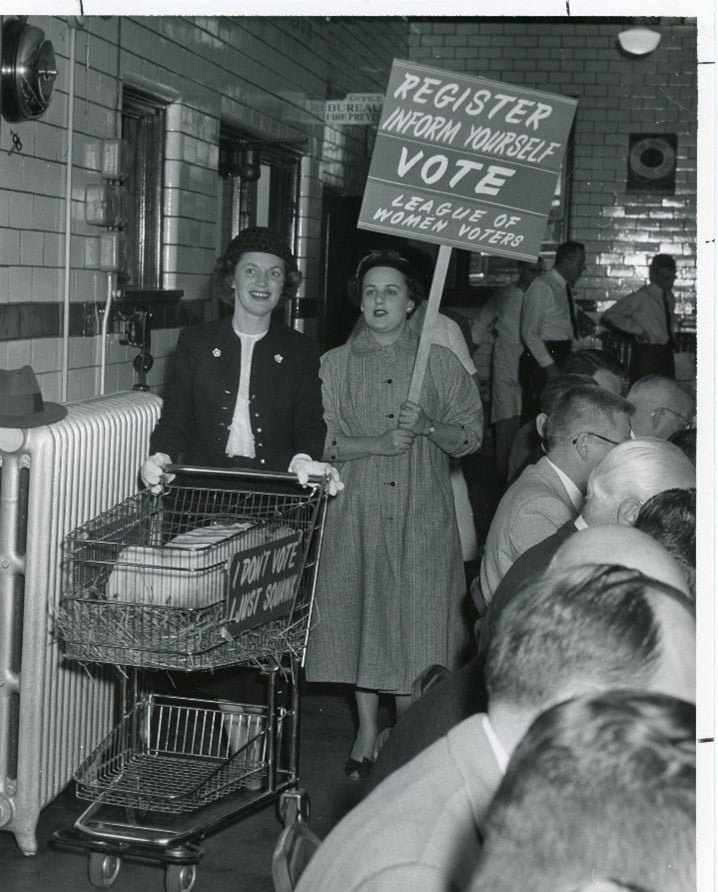
Outside of campaign materials, animals have been used to encourage people to vote and engage in the democratic process. the League of Women Voters (LWV) produced many pamphlets, flyers, and printed materials featuring lots of animals. the Cedar Rapids-Marion LWV had a get out the vote effort that ruffled some feathers. Women pushed a cart of chickens around a dining hall with a sign saying “I don’t vote, I just squawk,” encouraging citizens to use their votes instead of just complaining.
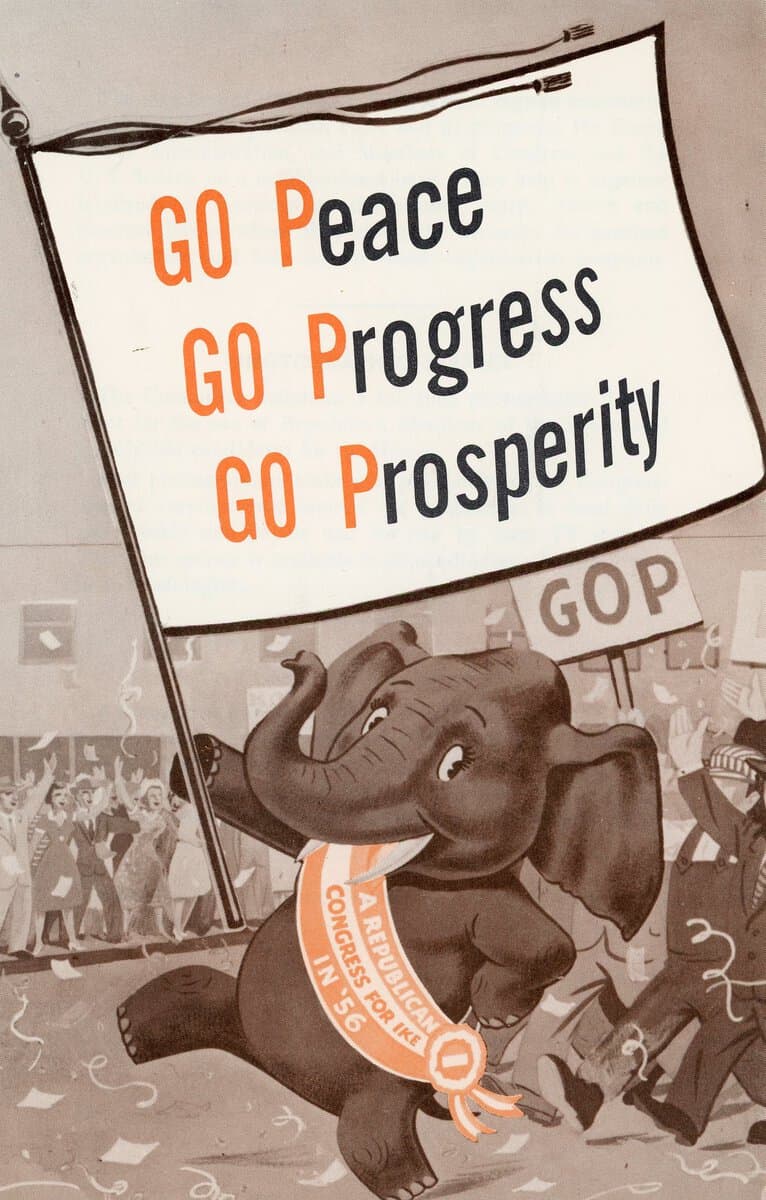
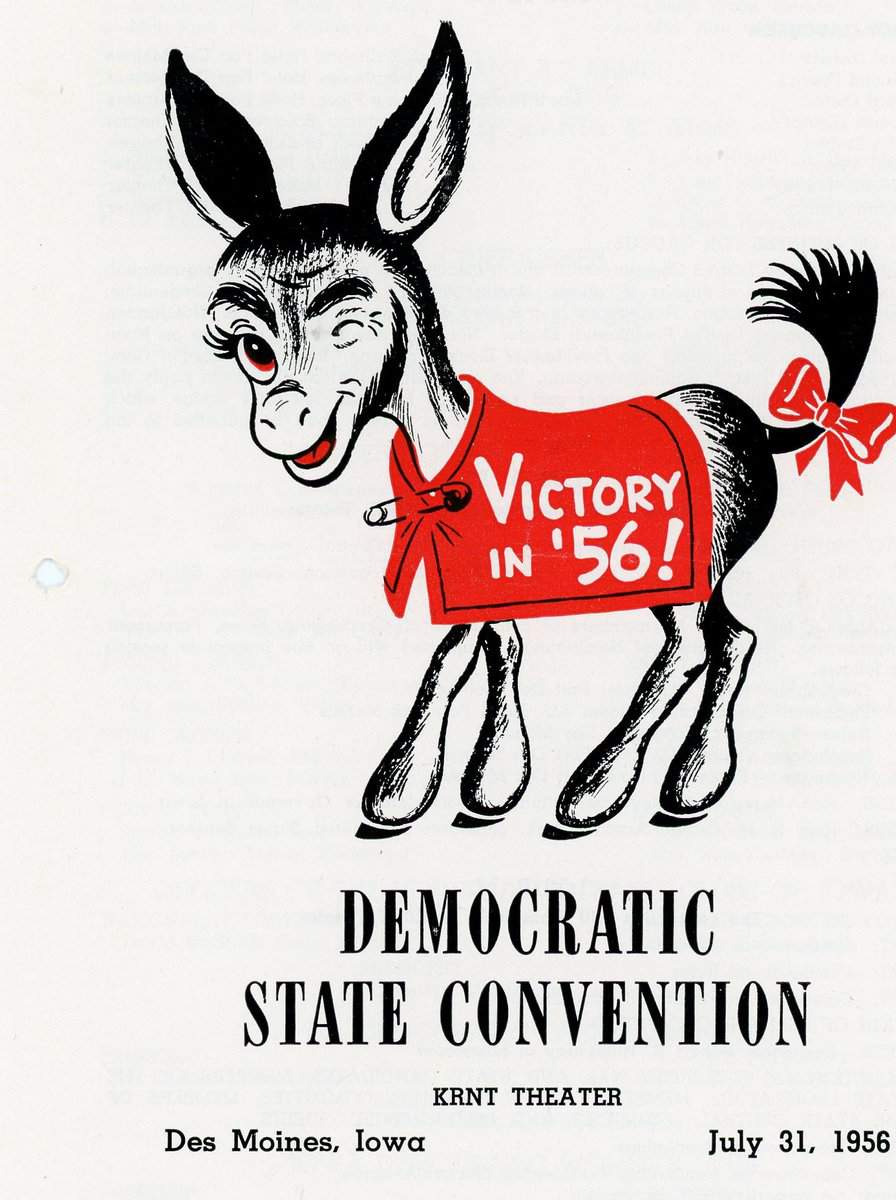
In American politics, after the eagle, the Republican elephant and the Democratic donkey are among the most popular animals amongst IWA’s political materials. These symbols were both popularized by political cartoonist Thomas Nast in the 19th century. The donkey was first used during the 1828 campaign, when opponents referred to Andrew Jackson as a “jackass” and he took it in stride, using the donkey on campaign materials. The elephant came later, as Abraham Lincoln was the first Republican president and “seeing the elephant” was a phrase used by Union soldiers when experiencing combat.1
1956 Republican Party ephemera from the Mary Louise Smith papers, Iowa Women’s Archives, University of Iowa Libraries.Democratic State Convention1956 program cover from the Alberta Metcalf Kelly papers, Iowa Women’s Archives, University of Iowa Libraries.
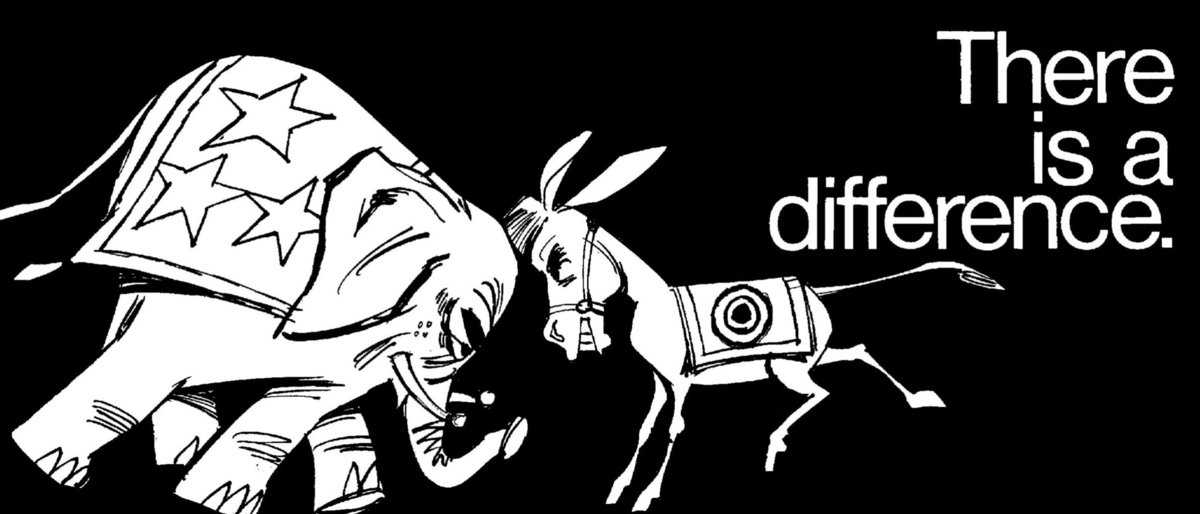
The elephant and the donkey have been used in cartoons, campaign materials, and party memorabilia. The two animals are very recognizable with their respective parties and serve as a quick calling card. They are often pitted against one another in campaign materials.
Cover of the Republican National Committee program, 1964, from the Mary Louise Smith papers, Iowa Women’s Archives, University of Iowa Libraries.
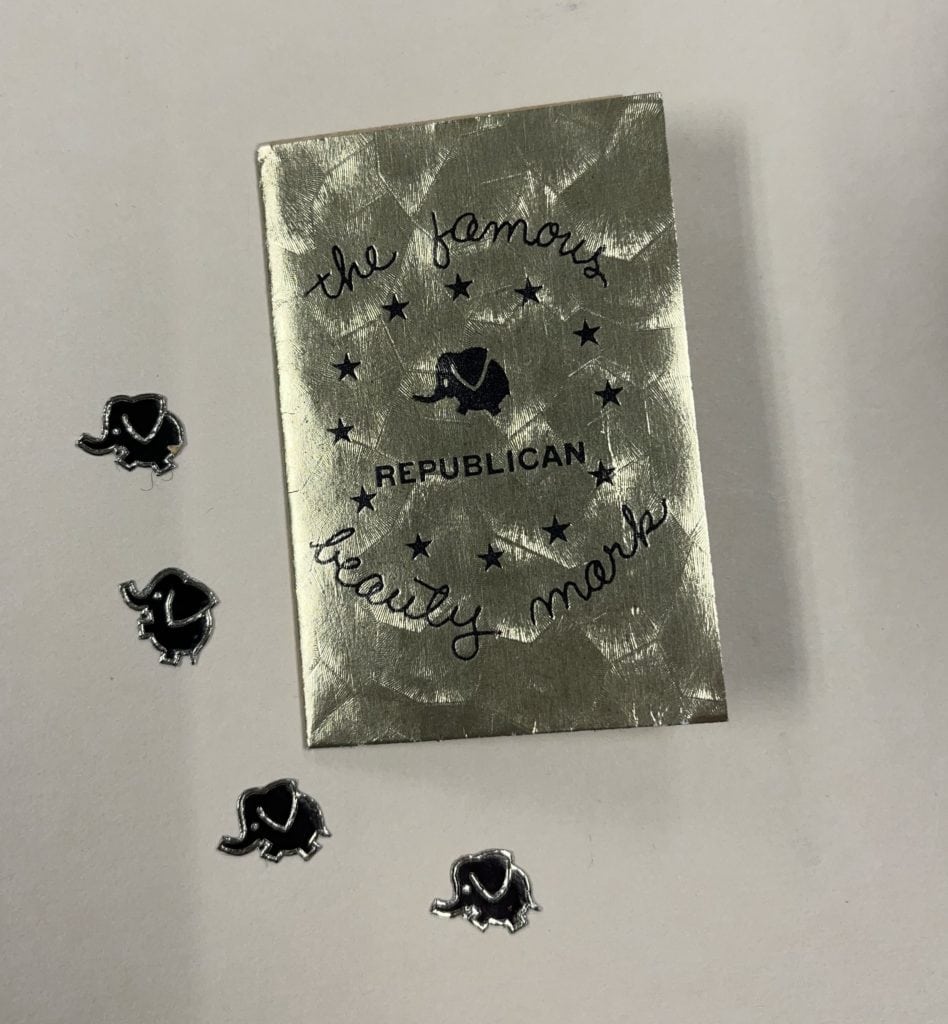
The elephant and the donkey are relied on to quickly identify party membership. Pins and buttons are a common use but more exciting tokens include the “Famous Republican Beauty Mark,” from the Anna Cochrane Lomas papers in IWA. It combines the symbol of Republicanism with a popular beauty trend of the 1960s.
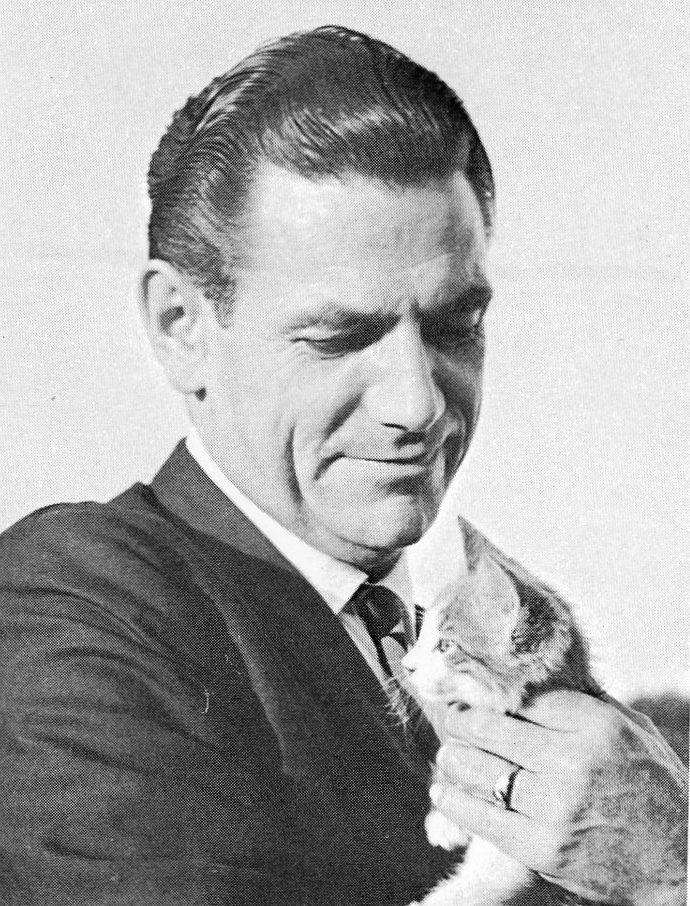
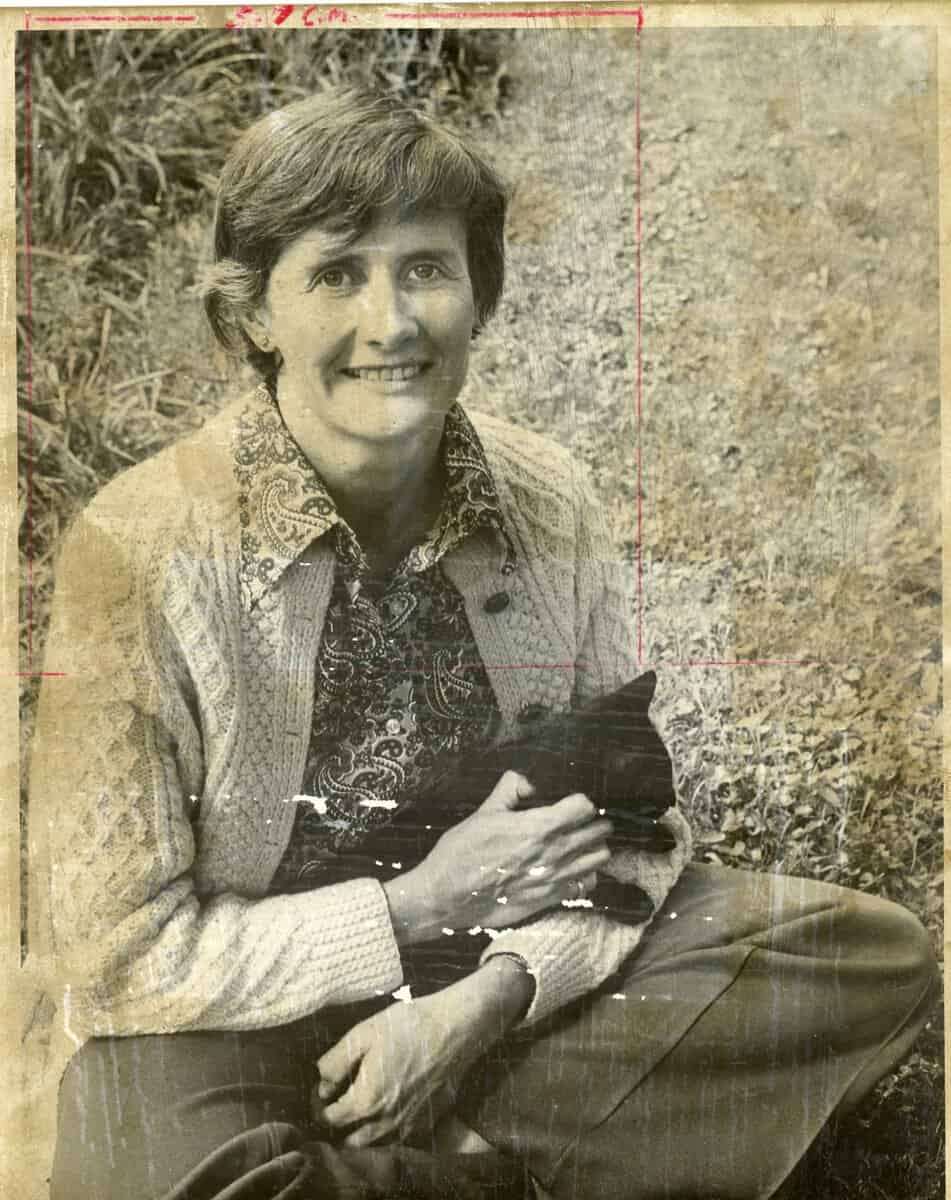
Besides invoking party symbols, politicians also use their pets on the campaign trail to humanize themselves and create a connection with potential voters. Below, former Iowa governor and U.S. Senator Harold Hughes poses with a small kitten, meant to demonstrate his compassion. As an elected official, he advocated for improved treatment of substance abuse disorders and stood against capital punishment.2 On the right, Mary Neuhauser holds a cat in a photograph used in her campaign materials. Neuhauser held a range of positions in local and state government for a political career spanning 25 years.
Harold Hughes campaign material from the Mary Louise Smith papers, Iowa Women’s Archives, University of Iowa Libraries.Mary Neuhauser City Council campaign photograph from the Mary C. Neuhauser papers, Iowa Women’s Archives, University of Iowa Libraries.
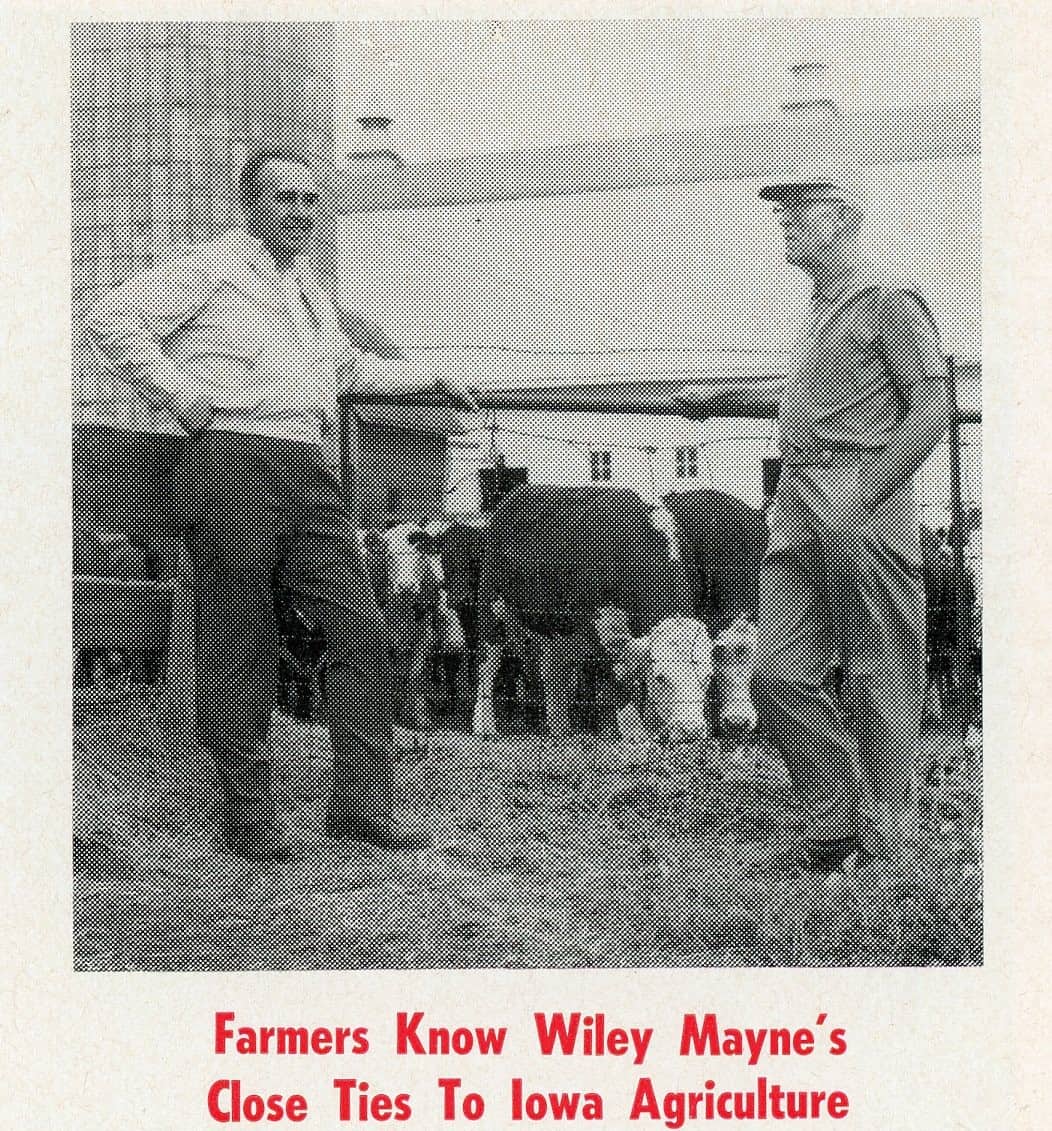
Pets are not the only live animals used in political campaigns. Particularly in Iowa, it is common for livestock to be heavily featured. For example, Wiley Mayne served in the U.S. House of Representatives for eight years, and his campaign materials present him as knowledgeable and focused on Iowa agriculture. Mayne served on the House Agriculture Committee and helped tackle the issues in the cattle market at the time.3
Wiley Mayne campaign pamphlet, 1960. Mary Louise Smith papers, Iowa Women’s Archives, University of Iowa Libraries.
As the 2024 election season approaches, there are sure to be sightings of donkeys, elephants, and more all around. Learn more about animals and politics by stopping into the Iowa Women’s Archives reading room to view the Political Animals exhibit or by liking our Facebook page.
Jimmy Stamp, “Political Animals: Republican Elephants and Democratic Donkeys,” Smithsoninan.com, October 23, 2012.↩︎
Congress.gov. “Harold E. Hughes.” June 25, 2024.↩︎
United States Congress, “MAYNE, Wiley,” accessed June 25, 2024. ↩︎
This post was written by Iowa Women’s Archives Graduate Assistant Beatrice Kearns.
In 1920, riding the excitement of the victorious passage of the 19th amendment, newly minted voters in Iowa (and across the nation) organized as the League of Women Voters (LWV) with a goal of creating a well-informed body of voters. A non-partisan organization, the LWV focuses on voters understanding their power and responsibility in government at all levels. It also emphasizes that for democracy to be for the people, citizens must engage with government at every level. In a 1947 project entitled You are Democracy, the LWV aimed to educate voters on the democratic process.
Forward of “You Are Democracy” from League of Women voters of Iowa records, Iowa Women’s Archives, University of Iowa Libraries.
The booklet followed John Q. Iowa Citizen, who is representative of the average man, through his questions and concerns about politics, voting, government, and legislation. In 1947, America was changing fast. Tensions between the United States and the Union of Soviet Socialist Republics (USSR) were rising, the post-World War II economy was booming, the atomic bomb was fresh in everyone’s mind, and the average citizen had a lot to consider when casting their vote. As all Iowans know, election season is long and in 1947 the build up to the 1948 races was already underway. The LWV intended You are Democracy to help voters navigate this fast-moving and complex election process. Despite being written by the organization, the booklet was not designed for women exclusively, but rather follows a man, emphasizing the desire to connect to all voters across the state. While the LWV had a goal of engaging women with their hard-fought right to vote, they do so by speaking of Mr. John Q. Iowa citizen and his wife, Mrs. John Q. The frustrations and concerns of voters are voiced through Mr. and Mrs. John Q. Iowa Citizen, “My wife says the time and trouble we take to make up our minds whom to vote for sometimes reminds her of putting good frosting on a poor cake. Other times she calls it trying to make bread without yeast”. While an outdated, sexist view on women as voters, You are Democracy offers a look into the time period and shows how the LWV worked to engage with all voters.
Harry Truman photographed by Frank Cancellare, United Press International. Retrieved from Smithsonian Institute National Portrait Gallery
The information in the booklet underlines how voters decide elections, not pollsters or news media, which was perfectly demonstrated during this election cycle. In the lead up to the 1948 presidential election between incumbent Harry Truman and Republican challenger Thomas Dewey, many pollsters and news outlets essentially declared Dewey the winner. The Chicago Tribune even printed and ran papers on election night before votes had been tallied with the headline “Dewey Defeats Truman!” when in reality Truman won the election by a sizable margin. Truman even posed for pictures holding newspapers with headlines stating he had lost after his victory.
The booklet also explains what rights a voter was entitled to in the state of Iowa, such as time off work for voting, assistance at the ballot box, and absentee voting. The detailed but simple explanation of the voting process makes it much more approachable for hesitant potential voters or new voters.
Are Democracy doesn’t just cover voting and the electoral process, but also explains the different levels of government and their functions. As Mr. Q Iowa Citizen puts it, “you have to know the job before you pick the man.” There is a plethora of information about local governments and their duties and responsibilities. It can be complicated to grasp the jurisdictions and roles of county, city, and state governments and this booklet provides a great deal of clarifications.
p. 12 of “You Are Democracy” discussing the voting process
p. 27 of “You Are Democracy describing the executive branch of Iowa state government
Correspondence from the National Association of Manufacturers, 1959
The LWV distributed over 100,000 copies of the booklet by 1964 and it became the model for Leagues in other states. A wide range of organizations and people found You Are Democracy important and useful, from colleges to labor organizations. Many of these organizations wrote to the LWV thanking them for such a wonderful resource. This booklet reached many voters and helped them understand the complexities of electoral politics. This was not a book to leave forgotten on a shelf, but rather a tool to carry around. Only slightly larger than a cell phone, bound simply with two staples, Mr. John Q. Iowa Citizen could come along everywhere.
The LVW of Iowa created a tool of voter engagement that helped thousands of Iowa voters understand their rights and responsibilities as constituents. Their dedication to a body of engaged citizens helps us all remember that as Americans we make the government.
Flyer encouraging voting, League of Women Voters, Iowa records. Iowa Women’s Archives, University of Iowa Libraries.
by Beatrice Kearns, graduate assistant, Iowa Women’s Archives
The University of Iowa Dental Hygiene Program began in 1953 with 24 students and despite being nationally renowned, the female-dominated program did not make it to its 50th anniversary. Until the final graduating class in 1995, the program trained hundreds of hygienists. Students took classes in a wide range of subjects such as pharmacology, anatomy, oral pathology, and community health-based coursework. In the beginning, students earned a certificate from the College of Dentistry (COD) and could choose to complete a BA in the College of Liberal Arts and Science. After 1967, all students earned BAs through the College of Liberal Arts and Sciences and in 1969 a dental hygiene major was approved. Student life of those studying dental hygiene was robust. Student chapters of the American Dental Hygienists Association, honors fraternities, and social clubs kept students busy. Students were expected to be knowledgeable of the anatomy of the head, neck, and mouth. This required the use of unique materials and methods of study. They were expected to identify any given tooth, spot abnormalities, and understand the development of healthy teeth.
Sandy Sonner, Dot Mundy, Helen Newell, Janet Burnham, and Diane Curl. University of Iowa Dental Hygiene Program, Iowa Women’s Archives, University of Iowa Libraries
The program was dominated by female students, as was the profession. When the American Dental Hygiene Association wrote their first bylaws in 1923, they used exclusively female pronouns. However, in 1964, they changed their Constitution to be gender neutral.
The dental program at the University of Iowa has a rich history, it is the first dental department west of the Mississippi river and the sixth oldest in the entire country. Dental hygienists have a long history as well, with the first program being opened in 1913 in Bridgeport, Connecticut. Hygienists focus in narrowly on the cleanliness of the mouth and teeth and preventative care, whereas dentists focus more on repairing damage and other oral health concerns. However, dental hygienists are not associated with the same prestige as dentists.
The program at the University of Iowa emphasized the professionalization of dental hygiene, hosting conferences and engaging in research. Faculty wanted to demonstrate the evolution of a knowledge-based profession, legitimizing dental hygienists as healthcare workers. There was also a strong tie to community service, many courses included outreach and service. The program hosted field trips for local school-aged children and educated them on the importance of oral hygiene. Despite this, hygiene students were often discredited and not taken as seriously as other dental students.
At right: Pins, 1983. University of Iowa Department of Dental Hygiene records, Iowa Women’s Archives, University of Iowa Libraries.
The Experimental Expanded Function study was a controversial look at broadening the tasks of dental hygienists. After learning about anesthesiology, periodontics, and other advanced topics, hygiene students were blindly examined against dental students. Results demonstrated that they performed on comparable levels, showing that hygienists were on par with students getting advanced medical degrees. Dental hygienists were not given the same respect and fought for their recognition. This demonstrates the evolution of the profession, from cleaning and polishing teeth to administering care and advocating for patient wellness.
At left: Dental Hygiene students studying in 1993
The UI Dental Hygiene Program was reviewed and recommended for closure in 1992. This was met with backlash from faculty and students. The university was looking to reduce spending over a four-year period. Three tenured faculty members, Pauline Brine, Elizabeth Pelton, and Nancy Thompson filed a lawsuit claiming that this closure was discriminatory against the woman-dominated program. They also claimed retaliation as faculty had been concerned about treatment and pay discrepancies within COD. The female faculty were routinely called “Mrs./Ms.” instead of “Dr./Professor” like their COD male counterparts. They were called hysterical and referred to as “Pauly’s puppets” referencing Pauline Brine, the department head. Their salaries did not grow at the same rate as faculty in the COD. Students were also treated unfairly. During exams, they were told they were not to answer certain questions despite being enrolled in the same classes with dental students, felt out of the loop of COD communication, and were called “genies” by others within the COD, including by instructors in front of classes.
Instructional skullStudents practicing dental examinationsWax model teeth made by a student
There were several programs brought up as potential for closure; library and information science, undergraduate-level social work, and dental hygiene to name a few. These are all historically dominated by women. In the fall of 2023, the School of Library and Information Science has an 86% female enrollment, undergraduate social work has 89% female enrollment, and the graduate program has 80% enrollment, and these have continued to be female-dominated programs at Iowa.
The university was concerned that female students were not enrolling in traditionally male-dominated programs because of the presence of female-dominated ones. One member of the Board of Regents, Mary Williams, staunchly disagreed with this claim, stating that the reason women weren’t enrolling in programs like medicine, law, and economics were because of “systematic exclusion of women by the gatekeepers”.
The lawsuit was heard in Des Moines, and a judge ruled that the university was not closing the department based on gender bias, but that the University did retaliate against the professors and violate their First Amendment rights. This ruling was appealed and overturned in the 8th U. S. Circuit Court of Appeals. The last class graduated from the program in 1995.
The controversial closure of the Department of Dental Hygiene is representative of a tumultuous time for women at the University of Iowa. Just a few years prior, the university lost a suit to Dr. Jean Jew, a professor in the anatomy department at the College of Medicine about sexual harassment and discrimination. A judge ordered the university to promote Jew, issue her back pay, and create a work environment free of sexual harassment. The Council on the Status of Women created a survey on sexual harassment, asking about experiences and consequences. The results show that many female students and faculty felt frustrated and disheartened by the process of reporting and lack of accountability for harassers.
Sexual Harassment Survey and results, 1993. University of Iowa Council on the Status of Women records, Iowa Women’s Archives, University of Iowa Libraries.
Gender discrimination in academia is an ongoing battle. The UI Department of Dental Hygiene ended in 1995 but gender minority students continue to fight for fair treatment and access in higher education.
Dr. Melissa Ford from Slippery Rock University, studying in the Iowa Women’s Archives
Dr. Ford is a scholar of Black American history and a recipient of the Linda and Richard Kerber Travel Grant, which assists scholars in traveling to Iowa City for their research. Ford’s research focuses on the intersections of race, gender, and class in the social movements of the Midwest. Her most recent book, A Brick and a Bible: Black Women’s Radical Activism in the MidwestDuring the Great Depression won the 2023 Illinois State Historical Society Certificate of Excellence. Building on her previous work, she plans to write a series of short biographies on Black activists entitled Their Examples Will Inspire Us: Five Black Communist Women. Edna Griffin will be one of the five.
Ford also knew of Griffin initially for her boycott of and suit against Katz Drug Store, but she also knew that her political activism went far beyond the boycott and into labor unions, peace activism, and organizations like the Progressive Party, which was the first political party in the United States to nominate a Black woman for Vice President.
Portrait of Edna Griffin from the Edna Griffin papers, Iowa Women’s Archives, University of Iowa Libraries.
Ford says the sources she found in IWA and Special Collections & Archives were “immensely helpful” in contextualizing Griffin within Black Des Moines in the 1950s and the peace activism movement. But her favorite find the Archives was personal. Ford has a connection to Iowa. Her father had been politically active in Des Moines in the 1970s. While reading a newsletter from Griffin’s papers, she spotted the name of an organization he had been in and realized she and Edna Griffin were just a few “degrees of separation” away from each other!
We loved having Dr. Melissa Ford at the Archives and can’t wait to read her fresh and in-depth take on the life of Edna Griffin and four other Black woman activists!
Ezra Temko pictured with image of Johnie Hammond, who inspires his work. Hammond served on the Story County Board of Supervisors, the Iowa House of Representatives, and the Iowa Senate.
Every year, the Linda and Richard Kerber Travel Grant allows researchers from across the country to come to Iowa City and use the Iowa Women’s Archives’ collections. Ezra Temko, is the grant’s first second-time winner. He first visited the IWA in 2018 as a PhD candidate in Sociology from the University of New Hampshire, where his research investigated gender representation in politics. Temko’s interest in Iowa was peaked when he learned that in 2009, it became the only state in the U.S. to require gender balance for state and local boards and commissions. Through personal interviews and his research at IWA, he discovered that the law’s underpinnings went back decades. IWA collections like the Iowa Women’s Political Caucus records and Governor Ray’s Commission on the Status of Women records played a central role in contextualizing his dissertation research. Here, Temko says, he found local stories that he could find nowhere else, like this one that Temko related from A Political Dialogue: Iowa’s Women Legislators Oral Histories:
“[ Joan] Lipsky was president of the Cedar Rapids AAUW. Her local school board was all men, and had a policy of having outgoing board members resign the summer before the elections, with the board appointing someone who could then run as an incumbent, giving them an advantage. They only appointed men, and when they appointed an incompetent man, Lipsky ran against him and lost. She then formed a coalition that put political pressure on the board to appoint a woman in 1958, and subsequently the coalition put pressure on the city council and county board to appoint women to their boards and commissions, something the local governments resisted. (Lipsky later ran for and served in the state legislature.)”
Now five years later, Dr. Ezra Temko is Assistant Professor of Sociology at Southern Illinois University Edwardsville, and he’s extending his dissertation research into a digital humanities project that will place Iowa’s political gender balance history into an online format. Temko wants a timeline that will move beyond the theoretical and transport users into the events and happenings that built up to Iowa’s 2009 law. But while developing the timeline, he found gaps in his original research. To successfully transform his dissertation into an online interactive experience, he needed more detailed stories to hook new researchers, and more images to illustrate them. So, it was back to IWA!
Over a six days of research in the IWA, Temko revisited collections he’d seen in 2018 like the Johnie Hammond papers and spent more time with the papers of politicians like Minnette Doderer and Beverly Hannon who battled sexism inside and outside of the state legislature. Temko found that women confronted the sexism that frustrated their work in different ways. Some leaned into the Iowa legislature’s women’s caucus to find solidarity, others pursued alternate routes. Temko’s favorite archival find from IWA was a picture with little holes from the Beverly A. Hannon papers. Hannon, a senator in the state legislature, had put pins into pictures of other legislators who frustrated her.
Temko’s timeline is not yet available online, but thanks to his week in the Iowa Women’s Archives, he’s feeling optimistic that he’ll soon be unveiling a digital resource that will introduce a new audience to half-century long story of board and commission gender balance in Iowa.