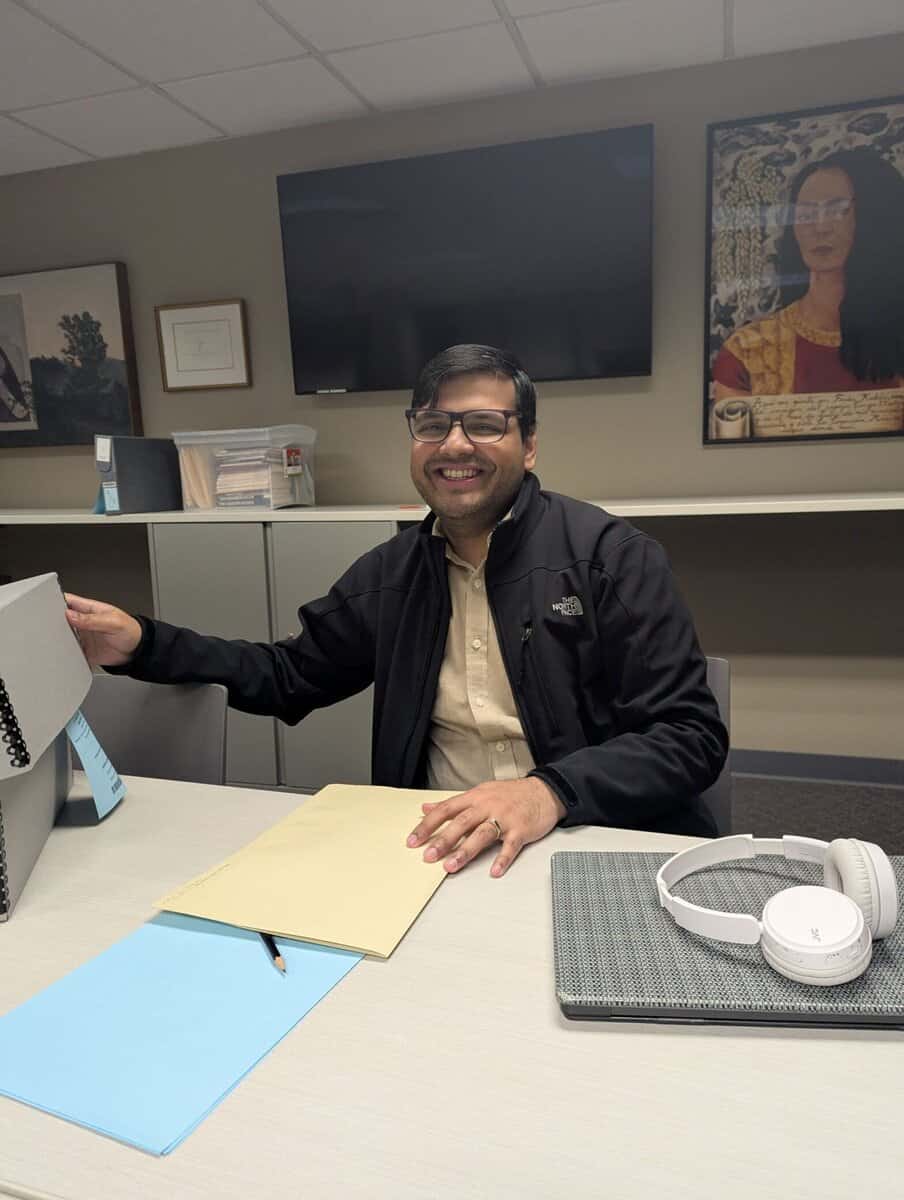
Divyansh Agarwal first learned about Iowa’s place in medicine from his mentor Dr. Carol Scott-Conner, UI professor emeritus, but ultimately Iowa’s rich history would draw him to visit the state. This fall, Dr. Agarwal came to the Iowa Women’s Archives hoping the papers of 19th and early 20th-century doctors would have something to teach him about women and the history of surgery.
Dr. Agarwal is this year’s Kerber Travel Grant recipient, and the first medical doctor to win the award. He studied molecular biology and journalism at Yale and later earned an MD and PhD from the University of Pennsylvania. Dr. Agarwal currently holds a position as chief resident in general surgery at Massachusetts General Hospital. But he still uses his journalism background to “take science and medicine to the public” by writing short articles about medical history based on his archival research.
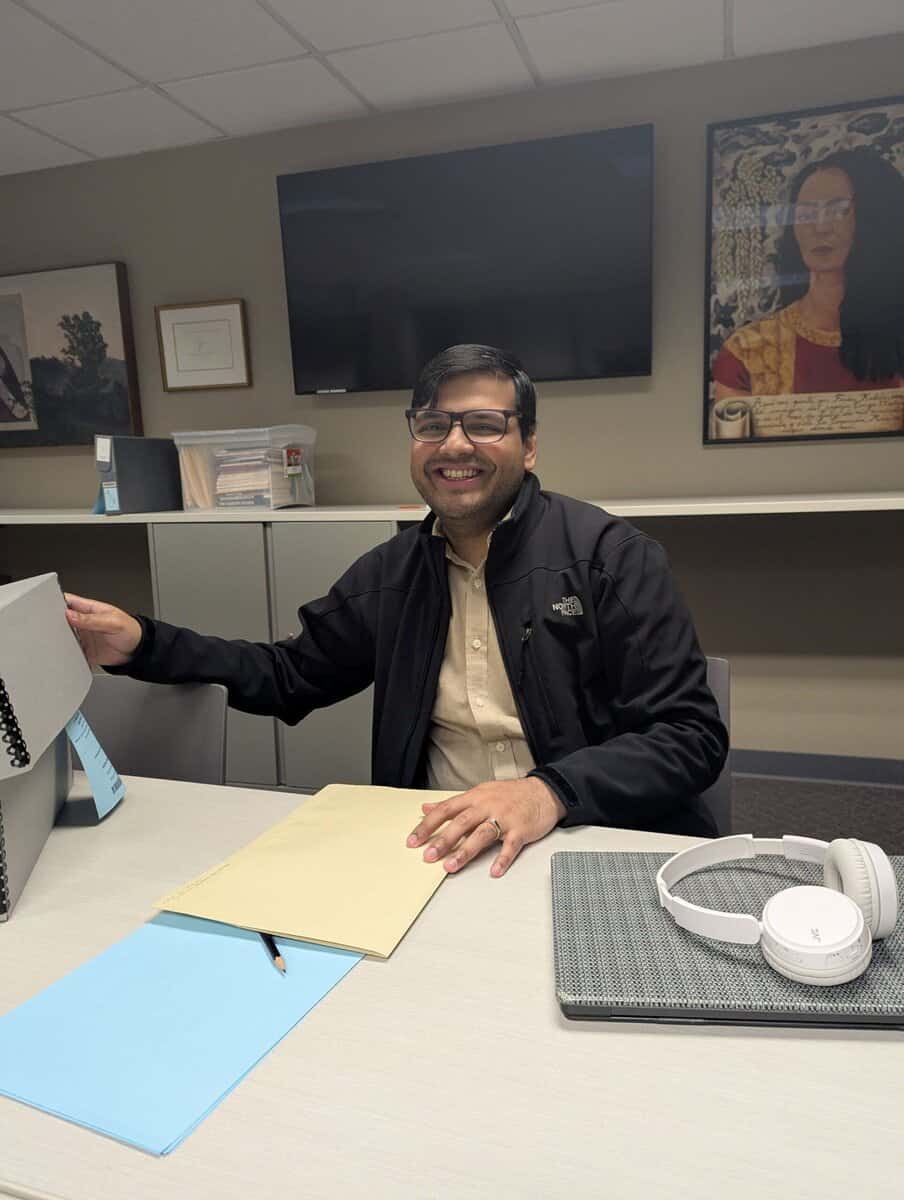
Agarwal’s current project focuses on women doctors in the 19th century who worked across borders and engaged in cross-country exchanges of practices and ideas. The Iowa Women’s Archives had three promising collections: the papers of Adele Fuchs, Myrtle Hinkhouse, and Stella Mason.
Adele Fuchs was born in 1862 to German American parents and traveled back and forth from Germany for much of her life. She studied medicine at the University of Iowa from 1893 to 1897 and practiced medicine in Iowa City until 1905 when she began teaching German in Des Moines. Her unusual career and many travels are referred to in her diaries, although her primary years in medical school and as a practicing doctor are omitted.
Dr. Myrtle Hinkhouse, originally from West Liberty, Iowa, spent most of her medical career in Chinese hospitals, working as a Methodist missionary and doctor from 1916 to 1943. Dr. Agarwal hoped to find primary source evidence of her working conditions and how she and other medical missionaries communicated about their experiences in medical journals and missionary reports scattered throughout the collection.
During his time in the archives, Dr. Agarwal’s most curious finds were surgical instruments in the Stella M. Mason collection. Mason received an MD from Hahnemann Medical College in 1893 and practiced medicine in Mason City, Iowa, until 1943. However, medical artifacts are the main evidence of her decades-long career. Dr. Agarwal says the medical instruments included in her papers are suited for reconstructive and vascular surgery that seem ahead of their time.
Dr. Agarwal is grateful for the Linda and Richard Kerber Travel Fund which made his trip possible. The fund was founded by Professor Emerita of History Linda Kerber and her husband, cardiologist Richard Kerber. Each year it is awarded to a scholar whose work would benefit from an extended visit to the Iowa Women’s Archives and who resides more than 100 miles from Iowa City. Dr. Agarwal said that his time in the archives brought up more questions than answers, but nonetheless he’s confident that the research he’s done here will be featured in his future work as a science communicator. We can’t wait to read all about it!
Are you interested in applying for the Linda and Richard Kerber Travel Fund? We accept applications every year. You can keep tabs on the deadline and learn more on our website.