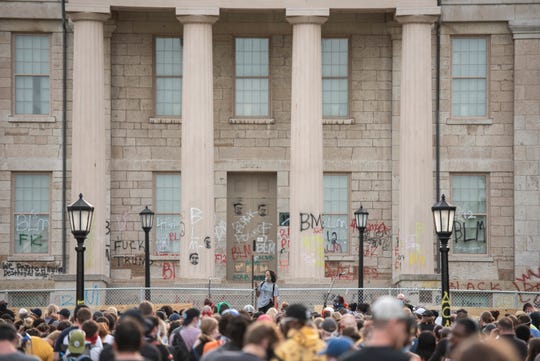
Protesters speak during a rally in front of the Old Capitol as protests for racial justice entered their eighth day in Iowa City on Saturday, June 6, 2020. Photo by Nick Rohlman for The Press Citizen
We’re living in unprecedented times. Protesters are speaking out against the murder of George Floyd, police brutality, and systemic racism. The UI Libraries’ Special Collections plans to pursue a careful approach toward archiving the protests in our community. We recognize potential pitfalls in a white institution rushing to collect materials about marginalized communities of color, problems such as collecting to “check the box” or collections that hurt or mischaracterize communities of color. We also recognize the problems with archival silence. Our efforts will be a three-tiered approach designed to expand authentically and ethically over time:
Gather photos.We are both taking and collecting photographs of graffiti around town and campus. These are photos of protest evidence that do not include people. We are not soliciting photographs of protests or protesters out of concern for protecting their identities.
Listen by reaching out to existing relationships within communities of color.We are working with pre-existing institutional and individual connections through three staff members who have long-established relationships with individuals in our community.
Erik Henderson, a student worker in Iowa Women’s Archives (IWA) and Special Collections, is reaching out to his connections, including campus and community groups.
David McCartney, the UI Libraries’ University Archivist, is reaching out to several connections.
Janet Weaver, assistant curator in IWA is reaching out to LULAC (League of United Latin American Citizens).
Wait for material to come in down the road.This is a tried-and-true measure for us that allows us to expand our collections organically as we build connections with individuals and with organizations over time, not overnight.
The University of Iowa Libraries has awarded 12 grants for Open Educational Resource (OER) projects for the 2020-2021 academic year. OpenHawks is a campuswide grant program that funds faculty efforts to replace current textbooks with OERs for enhanced student success.
The funded OER projects, which were selected through a competitive application process, will benefit students in a wide range of disciplines, including fine arts, English as a second language, neurobiology, political science, foreign languages, communication sciences and disorders, education, communications, and biostatistics.
OER (such as textbooks, videos, assessment tools, lab books, research materials, or interactive course modules) are free for students to use. The 2020-2021 OER projects will save UI students $171,000 in the first year alone. Removing cost barriers to course materials opens student access and positively impacts learning.
The value of OER extends to the wider academic community, since they carry legal permission for open use. The open licenses under which these items are released allow any user at any institution to create, reuse, and redistribute copies of the resources.
OER provide further benefit when faculty fully integrate free resources into their curricula by “remixing” or tailoring materials to enhance specific learning objectives.
Stephanie Dowda DeMer OER creation grant: $4,700 Title: Material Encounters.
Material Encounters is a textbook that will fill significant gaps in the research and presentation of alternative photography processes and theory. It achieves this by bringing together traditionally siloed information regarding process, theory, and interdisciplinary practice into one text to serve student research and faculty pedagogy. The textbook will include interviews with female-identifying and queer artists who innovate alternative processes and use their practices to address social, environmental, or personal issues.
Craig Dresser OER creation grant: $8,200 Title: Elements of Academic Writing
This text will help ESL students understand the purposes of writing assignments and their common component. This approach relies heavily on decision-making, informed by consideration of the context around the assignment. It aims to increase the students’ understanding and efficacy in the ways in which they communicate with their teachers through academic writing. In the end, students should be empowered to take on any manner of writing assignment, confident in their ability to communicate effectively.
Mei-Ling Joiner and Jason Hardie OER creation grant: $8,200 Title: A Centralized Online OER for Introduction to Neurobiology
Joiner and Hardie are developing a neurobiology OER to better align with the course as it is currently taught and to save students significant money on textbook costs. Existing textbooks for this course almost exclusively follow a molecule to whole organism approach, but the course begins with whole organism, then later addresses molecular level mechanisms, which invites the interest of students newly encountering neurobiology.
Courtney Juelich OER creation grant: $3,000 Title: Online Videos for Introduction to American Politics
By developing an online lecture system, students will replace the current $200 textbook with online video lectures and come to class ready to show comprehension and critical thinking through a discussion-based class. Teaching students of all majors about the basis of the United States government’s innerworkings, and the history of its laws is essential for our students’ growth and for our democracy.
Irene Lottini, Lucia Gemmani, Claudia Sartini-Rideout Course redesign grant: $2,000 Title: E-textbook and Workbook for Elementary Italian
The authors are planning to redesign this sequence to better help our students achieve the College of Liberal Arts and Science General Education Program Outcomes and be prepared for programs abroad. The goal is to create an e-textbook and a workbook that will fulfill the two main objectives of redesigned courses: supporting students’ acquisition of the grammar and vocabulary that ensure meaningful communication and enhancing students’ familiarity with Italian culture. This project is co-funded by OTLT.
Stewart McCauley and Jean Gordon Course redesign grant: $2,000 Title: OER Redesign of Basic Neuroscience for Speech and Hearing
The authors will design a textbook that integrates topics in communication disorders with foundational concepts in neuroscience. This can best be achieved by using OER materials from a variety of domains—especially taking advantage of the wealth of freely available online audiovisual case illustrations—to better interweave normal and disordered processes. This project is co-funded by OTLT.
Mark McDermott OER creation grant: $8,200 Title: Developing an OER Toolkit for Science Methods Courses
McDermott will work with former students to develop an Open Educational Resource Toolkit that provides background information about the argument-based pedagogical approach the class explores, tools for planning units based on this pedagogical approach, supplemental resources for supporting science conceptual understanding, and sample activity plans for the experiences engaged in during the courses.
Sylvia Mikucki-Enyart OER creation grant: $8,200 Title: Sexual Communication in Personal Relationships
The primary objective of this project is to create a no-cost, accessible, interactive, and flexible textbook and companion materials (e.g., activities, study guides) that enhance UI students’ theoretical understanding of sexual communication and increase their sexual communication efficacy to engage in sexual communication tasks (e.g., conversations surrounding consent, safe sex practices).
Swahili teaching and learning materials have relied on traditional textbooks, some of which lack listening materials. Listening is one of the most important skills in foreign language teaching and learning. The Swahili Online Course will be a proficiency-based teaching and learning resource for elementary levels and will provide interactive activities based on listening to native speakers of Swahili. Students will have an opportunity to listen and react to the video and audio in different ways, such as speaking, writing, reading, and identifying culture.
Caitlin Ward and Collin Nolte OER creation grant: $6,000 Title: Simulation Based Inference in Introductory Biostatistics
The American Statistical Association (ASA) recommends that introductory statistics education focuses on conceptual understanding, with an emphasis on technology and real data. Statistics education often places priorities on an antiquated view of the former, with symbolic manipulation and contrived examples taking priority over data exploration and statistical thinking, and BIOS:4120 is no different. Both the ASA recommendations and the advances in pedagogical literature on active learning bring to the forefront the need to restructure this course. The authors’ proposal aims to meet this need by developing a new resource, which empowers students to achieve a higher level of understanding through the use of technology and real-world data.
Sang-Seok Yoon and Joung-A Park OER creation grant: $8,200 Title: Developing a Textbook for First Year Korean Course
The objective of developing this resource is to make students’ learning experience more active, fun and challenging, and to reduce students’ financial burden of purchasing the textbook used in First Year Korean: First Semester. This textbook is an essential part of the class for self-study in addition to attending lectures and doing exercises in the class.
Giovanni Zimotti and Alexis Jimenez Candia OER creation grant: $8,200 Title: Intermediate Spanish II: Spanish for Healthcare
The Department of Spanish and Portuguese is undertaking efforts to redesign the GE CLAS Core sequence of Spanish. The aim is to modernize the curriculum offered to meet the needs of 21st century students and to better prepare them in their future careers. As part of this redesign, it is paramount to develop materials that are meaningful for the specific type of students that will be taking this course. Unfortunately, the commercially available textbook we currently use is very expensive for students and outdated. This project aims to create an OER textbook that is personalized to the educational needs of the students of Spanish Intermediate II: Spanish for Healthcare.
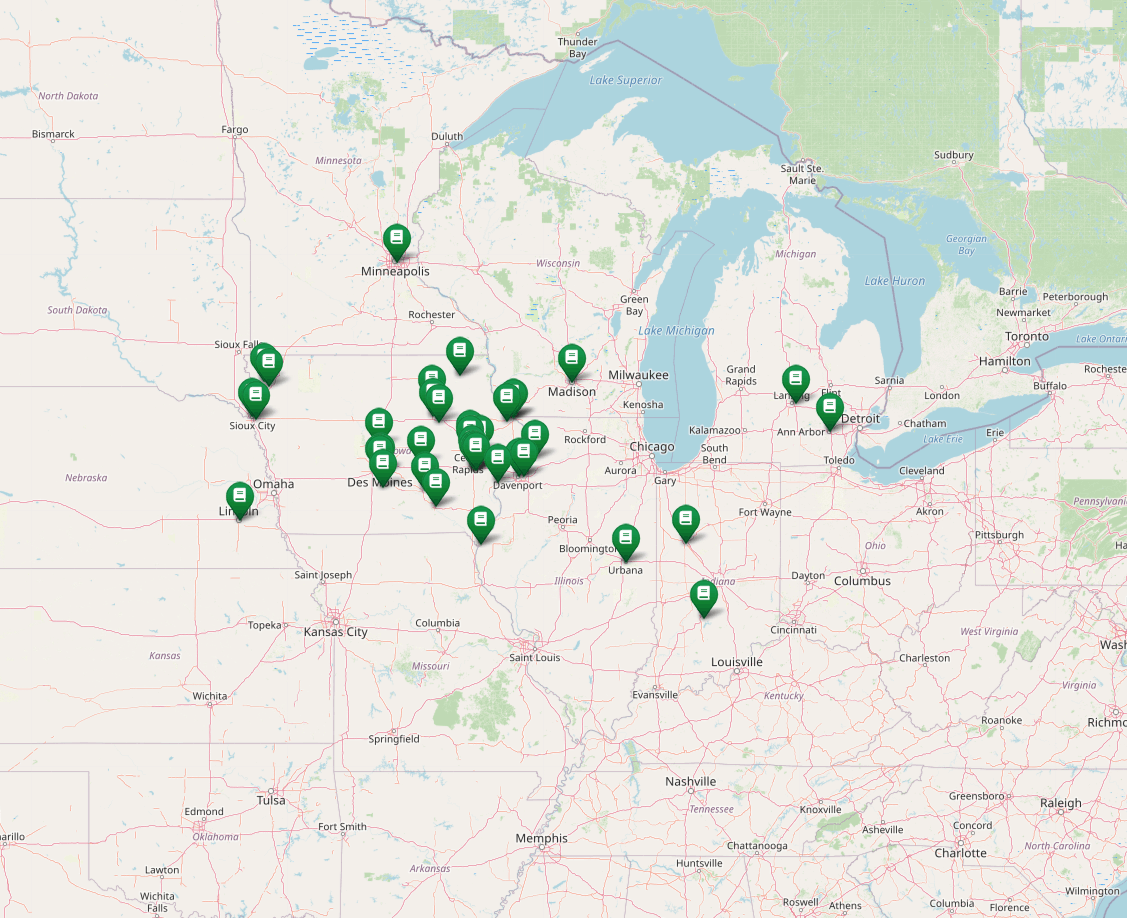
University of Iowa Libraries’ regional book return map. Find a location near you to return your UI Libraries books and DVDs. The UI Libraries plans to continue this service while it’s needed.
University of Iowa students can return items to the UI Libraries from afar by dropping off items at one of 47 participating libraries across the state and region. See a map of these locations or the list of locations at the end of this article.
The UI Libraries has spearheaded this special service to help students living far from campus due to the pandemic. With the aid of partnering public and academic libraries, the UI Libraries will continue to offer this service while it’s needed.
This network of libraries is participating in an unprecedented cooperative project to assist library users who are sheltering far from the library from which they borrowed items. Each library in this network will accept items from the other participating libraries and return those items at no cost to the borrower.
Students who have University of Iowa library books to return can check the UI Libraries’ book return map for drop-off locations in the state and region. Students without access to a drop-off library and those living further than 30 miles from Iowa City can requesta UPS shipping label.
Students living near campus are encouraged to return books at the Main Library drop box (125 W. Washington Street, return slots available at both the south and north entrances) or the Hardin Library drop box (600 Newton Road, next to the entrance that faces University of Iowa Hospital and Clinics). Students with tools or electronic equipment should schedule a drop off to ensure the security and safety of the items.
Art Library: Please use the library drop box.
Business Library: Please use the drop box for books and DVDs. Please return non-book items to the service desk or schedule a time by emailing lib-bus@uiowa.edu
Engineering Library: Please use the drop box for books and DVDs. Please return non-book items to the service desk.
Hardin Library: Please use the drop box for books and DVDs. Please return non-book items to the service desk.
Main Library: Please use the drop box for books and DVDs. Please return non-book items to the service desk.
Music Library: Please use the hallway book drop on the first floor of the Voxman Music Building.
Sciences Library: Please return items to the service desk.
Before returning library items, please observe the following safe-handling practices:
Do not clean, disinfect, or microwave library materials before returning them. For example, do not use water, Lysol, or any other cleaner on materials.
If you or your family members are sick or have been sick, seal materials in a zip-lock style bag if possible before returning.
Wash your hands or use hand sanitizer before handling library materials for return and again after you have completed the return.
List of locations for materials return
Iowa State University Parks Library, 701 Morrill Road, Ames, IA
DMACC Ankeny campus Library Bldg 6, 2006 S. Ankeny Blvd, Ankeny, IA
Scott Community College Library, 500 Belmont Rd, Bettendorf, IA
DMACC Boone campus Library, 1125 Hancock Drive, Boone, IA
Northeast Iowa Community College Library Student Center, 1625 Hwy 150 S., Calmar, IA
DMACC Carroll campus Library, 906 North Grant Rd., Carroll, IA
University of Northern Iowa Rod Library, 1227 W 27th Street, Cedar Falls, IA
Mount Mercy University Busse Library, 1330 Elmhurst Drive NE, Cedar Rapids, IA
Kirkwood Community College Library Benton Hall, 6301 Kirkwood Blvd. SW, Cedar Rapids, IA
Clinton Community College Library, 1000 Lincoln Blvd, Clinton, IA
Coralville Public Library, 1401 5th Street, Coralville, IA
Southwestern Community College Library, 1501 W. Townline Street, Creston, IA
Saint Ambrose University Library, 518 W. Locust Street, Davenport, IA
DMACC Urban/Des Moines campus Library Bldg 1, 1100 7th Street, Des Moines, IA
Drake University Cowles Library, 2725 University Avenue, Des Moines, IA
Grand View University Library, 1350 Morton Avenue, Des Moines, IA
Mercy College of Health Sciences Library Sullivan Center, 928 6th Avenue, Des Moines, IA
Loras College Library, 1450 Alta Vista, Dubuque, IA
University of Dubuque Charles C. Myers Library, 2195 Grace Street, Dubuque, IA
Grinnell College Library, 1111 6th Ave, Grinnell, IA
Simpson College Dunn Library, 508 N C Street, Indianola, IA
Kirkwood Community College Library, 1816 Lower Muscatine Rd, Iowa City, IA
Iowa City Public Library, Iowa City, IA
University of Iowa Hardin Library, 600 Newtown Road, Iowa City, IA
University of Iowa Main Library, 125 W. Washington Street, Iowa City, IA
Southeastern Community College Fred Karre Memorial Library, 335 Messenger Rd, Keokuk, IA
Cornell College Cole Library, 320 3rd Street SW, Mount Vernon, IA
Muscatine Community College Library, 152 Colorado Street, Muscatine, IA
North Liberty Public Library, 520 W. Cherry Street, North Liberty, IA
Northwestern College DeWitt Library, 101 7th Street SW, Orange City, IA
William Penn University Wilcox Library, 201 Trueblood Avenue, Oskaloosa, IA
Indian Hills Community College Library, 525 Grandview Avenue, Ottumwa, IA
Northeast Iowa Community College Library, 8342 NICC Drive, Peosta, IA
Dordt University Hulst Library, 700 7th Street NE, Sioux Center, IA
Briar Cliff University Bishop Mueller Library, 3303 Rebecca Street, Sioux City, IA
Morningside College Library, 1501 Morningside Avenue, Sioux City, IA
Hawkeye Community College Library Main Campus, 1501 East Orange Road, Waterloo, IA
Wartburg College Vogel Library, 100 Wartburg Blvd, Waverly, IA
University of Illinois Main Library, 1408 W Gregory Drive, Urbana, IL
Indiana University Wells Library, 1320 E. Tenth Street, Bloomington, IN
Purdue University Library, West State Street, West Lafayette, IN
University of Michigan Hatcher Graduate Library, 913 S. University Avenue, Ann Arbor, MI
Michigan State University Main Library, 366 W. Circle Drive, East Lansing, MI
University of Minnesota Wilson Library, 309 19th Avenue S, Minneapolis, MN
University of Nebraska Love Library, 13th & R Street, Lincoln, NE
University of Wisconsin Memorial Library, 728 State Street, Madison, WI
Effective immediately and until normal access to physical collections resumes, students, faculty, and staff at the University of Iowa have online access to a large portion of the University Libraries’ print collection—volumes that would have been difficult to access from library facilities that are closed due to COVID-19.
Reading access todigitized copies of print volumes has been granted to the UI by HathiTrust, a not-for-profit, collaborative digital library that holds over 17 million volumes digitized from academic and research libraries. The UI Libraries,in collaboration with the Big Ten Academic Alliance, is a founding member of HathiTrust.
This means that any books available through HathiTrust that are also in the UI Libraries’ collections will be available online without the additional step of requesting a digital scan. HathiTrust’s online collection containsnearly half of the UI Libraries’ book collection for an additional 1.6 million volumes now available online for our campus community.
To take advantage of this resource:
Visit HathiTrust and click the yellow “LOG IN” button.
Select “University of Iowa” and log with your HawkID.
Use the site to locate the item you wish to view.
Click on theTemporary Accesslink at the bottom of the record to check out the item through the Emergency Temporary Access Service.
You will have 60 minutes of access to the book during any session. If you remain active in the book during any session, access time will be extended.
Please note that it is not possible to download books from HathiTrust. This is to protect authors’ rights.
HathiTrust has provided detailed instructions, including how to use the service on a phone or tablet.
For help with access to these and other digital resources at the UI Libraries, please contact us.
Although the campus libraries are closed in response to the COVID-19 pandemic, the staff of the Scholarly Impact Department are working remotely to assist UI faculty, staff, and students. Extensive resources and information about our services is always available at our website: https://www.lib.uiowa.edu/scholarly-impact/. We offer virtual one-on-one consultations and group training sessions upon request. Contact us today at lib-impact@uiowa.edu for scheduling!
If you need assistance with Scholarly Communication issues, such as:
The Libraries are happy to announce our second round of OpenHawks funding, available to any faculty member or graduate student who is interested in using or developing Open Educational Resources (OER) for a UI course. If you are concerned about the cost or quality of your existing textbooks and would like to explore OER, this might be the nudge you need!
We’re offering a range of awards, depending on the type of project you’d like to complete.
Award Type
Award Range
Requirements
Adoption
$500-$1,000
Use an existing open textbook for a course with no editing and minimal course adaptation required.
Remixing
$750-$2,000
Adapt, update, combine, or improve existing OER to replace a currently used textbook. Use of library-licensed materials may also be considered.
Support Materials
$1,000-$3,000
Develop test bank questions, teaching support materials, quizzes, interactive learning aids, or other support materials for existing OER.
Course Redesign
Up to $5,000
Redesign a course around the use of OER.
OER Creation
Up to $10,000
Create an original Open Educational Resource to be used in a course and shared under an open license.
To find out more, visit the OpenHawks website. Here, you’ll find the Call for Proposals, as well as general information about OER, training materials, and more. Applications are due on April 24, 2020.
OpenHawks is a program funded by the Provost’s Innovation Fund (PIF) and UI Student Government.
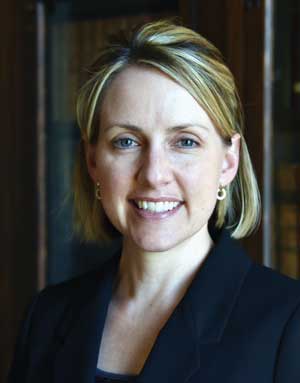
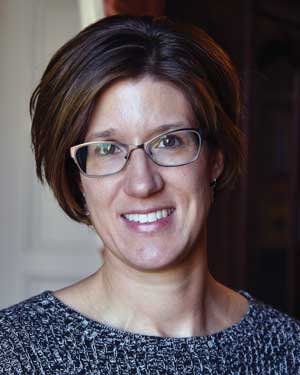
By clinical education librarians at UI Libraries’ Hardin Library for the Health Sciences Jennifer DeBerg and Heather Healy
Since 2011, Hardin Library for the Health Sciences has provided a systematic review service to support research across the health sciences. Systematic reviews, a critical component of evidence-based clinical practice, follow a specific research methodology that attempts to identify, select, assess, and synthesize all the studies related to a specific question to guide decision making. Related review types include meta-analyses and meta-syntheses. All these review types need to follow a process that minimizes bias to ensure the results are valid.
Heather Healy
ROLES FOR LIBRARIANS
Unfortunately, not all systematic reviews are conducted using a bias-minimizing methodology, which can have significant implications for decision making in healthcare. Several efforts have focused on improving the quality of systematic reviews that are developed and published.
Published in 2009, PRISMA—Preferred Reporting Items in Systematic Reviews and Meta-Analysis—is a framework of reporting standards that addresses problems observed in methodology quality. Parts of the standards relate to conducting rigorous and systematic searches of the literature to locate the relevant studies and to reporting specific details of the searching process. Two important elements of the framework are the PRISMA flow diagram and the PRISMA checklist.
In 2011, the Health and Medicine Division (formerly the Institute of Medicine) of the National Academies of Science, Engineering, and Medicine in the report Finding What Works in Health Care: Standards for Systematic Reviews states that a librarian or other information professional should be included in developing the systematic review search plan. Additionally, a 2014 article by Rethlefsen, Murad, and Livingston from the Journal of the American Medical Association indicates that gaining assistance from librarians helps ensure thoroughness and reproducibility.
The primary role for health sciences librarians is to help develop and conduct highly sensitive bibliographic database search strategies that capture all the published evidence related to the research question. Hardin librarians have each attended formal systematic review training to learn the specialized literature searching process.
The training also covers the methodology for the whole review, as well as the reporting standards for reviews. Other roles librarians play can include
Jennifer DeBerg
project manager, reference manager, reference screener, consultant for the team, and others.
The roles Hardin librarians play varies based on what the researchers need and may range from something simple, such as training the researchers how to manage records in EndNote, a citation management tool, or a thorough review of already-completed search strategies. More often, however, researchers request the most complete service, which may include all or a combination of the following: assistance with the development of the review protocol (the research plan); deciding which bibliographic databases to search; design of bibliographic database search strategies (including identifying and testing potential search terms); removing duplicates from the search results; finding missing abstracts; accessing full text of articles from the search results; and writing the search methods for reporting in the article or other end product. Sometimes, researchers request help with searching for grey or non-traditionally published literature, another part of review methodology that helps minimize bias.
Systematic reviews that demand the most extensive level of service require between 20 and 100 hours of librarian time. The total amount of time depends on many variables, such as the organization and communication of the research team, the nature of the topic, the number of databases to be searched, particularities of the databases, including subject heading availability and the quality of the indexed records. When this level of service is provided librarians request co-authorship on the resulting article because this level of contribution meets the standards for authorship recommended by the International Committee of Medical Journal Editors. When lesser but still substantial assistance has been provided, librarians may request a formal acknowledgment rather than co-authorship.
Not all requests for assistance result in a published systematic review. In consultation with librarians, some researchers discover their project idea is not a good fit for the systematic review methodology, and so their project takes another direction. Systematic reviews require significant time and work, frequently taking a year or more to complete. In some cases, projects may be started but not completed due to the researchers’ time constraints, inability to secure a project team, lack of methodological expertise, or other reasons. Some projects are completed but are reported at conferences with no intent to publish the results as an article.
GROWTH OF THIS SERVICE
Between 2011 and 2016, the small team of Hardin librarians initiating and developing the service created a two-part workshop to help train faculty, staff, and students about developing search strategies for systematic reviews. They also developed a hard copy intake form and created an online guide that allow researchers to request assistance and to provide resources to help with their process. In this timeframe, the service received about 25 requests for assistance.
In 2016, several new staff joined the team and helped make important improvements to the service, including a redesign of the online guide (see link at the bottom of page 23) development of an online intake form and other documents needed to support workflow, implementation of an improved file structure for organizing projects, revisions to workshop materials, and regular meetings to discuss service changes and ongoing learning opportunities in this specialty area. Since these changes were enacted in early 2017, the service has received 109 requests for support from researchers. The total for the full duration of the service is approximately 170 requests for assistance.
Recently published systematic reviews have been completed with support from Hardin librarians, including Chris Childs, Jen DeBerg, Janna Lawrence, and Heather Healy. Reviews cover a wide range of research topics and appear journals such as World Journal of Gastroenterology, The Journal of Arthroplasty, Clinical Infectious Diseases, and Journal of General Internal Medicine.
ASSESSING THE SERVICE
For the past few years, a team at Hardin has worked to assess the impact of the systematic review service on reviews authored by health sciences faculty at the UI. Hardin librarians have co-authored or been formally acknowledged in 50 published systematic reviews.
The team has also examined whether the systematic reviews authored by UI health sciences faculty (whether they included a librarian or not) met standards detailed by the PRISMA checklist. The team found that approximately 75% of reviews include the PRISMA flow diagram, an important signifier of the quality of the review process. The inclusion of this diagram, however, does not reflect the quality of the literature search. The team’s findings indicate that measures of the inclusion of a replicable search strategy, which provides transparency for the search process, are around 40% and inclusion of both subject heading and keywords in the search strategies, a signifier of search comprehensiveness, are around 30%.
Hardin librarians are continuing to discuss how to improve the reach of the systematic review service in sustainable ways that might include further development of general training workshops or redesign of the online guide to help increase awareness of systematic review standards among faculty. The librarian team is small and expanding the service to increase the amount of direct involvement of librarians in systematic reviews is not feasible currently. Furthermore, increased awareness and use of the standards relies not only efforts by librarians and researchers but also on the awareness of the standards by journal editors and journal peer reviewers.
The assessment team is analyzing which departments publish systematic reviews most often and which are most likely to benefit from assistance. Hardin librarians are hopeful that as they extend education to those who need it most, they can continue to positively influence the quality of the methodology for systematic reviews in the health sciences.
The following list provides a sampling of recently published systematic reviews that were completed with support from HLHS librarians, including Chris Childs, Jen DeBerg, Janna Lawrence, and Heather Healy:
Ashat, M., Arora, S., Klair, J. S., Childs, C. A., Murali, A. R., & Johlin, F. C. (2019). Bilateral vs unilateral placement of metal stents for inoperable high-grade hilar biliary strictures: A systemic review and meta-analysis. World Journal of Gastroenterology, 25(34), 5210–5219. https://doi.org/10.3748/wjg.v25.i34.5210
Bedard, N. A., DeMik, D. E., Owens, J. M., Glass, N. A., DeBerg, J., & Callaghan, J. J. (2019). Tobacco use and risk of wound complications and periprosthetic joint infection: A systematic review and meta-analysis of primary total joint arthroplasty procedures. The Journal of Arthroplasty, 34(2), 385–396.e4. https://doi.org/10.1016/j.arth.2018.09.089
Puig-Asensio, M., Braun, B. I., Seaman, A. T., Chitavi, S., Rasinski, K. A., Nair, R., Perencevich, E. N., Lawrence, J. C., Hartley, M., & Schweizer, M. L. (2019). Perceived benefits and challenges of Ebola preparation among hospitals in developed countries: A systematic literature review. Clinical Infectious Diseases. Advance online publication. https://doi.org/10.1093/cid/ciz757
Seaman, A. T., Steffen, M., Doo, T., Healy, H. S., & Solimeo, S. L. (2018). Metasynthesis of patient attitudes toward bone densitometry. Journal of General Internal Medicine, 33(10), 1796–1804. https://doi.org/10.1007/s11606-018-4587-3
Good data management and curation practices will make it easier for you to preserve and share your data.
Graduate students are often responsible for many of the data management tasks associated with their research, and these practices may be new to them. These changing expectations and requirements may also be unfamiliar to faculty and staff. In order to assist with these tasks, the libraries provides instruction, consultations, and infrastructure to help researchers across the university with data management and curation.
In Spring 2020, we will be offering a 1-credit course on research data management.
This course is intended to build knowledge and expertise in essential best practices that students can immediately apply in their own research settings. We’ll focus on active-learning, with readings and discussion-based explorations of how to apply good data management to planning, active research, and preserving and sharing data.
The course is appropriate for any researcher who deals with quantitative data. We hope to see you there!
Course Title: Managing Data to Facilitate Your Research
Time and Location: 9:30 am – 10:20 am, Mondays, in 1100 UCC
From the left: Jenay Solomon, librarian in the UI Libraries’ Undergraduate Engagement Department; Undergraduate Library Research Award winner Allexix Mahanna; John Culshaw, Jack B. King University Librarian
Allexis Mahanna, a UI senior majoring in global health studies, won the inaugural Undergraduate Library Research Award (ULRA) offered by the University of Iowa Libraries. Mahanna was selected from a competitive pool of undergraduate researchers who applied for the award and presented their work at the University of Iowa’s Fall Undergraduate Research Festival held November 13, 2019.
Mahanna’s research focuses on the differences in migration policies between the autonomous community of Catalonia and the local municipality of Barcelona, Spain. She evaluated the local migration policies of Barcelona through a case study framework analyzing country-wide policies and community perceptions of migrants.
Her research integrated library resources—including databases such as Web of Science, SAGE research methods, and services in SEAM—with specialized instruction on coding methods from SEAM Graduate Student Megan Dial-Lapcewich. Mahanna also met with librarians Brett Cloyd and Cathy Cranston and sought poster design assistance from Nikki White in the Libraries’ Digital Scholarship & Publishing Studio in preparation for presenting at the Fall Undergraduate Research Festival.
The Undergraduate Library Research Award was established this year by Jenay Solomon, librarian in the UI Libraries’ Undergraduate Engagement Department, who collaborated with Bob Kirby and Melinda Licht of the Iowa Center for Undergraduate Research (ICRU) to integrate the new award into the Fall Undergraduate Research Festival.
The award carries a $500 prize, which is funded by the Friends of the University of Iowa Libraries. The Libraries will offer the award again at the UI’s Spring Undergraduate Research Festival. The award is open to any undergraduate student in any year or discipline who demonstrates creative or innovative research skills in the selection, integration, and synthesis of resources, services, and materials from the UI Libraries.
Special thanks to UI librarians who served on the Fall 2019 ULRA review committee: Conrad Bendixen (from the Sciences Library and Main Library Liaison Services in Humanities and Social Sciences) and Kelly Hangauer (from Main Library Liaison Services in Humanities and Social Sciences), Heather Healy (from the Hardin Library for the Health Sciences), and Laurie Neuerburg (from the Sciences Library). Committee members helped create an assessment rubric for evaluating applicants and assisted in selecting this semester’s winner.