John Culshaw, Jack B. King University Librarian at the University of Iowa Libraries
John Culshaw, the Jack B. King University Librarian at the University of Iowa, has been elected to serve as incoming vice president/president-elect for the Association of Research Libraries (ARL). Culshaw will become ARL president on October 7, 2020.
The Association of Research Libraries (ARL) is a nonprofit organization of 124 research libraries in Canada and the US whose mission is to advance research, learning, and scholarly communication. The Association fosters the open exchange of ideas and expertise, promotes equity and diversity, and pursues advocacy and public policy efforts that reflect the values of the library, scholarly, and higher education communities. ARL forges partnerships and catalyzes the collective efforts of research libraries to enable knowledge creation and to achieve enduring and barrier-free access to information.
“John’s leadership, both on campus and with national organizations, emphasizes collaborative efforts, empowering our librarians and scholars to work together to find and share research in ways that build pathways to new knowledge,” says Montserrat Fuentes, UI executive vice president and provost.
Culshaw has served as the university librarian at Iowa since 2013, leading the UI Libraries in providing information services, collections, and spaces to the university community and beyond. In addition to his campus duties, he has served in leadership roles with the HathiTrust Digital Library and Association of College and Research Libraries. Culshaw has played an active role with the Big Ten Academic Alliance Library Initiatives, which recently announced the BIG Collection, an effort to create collaborative processes for building a networked collective collection to benefit Big Ten scholars.
With his direction and support, UI Libraries staff garnered a grant to become the National Network of Libraries of Medicine Greater Midwest Regional Office; strengthened partnerships with the UI’s Center for the Book and the Iowa City UNESCO City of Literature; merged the Studio, a collaborative incubator for digital scholarship and publishing, into Libraries operations; and brought important new research collections to Iowa including the Sackner Archive of Concrete and Visual Poetry. In 2018, Culshaw was invested as the first Jack B. King University Librarian Chair.
Culshaw received a BA in history from the University of Wisconsin-Parkside and holds an MS in information studies from Drexel University. He received UW-Parkside’s Traditions of Excellence Distinguished Alumni Award in 2015. Prior to Iowa, he held positions at the University of Colorado Boulder.
The Ithaka S+R University of Iowa Faculty Survey on Library services and space will help the Libraries evaluate faculty use of our facilities, resources and services.
All UI faculty are invited to participate in an important study designed to inform the University of Iowa Libraries’ strategic decision-making as it moves forward with plans to engage campus, provide resources and services, and renovate the Hardin and Main Libraries. The study, conducted by Ithaka S+R on behalf of the University Libraries, asks faculty about their perspectives on the Libraries’ resources, services, and spaces. The survey is completely anonymous, and the results will be reported only in the aggregate.
Faculty members will have received a link to the survey in an email from Ithaka S+R. During the week of November 18, 2019, faculty will receive another link to the survey in a second email.
Q: Why is the University of Iowa Libraries participating in this survey?
A: This survey is designed to inform the University of Iowa Libraries’ strategic decision-making as we move forward with plans to engage campus, provide resources and services, and renovate the Hardin and Main Libraries.
Q: What kinds of questions will be on the survey?
A: The survey will ask faculty their perspectives on a range of topics, including how you engage with and perceive the Libraries’ resources, services, and current spaces, as well as how we can best meet your current and future needs by altering the Libraries’ infrastructure. The survey is completely anonymous, and the results will only be reported in the aggregate.
Q: What will be the impact of the survey?
A: The survey will help shape the future of the University of Iowa Libraries’ resources, services, and spaces, including but not limited to the renovation of the Hardin and Main Libraries. Additionally, The University Libraries will donate $2 per completed survey to ComUnity Crisis Services and Food Bank. Your participation will help support community members in need.
Q: Who designed the survey?
A: Ithaka S+R designed the survey. Ithaka S+R is a research consulting service that helps academic, cultural, and publishing organizations consider how to shift their policies, services, and holdings to meet the needs of the digital future. Ithaka S+R is a part of ITHAKA, a not-for-profit organization that also includes JSTOR and Portico. Their survey was reviewed by the University of Iowa’s Institutional Review Board (IRB) and given exempt status.
Q: Will a summary of the survey’s findings be shared publicly?
A: Yes.
Q: How long does the survey take to complete?
A: 15-30 minutes.
Q: Is the survey compatible with mobile devices?
A: Yes. The survey is responsive to device type. Our survey platform can detect respondents’ devices and automatically adjust the questionnaire and questions into an appropriate format.
Q: Can participants stop and later continue their survey from the same point?
A: Respondents will be able to save their responses and continue later by clicking on their individualized link, even if they close their browser, use a different browser, or use a different device.
Q: Can participants back up and change their responses?
A: No. Because the survey may branch based on participants’ responses, allowing respondents to back up and change their responses will confuse the survey software.
Q: Is the survey accessible to respondents using screen savers or other Accessibility technology, such as JAWS?
A: Yes. The survey questions we use in our platform have been tested for compliance with the accessibility standards contained in Section 508 of the Rehabilitation Act of 1973, and are compatible with screen readers and similar software.
Q: Who should I contact if I have additional questions?
A: Please contact Linda Walton, Associate University Librarian, at linda-walton@uiowa.edu.
The University Libraries is seeking nominations for the Arthur Benton University Librarian’s Award for Excellence. Funded by a generous endowment, this prestigious award acknowledges a library staff member’s professional contributions in the practice of librarianship, service to the profession, scholarship, or leadership which has had a significant impact or innovation to the operations of the Libraries or the University of Iowa.
The $1,500 award may be used to support professional development activity expenses for conferences or workshops in support of research projects and publications related to services, or it may be taken as a cash award. Any member of the University of Iowa community may make a nomination, or self-nominations are also accepted. The nomination form is available at: http://www.lib.uiowa.edu/admin/bentonaward/ . The due date is Wednesday, October 30.
OpenHawks is a campus-wide grant program that funds faculty efforts to replace their current textbooks with OERs for enhanced student success.
Students will benefit from Open Educational Resource (OER) projects
The University of Iowa Libraries has awarded fifteen grants to eighteen faculty for Open Educational Resource (OER) projects for the 2019-2020 academic year. OpenHawks is a campus-wide grant program that funds faculty efforts to replace their current textbooks with OERs for enhanced student success.
OpenHawks is one of five innovative, interdisciplinary initiatives funded by the annual Provost Investment Fund (PIF) from the UI Office of the Provost. The PIF will provide OpenHawks projects with funds totaling $87,288 for AY 2020. The funded OER projects, which were selected through a competitive application process, will benefit students in the College of Education, College of Liberal Arts and Sciences, College of Medicine, and Tippie College of Business.
OER (such as textbooks, videos, assessment tools, lab books, research materials or interactive course modules) are free for students and carry legal permission for open use. The open licenses under which these items are released allow users to create, reuse, and redistribute copies of the resources.
Removing cost barriers to course materials opens student access and positively impacts learning. OER provide further benefit when faculty fully integrate free resources into their curricula by “remixing” or tailoring materials to enhance specific learning objectives.
The next call for proposals will be in the spring of 2020. For more information, visit www.lib.uiowa.edu/openhawks
Mercedes Bern-Klug, faculty in the School of Social Work in the College of Liberal Arts and Sciences, has been awarded $7,000. For this project, Dr. Bern-Klug will create an OER textbook on global aging. By replacing the textbook with up-to-date readings and resources from different sources, Bern-Klug ensures students will learn the material from organizations and authors with a track record of producing high-quality materials germane to global aging.
Stephen Cummings, faculty in the School of Social Work in the College of Liberal Arts and Sciences, has been awarded $1,400 for Human Behavior in the Social Environment. Cummings will develop an OER textbook on human behavior in social settings for an online, graduate-level course in Social Work. Students will benefit from the vibrant content of this textbook, reflecting current events and engagement for a more dynamic learning environment. The OER resource is projected to save students money, as it will replace a $55 textbook.
Hannah Givler, lecturer in the School of Art and Art History in the College of Liberal Arts and Sciences, has been awarded $9,000 for Woodworking: Theory and Practice in Studio Arts. Givier will create an OER textbook that combines theory and practice, illuminating the material behaviors of wood. The resource will include foundational and experimental techniques for bending, joining, and framing. The textbook will be used by students in her wood-bending and wood-joinery courses in the School of Art and Art History. It will provide students with the narratives and experiences of contemporary artists working conceptually with wood materials—a perspective missing from currently available textbook resources.
Julia Kleinschmit, faculty in the School of Social Work in the College of Liberal Arts and Sciences, has been awarded $1,300 for her OER project, Computer Lab: statistics with less pain – in your wallet. Students taking a required one-semester-hour statistics course will benefit from this resource. Kleinschmit will remix existing OER resources to replace existing textbooks and eliminate expensive software purchases, saving students nearly $150 each.
Mouna Maalouf, lecturer in Chemistry in the College of Liberal Arts and Sciences, has been awarded $4,000 for Principles of Chemistry II—Lab Manual in pressbook. The goal of this project is to create an OER lab manual for the freshman chemistry laboratory, replacing lab manuals from publishers that range in cost from $10 to $40. The born-digital lab manual will be easier for students to access and navigate. In addition, the digital resource will be easier for the instructor to update frequently.
Kate Magsamen-Conrad, faculty in Communication Studies in the College of Liberal Arts and Sciences, has been awarded $10,000 to create no-cost, accessible, engaging, tailored resources for UI students. The project, Introduction to Social Scientific Communication Research Methods, will include a textbook, study guides, presentation materials, and class activities developed in collaboration with UI librarians, the UI Human Subjects Office, and other campus partners. Conrad is replacing an $125 textbook with content tailored for UI students.
Emilia Illana Mahiques, faculty in Spanish & Portuguese in the College of Liberal Arts and Sciences, has been awarded $1,000 for an OER project titled Aligning peer review, assessments, and learning objectives in SPAN:2000 based on the framework resulting from her research study on peer review. Through this project, Mahiques will create a bank of activities instructors can use to train students on effective, efficient peer review processes aimed at improving students’ abilities to write in their second language. She will also create peer review guidelines and corresponding assessment rubrics according to the curricular requirements of the Spanish Writing course.
Brandon Myers, lecturer in computer science in the College of Liberal Arts and Sciences, has been awarded $2,999 for a project titled Guided Inquiry Activities for Advanced Computer Science. Myers will create OER learning activities using an instruction strategy shown to improve student engagement and learning called Process Oriented Guided Inquiry Learning (POGIL). In POGIL, students cooperate in teams to construct and apply concepts in carefully designed activities. Unfortunately, such activities are not readily available to computer science instructors. In this project, Myers aims to create, pilot, revise, and share four to six POGIL activities to support two courses, Database Systems and Programming Languages. The activities will be shared with a Creative Commons license on the CS-POGIL project website (http://cspogil.org).
Ted Neal, professor of Teaching and Learning in the College of Education, has been awarded $10,000 to create an OER titled Earth and Space Science for Elementary Teachers. Neal will develop an OER textbook, in cooperation with students, that will cover broad topic areas as mandated by the State of Iowa’s new science curriculum for which adequate teaching resources do not yet exist. Under Neal’s direction, students will develop this comprehensive resource, providing future elementary science teachers with concise, accurate, and centralized resources for K-12 instruction in earth and space science.
Marc A. Pizzimenti, faculty in Anatomy and Cell Biology in the Carver College of Medicine, has been awarded $9,859 for Online Physical Examination Skills Modules with Integrated Basic Science Review. These instructional modules will help students learn basic physical examination (PE) skills by creating efficient, timely, scalable, easily accessible resources that will assist in training, but will also serve as the primary resource for students learning the basics of PE.
Jacob B. Priest, faculty in Psychological and Quantitative Foundations in the College of Education, and Rachel Williams, faculty in Gender, Women, and Sexuality Studies in the College of Liberal Arts & Sciences, have been awarded $8,000 for their project titled Heathy Relationship OER. Priest and Williams will create an OER to replace a $141 textbook on relationships. Their resource will be designed to enhance relationship communication and skills so students can make and maintain healthy relationships. Rather than providing statistics about relationships, this OER will help students learn actual relationship skills and apply them to different relationship situations.
Steven Stong, faculty in economics in the Tippie College of Business, has been awarded $1,000 for Test bank and clicker questions for Principles of Microeconomics 2e openstax. This project involves creating a 100-question bank of exam and quiz questions designed to help students develop a better theoretical understanding of economics and also gain the analytical skills they need to apply the theories to solve real-world economic problems. Strong is developing these questions to supplement an OER textbook that he is already using for Microeconomics.
Christine Wingate, faculty in English as a Second Language (ESL) in the College of Liberal Arts and Sciences, has been awarded $7,730 for American English Sounds, an online resource already under development for courses focused on ESL speaking skills. Pronunciation is a vital part of these courses, and students need more time to practice and improve pronunciation than is possible during class. Wingate’s OER will help students practice pronunciation independently as directed by the teacher with tutorials, which will be accessible online through a computer or mobile device. Each tutorial will provide explanation, examples, and practice activities, including activities that could be recorded and submitted for teacher feedback.
Sang-Seok Yoon and Joung-A Park, faculty in Asian & Slavic Languages in the College of Liberal Arts and Sciences, have been awarded $5,000 for First Year Korean: First Semester. Yoon and Park will create an OER workbook for students studying the Korean language. This workbook will improve on the currently used commercial text by incorporating stronger content in conversations, listening comprehension, and Korean culture. The resource will reduce expenses for students while providing a more engaging and effective learning tool for UI students, with a special focus on preparing students for specific study abroad and work experiences in Korea.
Giovanni Zimotti, lecturer in Spanish & Portuguese, and Fernando Castro Ortiz, lecturer in Spanish and director of the Spanish Speaking, Writing, and Conversation Center in the College of Liberal Arts & Sciences, have been awarded $9,000 for Intermediate Spanish II: Spanish for Educators, a new UI course designed specifically for educators. Commercially available textbooks for this course are pedagogically outdated, very expensive for the students, and lack a well-developed online component. Zimotti and Castro Ortiz will create an OER textbook customized to fulfill the educational needs of UI students taking this new course, integrate content and technology already available at our institution and/or online, create self-assessment materials to supplement the OER textbook and classroom instruction, test and teach a pilot course using the content created in this project, and promote this new OER resource at national conferences and other professional venues.
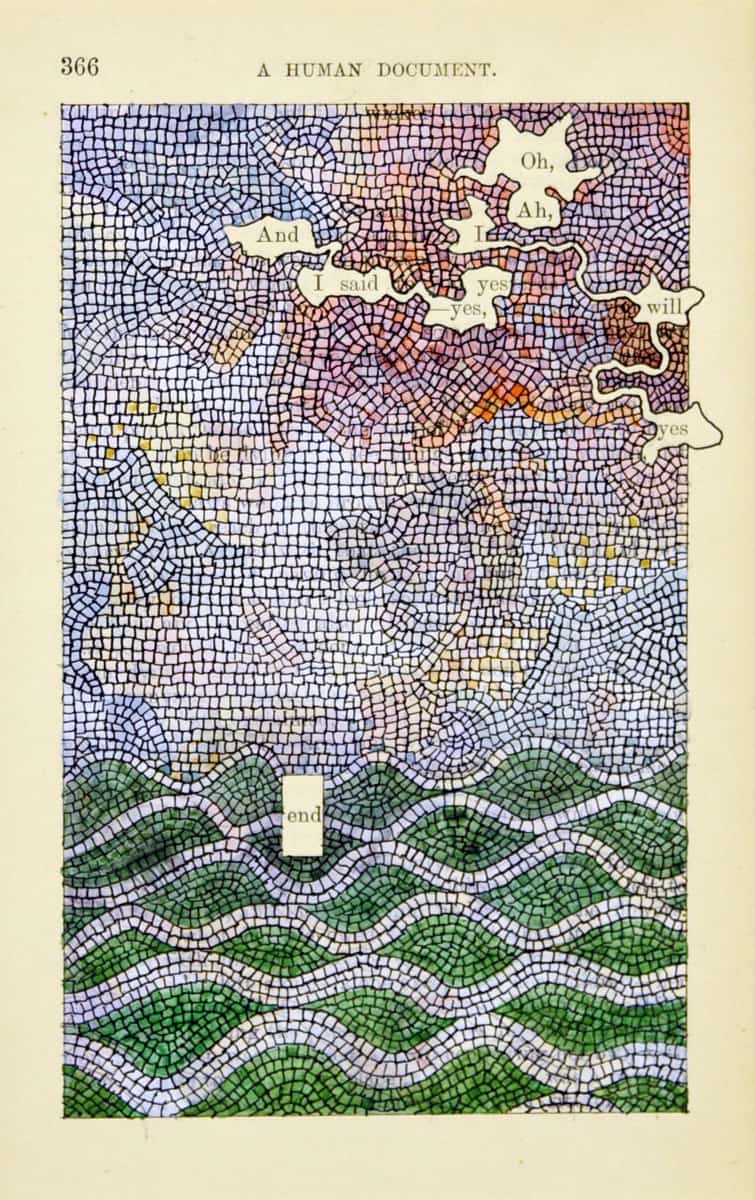
A Humument Fourth Revision Page 366 by Tom Phillips, 1997. The drawing depicts a varicolored stone mosaic, which, based on the content of the poem on this page, may be an abstraction of the facade of Morro Castle that opens James Joyce’s “Ulysses.” The poem adapts Molly Bloom’s closing soliloquy that ends the book: “Oh, Ah, And I said — yes yes – I will yes – end.”
The University of Iowa Libraries Special Collectionsis the new home of the renowned Sackner Archive of Concrete and Visual Poetry. Founded by Ruth and Marvin Sackner in 1979 in Miami Beach, Florida, the Sackner Archive currently holds the largest collection of concrete and visual poetry in the world.
The archive includes over 75,000 items that document the concrete poetry movement. Annotated books, periodicals, typewritings, drawings, letters, print portfolios, ephemera, and rare and out-of-print artists’ books and manuscripts represent 20th-century art movements such as Italian Futurism, Russian and Eastern European Avant Garde, Dada, Surrealism, Bauhaus, De Stijl, Ultra, Tabu-Dada, Lettrisme, and Ultra-Lettrisme.
Among many notable items, the collection includes materials by and about the founders of the contemporary concrete poetry movement, such as Haroldo de Campos, Augusto de Campos, Eugen Gomringer, Öyvind Fahlström, Décio Pignatari, and Ian Hamilton Finlay. Also among the richly varied cross section of artists and poets represented in the archive are Dom Sylvester Houédard, Henri Chopin, John Cage, Johanna Drucker, Yoko Ono, and Nam June Paik.
“It’s a great honor for the UI Libraries to become the new home for the Sackner Archive, which will enrich scholarship, inspire generations of students, and draw visitors from around the world,” says John Culshaw, the Jack B. King university librarian at the UI.
Margaret Gamm, head of UI Libraries Special Collections, says the Sackners’ extensive work with item descriptions makes the archive of even greater value to scholars.
“We will soon be able to make a truly remarkable assortment of materials available, thanks to the dedication of Ruth and Marvin Sackner, their love of collecting, and their determination to create a complete archive by creating descriptive item records for each piece,” Gamm says. “I cannot wait to see how our students, faculty, and community use these materials in their research and classes.”
The entire archive has been moved to the UI Libraries, where it will be housed and maintained. The Sackner family has arranged for a scheduled donation of materials to be transferred to the UI Libraries’ ownership. The archive will be open by appointment to students, scholars, and the general public starting January 2020.
The Sackner family chose the University of Iowa Libraries as the new home for the archive due to the Libraries’ reputation as a center for the study of Dadaism, with its substantial holdings in the International Dada Archive. In addition, the Libraries’ world-class conservation program, the UI’s nationally recognized Center for the Book and the Iowa Writers’ Workshop, collections in the University of Iowa Stanley Museum of Art, and location in Iowa City (a UNESCO City of Literature) were also factors influencing their decision. The Sackners’ first encounter with Iowa was to loan work for the 1983 UI exhibition Lettrisme: Into the Present, not knowing that those items would eventually find their way back to the Midwest.
“My beloved wife, Ruth, and I had a dream that one day our efforts to build our collection into one that would reside in a world-class educational institution like the University of Iowa would come true,” Dr. Marvin Sackner says. “Our dream has finally become a reality. I am just sorry that Ruth is no longer with us to witness this monumental moment.”
In addition to housing the archive in Special Collections, the UI Libraries will maintain the condition of archive items, including fragile materials and rare or one-of-a-kind items. The Libraries Preservation and Conservation department has begun repairs on items damaged during Hurricane Irma in 2017.
In its new home, the Sackner Archive will continue to function as a living record of the concrete poetry movement, as new works are accepted into the collections. The UI Libraries will house new items as they come in and work to make the material available to all.
“It’s a pleasure to collaborate with the University of Iowa Libraries staff to ensure the safety of the collection during the move and into the future,” says Amanda Keeley, who has served as associate curator of the Sackner Archive for three years. “Margaret [Gamm] has been a particularly helpful partner, allowing a smooth process for moving this substantial archive to Iowa City.”
The University of Iowa Libraries plans to host a celebration of the Sackner Archive in the near future. At a later date, UI Libraries staff will mount an exhibition of select archive items in the Main Library Gallery. The exhibition dates will be announced at lib.uiowa.edu/gallery.
Contact
Margaret Gamm, head, Special Collections, University of Iowa Libraries margaret-gamm@uiowa.edu
Tim Shipe, curator, International Dada Archive, University of Iowa Libraries timothy-shipe@uiowa.edu
Images from the collection
The Sackner Archive of Visual and Concrete Poetry includes items created in a wide variety of styles and media. Initially, the Sackners collected examples of artists who started the concrete poetry movement, but the archive has since expanded in scope and now includes a broad array of works that integrate text and image. Examples include experimental typography, experimental calligraphy, correspondence art, stamp art, sound poetry, performance poetry, micrography, ‘zines,’ graphic design, and artist magazines.
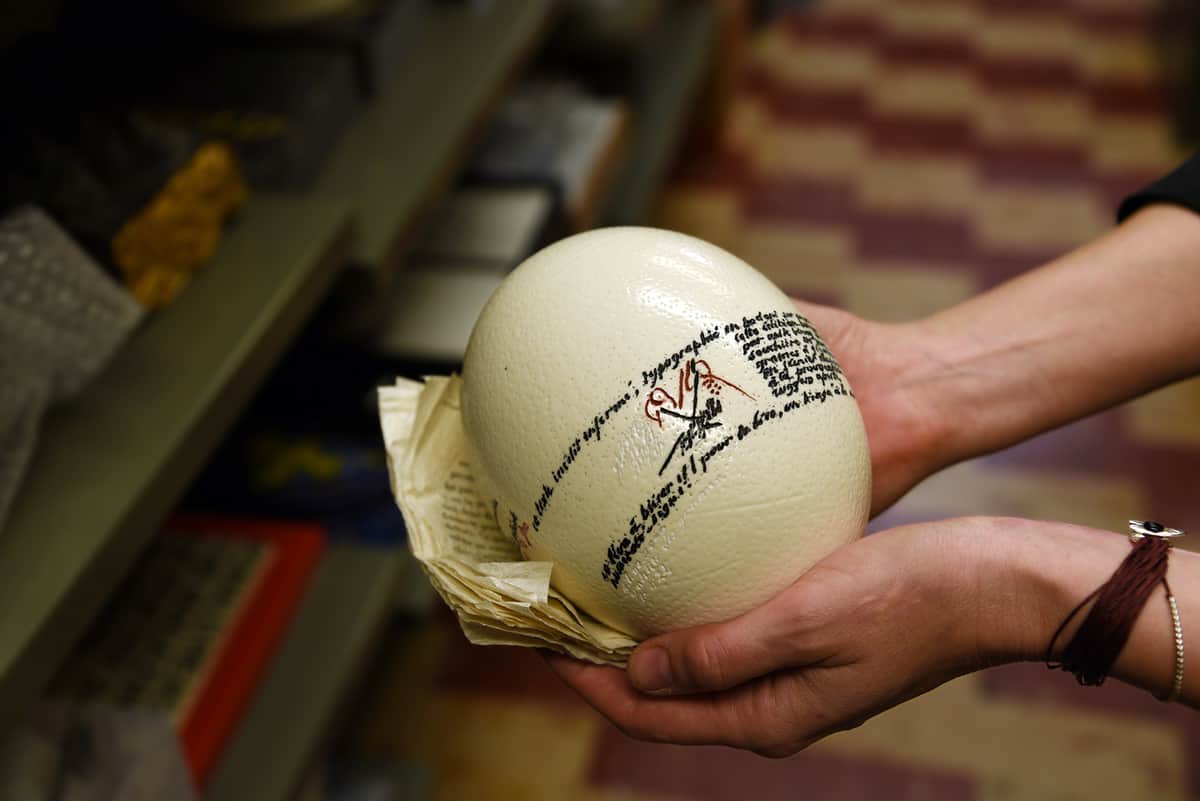
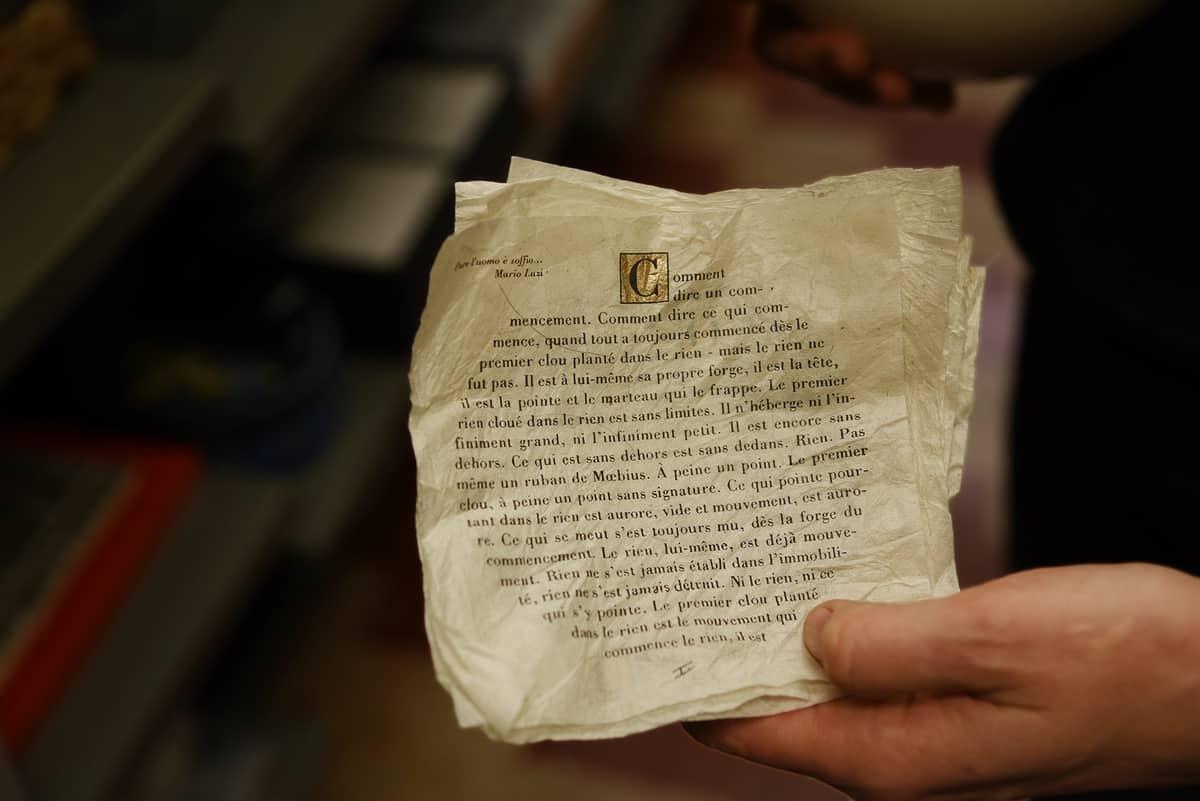
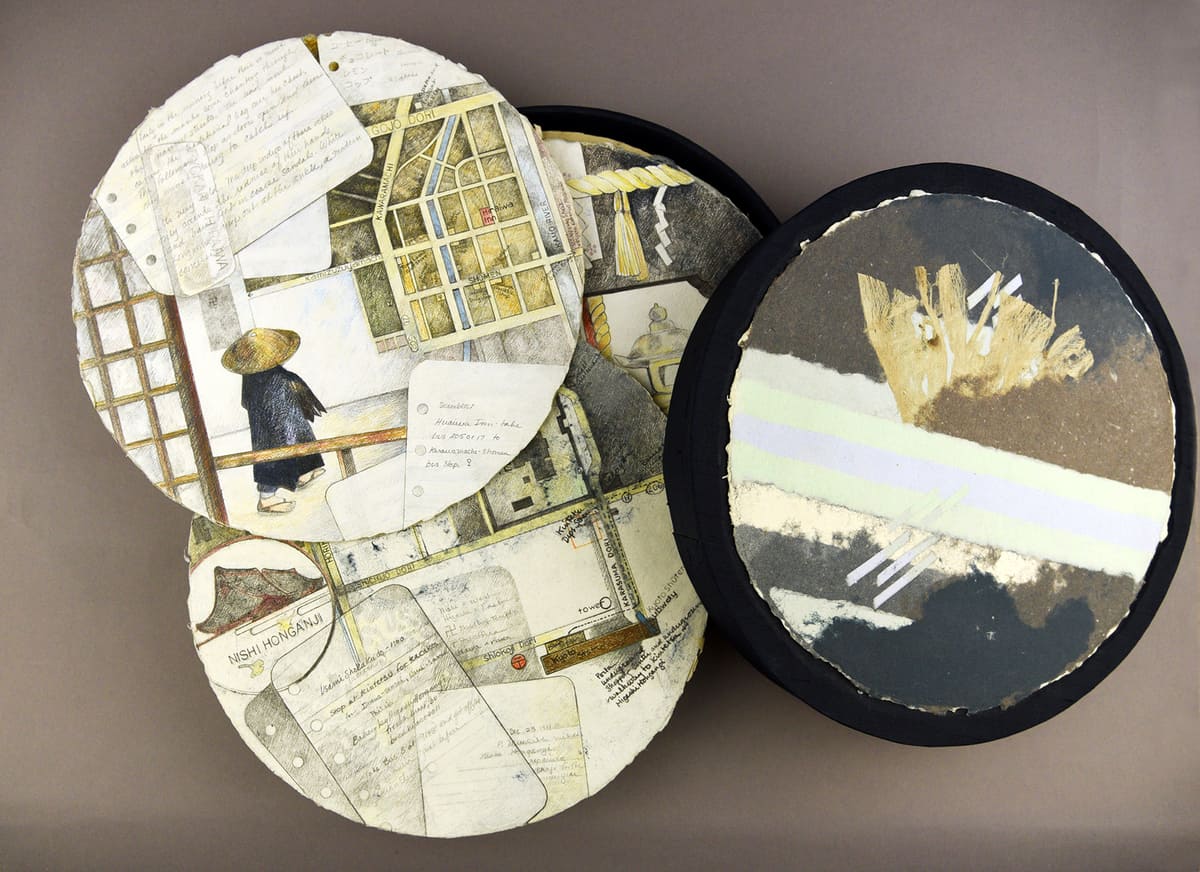
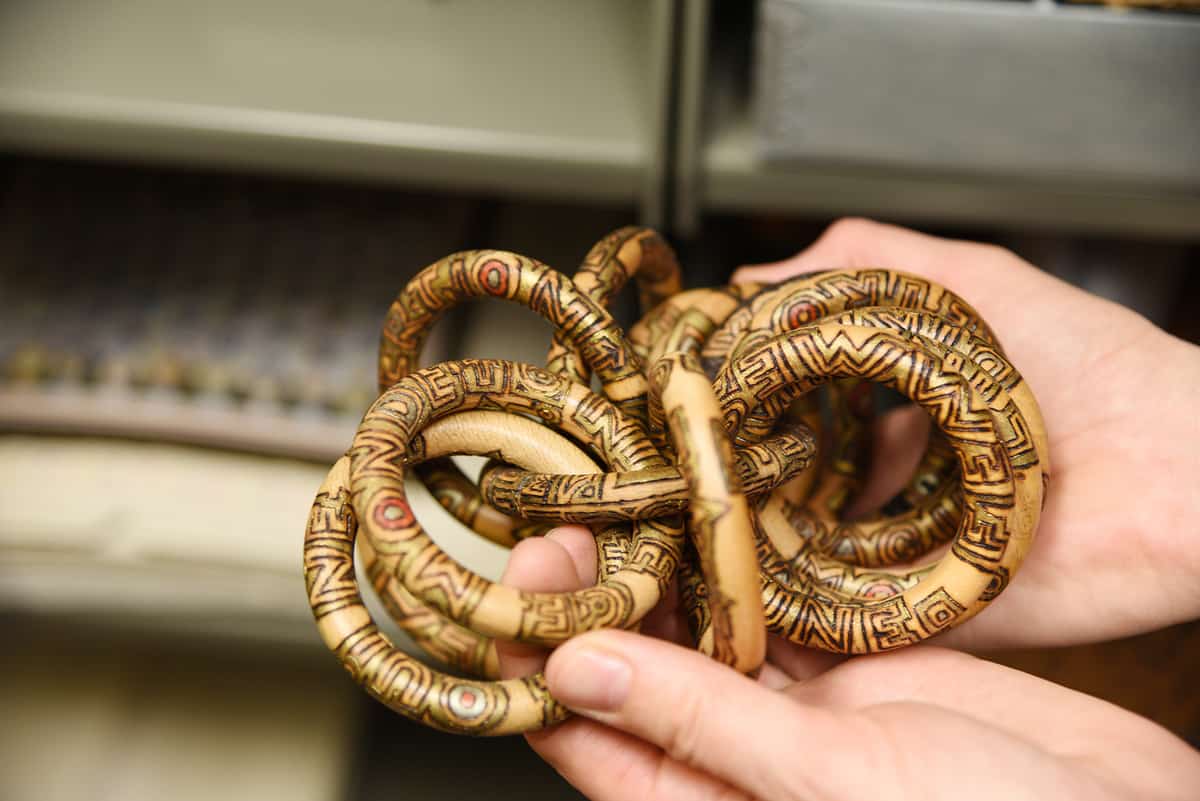
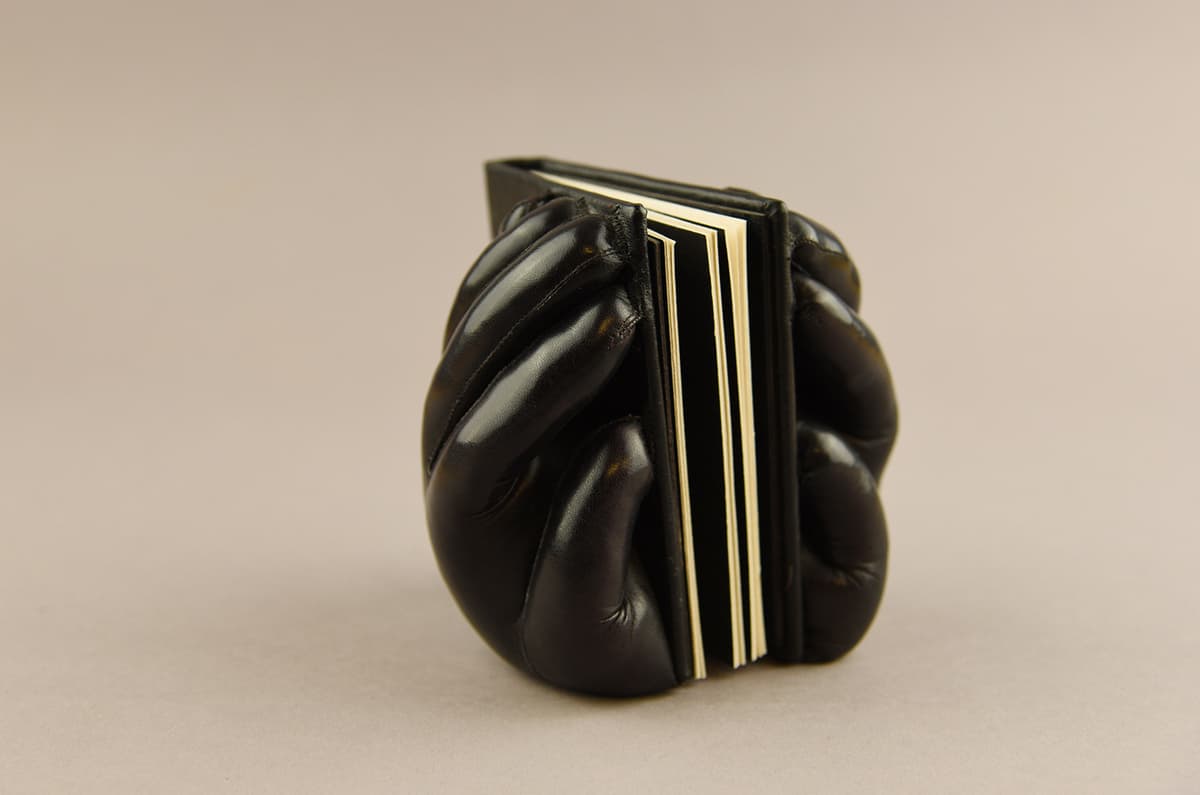
The images below show a variety of materials and techniques such as calligraphy on an ostrich egg, a “handmade” leather book cover, pressed leaves, lithograph, embossed paper, tea bags encased in paper, one-of-a-kind artist’s book in a round box, carved/painted wood, and an altered book page on which poetry was created through a technique called “erasure.”
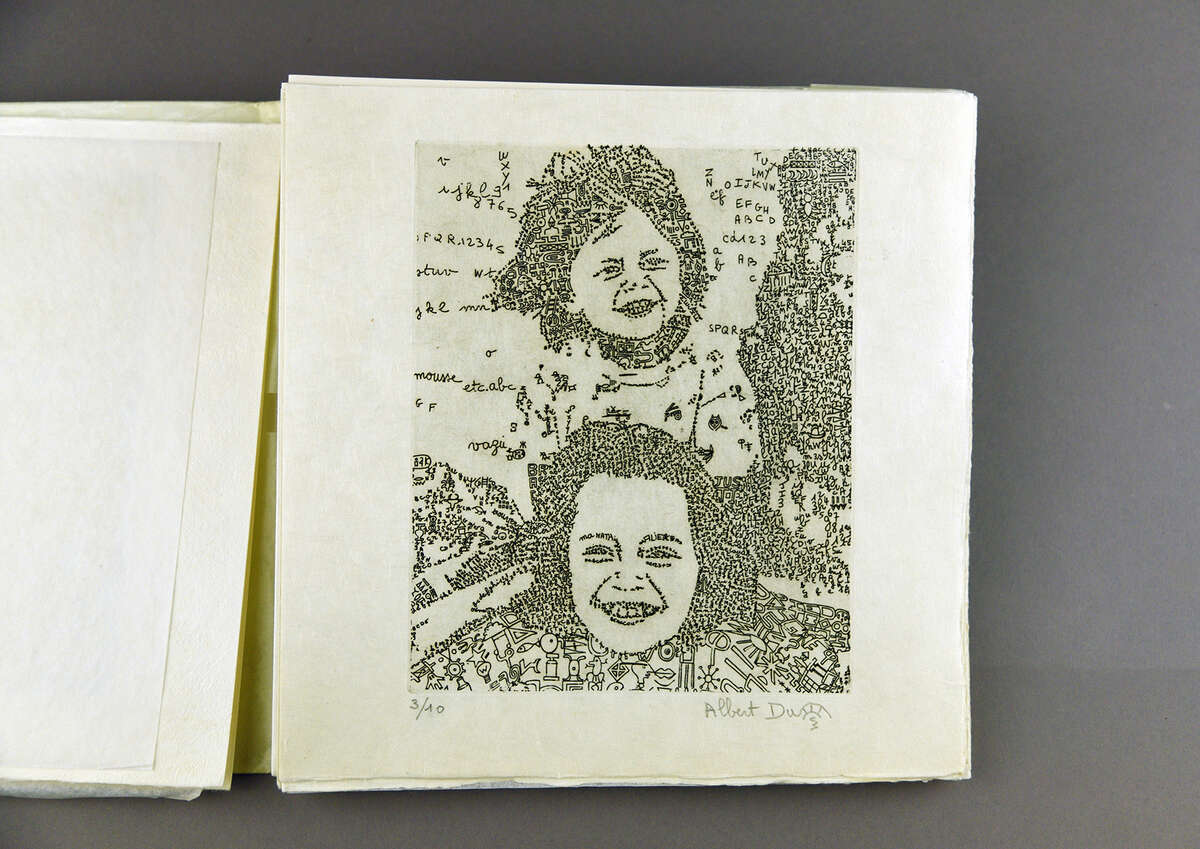
Couve le Feu, part of a series published by Atelier des Grames, 2000. The egg is engraved with the title and embellished with an original engraving enclosed with a text by Michael Gluck. This book object was delivered with rolled, uncrumpled pages within the shell. Their removal caused them to crumple. The texts are egg-shaped and printed on Tibetan paper with a gilded initial on each page.Couve le Feu, part of a series published by Atelier des Grames, 2000.Kyoto Grids by Margaret Ahrens Sahlstrand, 1984. Unique artist’s book, which captures the grids of Kyoto’s streets in original drawings contained within an unusual circular shape.Les Clés de la Tombe, conceived and realized by Émile Bernard Souchière for Christian Gabriel/le Guez-Ricord. Atelier des Grames, 1987.Guez Ricord by Christian Gabrielle, a series by Atelier des Grames, 1982.Engraving by Albert Dupont, from Isidore Isou’s Concerto pour œil et oreille (Paris: Atelier Dupont-Visat, 1984).
Today hefty paywalls prevent research published in most scholarly journals from being read online by audiences that many academics often most want to reach—policy makers and elected officials, industry leaders, non-profits, educators, the general public, and even faculty from smaller teaching colleges and community colleges. The University of Iowa Libraries has signed an institutional agreement with Cogitatio Press to support Open Access publishing by faculty, students and staff in their journals. According to SPARC, “Open Access is the free, immediate, online availability of research articles coupled with the rights to use these articles fully in the digital environment.” Instead of paywalls, Open Access is often supported by article processing fees (APC), that are often the responsibilities of the authors (or their institutions). The agreement with Cogitatio means the APCs are paid for as part of a 3-year membership by the university. This means that the scholarly research produced by University of Iowa faculty and students can be viewed in full text online and shared widely.
In Political Science, Professor Caroline Tolbert and graduate students Scott LaCombe and Courtney Juelich each have had articles accepted for publication in a special issue of Politics and Governancededicated to understanding state ballot measures (initiatives and referenda) after completing a rigorous peer-review process. Professor Tolbert is excited about the prospect of having coauthored work published in an Open Access journal that is rigorously peer-reviewed. “There are not yet many options for Open Access in Political Science, and this model of publication is one model for the future for scholarly writing. We need to expand our readers beyond just other academics and engage in conversations with policymakers and the general public. I also found Cogitation’s peer-review process very thorough. Politics and Governance is a high quality journal. Some scholars worry that Open Access is not as prestigious, but I encourage my colleagues to take a look.”
The Libraries’ Scholarly Publishing guides for “What Faculty Can Do” and “Open Access Models” provide additional information on Open Access at the University of Iowa.
by Jenay Solomon, Undergraduate Engagement Librarian, UI Libraries
Celebrating student accomplishments and getting to showcase all the amazing services and resources the UI libraries provide for students is always a great thing to do. Even on a Saturday!
Earlier this spring on a beautiful sunny Saturday, I spent the day at the 2nd Annual “I’m the First” First-Generation Summit celebrating the experiences and accomplishments of first-generation college students at Iowa. The Summit is entirely student-led and coordinated by the UI Student Government, who also provide the majority of funding. UISG did an amazing job at making the entire event very student-focused, while also encouraging networking and conversation among students, staff, and faculty.
The day began with a panel of first-generation students moderated by Dr. Melissa Shivers, VP for Student Life, who is herself first-generation, where they discussed challenges of being first-gen at Iowa, while also reminding attendees of the many strengths and talents being first-gen also brings. The day continued with breakout sessions, and two fabulous keynote speakers who spoke about their own experiences being a first-gen and a continuing college student.
During the afternoon “task force town-hall” session, I had the opportunity to sit on a panel with six other staff across campus in the departments of Academic Support & Retention, Academic Advising, TRiO Student Support Services, English as a Second Language, and University Counseling Service. Each of us discussed our roles in our departments and the different ways we reach out to first-gen students. It was interesting and informative listening to the others discuss their services and the various ways they reach out to students and first-gen in particular. Though we each came from different backgrounds and had distinct roles on campus, we all had commonalities when it came to caring about student success and empowering students to reach their potential.
When it came time for me to speak, I decided to showcase all the ways the Libraries provide support for students, through instruction, research consultations, our collections, and spaces. As the Undergraduate Engagement librarian, I shamelessly promoted services in The SEAM, spoke about the importance of offering flexible late night and drop-in research help for students who have different needs, crazy schedules, and who no longer fit the “traditional” mold of what a first-year student looks like. I stressed the importance of the how we all, as library staff, work hard to create a safe, comfortable, and judgment-free zone at the Libraries, whether that’s through our collections, our physical spaces, or our public outreach. I also took the opportunity to remind the students it’s our job to answer questions and help them find the information they need – so don’t be shy!
I’m hopeful we can continue being a part of the First-Generation Summit and I would encourage anyone, whatever role you’re in, to attend or present in next year’s 3rd annual summit. As librarians and library staff, we always relish the chance to promote the services we provide and remind students of the importance of their Libraries as part of their success story at Iowa. Simply attending the Summit and being a part of the program was a great opportunity to do just that.
The University of Iowa Libraries announces OpenHawks, a campus-wide grant program that funds faculty efforts to adopt or develop Open Educational Resources (OER) for enhanced student success.
What are OER?
OER (such as textbooks, videos, assessment tools, lab books, research methods, or interactive course modules) are free for students and carry legal permission for open use. The open licenses under which these items are released allow users to create, reuse, and redistribute copies of the resources.
Why use OER?
Removing cost barriers to course materials opens student access and positively impacts learning. OER provide further benefit when faculty fully integrate free resources into their curricula by “remixing” or tailoring materials to enhance specific learning objectives.
Acknowledging the rising costs of educational resources and increasing financial pressures on students, the UI Libraries works to provide creative solutions in partnership with other campus units. As a result of this collaborative work, OpenHawks grants support faculty efforts to use OER at any level: adopting or remixing existing materials, developing open access assessment and learning tools, redesigning courses, or creating an original OER to share under an open license.
How to apply
The UI Libraries will issue a formal Call for Proposals in March 2019. The award levels outlined below provide guidance for grant applicants on the amount of funding that may be approved for different types of proposals. UI instructors can apply for awards at any of these levels.
Award Type
Award Range
Requirements
Adoption
$500-$1,000
Use an existing open textbook for a course with no editing and minimal course adaptation required.
Remixing
$750-$2,000
Adapt, update, combine, or improve existing OER to replace a currently used textbook. Use of library-licensed materials may also be considered.
Support Materials
$1,000-$3,000
Develop test bank questions, teaching support materials, quizzes, interactive learning aids, or other support materials for existing OER.
Course Redesign
Up to $5,000
Redesign a course around the use of OER.
OER Creation
Up to $10,000
Create an original Open Educational Resource to be used in a course and shared under an open license.
OpenHawks grants are funded by the Office of the Provost and UI Student Government (UISG) and administered by the UI Libraries with support from the Office of Teaching, Learning & Technology (OTLT), University College, and the College of Liberal Arts and Sciences (CLAS).
Faculty and instructors interesting in applying for OpenHawks funding can direct questions to Scholarly Communications Librarian Mahrya Burnett at mahrya-burnett@uiowa.edu.
The University of Iowa is now an institutional member of QDR (Qualitative Data Repository) . The QDR membership gives faculty and other researchers a platform to store and share their qualitative data and enhances campus efforts for providing Research Data Services.
“QDR is a dedicated archive for storing and sharing digital data (and accompanying documentation) generated or collected through qualitative and multi-method research in the social sciences,” according to the Syracuse University based organization. “QDR provides search tools to facilitate the discovery of data, and also serves as a portal to material beyond its own holdings, with links to U.S. and international archives.”
“The main benefit of membership is curation and preservation of data projects deposited by affiliates – faculty, students, and research staff – of member institutions”.
Most data repositories focus on quantitative data. QDR offers an advantage for curating qualitative data. Alternatives include having researchers manage data on their own, which would mean more time and expense.
QDR is being funded at the University of Iowa by the University Libraries and the Iowa Social Science Research Center. The University of Iowa Libraries has been working closely with the Office of the Vice President of Research and Economic Development, Information Technology Services, and campus offices to support data management. Brett Cloyd (brett-cloyd@uiowa.edu | (319)335-5743) from the UI Libraries is the QDR Institutional Representative and serves as liaison with QDR. Please contact Brett with questions for help in getting started. More information is available at the UI Libraries’ QDR Guide.