Special Collections student worker Seth Torchia spent a fascinating summer interning at the National Archives. We are excited for Seth to have had this wonderful opportunity and asked him to share his experiences below.
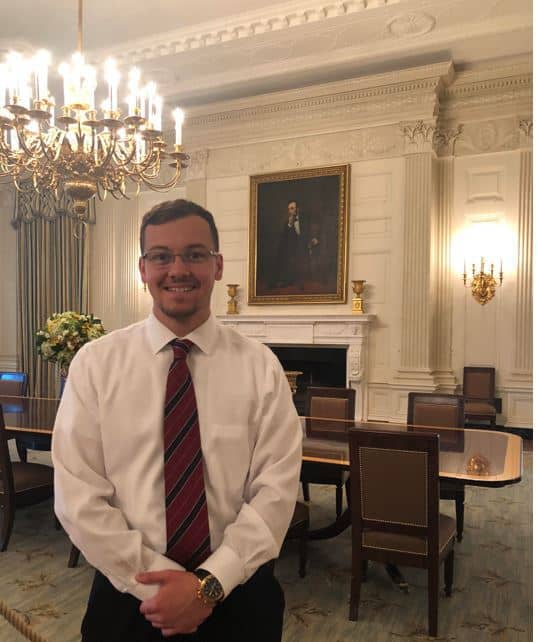
Seth in front of Lincoln’s Portrait
National Archives in D.C.
This summer, I interned at the National Archives assisting with the Lincoln Archives Digital Project. The Lincoln Archives Digital Project is a website that posts documents used during Lincoln’s presidency that are stored at the National Archives. Throughout the summer, I was in charge of the letters that were used to discharge immigrants from the Union Army because they were not yet legal citizens of the United States. The letters were issued to Edwin Stanton, the Secretary of War, from Secretary of State William H. Seward, informing Stanton of their discharge. The majority of these immigrants came from modern-day Germany and Great Britain and were living in either Wisconsin, Pennsylvania, or Maryland.
My duties included taking inventory of all of the letters, scanning and photoshopping the letters for the website, as well as typing out the software coding for the letters to be posted onto the website. Apart from myself, I worked with 3 other students, who were working on their own document collections, and with my supervisor and founder of the website, Karen Needles. On Mondays we would work at the National Archives facility in College Park, Maryland where we would focus on the website programming. The following Tuesdays, Wednesdays, and Thursdays, involved working at the main building in Washington, D.C. where we would continue our work on inventory, scanning, or photoshopping.
Note from A. Lincoln
During my internship, I had time do my own research, and I found Abraham Lincoln’s signature in regards to a pardon case. I also discovered my great-grandfather’s promotion notice during his service in World War I. Working at the National Archives was a surreal experience as I was working in one of the world’s largest archival facilities, as well as one of the most historic places in the United States. I gained new skills during my internship, such as advanced computer knowledge, and feel I have really improved my research skills. I also got to see three of my professors who have taught me in previous classes here at Iowa. They were doing their own research, which I thought was neat to see.
As well as my internship, I had plenty of time to explore Washington, D.C. My favorite things in D.C. were visiting the Library of Congress, touring the FBI Building, spending the 4th of July on the National Mall, and watching the Washington Capitals win the Stanley Cup. I had a great summer living in D.C. and my internship will be an experience I will never forget!
With the new school year beginning, Special Collections has brought in 21 new manuscripts for the fall semester for professors, students, and enthusiasts to enjoy and learn from.
These manuscripts are on loan from Les Enluminures, a company with locations in Paris, New York and Chicago. Les Enluminures was created to offer a large and wide-ranging inventory of text manuscripts on the market. They developed a program that allows educational institutes in North America to borrow some manuscripts, giving more people the opportunity to see these wonderful books. The program is called “Manuscripts in the Curriculum.”
Some institutions do not have a collection of manuscripts for students to learn from and use as primary sources in their papers. Even though we are fortunate to have a Medieval Manuscript collection already, by acquiring these on loan for the semester, we are allowing students to gain a broader understanding of the Middle Ages and to experience something new.
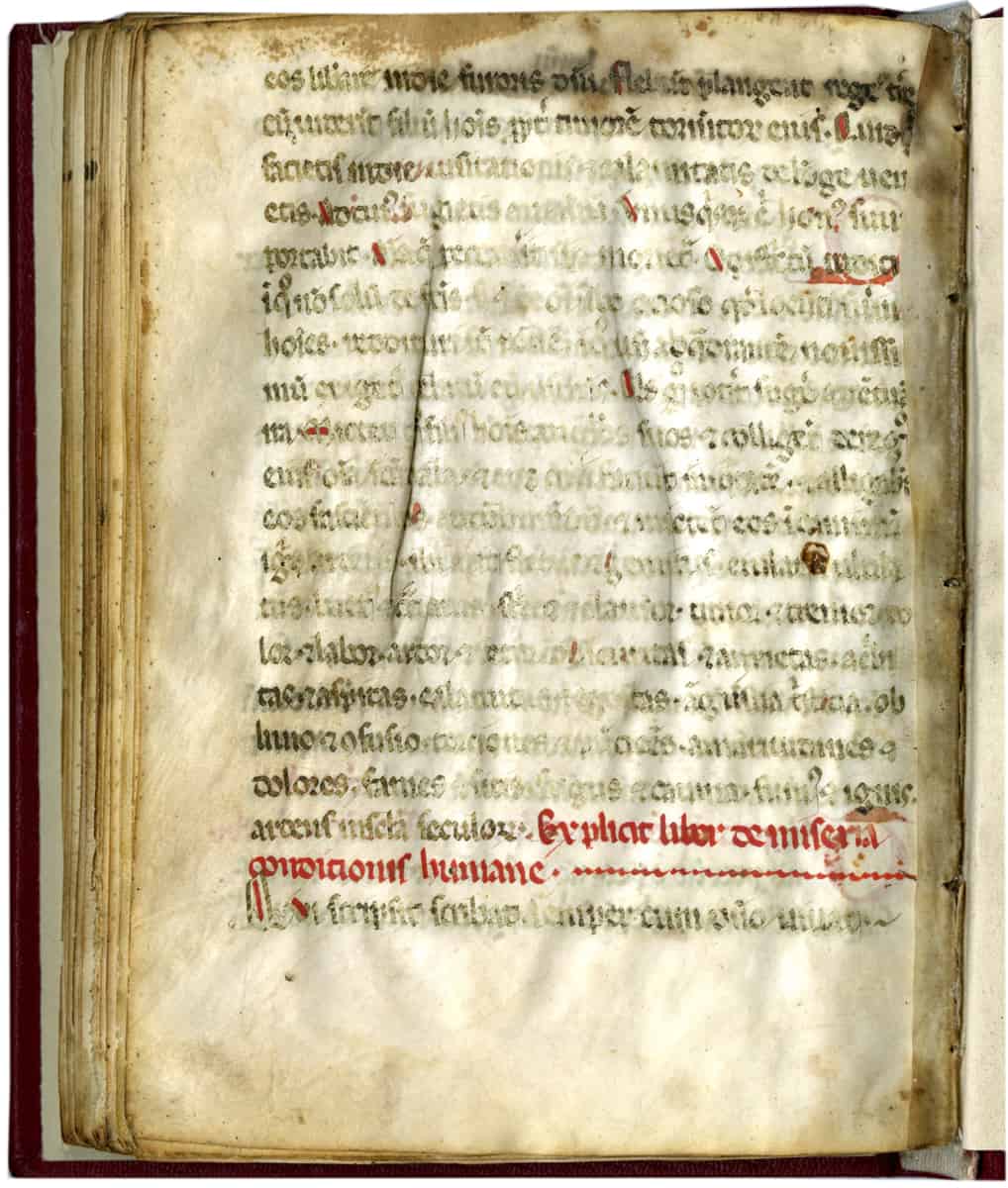
De miseria humanae conditionis (On the Misery of the Human Condition)
Special Collections will be welcoming the manuscripts to their collection for the Fall 2018 Semester, arriving on August 27th and leaving mid November.
The manuscripts were written throughout Europe from the 13th century to the 19th century, and each manuscript has a diverse subject including the lives of the saints, school books, humanism, liturgy and canon law.
One of the manuscripts, Lotario Dei Segni’s De miseria humanae conditionis (On the Misery of the Human Condition), has been cited by famous authors, including Chaucer and Christine de Pizan. This medieval manuscript is a reflection on the Middle Ages.
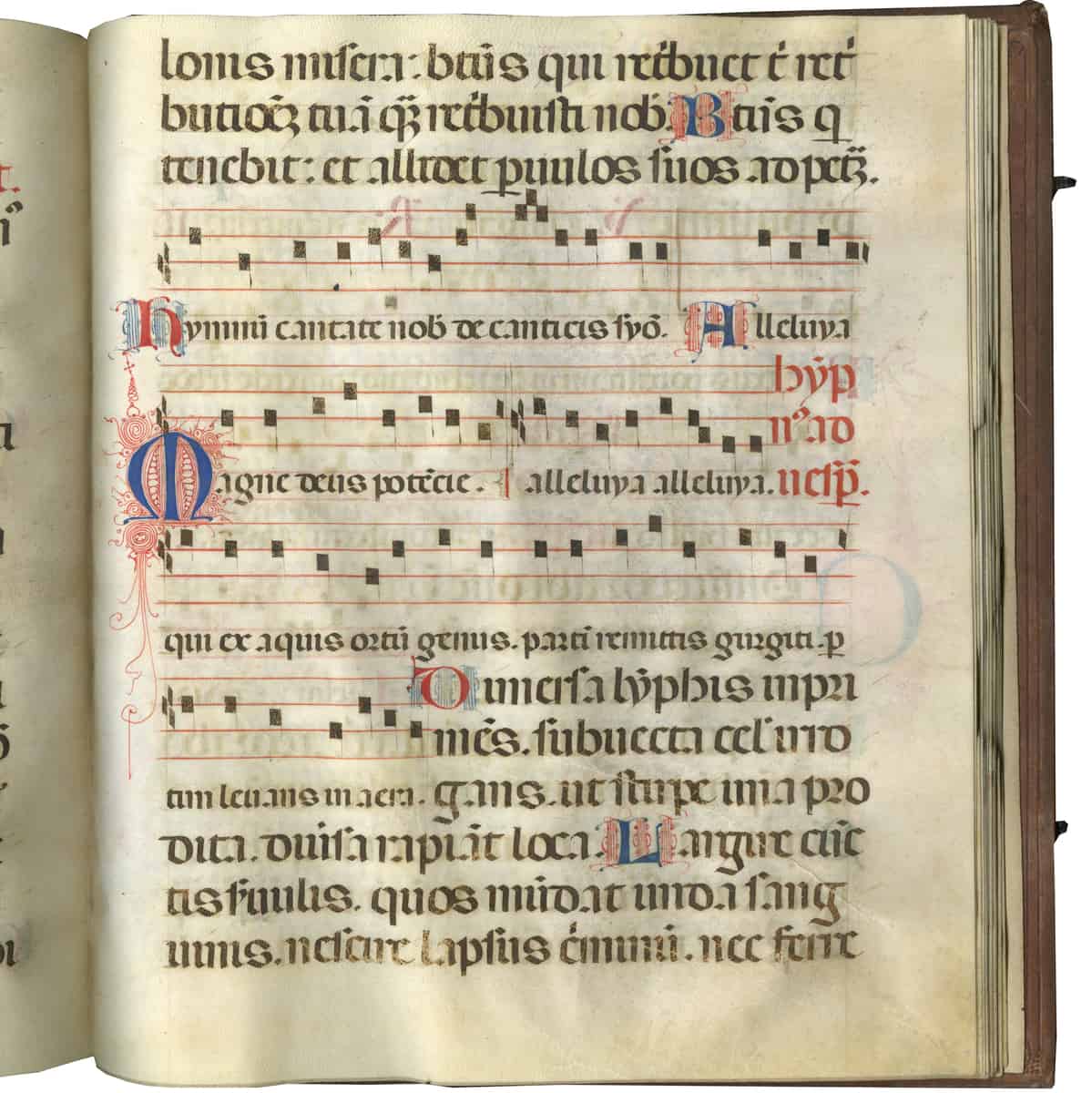
Choir Psalter
Saint Benedict’s Regula sancti Benedicti and Saint Augustine’s Regula sancti Augustini episcopi are pocket-sized manuscripts containing foundation documents of early Western monasticism. Even though monks were not allowed any personal property of their own, there is still evidence that a Benedictine monk or abbot had owned the manuscript in the 15th century.
Along with these manuscripts, there may be some that have missing leaves. However, those missing leaves add more to the story than if they were still bound with the manuscript.
An incomplete Noted Choir Psalter and Hymnal is bound out of order and is missing numerous leaves; however, it still represents the opportunity to acquire a liturgical manuscript from Northern Italy.
There is so much to learn from these manuscripts, and we hope you can come in and enjoy them. In addition to the manuscripts coming to Special Collections for classroom use, every Tuesday from 4 p.m.-7 p.m. Aug. 28- Nov. 13, we will showcase a few manuscripts during our open houses.
For those interested in seeing the manuscripts, for class use or personal interest, please contact us at lib-spec@uiowa.edu.
We will also be welcoming an international specialist from Les Enluminures to give a lecture about the manuscripts. Dates are TBD, so stay tuned for more information.
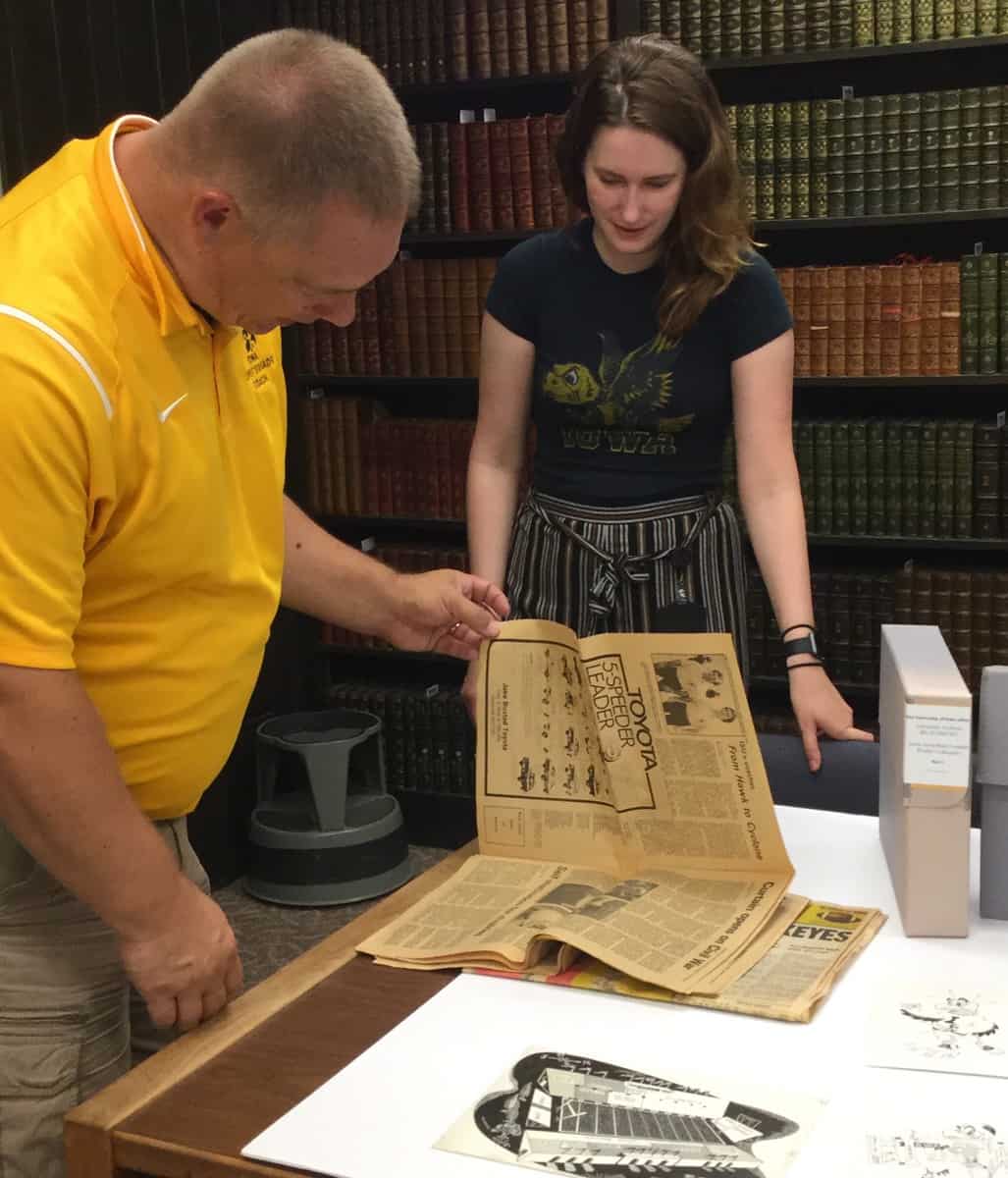
What do the UI Libraries and UI Athletics have in common? Hawkeye History! In this blog post, Chloe Waryan, Exhibit Design Intern at the University of Iowa Special Collections, interviews Gregg Niemiec, Spirit Coach of the Iowa Spirit Squad. For Herky’s 70th birthday, Gregg and Chloe team up in the Special Collections to discuss the items from the collections pertaining to Herky history. Read the interview below, and be sure to check out the exhibit “Hatching Herky” at the University of Iowa Special Collections and University Archives opening August 20!
Chloe and Gregg look at Herky from the archives
Can you tell us a little about what you do?
I am the Spirit Coordinator; I am in charge of the Iowa Spirit Squads which consists of the Iowa Cheerleaders, the Iowa Dance Team and Herky the Hawk […] For the Herkys, I help coordinate all of the events that Herky attends. [I] keep him clean and updated with the latest materials, costumes, and props.
What does a typical day look like for you?
Most days, I am at Carver Hawkeye Arena in my office by 9:00am. I start the day [by] checking emails and voicemails, responding back to questions fans have, organizing upcoming events, traveling for away games, and coordinating any other items for our 50+ members. Usually […] I am either moving bags of things in or out of Carver, to or from my car to keep Herky on the move. In the afternoons, […] I lead the Cheerleaders at practice. On weekends we have games and events. It is kind of a 24/7/365 job.
Do you conduct tryouts for Herky? What is that process like?
We have tryouts each spring. These start in late January with informational meetings [to] give everyone a heads up on what to expect. [F]rom there we do skills days, and get [the Herky candidates] ready for what they are getting themselves into: the walk, ball skills, improvisation, creativity, and movement. We will do a few rounds of these items as [candidates] get used to what is expected of them. Then there is normally a Final Tryout.
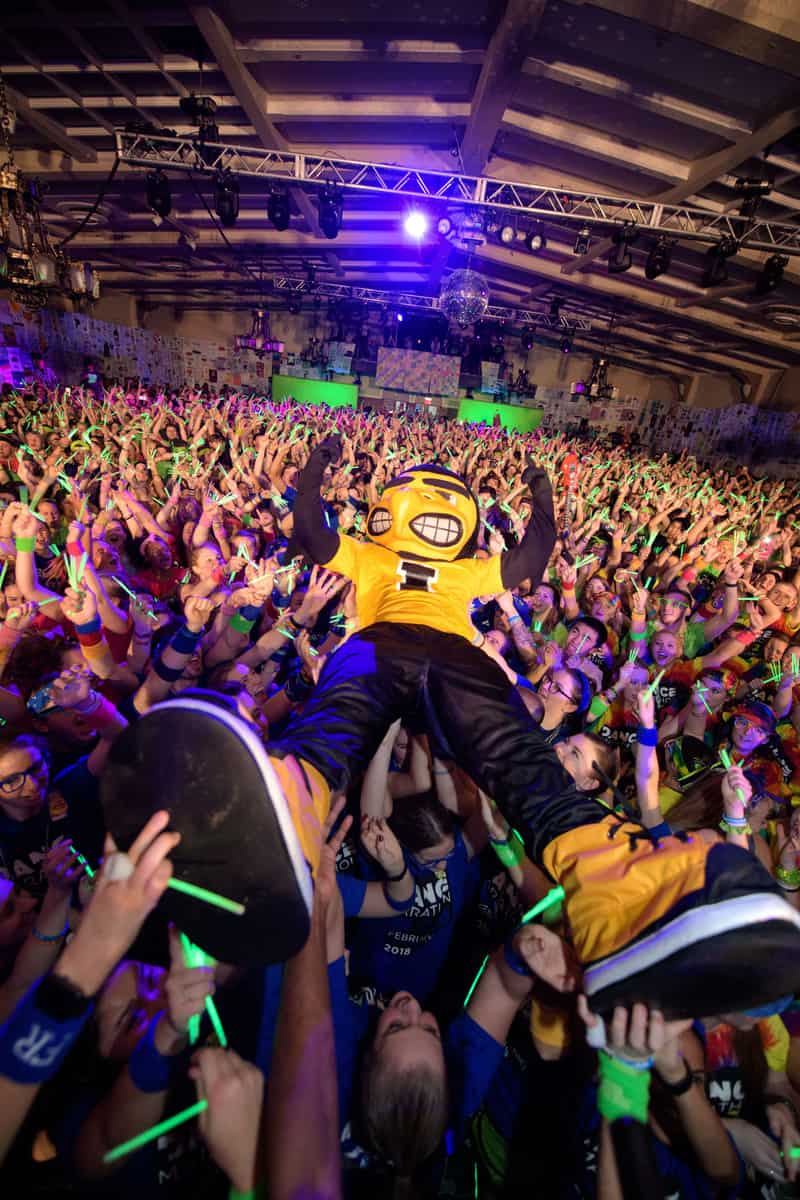
Herky brings the party to Dance Marathon
How many Herky’s are chosen per year?
There is one Herky the Hawk, who represents the University of Iowa. But Herky has some helpers called Herky Security. These members can usually be found with Herky, protecting the symbol of the University of Iowa. There are usually six Herky Security members each year.
What do you look for in a Herky candidate?
Athleticism, creativity, ability to think quickly on your feet, love of the Hawkeyes, and ability to communicate. During the tryout process all of these items are tested, along with doing an interview with all of them, and lots of time to talk between things at tryouts.
What does Herky do and where can Herky be seen?
Herky can be found just about anywhere – all Hawkeye Athletic events, and most of the larger campus events (ONIOWA!, Homecoming, Dance Marathon, Orientations, Admissions Days, etc)… Craziest [places where] Herky has been seen: rappelling down a building, a few funerals, swimming (with proper lifeguard notification), and pretty much just about anywhere.
You said that you helped with the art installation project Herky on Parade. What was that process like?
The installation of Herky on Parade took place in the middle of the night. [In 2014], they had special shirts made for those helping, with a logo describing the night as a secret installation of Herky on Parade. There were 3-4 teams of people that met at the storage area and helped pull the statues out onto UHaul trucks. We loaded those up with 6-8 people and went to our designated areas around town. The concrete bases were already in place, so we would take the statue out of the truck and place it on the base and fasten it with large bolts to the base. We would place a name plate on each and then cover them up, as the big reveal happened the next morning. It took about three hours. It was neat to see them pop up around campus as we drove to the next one. The next morning, volunteers helped at each of the sites and pulled the covers off. It was great to see the creativity of the artist in what they did. From Hayden Fry Herky, Star Trek Herky, Farmer Herky, to some artistic Herkys that made you think. It was neat to see and be a part of the installation staff of Herky on Parade.
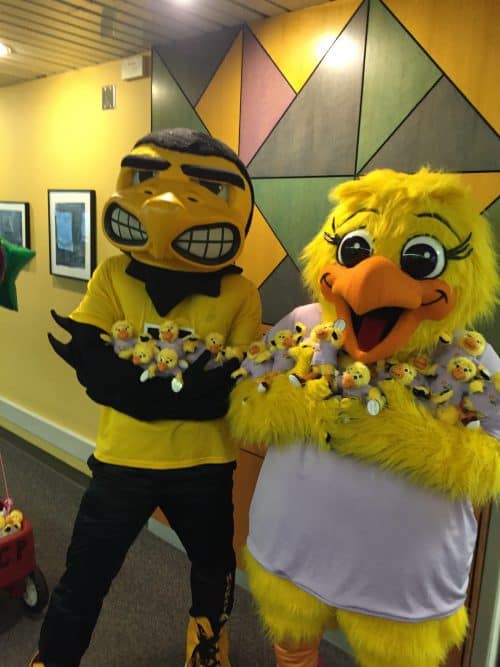
Herky with the cousin Perky
What is one thing about Herky that we might not know?
He has a cousin named Perky. She hangs out at the University of Iowa Stead Family Children’s Hospital. Perky makes kids young and old happy as they go through some rough times at the hospital.
How do you think libraries and athletics can work together?
There is a lot of history in Athletics around the University, and those events […] can be brought to life at the library, with books and media that reflect what Athletics around the University has done. Libraries are a cornerstone of knowledge, without them we would be lost.
This fall brings several big changes to Special Collections that we are excited to share with you!
We will soon be introducing Aeon, our new reading room management tool. This new system for patrons will be used in Special Collections, the John Martin Rare Book Room at Hardin Library, and the Cantor Rare Book Room at the Music Library.
Using Aeon, you can:
Set up an account in advance of your visit. This only needs to be done once, so there’s no more paperwork each time you use a new manuscript collection.
Request material before your visit to the reading room, making your visit more time efficient.
Record past visits, helping you keep track of material you have already viewed or wish to revisit.
Order scans or photocopies more easily, and retrieve scans more quickly.
While Aeon will change how some things are done, don’t worry! Staff will be on hand with resources to help you navigate this new system.
In tandem with the introduction of Aeon, Special Collections will be changing its reading room hours. Starting July 30th, Special Collections reading room will implement the following hours:
Monday: 10 am- 5pm
Tuesday: 10am- 7pm
Wednesday: 10am-5pm
Thursday: 10am-5pm
Friday: 10am-5pm
8 am to 10 am Monday-Friday remains available to patrons by advance appointment. Feel free to contact us to set up one of these appointments whether you are traveling across the country or across the campus!
Iowa Women’s Archives reading room hours will remain the same as they have been.
If you have questions or want to schedule an appointment, reach out to us at lib-spec@uiowa.edu or call (319) 335-5921
Environmental activist and Beyond Dirty Fuels creator Bryan Parras presented this question during the final plenary at the Rare Books and Manuscripts Section (RBMS) conference in New Orleans. Despite the simplicity, I felt at a loss for a response. Sure, many things are important to me—family, education, my love for all things coffee—but with preservation, what is truly “special” to me? I left the plenary to ponder the query by wandering the colorful streets of the French Quarter.
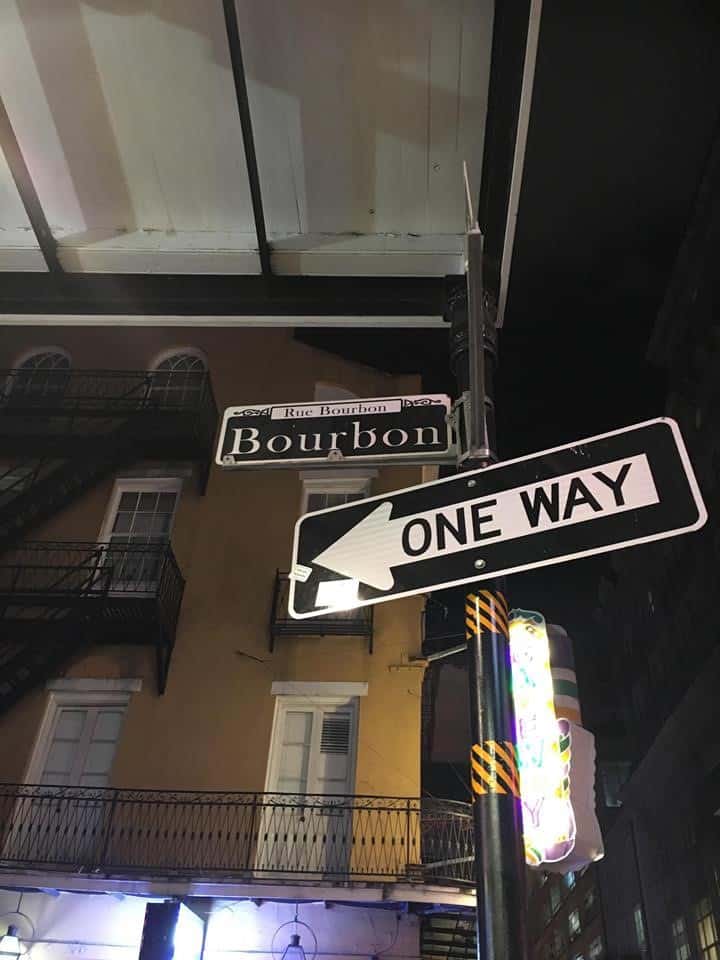
I strolled under Bourbon Street’s French and Spanish balconies, lost in the rhythms of jazz musicians. Performers lined the sidewalks: from Poets-for-Hire and human statues to bellowing singers and bucket drummers, the street was alive, despite the sweltering heat. The sights and sounds of the French Quarter were unlike anything I had ever experienced, and that’s when it hit me. These individuals from various walks of life carry distinctive, stratified identities that are important to their past, present, and future.
Bourbon Street at night
In a special collections or archive, I want to see my identities represented in the collections I am preserving, researching, and marveling. Several collections at The University of Iowa resonate with me because of my identities as a woman, a Mexican American, and a student. I am, however, well-aware that others do not have this equal advantage, nor the opportunity to engage with items in a special collections or archive. The supplemental panels, plenaries, and seminars at the RBMS conference extended the ways that I can assist in diversifying collections and the individuals that engage with them. RBMS made me increasingly more interested in how a special collections can contribute to constructions of self-identity and belonging.
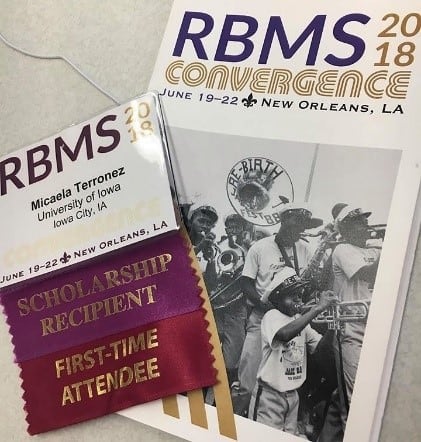
This year’s theme, Convergence, focused on “the idea of convergences and [spoke] directly to our field’s preparedness for increasing environmental vulnerabilities on our facilities, our readiness for the inclusion of different people and cultures in what we collect, how we perform outreach and programming, and who we select to staff and lead our repositories…” (conference.rbms.info/2018/). The conference offered numerous speakers from a variety of backgrounds, interests, and practices speaking on the many collaborations within special collections.
RBMS 2018 Convergence
I attended several sessions throughout the conference including presentations on diversity in the workplace, oral history projects, instruction, collection development, and outreach. The most helpful session for my research interest on equal representation in special collections included the panel “The Value of Diverse Collections: Changing Collections, Institutions, and Researchers” given by several archivists on their collection development projects. Laurinda Weisse from the University of Nebraska-Kearney discussed her recent oral history project with the local Latino/a communities and their previous silence within the archives. Dr. Francesca Marini and Professor Rebecca Hankins of Cushing Memorial Library and Archives presented on their collection of LGBTQ+ communities and how Texas A&M utilizes them in instruction and outreach initiatives. Lastly, Jessica Perkins Smith of Mississippi State University and Jasmaine Talley of the Amistad Research Center demonstrated how archivists can support the research and study of African American history by highlighting “hidden” collections through exhibits, social media, workshops, and instruction. This panel of presenters provided an open forum for discussing ideas in collection development with and within marginalized communities.
Moreover, most of the sessions I attended directly spoke to my previous research and interests in diversifying collections, users, and the people leading these collections. During the first plenary on workplace diversity, Ana M. Martinez of Boston College presented on an action plan to attract more candidates of color in higher education. Monika Rhue, Director of the James B. Duke Memorial Library, followed this presentation by recounting the lack of diversity within library workplaces despite the extensive work towards moving the needle. Audra Eagle Yun, Krystal Tribbett, Thuy Vo Dang, and Jimmy Zavala, all from the University of California-Irving, discussed how they incorporated and assessed their instruction services to students of Ethnic Studies courses. During a papers panel, I was amazed by the outreach initiative of the University of North Carolina at Chapel Hill and Inherit, a cultural heritage research organization. Their program titled Maya from the Margins connects the Mayan youth of North Carolina and Yucatan, Mexico with exploring their identities and heritage by using primary sources found in special collections. These sessions and many more centralized diversity and inclusion in the conversation. Critical analysis and constructive dialogue is needed in these types of conversations, and I believe that RBMS was an ideal environment for me to learn, speak confidently, and become further aware of the underrepresentation in libraries.
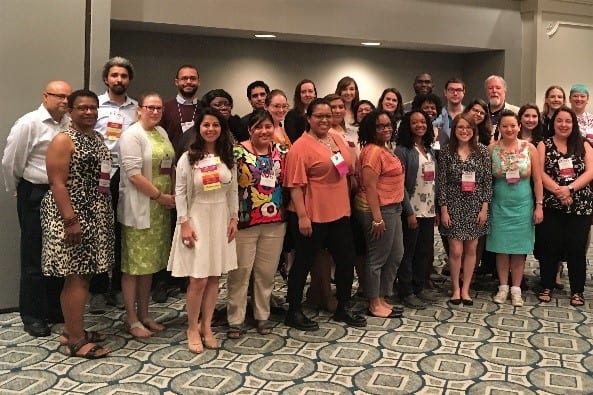
Beyond the eye-opening sessions, I also enjoyed how RBMS supports emerging librarians and graduate students by providing networking opportunities and informative introductions to RBMS/ACRL. As a new member, I had the opportunity to attend an orientation where I met current RBMS leaders and learned how to get more involved with the ACRL section. I also discussed employment, graduate research, and day-to-day experiences with fellow graduate students and new librarians during the Scholarship Recipient Breakfast. These opportunities created a welcoming environment for me as first-time attendee and allowed me to visualize myself as a continuing member of RBMS.
RBMS Scholarship Breakfast
I left New Orleans with many take-aways, but two stick out most prominently. First, this conference reaffirmed that I belong in this profession. As an ethnically marginalized first-generation college student, it’s been difficult to visualize myself working alongside others in my profession with significantly different, homogeneous backgrounds. However, Athena Jackson’s closing remarks deeply affected my mindset. A Mexican-American herself, she noted to, “Look around” and know that people are rooting for me and here to support me in my endeavors. And second, our work is not just about books, it’s about people. The unique, rare collections we house are meant to be shared, explored, and criticized. However, that can’t happen without wider communities being a part of the process of our work. In environments traditionally set aside for academics, I hope that I will assist in building relationships with wider communities left out of the conversations in special collections and archives. This conference was indispensable to my future as a librarian, and I hope to return again in the future.
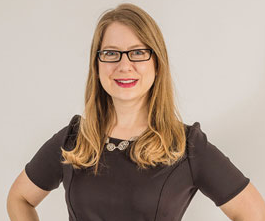
The University of Iowa Libraries is delighted to announce Margaret Gamm as the new Head of Special Collections. She replaces Greg Prickman, who leaves on July 2 to become the Eric Weinmann Librarian and Director of Collections at the Folger Shakespeare Library after serving as Head of Special Collections since 2011.
Gamm joined the UI Libraries in 2013 as the Special Collections Librarian in the Map Collection. In 2014 she was appointed Acquisition and Collection Management Librarian for Special Collections, and this past year served as Assistant Head of Special Collections.
Gamm arrived at the University of Iowa having interned at the Smithsonian Institution Libraries and the University of Georgia Georgiana Collection, and served as a research assistant in the Rare Book Collection at the University of North Carolina, Chapel Hill. Over the past five years, she has overseen the acquisition of new materials, supervised staff, managed budgets, led the implementation of new software programs, and curated rare works–particularly medieval manuscripts, incunabula, cartographic works, and artists’ books. Gamm has also worked to bring Special Collections further into the UI community, teaching sessions on book and cartographic history, working closely with donors, and devising new engagement opportunities for patrons.
“I am thrilled to begin my new role as Head of this incredible department that has accomplished so much,” said Gamm. “We have a lot of momentum here in Special Collections that will carry us into the future, and I am so excited to lead us there. I am already looking forward to a busy year filled with new exhibits, visiting medieval manuscripts, the debut of an online patron registration system, and so much more.”
As a dedicated and visionary librarian, Gamm maintains a staunch commitment to the evolving staffing needs of a 21st century Special Collections, as well as the dynamic spaces required to house and showcase the UI Libraries’ remarkable holdings. Looking ahead she sees great potential for new collaborations across campus and within the Libraries to advance understandings of and access to these collections.
A 2010 graduate of the University of Georgia, Gamm majored in English and History, before obtaining her Master of Science in Library Science with a concentration in archives and records management at UNC-Chapel Hill. In 2015, Gamm was named a “Bright Young Librarian” by Fine Books & Collections magazine.
Special Collections is excited to see Gamm as the new head of the department and cannot wait to see what the next chapter will bring.
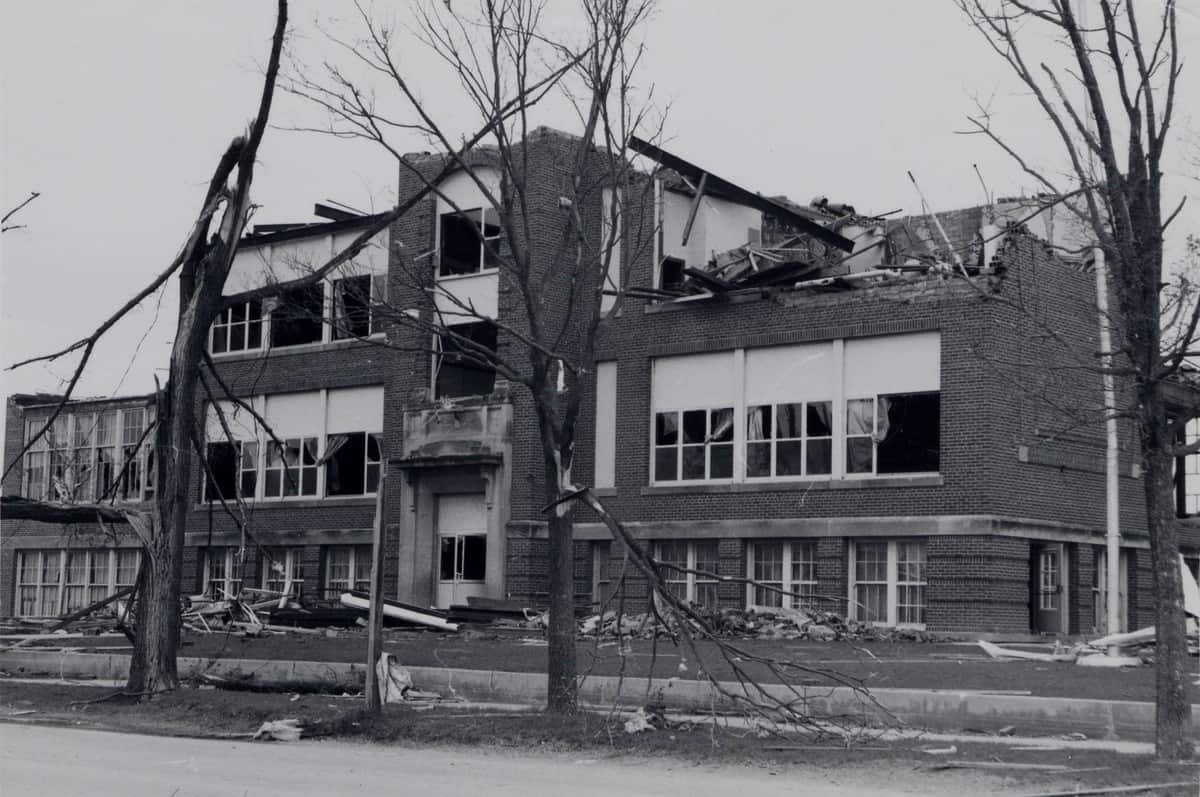
Summer for a Midwesterner means corn on the cob, days at the pool or setting up the sprinkler in the front yard, gnats galore, and humidity that makes the air feel like soup. However, summer in the Midwest also brings to mind pictures of tornadoes that swoop down from the sky and destroy so much in so little time. As scary and damaging as these moments are, the sheer power of Mother Nature can leave lasting impressions of awe in us.
Our own University Archivist, David McCartney, has been recollecting his own experiences with tornadoes. David’s home town, Charles City, Iowa, recently marked the 50th anniversary of when an F5 tornado ripped through the town, killing 13 people and injuring 450 more. On May 15, 1968 a tornado estimated to be half a mile wide hit Charles City at 4:50 PM. Roughly 60 percent of the city was damaged by the tornado, and the damage was estimated to be around $30 million. The tornado continued on for 65 miles, destroying farms and anything else along the way.
David was 11 at the time, but he still can recall many of the events of the day, including his school’s annual track and field event, that earlier afternoon being incredibly windy, and his brother watching the progression of the tornado from the basement window and reporting it to the family who sat waiting nearby. To mark the 50th anniversary, David appeared as a guest on KCHA, the local radio station, which aired a special program to commemorate the event. For David, he first heard the news about the approaching tornado when he got home from school and turned on the TV and believes the local TV and radio stations reporting the progress of the tornado helped save many lives. David, himself a former broadcaster, assisted the station’s staff with research of the event and arranging several interviews with those who witnessed the tornado’s destruction.
A lot can change in a matter of moments, and we are glad David is here to share his stories.
It is with a mix of sadness and joy that Special Collections bids goodbye to Colleen Theisen as she leaves to start her next big adventure. Colleen has accepted a job at Syracruse University as their Chief Curator of Exhibitions, Programs, and Education. Although we are sad to see her go, we cannot help but feel excited for this new chapter in her life. While at Iowa, Colleen helped create the group Historic Foodies, curated the exhibit “The Land Provides: Iowa’s Culinary Heritage” at Old Capitol, grew Special Collections instruction program, and brought national attention through NBC Nightly News and Atlas Obscura to our collections. Colleen’s last day will be June 1st, and we wish her the best of luck!
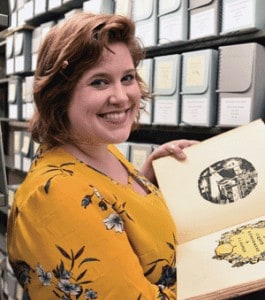
Taking over as our new Outreach and Engagement Librarian is Elizabeth Riordan. A recent graduate from the University of Iowa’s School of Library and Information Science, Riordan has been involved with Special Collections for the past two years, working as the Brokaw Graduate Research Assistant this past year. A Des Moines native, Elizabeth received BAs in Anthropology and in Theatre Arts from Augustana College in Rock Island, IL. A self-diagnosed silent film nut, Elizabeth is excited to work more with the Brinton Entertaining Company Collection and other film-related material here at Special Collections. She looks forward to getting involved with the community and finding ways to bring the collections out of the stacks for all to see.
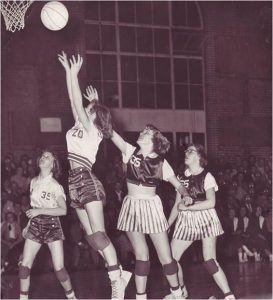
Hear Kären Mason, curator of the Iowa Women’s Archives (at the University of Iowa Libraries) reflect on the significance of 6-on-6 high-school girls’ basketball, drawing on rich personal narratives from Iowa Women’s Archives collections. For most of the 20th century, the state of Iowa was nationally known for its devotion to a unique form of women’s sport known as 6-on-6 girls’ basketball. As other states abandoned 6-on-6, Iowa remained steadfast in its commitment until the state’s final 6-player championship in 1993, where Hubbard-Radcliffe prevailed over Atlantic, 85-66. The year 2018 marks the 25th anniversary of the end of 6-on-6 girls’ basketball in Iowa.
Free to attend. Registration required.
Exhibits
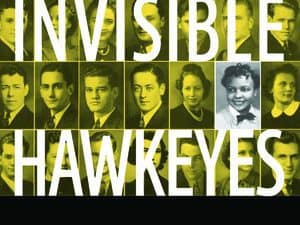
Invisible Hawkeyes – African American pathfinders & tastemakers, 1930-1970
By looking at the University of Iowa and a smaller Midwestern college town like Iowa City, this book reveals how fraught moments of interracial collaboration, meritocratic advancement, and institutional insensitivity deepen our understanding of America’s painful conversation into a diverse republic committed to racial equality.
An exhibition co-curated by all the student employees in Special Collections. Their work processing collections, shelving books, providing references services, and teaching in our classroom brings the most beautiful, bizarre, profound, and silly historic items to their attention and each person provided a favorite item that you’re bound to love.
Where: Special Collections on the 3rd floor of the Main Library. When: 8:30AM-5:00P M, W-F and 8:30AM-7PM on Tuesdays.
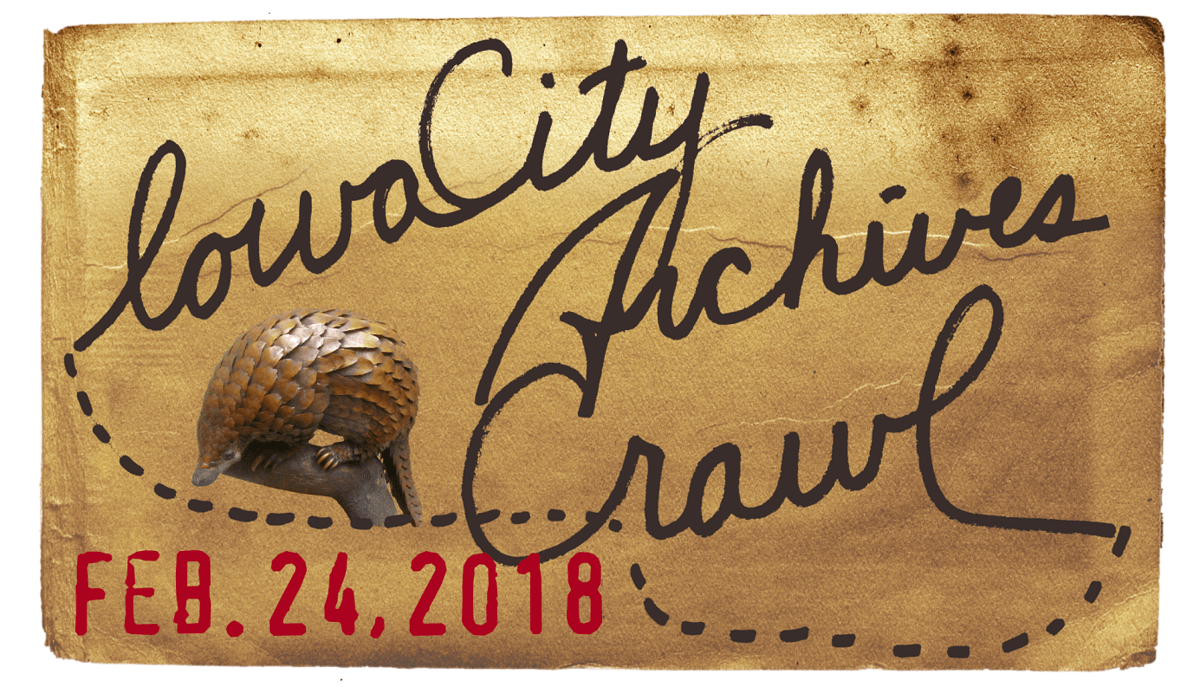
What gems are preserved inside of Iowa City’s libraries, museums, and archives?
At the area’s first-ever archives crawl, visitors can snoop in between the pages of historic diaries, read other people’s mail, hold feathers and fossils, and peer into mysteries revealed by historic artifacts like swords and locks of hair kept in remembrance.
All events are free and open to the public!
Between 11:00 am and 3:00 pm, the following sites will be open to the public. Each will offer tours, demonstrations, and short talks by experts (see specific times at archivesagainstamnesia.com/archives-crawl). Start your crawl at any of these sites, where you can pick up an archives crawl “passport” and map. Bring your fully stamped passport to any site for a prize!
University of Iowa Main Library, 125 W. Washington St.
University of Iowa Museum of Natural History, Macbride Hall, 17 N. Clinton St.
Iowa City Public Library, 123 S. Linn St.
State Historical Society of Iowa Research Center, 402 Iowa Ave.
All four sites will be open to visitors between 11:00 a.m. and 3:00 p.m.
The Iowa City Archives Crawl will occur prior to the 2018 Provost’s Global Forum and Obermann Humanities Symposium, Against Amnesia: Archives, Evidence, and Social Justice.
Free and open to the public.
Individuals with disabilities are encouraged to attend all University of Iowa-sponsored events. If you are a person with a disability who requires a reasonable accommodation in order to participate in this program, please contact Colleen Theisen in advance at 319-335-5923.