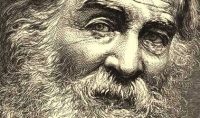
Hailed as “America’s poet” by poet Ezra Pound and others, Walt Whitman is a familiar name to most Americans, even if they haven’t read his most famous work Leaves of Grass. Even 200 years after his birth, Whitman finds himself the center of countless research questions and an inspiration for modern writers. For someone who starts one of his famous poems with “I celebrate myself, I sing myself,” it only makes sense that the University of Iowa Libraries follow suit and take time to celebrate Whitman’s legacy with the exhibit Walt Whitman: A Bicentennial Celebration.
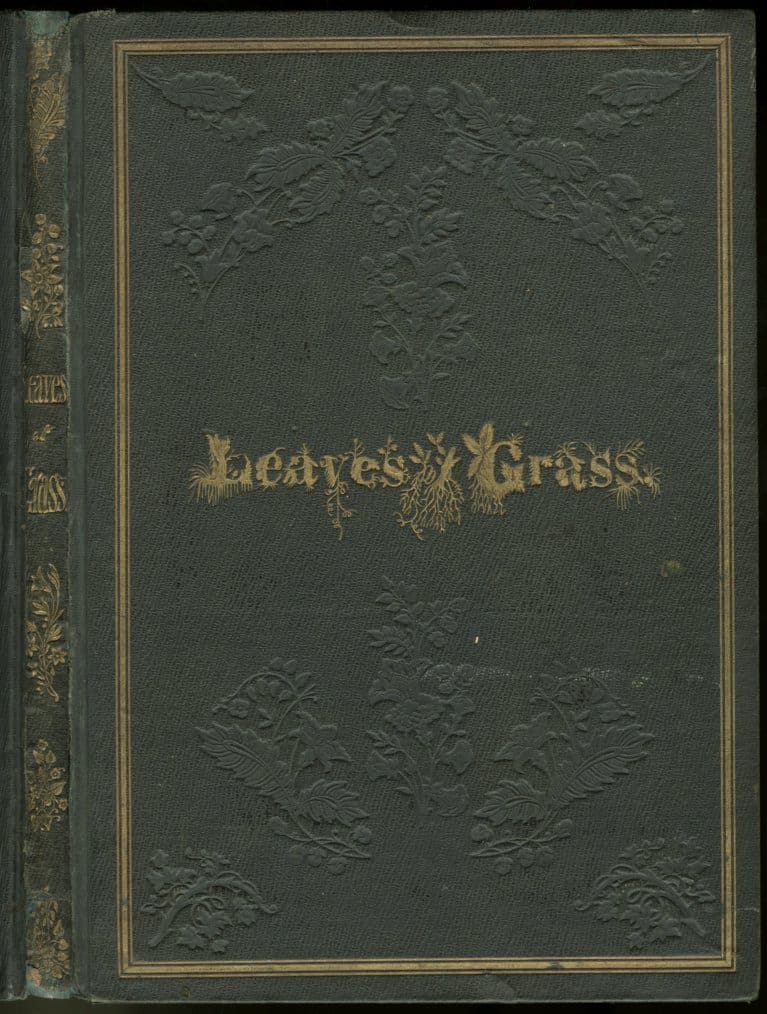
Leaves of Grass (1855) : picture from The Walt Whitman Archive website
Curated by Stephanie Blalock, a Digital Humanities Librarian, James O’Neil, a Ph.D candidate in English, and Ed Folsom, a professor of English, this exhibit aims to highlight Whitman’s life through his early works of fiction, as well as his famous editions of Leaves of Grass.
“What we’re going to have on display here is just the tip of the iceberg in our collection, really,” O’Neil said.
All three of the curators have a different focus when it comes to Whitman’s life. This aided to the curation of the exhibit, as each curator was able to fill in specific gaps of knowledge about the poet’s life.
This exhibit has been in the works since 2016. With the vast amount of resources available about Whitman through the Whitman Archive and the holdings at University of Iowa Libraries’ Special Collections, the exhibit looks at several versions of his notable work Leaves of Grass, including a first edition. However, the curators also want to focus on his fiction, journals and old age prose.
“Whitman is generally remembered as the author of Leaves of Grass, but not as a fiction writer,” Blalock said. “He actually got his early start in the early 1840’s when he was about the age of some of our undergraduates here, writing for newspapers as a journalist and writing fiction.”
There will also be a connection to Iowa. The University Press reprinted several of Whitman’s political pamphlets he wrote after the Civil War, so there will be a case about Iowa, as well as other references sprinkled throughout the exhibit. The curators also stress looking at the screen outside of the exhibit entrance. The screen will have different artwork and interactive maps to give viewers more areas of exploration outside of the exhibit space.
Walt Whitman: A Bicentennial Celebration will open April 5th and there will be a talk in the exhibit space from 3:30-6:00 by curators Stephanie Blalock and Ed Folsom that day. Their talk will kick off a series of events to take place throughout spring and the beginning of summer. The schedule of Walt Whitman Symposium Events can be downloaded through the link.
Exciting news from University Archivist, David McCartney, about the incredible recordings found in the Eric Morton Civil Rights Papers.
In 1963 and 1964, attorney Bob Zellner recorded a series of interviews with civil rights activists in Mississippi and Alabama. Zellner conducted the interviews on behalf of the Student Nonviolent Coordinating Committee (SNCC) in an effort to document the activists’ experiences, which were often under challenging and violent circumstances.
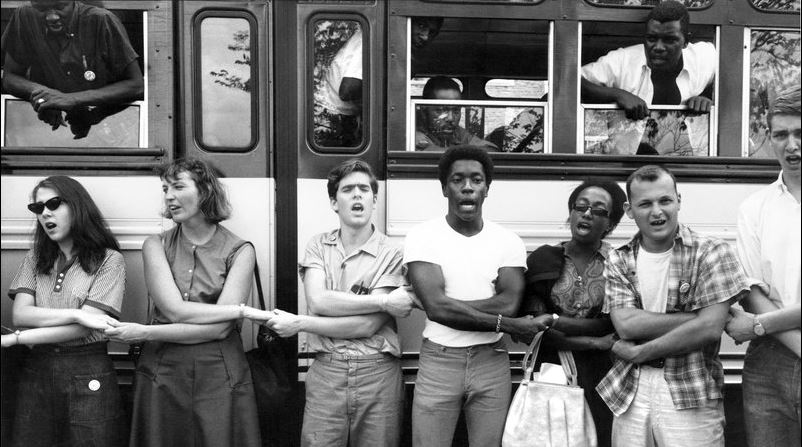
The interviewees participated in the Mississippi Summer Project in 1964, later to be known as Freedom Summer, a drive to register African Americans in the Magnolia State to vote. For decades, attempts by blacks to register at county court houses across the state were met with intimidation, harassment, and even violence. Freedom Summer was an organized response to this situation, with activists from across the U.S. participating, including over 800 college and university students. Among them were about a dozen students from the University of Iowa.
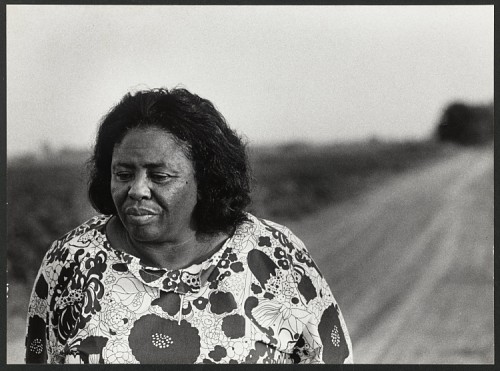
Freedom Summer: Photo from the Ted Polumbaum collection at Newseum
Why Mississippi? At the time, only seven percent of eligible black adults in the state were registered to vote, the lowest rate in the nation. SNCC, the Council of Federated Organizations, the NAACP, and other civil rights organizations targeted Mississippi for this effort due its discriminatory Jim Crow laws and practices. In response to this, the Voting Rights Act of 1965 was passed by Congress and signed into law by President Lyndon B. Johnson the following year.
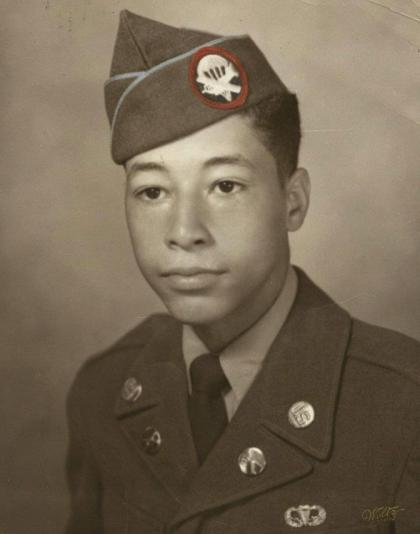
Eric Morton in 1951: Photo from Eric Morton Civil Rights Papers
The interviews are part of the Eric Morton Civil Rights Papers (MsC 0999). Morton (1934-2015), a native of Detroit, Michigan, and a U.S. Army veteran of the Korean Conflict, held various positions with SNCC from 1962 to 1966 in Georgia, Mississippi, Alabama, and North Carolina. He was Materials Coordinator for Freedom Summer and later served as Project Director for the North Carolina Project, which covered nine Black Belt counties. After this he worked to elect black officials including John Conyers and Ron Dellums to Congress and Coleman Young as mayor of Detroit.
In 1968 Morton worked with a group of local activists to organize the 1969 National Black Economic Development Conference where James Forman presented his historic speech, “The Black Manifesto.” In later years, Morton worked as an International Organizer for AFSCME organizing hospital workers and housekeepers in northern California and UC Berkeley. Later, his academic career included the position of Associate Professor of Philosophy at Fort Valley State University of Georgia.
Eric Morton donated his papers to the University of Iowa in 2014, in large part because of his friendship with Stephen Smith (1944-2009), a University of Iowa student from Marion, Iowa. Morton and Smith worked together in Mississippi during Freedom Summer; both were assaulted by white supremacists on the night of July 15, 1964 while delivering voter registration materials from Jackson to Greenwood.
More about how the Eric Morton papers arrived at Iowa is here.
Listen to the interviews from these activists and other recordings from Morton’s collection below:
The great thing about artists books is that it shows us the various shapes, sizes, and textures that books can come in. Publishing companies, who also vary in shapes and sizes, help get these books out into the world for everyone to enjoy.
Curated by University of Iowa Professor Jennifer Buckley, Seeing Seeking Feeling Reading: Granary Books is an exhibit highlighting the book’s flexibility as a concept and as an intellectual and sensory experience by exploring the works published by just one company, Granary Books.
Granary Books is an independent publishing company in the United States and one of the proprietors is a University of Iowa graduate, Steven Clay. Clay graduated with a Bachelor’s in English and Religion in 1978. He describes Granary’s mission as “exploring the relationships between seeing and reading, reading and seeking,” which is where the name of the exhibit comes from.
The exhibit will feature Granary editions all organized into three categories: limited edition artists’ books, writer/artist collaborations, and books about books.
“These Granary Books live on the third floor in Special Collections, but many library patrons don’t know that they exist, or where to access them,” Buckley said. “The Main Library Gallery is a wonderful publicly accessible and beautiful site in which to share the riches of Special Collections.”
Buckley was able to work with Clay and library staff, including Exhibition Designer Kalmia Strong and Head Conservator Giselle Simón, in order to make this exhibit happen.
Seeing Seeking Feeling Reading: Granary Books will be open to the public on February 1 until March 15 on the first floor of the Main Library.
In addition to the exhibit, Cecilia Vicuña, a multidisciplinary artist-activist who makes poems, paintings, installations, books, performances, and films, is coming for a lecture on February 14 at 7:30 p.m. in 240 ABW and she will be doing a poetry reading on February 15 at 4:30 p.m. at the Dey House.
Steven Clay is also coming to give a lecture about the publication and materials in the Main Library on February 15 from 3 p.m.-4 p.m.
“I want viewers to leave the exhibit reminded that books come in many forms and formats, and that viewing is not all we do to or with them,” Buckley said. “Readers can interact with books in multiple ways while using multiple senses. Exhibitors should come back to Special Collections to see, hold and feel Granary Books for themselves.”
If you’re like me, then you haven’t really given them much thought. Growing up in pre-Google days, my family owned a 1988 set that was used and abused by my siblings and I, for both school reports and building forts, and they proved a go-to for school projects and reports in those early years of my education. However, I was more concerned about the information contained within these volumes that I never thought about these encyclopedias as an object in themselves.
On February 13th, Iowa Bibliophiles will finally give you and me the chance to take a moment to appreciate the encyclopedia as an object. Professor Emeritus Arthur Bonfield will be giving his talk “Development of the Eighteenth Century English Encyclopedia or Dictionary of the Arts and Sciences,” exploring not only the history of the English encyclopedia, but also examining early Latin and French encyclopedias that preceded the 18th century English publications.
Professor Arthur Bonfield among his collection.
Professor Emeritus Bonfield has been collecting rare books for over 60 years now. His collections includes over 1,000 original copies of books from early printing days, including volumes on exploration, geography, English literature and history, and of course encyclopedias.
Encyclopedias might seem like an uncommon topic to collect, but as Rebecca Romney and J.P. Romeny explain in their book Printer’s Error: Irreverent Stories from Book History,
“The ability to organize information and distribute it to the public is an incredibly powerful tool…to prioritize information is to control information. And to control information is to control people.” (Romeny 90)
Please join Special Collections and Iowa Bibliophiles on February 13th to hear a fascinating talk about something so many of us take for granted with Professor Bonfield.
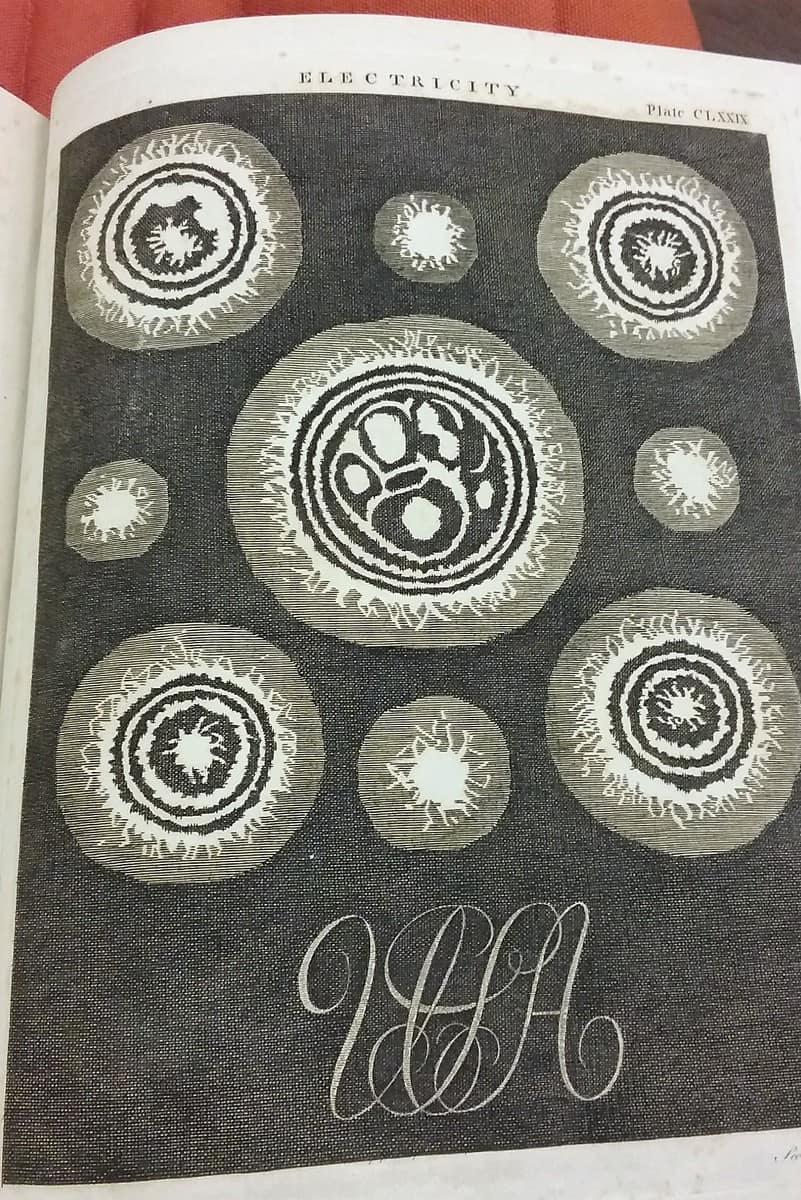
An image of ‘electricity’ found in an 18th C. English Encyclopedia
Event starts at 7pm in the Special Collection’s Reading Room (3rd floor of the Main Library), with refreshments served at 6:30pm. Find out more on our Facebook event or on the UI Event Calendar.
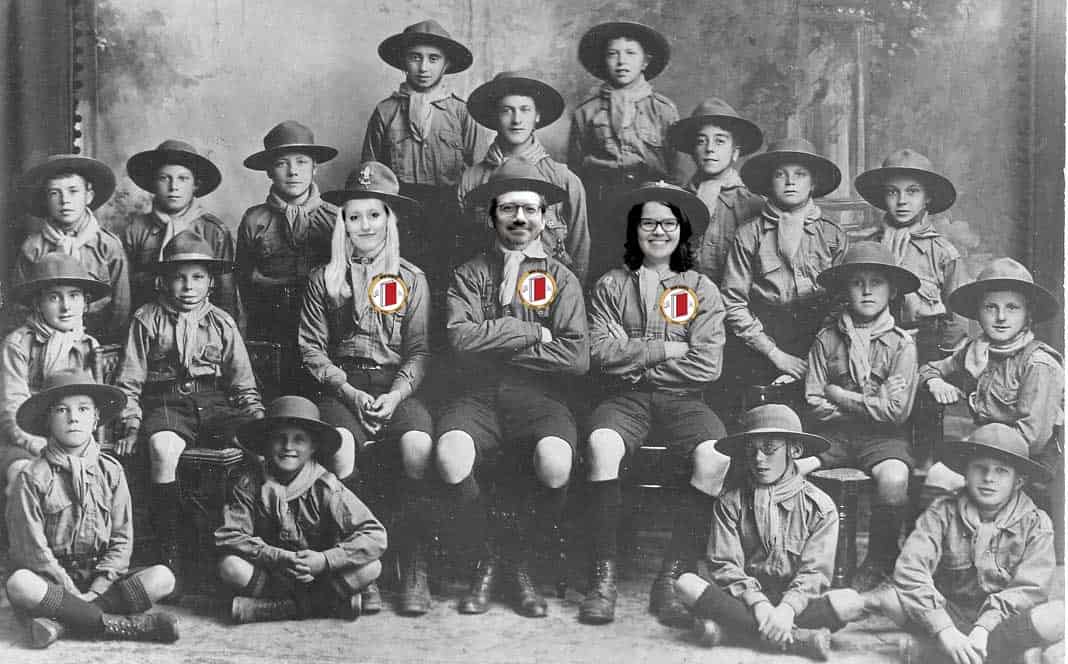
Do you have an interest in bookbinding? Have you always wanted to be a boy or girl scout but never took the opportunity to join? Or maybe you miss those scouting days? Well, now is your chance to earn your Bookbinding badge and join the Book Scouts.
Curated by Olson Graduate Assistant Laura Michelson, graduate student Zoe Webb, and graduate student Damien Ihrig, How to Earn Your Book Scouts Merit Badge is an exhibit now on display in the reading room of Special Collections.
This exhibit breaks down the process of bookbinding in chronological order, starting with a 1950’s Official Boy Scout Bookbinding Kit, which they discovered up in the Conservation Lab of the Main Library. From there, the three graduates display the materials used in making books, including parchment and minerals used in making different colored paints and dyes. The exhibit continues with displays of several historical book binding models, as well as their own creations from their classes in Center for the Book.
Official Boy Scout Bookbinding Kit
“There’s more to the creation of books that people don’t understand sometimes,” Michelson said.
The addition of their own bookbinding work brings their curation of this exhibit to a personal level.
“It does a good job of capturing the specific things that we’re interested in individually,” Ihrig said.
Michelson, Webb, and Ihrig are three graduate students in the School of Library and Information Sciences with a graduate certificate in Book Studies (BLIS). They were asked to create an exhibit about their experiences in the BLIS program and they found that bookbinding was something they all had in common.
But, what made this exhibit really come to life was the boy scout bookbinding kit.
From left to right: Zoe Webb, Damien Ihrig, and Laura Michelson
“We weren’t sure how to set up the exhibit,” Webb said. “We had a lot of the pieces but it was still a little confused, and the kit made everything fall into place.”
They also wanted to add an element of interactivity with the exhibit because the boy scout bookbinding kit included a checklist on how to earn the badge in bookbinding. So, they created their own list for participants to earn their book arts badge for the new Book Scouts.
Along with the list, there will also be a pop-up exhibit on March 6th from 1 p.m. to 4 p.m. where people can make their own book and check-off an item on their list to get their badge. Other items include visiting the exhibit, visiting Special Collections, attending a bibliophiles talk and then submitting a form by April 2nd. Then you could be an owner of a Book Scouts Merit Badge.
You can download the list here or pick one up at the front desk at Special Collections. Once filled out, turn it into the Special Collections front desk to receive your own badge!
How to Earn Your Book Scouts Merit Badge is currently on exhibit and will be up until the mid-to-late April.
I was hired at Special Collections to shelve things. Books, boxes and everything in-between. As time went on, I began putting away newly acquired books as well as gathering the material for classroom use.
There are so many books and material passing through my hands each shift I complete, and each book or item is unique. Some test the true definition of what a book should be, or what our image of a book is. So, in no particular order, here are my ten favorite books I have found in the stacks:
Winnie ille Pu by A.A. Milne (xPZ5.M65 W512)
This is a Latin version of A.A. Milne’s Winnie the Pooh. This silly old bear is still a favorite of mine, and I love that it is so popular that it even comes in a dead language. The cover also depicts Pooh and Piglet wearing Roman battle gear.
The inside of Paper Samples.
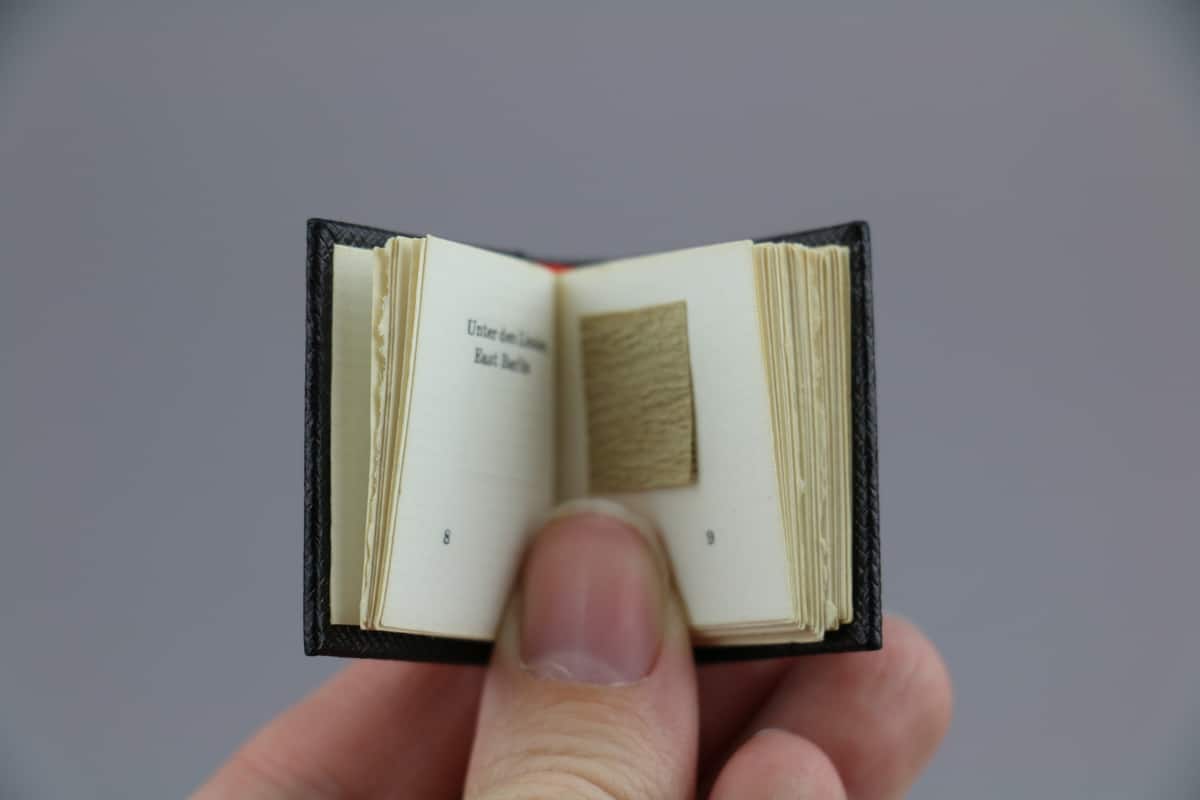
Paper Samples 1966 by Glen Dawson (Smith TS1220.D27 1966)
This is one of our many miniature books, but it is one of my favorites because it is a mini-book with little paper samples in it. That’s it.
The Perfect Martini by Emily Martin (Szathmary N7433.4.M364 P47 1998)
I really enjoy this artist book because it makes you consider what a book to be. This is literally a martini glass with an olive in the bottom. The only words are on the box it is encased in, saying: “Place ice in a shaker, fill as needed with gin. Observe a moment of silence for the vermouth. Strain into a martini glass. Add olives and serve. Instructions may be repeated.”
Complete Works by William Shakespeare
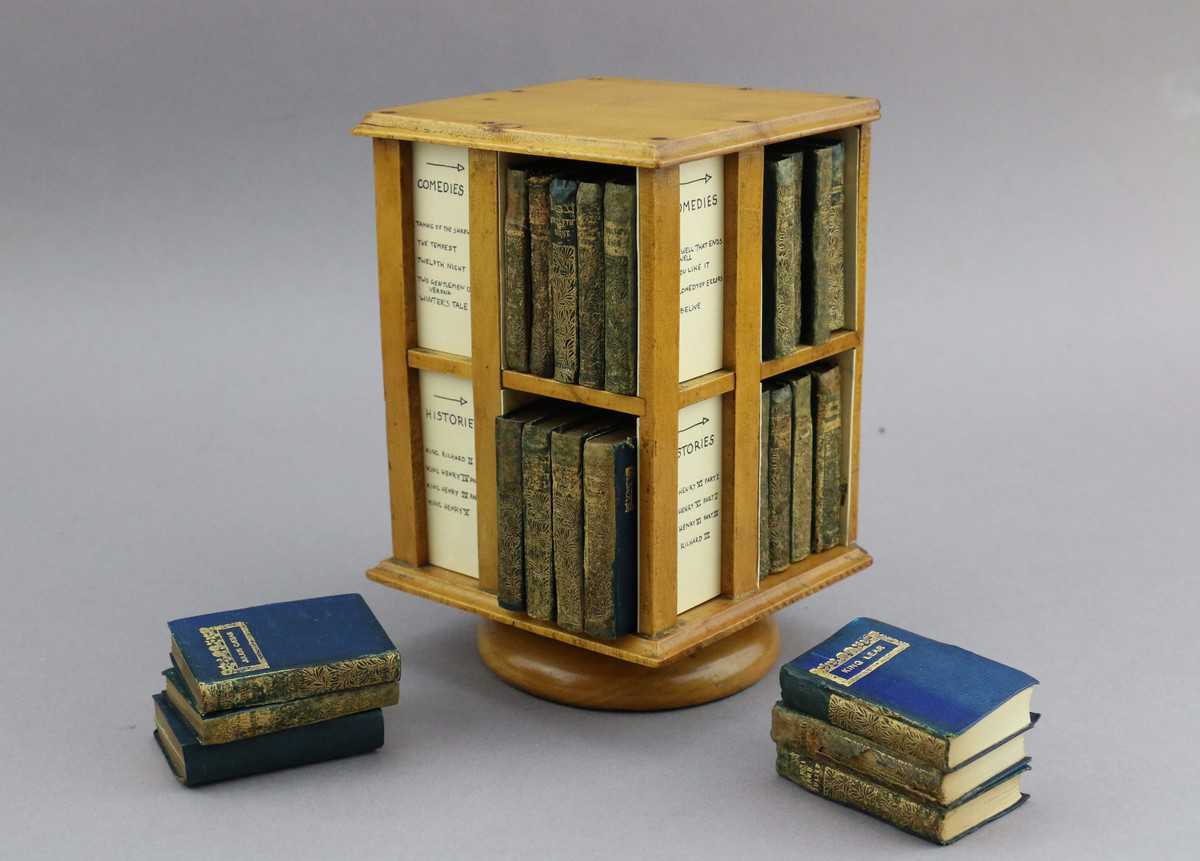
Complete Works by William Shakespeare (Smith PR2754.E5 1904 v 1-40)
Shakespeare is one of my favorite authors to study, so it’s only fitting to put him in my list. This book I listed is actually all of his plays, but they’re mini!!! And they come with their own rotating bookshelf! I love everything about this set, including the floral end-paper.
Global Perspectives by Christian Science Publishing Society (Maps G3201.A67 1968 .C5)
This one is from our Maps Collection. We have so many different maps, but this one stuck out to me because it’s the United States seen from the perspective of Canada.
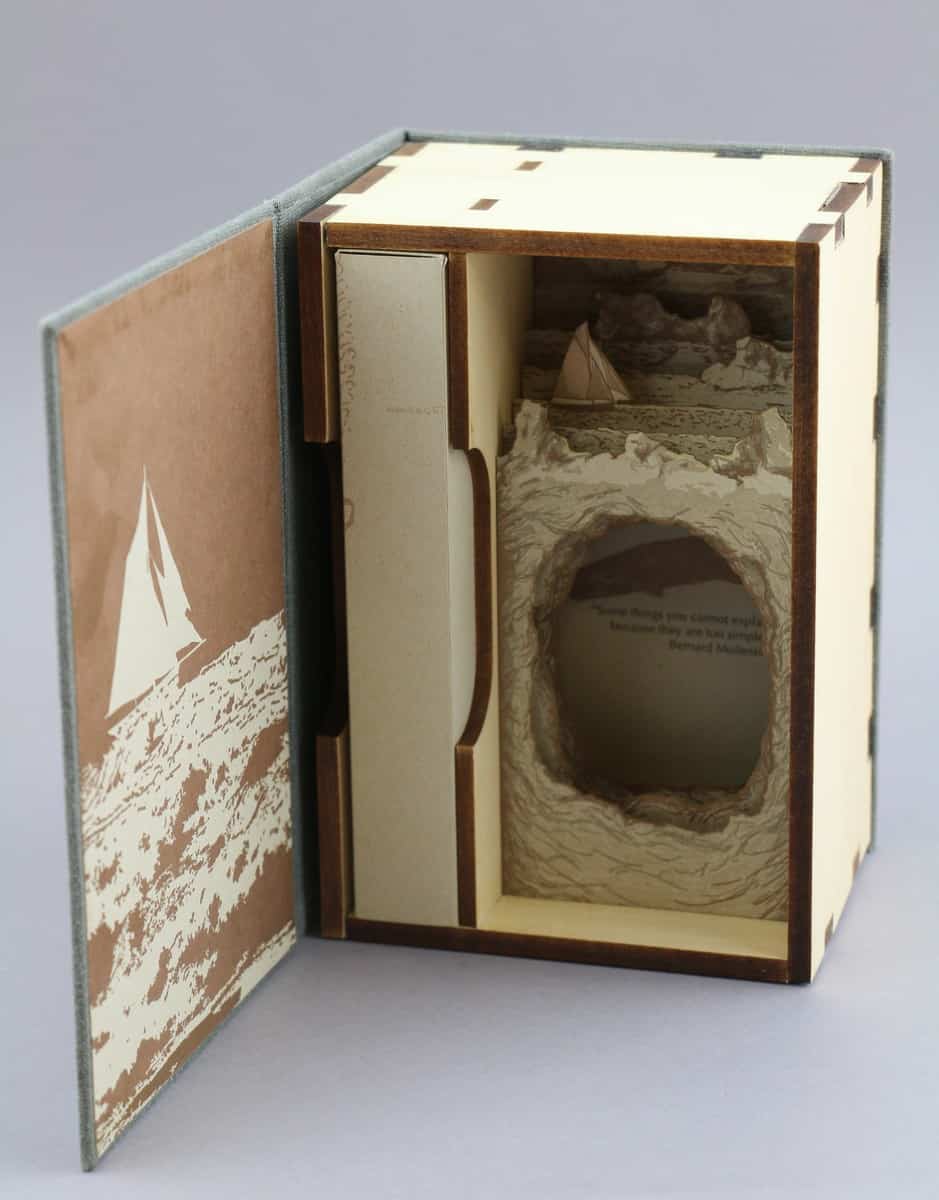
Box for God Created the Sea and Painted it Blue so We’d Feel Good on it
God Created the Sea and Painted it Blue So We’d Feel Good on it by Michelle Ray (xN7433.4.R39 G63 2013)
This was one of the first books I came across while working here, and it has stuck with me during my two years here. It isn’t the book that is the wow factor, but the box that holds the book. It is simply beautiful. The detail included on it and the way you can feel the water moving makes it a special piece.
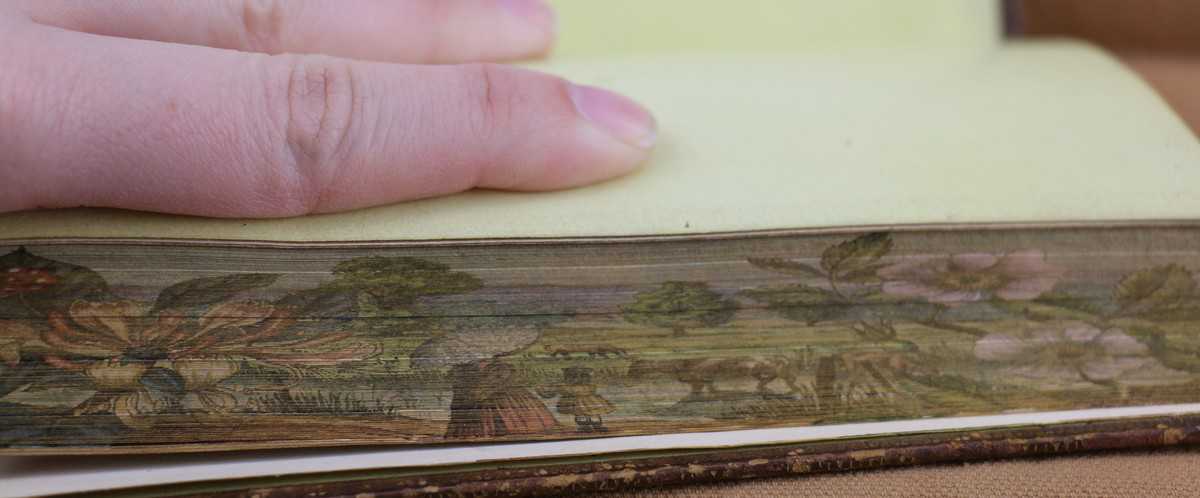
The edge of Summer
Autumn; or: The Causes, Appearances, and Effects of the Seasonal Decay and Decomposition of Nature by Robert Mudie (QH81.M93 1837), Spring, or: The Causes, Appearances, and Effects of the Seasonal Renovations of Nature in All Climates by Robert Mudie (QH81.M933 1837), Summer, or: The Causes, Appearances, and Effects of the Grand Nuptials of Nature in All Its Departments by Robert Murdie (QH81.M934 1837) and Winter, or: The Causes, Appearances, and Effects of the Great Seasonal Repost of Nature by Robert Murdie (QH81.M935 1837)
I had to group all four of these together because it is just too hard to pick one. If you do pick one, then you pick your favorite season. I don’t like these books for the words or the cover, but for the image that is hidden on the spine. When you fold the pages of the book a certain way, an image is presented to you. That image is a season; four books for four seasons.
El Taco de Ojo = Easy on the Eye
El Taco De Ojo = Easy on the Eye by Edward H. Hutchins (Szathmary N7433.4.H88 T33 2000)
I couldn’t tell you exactly why I like this book so much, or why it made it to the list instead of other books. I mean, it’s literally a book in the shape of a taco. And who doesn’t love tacos?
Plotted: a Literary Atlas by Andrew DeGraff (Maps PN56.M265 D44 2015)
Now, this is an interesting piece because it also comes from our Maps Collection, but it isn’t a map of a place you can visit physically. This book contains different maps of famous literary tales, including the short story “The Lottery” and The Odyssey.
Curtis’s Botanical Magazine by John Sims (xQK1.C9 any volume)
Inside Curtis’s Botanical Magazine volume 5-6.
These are simply beautiful. They have illustrations of different flowers in it and its gorgeous. It makes me wish I had the talent to do something like that. And all of the volumes are created that way.
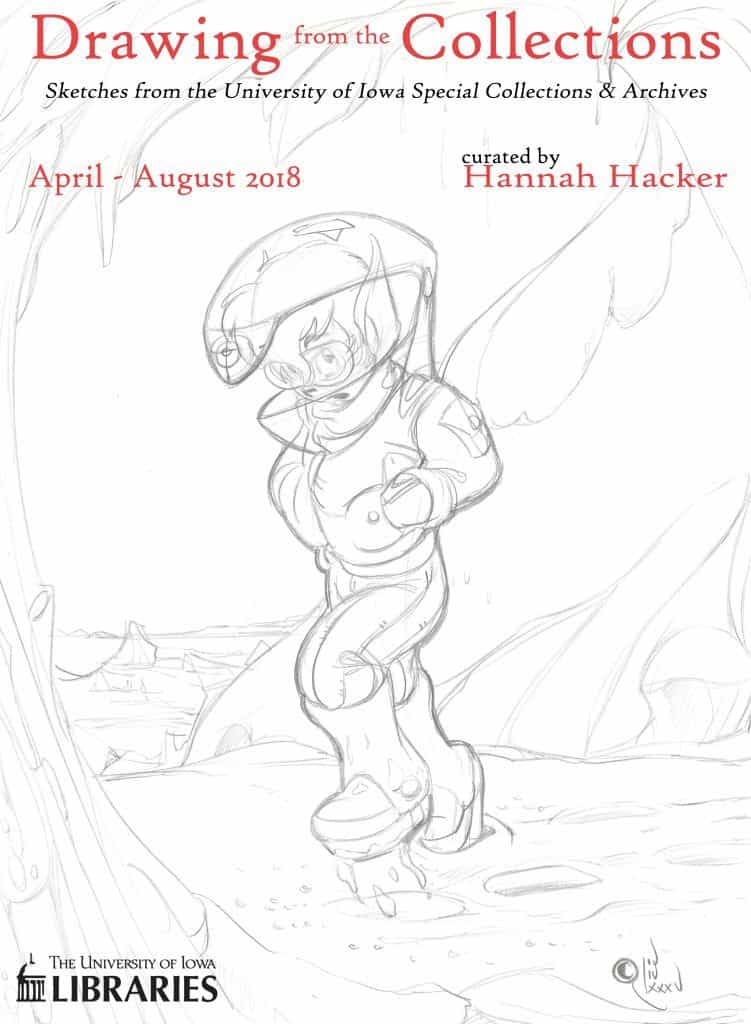
My Favorite Things (a la Special Collections) by Hannah Hacker
For the past two and a half years, I have had the honor to work as a graduate assistant at the University of Iowa Special Collections. I am thrilled about graduating from my Library Science and Book Arts program this semester, and I am excited to see what adventures I’ll embark on next, but I will certainly miss my Special Collections family. I am thankful for the friends I have met here and the opportunities that I was given. I’m not the best at waxing emotional, so, instead, I will leave you all with my own little rendition of a classic, “My Favorite Things”:
Archival boxes And sketches of spaceships Bright crimson wax on some very aged papers Gray Wonder boxes high on the shelves These are a few of my favorite things
Cream-colored parchment and crisp comic pages Dress swords and old maps And Medieval doodles Really small books with tiny wood-prints These are a few of my favorite things
Kids in the classroom with handwritten letters Red rot that stays on my shirts and nice sweaters Staple-bound fanzines and pulp magazines These are a few of my favorite things
When the day’s long When the class is done When I’m feeling sad I simply remember my favorite things And then I don’t feel so bad
Thanks to Hannah for the hard work, laughs, and pure librarian magic that you brought Special Collections!
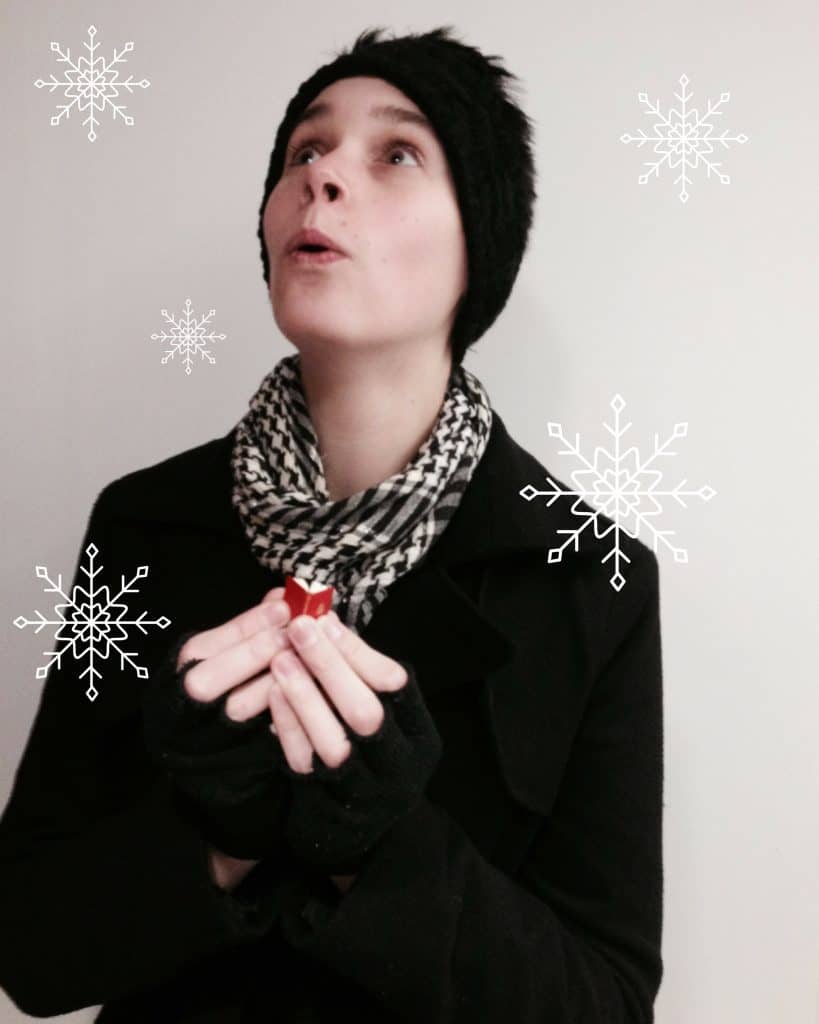
Hannah HackerPoster from Hannah’s Final ExhibitHannah singing carols from a Smith MiniHalloween fun in the StacksDancing with the books
Below is a reflection from Micaela Terronez, Olson Graduate Assistant, on the “Manuscripts at Special Collections” open houses.
Can I really touch it?
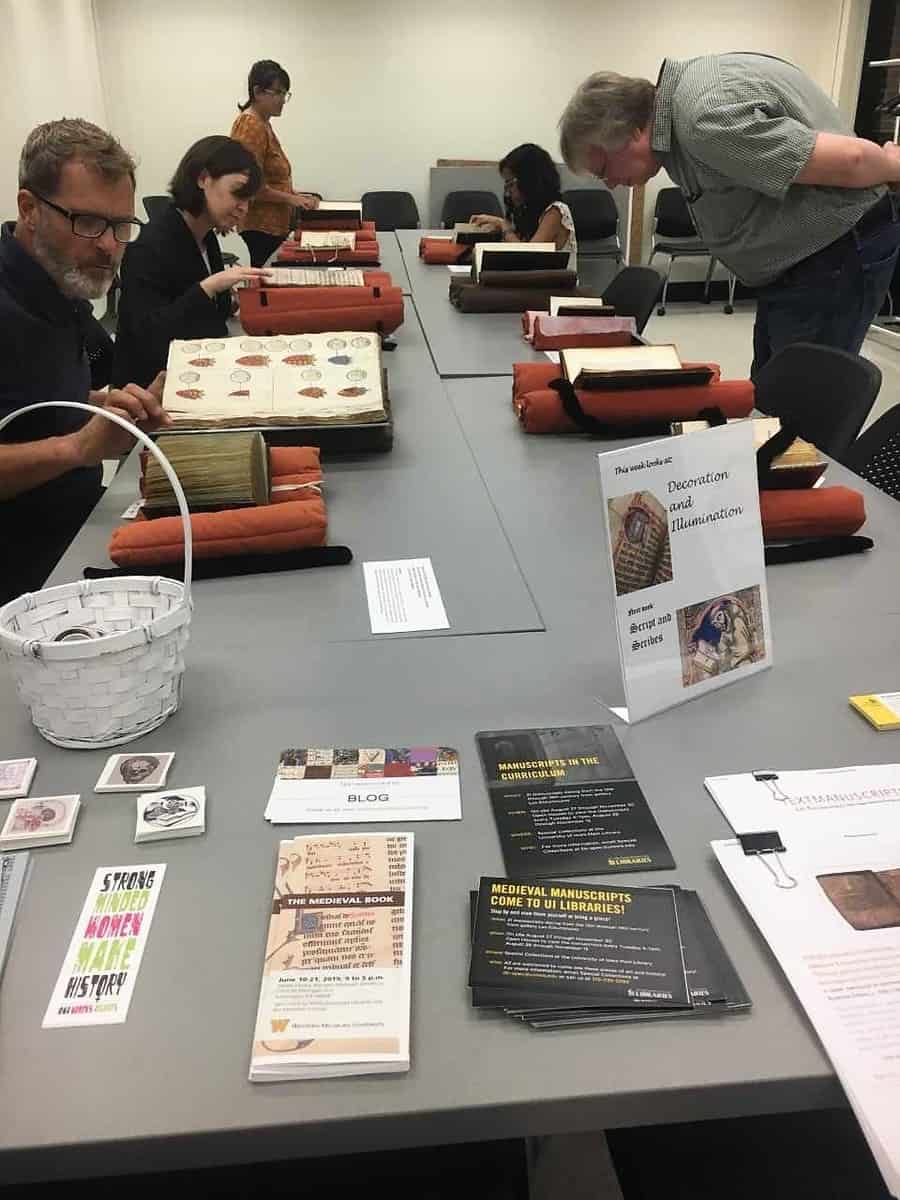
One curious visitor asked this question in amazement as they gazed at one of the twenty-one visiting manuscripts from Les Enluminures, a gallery of unique text manuscripts with locations in New York, Paris, and Chicago. As a part of the program, “Manuscripts in the Curriculum,” Les Enluminures temporarily loans a select group of unique manuscripts to educational institutions. Fortunately, The University of Iowa Libraries’ Special Collections was able to host the manuscripts, covering various contexts and locations from the 13th to the 19th century. In addition to classroom integration, Special Collections planned a series of open houses for the University and broader community to have hands-on experience engaging with these one-of-a-kind pieces. From August to November, around 200 visitors viewed the visiting manuscripts—along with a couple favorites from our own collections.
Logistically speaking, each open house exhibited 10 to 12 manuscripts aligned with a pre-decided theme. The themes included: Signs of Production, Decoration and Illumination, Script and Scribe, Manuscripts Outside Latin West, Medieval Society, Vernacular Texts, Music, Medieval Authors, and Bestsellers. This diverse set of themes allowed us to highlight certain texts each week without exhausting the materials or the visitors. The open houses were marketed through classroom instructions, social media, departmental networking, events, newsletters, and blogs. These efforts garnered an audience of students, scholars, and outside community members of various ages and backgrounds.
At the open houses, guests were given brief guidelines to handling the manuscripts and were encouraged to turn the leaves by the margins. Like the curious visitor above, many could not believe that they could touch, let alone, move through the leaves of a codex to see every script and image. However, in cases with a large number of visitors, guests were advised to admire the manuscripts without touching as to protect the longevity and structure of the manuscript. During these events, special precautions were taken to make sure the manuscripts were handled carefully, while also allowing the viewer to engage and ask questions. Non-flash photographs were highly encouraged, and many patrons took away some amazing captures to keep and share with friends and family. We also offered an interactive matching game of medieval authors, temporary tattoos, buttons, and bookmarks for visitors to take home.
Because of an increase in public visitors, the fall semester was a whirlwind of planning, marketing, curation, learning, and teaching. For example, Elizabeth Riordan (Outreach and Engagement Librarian) and I created specially made description cards for each manuscript on display—that’s a lot of writing and research! The description cards served two purposes. First, it was the perfect way for us to learn more about the visiting manuscripts, along with the interesting details and histories. This knowledge proved highly valuable during open houses and classes. Secondly, visitors were able to easily understand the terminology, history, production, and uses of the items exhibited. These descriptions also helped to spur questions and discussions throughout the weeks. Riordan and I also enjoyed choosing manuscripts from our own collections to feature alongside the visiting manuscripts. In this way, we were both able to think more contextually about the manuscripts from Iowa and what themes can be highlighted throughout them. In addition to our visitors, we both walked away from the open houses more knowledgeable about medieval manuscripts, their features, and histories.
There were several other benefits and take-aways from these open houses. Perhaps most importantly, we learned a great deal about the value of increasing access and visibility of the manuscripts through hands-on exploration. Patrons made incredible observations about the texts, while also initiating fruitful discussions amongst themselves and with staff. They also inquired about the contexts, materiality, users, producers, and authors. More so, visitors were able to actually feel the hair of the parchment, translate scripts, study the bindings, and so much more! With calm medieval chants playing in the background, many also took the events as an opportunity to relax and purely admire the artistry behind the texts. I would say friendships and interactions were created among these beautiful works, an effect that perhaps wouldn’t have happened without the hands-on experience with the manuscripts.
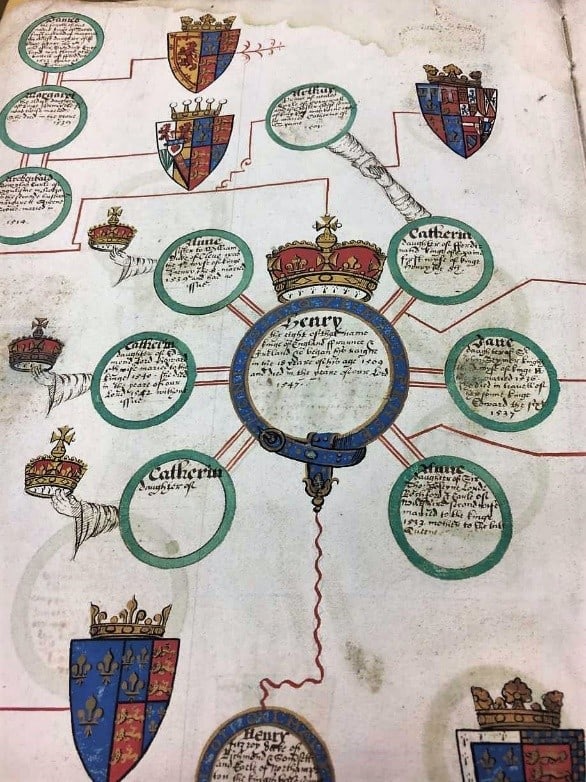
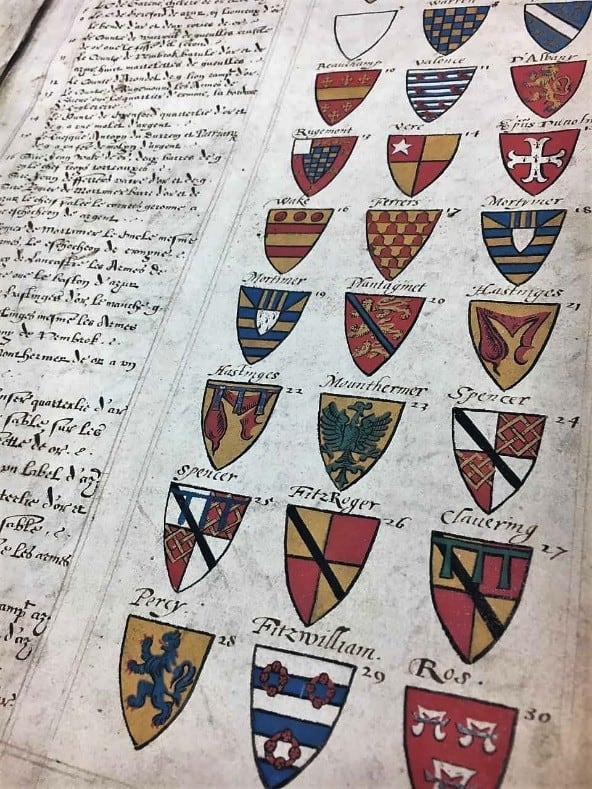
The open house series ended with one last exhibit, as well as a visit and talk titled “People and the Book: the Voices of Manuscripts from the Middle Ages” from Laura Light of Les Enluminures. These final events allowed visitors to ask intriguing questions about the visiting manuscripts from Light, an expert historian on medieval works. As November comes to a close, it is now time to say goodbye to these works. I, for one, am going to miss the manuscripts very much. Here are a couple of photographs from my favorite visiting manuscript, a “Roll of Arms” created during the Elizabethan period in England. The manuscript features stunningly detailed shields, illustrated crowns, and stylized arms shaking hands to signify marriage. Like myself, I am sure many visitors appreciated the work and talent that went into these lovely pieces.
The successful planning and implementation of the open houses was a team effort of the library and conservation staff, and we were incredibly grateful for the opportunity to engage with the community, students, and faculty during these open houses. Thank you to all that visited Special Collections, asked questions, and made us ponder the creation and use of these manuscripts. We hope you continue to visit us in the future, whether it is for research, exploration, or just admiring a cool book or leaf.
This Halloween season, Frankenstein is everywhere. And no wonder, for the book turned 200 this year and is overdue for a party. While the monster is everywhere, what about the woman who created the famous story? We’ve asked our own Frankenstein expert and Curator of Science Fiction and Popular Culture, Peter Balestrieri to review the latest film on the famed female author.
Review of Mary Shelley, from Peter Balestrieri
In 2018, the 200th anniversary of the publication of Mary Shelley’s Frankenstein, a new film by director, Haifaa Al-Mansour, Mary Shelley, opened and died quietly. Not the subject, writing, direction, nor the talent and reputations of its stars could save it. I saw it and enjoyed it very much. I anxiously waited for this film after it went into production and hoped it could do justice to its subject and the Romantic period. It comes not long after a recent biopic of doomed John Keats, and, featuring doomed Percy Bysshe Shelley, doomed Lord Byron, and doomed John Polidori, along with possibly the greatest teenage author ever, Mary Shelley, it promised to be a welcome addition to all the scholarly and pop culture attention focused on Frankenstein. Alas, it bombed.
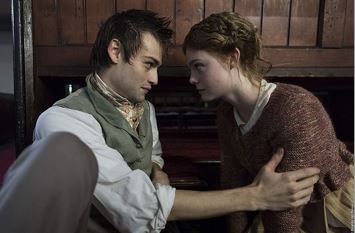
Elle Fanning and Douglas Booth in Mary Shelley (2017)
Some critics panned the film for deviating from historical fact; it is actually very close to the mark with a few notable exceptions. Some have objected to the acting; it was certainly good enough, with Elle Fanning doing a wonderful job, proving again that she is one of film’s best young talents. Familiar faces from Game of Thrones and BBC productions round out the cast. Most reviewers agree Mary Shelley is a very good film to look at; I thought so too, especially the costumes and interior shots. Also good: the dialog, both sharp and poetic. For me, though, one feature more than any other makes this a film worth seeing for anyone interested in the period, the subject, the personalities involved: the troubled, complex relationship between Mary and Percy.
I began research into Frankenstein years ago, using materials from Special Collections and Shelley biographies and it was Mary’s story that impressed me the most. I think Mary put much of her pain and frustration with Percy and his treatment of her into the novel, writing Percy as Victor Frankenstein and herself as the Creature. The film goes into this territory in a way unseen before and I loved it. Percy Shelley is a Bad Boy, who, along with Byron and others, creates the lifestyle emblematic of the Romantics, doomed libertine artists who blaze comet-like and are gone too soon. When Mary rejects her husband’s hypocrisy, cruelty, and excess, the film sends a powerful message to young women and men. See Mary Shelley if you get the chance. I will definitely be seeing it again. It is, however, not a good Halloween film; the only monsters in Mary Shelley are the people in her life.
This week we said goodbye to our Herky exhibit and said hello to the beauty of papermaking.
Giselle Simón, Head Conservator at University of Iowa, was invited to curate an exhibit called Hand Papermaking Portfolios: Selections from 1994-2017 in honor of the Dard Hunter and the American Printing History Association joint conference, which will be held here, in Iowa City, starting Thursday, October 25th.
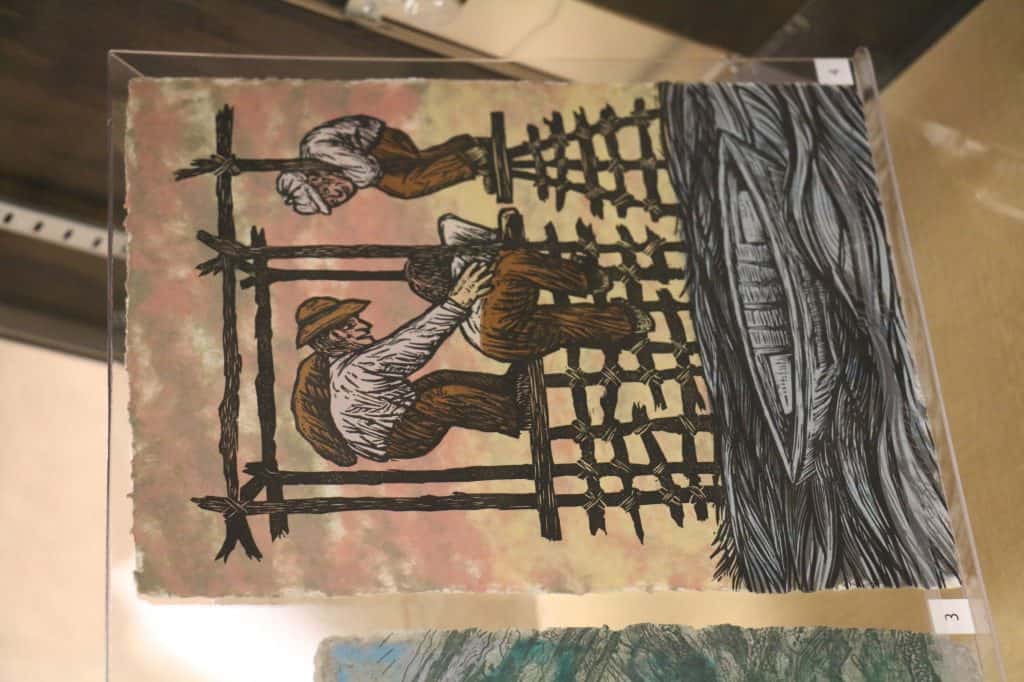
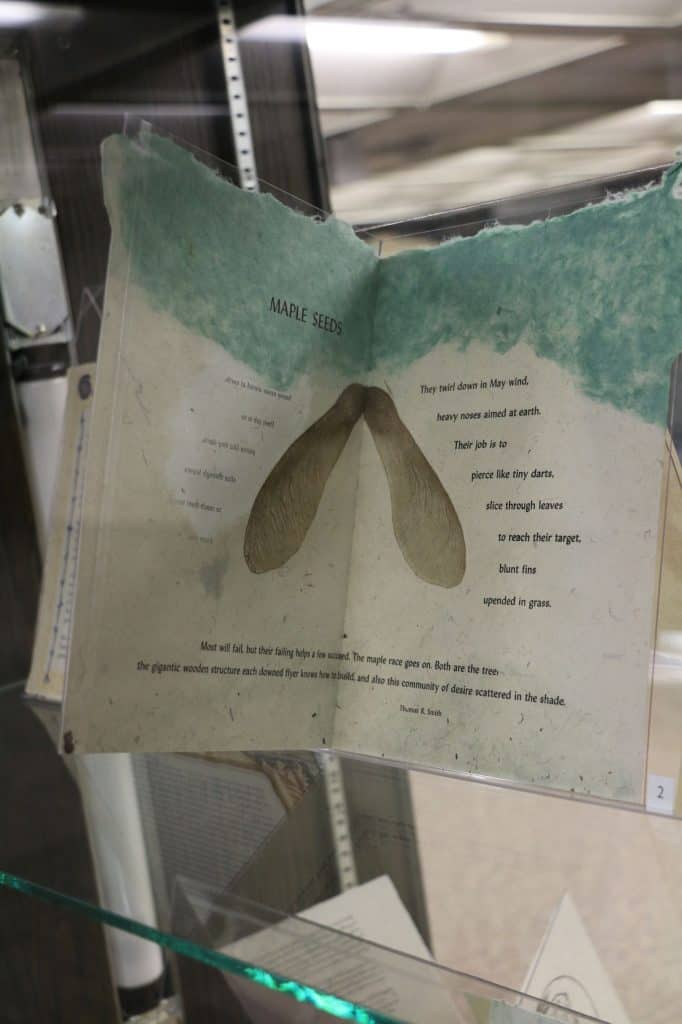
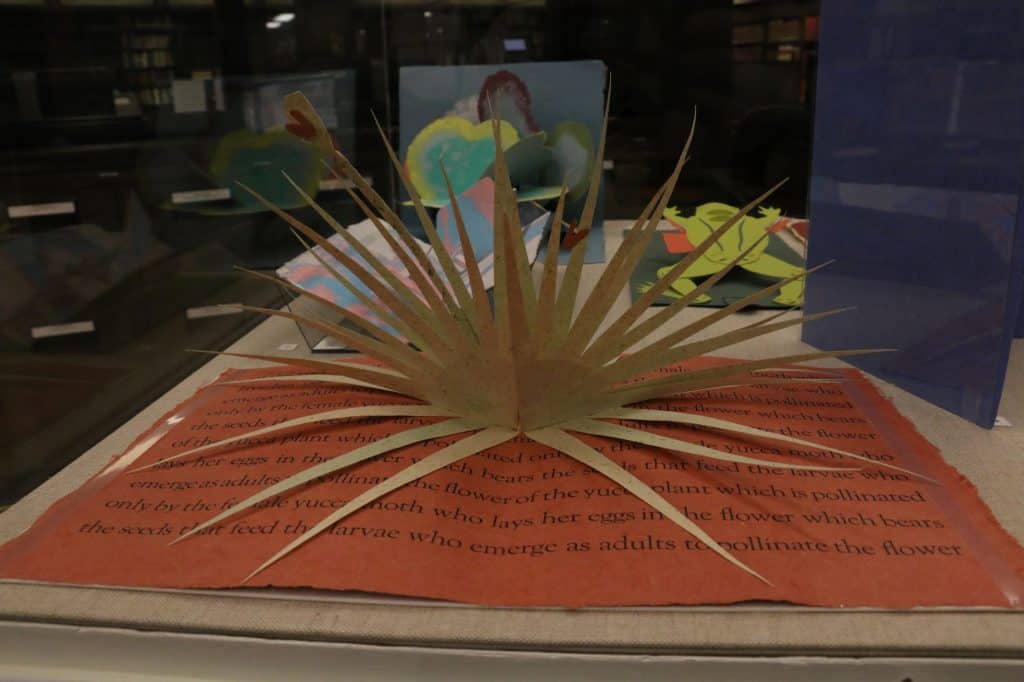
The pieces on display in the Special Collections Reading Room all come from the Hand Papermaking Portfolios held within Special Collections. There are twelve different categories, including calligraphy, watermarks, pop-up and more. Simón was able to include something from each portfolio for the display, a task that has not been done before now.
This series is a growing collection, with the first modern hand papermaking produced in 1994 by Hand Papermaking Magazine (a publication founded by Michael Durgin and Amanda Degener in 1986). The goal of the magazine itself was to provide an educational resource for those who did hand papermaking. The portfolios allow paper artists to come together and share skills and information about their work, and they contain the works of several individuals, making this project a true community effort.
“I want people to see the different varieties in hand papermaking,”Simón said. “I want them to see hand papermaking as another medium of making art.”
By looking at the display, viewers can certainly tell it is a form of art. The watermarks display case is an example of that.
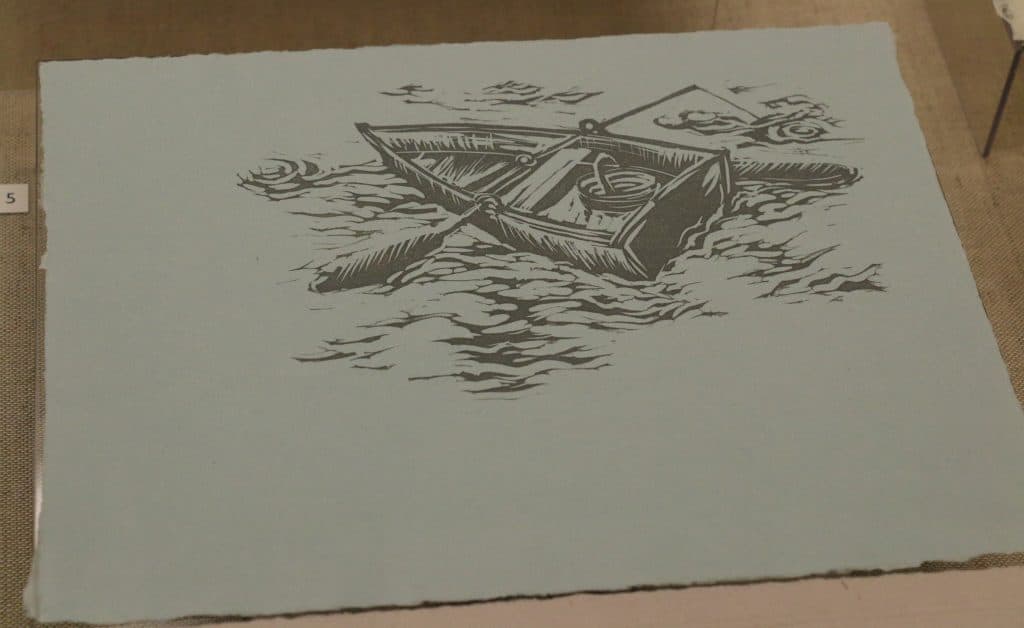
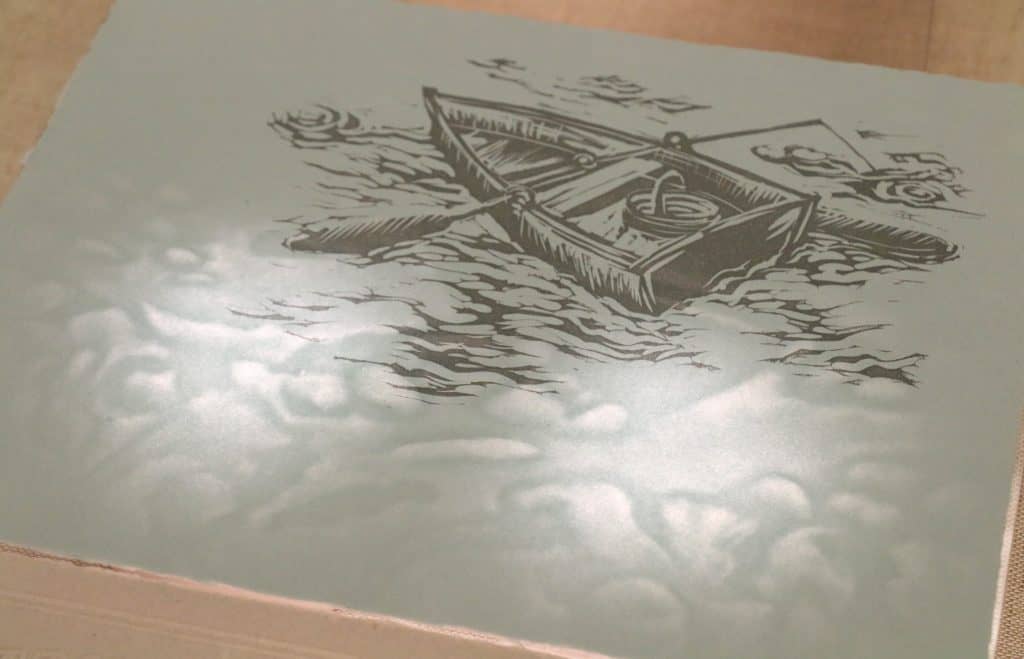
When looking at this particular display case, the selections are interesting, but seem to be missing something. Some just look like pieces of paper with a simple image on it. However, it isn’t until the visitor turns on the lights placed underneath the paper that the watermarks are revealed and the images are completed.
“I enjoyed working with Bill Voss, the exhibit preparator, to create mounts that would illuminate the watermarks,”Simón said.
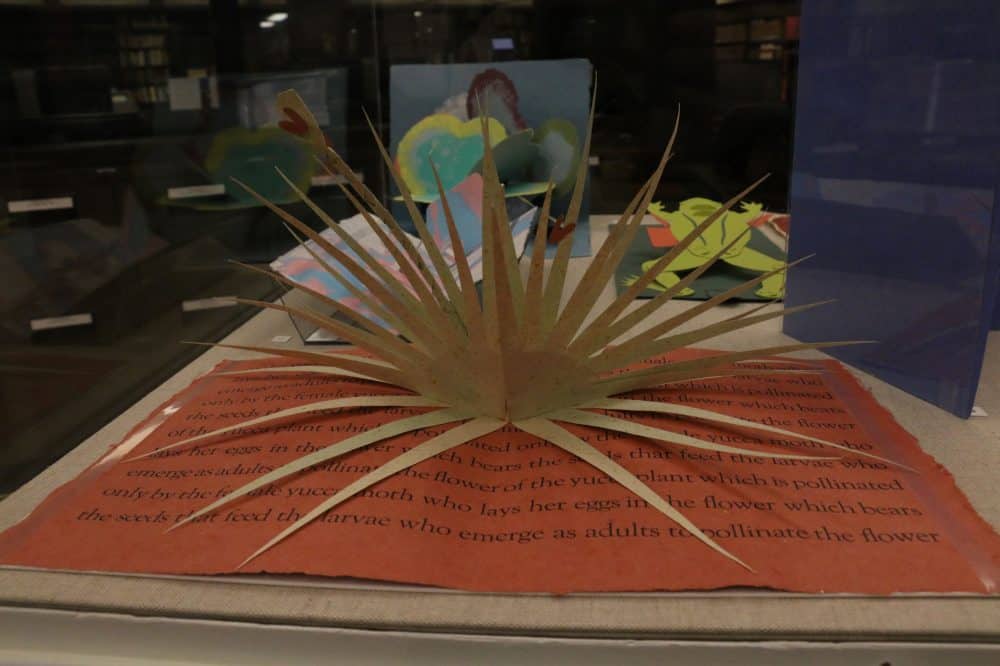
The watermarks are not the only thing coming to life in the display. There is a display case devoted to pop-up papermaking and it is truly sprouting life. Every piece on exhibit shows how papermaking is a work of art.
Hand Papermaking Portfolios: Selections from 1994-2017 is now open and will be until early January.
Art in papermakingNature inspired papermakingWatermark before lightsWatermark after lightsPop-Up Portfolio