Soldering is one of the most fundamental skills needed to dabble in the world of electronics. The two go together like peas and carrots. And, although it is possible to learn about, and build, electronics without needing to pick up a soldering iron, you’ll soon discover that a whole new world is opened with this one simple skill. This class will focus on doing surface mount soldering.
Jeremy Roszell, Engineering Electronics Shop, will be teaching this workshop!
This is a FREE workshop, but space is limited! Be sure to register today!! Visit the Learn & Create webpage for more information on all these great workshops!
Soldering Basics – Through Hole
Tuesday, September 17th; 5:00 p.m.
Engineering Library Creative Space
Individuals with disabilities are encouraged to attend all University of Iowa-sponsored events. If you are a person with a disability who requires a reasonable accommodation in order to participate in this program, please contact Kari Kozak at kari-kozak@uiowa.edu in advance of the event.
Hey students! Are you interested in giving your idea, project, or invention a kick-start? Want to make that project a reality?
Registration is now open for the Kick-Start program! The Engineering Library and the Engineering Technology Center (ETC), are pleased to once again present the Creative Kick-Start program! Applications will be accepted through October 25th.
The program is designed so engineering students (undergraduate and graduate) may request funding to pay for prototyping and/or finishing projects – using the services offered through ETC and the Library Creative Space,
There will be ten $500 awards!!How exciting is that!?
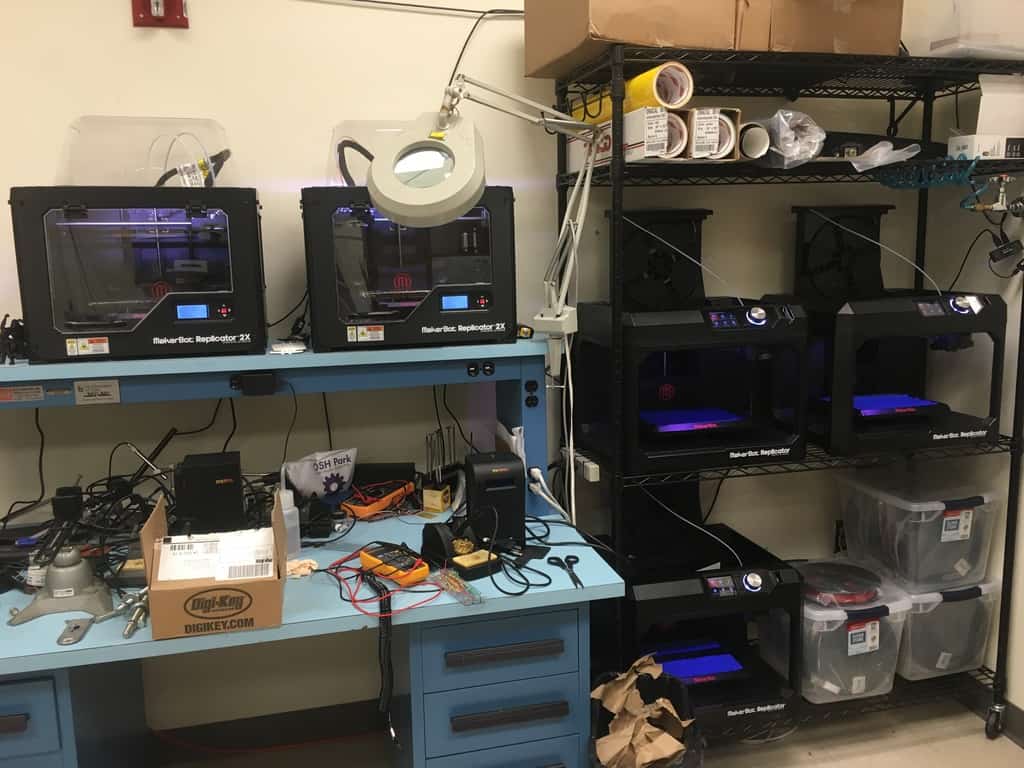
Five 3D printers available in the Engineering Electronics Shop (EES)
Since there will only be 10 awards, this is a competitive process! Make sure you check the Kick-Start webpage to get complete details and get your application in soon!
Briefly, any graduate or undergraduate engineering student may apply for a Kick-Start award. You come up with an idea which can be completed in roughly 3 months, find a faculty or staff sponsor, complete an online application form, attend an in-person workshop (approximately an hour), hand in a progress report, and present your project in April!
There are a few requirements which include (but aren’t limited to) keeping receipts and a record of all expenses (a budget spreadsheet template will be be provided). A post-project survey of the Kick-Start program will also be required.
You are strongly encouraged to visit the Hanson Center for Technical Communication for assistance with writing your proposal before it is submitted. We also suggest you fill out a hackaday.io page and use it to post regular, substantial updates on the status of your project. Each update should include photos – of your project, notes or sketches – and text explaining your progress. Invite a university photographer to take photos while you are working on your project (contact info will be provided later).
There are a few restrictions, one of which is you may not already be receiving funding for this project from any other source. There can only be one idea per submission and a student may only be the primary investigator on one Kick-Start per year. Students may be co-investigators on more than one project. Be sure to check the Kick-Start webpage for more information.
So what else do you need to know?
Creative Kick-Start Innovation Kit!
The idea for the project is yours, and may be a finished product or a prototype. You maintain ownership of your idea and anything you build during the project. A team may work on the project together, but one student must be designated as the primary investigator. A primary investigator may be a co-investigator on another project.
You may keep any materials you purchase for your project, but tools purchased should be turned in to the Creative Space for use by future makers. Knowing what items must be returned can be a gray area, so please direct any questions about what should be returned to lib-engineering@uiowa.edu. The $500 award may only be used in ETC for materials, tools, and labor, etc. Any unused funds will revert back to the program and will go toward helping another future maker build their idea. There also are many tools in the Tool Library which are available to check out.
You are required to have a sponsor who will review the requirements of the Kick-Start program and review your application before it is submitted. The sponsorship officially ends with the presentation in April, but the sponsor and student(s) are free to continue to work on the project if they so choose.
Remember that ‘failure’ is part of the creative process. The important thing is you learn from these failures and therefore are better prepared for future projects. You will still be required to present your project in April – your presentation can deal with what went wrong, how it could be fixed, what you would do differently, and what you learned through the process. As Elon Musk said, “Failure is an option here. If things are not failing, you are not innovating enough.”
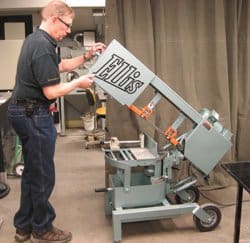
Ellis mitre band saw in the Engineering Machine shop (ETC).
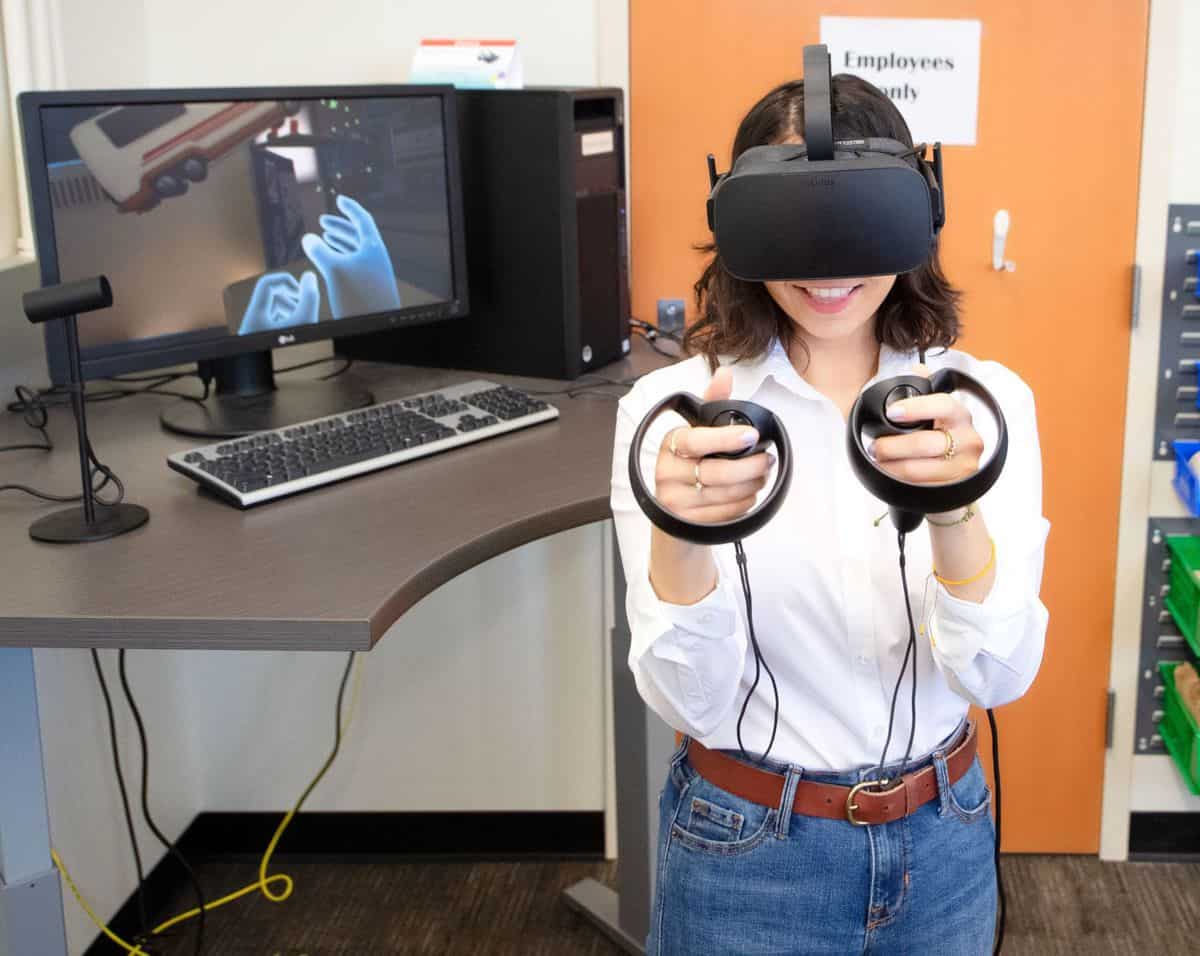
There are so many resources to help you complete your project! Our Creative Space is a great place to begin! Two collaboration tables, each with a quad-screen monitor will help your team work together to imagine your project. There are 4 modeling stations with the high-powered software you need. 3D cameras, a 4400 Dell computer with a video card, Leap Motion controllers and an Oculus Rift virtual reality headset and controllers can help you manipulate your project in virtual reality (check the Tool Library resources!). ETC hasthe equipment you need to take your project from virtual reality to reality! EES provides circuit board fabrication, dye sublimation printing, PC board prototypes, laser cutting and etching and 3D printing (among other things!). There are also sheet metal tools, power hand tools, computer controlled machine tools (and more!) ETC staff are happy to answer questions and provide guidance!
The funds for this project are generously provided by the Engineering Technology Centers.
Application Review Committee is Kari Kozak (Head, Lichtenberger Engineering Library), Jeff Nock (Entrepreneur in Residence/Lecturer, John Pappajohn Entrepreneurial Center), and Spencer Stumpf (Inventions Manager, UI Research Foundation).
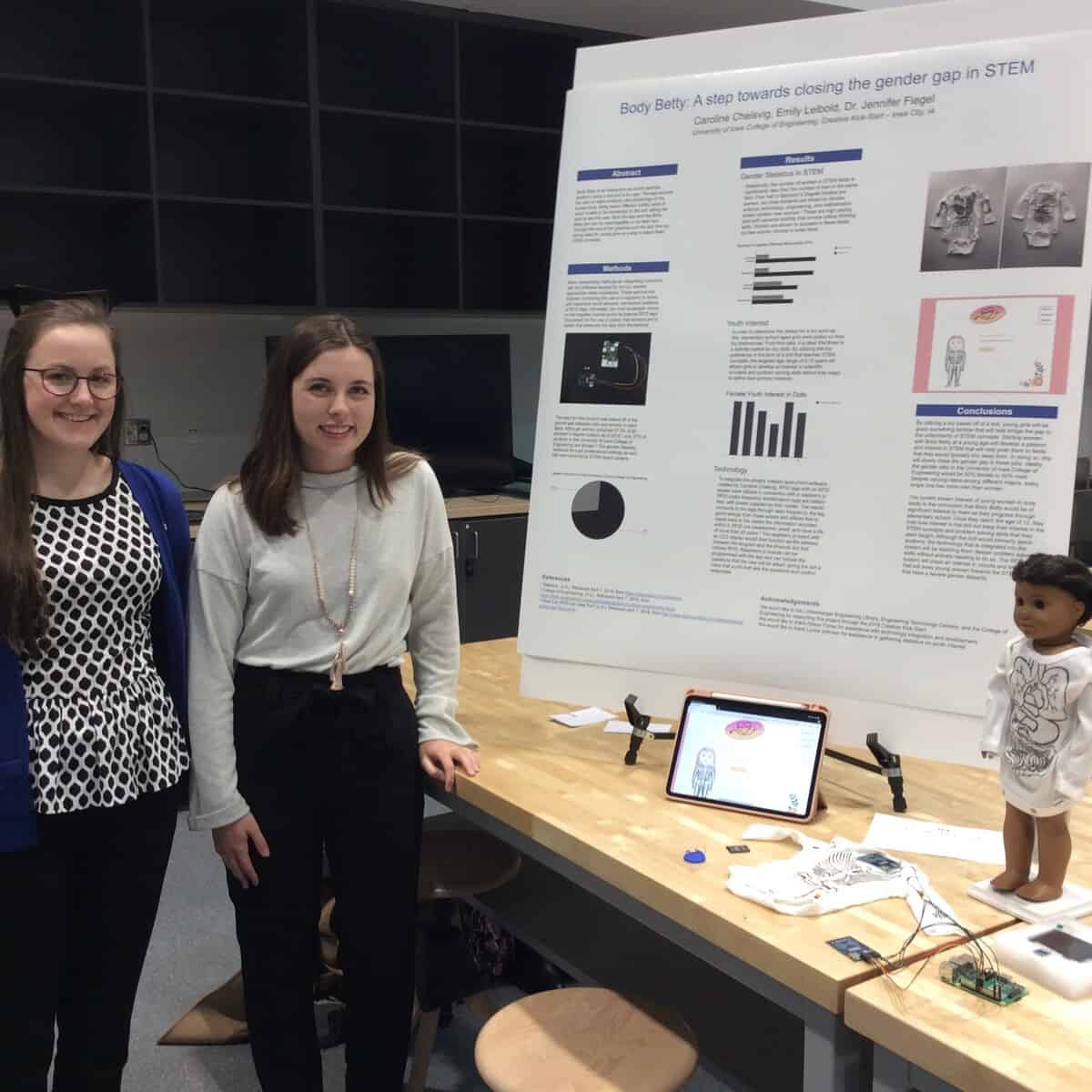
“Body Betty” created by Caroline Chelsvig & Emily Leibold“Root Canal Pal” Ethan Slater, Collin Zweifel, Annie Cahill, Shao Yang Zhang, & Nina VanDerZanden
Here are two of the groups which have received Kick-Start awards! You could be an award winner, too! Get your application in before Oct. 25th and start making your vision a reality!
We look forward to seeing your projects and working with you to make them a reality!
What is a patent and how the heck can you find one? Kari Kozak, Head Lichtenberger Engineering Librarian, will be leading a FREE workshop on those very questions (and more!)
Come and explore the hidden resources of patents! About 85% of the technical information in patents is found nowhere else. This workshop will feature a basic introduction to what a patent is, the various types of patents in existence, and how to complete patents searches. In addition to providing inventor exclusive rights to products they produce, patents also give great detailed information on certain products and method.
The workshop is FREE – but space is limited, so be sure to register today! For more information about all our Learn & Create workshops, go to our webpage
Tuesday, September 10th at 5:00pm in the Engineering Library Creative Space
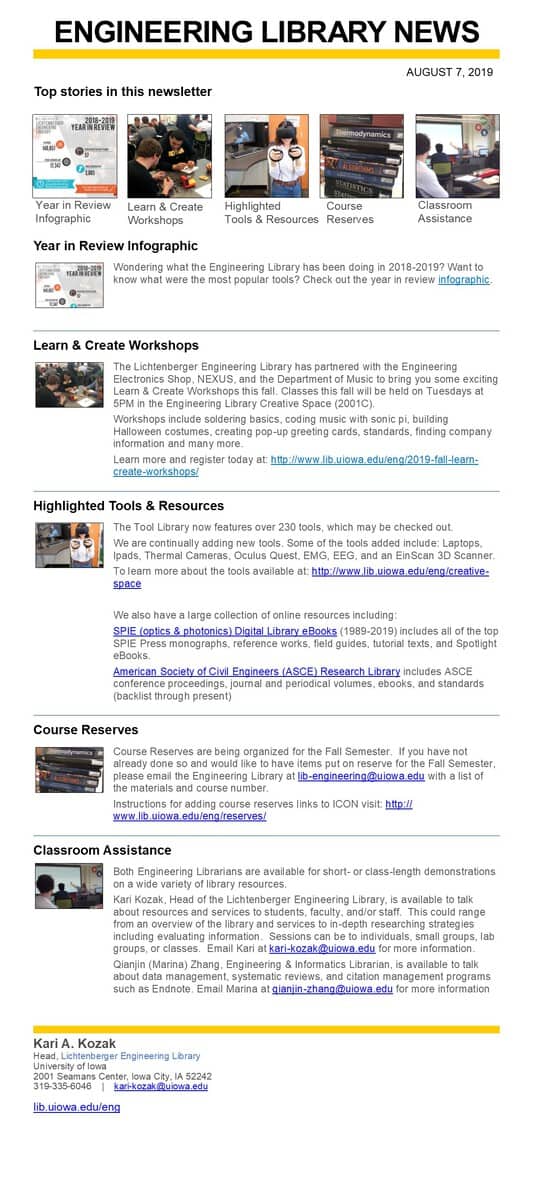
Now is your chance to learn about the breadth of resources available in the engineering library, from the online databases and books to technical reports and standards. Get a tour of the space and learn about the over 230 tools now available for checkout including new 3D scanners, EEG, oscilloscope, and VR headsets, just to name a few items.
Registration is limited, so register now! Get this fall started off right by meeting Kari and learning about all we have to offer!
Check out the amazing lineup of Learn & Create Workshops we have this fall! They will be held on Tuesdays at 5:00 pm in the Lichtenberger Library Creative Space. Workshops are sponsored by the Engineering Electronics Shop, Lichtenberger Engineering Library, NEXUS, and the Department of Music. Class size is limited to 25 participants – so sign up today!!
Sept 3 – What’s Happening in the Engineering Library
Learn about the breadth of resources in the engineering library, from the online databases and books to technical reports and standards. Get a tour of the space and learn about the over 230 tools now available for checkout including new 3D scanners, EEG, oscilloscope, and VR headsets, just to name a few items. Taught by Kari Kozak, Head, Lichtenberger Engineering Library.
Explore the hidden resources of patents. About 85% of the technical information in patents is found nowhere else. This workshop will feature a basic introduction to what a patent is, the various types of patents in existence, and how to complete patents searches. In addition to providing inventor exclusive rights to products they produce, patents also give great detailed information on certain products and methods. Taught by Kari Kozak, Head, Lichtenberger Engineering Library.
Soldering is one of the most fundamental skills needed to dabble in the world of electronics. The two go together like peas and carrots. And, although it is possible to learn about, and build, electronics without needing to pick up a soldering iron, you’ll soon discover that a whole new world is opened with this one simple skill. This class will focus on doing through hole soldering. Taught by Jeremy Roszell, Engineering Electronics Shop.
Soldering is one of the most fundamental skills needed to dabble in the world of electronics. The two go together like peas and carrots. And, although it is possible to learn about, and build, electronics without needing to pick up a soldering iron, you’ll soon discover that a whole new world is opened with this one simple skill. This class will focus on doing surface mount soldering. Taught by Jeremy Roszell, Engineering Electronics Shop.
Have you ever struggled with doing literature reviews? Although you do not have to conduct a literature review as high quality as a systematic review, some strategies from systematic reviews (defined as “a research method that aims to locate and summarize all available evidence for a research question in order to guide decisions and practices”) may help you tackle your research question in a more rigorous way. This workshop will introduce three review types (literature reviews, scoping/mapping reviews and systematic reviews), the review process and research question frameworks, search strategy and some available resources and services. Taught by Marina Zhang, Engineering & Informatics Librarian, Lichtenberger Engineering Library.
Have you ever struggled with doing literature reviews? Although you do not have to conduct a literature review as high quality as a systematic review, some strategies from systematic reviews (defined as “a research method that aims to locate and summarize all available evidence for a research question in order to guide decisions and practices”) may help you tackle your research question in a more rigorous way. This workshop will introduce three review types (literature reviews, scoping/mapping reviews and systematic reviews), the review process and research question frameworks, search strategy and some available resources and services. Taught by Marina Zhang, Engineering & Informatics Librarian, Lichtenberger Engineering Library.
Pick up the beat with this new open source programing environment called Sonic Pi. Learn the basics of coding while creating music! Using a Raspberry Pi, this class will have you making music in real-time. Each line of code you put in will change the song being heard. Taught by Jean-Francois Charles, School of Music.
Want to learn quick and easy ways to spice up your Halloween costumes? Learn to incorporate nano pixels, lights and sound into your Halloween costumes. Taught by John Kostman, Engineering Electronics Shop.
Oct 29 – Standards: Guides and Regulations for Building and Testing
From medical devices to concrete in walkways, standards are part of our everyday life. This workshop will allow you to gain an introduction to standards and specifications. You will learn about standard that are both government mandated as well as voluntary. The library provides access to over 100,000 standards including ASTM, ISO, ADA, NFPA (Fluid), and the U.S. Code of Federal Regulations. Taught by Kari Kozak, Head, Lichtenberger Engineering Library.
Nov 5 – Creating Citations Quickly & Easily with Endnote
Want to make your research and writing more efficient? Hate the last minute rush of trying to create a correctly formatted bibliography? This workshop is for you! We will introduce Endnote, a citation management tool that can help you import, organize, share, and manage your citations and documents, as well as create correctly formatted in-text citations and bibliographies in almost any style — in seconds. Taught by Marina Zhang, Engineering & Informatics Librarian, Lichtenberger Engineering Library.
The web version of Endnote Basic will be taught: not the full client version.
Learn to create a mini piano! Learn all the steps to make your own mini piano using an Arduino and circuit board. This lightweight keyboard allows you to play an octave worth of notes using capacitive touch, no strings or hammers required! This class will walk through the basic programming and ways to personalize the keyboard. Taught by Jeremy Roszell, Engineering Electronics Shop.
Want to impress your friends and family with fun and unique greeting cards? Learn about paper folding to create a pop-up cards with lights. Taught by Deanne Wortman, NEXUS.
Remember when you were in grade, middle, and high school? Remember the lists of supplies you needed? The excitement of new notebooks, pens, and new backpacks? All those things designed to help make you more successful in your school career? We don’t have a list of supplies you’ll need to purchase for the new school year, but we do have so much that will help you be successful through this academic year!
When you start those classes you’ll no doubt find your professors have resources they have put “on reserve.” That means we have them here in the library and available for you to check out. Check our website for complete information about our circulation policies for all our materials – including course reserves!
Forgot your charging cable for your laptop? Guess what – you can check one out! We have over 230 tools available! We also have cables and cords – I’m guessing we have the exact one you need! Head to our Tool Library webpage – we have everything from 3D scanners, 360 Degree Cameras, Go Pro, computer mice, creative boxes to help you with programming & circuits, hammers, screwdrivers, phone & computer chargers, and SO much more! And, we add more tools all the time! New tools for this fall include an Oculus Quest – no wires! And that means we know have both the Oculus AND the Oculus Quest!!! We also now have a Muse – a headband which tracks your brain signals. It measures brain signals much like a heart monitor senses your heartbeat.
And, our tools go perfectly with our Creative Space! We have a virtual reality station, collaboration tables, modeling stations and a prototyping station – the perfect place to collaborate with team members on class projects! It is also the perfect place to tinker and be creative! As Thomas Edison said, “I have not failed. I’ve just found 10,000 ways that won’t work.” So, stop in, be creative – who knows what you’ll invent!
If you want to work together as a team, but need a space that is a bit quieter – we’ve got 2 study pods! Pod 1 has a white board and Media:Scape! Media:Scape is designed for easy collaboration – up to 6 electronic devices can be connected to the large screen monitor! Pod 2 is smaller but has a large white board, Markers are available to check out in the Tool Library! The pods may be reserved – go to the Group Study Rooms webpage for instructions! We also have 27 ITC computers, 2 scanners, and 2 printers!
In all, we have over 140 seats available in 8 different types of seating! We have study carrels, easy chairs, bean bags, gamer chairs, not to mention the all the computers!
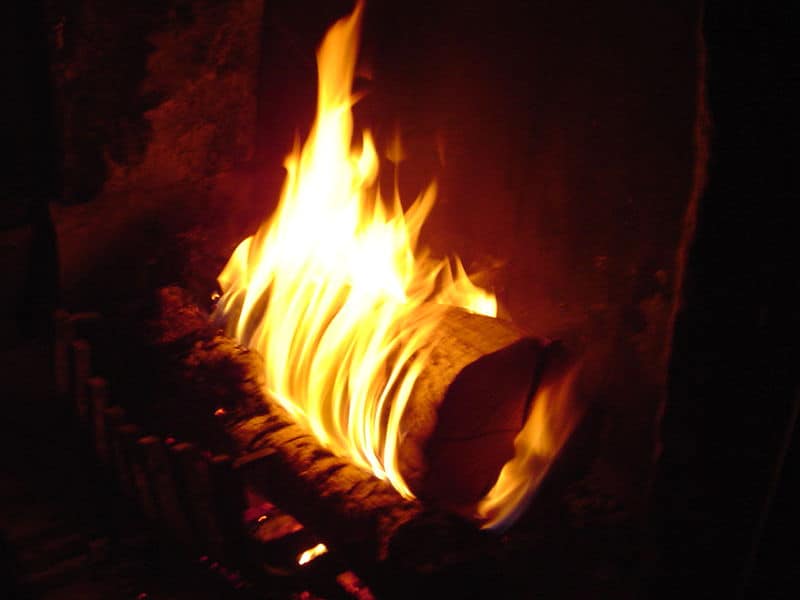
Need a quiet place to study? Our lower level (where all the books are located!) is a dedicated quiet space. All the study carrels and the new easy chairs have access to electrical outlets for that all-important charging! We also have both gaming chairs and bean bags! A new feature this year are two faux-fireplaces! Feel free to come, sit in our easy chairs and study before a (fake) fire!
Did you know we have a youtube channel? We do! Subscribe to us – UIEngLib! We are adding more and more videos all the time – an overview of the library, instructional videos on resources such as Endnote Basic – AND we’ve added a Detective Jones series! Watch the short video which will pose a question at the end, choose the answer you believe is the best and it will take you to the next video! Stay tuned – there will more cases for you and Detective Jones to solve!
If you want up-to-date information about all we have going on, be sure to follow us on Twitter and “like” us on Facebook (@UIEngLib). You’ll get the scoop on special events (like Learn & Create classes, Pi Day, new resources…).
We have over 145,o00 print resources and over 800 electronic journals! Need help navigating all that information? Check our LibGuide page. Our Head Librarian, Kari Kozak and Informatics Librarian, Qianijn (Marina) Zhang, are also available for research consultations! And all our staff are available to help you find the resources you need!
Welcome back! Stop in and see all we have to offer!!
Resources:
Notebook photo: By Sfoerster – Own work, CC BY-SA 3.0, https://commons.wikimedia.org/w/index.php?curid=15504332
SEE WHO IS BEHIND THE SCENES AT THE ENGINEERING LIBRARY!!
The Lichtenberger Engineering Library staff is here to help you find what you need to be successful in your college career! But, who are we? And how did we end up here in the engineering library?
Kari Kozak is the Head of the Lichtenberger Engineering Library. She manages the space, collection, and staff. She loves hearing about all the different projects that are being worked on within the College of Engineering and how she can help. She is a great resource for helping you find the resources you need to get your project done! She has her undergraduate in meteorology, and when she was a senior in college she heard about the need for librarians with science and technology degrees. She applied to both meteorology and library school programs before ultimately deciding on a degree in library science. She was a weather chaser in college and says if she weren’t a librarian she would probably be researching severe weather and climatology. Or, she’d find a way to get paid to travel! Traveling the world is one of her passions. She is also an avid curler – organizing, playing, watching – and traveling with her curling friends! She is also very crafty – loves to crochet and work on a multitude of craft projects. She loves the eclectic nature of Iowa City – especially all the summer activities.
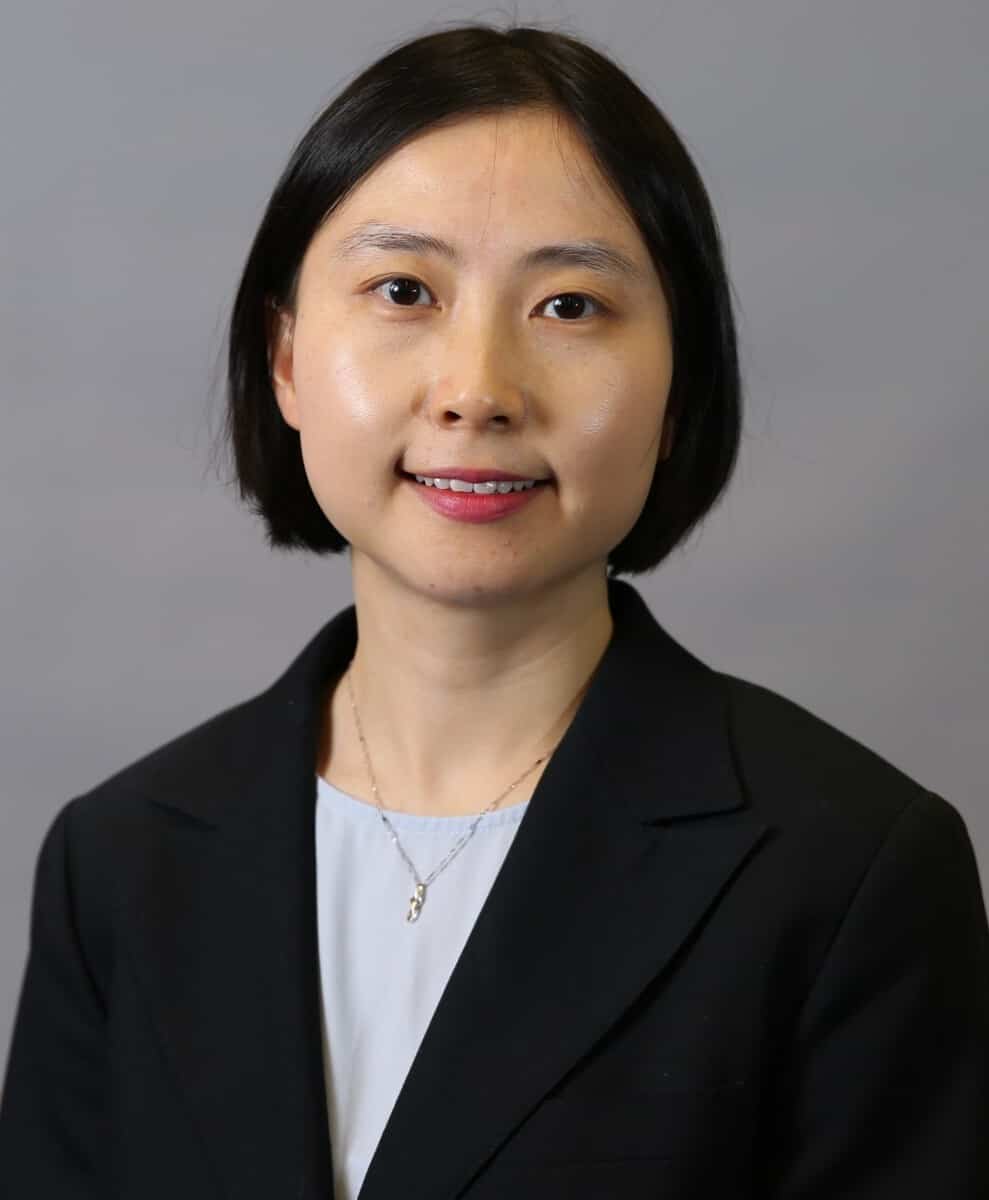
Qianjin (Marina) Zhang is our Engineering and Informatics Librarian. She works with faculty, staff and researchers and supports comprehensive literature reviews, citation management and research data management. She decided to go to library school because they had a bioinformatics track which caught her interest. She is a great resource for any of your data questions! If she wasn’t a librarian she would probably be a technician in a biomedical lab and doing experiments. She enjoys reading mysteries and prefers the physical book. One of the things she likes best about Iowa City is that it is a City of Literature! A fun fact is that she is learning to play basketball!
James M. Cox is our Library Assistant IV. He oversees all our student employees, takes care of course reserves and circulation. He is our go-to for course reserves (among many other things!). One of his favorite parts of the job is learning about what the student employees’ academic and career interests are. He started out studying aerospace engineering at Iowa State University before deciding that wasn’t the right path for him. He then studied history here at UI and realized that he could combine history and engineering while working as a librarian. If he wasn’t working in the library he’d probably be in the computer science field – he loves programming, working with data, and problem solving. He likes to read fantasy/alternative history and non-fiction history. Interestingly, he reads the non-fiction on a device, but prefers a physical book when reading non-fiction. He has several hobbies and interests. He’s a leader in DeMolay, a young men’s organization that focuses on leadership and character building; playing with Winston, his Chocolate Lab/Husky mix dog. Who “…loves playing fetch, tug-of-war until my arm falls off, and sniffing around on walks.” One thing he’d like people to know is that if you need help – ask. He rarely just says “no.” He likes working towards a solution on any library and academic questions. If someone wrote a book about him, the title might be, It Takes a Community: A Story of How Good Role Models Influence Life.
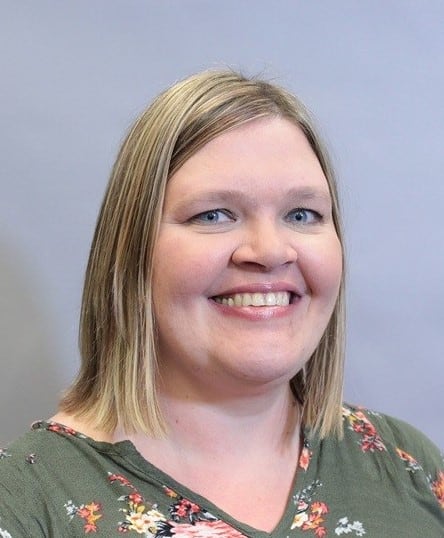
Carol Johnk (me!) is a Library Assistant III. I did not intend to work in the library world, even though I spent a great deal of time in libraries as a kid and toyed with the idea of becoming a children’s librarian. I sort of fell into working in the University of Iowa library system and now I have one of the best jobs in the world. I work with social media and promotion for the engineering library. I am lucky enough to write blogs and social media posts – I am discovering how fascinating engineering is (I’m definitely not cut out to be an engineer, however!). I have had a lot of jobs through the years, including being a reporter for the Rapid City (SD) Journal. If I weren’t working in the library I would love to be photo journalist. Or an author, or psychologist, or music therapist …or any number of things! I enjoy reading mysteries and biographies and do a lot of reading on my devices – easier to carry with me. But, there is something about holding an actual, physical book in my hands. Spare time is spent enjoying my dog, Ralphie, perfecting my photography skills, being in my back yard (reading or knitting – not actual yard work!)
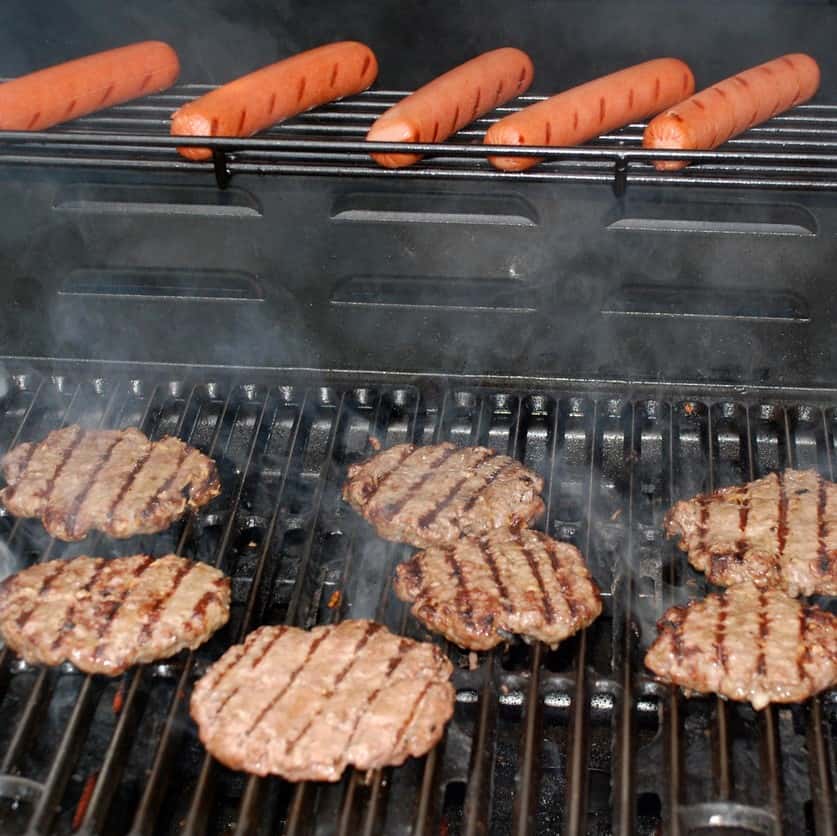
The time when thoughts often turn to picnics and barbecues!
Yup, it is that time of year – the time for summer cookouts and get-togethers. And, hopefully, no food-borne illnesses!
Did you know the Centers for Disease Control and Prevention (CDC) estimates that 48 million people get sick from a foodborne illness, 128,000 are hospitalized, and 3,0o0 die, each year (emphasis mine).
There are things that can be done to keep you, your friends, and family from becoming one of those statistics. We have the resources to help you stay safe, although according to Jeff Potter, author of Cooking for Geeks: Real Science, Great Hacks, and Good Food, there is “no such thing as 100% safe.”
Planning to marinate meat to grill? Potter warns: “… recipes that say that say to marinate at room temperature: don’t! Let it marinate in the fridge.” That is because of the “danger zone rule.” Bacteria which is related to foodborne illnesses begin to multiply above 40°F/4.4°C. The standard safety rule provided by the FDA says that food should not be held between the temperatures or 40°F/4.4°C and 140°F/60°C for more than 2 hours. Bacillus Cereus has the highest survival temperature, at 131°F/55°C. (Potter notes: “Who said scientists don’t have a sense of humor? Try saying B. Cereus out loud.”)
Here’s a Fun Fact: “hamburger” can have beef fat added to it; “ground beef” can’t!
Salmonella is one of the most well-known foodborne illnesses. But, the primary source of salmonella isn’t chicken or meat, but vegetables and fruits. So, be sure to wash those fruits and veggies!! A single bacterium of salmonella probably won’t cause a problem, but a few dozen cells will dramatically increase the chances of illness. Norovirus (from the family of caliciviruses) also receives a good deal of attention. The norovirus is contracted when a sick person prepares food for others. For more information and a list of pathogens and the foods which may be carriers head over to Wiley Online. (You’ll need to sign on with your Hawk ID and password).
Note: “… Salmonella is killed at 136°F only when held for a sufficient length of time…” Seeing your thermometer register a hotter temperature does not guarantee the food will be free of salmonella. For more information check out the U.S. Food & Drug Administration’s Bad Bug Book.
Did you know that serving spoons are supposed to stay in the food? This insures they stay above the 140°F temperature. “Otherwise, that mashed potato clinging to the serving spoon at room temperature will be a potential hangout spot for bacteria.”
When cooking meat, be aware that a change in the color is really not an accurate indicator of how done the meat is. “Myoglobin, oxymyoglobin, and metmyoglobin can begin to turn grey starting around 140°F/60°C, and they can also remain pink at 160°F/71°C if the pH is at or about 6.0.” It is important to use a thermometer when cooking ground meats and poultry!
Potato salad is notorious for spreading foodborne illnesses, but contrary to to what you might think, mayonnaise that isn’t the culprit! In fact, you could leave commercial mayonnaise out at room temperature and not worry about it making you ill. However, potato salad is often prepared and served at room temperature and it is often outside at a picnic or gathering at which there is no refrigerator. So, what does make potato salad so notorious? It takes 2-4 hours for staph or other pathogens to “get accustomed to their surroundings and really get ready to ramp up binary fission.” (Potato salad, food poisoning and contortionists). If the potato salad has been sitting for several hours at the right temperature, “trouble will ensue.”
If you are worried about bacteria multiplying and spreading in your food, remember this trick: FAT TOM.
F=Food: bacteria need proteins and carbohydrates to multiply, so obviously, no food, no bacterial multiplication!
A=Acidity: bacteria need certain pH ranges. Too acidic and proteins in the bacteria denature.
T=Temperature: Too cold – the bacteria sleep; too hot and they die.
T=Time: There needs to be enough time for the bacteria to multiply to a point where there enough to make a person ill.
O=Oxygen: Bacteria needs sufficient oxygen to multiply. (Note: Vacuum-packed bags ore not necessarily devoid of oxygen).
M=Moisture: Bacteria need water to reproduce. Bacteria need a water activity value of 0.85 or higher in order to multiply. (The water activity scae is used to measure the freely available water in a material – from 0 to 1).
Wondering how to accurately measure temperature? Head to our Tool Library webpage and explore the measuring devices that are available for you to check out! We have 2 thermal cameras, an infrared thermometer, environmental meter and more! Use our tools to help keep your food at safe temperatures!
Now that you are sure that your meats and potato salads will be safe for your outdoor party, you can think about what cold beverage you’d like to serve! How about making your own root beer? Homemade Root Beer, Soda, & Pop will explain the history and discuss the equipment needed to make them! It even includes recipes for ginger beer and cream soda!
Enjoy the summer grilling and picnic season! And, be safe!!
Resources:
Potter, Jeff. 2010. Cooking for geeks : real science, great hacks, and good food. Sebastopol, CA : O’Reilly First Edition. Engineering Library TX715 .P88 2010
Kuhne, Cecil C. III. 2013. The little book of BBQ law. Chicago : American Bar Association. Law Library KF1250 .K85 2013
Nemerow, Nelson L. 2009. Environmental engineering. Prevention and response to water-, food-, soil-, and air-borne disease and illness. Engineering Library RA643 .E58 2009