The University of Iowa is now an institutional member of QDR (Qualitative Data Repository) . The QDR membership gives faculty and other researchers a platform to store and share their qualitative data and enhances campus efforts for providing Research Data Services.
“QDR is a dedicated archive for storing and sharing digital data (and accompanying documentation) generated or collected through qualitative and multi-method research in the social sciences,” according to the Syracuse University based organization. “QDR provides search tools to facilitate the discovery of data, and also serves as a portal to material beyond its own holdings, with links to U.S. and international archives.”
“The main benefit of membership is curation and preservation of data projects deposited by affiliates – faculty, students, and research staff – of member institutions”.
Most data repositories focus on quantitative data. QDR offers an advantage for curating qualitative data. Alternatives include having researchers manage data on their own, which would mean more time and expense.
QDR is being funded at the University of Iowa by the University Libraries and the Iowa Social Science Research Center. The University of Iowa Libraries has been working closely with the Office of the Vice President of Research and Economic Development, Information Technology Services, and campus offices to support data management. Brett Cloyd (brett-cloyd@uiowa.edu | (319)335-5743) from the UI Libraries is the QDR Institutional Representative and serves as liaison with QDR. Please contact Brett with questions for help in getting started. More information is available at the UI Libraries’ QDR Guide.
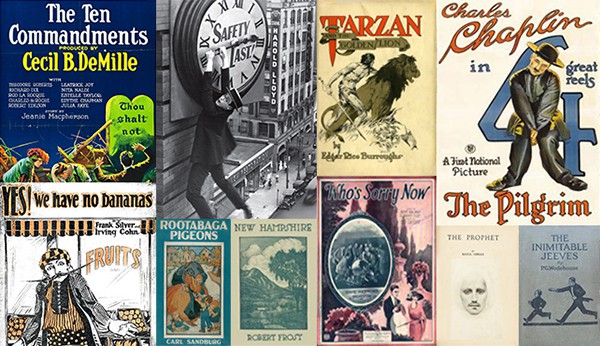
Photo Credit: Center for the Study of the Public Domain
For the first time in 20 years, artistic works copyrighted in the U.S. will enter the public domain, opening up a trove of material published during 1923 to be freely digitized, read, and used as the basis for new works. But why is this happening now? After all, shouldn’t copyrights expire and works enter into the public domain every year? One would think so, but since the late 1970s, U.S. copyright law has been subject to a series of extensions and retroactive patches that have tied up and confused the status of copyrighted works produced during the mid-20th century. (Duke’s Center for the Study of the Public Domain has an excellent breakdown of recent copyright history here. The Atlantic also published a comprehensive article on this issue, which can be found here.) The result has been that nothing has entered the public domain since 1998. But January 1, 2019 marks a pause in the era of the shrinking public domain. If no legislative action is taken to the contrary, each year, we will now have a new set of books, recordings, movies, and other creative works to enjoy freely.
Here are some places to check out the creative works of 1923:
Public Domain Review – This journal specializes in mining the public domain. Here are their international picks for this year.
Interested in finding out more about U.S. copyright law and how to determine a work’s copyright status? As part of the library’s new Scholarly Impact Department, part of my job is to help faculty work through complex copyright issues, such as what can be used in the classroom, how to retain your rights as an author, and how to apply Creative Commons licensing. Feel free to send me an email at mahrya-burnett@uiowa.edu to set up a consultation. You might also try these excellent copyright resources:
Digital Copyright Slider – This Flash-based slider provides copyright status for works, depending on when they were published and whether copyright was renewed.
UI Libraries Copyright Guide – This guide provides the basics on copyright issues, such as Fair Use, seeking permissions, author rights, and licensing
How will I afford my textbooks this semester? Can I pass this course even though I don’t have the book? Is it illegal to download this PDF of the book that I found online?
These are the kinds of questions students ask at the beginning of the semester. The solutions they find are creative. Sometimes a whole group of roommates will share a book. In other cases, they will find a dubious copy for free online. Other times, they skip textbooks entirely. For some students, it’s a matter of buying food or buying books.
UI Libraries and UI Student Government are easing some of this burden with a collaborative project called the Textbook Affordability Pilot (TAP). Under TAP, a committee of library staff and student government representatives collect donated textbooks and purchase new ones for “high impact courses.” These are classes for which the cost of books is high and more than 100 students are enrolled in the course. These books are placed on course reserves in Main Library and the branch libraries for students to use free of charge.
Plans for TAP began in the summer of 2017, when student government approached the Libraries with questions about making textbooks more affordable. The UI Libraries encourages faculty to bypass traditional textbooks where possible by using books from the Libraries’ collection and using open educational resources. The Libraries also keeps copies of some textbooks on course reserve. Despite these efforts, librarians and students realized more could be done.
UISG Director of Academic Affairs, Tristan Schmidt, and Scholarly Communications Librarian, Mahrya Burnett, along with interested colleagues, began to explore the idea of purchasing textbooks and collecting donated copies. There was broad interest on both ends. Eventually, UISG and UI Libraries both allocated funds, totaling $17,000 for the one-year pilot. The committee drafted a set of criteria for books to be included in TAP and identified objectives for success. Then they started buying and collecting books.
As TAP began accepting donations last spring, the response from students was overwhelming. They donated hundreds of books, filling the UISG offices at the IMU. The committee is now working with faculty, students, and librarians to finalize its purchase list in order to get new books processed and on the shelves. TAP aims to have 100 books available for student use through course reserves at the Main Library and several other campus libraries by spring semester 2019. Their hope is to see the program grow over time so that more and more books are available for the students who need them.
TAP information for students Can I access my textbooks for free? One easy way to find out whether your textbook is on Course Reserves is to use this simple search tool. Search by course name, instructor, or book title.
TAP information for faculty, instructors, and TAs Do the textbooks for my course qualify for TAP? Faculty can email LIB-TAP@uiowa.edu to see if their textbooks are TAP eligible.
All theses and dissertations in Iowa Research Online have now been assigned DOIs. DOIs, or Digital Object Identifiers, are unique and persistent IDs for electronically published documents. DOIs will be used by publications citing your thesis/dissertation, so that there will be better information about where your work has been cited. Using a DOI also allows less formal usage to be tracked as well, such as tweets, links in Wikipedia, blog posts, etc. and will be included in alternative metrics (altmetrics).
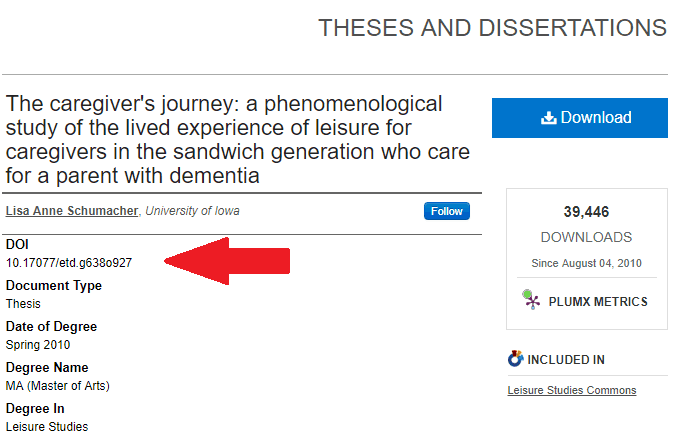
A DOI looks like this: 10.17077/etd.g638o927 and a DOI link looks like this: https://doi.org/10.17077/etd.g638o927. Clicking on the DOI link will take you to the current URL for the publication. URLs can change, but DOIs don’t. If the URL for your thesis or dissertation changes, due to a service migration or other updates, the DOI link will direct traffic to the correct URL. That’s why it’s important to include DOIs or DOI links in your citations, so your readers can follow your work back to the references you cited.
To find the DOI for your thesis or dissertation, go to the IRO theses and dissertation series or your favorite search engine and search for your name and your thesis or dissertation title. Click on the title of your thesis or dissertation, and the DOI will be listed in the first field in the record. If you have any questions, or if you are not receiving monthly download counts and would like to, please contact lib-ir@uiowa.edu.
Eight Big Ten universities, a federal funding agency, and private companies come together to fund the development of Collaborative Archive Data Research Environment (CADRE)
Students, faculty, and researchers across the Midwest and beyond will gain crucial access to large research datasets through a secure, cloud-based platform called CADRE (Collaborative Archive Data Research Environment). CADRE will be developed through a large-scale partnership led by the Indiana University Libraries and the Indiana University Network Science Institute.
The University of Iowa Libraries will collaborate with IU Libraries and other partners from the Big Ten Academic Alliance (BTAA) to develop a cloud-based platform that will allow library users direct, hands-on access to bibliometric, patent, and other large databases.
Other BTAA partners are Michigan State University, University of Michigan, University of Minnesota, The Ohio State University, Pennsylvania State University, Purdue University, and Rutgers University.
“We firmly support this project because this type of shared secure data mining service is badly needed by research libraries, and importantly, by sharing the costs of enhancing, maintaining, and updating the platform across libraries, the costs become very affordable,” says John Culshaw, the Jack B. King university librarian at the UI Libraries. He says that without collaborative partners, the University of Iowa would not be able to “parse, secure, and host such enormous repositories of data, let alone develop the Graphical User Interfaces necessary to facilitate patron-driven queries.”
“This project exemplifies the role of libraries in the information age,” says Jamie Wittenberg, research data management librarian and head of scholarly communication at Indiana University Libraries, who will direct the project. “Our mission is to efficiently and effectively connect researchers with the materials they need to advance innovation and discovery. CADRE will open up the power of data mining to everyone, not only people with specialized expertise.”
Bibliometric research is the “science of science” The ability to deeply analyze connections between these texts will support bibliometric research, a growing field that plumbs the world’s increasingly large and complex databases to reveal the underlying structural forces that affect the production of scientific knowledge. This work—often called the “science of science”—has shed light on a wide range of subjects. For example, bibliometric analysis has helped reveal the depth of women’s historical contributions to science and the influence of large-scale historical events on research activity.
CADRE will provide a user-friendly “front door” through which the partner institution members can request bibliometric analysis of available data. The project will automate many complex and time-consuming tasks that were previously required to conduct this research.
Product developers seeking input. To build user interfaces that will be of the highest utility for you, CADRE seeks your input. Potential users in all disciplines (faculty, staff, and students) are encouraged to provide input through user stories. To share your user story, please complete this form. All responses, no matter how abstract or seemingly trivial, are very helpful for us and will be given serious consideration as we plan for the development of CADRE.
Another important feature of the system is the power to share data. Individuals who use the platform will not only be able to share the results of their analyses, but also the software code, algorithms, workflows, methods, and the specific software versions and configurations used to run their analyses. This is critical for making the work reproducible, as well as helping the original researchers refine their methods for other projects.
The first new materials to be accessed via CADRE are records of the U.S. Patent and Trademark Office, which contains data on publicly-available patents and intellectual property, and the Microsoft Academic Graph, a public database of 160 million scientific records.
This year’s International Open Access Week is emphasizing equitable foundations for open knowledge. Across the sciences, social sciences, and humanities there is a growing recognition of the importance of open access to research data. The FAIR (Findable, Accessible, Interoperable, and Reusable) data principles encompass a set of technical/ computational characteristics that enable data discovery and reuse. Data sharing can advance the rate of research discovery, provide the basis for new forms of computational and multi-disciplinary research, and on a personal level, may lead to increased citations of the related articles.
To bring this to a more personal level of application, here are just a few ways in which you can start supporting open access to your own research data.
1. Use open, non-proprietary file formats whenever they are available and appropriate for your research. By using these formats you enable others to view and use your data without the need for specialty software, and provide some assurance that when software changes, or disappears, your data will still be usable by others (and yourself).
Data repositories, research funding organizations, and some publishers provide guidelines and suggested formats for data. The UK Data Services recommended formats cover more common file types. Your research domain may have specific standards, such as those for earth sciences, medical imaging, and chemistry.
Sometimes data will need to be converted to an open format, and it’s important to be aware of the considerations about what might happen to the data, or embedded information, during this process. The UK Data Services website and other sources outline these issues, and you can also contact us for assistance.
2. Deposit in repositories that will provide long-term, open access to and preservation of the data. Do not rely on supplemental files with articles that may be locked behind a paywall. Instead, seek out repositories that are sustainably funded, and provide open access to at least the metadata via a Digital Object Identifier (DOI) or other persistent identifier. Some funding organizations list their preferred data repositories with their data management planning guidelines, and you can also contact us for assistance.
In addition to external data repositories, the UI provides a data repository in which you can deposit your research data, and we can assist you with this as well.
3. When you deposit your data, insure that it is well-documented so that others can find it, understand it and know about any restrictions on its use. Most repositories provide standardized fields for you to submit this information. Document the collection/generation process, analysis, and any other computational workflow that would be necessary to understand or reproduce the data. You may also want to deposit a readme file for additional information, if the repository allows.
These are a few basic steps that you can take when you are ready to share your research data. With some time and effort, your data will be accessible and enable you to have a broader impact through sharing these products of your research.
Written by Mahrya Burnett, Scholarly Communications Librarian
In the libraries, we spend the whole month of October celebrating Open Access (OA), and with good reason. As scholarly publishing continues to evolve and spawn new models for disseminating knowledge, it’s more important than ever to make sure that anyone can access critical research and that scholars from anywhere in the world can publish their discoveries. It’s also important for scholars at the University of Iowa to understand how to manage the impact of their research, disseminate it as widely as possible, and to choose publication venues that will help reach their goals.
Guiding researchers as they navigate these issues is a big part of my job as a scholarly communications librarian. I meet with all kinds of students and faculty to talk about the ins and outs of publishing their research. If you’re interested in getting your publications out from behind paywalls and into the hands of readers, here’s how I can help:
Find open access journals in your discipline
One way to make your research open is to publish in an open access journal. But what does that mean? Open access journals are publications that make it free for readers to access ALL of their content through the publisher’s website. Quality OA journals will be transparent in their business and editorial practices and should be well-regarded in your field. They should also be up-front about any Article Processing Charges (APCs) used to offset the cost of publishing. The Directory of Open Access Journals can help you determine whether a journal is, in fact, open and can help you find open journals in your discipline. I can help you navigate this directory or provide you with additional information about journals.
Get your work into Iowa Research Online
Iowa Research Online (IRO) is Iowa’s institutional repository for publications and other research artifacts. This means that UI faculty, staff, and students can upload their published work and make it discoverable to anyone with an internet connection, anywhere in the world. Including your article in IRO is another great way to make your research open, and I would be glad to help walk you through the process. Not every publisher will allow you to include the final version of your article in a repository. But luckily, there are tools that we can use to determine exactly what your publisher will allow. Sherpa/RoMEO is one such tool. This directory lists current publisher policies on self-archiving and will tell you what you can and cannot include in IRO.
Find funding for Article Processing Charges (APCs)
APCs are one of the most misunderstood aspects of scholarly publishing. In some disciplines, it has long been standard practice to charge authors “page fees” for charts, graphics, color printing, or other publication costs. In other disciplines, giving money to a publisher is considered “pay to publish,” and is not seen as a legitimate practice. In the world of open access publishing, we have seen APCs crop up, proliferate, and grow to sometimes thousands of dollars per publication. Not all OA journals charge APCs, in fact the vast majority do not. However, the ones who do are often big name journal titles, with high impact factors, produced by major academic publishers. These are often the same journals in which scholars need to publish, for promotion and tenure, or simply to be widely read. In many ways, these publishers still control the landscape, even the OA landscape, and it looks like their APCs aren’t going away anytime soon. If you find yourself needing to pay an APC or are considering an OA publication, but don’t know how to fund it, I can help. Often, you can designate grant funding to be earmarked for APCS or your department may have funds available for this purpose.
Get up-to-date on funder mandates for open
Funding organizations are slowly recognizing that the research they fund as a public good should, in fact, be available to the public. While other parts of the world are further along that the United States in this regard (See Plan S, for example), certain federal agencies require that funded research be made publicly available. When this is the case, researchers must comply with the mandate. Some agencies, such as the National Institute of Health, make complying with this policy relatively easy. Others are a bit more tricky. This is another area where I can be of assistance.
If you’d like to discuss how to make your research open, I’d love to hear from you. Feel free to send me an email at mahrya-burnett@uiowa.edu to set up an appointment. I’m also a part of the library’s new Scholarly Impact Department, which rolls our scholarly communications and data services into one unit. If you’d like to learn more about the new department, please contact us at lib-impact@uiowa.edu. Let’s work together to make Iowa’s scholarship as open as it can be!
During the month of Open Access week (October 22-28, 2018) we will be highlighting a number of guest posts from University of Iowa Faculty and Staff who have personal experience making their work Open Access. We appreciate their contributions.
The fourth post is by Alex C. Essenmacher, MD, Diagnostic Radiology.
Open Access – a fitting model for the case report
Medical knowledge has proliferated rapidly in recent decades and seems to be accelerating, and with increasingly subspecialized knowledge there are constant changes in treatments and practice. The newest discoveries published don’t tend to change the wider practice of medicine right away; understandably, more certainty about the effectiveness and safety of a change in practice needs to be established before it reaches a patient. Review articles, meta-analyses, and comparative studies that follow shortly after a new discovery might bring about that change, rendering approaches recently taught in medical school obsolete.
There is an increased drive from national medical leadership to teach and encourage good scholarship in physicians. This push manifests as statistics questions and sample literature comprehension on medical board examinations and required scholarship projects from residents and fellows. In graduate medical education, advancement is generally less dependent on publications than non-clinical, university academics, but residents in medical education programs may pursue publication as a way to fulfill the scholarly project mandated by the American College of Graduate Medical Education.
In the internet age, publication in many varieties, including academia, differs from the old model. Journals can make content available digitally as soon as it is approved and reach a larger audience even with fewer printed copies circulating. Despite the plethora of venues, publishing a manuscript can remain difficult because the most established journals in a field are often in environments of increasing complexity and subspecialization. Clinical residents have the primary responsibility of mastering patient care rather than become researchers, so the time to complete large projects may not be available to them.
Physicians and others in the healthcare field communicate not just in research and review articles but often in case reports – detailed descriptions of one patient and the disease diagnosis, course, and outcome – that is usually reported for novelty or educational value. It is a way to exchange useful knowledge in the confines of the academic setting that doesn’t require long data acquisition periods and a statistician. The most recognized journals in medical fields, because of the increased complexity of the science, often forgo consideration of case reports. There is still a home for publishing medical case reports, but now it is often in a smaller journal, usually newer, sometimes online-only, and disproportionately utilizing an open-access model. The University of Iowa Open Access Fund makes it easier to share insightful cases from the university hospital with the world, and the process is quick and easy!
During the month of Open Access week (October 22-28, 2018) we will be highlighting a number of guest posts from University of Iowa Faculty and Staff who have personal experience making their work Open Access. We appreciate their contributions.
The third post is by Jose Assouline, Ph.D. Bioengineering and NanoMedtrix, LLC
Biomedical Cutting Edge Technology and Open Access Publication: A Synergistic Must
For decades, modern medical and scientific discoveries, and therapeutic discourse were published in journals/books. The paper versions were widely circulated among the scientific community and were the basis for new research. In ancient history hand-written and printed empirical experiments and commentaries were the physical storage and dissemination of the knowledge of the time. It took time and money to get knowledge. Times have changed, it is now an era when new technology and information can be acquired nearly instantly. Scientific, medical, and engineering innovations have to be accessible by scientist and lay population alike. Everyone should have an equal opportunity to newly acquired knowledge that is ready for public consumption.
The burden of scientific rigor remains in the hands of the generator of the science being disseminated, as well as the high level of scientific scrutiny and integrity of the reviewers. A number of new scientific journals have popped up in every field, although the quality of the journals vary. However, publication in all these journals is expensive and the distribution may not be as widespread (and free) as the brochure had suggested. Open Access (OA) publication is the most welcome solution to the growing demand for quality publications freely accessible by anyone. The scientific scrutiny for most OA journals is as high as any printed versions. The bonus is: the deployment of ideas, technology, and comments have a wider and more far-reaching impact.
My field is nanotechnology applications in medicine and engineering. I make every effort to submit to OA publications for the high quality of the review, the expedience of the process, and the broad/instant distribution. As an educator and scientist what better vehicle to teaching and intellectual discussion could there be, than a nearly immediate transmission to students/readers? Nanotechnology changes and evolves constantly and snags numerous complications along the way. It spans many disciplines and it is difficult to master them all. Nanotechnology in medicine is almost a contradiction in terms. Small technology and patient care, innovations that make people feel better. How to reconcile these two seemingly disparate worlds? Only an open platform can help experts from various walks of life view the documents, data, and comments. Only OA can expose the intricacy of these minute technological marvels. Undoubtedly, OA has opened a novel dialogue platform, a new way out of the artificially constraining, traditional form of publishing ideas. Now, the inherent delay between discoveries and distribution, has vanished. Open Access publication offers scientists a natural projection for innovative ideas in their respective fields.