The University of Iowa Libraries are committed to providing services that support the success and well-being of campus community members.
The Reflection Room at the Main Library is open to all students, staff, faculty, and visitors with borrowing privileges. Room 2060 on the second floor serves as a designated reflection space, providing a quiet area for meditation, contemplation, or calming sensory overload.
Features
The Reflection Room provides subdued lighting, a white-noise machine, and comfortable seating.
Guidelines
This space is available by checking out a key from the Service Desk on the first floor. Room use is limited to up to 60 minutes, after which the key must be returned to the Service Desk.
Please be respectful toward other individuals using the space. The room is not to be used for studying, lounging, or napping.
Please use headphones for any audio playback with volume that does not disturb others.
No food and beverages are permitted, except for water.
The room should remain clean and neat.
No signs or advertising may be posted or left in the room.
No candles, incense, or other flammable materials are permitted.
All users are expected to comply with the Libraries Conduct Policy. Issues or concerns regarding space policies and usage can be reported to the Service Desk at 319-335-5299.
Please remember, this room is not a study space. Learn more about the variety of study and academic work environments for Main Library users on the Libraries website.
Please visit Well-Being at Iowa to learn about mental health resources at the university.
You can also find a Reflection Room at the Hardin Library for the Health Sciences.
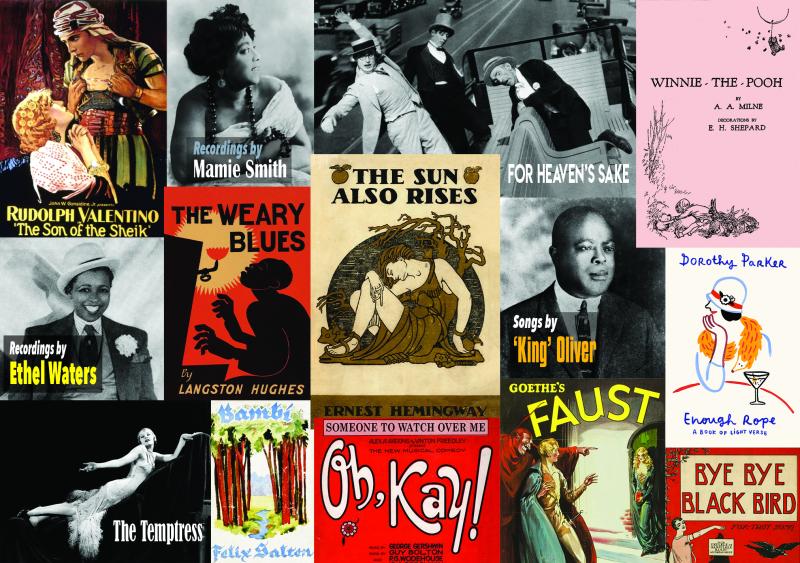
COURTESY: THE CENTER FOR THE STUDY OF PUBLIC DOMAIN AT DUKE LAW SCHOOL
Now, you have even more works—and for the first time, sound recordings—available to be freely digitized, read, and used as the basis for new work.
On Jan. 1, 2022, debut novels by Ernest Hemingway and William Faulkner, A.A. Milne’s Winnie the Pooh, and about 400,000 sound recordings from before 1926 were among the many books, recordings, movies, and other creative works that entered the public domain.
So, why is the public domain important? Permission is no longer needed to copy or use the works, which is an essential opportunity to foster learning, innovation, and the creation of new works.
Here are some places to check out the newly available creative works from 1926 available in the public domain:
Interested in finding out more about U.S. copyright law and how to determine a work’s copyright status? The Scholarly Impact Department helps faculty work through complex copyright issues, such as what can be used in the classroom, how to retain your rights as an author, and how to apply Creative Commons licensing. Feel free to send an email to mahrya-burnett@uiowa.edu to set up a consultation. You might also try these excellent copyright resources:
Digital Copyright Slider – This Flash-based slider provides copyright status for works, depending on when they were published and whether copyright was renewed.
UI Libraries Copyright Guide – This guide provides the basics on copyright issues, such as Fair Use, seeking permissions, author rights, and licensing.
This semester, the UI Japanese Program and the UI Libraries are presenting Tadoku Club, which offers opportunities for anyone to enjoy reading Japanese books at a comfortable setting.
Tadoku (多読) means reading a lot of books for fun. We have a variety of Japanese books suitable for all levels of learners, including graded readers, picture books, and manga!
The UI Tadoku Club is open to the public. Anyone interested in reading Japanese books can join us.
Where:
East Asian Reading Room (2nd floor of the UI Main Library)
In August 2021, I had the opportunity to participate in the Evidence Synthesis Institute. This four-day online institute is funded by the Institute of Museum and Library Services (IMLS) and is a partnership between University of Minnesota, Cornell University, and Carnegie Mellon University. The goal of the institute is to equip librarians who work outside of the health sciences with the tools to provide evidence synthesis support at their institutions.
So what is evidence synthesis? Evidence synthesis (ES) is a broad term that encompasses all types of reviews including systematic reviews, meta-analyses, scoping reviews, critical reviews, rapid reviews, mapping reviews, umbrella reviews, etc. The most common reviews, and the ones we focused on the most, are systematic reviews.
Evidence synthesis is an increasingly important aspect of academic research and informs evidence-based practices. While ES is most common in the health sciences, it is also important for social sciences. In my work as a liaison to the College of Education and Department of Psychological and Brain Sciences, I have noticed a demand for this type of service among faculty and graduate students.
The Evidence Synthesis Institute was thoughtfully arranged. Not only did we have presentations, breakout rooms, and small group debriefs, but we also had clear objectives and informative videos available through PressBooks. The coordinators of the Institute are all librarian experts with lots of ES experience.
Librarians are perfect partners for ES work and can raise the caliber of an ES project. This is because ES necessitates complex search strategies using Boolean operators, keywords, and Subject Terms; thorough knowledge of databases and indexes; strategies for finding grey literature; and citation management. Librarians can collaborate in a consultation or co-authorship capacity, depending on the level of involvement.
Prior to attending the Institute, I received excellent training from Jen DeBerg at Hardin Library and had built up some experience consulting and co-authoring on ES publications. The Institute reinforced what I had already learned and gave me a greater appreciation for reporting guidelines (such as PRISMA and PRESS), protocol registration, frameworks for extracting concepts (such as PICO, SPICE, and SPIDER), and ensuring the entire search strategy is transparent and reproducible. In fact, one of the biggest takeaways from the Institute is that transparency and reproducibility are extremely important and can best be accomplished by engaging in peer review of search strategies and publishing complete search strategies through institutional repositories or the Open Science Framework.
I am thankful for having had the opportunity to participate in this Institute and would highly recommend it to other librarians who are interested in becoming more involved in ES work.
The University Libraries is seeking nominations for the Arthur Benton University Librarian’s Award for Excellence. Funded by a generous endowment, this prestigious award acknowledges a library staff member’s professional contributions in the practice of librarianship, service to the profession, scholarship, or leadership which has had a significant impact or innovation to the operations of the Libraries or the University of Iowa.
The $2,000 award may be used to support professional development activity expenses for conferences or workshops in support of research projects and publications related to services, or it may be taken as a cash award.
Any member of the University of Iowa community may make a nomination, or self-nominations are also accepted. See eligibility requirements and nomination form at: http://www.lib.uiowa.edu/admin/bentonaward/ . The due date is Wednesday, October 27. Contact Kelly Taylor (Kelly-taylor-1@uiowa.edu) with any questions you may have.
The University of Iowa Libraries has entered into a transformative agreement with the Electrochemical Society (ECS) that allows University of Iowa authors to publish open access for free in ECS journals. The number of open access articles that can be published for free is unlimited and takes effect immediately. Publishing open access allows articles to reach a wider audience because they are free to read online and not limited to subscribers. This transformative agreement for open access publishing means that UI authors will not have to pay out of pocket for the article processing fees that are traditionally charged for open access publishing.
To take advantage of free open access publishing in ECS, UI authors must select ECS Plus under Step 6 – Open Access Waivers, Charges and Credits at the time of manuscript submission to take advantage of an article credit.
When you submit your article to an ECS journal, you’ll be asked if you wish to publish open access. Select ‘Yes’
Select ‘ECS Plus’ and name your institution in the supporting information box
In additional to free open access publishing, University of Iowa students, faculty, and staff have full access to the contents of the ECS Digital Library.
Looking for more? Check out the UI Libraries full list of transformative agreements (also known as read and publish agreements).
Welcome to our rotating DVD display, here we will present a themed selection of titles for you to browse. If you would like to borrow a DVD, just click the link below the title and sign in with your Hawk ID and password to make a request. Thanks for browsing!
Parasite
Bong Joon Ho brings his singular mastery home to Korea in this pitch-black modern fairytale. Meet the Park Family: the picture of aspirational wealth. And the Kim Family, rich in street smarts but not much else. Be it chance or fate, these two houses are brought together and the Kims sense a golden opportunity. Masterminded by college-aged Ki-woo, the Kim children expediently install themselves as tutor and art therapist, to the Parks. Soon, a symbiotic relationship forms between the two families. The Kims provide “indispensable” luxury services while the Parks obliviously bankroll their entire household. When a parasitic interloper threatens the Kims’ newfound comfort, a savage, underhanded battle for dominance breaks out, threatening to destroy the fragile ecosystem between the Kims and the Parks. By turns darkly hilarious and heart-wrenching, Parasite showcases a modern master at the top of his game.
It has been called “the most audacious, difficult, complicated rescue mission ever attempted.” Desert One uniquely blends emotion and bravado to tell the incredible tale of America’s secret mission to free the hostages of the 1979 Iranian Revolution. Two-time Academy Award®-winning filmmaker Barbara Kopple discovers a wealth of unearthed archival sources and receives unprecedented access, engaging in intimate conversations with many of the soldiers closest to the story, some for the first time, as well as President Jimmy Carter, Vice President Walter Mondale and TV newsman Ted Koppel. Evocative new animation brings audiences closer than anyone has ever gotten to being on the inside for this history-making operation.
Based on the thrilling and inspirational life of an iconic American freedom fighter, Harriet tells the extraordinary tale of Harriet Tubman’s escape from slavery and transformation into one of America’s greatest heroes. Haunted by memories of those she left behind, Harriet (Cynthia Erivo) ventures back into dangerous territory on a mission to lead others to freedom. With allies like abolitionist William Still (Leslie Odom, Jr.) and the entrepreneurial Marie Buchanon (Janelle Monáe), Harriet risks capture and death to guide hundreds to safety as one of the most prominent conductors of the Underground Railroad. Witness the story of a woman who defied impossible odds to change the course of her life and the fate of the nation.
A Jamaican teen who is burdened by an unstable father and an unruly older brother hopes a meteoric rise in track-and-field can reunite him with his mother, who has lived illegally in the U.S. for over a decade. Bonus features include: English subtitles for the deaf and hearing-impaired, 5.1 Surround, 2.0 Stereo, Theatrical Trailer, Photo Gallery, Sprinter Premiere at The Grove
Fred Flarsky (Seth Rogen), an unemployed journalist battered by his own misfortune, endeavors to pursue his childhood crush and babysitter who now happens to be one of the most powerful and unattainable women on the planet (Charlize Theron).
A vivid yet languid ‘70s mood out of a John Cassavetes film, complete with a softly intoxicating score, welcomes you into the world of “Goldie” in its early moments. Then with a serene pace, writer/director Sam de Jong’s electric touches light up the screen with humanistic hues: we are in a colorful and energetic corner of the Bronx, following a young woman leading a life that stands in such stark contrast to all the vibrancy that surrounds her. Played by Instagram model Slick Woods in a stunning debut performance, she is the 18-year-old title character Goldie, holding on to the dream of becoming a famous dancer one day. While her youthful mind and soul keep her vision alive against all the odds, she pursues a lucky break in a rap video any which way that she can.
Written and directed by Jon Stewart, Irresistible is a comedy about what happens when a small town becomes the main attraction for two rival political consultants. Top Democratic consultant (Steve Carell) sees an opportunity to win back voters in America’s heartland when a video of a passionate farmer and retired Marine colonel (Chris Cooper) goes viral. After a long, hard day’s work as a farmhand, Gary persuades the farmer to run for mayor. However, when the Republican National Committee counters him by sending in his brilliant nemesis, Faith Brewster (Rose Byrne), Gary is more than primed to up his game, turning this local race into a hilarious game of tug of war.
It should have been a wonderful evening. Stephan and Elisabeth have invited their family and friends over for dinner, but as soon as Thomas announces that he and his pregnant girlfriend Anna are planning to name their unborn son Adolf, things get out of hand. As the evening escalates, secrets are revealed and truths are dragged to light in a clash of egos, wounded prides and hidden passions, served up for all to enjoy. A breakout hit at the German box office, award-winning director Sönke Wortmann (The Miracle of Bern) has crafted a hilarious social satire lathered in witty dialogue and perfect timing, where German guilt and angst over the Nazi past meets a family dinner gone awry.
Written, directed and produced by Academy Award winner Angelina Jolie Pitt, By the Sea follows an American writer named Roland (Brad Pitt) and his wife, Vanessa (Angelina Jolie Pitt), who arrive in a tranquil and picturesque seaside resort in 1970s France, their marriage in apparent crisis. As they spend time with fellow travelers, including young newlyweds and village locals, the couple begins to come to terms with unresolved issues in their own lives.
Join Linda Galloway, Elsevier Customer Consultant, to learn about SciVal, Elsevier’s analytics solution. SciVal provides access to the comprehensive research performance of over 19,000 research institutions and their associated researchers from 230 nations worldwide. SciVal allows you to visualize your research performance, benchmark relative to peers, develop strategic partnerships, identify and analyze new, emerging research trends, and create uniquely tailored reports. SciVal is fully supported by the Scholarly Impact department in the UI Libraries. All workshops will be recorded.
Date
URL
SciVal Topic
Wed, July 21
3pm Central
Join us to learn about SciVal, an analytics and benchmarking tool. You will discover how to navigate the modules, where the data comes from, explore entity types and learn how to export charts and data. Session duration: 60 minutes.
In this session we will discuss key institutional metrics, begin to explore areas of research focus, and learn how to identify areas of research excellence. Session duration: 60 minutes.
U of Iowa SciVal: Institutional Insights, Workshop 2
Wed, Aug 18
3pm Central
With more than 35 metrics included, SciVal opens up new ways of characterizing research impact. Join us to learn about the most popular metrics, how to ethically apply metrics and where to go for more information. We will also introduce Topic Prominence. Session duration: 60 minutes.
U of Iowa SciVal: Research Impact Metrics, Workshop 3
Thurs, Sept 2
11:30am Central
SciVal’s Benchmarking Module offers great flexibility in analyzing research performance and impact. We will take an in-depth look at this very useful module including re-purposing the data and visualizations in other systems. Session duration: 60 minutes.
U of Iowa SciVal: Performance is relative: Benchmarking, Workshop 4
Wed, Sept 15
3pm Central
Collaborations further academic research and can lead to a highly productive environment. Find out how collaborations influence research impact, learn how to explore current collaborations and foster new connections. Session duration: 60 minutes.
U of Iowa SciVal: Facilitating Collaborations, Workshop 5
Thurs, Sept 30
11:30am Central
In our final workshop session, we will take a deep dive into the Trends module. Find out what type of information you can glean from Trends and learn how to use pre-existing research areas and create bespoke research areas. Session duration: 60 minutes.
In addition to the live workshops, we invite you to register for the free SciVal Certification online training program. Would you like to improve your SciVal skills and take on more challenging tasks? Or perhaps you wish to expand your understanding and use of SciVal to train and support others at your organization? This free, asynchronous, six-module course is designed to be completed in six weeks. Each module takes about 1.5 hours to complete.
Register here for Cohort 3, running from Sept 6 – Oct 13, or place yourself on the waiting list for Cohort 4, running from Nov 1 – Dec 10, 2021. We will contact you prior to the class to confirm your spot.
If you have any problems registering or questions about SciVal, please contact Sara Scheib, Head of the Scholarly Impact department in the UI Libraries.
Welcome to the Library’s virtual New Book Shelf. Here we will present new titles for you to browse and check out. Titles listed here will be monographs published in the current year. If you see a title you would like to borrow, please click the link below the item and sign in with your Hawk ID and Password to request a loan.
Stanley Kubrick
Stanley Kubrick revolutionized Hollywood with movies like Dr. Strangelove, 2001: A Space Odyssey, and A Clockwork Orange, and electrified audiences with The Shining and Full Metal Jacket. David Mikics takes listeners on a deep dive into Kubrick’s life and work, illustrating his intense commitment to each of his films.
Kubrick grew up in the Bronx, a doctor’s son. From a young age he was consumed by photography, chess, and, above all else, movies. He was a self-taught filmmaker and self-proclaimed outsider, and his films exist in a unique world of their own outside the Hollywood mainstream. Kubrick’s Jewishness played a crucial role in his idea of himself as outsider. Obsessed with rebellion against authority, war, and male violence, Kubrick was himself a calm, coolly masterful creator and a talkative, ever-curious polymath immersed in friends and family.
Drawing on interviews and new archival material, Mikics for the first time explores the personal side of Kubrick’s films.
Is George Orwell the most influential writer who ever lived? Yes, according to John Rodden’s provocative book about the transformation of a man into a myth. Rodden does not argue that Orwell was the most distinguished man of letters of the last century, nor even the leading novelist of his generation, let alone the greatest imaginative writer of English prose fiction. Yet his influence since his death at midcentury is incomparable. No writer has aroused so much controversy or contributed so many incessantly quoted words and phrases to our cultural lexicon, from “Big Brother” and “doublethink” to “thoughtcrime” and “Newspeak.” Becoming George Orwell is a pathbreaking tour de force that charts the astonishing passage of a litterateur into a legend.
Rodden presents the author of Animal Farm and Nineteen Eighty-Four in a new light, exploring how the man and writer Orwell, born Eric Arthur Blair, came to be overshadowed by the spectral figure associated with nightmare visions of our possible futures.
Rodden opens with a discussion of the life and letters, chronicling Orwell’s eccentricities and emotional struggles, followed by an assessment of his chief literary achievements. The second half of the book examines the legend and legacy of Orwell, whom Rodden calls “England’s Prose Laureate”, addressing his influence on everything ranging from cyberwarfare to “fake news.” The closing chapters address both Orwell’s enduring relevance to burning contemporary issues and the multiple ironies of his popular reputation, showing how he and his work have become confused with the very dreads and diseases that he fought against throughout his life.
The Ethics of Engagement: Media, Conflict and Democracy in Africa
In Africa, the media plays a significant role in conflict management and resolution. Which conflicts the media report, which are ignored, and how conflicts are represented can have a profound impact on the outcomes. While the media can in some cases ensure the stability of African democracy, critics have pointed out that in other cases, the media actually increases tensions in areas of conflict. The media tends to privilege only elite voices, offering superficial coverage of marginalized groups in a way that increases polarization.
In The Ethics of Engagement, Herman Wasserman explores the ethics of the media in conflicts that arise during transitions to democracy in Africa. He examines the roles, responsibilities, and obligations of media in contexts of high socioeconomic inequality. In doing so, he looks at ethnic and racial polarization in the histories of colonialism, post-colonial authoritarianism, and hybrid regimes. Taking a critical view of the normative guidelines and professional identities of journalism inherited from contexts outside of Africa, he argues that a more reciprocal and collaborative approach is needed. He develops a new ethics of engagement that would require the media to facilitate the resolution of conflicts across differences of ethnicity, citizenship, and class. A central point of this theory is the development of an “ethics of listening” which would enable the media to conceive of their role as facilitators in democratic deliberation and community-building. Wasserman applies his ethics of listening to case studies across the African continent. He finds that by following this new model of conduct, the media may actually deepen democracy and help de-escalate conflict. This original study provides a useful framework for reimaging the media’s role in transitional democracies in Africa–and across the globe.
Konstantin Stanislavsky (1863–1938) was one of the most innovative and influential directors of modern theatre and his system and related practices continue to be studied and used by actors, directors and students. Maria Shevtsova sheds new light on the extraordinary life of Stanislavsky, uncovering and translating Russian archival sources, rehearsal transcripts, production scores and plans. This comprehensive study rediscovers little-known areas of Stanislavsky’s new type of theatre and its immersion in the visual arts, dance and opera. It demonstrates the fundamental importance of his Russian Orthodoxy to the worldview that underpinned his integrated System and his goals for the six laboratory research studios that he established or mentored. Stanislavsky’s massive achievements are explored in the intricate and historically intertwined political, cultural and theatre contexts of Tsarist Russia, the 1917 Revolution, the volatile 1920s, and Stalin’s 1930s. Rediscovering Stanislavksy provides a completely fresh perspective on his work and legacy.
After toppling the Ming dynasty, the Qing conquerors forced Han Chinese males to adopt Manchu hairstyle and clothing. Yet China’s new rulers tolerated the use of traditional Chinese attire in performances, making theater one of the only areas of life where Han garments could still be seen and where Manchu rule could be contested.
Staging Personhood uncovers a hidden history of the Ming–Qing transition by exploring what it meant for the clothing of a deposed dynasty to survive onstage. Reading dramatic works against Qing sartorial regulations, Guojun Wang offers an interdisciplinary lens on the entanglements between Chinese drama and nascent Manchu rule in seventeenth-century China. He reveals not just how political and ethnic conflicts shaped theatrical costuming but also the ways costuming enabled different modes of identity negotiation during the dynastic transition. In case studies of theatrical texts and performances, Wang considers clothing and costumes as indices of changing ethnic and gender identities. He contends that theatrical costuming provided a productive way to reconnect bodies, clothes, and identities disrupted by political turmoil. Through careful attention to a variety of canonical and lesser-known plays, visual and performance records, and historical documents, Staging Personhood provides a pathbreaking perspective on the cultural dynamics of early Qing China.
In this ground-breaking work, Bridget Orr shows that popular eighteenth-century theatre was about much more than fashion, manners and party politics. Using the theatre as a means of circulating and publicizing radical Enlightenment ideas, many plays made passionate arguments for religious and cultural toleration, and voiced protests against imperial invasion and forced conversion of indigenous peoples by colonial Europeans. Irish and labouring-class dramatists wrote plays, often set in the countryside, attacking social and political hierarchy in Britain itself. Another crucial but as yet unexplored aspect of early eighteenth-century theatre is its connection to freemasonry. Freemasons were pervasive as actors, managers, prompters, scene-painters, dancers and musicians, with their own lodges, benefit performances and particular audiences. In addition to promoting the Enlightened agenda of toleration and cosmopolitanism, freemason dramatists invented the new genre of domestic tragedy, a genre that criticized the effects of commercial and colonial capitalism.
Go behind the scenes and be mentored by the best in the business to find out what it’s really like, and what it really takes, to become a teacher. Educators are the bedrock of a healthy society, and the exceptional ones have a lasting impact. The best teachers surpass mere instruction to cultivate and empower students beyond school.
In LaQuisha Hall’s classroom, students are “scholars,” young ladies are “queens,” and young men are “kings.” The Baltimore high school English teacher’s pioneering approach to literacy has earned her teacher of the year accolades, and has established her as a visionary mentor to the young black men and women of Baltimore. Acclaimed education writer Melinda D. Anderson shadows Mrs. Hall to reveal how this rewarding profession changes lives. Learn about Hall’s path to prominence, from the challenging realities of her rookie year to her place of excellence in the classroom. Learn from Hall’s inspiring approach and confront the critical issues of race, identity, and equity in education. Here is how the job is performed at the highest level.
The Game analyzes our current cultural and social moment by examining just how it is that we got here. Year by year, innovation by innovation, the book recontextualizes our relationship with technology. Alessandro Baricco explores not only how massive technological leaps have changed our world, but how they modified human behavior, economics, and our relationship with our possessions and contemporaries. He focuses on how Space Invaders dramatically shifted how we view our interaction with digital and social space, how the dot-com bubble birthed the online venture capitalist, and how the advent of the algorithm permanently delegitimized the cultural and academic elite in a way we’ll grapple with for decades to come. Razor sharp and technically astute, this book-length essay also reverberates with humanity.
That man should have dominion “over all the earth, and over every creeping thing that creepeth upon the earth” is a prophecy that has hardened into fact. So pervasive are human impacts on the planet that it’s said we live in a new geological epoch: the Anthropocene.
The question we now face is: Can we change nature, this time in order to save it? Elizabeth Kolbert, the Pulitzer Prize-winning author of The Sixth Extinction, takes a hard look at the new world we are creating. Along the way, she meets scientists who are trying to preserve the world’s rarest fish, which lives in a single, tiny pool in the middle of the Mojave; engineers who are turning carbon emissions to stone in Iceland; Australian researchers who are trying to develop a “super coral” that can survive on a hotter globe; and physicists who are contemplating shooting tiny diamonds into the stratosphere to cool the earth.
One way to look at human civilization, says Kolbert, is as a 10,000-year exercise in defying nature. In The Sixth Extinction, she explored the ways in which our capacity for destruction has reshaped the natural world. Now she examines how the very sorts of interventions that have imperiled our planet are increasingly seen as the only hope for its salvation. By turns inspiring, terrifying, and darkly comic, Under a White Sky is an utterly original examination of the challenges we face.
In Stories from Palestine: Narratives of Resilience, Marda Dunsky presents a vivid overview of contemporary Palestinian society in the venues envisioned for a future Palestinian state. Dunsky has interviewed women and men from cities, towns, villages, and refugee camps who are farmers, scientists, writers, cultural innovators, educators, and entrepreneurs. Using their own words, she illuminates their resourcefulness in navigating agriculture, education, and cultural pursuits in the West Bank; persisting in Jerusalem as a sizable minority in the city; and confronting the challenges and uncertainties of life in the Gaza Strip. Based on her in-depth personal interviews, the narratives weave in quantitative data and historical background from a range of primary and secondary sources that contextualize Palestinian life under occupation.
More than a collection of individual stories, Stories from Palestine presents a broad, crosscut view of the tremendous human potential of this particular society. Narratives that emphasize the human dignity of Palestinians pushing forward under extraordinary circumstances include those of an entrepreneur who markets the yields of Palestinian farmers determined to continue cultivating their land, even as the landscape is shrinking; a professor and medical doctor who aims to improve health in local Palestinian communities; and an award-winning primary school teacher who provides her pupils a safe and creative learning environment. In an era of conflict and divisiveness, Palestinian resilience is relatable to people around the world who seek to express themselves, to achieve, to excel, and to be free. Stories from Palestine creates a new space from which to consider Palestinians and peace.
The hero stands on stage in high-definition 3-D while doubled on a crude pixel screen in Billy Lynn’s Long Halftime Walk. Alien ships leave Earth by dissolving at the conclusion of Arrival. An illusory death spiral in Vertigo transitions abruptly to a studio set, jolting the spectator. These are a few of the startling visual moments that Garrett Stewart examines in Cinemachines, a compelling, powerful, and witty book about the cultural and mechanical apparatuses that underlie modern cinema.
Engaging in fresh ways with revelatory special effects in the history of cinematic storytelling—from Buster Keaton’s breaching of the film screen in Sherlock Jr. to the pixel disintegration of a remotely projected hologram in Blade Runner 2049—Stewart’s book puts unprecedented emphasis on technique in moving image narrative. Complicating and revising the discourse on historical screen processes, Cinemachines will be crucial reading for anyone interested in the evolution of the movies from a celluloid to a digital medium.
For centuries, scientists and society cast moral judgments on anyone deemed mentally ill, confining many to asylums. In Nobody’s Normal, anthropologist Roy Richard Grinker chronicles the progress and setbacks in the struggle against mental-illness stigma – from the 18th century, through America’s major wars, and into today’s high-tech economy.
Nobody’s Normal argues that stigma is a social process that can be explained through cultural history, a process that began the moment we defined mental illness, that we learn from within our communities, and that we ultimately have the power to change. Though the legacies of shame and secrecy are still with us today, Grinker writes that we are at the cusp of ending the marginalization of the mentally ill. In the 21st century, mental illnesses are fast becoming a more accepted and visible part of human diversity.
Grinker infuses the book with the personal history of his family’s four generations of involvement in psychiatry, including his grandfather’s analysis with Sigmund Freud, his own daughter’s experience with autism, and culminating in his research on neurodiversity. Drawing on cutting-edge science, historical archives, and cross-cultural research in Africa and Asia, Grinker takes listeners on an international journey to discover the origins of, and variances in, our cultural response to neurodiversity.
Urgent, eye-opening, and ultimately hopeful, Nobody’s Normal explains how we are transforming mental illness and offers a path to end the shadow of stigma.
At the beginning of the twentieth century, poetry, music, and painting all underwent a sea change. Poetry abandoned rhyme and meter; music ceased to be tonally centered; and painting no longer aimed at faithful representation. These artistic developments have been attributed to cultural factors ranging from the Industrial Revolution and the technical innovation of photography to Freudian psychoanalysis. In this book, Samuel Jay Keyser argues that the stylistic innovations of Western modernism reflect not a cultural shift but a cognitive one. Behind modernism is the same cognitive phenomenon that led to the scientific revolution of the seventeenth century: the brain coming up against its natural limitations.
Keyser argues that the transformation in poetry, music, and painting (the so-called sister arts) is the result of the abandonment of a natural aesthetic based on a set of rules shared between artist and audience, and that this is virtually the same cognitive shift that occurred when scientists abandoned the mechanical philosophy of the Galilean revolution. The cultural explanations for Modernism may still be relevant, but they are epiphenomenal rather than causal. Artists felt that traditional forms of art had been exhausted, and they began to resort to private formats―Easter eggs with hidden and often inaccessible meaning. Keyser proposes that when artists discarded their natural rule-governed aesthetic, it marked a cognitive shift; general intelligence took over from hardwired proclivity. Artists used a different part of the brain to create, and audiences were forced to play catch up.
The Swire Group, started by John Swire in 1816, had its beginnings as a modest Liverpool import-export company, focused mainly on the textile trade. John Swire’s sons, John Samuel (1825-1898) and William Hudson (1830-1884), took the firm overseas and it was John Samuel Swire in particular whose entrepreneurial instincts would be at the root of the firm’s successes in years to come.
In 1861, John Swire & Sons Limited began to trade with China. In 1866, in partnership with R.S. Butterfield, the firm of Butterfield & Swire was established in Shanghai. Four years later, a branch of Butterfield & Swire was opened in Hong Kong.
In 1953, four years after the establishment of the People’s Republic of China, Butterfield & Swire closed all of its China offices. In 1974, Butterfield & Swire in Hong Kong was renamed John Swire & Sons (H.K.) Ltd. Today, Swire is a highly diversified group of companies–covering shipping, airlines (including Cathay Pacific), luxury hotels and agribusiness–and continues to operate out of Hong Kong, with a formal group HQ in London.
Welcome to the Library’s virtual New Book Shelf. Here we will present new titles for you to browse and check out. Titles listed here will be monographs published in the current year. If you see a title you would like to borrow, please click the link below the item and sign in with your Hawk ID and Password to request a loan.
The Frightened Ones
In her therapist’s waiting room in Damascus, Suleima meets a strange and reticent man named Naseem, and they soon begin a tense affair. But when Naseem, a writer, flees Syria for Germany, he sends Suleima the unfinished manuscript of his novel. To Suleima’s surprise, she and the novel’s protagonist are uncannily similar. As she reads, Suleima’s past overwhelms her and she has no idea what to trust – Naseem’s pages, her own memory, or nothing at all?
Narrated in alternating chapters by Suleima and the mysterious woman portrayed in Naseem’s novel, The Frightened Ones is a boundary-blurring, radical examination of the effects of oppression on one’s sense of identity, the effects of collective trauma, and a moving window into life inside Assad’s Syria.
Will’s mother’s hokey homily, Waste not, want not… hisses in his ears as he oscillates furiously on the spot, havering on the threshold between the bedroom and the dying one… all the while cradling the plastic leech of the syringe in the crook of his arm. Oscillating furiously, and, as he’d presses the plunger home a touch more… and more, he hears it again and again: Waaaste nooot, waaant nooot..! whooshing into and out of him, while the blackness wells up at the periphery of his vision, and his hackneyed heart begins to beat out weirdly arrhythmic drum fills – even hitting the occasional rim-shot on his resonating rib cage. He waits, paralysed, acutely conscious, that were he simply to press his thumb right home, it’ll be a cartoonish death: That’s all folks! as the aperture screws shut forever.
In this heartfelt, intimate memoir, Yan Lianke brings the reader into his childhood home in Song County in Henan Province, painting a vivid portrait of rural China in the 1960s and ’70s. Three Brothers is a literary testament to the great humanity and small joys that exist even in times of darkness.
With lyricism and deep emotion, Yan chronicles the extraordinary lives of his father and uncles, as well as his own. Living in a remote village, Yan’s parents are so poor that they can only afford to use wheat flour on New Year and festival days, and while Yan dreams of fried scallion buns, and even steals from his father to buy sesame seed cakes. He yearns to leave the village, however he can, and soon novels become an escape. He resolves to become a writer himself after reading on the back of a novel that its author was given leave to remain in the city of Harbin after publishing her book. In the evenings, after finishing back-breaking shifts hauling stones at a cement factory, sometimes sixteen hours long, he sets to work writing. He is ultimately delivered from the drudgery and danger of manual labor by a career in the Army, but he is filled with regrets as he recalls these years of scarcity, turmoil, and poverty.
A philosophical portrait of grief, death, home, and fate that gleams with Yan’s quick wit and gift for imagery, Three Brothers is a personal portrait of a politically devastating period, and a celebration of the power of the family to hold together even in the harshest circumstances.
Violette Toussaint is the caretaker at a cemetery in a small town in Bourgogne. Casual mourners, regular visitors, and sundry colleagues – gravediggers, groundskeepers, and a priest – visit her to warm themselves in her lodge, where laughter, companionship, and occasional tears mix with the coffee she offers them. Her life is lived to the rhythms of their funny, moving confidences.
But her routine is disrupted by the arrival of the local police chief, who insists on scattering the ashes of his recently deceased mother on the gravesite of a complete stranger. Soon it becomes clear that his inexplicable gesture is intertwined with Violette’s own difficult past.
With Fresh Water for Flowers, Valérie Perrin has given listeners an intimately told story that tugs on the heartstrings about a woman who believes obstinately in happiness, despite it all. A number-one best seller in France, it is a heartwarming and tender story that will stay with listeners long after they finish it.
Vienna is an uncanny, magical, and sometimes brutally alienating city. The past lives on in the cafes where lost souls come to kill time and hash over the bygone glories of the twentieth century―or maybe just a recent love affair. Here, in one of these cafes, an anonymous narrator meets a strange character, “like someone out of a novel”: a decrepit old Russian named Suvorin.
A Soviet pianist of international renown, Suvorin committed career suicide when he developed a violent distaste for the sound of applause. This eccentric gentleman―sometimes charming, sometimes sulky, sometimes disconcertingly frank―knows the end of his life is approaching, and allows himself to be convinced to tell his life story. Over a series of coffee dates, punctuated by confessions, anecdotes, and rages―and by the narrator’s schemes to keep his quarry talking―a strained friendship develops between the two men, and it soon becomes difficult to tell who is more dependent on whom.
Rhapsodic and melancholic, with shades of Vladimir Nabokov, W. G. Sebald, Hans Keilson, and Thomas Bernhard, Wolf Wondratschek’s Self-Portrait with Russian Piano is a literary sonata circling the eternal question of whether beauty, music, and passion are worth the sacrifices some people are compelled to make for them.
From Slave Cabins to the White House: Homemade Citizenship in African American Culture
Koritha Mitchell analyzes canonical texts by and about African American women to lay bare the hostility these women face as they invest in traditional domesticity. Instead of the respectability and safety granted white homemakers, black women endure pejorative labels, racist governmental policies, attacks on their citizenship, and aggression meant to keep them in “their place.”
Tracing how African Americans define and redefine success in a nation determined to deprive them of it, Mitchell plumbs the works of Frances Harper, Zora Neale Hurston, Lorraine Hansberry, Toni Morrison, Michelle Obama, and others. These artists honor black homes from slavery and post-emancipation through the Civil Rights era to “post-racial” America. Mitchell follows black families asserting their citizenship in domestic settings while the larger society and culture marginalize and attack them, not because they are deviants or failures but because they meet American standards.
Powerful and provocative, From Slave Cabins to the White House illuminates the links between African American women’s homemaking and citizenship in history and across literature.
By the time Chloé Hilliard was 12, she wore a size 12 – both shoe and dress – and stood over six feet tall. Fitting in was never an option. That didn’t stop her from trying. Cursed with a “slow metabolism”, “baby weight”, and “big bones” – the fat trilogy – Chloe turned to fad diets, starvation, pills, and workouts, all of which failed.
Realizing that everything – from government policies to corporate capitalism – directly impacts our relationship with food and our waistlines, Chloé changed her outlook on herself and hopes others will do the same for themselves.
The perfect mix of cultural commentary, conspiracies, and confessions, F*ck Your Diet pokes fun at the all too familiar, misguided quest for better health, permanent weight loss, and a sense of self-worth.
“Fake news” is a term you’ve probably heard a lot in the last few years, but it’s not a new phenomenon. From the ancient Egyptians to the French Revolution to Jack the Ripper and the Founding Fathers, fake news has been around as long as human civilization. But that doesn’t mean that we should just give up on the idea of finding the truth.
In True or False, former CIA analyst Cindy Otis takes listeners through the history and impact of misinformation over the centuries, sharing stories from the past and insights that listeners today can gain from them. Then, she shares lessons learned in more than a decade working for the CIA, including actionable tips on how to spot fake news, how to make sense of the information we receive each day, and, perhaps most importantly, how to understand and see past our own information biases so that we can think critically about important issues and put events happening around us into context.
Giovanna’s pretty face is changing, turning ugly, at least so her father thinks. Giovanna, he says, looks more like her Aunt Vittoria every day. But can it be true? Is she really changing? Is she turning into Aunt Vittoria, a woman she hardly knows but whom her mother and father clearly despise? Surely there is a mirror somewhere in which she can see herself as she truly is.
Giovanna is searching for her reflection in two kindred cities that fear and detest one another: a Naples of the heights, which assumes a mask of refinement, and a Naples of the depths, a place of excess and vulgarity. She moves between both in search of the truth, but neither city seems to offer answers or escape.
Named one of 2016’s most influential people by Time Magazine and frequently touted as a future Nobel Prize winner, Elena Ferrante has become one of the world’s most read and beloved writers. With this novel about the transition from childhood to adolescence to adulthood, Ferrante proves once again that she deserves her many accolades.
In The Lying Life of Adults, listeners will discover another gripping, highly addictive, and totally unforgettable Neapolitan story.
Alfred Hitchcock is said to have once remarked, “Actors are cattle”, a line that has stuck in the public consciousness ever since. For Hitchcock, acting was a matter of contrast and counterpoint, valuing subtlety and understatement over flashiness. He felt that the camera was duplicitous and directed actors to look and act conversely. In The Camera Lies, author Dan Callahan spotlights the many nuances of Hitchcock’s direction throughout his career, from Cary Grant in Notorious to Janet Leigh in Psycho. Delving further, he examines the ways that sex and sexuality are presented through Hitchcock’s characters, reflecting the director’s own complex relationship with sexuality.
Detailing the fluidity of acting, Callahan examines the spectrum of treatment and direction Hitchcock provided well- and lesser-known actors alike, including Ingrid Bergman, Henry Kendall, Joan Barry, Robert Walker, Jessica Tandy, Kim Novak, and Tippi Hedren. As Hitchcock believed, the best actor was one who could “do nothing well” – but behind an outward indifference to his players was a sophisticated acting theorist who often drew out great performances. The Camera Lies unpacks Hitchcock’s legacy both as a director who continuously taught audiences to distrust appearance and as a man with an uncanny insight into the human capacity for deceit and misinterpretation.
From the seventeenth to the nineteenth century, the Russian Empire made concerted efforts to collect information about China. It bribed Chinese porcelain-makers to give up trade secrets, sent Buddhist monks to Mongolia on intelligence-gathering missions, and trained students at its Orthodox mission in Beijing to spy on their hosts. From diplomatic offices to guard posts on the Chinese frontier, Russians were producing knowledge everywhere, not only at elite institutions like the Academy of Sciences in St. Petersburg. But that information was secret, not destined for wide circulation.
Gregory Afinogenov distinguishes between the kinds of knowledge Russia sought over the years and argues that they changed with the shifting aims of the state and its perceived place in the world. In the seventeenth century, Russian bureaucrats were focused on China and the forbidding Siberian frontier. They relied more on spies, including Jesuit scholars stationed in China. In the early nineteenth century, the geopolitical challenge shifted to Europe: rivalry with Britain drove the Russians to stake their prestige on public-facing intellectual work, and knowledge of the East was embedded in the academy. None of these institutional configurations was especially effective in delivering strategic or commercial advantages. But various knowledge regimes did have their consequences. Knowledge filtered through Russian espionage and publication found its way to Europe, informing the encounter between China and Western empires.
Based on extensive archival research in Russia and beyond, Spies and Scholars breaks down long-accepted assumptions about the connection between knowledge regimes and imperial power and excavates an intellectual legacy largely neglected by historians.
In 1799, a French Army officer was rebuilding the defenses of a fort on the banks of the Nile when he discovered an ancient stele fragment bearing a decree inscribed in three different scripts. So begins one of the most familiar tales in Egyptology – that of the Rosetta Stone and the decipherment of Egyptian hieroglyphs. This book draws on fresh archival evidence to provide a major new account of how the English polymath Thomas Young and the French philologist Jean-François Champollion vied to be the first to solve the riddle of the Rosetta.
Jed Buchwald and Diane Greco Josefowicz bring to life a bygone age of intellectual adventure. Much more than a decoding exercise centered on a single artifact, the race to decipher the Rosetta Stone reflected broader disputes about language, historical evidence, biblical truth, and the value of classical learning. The authors paint compelling portraits of Young and Champollion, two gifted intellects with altogether different motivations. Young disdained Egyptian culture and saw Egyptian writing as a means to greater knowledge about Greco-Roman antiquity. Champollion, swept up in the political chaos of Restoration France and fiercely opposed to the scholars aligned with throne and altar, admired ancient Egypt and was prepared to upend conventional wisdom to solve the mystery of the hieroglyphs.