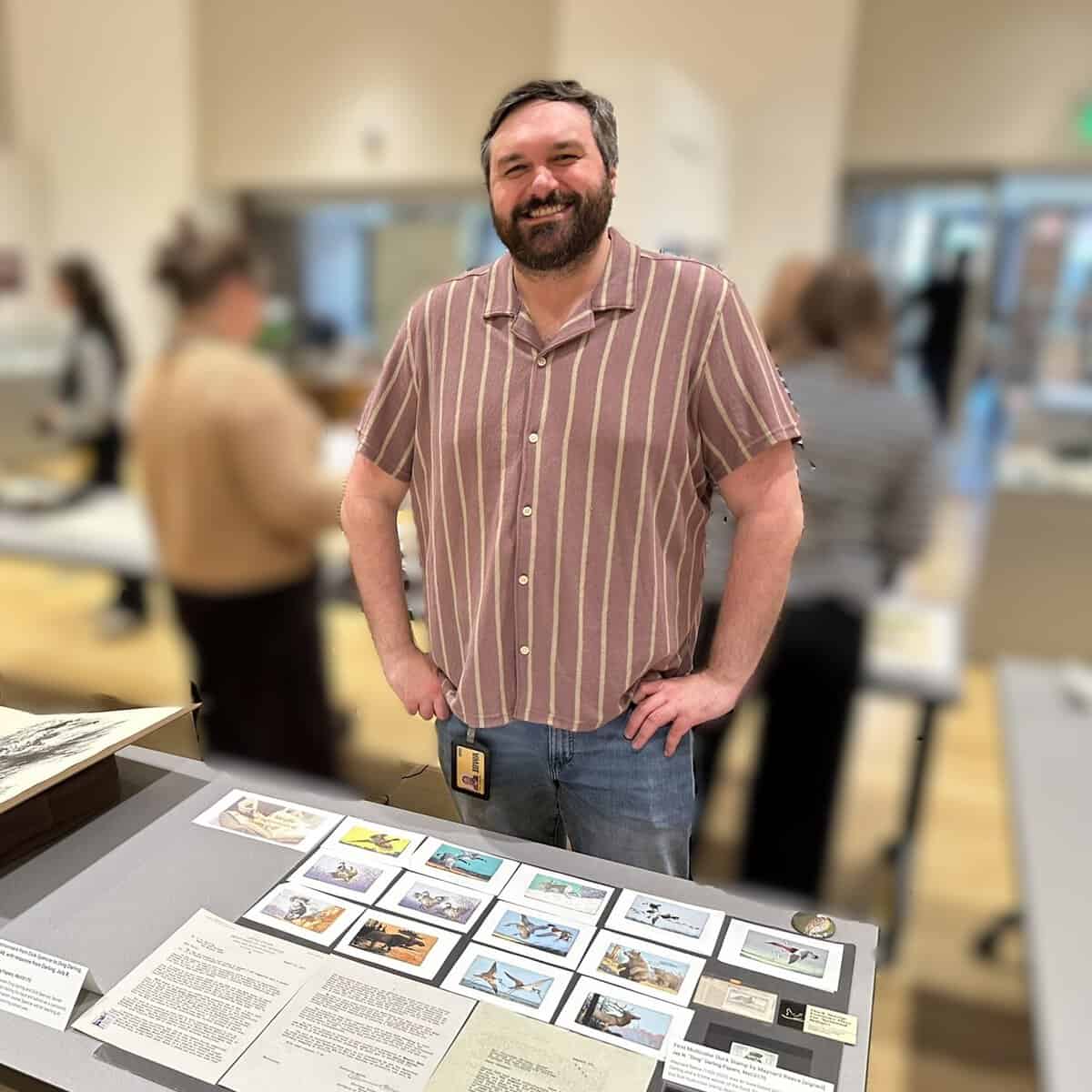
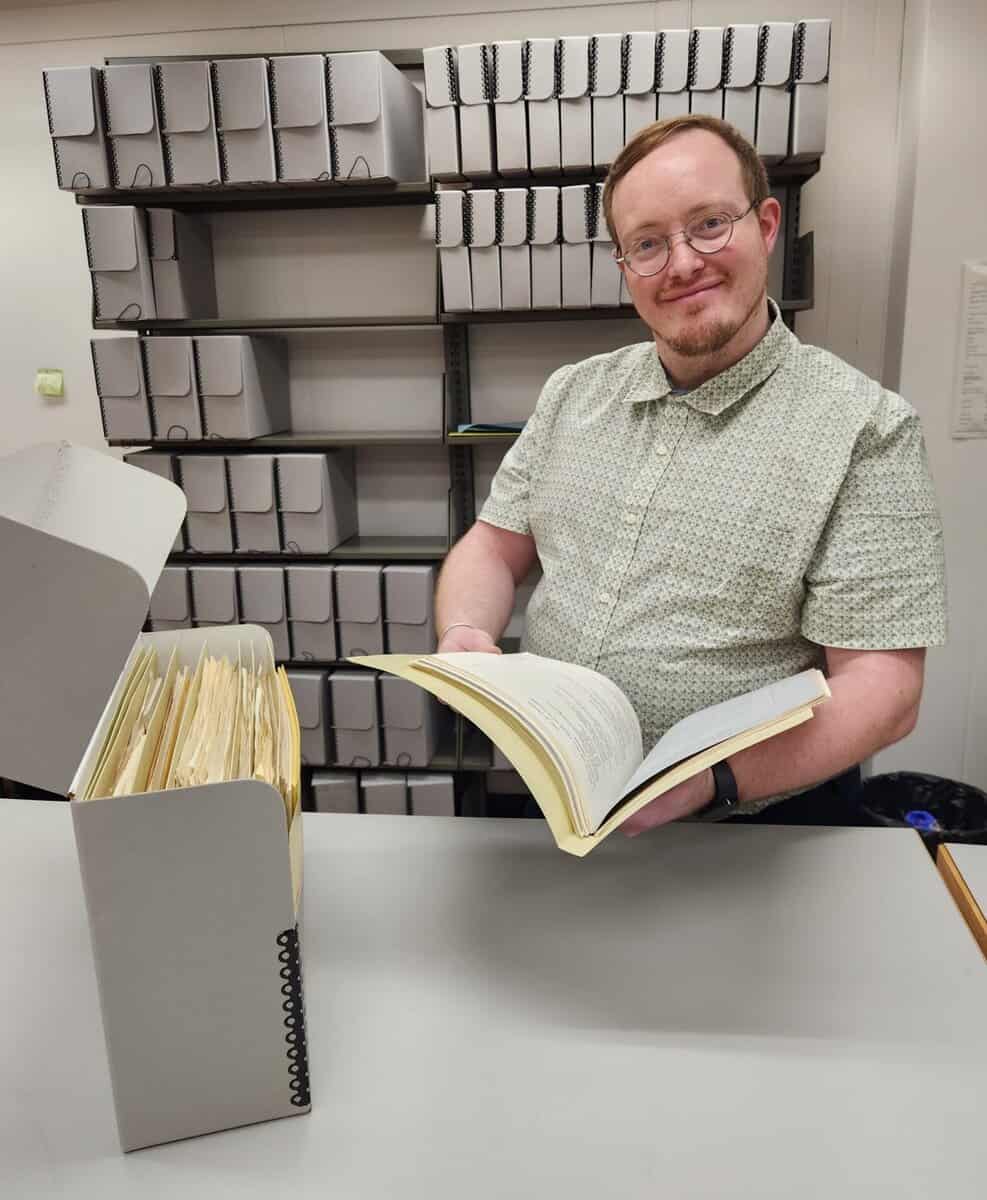
We are excited to introduce Collin Vandewalle to the University of Iowa Libraries Special Collections and Archives team as the Sackner project archivist for the next year.
Originally from Cedar Rapids, Iowa, Collin grew up in Chattanooga, Tennessee. Unable to stay away from his prairie roots, he returned at 18 to attend Drake University. There, he double majored in law, politics, and society; and rhetoric, media, and social change. While at Drake, Collin worked in Cowles Library’s Special Collections and Archives as a student assistant, where he fell in love with archival work. After Drake, he taught English at a university in Guilin, China, for a year before coming back to Iowa to enroll in the master’s program at the UI School of Library and Information Science. During this time, Collin had a position as a student lead in Special Collections and Archives. His focus during this time was on reprocessing J. N. “Ding” Darling’s Papers for a celebration of what would be his 150th birthday in 2026. Collin also co-curated an exhibit on Darling, now open in the Main Library Gallery.
“I most look forward to the chance to make the Ruth & Marvin Sackner Archive of Concrete and Visual Poetry more accessible to the public. It is a wonderful collection full of surprising and thought-provoking pieces. Every time I wander through the collection, I find a new exciting piece that I cannot wait for researchers and students to see as well,” says Collin. “I hope to have many engaging conversations [with researchers] about the Sackner materials during my term.”
In his spare time, Collin is a self-proclaimed nerd, regularly playing Magic: The Gathering and Dungeons & Dragons with friends and family. Right now, his new reading obsession is the Dungeon Crawler Carl series. He also enjoys staying active by going on frequent hikes with his partner and playing racquetball with friends. Glad to have you on board, Collin!
Please help us welcome Frances Ritter, collections archivist for the Iowa Women’s Archives (IWA) at the University of Iowa Libraries.
Frances is from Lansing, Michigan, where her previous job was collections archivist for the Archives of Michigan. She studied history and German at Kalamazoo College in Kalamazoo, Michigan, and received a Master of Library and Information Science and a Graduate Certificate in Archival Administration from Wayne State University in Detroit. As of this summer, she is also a certified archivist through the Academy of Certified Archivists.
As an archivist starting at the university, Frances looks forward to preserving women’s history at IWA. She worked with other women’s organizations, including the Michigan Women’s Hall of Fame, and is excited to dig into the history of Iowa women as she gets to know her new state.
“My favorite thing about being an archivist is knowing that my work directly contributes to solving someone’s information need, whether that need is academic, professional, or personal,” says Frances.
When not at work, you can expect Frances to be working in her vegetable garden or listening to history podcasts. Newly married, Frances and her husband are also excited to explore Iowa by taking lots of road trips and traversing some fantastic hiking trails. Got a spot to recommend? Be sure to let Frances know when you see her in the archives!
This series features the work and research of University of Iowa students. The following is written by Noah Jedlicka, a student worker at Special Collections and Archives working on his Master of Arts in classics.
“When in the Course of human events, it becomes necessary for one people to dissolve the political bands which have connected them with another, and to assume among the powers of the earth, the separate and equal station to which the Laws of Nature and of Nature’s God entitle them, a decent respect to the opinions of mankind requires that they should declare the causes which impel them to the separation.”
With this introduction, the world would soon learn the name “The United States of America.” This is the start of the words upon which this nation was founded, written by Thomas Jefferson and the other members of the Committee of Five, who would bring the document before the Second Continental Congress in 1776 and ignite a war that would redefine the status –quo of the world, throwing off the chains of monarchy.
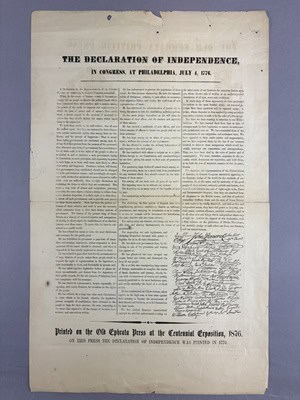
“Declaration of Independence, Printed on the Old Ephrata Press at the Centennial Exposition, 1876”, Springer FOLIO 342.731 .U52 1876
“In every stage of these Oppressions We have Petitioned for Redress in the most humble terms: Our repeated Petitions have been answered only by repeated injury. A Prince, whose character is thus marked by every act which may define a Tyrant, is unfit to be the ruler of a free people.”
In the spring of 1776, the focus in the Second Continental Congress, taking place in Philadelphia, was that of the question of independence. After much debate, the Congress voted to move forward with their national divorce, and the Committee of Five was tasked with drafting their statement to the world. The Committee was made up of Robert Livingston, John Adams, Roger Sherman, Benjamin Franklin, and Thomas Jefferson. Jefferson and Adams, delegates from Virginia and Massachusetts, became the subcommittee to form the draft. Some historical gray areas lie around the role of Adams, and how much he actually edited; however, pretty much all agree that the large majority of the Declaration was written by Jefferson.1
Before heading further back in time to its contemporaries, we’ll stop at another anniversary celebration. This copy of the Declaration was printed on the Old Ephrata Press for the 100th anniversary in 1876. The press had historically been used by Peter Miller, a clergyman of the Seventh-Day Baptist Society, to print versions of the Founding Document in both English and five other languages, sent to other countries after the Revolution.
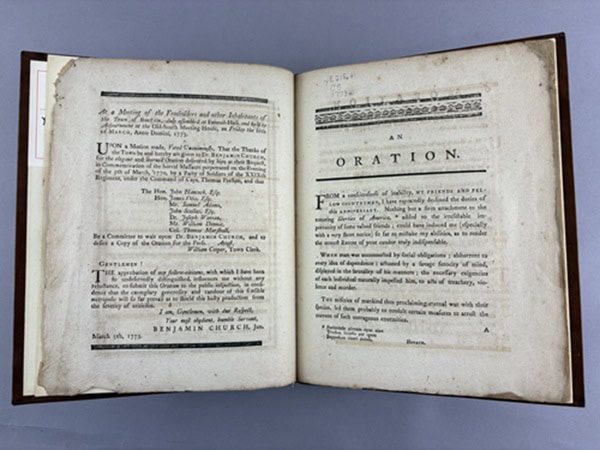
An oration; delivered March 5th, 1773 : at the request of the inhabitants of the town of Boston; to commemorate the bloody tragedy of the fifth of March, Dr. Benjamin Church, 1770 x-collection E215.4 .C5 1773a
“As in every government there must exist a power superior to the laws, viz. the power that makes those laws, and from which they derive their authority: therefore the liberty of the people is exactly proportioned to the share of the body of the people have in the legislature; and the check placed in the constitution on the executive power.”
Benjamin Church spoke these words on the steps of Faneuil Hall in Boston, just down the street from the Old State House where the Boston Massacre had taken place. Under the command of Thomas Preston, British soldiers were stationed outside of the building on the night of March 5, 1770. A crowd of Americans, dissatisfied with the continued stationing of British troops, began to jeer and mock the troops; when objects began being thrown, the soldiers fired into the crowd, killing five colonists.
This oration was given in 1773 on the third anniversary of the shooting. Benjamin Church, an elected member of the Massachusetts Congress, spoke not only in memory, but also in reason, clearly articulating his perceived faults of the British government and rallying the Revolutionaries through his words.
In time, it would turn out that Church was a British spy, and he would eventually be arrested and jailed. Banished from the new nation, he sailed for the Caribbean, only for his ship to become lost at sea. However, the sentiments he voiced provided both emotional and motivational inspiration for the colonies.
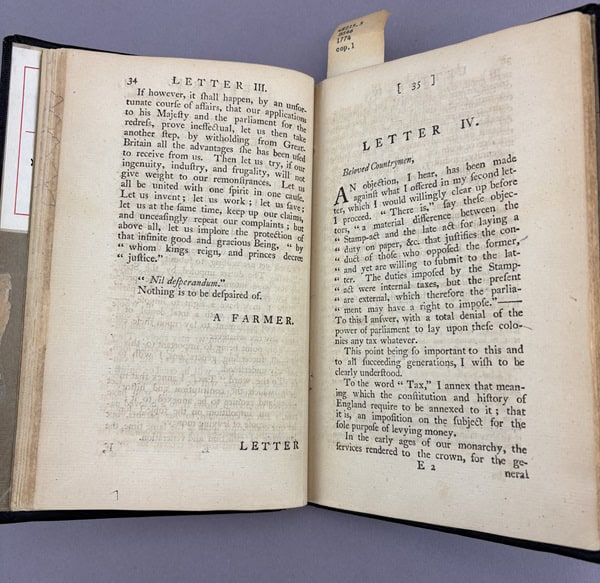
Twelve Letters From a Farmer, John Dickinson x-collection E215.5 .D546 1774
“If the Parliament may lawfully deprive New York of any of her rights, it may deprive any or all the other colonies of their rights; and nothing can possibly so much encourage such attempts as a mutual inattention to the interests of each other. To divide, and thus to destroy, is the first political maxim in attacking those who are powerful by their union.”
Thus begins John Dickinson’s first letter to his fellow colonial subjects, written in 1767. Having been a member of the Stamp Act Congress, Dickinson saw first-hand how the iniquities of Britain’s rule were affecting the colonies. He would write a total of 12 letters over the course of almost two years, with the final being published in 1768. These letters would be printed in a collected edition in Philadelphia, with this edition being printed in 1774, sold for the “price of two shillings.” Predating Thomas Paine’s Common Sense, it would become the de facto text for the early Revolutionaries, read throughout bars and meeting houses across the colonies.
Dickinson’s letters were published without an author, choosing to refer to himself as “A Farmer” — not to be confused with A. (W.) Farmer, Samuel Seabury’s pseudonym for his letters against the Continental Congress. It’s important to note that neither of the two, as it turns out, were farmers when composing their treatises, and probably chose these aliases to seem more in –touch with the wider public.
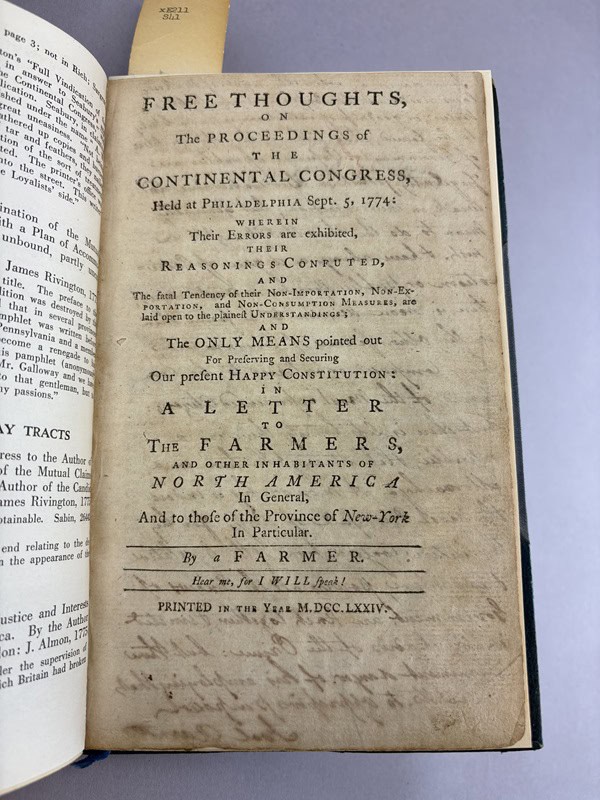
Free Thoughts on the Proceedings of the Continental Congress, Held at Philadelphia Sept. 5, 1774, Samuel Seabury, x-collection E211 .S41
“Hear me, for I WILL speak!”
Speaking of A.W. Farmer, Seabury would write a few different essays opposing the Continental Congress before being arrested and thrown in prison in the fall of 1775. Perhaps his most famous is that of Free Thoughts on the Proceedings of the Continental Congress, Held at Philadelphia Sept. 5, 1774.
In it, Seabury voices many worries and concerns following the American resolution to no longer import goods from Great Britain or any of its colonies. Concerned with the effect on prices, he attempts to lay out different ways the supply chain will be disrupted — and he may have been right. A printed note, at the bottom of page seven, reflects the rising price of feed, having jumped from 10 to 13 shillings between writing to printing.
Following the end of the Revolution, Seabury would continue to live in America and eventually came to support the new government. Rising to the status of Bishop in the Episcopal Church, he would write and publish one of the first prayers for the American Congress.
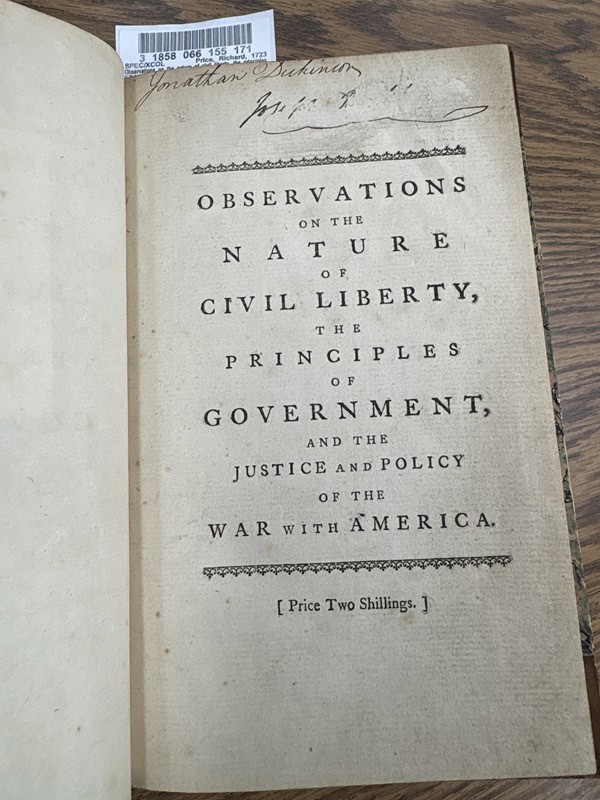
Observations on the Nature of Civil Liberty, the Principles of Government, and the Justice and Policy of the War With America, x-collection E211 .P961
“The following observations on this subject appear to me important, as well as just; and I cannot make myself easy without offering them to the public at the present period, big with events of the last consequence to this kingdom. I do this with reluctance and pain, urged by strong feelings, but at the same time checked by the consciousness that I am likely to deliver sentiments not favourable to the present measures of that government, under which I live, and to which I am a constant and zealous well-wisher.”
Richard Price, writing across the sea in the land of King George III, knew full –well the potential consequences of his actions. In this pamphlet, Observations on the Nature of Civil Liberty, the Principles of Government, and the Justice and Policy of the War with America, published in 1776, Price breaks down the “Nature of Liberty” through four categories: Physical Liberty, Moral Liberty, Religious Liberty, and Civil Liberty.
Perhaps unknowingly making a reference to the future congressional system that would develop in America, Price works through these different forms of liberty on different scales, noting that just as the great state of Britain sat atop the states of the colonies, civil liberty cannot be guaranteed when one state is more powerful than another: “It would, therefore, be a remedy worse than the disease; nor is it possible it should be approved by any mind that has not lost every idea of Civil Liberty,” he said.
Rather, Price supports the idea of representatives in a state assembly, apportioned to the population, as a way to ensure a state “will be still free or self-governed, more or less so in proportion,”, and, in its name, be represented: the very thing King George III refused to give to the colonies and spurred on the conflict.
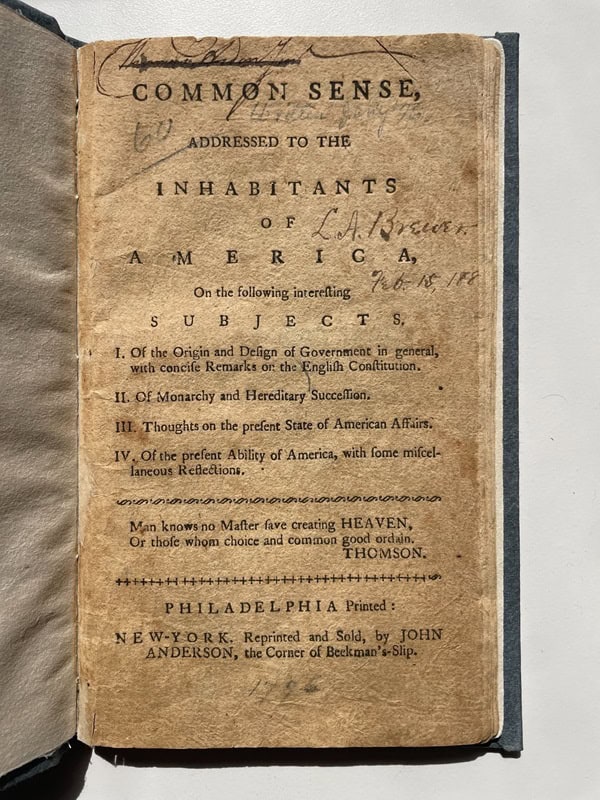
Common Sense, Thomas Paine xVAULT E211 .P1455 1776
“I have never met with a man, either in England or America, who hath not confessed his opinion, that a separation between the countries, would take place, one time or other.”
Thomas Paine’s Common Sense is perhaps the most well-known of any pamphlet arising from the American Revolution. Written in 1775 and published in 1776, it carried the torch lit by Dickinson seven years earlier. Having been born in England, Paine migrated to America in 1774 and immediately joined the Revolution. Having just lost his business, his job, and separated from his wife, he joined his friend Benjamin Franklin in the colonies, and after a year, began writing Common Sense.
Paine’s monumental essay rails relentlessly against monarchy and tyranny: “But how a race of men came into the world so exalted above the rest, and distinguished like some new species, is worth enquiring into, and whether they are the means of happiness or of misery to mankind.” With inspiration from English preacher John Locke, and echoing both Dickinson and Price above, Paine focuses on natural rights and liberty.
It originally had the working name “Plain Truth” — which is also the name of an essay rebuking Common Sense, written by James Chalmers, a Loyalist and eventual exile of the colonies.
You can view these and other pieces in Special Collections and Archives, located on the third floor of the Main Library, which is open to the public. Still wanting to find ways to mark the 250thanniversary? Stop by the Great American Melting Pot pop-up exhibit on Sept. 10, 2026, from 11 a.m. to 1 p.m. on the first floor of the Main Library. We’ll be celebrating the rich food tapestries that make up these United States.
The Cambridge Companion to the Declaration of Independence, Edited by Mark A. Graber and Michael Zuckert, “The Process of Writing and Procedures for Adopting the Declaration”, Peter Charles Hoffer and Williamjames Hull Hoffer
“Declaration of Independence, Printed on the Old Ephrata Press at the Centennial Exposition, 1876”, Springer FOLIO 342.731 .U52 1876
An oration; delivered March 5th, 1773 : at the request of the inhabitants of the town of Boston; to commemorate the bloody tragedy of the fifth of March, Dr. Benjamin Church, 1770 xE215.4 .C5 1773a
Twelve Letters From a Farmer, John Dickinson xE215.5 .D546 1774
Free Thoughts on the Proceedings of the Continental Congress, Held at Philadelphia Sept. 5, 1774, Samuel Seabury, xE211 .S41
Observations on the Nature of Civil Liberty, the Principles of Government, and the Justice and Policy of the War With America xE211 .P961
Common Sense, Thomas Paine xVAULT E211 .P1455 1776
This series features the work and research of University of Iowa students. The following is written by Noah Jedlicka, a student worker at Special Collections and Archives working on his Master of Arts in Classics.
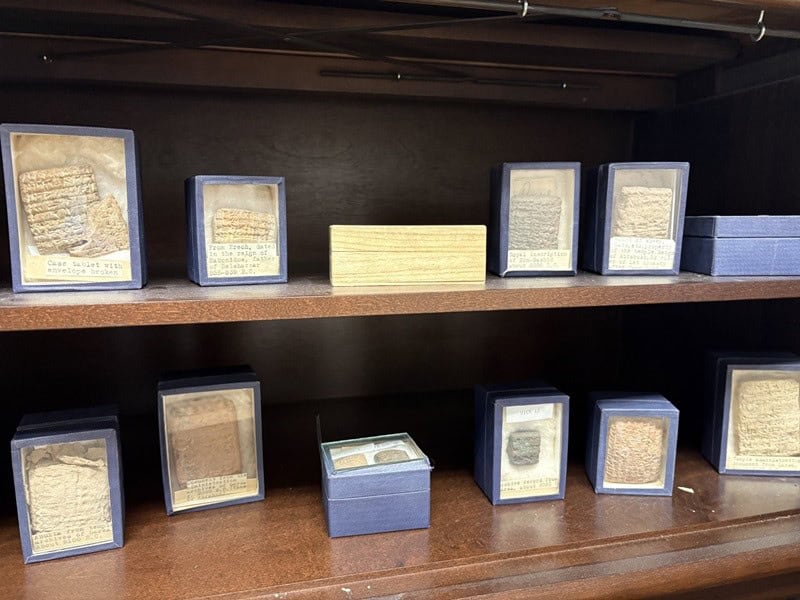
The University of Iowa has many texts and writings scattered throughout different departments, libraries, and seminar rooms across campus. As the university has only existed for 179 years, the large majority of these texts sit in that time range, with most being published or printed in the 1800s to 1900s. Sitting in a display case in the corner of the lobby of the Department of Classics, however, reside 23 clay tablets, some dating to those 19th and 20th centuries — albeit, BCE.
While they may not look like much, these are instances of writing around 3,000 to 4,000 years old. The tablets are in a variety of shapes and sizes, from quadrilateral parallelograms to a cone, and range from four to eight inches tall. Some, in the many years since they were produced, have seen wear and tear — or, in this case, cracks. They are preserved in small blue boxes, with cotton behind them, and feature a translation of the text.
The tablets, in their boxes, housed in the Department of Classics. Seen in the top left case is not only a clay tablet, but the clay envelope it was originally sent in.
In 1979, a study of the tablets was undertaken by Dr. Francesca Rochberg-Halton and Dr. Paul Zimansky, two researchers out of the University of Chicago. In the study, the first 18 tablets were copied and translated by Rochberg, with Zimansky undertaking the final five:
“The twenty-three tablets, ranging in date from the Ur III period to the reign of Cambyses, can be seen as a representative sample of common legal and economic documents, with the addition of two typical Sin-kasid votive inscriptions,’ and a Sumerian literary tablet. No records exist of how or when this diverse collection came into the possession of the University of Iowa, but the collection conforms in size and character to other groups of tablets sold in the United States in the early decades of the twentieth century. We wish to thank Prof. O. E. Nybakken, curator of the Museum, and Prof. Roger A. Hornsby, Chairman of the Classics Department, for permission to publish these texts. Thanks are also due Prof. Hermann Hunger and Prof. Miguel Civil for their generous assistance. The first eighteen tablets were copied by Rochberg-Halton, and the remaining five by Zimansky.”
As noted above, in the introduction to their research paper, the Department of Classics had no paper trail or known connections to the tablets. However, the University of Iowa Libraries Special Collections and Archives maintains an extremely strong records collection detailing the history of our university, and, as a Classics major, I wondered if the answers were residing there.
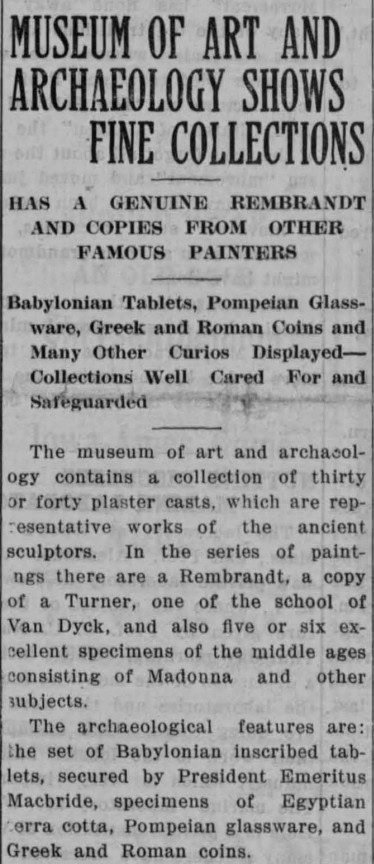
Having been born in a digital era, newspapers were not my first thought to explore. However, as I would learn over the course of this project, a wealth of information was recorded daily in these papers — a sort of pseudo-diary for the campus. The university has over 100 years of digitized editions of The Daily Iowan in its archives, and it doesn’t stop there. The archives also include records that go back to 1868, allowing access to the student newspapers that were published preceding the DI. Searching several variations for “cuneiform tablets,” I found an article from Nov. 17, 1916, detailing the collections at the university’s Museum of Art and Archaeology. This article, seen below, asserts that then-President Emeritus Thomas Huston Macbride had acquired the tablets for the museum:
This now-extinct museum was located in 305 Schaeffer Hall. Located directly next door, in room 306, was the Mark Ranney Collection, and the two collections were eventually merged. In 1951, following the opening of the university’s General Library (now known as the Main Library), portions of these collections went different ways to the departments in which they belonged. The Ranney Collection is currently in Special Collections and Archives, with the coins and the tablets housed in the Department of Classics.
President Macbride, for whom the building on campus is named, was hired by the University of Iowa in 1883 as a professor of botany. In 1902, 19 years after arriving at our institution, he was named the head of the Department of Botany, and he would serve in that position until his promotion to university president in 1914. While he would only hold this post for two years, citing age and health as his reasons to step down, his service to the University of Iowa was busy and full.
President Thomas Huston Macbride, Presidential Portrait Photographs Collection, University of Iowa Archives.
In March 1916, the very year he would resign, Macbride read a book by Dr. Albert T. Clay, titled Miscellaneous Inscriptions in the Yale Babylonian Collection. Macbride was shocked to find that a good many of these tablets contain “simple contracts, such as for the construction of ditches… houses… and land leases.” In a letter to Clay, around that time, Macbride asked for some tablets of that nature to be sent to the university: “In regards to the tablets, I beg to say that I should be very glad if you would select for me about $40 worth.” Clay agreed and began preparing the tablets.
For a short while, it seems that Clay didn’t respond, and this worried Macbride. In a follow-up letter, dated May 27, 1916, he provided a deadline:
“Some time since I was favored with a letter from you, in which you stated that you were making up a little set of tablets for the University, and saying that you would send them in the near future. I made no reply, because I understood that you were proceeding without further advice. Fearing that there may be some misunderstanding, and that you are awaiting a definite order from me, I am writing this morning. I beg to say that we shall be glad to receive the objects which you are setting out for us, and I should be glad to know whether we might have them before the fifteenth of June.”
(The University Archives has a vast collection of correspondence saved from historic individuals related to the University, and a large quantity of Macbride’s survives. The letters quoted above both come from this collection)
Clay would respond three days later, and after a few more letters back and forth, would send 25 tablets to Iowa. The boxes, having been made by Yale and shipped with the tablets, cost $2.50. They arrived on June 7, 1916, clear of the June 15th deadline, and have resided here ever since.
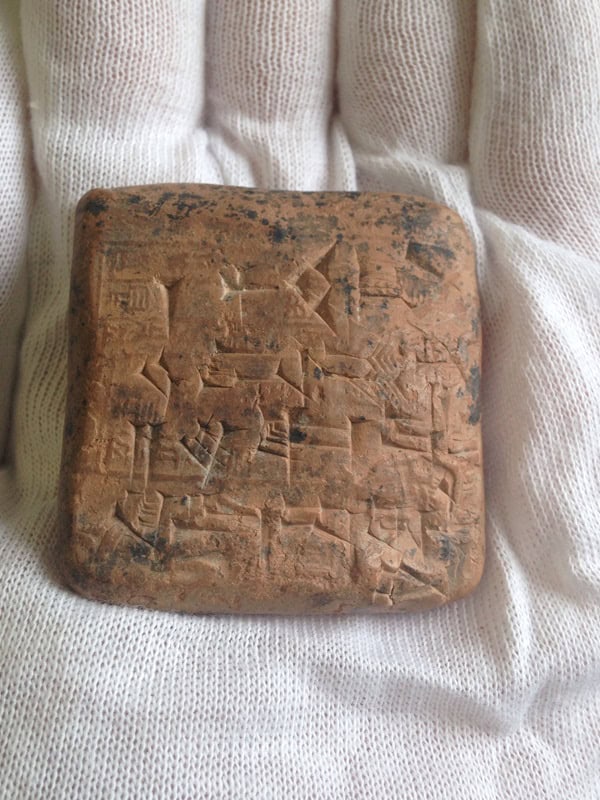
If you’d like to see these tablets, you may have to wait — the Department of Classics is currently merging with Religious Studies and changing spaces. However, Special Collections and Archives also have a tablet in their Smith Miniature Book Collection dating to around the same period, and they are open Monday through Friday, 9 a.m. to 4 p.m.
Special Collections and Archives cuneiform tablet
Works Cited and Further Reading:
Clay, Albert T. 1915. Miscellaneous Inscriptions in the Yale Babylonian Collection. AMS Press.
Daily Iowan. 1916. “Museum of Art and Archaeology Shows Fine Collections.” November 17, 1916, 1. https://dailyiowan.lib.uiowa.edu/DI/1907/di1907-10-06.pdf.
Rochberg-Halton, Francesca, and Paul Zimansky. 1979. “The University of Iowa Cuneiform Tablets.” Journal of Cuneiform Studies 31, no. 3 (July): 127-188. https://doi.org/10.2307/1359823.
“Thomas Huston Macbride (1914-1916).” n.d. In UI Presidents, Main Library Gallery. University of Iowa Libraries. https://www.lib.uiowa.edu/gallery/ui-president/thomas-huston-macbride/.
This series features the work and research of University of Iowa students at the Libraries. The following is written by Jenna Zukauskas, an undergraduate student worker at Special Collections and Archives.
Before there was the “get ready with me” or “do it yourself” trends, fashion and style had to find other ways to make their way into society. But fear not, women had their ways of adapting. Instead of TikTok or Instagram, women read periodicals. An easy and comprehensive view of the best gossip, fashion advice, romance stories, and do-it-yourself crafts were offered in the time’s most popular magazines. A quick tour through UI Special Collections and Archives will reveal all the fashionable do’s and don’ts of Georgian style icons.
Perhaps the most notable of such periodicals was the British publication known as the Lady’s Magazine, which ran from 1770 to 1832. While publication under its original name ceased in 1832, the periodical merged with other successful women’s magazines to continue circulation throughout British society. As a pillar of middle-class female literature, this magazine, including its successor publication, was of high interest to any woman seeking entertainment and knowledge that was not available elsewhere.
While fashion prints were not a consistent feature of the Lady’s Magazine until 1800, style was still considered one of its selling points. The magazine focused on reproduction and replication when it came to sharing fashion advice. Many styles were copied and recycled from elite fashion periodicals. The Lady’s Magazine succeeded in bringing high society to everyday women who shared the feminine sentiment of wishing to dress like European elites.
Fig. 1-4: Fashion plates from 1818 Lady’s Magazine publications. Includes promenade, walking, and mourning dresses. Feature designs from the months of February, March, May, and December.
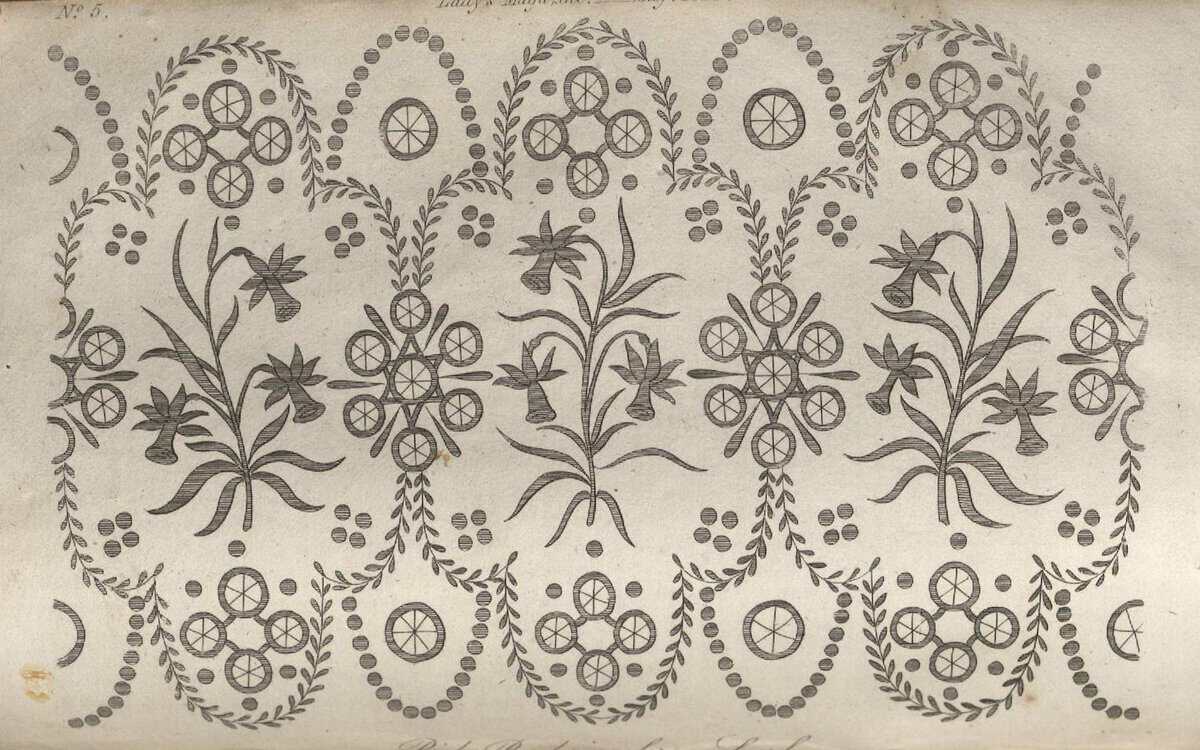
Alongside the all-important fashion prints, the Lady’s Magazine included embroidery patterns. It was the first periodical to boast consistent publication of such embellishment guides. These fold out papers were meant to be removed from their bindings in order for them to be used by readers. The embroidery included both male and female focused patterns and outlined specific suggestions on what it should be used for. By providing this, the magazine offered a do-it-yourself opportunity to elevate one’s look in a cost-efficient and personalized manner. Likely, the purpose of these embroidery patterns was to furnish middle class women with the tools to assimilate to upper class standards, just as the fashion plates aimed to do.
Fig. 5: Lady’s Magazine, V17 from 1786, “New Pattern for Working a Gown or Apron”
It is impossible to discuss the Lady’s Magazine without recognizing similar prints that were in publication at the same time. Rival periodicals, such as the Lady’s Monthly Museum, and La Belle Assemble all worked to publish similar content to capture the interest of their female audiences. To compete with these magazines, the Lady’s Magazine had to adapt. Beginning in 1820, the magazine began to alter its series, ultimately ending with a competitor merge in 1832. The three series mentioned above became one as they vied for survival in the cutthroat field of entertainment literature.
Even with changes to their content, the Lady’s Magazine remained a shining beacon of style for its female audiences in the late 18th to the early 19th century. Not only did these magazines provide women with colorful depictions of fashion, but they also worked to inspire the individual female. The embroidery patterns, plates, and sheets that were featured in the Lady’s Magazine, as well as other women’s periodicals, offered a connection to society, while still allowing creative freedom. Through homemade articles of clothing, embellished with designs offered through such magazines, women were able to assimilate to the expected styles of the time and fit into social gathering. Fashion and practicality were presented as a vessel in which women were able to involve themselves in social interactions occurring within their own societies.
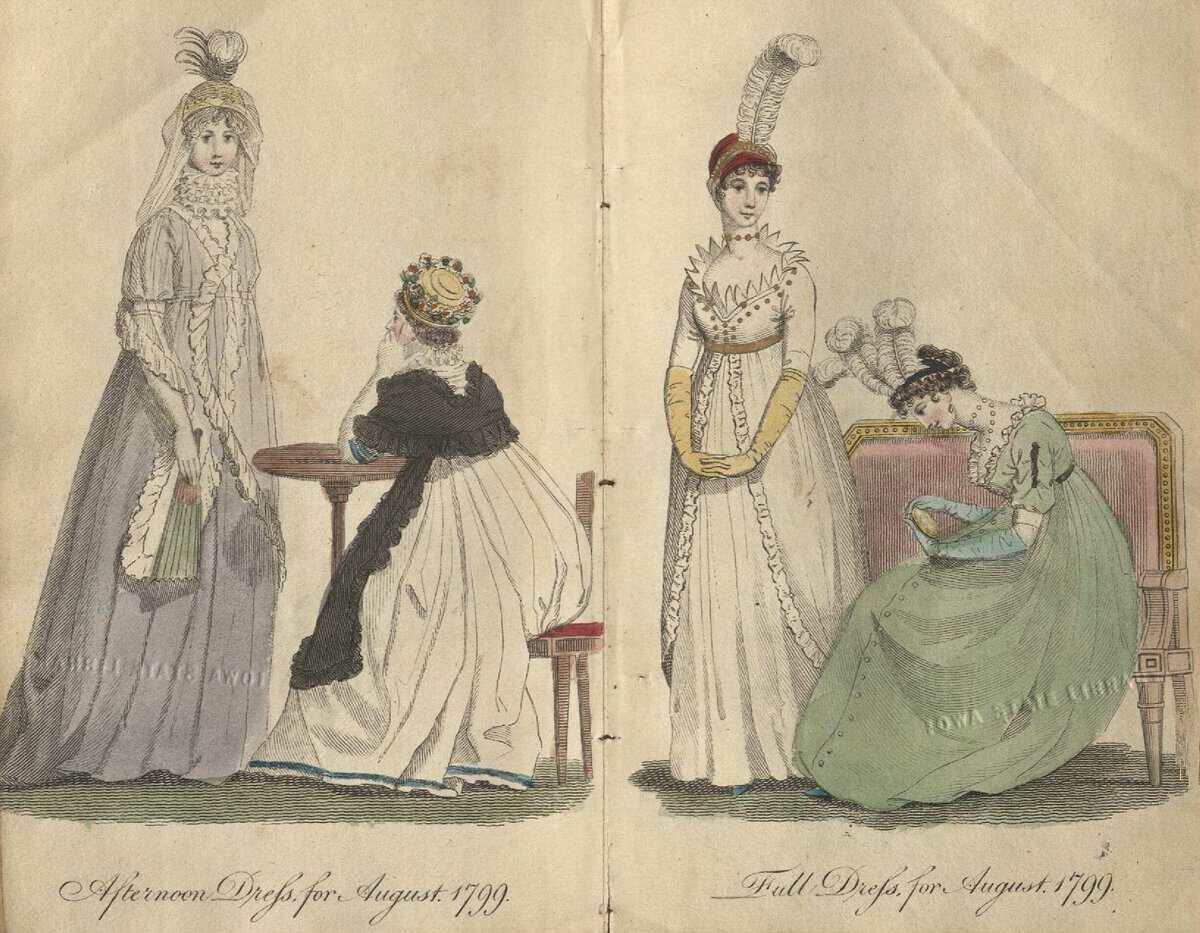
Fig.7: Lady’s Monthly Magazine , V.3 from 1779 “Afternoon Dress for August 1799” and “Full Dress for August 1799”
Works Cited and Further Reading:
Batchelor, Jennie, and Manushag N Powell. Women’s Periodicals and Print Culture in Britain, 1690-1820s : The Long Eighteenth Century / Edited by Jennie Batchelor, and Manushag N. Powell. Edinburgh: Edinburgh University Press, 2018.
Jennie Batchelor. “Rivals: The Changing Face of the Women’s Magazine.” In The Lady’s Magazine (1770–1832) and the Making of Literary History, 162. Edinburgh University Press, 2022. https://doi.org/10.1515/9781474487665-008.
Miller, Peter John. “Eighteenth-Century Periodicals for Women.” History of Education Quarterly 11, no. 3 (1971): 279–86. https://doi.org/10.2307/367294.
Lady’s Magazine. University of Iowa Libraries Special Collections and Archives. X-Collection. AP 4 .L226 v.17 1786, Cop. 1
Lady’s Magazine. University of Iowa Libraries Special Collections and Archives. X-Collection. AP 4 .L226 v.49 1818, Cop. 1
Lady’s Monthly Magazine. University of Iowa Libraries Special Collections and Archives. X-Collection. AP4 .L227 V.3, Cop. 1
This series features the work and research of University of Iowa students at the Libraries. The following is written by Brianna Bowers, an undergraduate student employee who has spent the last couple years working on describing French Revolution pamphlets at Special Collections and Archives for the catalog.
Do you want to know your horoscope? Well, don’t look to the stars! Since history loves to repeat itself, we’re looking into the past at how the thousands of French Revolution pamphlets housed in the Special Collections and Archives at the University of Iowa may reveal advice (or warnings) for your future.
Aries
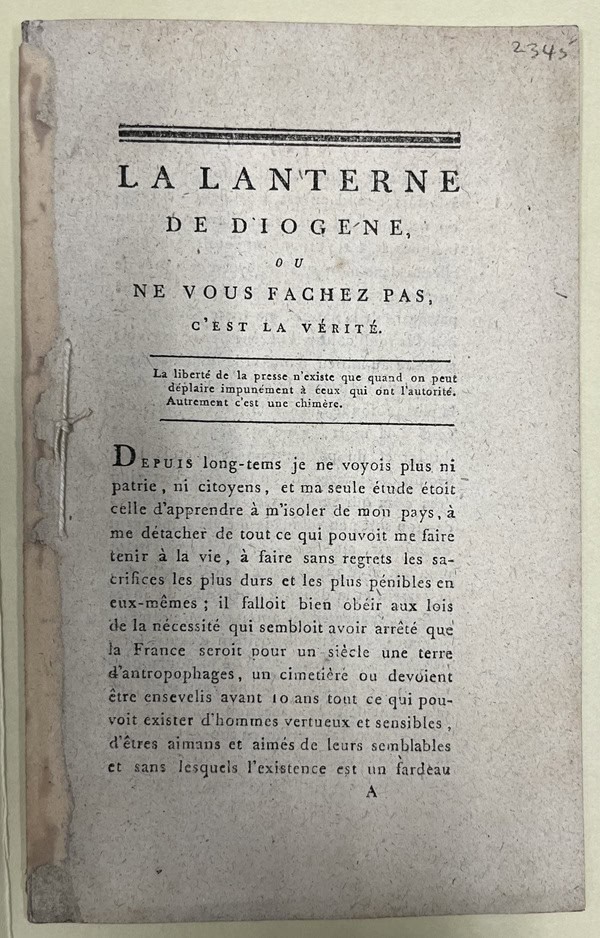
This pamphlet from March 20, 1795, is honest and bold enough for an Aries: “La lanterne de diogene, ou ne vous fachez pas, c’est la vérité. La liberté de la presse n’existe que quand on peut déplaire impunément à ceux qui ont l’autorité. Autrement c’est une chimère.” This translates to “Diogenes’ lantern, or don’t get upset, it’s the truth. ‘Freedom of the press exists only when one can offend those in authority with impunity. Otherwise, it’s a chimera.’” Aries aren’t afraid to demand the right to always speak their minds, so the stars are telling you to get your keyboard into the comment section to practice some free speech.
(Pamphlet 2345 in box 2305-2375.)
Taurus
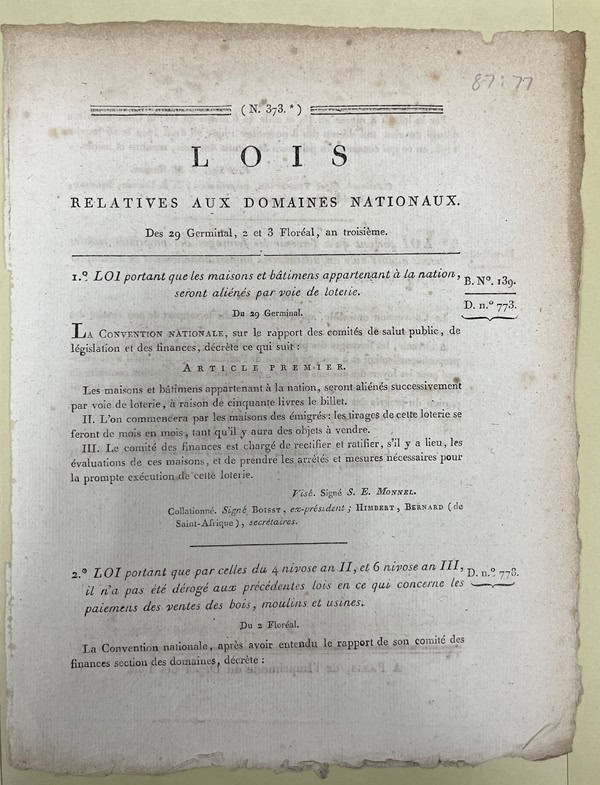
Pamphlet 87:77, from April 22, 1795, will appeal to the responsible and creative Taurus: “Lois relatives aux domaines nationaux. Des 29 Germinal, 2 et 3 Floréal, an troisième.” In order to raise the most funds for the sale of surplus national property, the National Convention decided to hold a lottery for them. This is a sign that some kind of lucky winning is right around the corner for Tauruses.
(Pamphlet 87:77 in box 87:1-87:95.)
Gemini
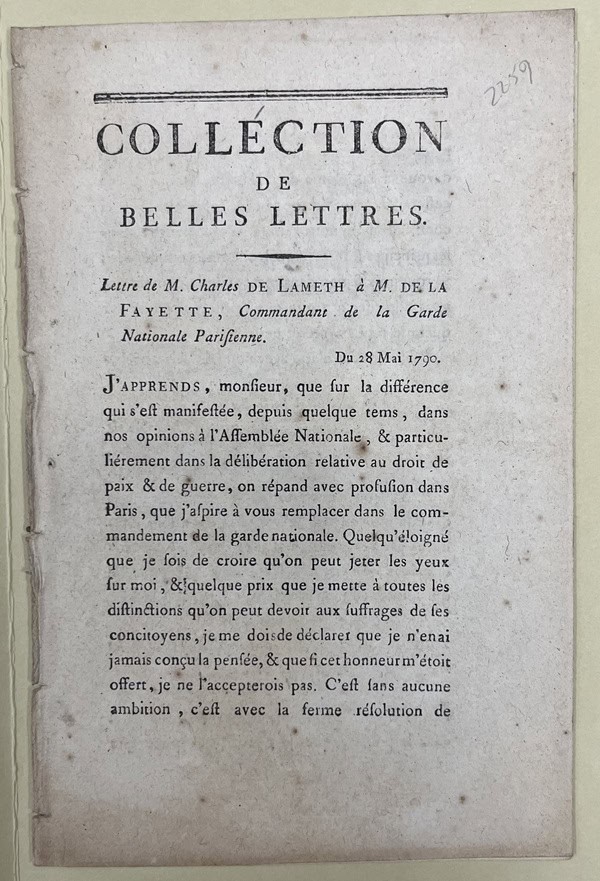
For a Gemini, we have a collection of letters purportedly written by Charles de Lameth, Duport, Delaborde, Alexandre de Lameth, and Barnave and collected together by an anonymous editor on May 28 or 29, 1790. The letters from these men all have the same purpose: to deny ambition and declare that they’re not after a high-ranking position. The headings of the letters reveal that many of them now have the positions that they in the letter professed to not want at all. This anonymous editor was probably a Gemini, since the editor is adept at mocking the false humility of these politicians in unique ways. The title is “Collection de belles lettres” [Collection of beautiful letters]. If you’re a Gemini, this pamphlet is warning you that your coworker who says they’re not jealous of your job might be scheming behind your back.
(Pamphlet 2259 in box 2234-2304.)
Cancer
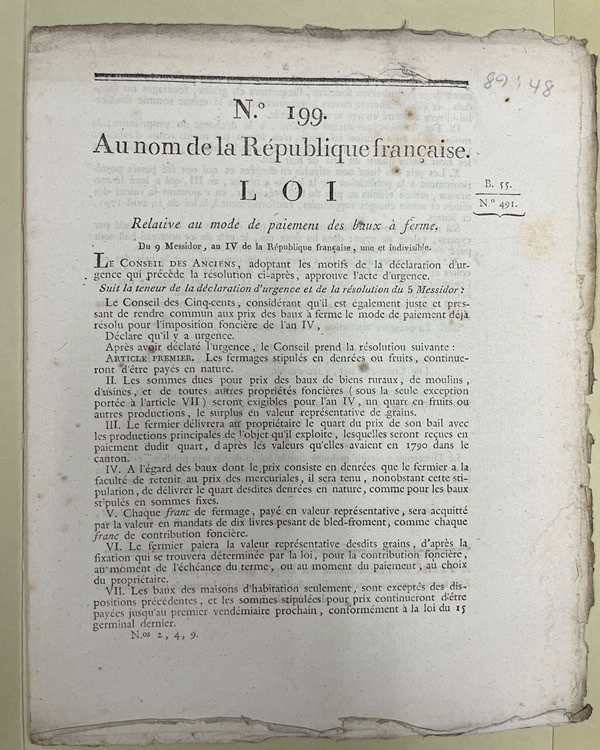
Would a Cancer be interested in a pamphlet entitled “loi Relative au mode de paiement des baux à ferme” about rent payments from June 27, 1796? Maybe, but they’ll definitely be charmed by something that makes the University of Iowa’s copy of this pamphlet unique: a long-dead bug impressed against the back cover. A sentimental and compassionate Cancer could stare at the little bug for hours. Is it a centipede? Where did it come from? Why is it preserved so well? How long has it been dead, and how long did it live? This pamphlet is telling Cancers that the next time they see a creepy critter inside their house, they should put it in a jar and take it outside instead of squishing it.
(Pamphlet 89:48 in box 89:35-89:140.)
Leo
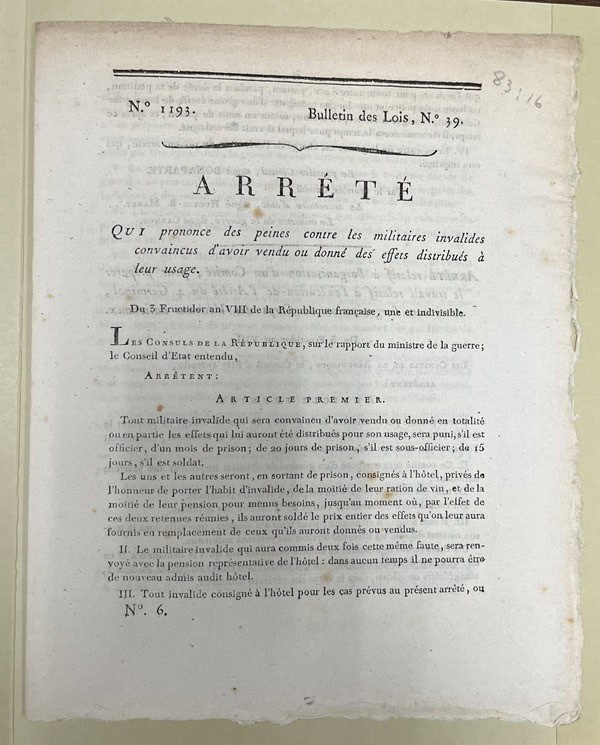
If I tell you Leos love glory, are confident to the point of arrogance, and are incredible leaders, who from the French Revolution pops into your head? The king? No. The revolutionaries of the National Assembly, who began the Revolution? Eh, glorious yes, but we’re not quite there . . . the republicans of the National Convention, who killed the king and paved the way for more progressive policies? Mm, we’re getting there . . . The weak and corrupt Directory which followed? Please. No, Napoleon was a Leo, and this pamphlet he signed well demonstrates this sign’s intensity: “N.ᵒ 1193. Bulletin des Lois, N.ᵒ 39. arrété Qui prononce des peines contre les militaires invalides convaincus d’avoir vendu ou donné des effets distribués à leur usage,” from Aug. 21, 1800. It imposes punishments on disabled soldiers who misuse their paychecks. Harsh! If you’re a Leo, remember not to invade Russia in the winter!
(Pamphlet 83:16 in box 82:118-83:40.)
Virgo
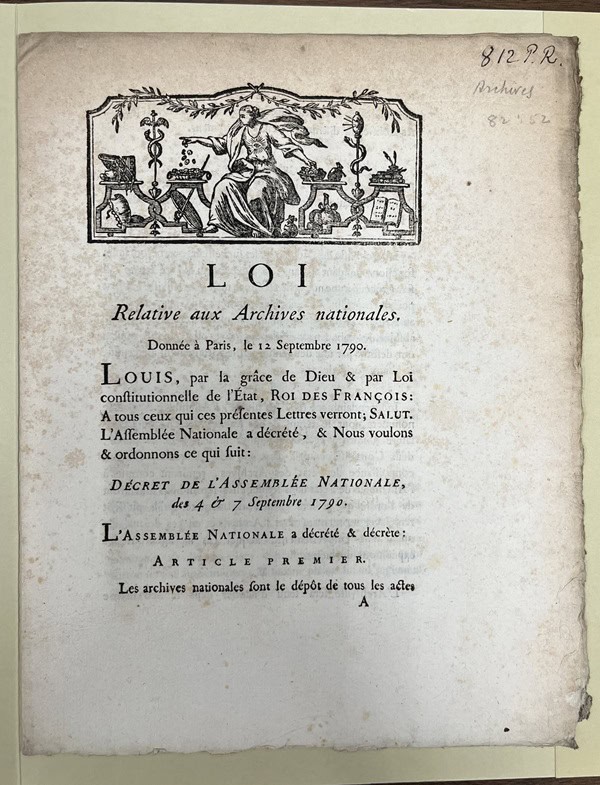
One famous Virgo is Louis XVI, the king who tried to cling to his throne and was guillotined. Although he barely made the cut to not be a Leo, he had much more of Virgo’s practicality than Leo’s fire: he pretended to go along with the Revolution for a long time, even though his strong loyalty was directed against it. While cooperating with the revolutionary National Assembly, he signed their decrees into law. One decree is the “Loi Relative aux Archives nationales” from Sept. 12, 1790. It’s about the National Archives of France, how much the head archivist and his assistants would be paid, when people could view the items in the Archives, and how no one was allowed to light any fires in the Archives. So the advice for Virgos today is: come to the Special Collections and Archives, and don’t bring any fire with you!
(Pamphlet 82:52 in box 82:28-82:117.)
Libra
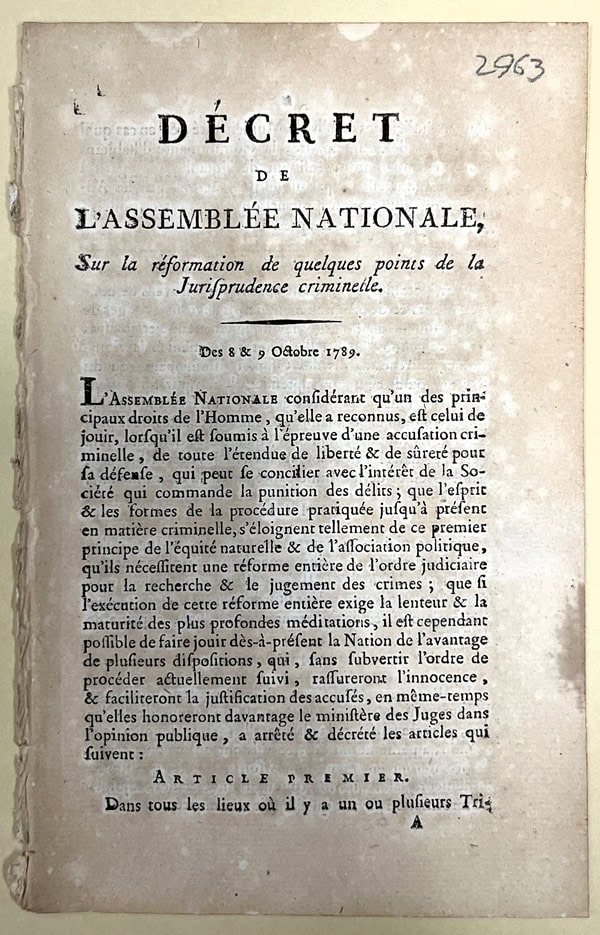
The fair and gracious mind of a Libra lends itself to social reforms like those to the criminal justice system in “Décret de l’assemblée nationale, Sur la réformation de quelques points de la Jurisprudence criminelle” [Decree of the National Assembly, on the reform of some points of criminal jurisprudence], from Oct. 8 or 9, 1789. If you’re a Libra, this is your sign to go directly to jail (to advocate for a change of your choice!) without collecting $200.
(Pamphlet 2963 in box 2933-2998.)
Scorpio
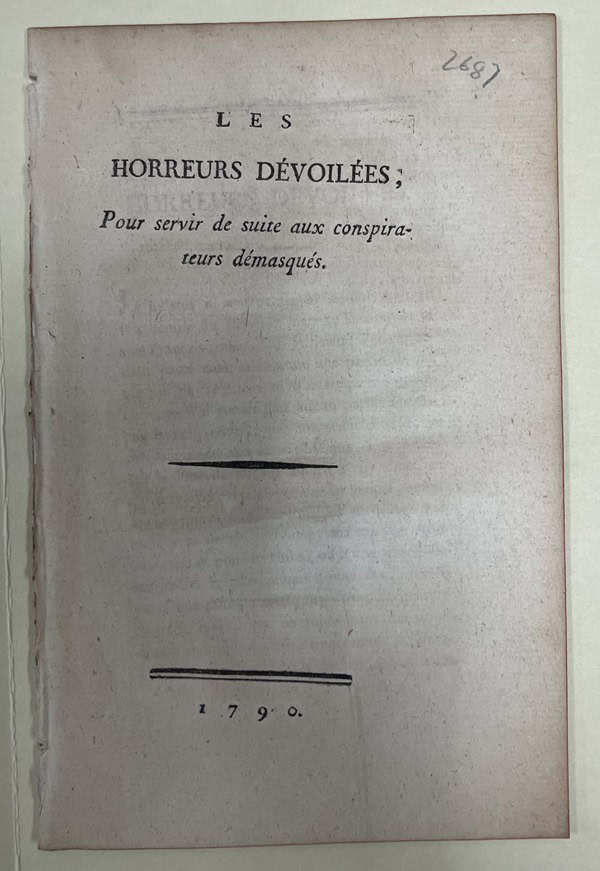
Your Scorpio passion is reflected in “Les horreurs dévoilées, Pour servir de suite aux conspirateurs démasqués.” It’s a classic example of neoclassical dramatism, with exclamations, declarations and flourishes galore, from Nov. 15, 1790. For the stubborn Scorpio who can sift their way through the purple prose, you’ll find amusing details like a misnomer of the not-yet-extremely-famous Maximilien Robespierre (here, Robertspierre) on page 23, as the anonymous author recalls a rumor that Robespierre was related to an attempted assassination of Louis XV, the previous king. Scorpios, this is too much drama for the page, so your stars want you to go to the theater!
(Pamphlet 2687 in box 2674-2727.)
Sagittarius
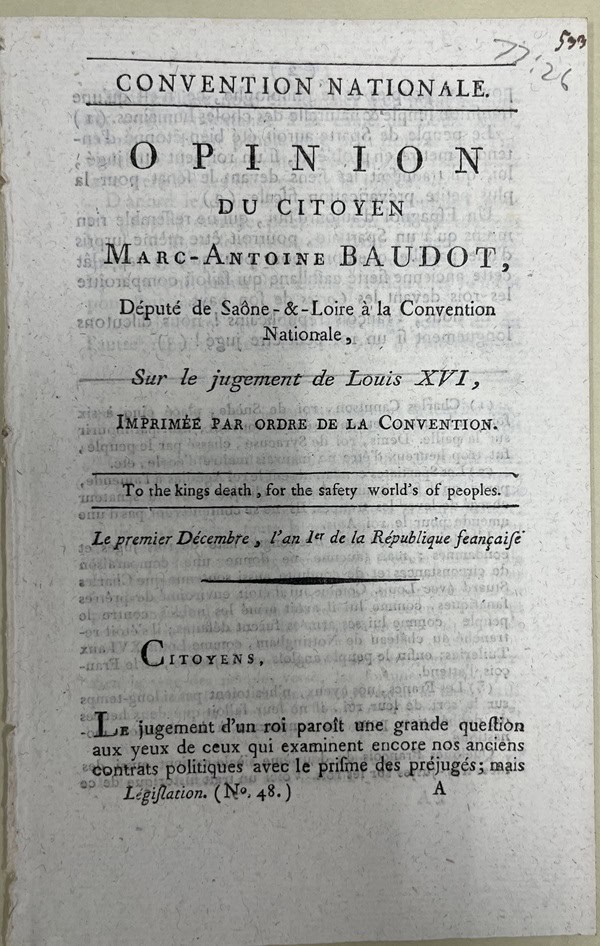
A fiery pamphlet for this fire sign, we have a representative in the National Convention arguing for Louis XVI’s execution from Dec. 1, 1792. Marc-Antoine here wanted to use Louis’s death to inspire the world outside of France to break the chains of tyranny as well. To show his devotion to the universal rather than national cause, he included a (badly spelled and grammarless) sentence in English in the title. “Convention nationale. opinion du citoyen Marc-Antoine baudot, Député de Saône-&-Loire à la Convention Nationale, Sur le jugement de Louis XVI, Imprimée par ordre de la Convention. To the kings death, for the safety world’s of peoples. Le premier Décembre, l’an Iᵉʳ de la République feançaise.” This pamphlet wants to remind Sagittarians to think about how their actions will affect the wider world.
(Pamphlet 77:26 in box 3202-77:65.)
Capricorn
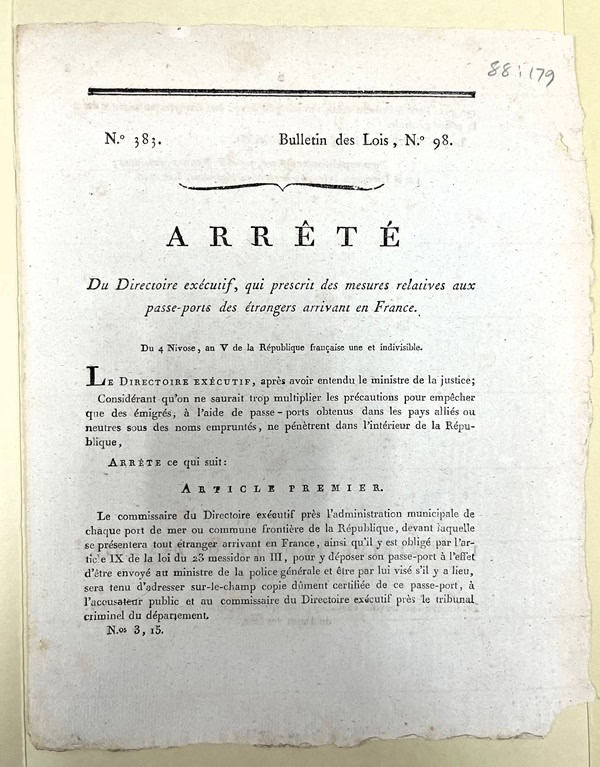
The French Revolutionary wars that broke out between France and monarchies across Europe made travel difficult for intrepid tourists, but if a Capricorn wanted to go see the beautiful French countryside, that wouldn’t stop them. They would instead take a diligent look at the laws in France at the time to make sure they didn’t accidentally look like a spy or commit counter-revolution. The pamphlet that they would consult about passports, “Arrêté Du Directoire exécutif, qui prescrit des mesures relatives aux passe-ports des étrangers arrivant en France,” was written in under their stars on Dec. 24, 1796. Capricorns’ horoscope says they’d do well to take a break and travel somewhere fun.
(Pamphlet 88:179 in box 88:115-89:34.)
Aquarius
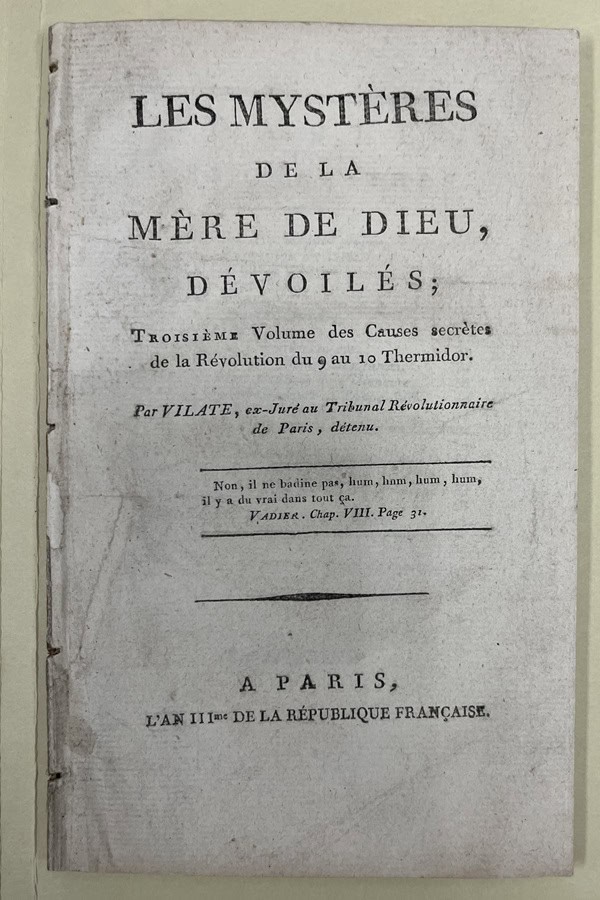
On Jan. 27, 1795, a politician named Joachim Vilate published the pamphlet “Les mystères de la mère de dieu, dévoilés; Troisième Volume des Causes secrètes de la Révolution du 9 au 10 Thermidor.” Vilate discusses how Catherine Théot, an old woman who claimed to be a prophetess, was used by Barère (a politician) to defame Robespierre (another politician), and how various newly formed pro-Revolution religious sects were created/wielded for political gain. The originality and imagination of what Barère shared with others, punctuated by dialogue between political figures of the day as they threw shade at each other, will entertain Aquariuses. The stars are telling you to start a dream diary so you can remember your own ‘visions’ better!
(Pamphlet 2199, box 2179-2233.)
Pisces
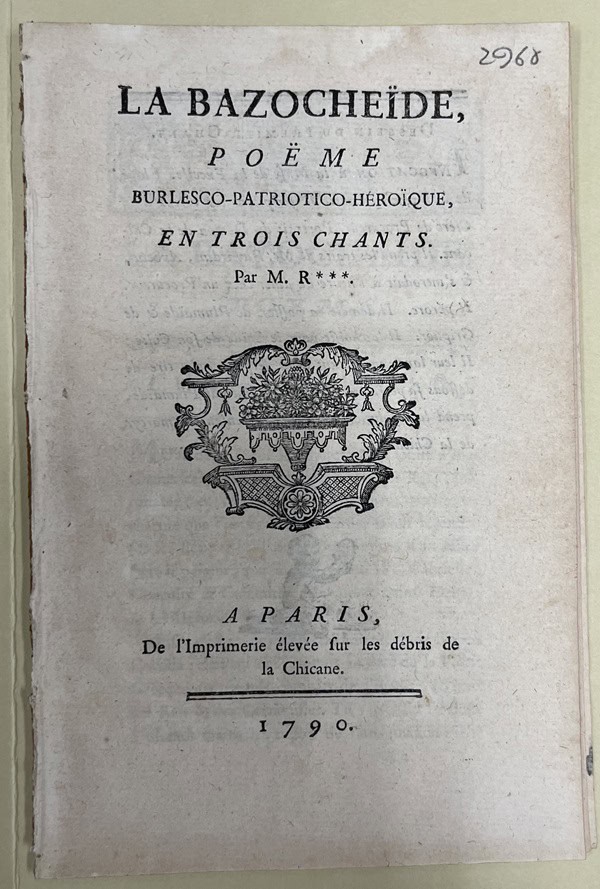
The artistic soul of a Pisces enjoys poems, pictures, and classical references, so the Iliad’s French parody, “La bazocheïde, poëme burlesco-patriotico-héroïque, en trois chants. Par M. R***,” will appeal to them. It’s a burlesque/patriotic/heroic poem scattered with beautiful drawings. This was printed in 1790, but doesn’t have a proper date on it, so is relying on the empathetic Pisces to adopt it. To all the Pisces reading, this is your sign to go to Bazoches, a commune in northern France with historic buildings and beautiful parks.
This series features the work and research of UI students. The following is written by Whitney Jensen, an undergraduate student worker at Special Collections and Archives.
Do you have an interest in the vast collection of Civil War documents found in Special Collections and Archives at the University of Iowa but unsure where to begin? Fret not; our student worker Whitney has compiled a list of the 10 most accessible items, from diaries that rode in the breast pockets of soldiers as they marched into battle to letters sent between loved ones over the course of the war. Follow along for a (by no means exhaustive) summary of some fascinating historical finds as told by soldiers across the United States!
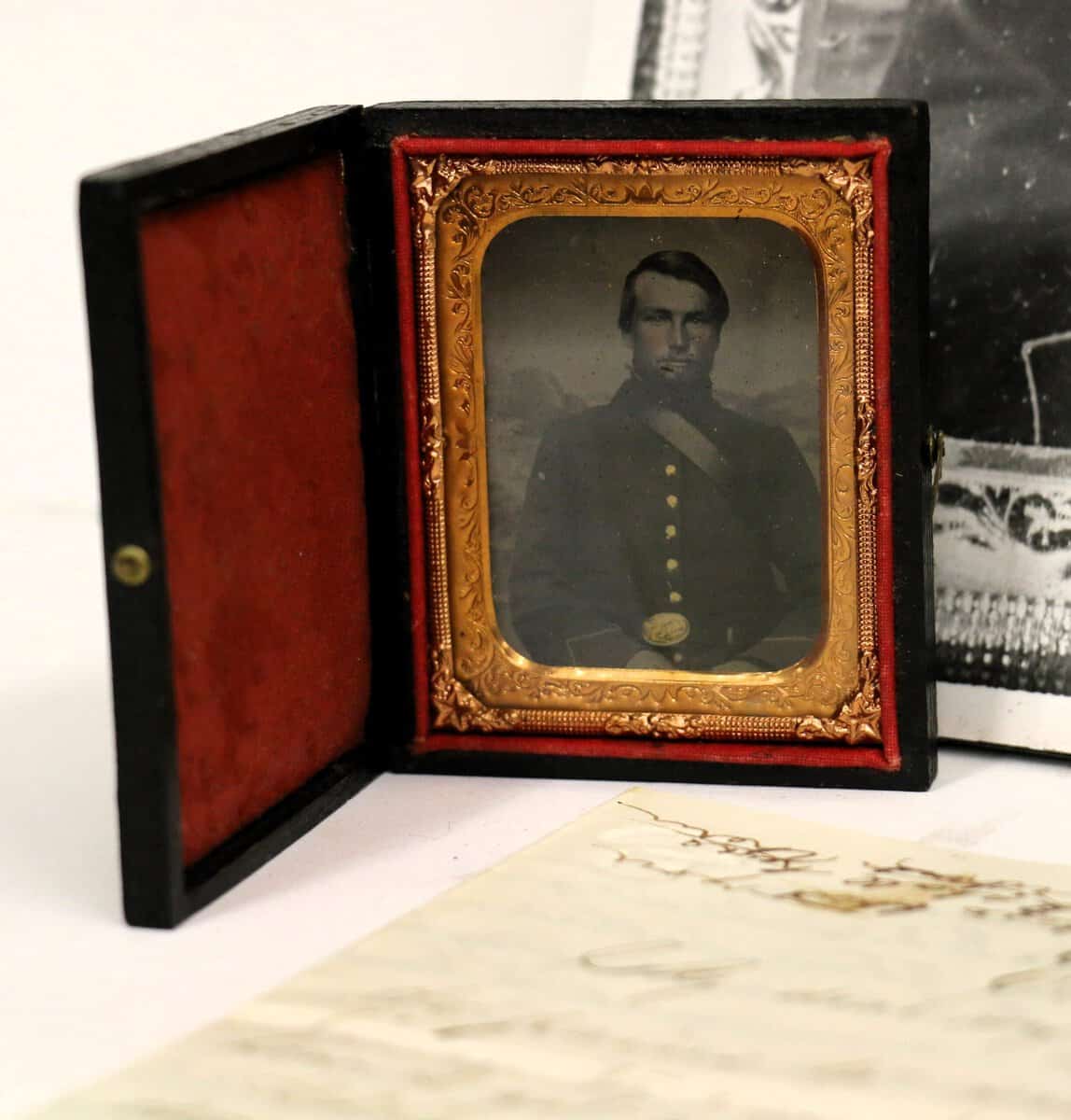
Photo of Thomas Rescum Sterns in uniform with hand-colored buttons.
Inside box 3 of the Civil War Collection are the diaries of a man named George C. Burmeister from 1861 through 1864. Burmeister was working as a schoolteacher near Muscatine when the war began, after which he served in the 35th Iowa Infantry. The handwriting in these is clearer than many other diaries in the collection, making them a nice reference for those who feel more inclined towards reading the real, historical documents rather than transcripts.
In box 10 of the same collection lives another interesting item. There are three diaries of a man named Turner S. Bailey, who served in Company A of the 3rd Iowa Infantry from 1861 to 1863. Alongside the physical diaries, there is a summative write-up which helps with comprehension of the events described within. It is important to note that the actual handwriting in these diaries is small, faded cursive, making it difficult to read. If you’re up for the challenge, this folder contains a great deal of information on one soldier’s time in the war (including a description of the battle in which he lost his right hand).
Box two of the Civil War Collection has a folder of particular interest, containing the work of a man named Samuel Fiske, who wrote under the pseudonym Dunn Browne in order to submit over 90 letters detailing his experiences serving in the Civil War. The collection has 13 of those letters, ranging from 1843 to 1876. They have been evaluated and organized into a clear inventory, making their contents a little more accessible to those who want to try and read some beautifully complex cursive.
Let’s look next at the letters of a man named Charles Arad Gates, alongside a thorough summary and description of their contents. These 39 letters range from September 1861 to December 1863, describing his experiences serving in the Battery B of the 1st New York Light Artillery. They are unique in the fact that Gates used illustrated stationary and drew maps of the battery’s camps as well as some battlefields they fought on. He also wrote a thorough letter describing two days of battle on the Fourth of July. Though there is not a direct transcript for each individual letter, the summary will prove helpful to anyone attempting to parse through them.
This is a unique collection as it contains both photographs and letters from the Sterns family at the time of the Civil War. There are correspondences of a man named Thomas Rescum Sterns, who joined the army the year prior and served as a corporal in Company F, Regiment 29 of the Wisconsin Volunteers. Folder 15, which houses a large chunk of Thomas’s letters, contains both the original papers as well as typed transcripts, and the handwriting is quite accessible. In a separate box are the photos, all labeled with the names of those pictured on the reverse side. There is also a photo album with personal pictures of several members of the family (the book is in poor shape, but the photos themselves look great). Not only are pictures a highly accessible item for those who benefit from a more visual style of learning, but having the original copies with contextual writing on the backs creates an additional layer of immersion that cannot be overlooked. This collection provides a fascinating glance into the impact that the Civil War had on families at the time.
Box 8 of the Civil War Collection contains the letters of a man named John Warner Hiatt, written between 1862 and 1863 during his service in the 28th Regiment, Company F of Tama County, Iowa. These letters are a particularly shining point of reference, as they have been compiled by Hiatt’s great-great-grandson, David Balding, and transcribed into a 100-page booklet that depicts the man’s wartime experiences in great detail. The final letter in the collection, dated May 20, 1863, was written by Hiatt from a field hospital after suffering a life-threatening injury in the Battle of Champion Hill. He would die 18 days later on June 7. While it is a large volume of writing to parse through, these letters are a solemn reminder of the thousands of men who did not live to see the war’s end.
Looking for some materials that don’t involve pages and pages of writing? Look no further than the items of a soldier named Ephraim Weaver, housed in box 4 of the Civil War Collection. While there is a letter to his parents included, Weaver also kept a tintype photograph of himself and a $10 bill from the Confederacy. If you’d like to get your hands on some real-life relics from this moment in history (other than the letters and diaries), this is a great place to start.
Keeping on the theme of non-letter items, box 5 of the same collection also has some neat items to explore. There are a handful of miscellaneous maps and other wartime paraphernalia, but the most fascinating thing is a box labeled “Civil War Relics Dug from Southern Battlefield and Campsites.” It contains a part of a fork, a .58 caliber round, two carbine cartridges, among a few other objects. Though no additional context is given as to what battlefields they come from, these items allow you to handle fragments of history.
One of the most accessible items in this whole collection is the writing of a man named Joseph Child, who served in Company K of the 26th Iowa Infantry. His diaries, which cover the span of nearly four whole years, have been transcribed word-for-word onto a typed document. This makes all the information that Child provides about battles and troop movements approachable for research. It’s a great first look into this vast collection; the only downside being that the physical diary itself is not present in the folder.
Not only does this collection contain the original leather diary of this Illinois infantryman, but a fully typed transcript as well as a digitized version that can be accessed via InfoHawk+ for you to pour over at home. He wrote in his diary almost every day from September 1863 to October 1864, even if to simply report on the weather. The writing style is short and summative, becoming more descriptive once his regiment begins engaging in combat with the rebels. Van Alstine keeps thorough track of every man’s death that he learns of, takes notes on the sermons he hears in camp, and maintains a ledger of expenses and mail (both sent and received) in the back. There is even some poetry, such as pieces titled “Friendships Parting Pledge” and “Unloved.” This diary contains just about everything one might wish to know about a soldier’s day-to-day life during the war and is expansive yet easy to comprehend. If you’re going to start anywhere in this vast collection, let it be here.
If these select few items have piqued your interest, there’s still lots more to see. Come visit us in Special Collections and Archives on the third floor of the Main Library, where you can leaf through Civil War documents of the Midwest until your thumbs fall off. We hope to see you there!
The following is written by Lead Public Services Librarian Lindsay Moen
The University of Iowa is home to the country’s oldest Museum Studies Program, with related courses dating as far back to the 1889–1890 academic year, according to early university course catalogs. This rich history of museum education continues today with Iowa’s Museum Studies Certificate Program that combines history, theory, and experiential learning to create a robust curriculum preparing students for work in a wide range of museums and cultural institutions.
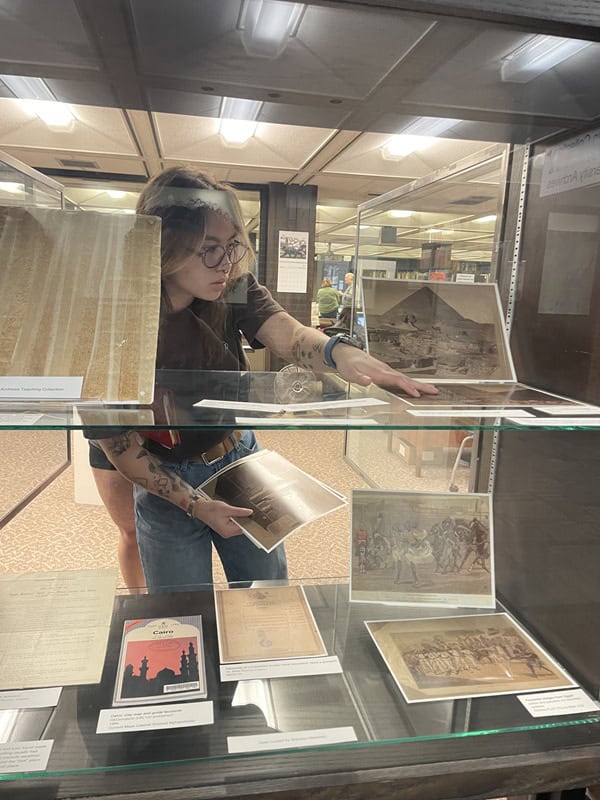
Special Collections and Archives at the UI Libraries is a proud collaborator with the certificate program, regularly hosting student interns within the department in order to provide hands-on experiences with collection materials and digital collection maintenance. During the spring 2026 semester, Special Collections had the opportunity to take experiential learning to new heights by working with Anthony Carfello’s MUSM:3004 Exhibition Planning course, where the students curated a group exhibit—Unpacking Travel—for the Special Collections Reading Room.
“Much of our course has focused on exhibitions as a method of communication, and at the core of exhibition-making is the notion of saying something with things, be they artifacts, artworks, records, etc.,” shared Carfello. “Working with the library was a crucial part of the semester, where everyone was able to take on the challenge of asking, ‘What can I convey using these materials?’ And it was even better that the special collections are vast and students had to narrow it down greatly.”
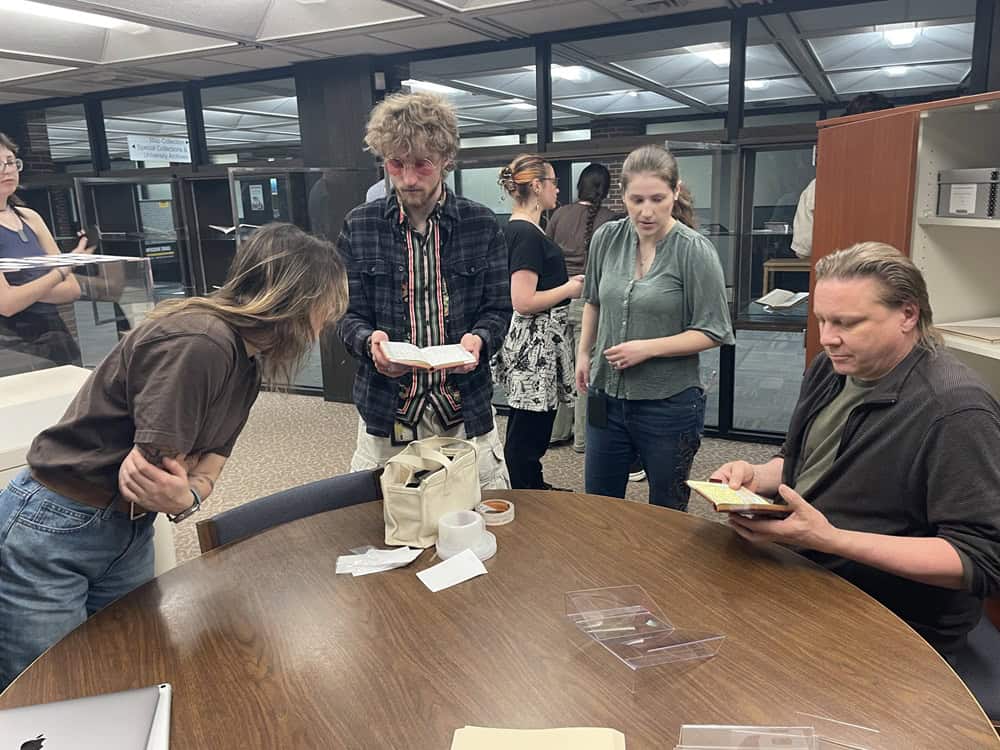
The class visited Special Collections and Archives eight times throughout the semester and worked with Lead Public Services Librarian Lindsay Moen; Curator of Rare Books & Maps Laura Michelson; Olson Graduate Research Assistant Calvin Covington; and Special Collections Graduate Student Lead Hailee McCormick, who helped guide the students in tandem with Carfello. The students learned more about exhibit curation within a special collections and archival setting, the way to search for resources within library-specific databases, what the roles of conservation and exhibit coordination staff are, all while thinking of how to present these physical materials to an audience. For each student, it was their first time curating an exhibit of any kind.
To better prepare the class for a fast-tracked exhibition experience, the theme of travel was selected. As Carfello noted, “because students come to the Museum Studies program from different interests—art, biology, classics, history, paleontology, and more—we arrived at geography as a common ground and sought out the collections focused on maps and travel books. The resulting exhibition presents these dozen students’ widely varied perspectives.”
As stated in the class’s curatorial statement, “the students of MUSM:3004 Exhibition Planning began with the general subject of travel, each charting their own path through the books, records, and maps of the Special Collections over the course of several weeks. Some approached travel as a pursuit; others saw it as means to an end. The resulting exhibition, Unpacking Travel, collects their perspectives, with particular emphasis on journeys of the past and the ways navigation determines understanding.”
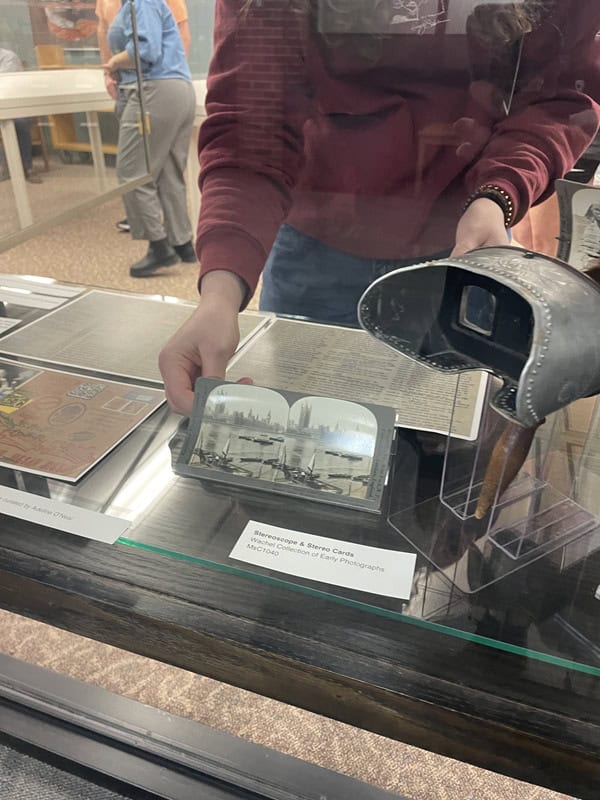
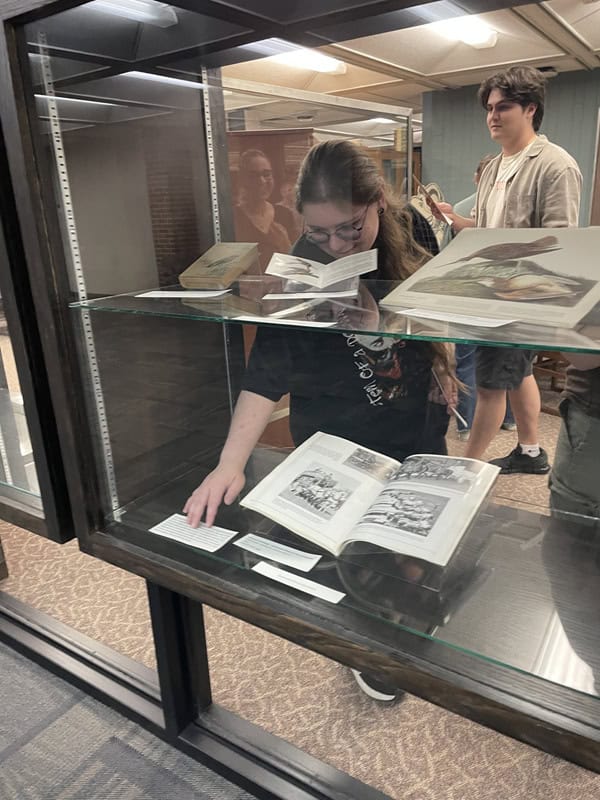
Museum Studies student adjusts exhibit labelStudent places a stereo card in the exhibitMuseum Studies student places copies of photos in exhibit case
As luck would have it, there were 12 students and 12 front case sections, so each student was assigned a section. After the four-week residence, the students came together with Carfello to create Unpacking Travel. Conservator Technician from the Libraries’ Conservation Lab Bill Voss prepared the selected materials for safe display, and the students were able to work with Voss to see how materials are prepared for library exhibitions.
Student Lauren Abbott described the experience as “an incredibly valuable experience in exploring and rehearsing the exhibition design process from start to finish. I gained a great understanding of the planning and creation of exhibits that I can carry into a career in museums or teaching centered on experiential learning.”
Grant Wiebke, another Museum Studies student in the class, added, “I’ve always enjoyed any chance I’ve had to work with collections, and getting to design and put together every part of an exhibition of my own for this class has been a great experience, and a lot of fun.”
Unpacking Travel is on display in the Special Collections Reading Room on the third floor of the Main Library and will be on display until May 7.
Bill Voss (far right) preps a mount for a book as Lindsay Moen and Calvin Covington assist students with exhibit install.
We are excited to welcome Steven Gentry, collections archivist for the University Archives.
Steven Gentry digs into the archives
Steven grew up in Columbia, Maryland, graduating from St. Mary’s College of Maryland in 2014 with a bachelor’s degree in history. After college, he worked at Howard County Public Library as a circulation clerk, at which time he learned to truly appreciate all the good work public librarians do. He attended Simmons College in Boston, Massachusetts, where he received a Master of Science in Library and Information Science with a focus in archives management in 2018. In 2019, Steven joined the team at the University of Michigan’s Bentley Historical Library as a processing project archivist, where he has been for the last six years.
As an archivist at Iowa, Steven looks forward to collaborating with colleagues to wrangle our backlogs, increase access to the University Archives, and participate in other projects that will meaningfully impact our users.
“I particularly enjoy the connections we make with others—whether with coworkers, researchers, or even the historical agents named in the materials we handle each day, “ says Steven.
When not tackling the archival backlog, you can find Steven and his fiancée, Timi, indulging in TV shows like “Desperate Housewives” or “Below Deck.” He also works on his cocktail-making and cooking game, claiming to make a mean chicken tikka masala pizza (which we are eager to try). But he is also looking for fun things to discover in the Iowa City/Cedar Rapids area. Got an idea of something he should explore? Let him know!
This series features the work and research of UI students. The following is written by Larisa Greway, a museum studies intern at Special Collections and Archives.
If you can read a piece of sheet music, you’ve benefited from over a thousand years of evolution. In the Middle Ages, music not only sounded, but looked much different than it does today. On this whirlwind tour through the medieval music of Special Collections and Archives, we’ll meet a few of the most melodious manuscripts we have to offer.
The development of music notation was a long and complicated process. Most medieval music that we can track the history of is liturgical, meant for use in church. The early liturgy was sung in plainchant, a simple style of chant meant to emphasize the text. Before the ninth century, no pieces of written notation survived. Instead, pieces of music were passed down via oral transmission, and because of this lack of standardization, local variations of chants abounded. But during the Carolingian Renaissance of the ninth century, interest in music theory began to grow, and the liturgy began to introduce multi-voice polyphony and more complicated settings. Systems of notation soon became necessary to record the new forms of music taking root.
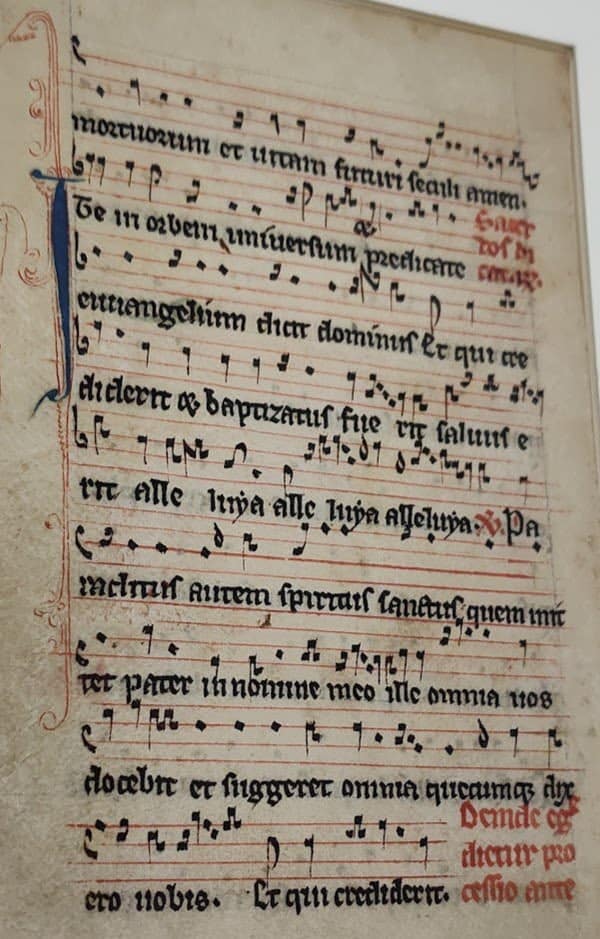
The most popular and enduring system used neumes. Whereas modern musical notes are based on an absolute system of rhythm and pitch, the earliest neumes showed pitch only in relation to each other. Later, heightened neumes were written on four-line staves with added symbols to indicate rhythm. This leaf from a gradual (a book collecting the musical items of the Mass) is the earliest example of neumatic notation in Special Collections and Archives, dating from 1230 in England (fig.1, xfMMs.Gr3).
The neumes are arranged on a staff with base and treble clefs, and the composition is highly melismatic: there are runs of many different notes in quick succession. The short paragraphs in red ink are rubrics, indicating particular directions to the celebrant of the Mass.
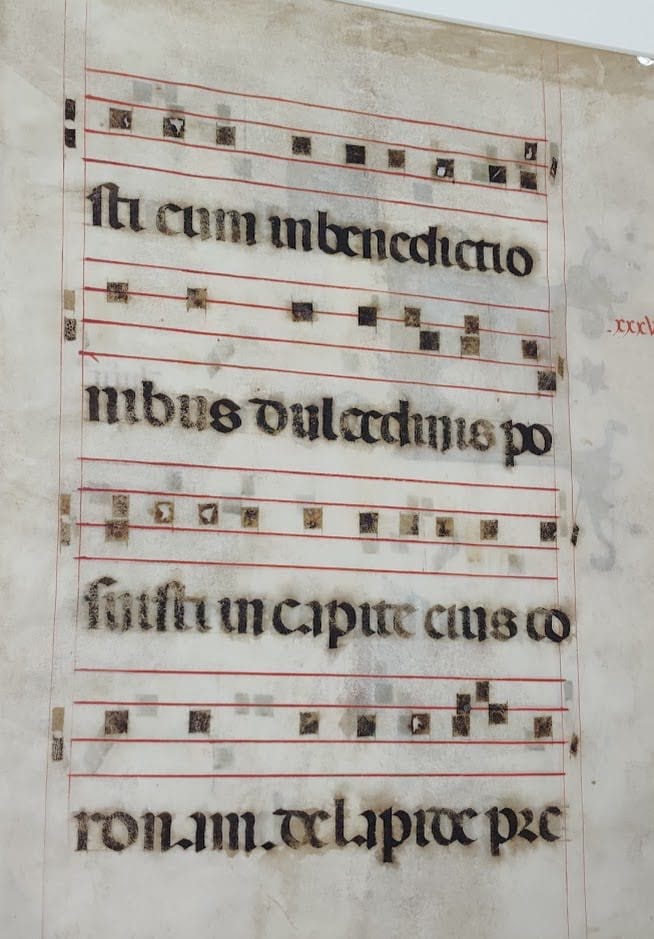
Figure 1: Gradual leaf from 1230, xfMMs. Gr3Figure 2: 15th c. Gradual, xfMMs. Ps4
In contrast, this chant (fig. 2, xfMMs.Ps4) from an early 15th-century gradual is syllabic: except for a couple of melismas, or vocal runs, there is one neume per syllable. It’s hard to get a sense of the size, but this manuscript is about 15 inches wide. It was likely used in a church choir to allow multiple singers to cluster around it. It isn’t quite as big as some of the antiphonals in our collection, though. Terms for medieval manuscripts can be slippery, but graduals were used as part of the regular Mass, while antiphonals were used in Divine Office, the daily round of prayers in monasteries. These various collections of music were often produced for use in monasteries and cathedral churches.
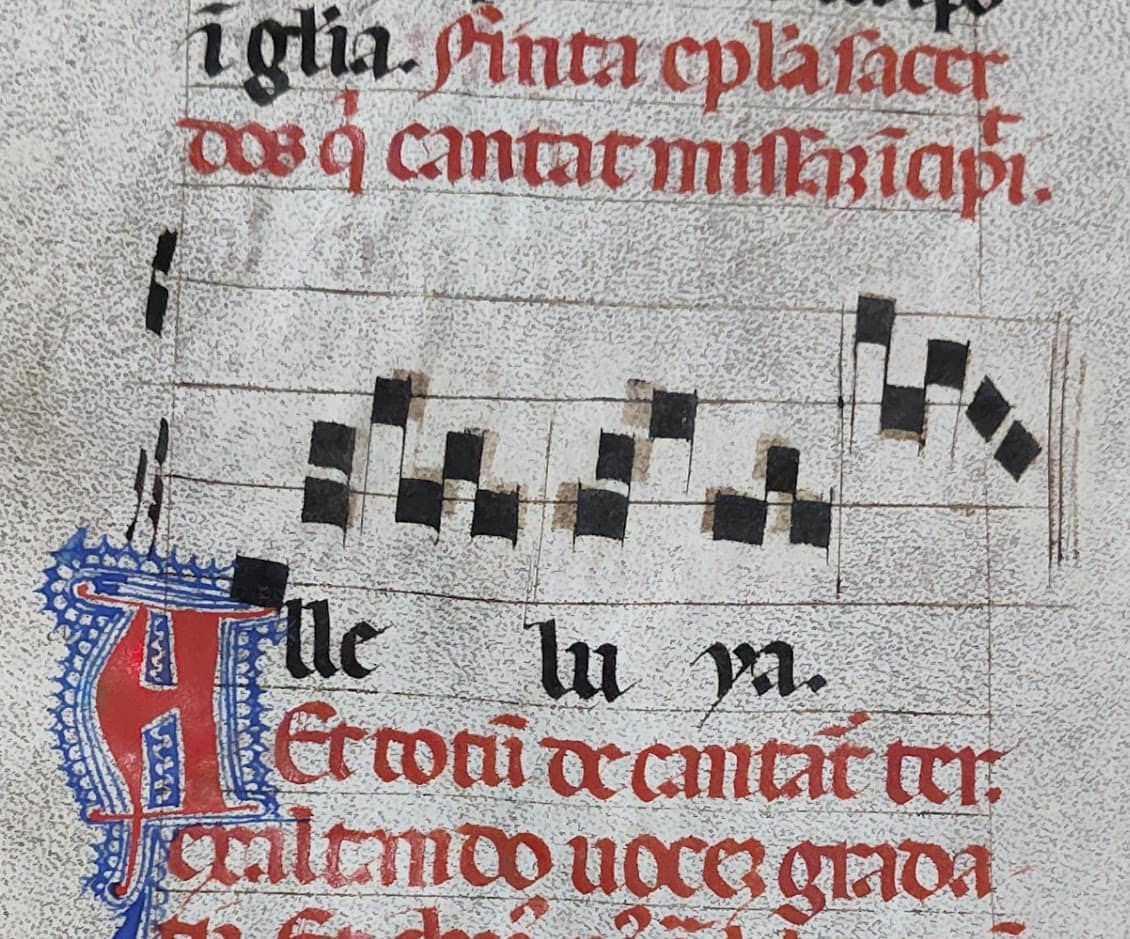
One more place you might find medieval music is in a missal, like this one from the late 14th-century Italy (fig. 3, xfMMs.Miss1). Missals compiled all the texts and instructions necessary to celebrate Mass, making them a handy reference tool or educational book. Missals might be noted or unnoted, depending on the needs of the institution for which it was produced. In this case, the scribe wrote the text first and inserted the music after. But scribes could also make mistakes.
Figure 3: Missale Romanum c. 1400, xfMMs. Miss1
This section of text pictured above contains an Alleluia setting that has run off the edge. You can see places where the scribe erased and rewrote the neumes to better fit the line.
The increasing use of notated chants ensured the proper performance of the Mass: no more forgetting the melody, and no more local variations of now-standardized chants. Neumes themselves would give way to more detailed methods of notation. But their history and the types of books they reside in provide a fascinating window into the musical life of the Middle Ages. View these manuscripts and more in our reading room, and learn even more about early music at the Canter Rare Book Room in the Music Library.
Works cited and further reading:
Bell, Nicolas. Music in Medieval Manuscripts. The British Library, 2001.
Crocker, Richard, and David Hiley, eds. The New Oxford History of Music: The Early Middle Ages to 1300. Oxford University Press, 1990.
Dunlap, Jennifer Rebecca. “A Paleographical Study of the Noted Missal Iowa City, University of Iowa Libraries, Special Collections xfMMS.Miss1.” Master’s Thesis, University of Iowa, 2008).
Seay, Albert. Music in the Medieval World. Prentice-Hall, Inc., 1965.
xfMMs.Gr3. Leaf from a gradual., circa 1230, 8. Medieval Manuscripts, MsC0542. University of Iowa Special Collections.
xfMMs.Ps4. Leaf from a gradual., early 15th century, 8. Medieval Manuscripts, MsC0542. University of Iowa Special Collections.
xfMMs.Miss1 Missale Romanum., circa 1400, 12. Medieval Manuscripts, MsC0542. University of Iowa Special Collections.