Because funding agencies like the National Institutes of Health (NIH) and the National Science Foundation (NSF) now require data management and sharing plans as part of grant applications, researchers tasked with writing these documents may feel at a loss about where to start. Luckily, University of Iowa researchers have support in this process. Not only does Research Data Services at the UI Libraries offer workshops, consultations, and web resources to facilitate the writing of data management and sharing plans, we’re also partnering with DMPTool to offer even more assistance for researchers.
DMPTool is a free, open-source web platform designed specifically to help users write data management and sharing plans. Originally created by eight research institutions (including UCLA, UC San Diego, University of Virginia, and the Smithsonian Institution), DMPTool now has over 300 partners – including the University of Iowa.
Here’s how DMPTool can be useful:
It offers step-by-step instructions. DMPTool walks users through the process of writing their plans with a click-through wizard. It has fill-in fields for the basics, like project title, abstract, and contributors, while also guiding users through describing their data types, standards, and preservation strategies. It even offers example wording someone can use as they craft their plan.
It includes funder-specific templates. Since different granting bodies require different elements in their data management and sharing plans, DMPTool offers templates tailor-made to meet the needs of various funders. In addition to heavy hitters like NIH and NSF, DMPTool also has built-in templates for many other agencies – including the National Oceanic and Atmospheric Administration (NOAA), National Endowment for the Humanities (NEH), United States Geological Survey (USGS), United States Department of Agriculture (USDA), and dozens more.
It integrates local help from the University of Iowa Libraries. Because Iowa is a DMPTool partner institution, our researchers have access to some added features – like the ability to submit your plan directly to a data librarian at the Libraries so you can receive feedback on it. When writing your plan you can also see UI-specific tips by clicking the box under “Select Guidance” in the Project Details tab. If you have questions at any point in the process, DMPTool also includes links to Research Data Services’ email and website at the top of every page. Just ensure you set up your account with your UI email address and these services will automatically be integrated into your dashboard.
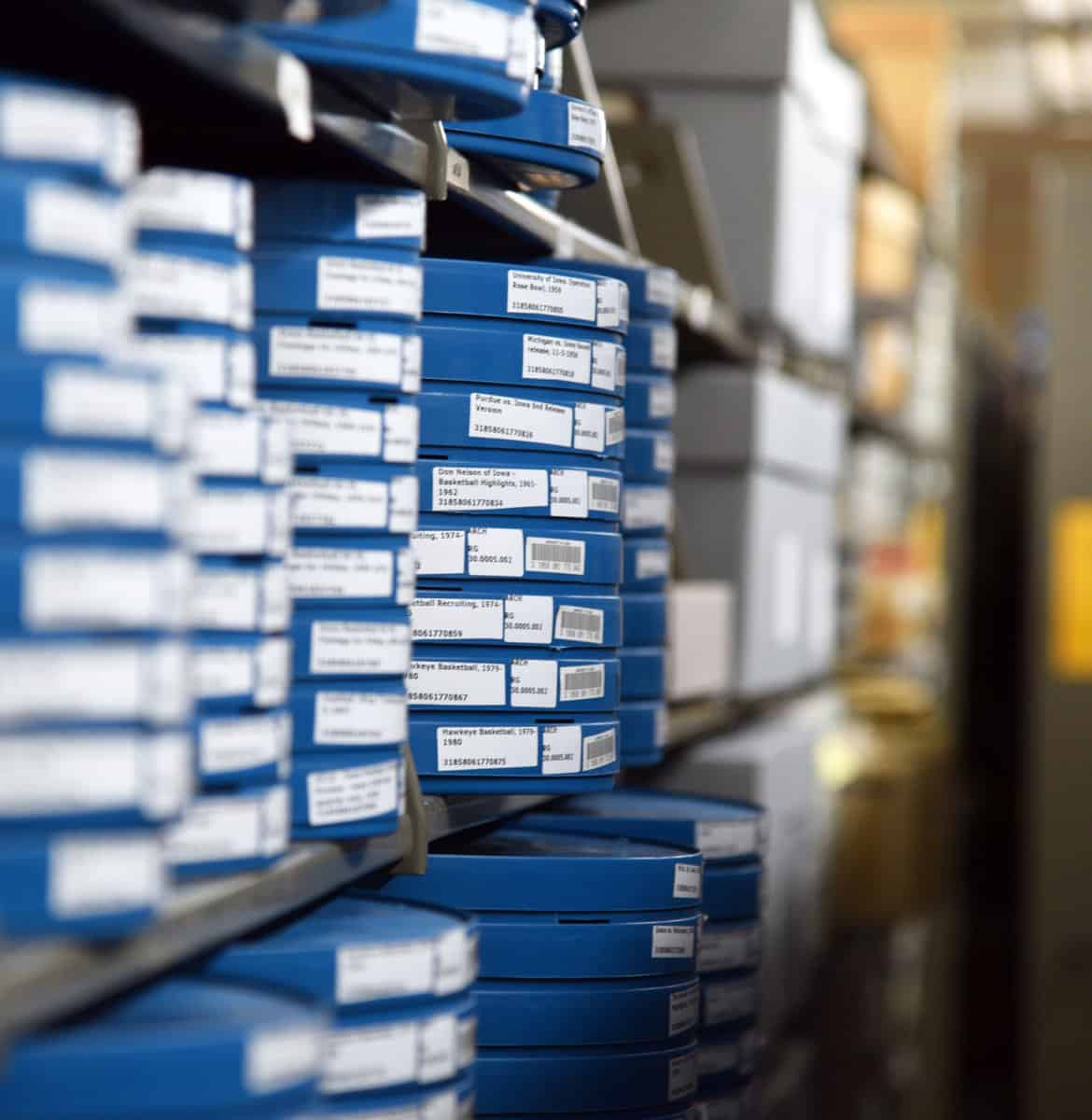
This image demonstrates the damage that can occur when reels are stored away for decades.
From the hardwood to Pasadena and the asphalt track to wrestling mats, now you have an opportunity to help preserve Hawkeye sports history, including the 1959 Rose Bowl, and make it accessible to all through a film digitization project.
The films’ state of degradation is dramatic, especially for the older material, and many of these films don’t have much life left in them. Due to the nature of film, degradation products induce further deterioration. It affects the plastic support, causing it to become acidic, to shrink, and to give off an acetic acid producing a vinegary odor, otherwise known as vinegar syndrome.
The reels in need of restoration cover decades of athletic events.
Projecting an original 16mm film can be risky and ultimately, we will no longer be able to view the originals, so digitization is critical. The digitization process helps create an exact and high-quality duplicate of the original, which can then be accessed online via the Iowa Digital Library.
The initiative is one way for past, present, and future Hawkeye fans to easily re-live memories such as watching the full game of the Hawkeyes prevailing over the California Golden Bears in the 1959 Rose Bowl. Currently, you can only watch highlights of the game thanks to the UI Sportsfilm production “The Evy Era of Iowa Football.”
You can donate to the UI Libraries Special Collections Fund, which will assist with the film digitization project, as part of One Day for Iowa here https://1dayforiowa.org/fa-libraries23.
The library directors of the Big Ten Academic Alliance recently made the decision to sunset the CADRE platform and its associated services due to low usage and continued challenges in resourcing technical support for the platform. As a result, the CADRE platform will be retired on June 30, 2023. Continued access to the CADRE Gateway and its datasets will remain available through that date.
Users will retain full access to existing files through June 30. Please be sure to download by June 30 offline copies of any data and scripts in your Jupyter notebooks to which you’d like to maintain access.
If you have any questions about the transition and how it might affect your research, or need assistance in downloading your data and scripts, please reach out to CADRE or contact Brian Westra, data services librarian.
Every researcher has likely seen Digital Object Identifiers (DOIs) attached to the articles they read, cite, and publish. As unique codes that distinguish a specific research article, dataset, or other digital object, DOIs make it much easier to find and cite the work of other scholars. What you may not know, however, is that DOIs are just one type of persistent identifier (PID). PIDs make your research findable now and in the future, reusable for the long term, and offer new insights into your research.
PIDs, sometimes referred to as persistent digital identifiers (PDIs) or globally unique identifiers (GUIDs) take many different forms. You may have seen an Open Researcher and Contributor ID (ORCID) attached to someone’s email signature, or a Research Resource ID (RRID) in a journal article identifying a specific antibody used in the study, or even an International Standard Book Number (ISBN) in a book you’ve read. All of these are PIDs, but don’t let the alphabet soup of initials intimidate you. In essence, all persistent identifiers have two traits that make them powerful.
The first is the part you see and use: the string of letters and/or numbers that uniquely define an entity (like an article, researcher, dataset, or institution). These codes will not change, will not be reused, and are a major reason finding information is so easy with PIDs. The second part of a PID is behind the scenes: the service that locates the resource (or “resolves” it) if its URL changes, ensuring that people who use the PID can always access what they’re looking for. This means, for instance, that even if the URL for an article changes the DOI never will.
Here’s an example: When a researcher deposits their dataset in the University of Iowa’s institutional repository, Iowa Research Online (IRO), a DOI for the dataset is reserved. A data librarian at UI Libraries will then review and curate the data. When the creator of the dataset gives the green light, IRO will register the dataset, its corresponding metadata, and the DOI with an organization called DataCite, activating the DOI and telling DataCite the landing page for the dataset (i.e., the URL that describes the data and provides access to the files). If IRO reorganized its servers in the future and the URL of the landing page changed, IRO would update this “address change” with DataCite. This ensures that the DOI will still point people to the new, correct URL.
The image below demonstrates how the DOI for a dataset resolves to the specific URL in IRO.
Image adapted from: Nosé, M. (2019). “Practice of research data management in solar-terrestrial physics [PowerPoint Slides]. Institute for Space-Earth Environment Research, Nagoya University. https://slideplayer.com/slide/17406586/
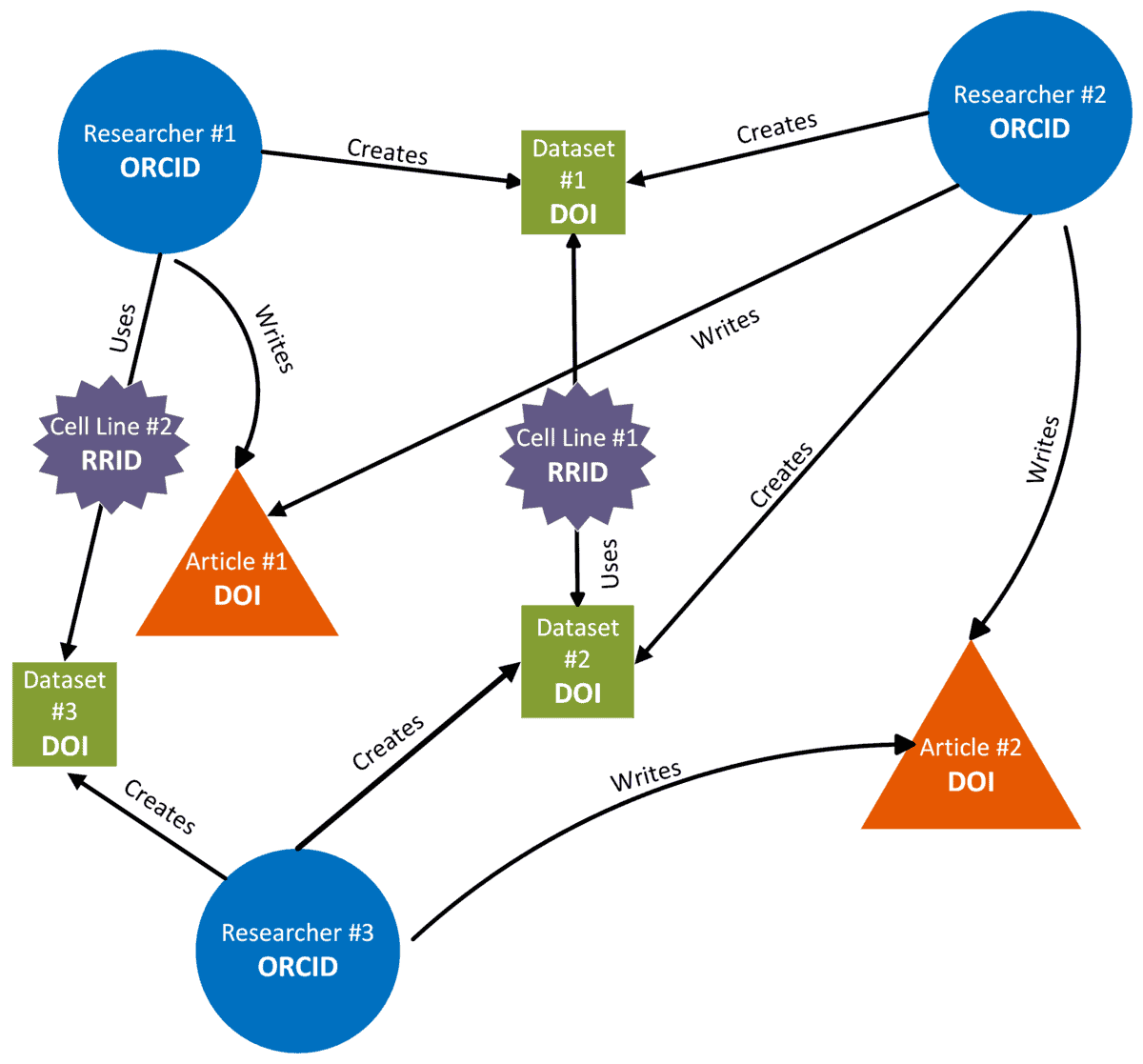
Another important benefit of using persistent identifiers is connection: linking the digital object to everything else that’s associated with it through PIDs, like the people who contributed to the work (through ORCIDs), the places they work (through Research Organization Registry IDs, or RORs), the cell lines they used in the research process (through RRIDs), and articles that use the data (through DOIs).
PIDs thus create a stable network of linked data that makes research outputs more FAIR (Findable, Accessible, Interoperable, and Reusable), helping people find new connections between data, articles, researchers, institutions, and granting bodies. A researcher who finds your dataset might then be curious if you’re the same person who wrote an article on a similar topic they read in a journal. This might lead them to click your ORCID to discover other research you’ve done, pointing them to the DOI of another dataset you’ve published, which they discover they could use for their own project. This discovery was facilitated by PIDs.
The image below offers an example of how PIDs connect these different entities.
You can do a few things to make the most of PIDs and leverage these connections:
Register for an ORCID if you don’t already have one, and use it in your repository deposits, code documentation, CV, personal website, grant applications, and anywhere else you can. It connects others to your research and keeps people from confusing you with another researcher with a similar name. The ORCID system will harvest and connect your research outputs – meaning you don’t have to.
Use RRIDs in your articles if the journal you’re submitting to supports them. The RRID website includes a list of journals that specifically ask for RRIDs (including Cell, Nature, and PLOS One) as well as a list of journals that will include them in articles if the authors add them.
Each of these steps is small and may not seem impactful on its own, but when all researchers do a few small things to enable FAIR data through PIDs, the entire research ecosystem benefits. If you’d like to learn more about repositories like IRO that support PIDs, reach out to Research Data Services in the Scholarly Impact Department of UI Libraries by email or through our website.
Although the term curation (from the Latin “care” or “attention”) might be a practice you associate with historical artifacts or priceless paintings, data curation is a collaborative, value-added process that provides care and attention to a dataset. It helps make data more FAIR (findable, accessible, interoperable, and reusable).
When you deposit your dataset in IRO, a data librarian at the Libraries will work with you to ensure that it is as complete, understandable, and accessible as possible. Data curation is different than peer review; its purpose is to ensure that the data can be found and used, not to judge the scientific methods that went into its creation.
Think of data curation as an investment, and working with a data librarian up front can get you a great return on that investment. It gives you a dataset that’s more valuable to a potential user because it’s easier to find, use, and interpret. This is a service that sets IRO apart from many other repositories, most of which simply don’t have the staff to offer this value-added process.
Depending on the specific dataset, data curation may entail:
checking to ensure all files open properly
reviewing file naming and organization strategies to ensure they’re transparent for future users
identifying proprietary file formats and recommending open alternatives
analyzing documentation, like data dictionaries or README files, to ensure others with knowledge of the discipline can understand them
ensuring tabular data in spreadsheets is clean, organized, and optimized for reuse
Confirming that the dataset has rich and complete metadata attached to it is an essential aspect of data curation. Metadata is something librarians talk about often, and with good reason. It’s the information needed for others to find, understand, and use the data. Different types of metadata – descriptive, administrative, and technical – all add value to your data in different ways, and a data librarian can help ensure the thoroughness of it all.
Descriptive metadata, for instance, is vital for discoverability (i.e., ensuring your data will appear in the results when someone does a relevant search on Google or InfoHawk+, the University of Iowa Libraries’ discovery tool). It includes having a clear and distinct title for the dataset, that all collaborators are named with contact information and ORCIDs (Open Researcher and Contributor IDs) included, and that there is a full abstract.
A data librarian can also help with technical metadata, like specifying the type of software someone needs to open the file, and administrative metadata, such as helping choose the license for the dataset. This information helps a potential user know how to get access to your data and what they can do with it once they do.
If you’d like help with data curation or depositing your data into IRO, Research Data Services is here to help. Contact us by email or visit our website to set up a consultation. If you’re ready to deposit data in IRO, we’ve created a metadata guide and a data deposit guide to walk you through the steps.
University of Iowa researchers are increasingly taking advantage of the university’s institutional repository, Iowa Research Online (IRO), to house their research and creative works. IRO currently holds nearly 115,000 research outputs from Iowa faculty, staff, and students, and has seen more than 12 million downloads of content since 2009. On top of preserving articles, books, conference proceedings, theses, and dissertations, IRO is also an ideal place for researchers to deposit their datasets and code.
IRO provides preservation, access, and curation of your data. Here’s what that means in practice:
Preservation
Your dataset or code will be housed on a secure server for the long term, maintaining it for future use. Despite the perception that digital files never wear out, they can deteriorate. Sometimes this happens due to bit loss – when the binary code that makes up the file degrades as the data is transferred from one place to another – or sometimes because of corrupted files. In other cases, file formats evolve and need to be converted to a different format to enable access and use.
The items in IRO are proactively managed to guard against these situations. Regular fixity checks act as “check-ups” for files to ensure they’re healthy and haven’t changed, multiple copies of the data are archived in different geographic locations in the case of a natural disaster, and corrupted files have self-healing capabilities thanks to the cloud infrastructure that houses them. All of this ensures that the products of your hard work are available now and in the future.
Using open formats for your work also helps with preservation, since these formats – like .sav, .mp3, and .mp4, to name a few – are more likely to remain functional in the future. In fact, using open formats also facilitates another benefit of archiving in IRO, access, since the files don’t require specialized proprietary software to open and use them.
Access
Your dataset will be accessible to researchers all over the world, increasing the reach and impact of your work. This access is made possible by a few key features.
First, all IRO deposits have a metadata record with pertinent information about the dataset – like the title, collaborators, abstract, grant information, dates of data collection, etc. Since all items in the repository are discoverable on Google and are indexed and searchable in InfoHawk+, the University of Iowa Libraries’ discovery tool, robust metadata makes it more likely that your dataset will appear in relevant searches. This is vital for helping others find your work.
Equally important is the stable, persistent URL your dataset will receive. Since the URL won’t change, it eliminates the tedium of identifying and updating broken links on your CV or personal website and makes it easier for you to share your work with others. And if you’re ever curious about the number of views and downloads a dataset receives, the metrics are readily available.
All IRO deposits also receive a digital object identifier (DOI) which makes it easy for others to cite your work when they use it and ensures you get credit when they do. When you deposit your data, you can also link to the DOI of the article or articles where the data is used. Research Data Services in the Scholarly Impact Department at the UI Libraries can even reserve a DOI for your dataset and keep it inactive so you can put the citation in a manuscript during the peer review process. After the article is published, just ask us and we’ll activate it.
Curation
A data librarian at the University of Iowa Libraries will also help curate your data when you deposit it in IRO. In addition to ensuring your file names and organization strategies are understandable to potential users, the librarian can also help you find open formats for your files, look at your documentation, and assist with the all-important metadata record that helps others find your work.
Get Started
Ultimately, depositing your data and code in IRO is a win-win. It helps you preserve your research outputs, disseminate them to increase the influence of your work, and enable scholars the world over to find and use your data and code for their own projects. And now that The National Institutes of Health require that researchers identify appropriate repositories for their data in their Data Management and Sharing Plans, IRO could be the answer – especially if no discipline-specific repositories exist in your field. IRO’s preservation, access, and curation features put it a step above other generalist repositories.
If you want help depositing your data or code in IRO or have questions about choosing a repository, Research Data Services is here to assist you. We have a guide on our website walking you through the steps to upload your content in IRO, do one-on-one consultations, and are available by email, too.
The University of Iowa Libraries is pleased to announce the expansion of the landmark open publishing agreement between the Big Ten Academic Alliance (BTAA) and Wiley. The new three-year agreement, which is effective Jan. 1, 2023, to Dec. 31, 2025, grants University of Iowa faculty, staff, and students access to publish and read in Wiley’s full journal portfolio, including Hindawi’s gold open access portfolio, with no fees, no caps, no limits, no hassle. Authors keep the rights to their own work under a Creative Commons license, making their work immediately open and available to anyone.
UI corresponding authors may publish their articles open access in any journal under the Wiley umbrella at no charge during the term of the agreement. Authors must identify themselves as being affiliated with the university when submitting articles through the Wiley publishing workflow process. Eligible publications:
Have a corresponding author from a BTAA institution;
Are primary research and review articles are primary research and review articles (which may include original articles, case studies, reviews, and short communications);
Are accepted for publication in a Wiley hybrid journal or submitted and accepted to a Wiley gold or Hindawi journal during the term of the agreement (Jan. 1, 2023 to Dec. 31, 2025).
Iowa Lichtenberger Engineering Library receives Patent and Trademark Resource Center designation Initiative provides individual inventors access to additional resources from federal agency
The PTRC is a resource for those with personally-owned inventions, such as student inventors and inventors from the community. It offers individuals from the university and throughout the state the ability to tap into the rich services provided by the USPTO’s vast networks of experts on intellectual property, which includes patents, trademarks, copyrights, and trade secrets. It also serves as a resource for University of Iowa Research Foundation (UIRF) staff as they work to protect faculty inventions owned by the university.
“The Lichtenberger Engineering Library has an abundance of experience promoting and delivering information and instruction services to the campus community and public, which is an essential element of the mission of the UI Libraries and university,” says John Culshaw, Jack B. King university librarian. “We’re very pleased to now have this opportunity for our skilled and dedicated librarians to continue collaborating to serve individuals looking to develop something impactful.”
“We congratulate the Lichtenberger Engineering Library for undertaking this initiative and the USPTO looks forward to working together to extend these important opportunities to as many individuals as possible,” says Robert Berry, manager of the Patent and Trademark Resource Center Program, U.S. Patent and Trademark Office.
US 1814357A (Acoustic Device for Sound Pick-up) invented by Harry F. Olson (BE ‘24, MS ‘25, PHD physics ‘28, EE ‘32)—A pioneer and leading authority in acoustics and electronic sound recording, Olson developed magnetic tape recorders for sound and television, the electronic music synthesizer, and underwater sound equipment.
The Lichtenberger Engineering Library also maintains an active instructional schedule, which includes on-campus lectures and classes covering intellectual property topics as a part of its information literacy program. These sessions are available as for-credit classroom work as well as open to the public.
The UIRF works to obtain intellectual property protection on innovations created by researchers through their work at the university and partners with industry for the commercial development of new products and services. While the UIRF manages patent protection for university-owned inventions, until now there has been no resource on campus for those with personally-owned inventions. In addition, access to patent records can serve as an asset for university faculty conducting basic research—often scientific discoveries, especially those from industry, end up in published patent applications even if they are never published in traditional academic journals.
“UIRF is particularly excited that this resource is now available for our faculty start-up companies,” says Marie Kerbeshian, assistant vice president and executive director for the UIRF. “As these companies create their own intellectual property independent of the university, they are now able to seek advice that will help them develop a strong intellectual property portfolio.”
You can learn more about and access patents here. For more information about educational opportunities, potential partnerships, and more, please contact Kari Kozak, director of the Lichtenberger Engineering Library, at kari-kozak@uiowa.edu.
Please note, the Lichtenberger Engineering Library is not a legal entity and a licensed lawyer should be consulted if you need legal assistance.
COURTESY: THE CENTER FOR THE STUDY OF PUBLIC DOMAIN AT DUKE LAW SCHOOL
1927 was a big year for the arts. It brought new fictional works from Virginia Woolf, A. A. Milne, Edith Wharton, Herman Hesse, and Franz Kafka. It gave us audio hits including Irving Berlin’s “Puttin’ on the Ritz” and the soundtrack to Ira and George Gershwin’s Funny Face. Movie audiences saw (and heard) the first “talkie” film, and Alfred Hitchcock’s first thriller kept viewers on the edge of their seats. And as of January 1, all of these works are now available in the public domain.
When a work enters the public domain, the public no longer needs to seek the artist’s permission to copy or use the work. This opens the door for creative riffs on the classics, and makes public domain materials available free of charge.
Here are some places to check out the newly available creative works from 1927 available in the public domain:
Interested in finding out more about U.S. copyright law and how to determine a work’s copyright status? The Scholarly Impact Department helps faculty work through complex copyright issues, such as what can be used in the classroom, how to retain your rights as an author, and how to apply Creative Commons licensing. Feel free to send an email to mahrya-burnett@uiowa.edu to set up a consultation. You might also try these excellent copyright resources:
Digital Copyright Slider – This Flash-based slider provides copyright status for works, depending on when they were published and whether copyright was renewed.
UI Libraries Copyright Guide – This guide provides the basics on copyright issues, such as Fair Use, seeking permissions, author rights, and licensing.
We’re grateful every day for our student workers, whose contributions are foundational to the University of Iowa Libraries. They’re the vital engine behind everything we do, from the front desk at the Lichtenberger Engineering Library to the stacks at the Main Library. These dedicated students make time alongside their classes to create friendly, helpful environments where library users can focus and explore.
For the 2022-2023 academic year, nine student employees have been awarded scholarships in recognition of their work in the UI Libraries. We’re proud to celebrate each of them, as they share how their time in the UI Libraries has impacted their studies, their confidence, and their plans for the future.
Elizabeth (Lizzi) Ayers has been awarded the Judy and Mike Greer Scholarship in Memory of Mary E. Greer. She is an English major and French minor from Iowa City, Iowa. Through a summer project maintaining 18th-century Belgian political pamphlets in Conservation & Collections Care, Ayers discovered a love of antique materials—and found the inspiration to begin her own career in librarianship.
“Working at the Libraries has helped me strengthen my professional communication skills (both verbal and written), as well as giving me a chance to pick up a variety of collections care/management-specific skills such as database navigation and caring for fragile items. [There is] variety in my work, day to day. Working in Collections Care has reassured me that libraries are anything but boring.”
Cara Heuer is a third-year student from Ames, Iowa studying human physiology. She received a UI Libraries Student Employee Scholarship for her work at the Sciences Library. During her time at the library, Heuer has come to appreciate the sense of connection and shared motivation that naturally grows within the space. She loves to help “set the tone” for each person’s library visit by making sure to greet them with positivity and enthusiasm.
“I have had the chance to interact with so many students and professors that I may not have otherwise met. During my time here I have been able to share so many small moments with those in the library and a part of the university community. These experiences have given me confidence in my ability to connect with others and communicate to solve problems. I hope to translate these skills into my connections with my patients and colleagues as a future healthcare provider!”
Adam Holmes is studying mechanical engineering with minors in art and mathematics. An Iowa City native, Adam was awarded a UI Libraries Student Employee Scholarship in connection with his work at the Lichtenberger Engineering Library. He was surprised to discover that library users often recognize him from the front desk when they cross paths elsewhere on campus; this made him realize that his work has an impact on each person’s experience.
“In the Engineering Library alone, it’s been fascinating to learn about our extensive tool collection, which has things that I hadn’t even heard of before this job. I also frequently have students working on research papers that come to me looking for books on a certain topic. I love seeing their surprised reaction when I show them our catalog, which usually has dozens of books, journals, and other media on their topic.”
Abigail Kellis is studying English and creative writing and history, with a certificate in museum studies. She was awarded a Dale M. and Mary Gail Bentz Scholarship for her work in Circulation Services at the Main Library. The spirit of collaboration and mentorship she feels with her fellow library workers has inspired Kellis to seek a future career in libraries, museums, and archives.
“The library has helped strengthen my ability to adapt and solve many different types of problems. All jobs and careers have issues that arise that need to be solved, and being able to solve them or contact the people with more expertise who can solve them is an important skill to have.”
Ana Koch was selected for a Dale M. and Mary Gail Bentz Scholarship. Koch is a nursing student with a minor in music and works at the Pomerantz Business Library, where her experience at the main desk has bolstered her skill in communicating with patrons. She believes that her time spent in a people-oriented role will strengthen her interpersonal skills in her future career as a healthcare provider.
“Working at the Business Library has helped me improve my time management and communication skills. Having a concise working schedule helps me to remain organized. An organized schedule encourages me to stay on top of my assignments while properly managing my time. I also communicate with people on a regular basis as I work. I help them with directions, solving problems, and checking out materials. Communicating with people in a respectful fashion is a huge part of nursing.”
Alyssa Lemay, a statistics and mathematics major from Sussex, Wisconsin, has been awarded a UI Libraries Student Employee Scholarship in connection with her work in Circulation Services at the Main Library. Lemay says that helping library users locate resources and navigate a vast collection has made her a flexible communicator and revealed her love of customer service—traits she looks forward to using in the future. “Working at the library, I have learned to communicate with people of all backgrounds effectively. Interacting with coworkers and patrons can sometimes be interesting or difficult because of these backgrounds! Learning to navigate these obstacles will for sure be helpful in my future career path. Part of being a statistician is working with groups of people, all of which have different educational backgrounds, to come to a conclusion. I need to be able to effectively communicate my ideas in order to achieve this goal.”
LilliAnna Scott is majoring in environmental policy and planning, with a certificate in sustainability. Scott received a Dale M. and Mary Gail Bentz Scholarship in recognition for her three years of work at the UI Libraries, in both the Main Library and the Art Library. As a first-generation student, she found that working at the Libraries gave her an immediate chance to familiarize herself with the academic resources available at a large research university.
“I have been surprised by the deep connections that the Libraries have with the community of Iowa City outside of campus and beyond. In my time working at the Art Library, I have had the pleasure of assisting many different patrons with a range of interests. I love to see the variety of topics of books that the graduate students check out for research or the many books we send and receive through the Interlibrary Loan. This has truly shown me the powerful connections of libraries and how they enrich our communities.”
Skylar Halley, a mechanical engineering student from Fairfield, Iowa, was awarded the Dale M. and Mary Gail Bentz Libraries Student Employee Scholarship. Halley works in the Lichtenberger Engineering Library, where his encounters with visitors and library co-workers exposed him to new fields of study within engineering. Meaningful discussions with one PhD student even encouraged him to reincorporate music into his life.
“I have learned both how to think on my feet, as well as the right questions and people to ask when I am not sure what to do. Working at the Libraries has provided me with the opportunity to interact with many fellow engineering students, which has shown me the range of people in the field with a multitude of different personalities and approaches towards engineering.”
Emiline Heimos was awarded a UI Libraries Student Employee Scholarship for her work at in the bookstacks at the Main Library. Originally from Labadie, Missouri, Heimos studies linguistics (teaching English as a second language) and translation for global literacy. She has come to love the quiet and calm of the stacks, finding a meditative sense of wellbeing among the books. This tranquility has served her in the classroom, where she’s noted a sense of increased confidence.
“Working at the library had helped me in many aspects, and developing professional skills is definitely one of them. I have learned patience, how to be organized and precise with my work, and how to think critically when going about my organization. I hope to be an ESL teacher in the near future, and I believe that all of these skills will apply there… as a library patron, you see a cart of books being shelved, and that might be all. Working here, I realized that there is so much more to accomplish, and I am happy to be a part of that.”