Marble Rock, Iowa, has a gentle geologic beauty. White limestone dots the landscape, and the nearby Shell Rock River is named for the fossils embedded on its banks. Very few people can claim to be from Marble Rock; the population peaked in the 1940s at just 660 people. One of those people was Pearl Knoop, a local teacher, librarian, and bird watcher. Although Marble Rock is known for the earth beneath it, Knoop looked at the skies. What she saw and unknowingly documented was a turning point for birds in Iowa and around the world.
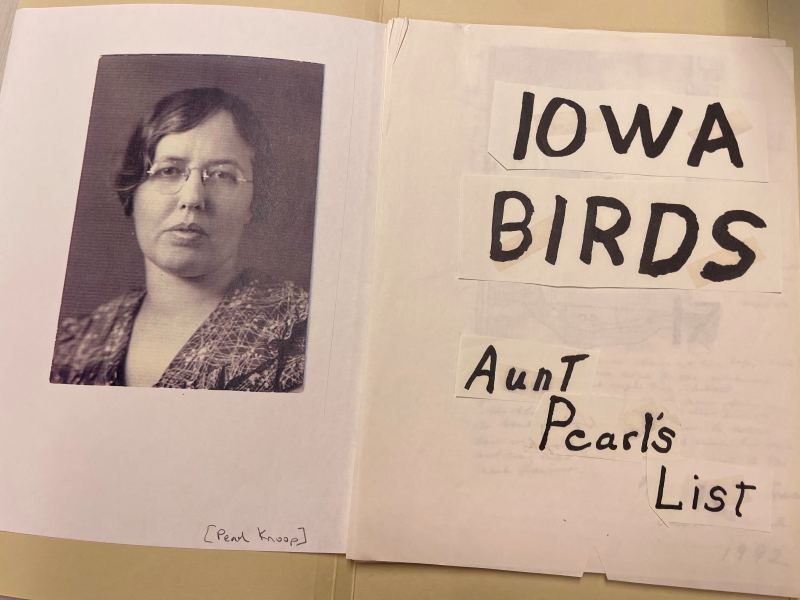
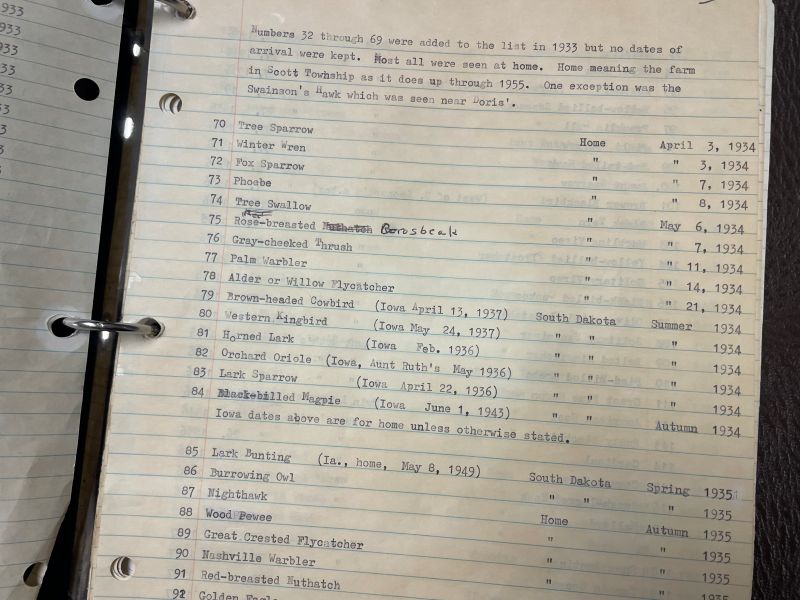
The uninitiated should know that birders do more than watch birds; they record what species they see and when and where. This data is compiled into a “life list,” an accounting of every bird a person has ever identified. From the 1930s to the 1980s, Knoop sighted hundreds of species of birds, despite rarely venturing more than an hour’s drive from Marble Rock. And why wouldn’t she? She lived in a birds’ paradise.
Knoop started identifying birds in 1933 on her family farm, where birds were tied to the rhythm of the year. Robins and killdeers arrived first in the spring, and the hummingbirds when the crab apples bloomed. The first brown thrasher of the year meant it was time for her father to plant corn with his single row plow and team of horses. Soon, she realized that birding in the autumn had its own rewards when she spotted new species migrating in flocks over their fields.
In 1962, nearly 30 years after Knoop began birdwatching, she saw her first bald eagle. It might seem curious that a dedicated midwestern bird watcher hadn’t seen a bald eagle in nearly 30 years, but by 1962, bald eagles had become shockingly rare. Also in 1962, Rachel Carson published Silent Spring, a seminal work of the environmental movement that offered an explanation for the bald eagle’s disappearance. In her book, Carson described a place not unlike the Iowa of Knoop’s girlhood, “a town in the heart of America where all life seemed to be in harmony with its surroundings.” It was a town surrounded by farms, blooming trees, and an abundance of birds. It could have been Marble Rock. But then something changed. The place imagined in Carson’s article had gone silent as the birds and much of the natural wildlife receded. Carson tied this loss to chemical pesticides like DDT that, among other things, weakened the eggshells of bald eagles, causing them to crack before they could hatch.
The case of the bald eagle offers both an example of a wider problem, and a glimmer of hope. After Silent Spring caught the attention of Americans, more people began pushing for environmental protections. As a result, Congress created the Environmental Protection Agency and banned DDT in 1972. Those actions, along with careful conservation measures and breeding programs, have brought bald eagles back from the brink. In 1963, there were only a few hundred breeding pairs of bald eagles in the United States. Today there are over 70,000 pairs and America’s national bird is no longer considered endangered.
Since 1970, the United States has lost one quarter of all of its birds, including over half of grassland birds, like those that live in Iowa. The causes are many, pesticide use, collisions, and predators like cats all contribute.
The U.S. Fish and Wildlife Service is tracking the decline in bird populations. The Bring Birds Back website describes the magnitude of the loss, but also suggestions of actions even individuals can take to help America’s birds in every kind of habitat. The service suggests planting oak trees, reducing pesticide use in your own yard, skipping raking in the fall, and yes, watching birds. As Carson and Knoop surely knew “monitoring birds is essential to understanding how birds are faring.” Today, any birder can use their life list for a larger cause by participating in Project FeederWatch, a Christmas Bird Count, or the North American Breeding Bird Survey. With time and attention, who knows how many species of birds could make a comeback and inspire a new generation of Pearl Knoops?
Would you like to see Knoop’s life list? You can see it and many other remarkable bird-themed materials this on Tuesday, March 24, at the Iowa Bibliophiles: Birds of a Feather event. Special Collections and Archives, Conservation and Collections Care, the Main Library Gallery, Rita Benton Music Library, Art Library, and the John Martin Rare Book Room will be showing off bird-themed highlights from their collections. Learn more about the event online and come join us!