The University of Iowa Libraries are pleased to announce an open access agreement with IWA Publishing, an internationally recognized publisher of peer-reviewed research on water, wastewater. and related environmental fields, and subsidiary of the International Water Association. The agreement includes:
Unlimited open access publishing by UI-affiliated corresponding authors, without payment of article processing charges (APCs), in all IWA Publishing journals.
Read access for the university community to IWA Publishing’s Complete Journals Collection, including over 46,000 research articles dating back to 1996.
By publishing open access, authors retain copyright of their articles, which are published with Creative Commons CC BY, CC BY-NC, or CC BY-ND licenses.
To publish open access in IWA Publishing journals, corresponding authors should submit their manuscript using their UI affiliation and email address—they will be automatically identified as eligible for the agreement. Detailed instructions with screenshots are available.
The University of Iowa Libraries honored two staff members with new awards in spring 2025. The recipients were selected by a committee, which reviewed nominations submitted by Libraries colleagues, and recognized during an awards reception.
Kevin Storey Distinguished Service Award
As a collections and delivery assistant at the Libraries , Kevin Storey plays a crucial role in the daily operations of the Libraries and exemplifies initiative, collaboration, and a service mindset. According to his nominator, Storey is an outstanding ambassador for the Libraries and consistently goes above and beyond, demonstrating a friendly, respectful, and compassionate demeanor in all his interactions with colleagues and community partners.
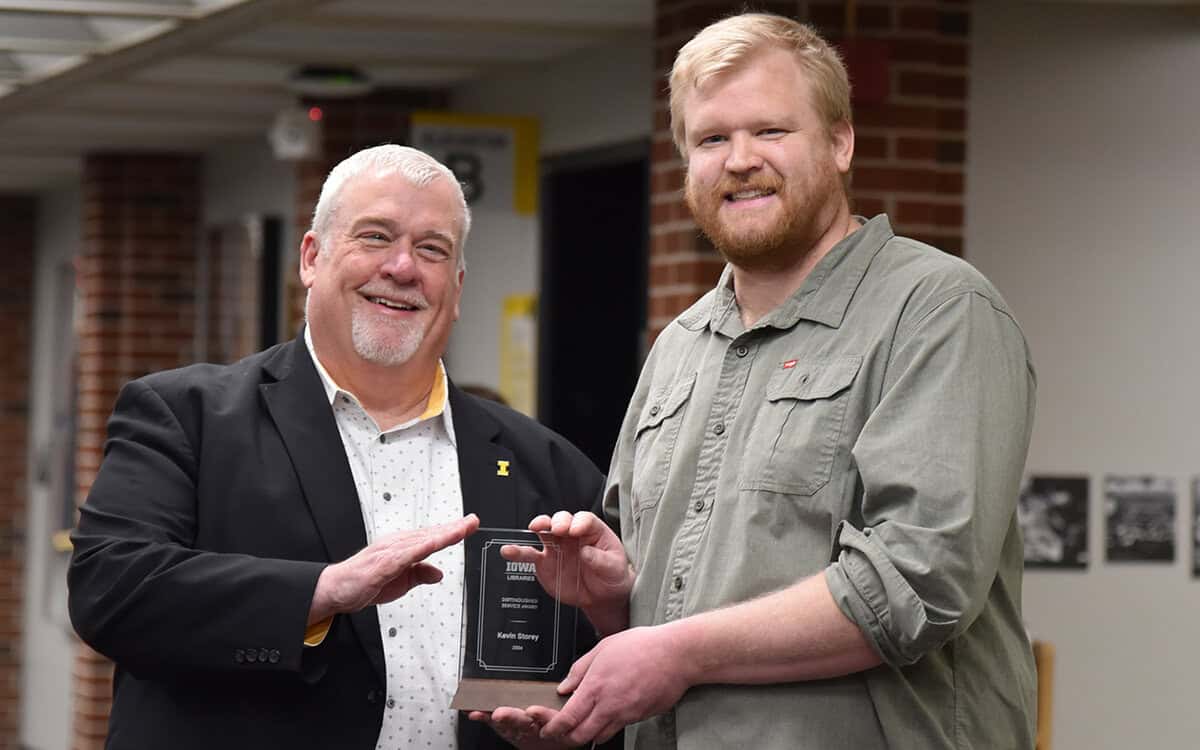
Kevin Storey, collections and delivery assistant, receives the 2024 Distinguished Service Award from Jack B. King University Librarian John Culshaw during a staff awards reception in March 2025.
In addition, Storey’s commitment to customer service is evident in his dedication to ensuring smooth and prompt deliveries and transport of materials, which are essential for many library services. His reliability and effective communication have earned him the trust and appreciation of departments across the Libraries. For instance, his teamwork, dedication, and assistance with several exhibit projects in the Main Library Gallery have been invaluable.
The Distinguished Service Award celebrates a Libraries Merit staff member recognized by their peers who shows initiative, promotes a service mindset, values collaboration, and demonstrates respectful and inclusive behavior. The recipient leads by example, is compassionate, and champions opportunities, making a difference to their colleagues, their work, or community.
Katie Peterson Early Career Award
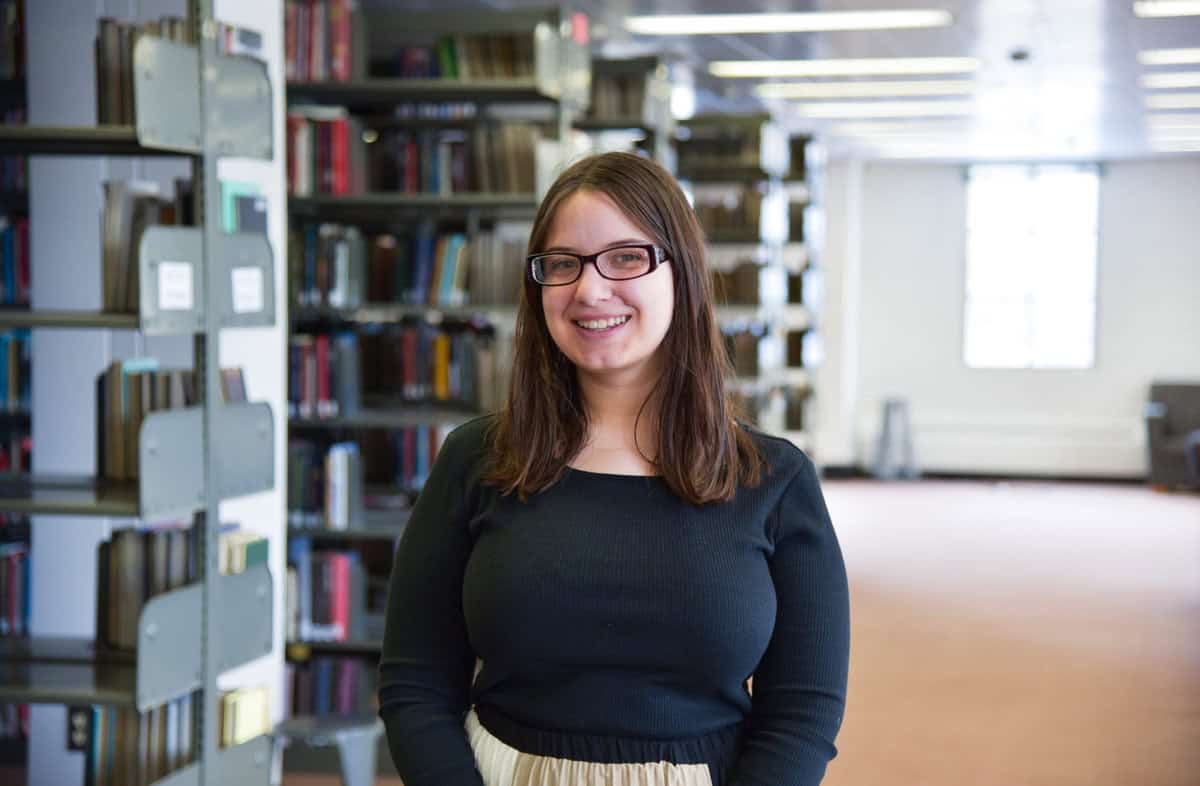
According to her nominator, Katie Peterson has demonstrated exceptional accomplishments through competency, initiative, and creativity qualities in her first professional librarian position at the Libraries. She serves as a metadata librarian and electronic resources cataloger and her primary responsibility has been managing electronic resources.
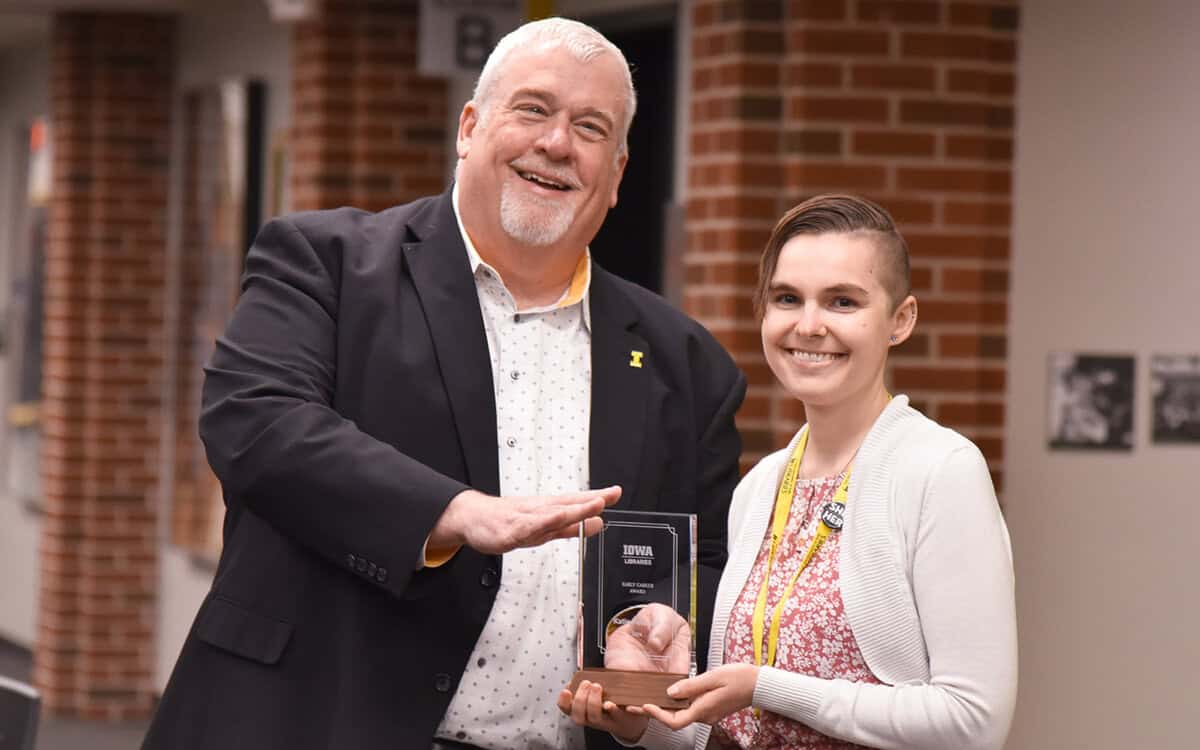
Katie Peterson, metadata librarian and electronic resources cataloger, receives the 2024 Early Career Award from Jack B. King University Librarian John Culshaw during a staff awards reception in March 2025.
Within Peterson’s first year, she fully cataloged and made available electronic books and streaming videos, reorganized collections to improve user access, and de-duplicated bibliographic records, which significantly enhanced the discoverability of Libraries electronic collections. During summer 2024, she updated the majority of streaming video titles to include more accurate language and accessibility information, and her work even influenced a vendor to adopt more inclusive subject headings.
In 2023, Peterson volunteered as the first chairperson of the Libraries’ MARC (MAchine-Readable Cataloging) Working Group, refining its responsibilities and guidelines while collaborating effectively with long-standing colleagues. Since February 2024, she has co-chaired the New Hires Interest Group, fostering a welcoming environment for new employees.
The Early Career Award celebrates a Libraries Professional and Scientific staff member recognized by their peers for demonstrated exceptional accomplishment(s) through competency, initiative, and creativity. This award is for early career professional Libraries staff members and mirrors the Arthur Benton University Librarian’s Award for Excellence.
Elizabeth Riordan has been named the 2024 recipient of the Arthur Benton University Librarian’s Award for Excellence in recognition of her commitment to student and faculty success, elevating the visibility of distinctive collections, and helping people of all ages connect with the University of Iowa Libraries.
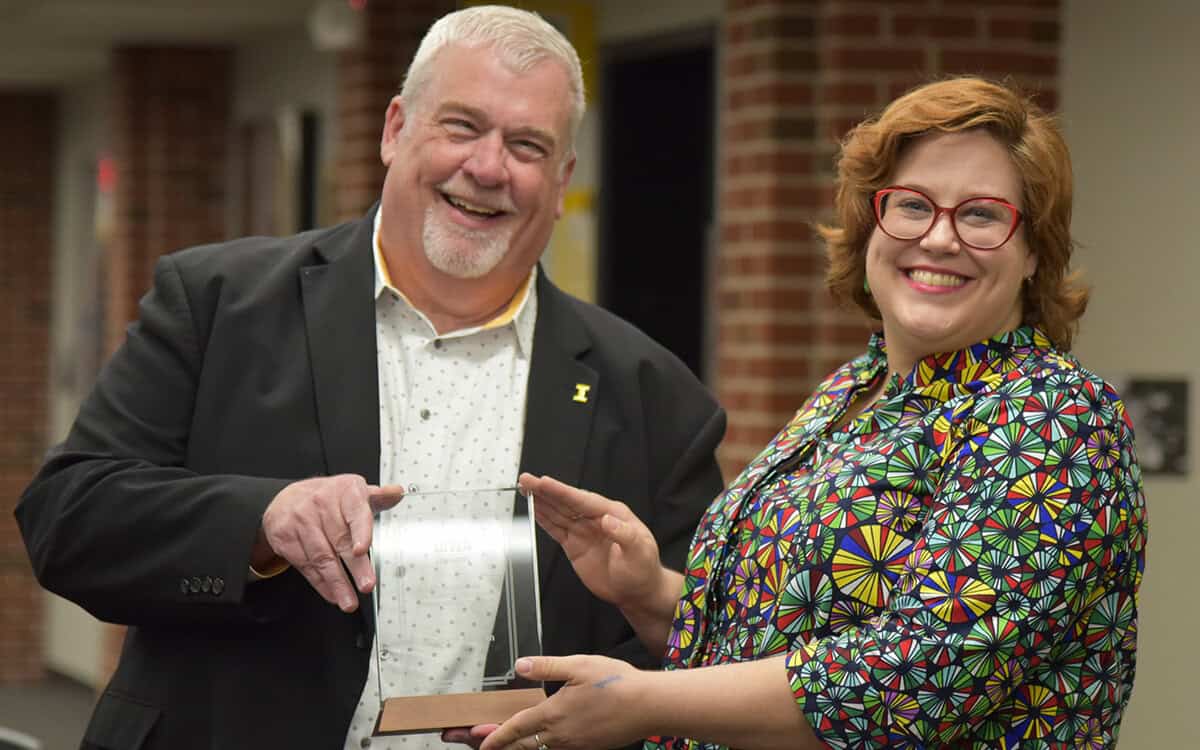
Elizabeth Riordan, lead outreach and engagement librarian for Special Collections and Archives, receives the 2024 Arthur Benton University Librarian’s Award for Excellence from Jack B. King University Librarian John Culshaw during a staff awards reception in March 2025.
“Liz has significantly increased the reach of Special Collections and the Libraries overall through elevated class visit rates, improving student and faculty satisfaction with the Iowa experience,” says John Culshaw, Jack B. King university librarian. “She’s an outstanding advocate for student success, our collections, and the Libraries through her work on campus and in the community.”
Sara Pinkham, Riordan’s nominator and exhibition and engagement coordinator for the Main Library Gallery, says her expertise and deep passion for helping students connect with rare materials is unmatched.
“Liz strives to reach students where they are and often ignites in them an abiding interest in history while introducing them to Libraries collections,” says Pinkham. “Many have their first-ever interactions with these types of collections under Liz’s guidance, and it is clear that her style of instruction and her relatability make infinitely accessible the resources we have to offer.”
Elizabeth Yale, assistant professor in the UI Department of History and Center for the Book, has worked closely with Riordan since 2018 and shared in her letter of support that Riordan has always been a fantastic collaborator.
“She approaches her work with clarity, hospitality, and a deep knowledge of the collections and of object-based teaching methods,” says Yale. “She fosters an environment in which beginning student researchers, in particular, feel welcomed and supported.”
It’s a sentiment shared by Paula Amad, associate professor of film studies in the UI Department Cinematic Arts, who has worked with Riordan in connection with class visits for both undergraduate and graduate students. Amad highlighted several examples of Riordan’s excellence as an outreach librarian, including classes showcasing the Brinton Collection.
“She has been simply superlative in her instruction outreach skills—exposing our students to the richness and cultural complexity of the collections, leading informative discussions, and collaborating productively with me on specific requests for each course,” says Amad. “She has often invited Mike Zahs (who ‘saved’ the Brinton materials). Those classes are a brilliant combination of material-based film history and live performance, and they have engaged our students on multiple levels.”
In addition to her noteworthy achievements in teaching, Riordan has been active with community outreach both on campus and off. She was an integral part of Connected for Life, an Institute of Museum and Library Services-funded program that provided engagement and enrichment to senior citizens in retirement communities during the lonely height of the COVID-19 pandemic. She also has helped to network campus GLAM (galleries, libraries, archives, and museums) staff with other museums and libraries in Eastern Iowa through group educational field trips, strengthening professional bonds and partnerships. She served as president of the ILA/ARCL (the Iowa chapter of the Association of College of Research Libraries) in 2020 and currently serves as co-chair of the Scholarship Committee for the Rare Book and Manuscript Section of the American Libraries Association. In addition, Riordan initiates several pop-up exhibits per year, such as at Lunch with the Chefs on campus, Iowa City Public Library, and more.
And when it comes to interacting with people, Damien Ihrig, curator of the John Martin Rare Book Room at the Hardin Library for Health Sciences added in a letter of support that Riordan “not only understands and supports the needs of our patrons but also connects with the stories and people behind the materials she curates—and she’s always willing to lend a helping hand or be a sounding board for new ideas, whether for instruction, exhibits, or beyond.”
Riordan was formally acknowledged as the recipient of the Benton Award during a staff recognition event in spring 2025.
The Arthur Benton University Librarian’s Award for Excellence is awarded each year to a member of the UI Libraries’ professional staff who has demonstrated outstanding commitment and leadership in furthering its mission to serve the university community. In addition to formal recognition, the award includes a grant of $2,000 for professional development that will support Riordan’s research projects or publications related to library services.
The late Dr. Arthur Benton, professor of psychology and neurology at the then-named University of Iowa Hospitals and Clinics, established the endowment to make this annual award possible.
Inside the University of Iowa Libraries is your look behind-the-scenes to meet the people and discover the stories making our organization unique and valuable. From cutting-edge databases to rare books, join us to explore a world of research, preservation, and discovery that fosters student success through countless touchpoints.
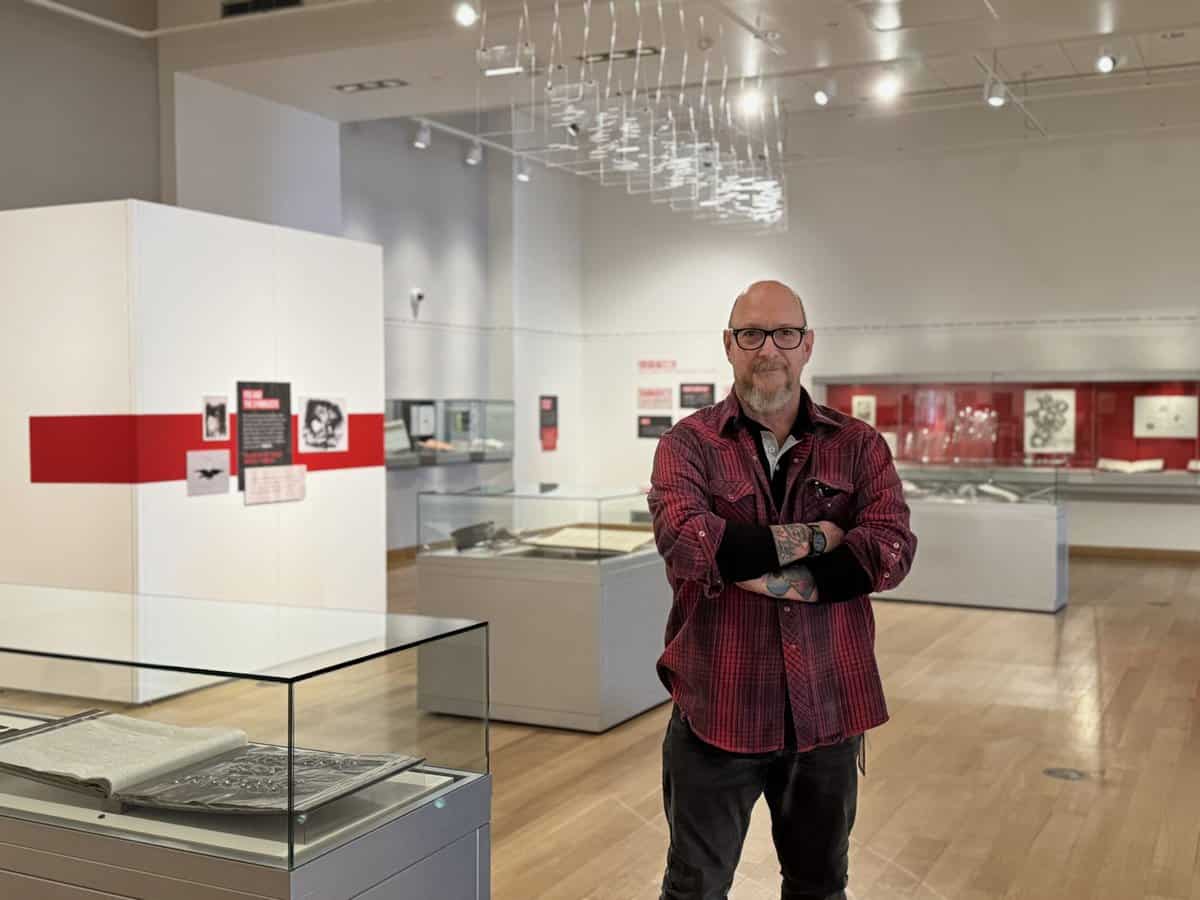
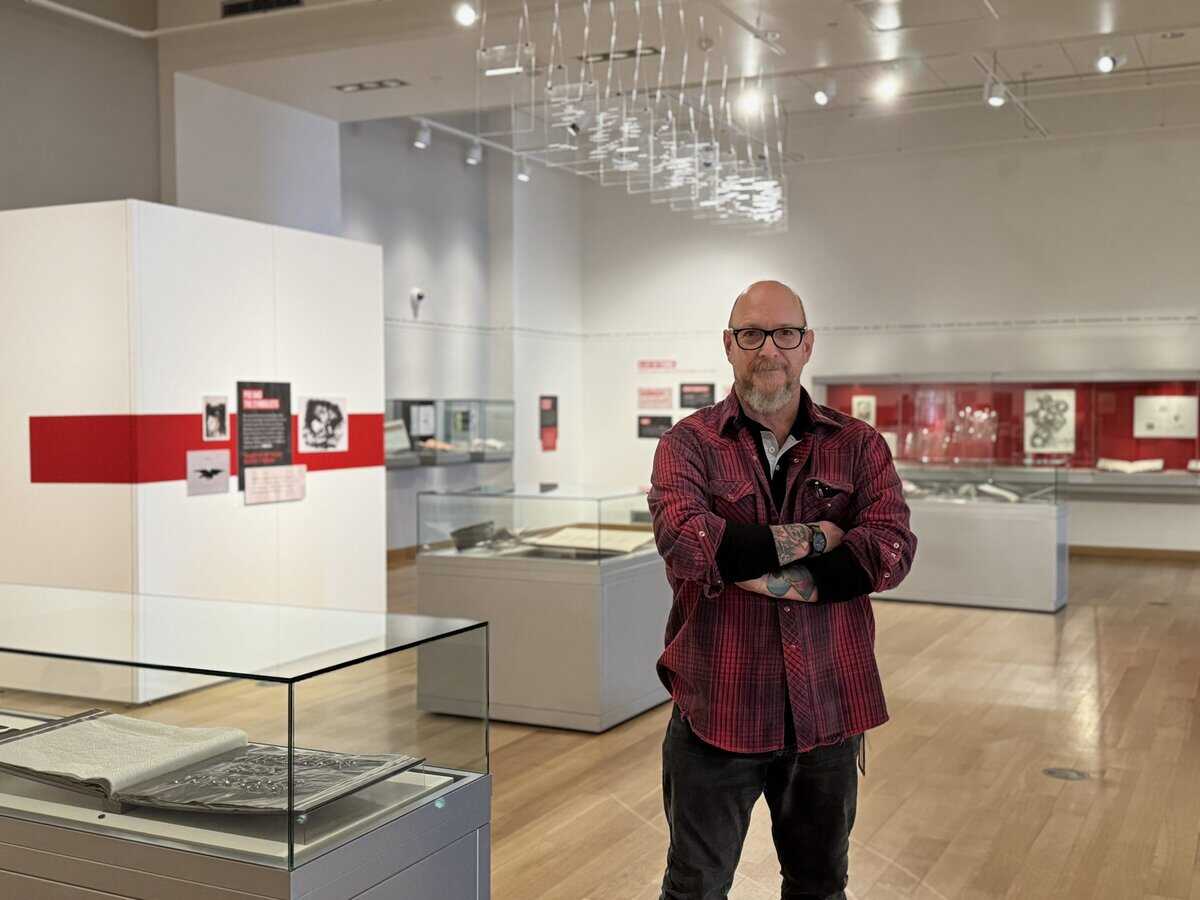
Rich Dana, the Sackner Archive project coordinator librarian, has something fascinating to add to every conversation. With his varied background as a librarian, instructor, artist, and carpenter, Rich will eagerly engage in conversations about everything from Avant-Garde art to the mechanics of early printing machines, like the mimeograph, to historic preservation. At the University of Iowa Libraries, Rich manages a unique archive of over 75,000 items.
This archive travelled from the east coast to the UI Libraries in 2019. The Ruth and Marvin Sackner Archive of Concrete and Visual Poetry was the personal collection of two collectors who championed some of the world’s most original creators of visual and concrete poetry. Their collection became the largest of its kind and contains items, now housed at the Libraries, that can’t be accessed anywhere else in the world.
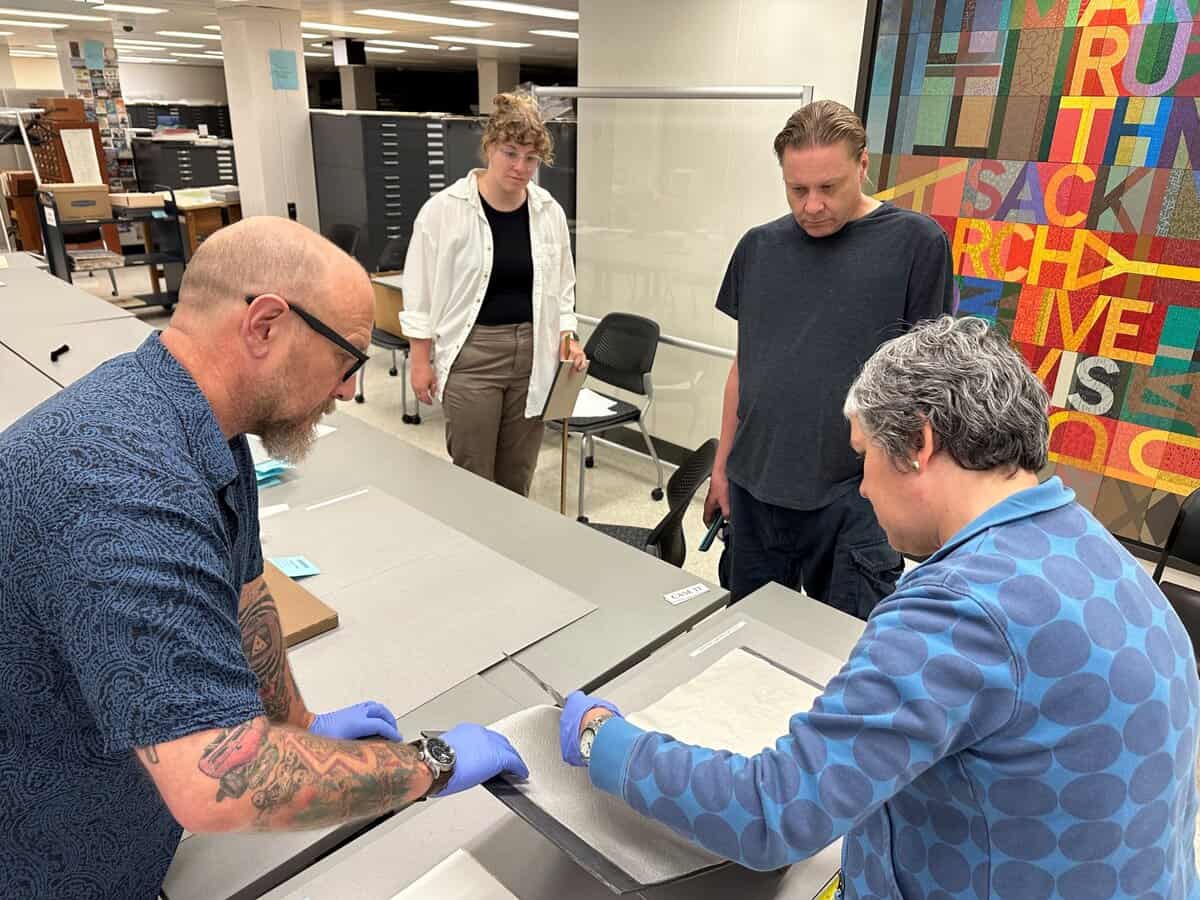
Rich works with the Conservation and Collections Care department to prepare materials for exhibition.
Rich has been raising awareness of this extensive resource and making the materials in the collection more accessible to patrons and researchers since 2022 through his position, which is funded by a three-year grant from the National Endowment for the Humanities (NEH). As a recent example, Rich curated the spring 2025 exhibit in the Main Library Gallery featuring Sackner Archive materials that were important to the collectors. For Ruth and Marvin Sackner, the groundbreaking poem by French Symbolist poet Stéphane Mallarmé was at the headwaters of the artistic and literary movements that became their obsession. The exhibit, A Roll of the Dice: Symbolism in the Sackner Archive, is named after that poem. It aims to construct a timeline of works that illustrate Mallarmé’s influence on the 20th- and 21st-century Avant-Garde art movements while simultaneously helping newcomers make sense of concrete and visual poetry.
In addition to his work at the Libraries, Rich is an instructor at the University of Iowa Center for the Book and the Center for Book Arts in New York City. He is the author of the book Cheap Copies!The Obsolete Press Guide to DIY Hectography, Mimeography & Spirit Duplication. Learn more about Rich and his insight working with the Sackner Archive in the questions and answers below.
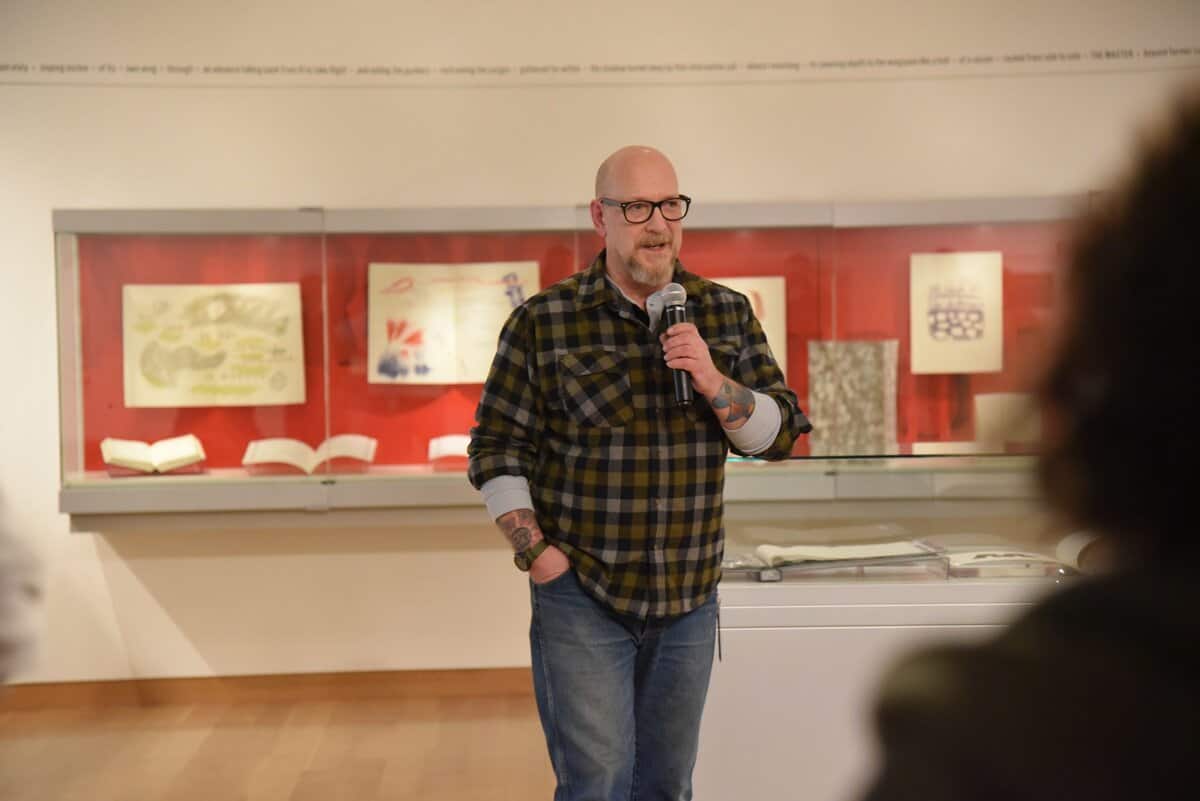
Rich guides a tour of the Sackner Archive in his exhibit, A Roll of the Dice: Symbolism in the Sackner Archive.
Q: When does your job feel most rewarding? A: I love helping students and researchers discover the incredible stuff in this collection. It is wonderful to meet the scholars from all over the world who visit the University of Iowa just to access the Sackner materials. It’s equally rewarding when I host a class visit, and some undergraduate students hang out after the class ends because they are so energized by what they saw and are full of questions!
Additionally, working with students has been one of the great joys of this job. The student librarians and interns who have chosen to come and work on the Sackner Archive have been just fantastic. Working with these unique materials is challenging, and it takes a certain kind of intellectual adventurousness. I’ve been very fortunate to find students who are curious and have fun with the materials while also being diligent and responsible stewards of the collection.
Q: What is an academic library to you? A: The Sackner Archive is a perfect example of the importance of an academic library. There are over 75,000 items in the archive, and it’s not practical or possible to digitize everything. There are objects, ephemera, and correspondence that provide insights for scholars, researchers, and authors that they simply cannot access anywhere else in the world.
Q: Share a skill or interest, outside of work. A: I have always been fascinated by old machines, particularly old printing technology. I like to incorporate these old technologies into my art and writing, in the hopes of reminding people to explore the physical world, the reality outside of their phones.
Q: What might colleagues or students find surprising about you? A: They might be interested to know that I didn’t get my master’s degree until I was in my 50s. Before that, I worked at a wide range of jobs—everything from carpenter to political lobbyist. I guess the message is: it’s never too late to try something different.
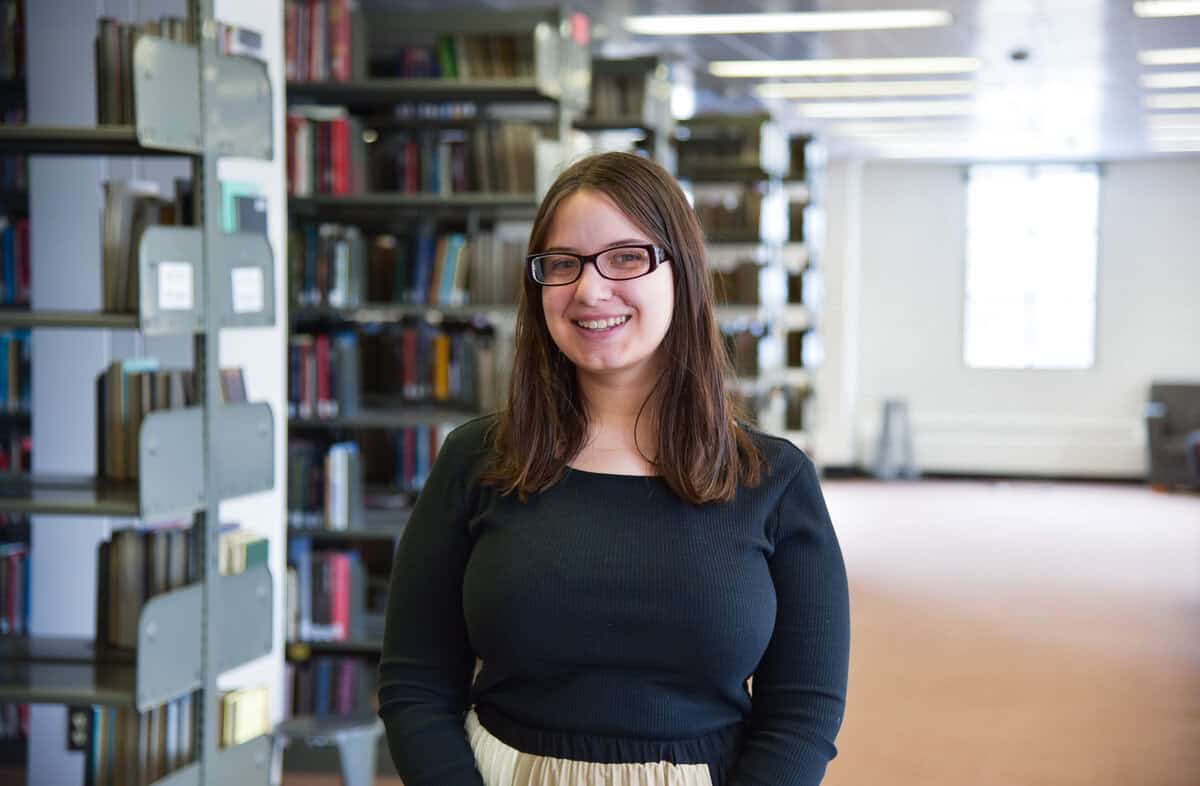
The University of Iowa Libraries offers students from the School of Library and Information Science (SLIS) a unique opportunity to develop their skills and passion through student employment and practicums. Eleanor Ball is one of these students and she stands out through her many positive contributions according to her instructors, supervisors, and peers. Her passion to foster scholarship, empower students, and advocate for libraries are at the heart of Eleanor’s dedication to her work.
Eleanor came to Iowa in the fall of 2023 to earn a Master of Library Information Science, after graduating from George Washington University with a Bachelor of Science in public health and English in 2022. She quickly made an impression in a SLIS course taught by Katie DeVries, who is a social sciences librarian at the Libraries. This led to Eleanor’s fall 2024 practicum, supervised by Katie. During this time, Eleanor developed and led a 50-minute information literacy session for a Communication Studies lecture section. Throughout the semester, she also staffed the Just Ask Desk, helping patrons with their research needs. Katie was impressed by Eleanor’s dedication and abilities.
“Eleanor maintains a consistent professional presence across contexts,” says Katie. “She exhibits expertise and openness. Students in the classroom and students in consultations seem at ease following Eleanor’s lead and her work in these areas is inspired and thorough.”
Eleanor Ball works in acquisitions and e-resources at the Libraries.
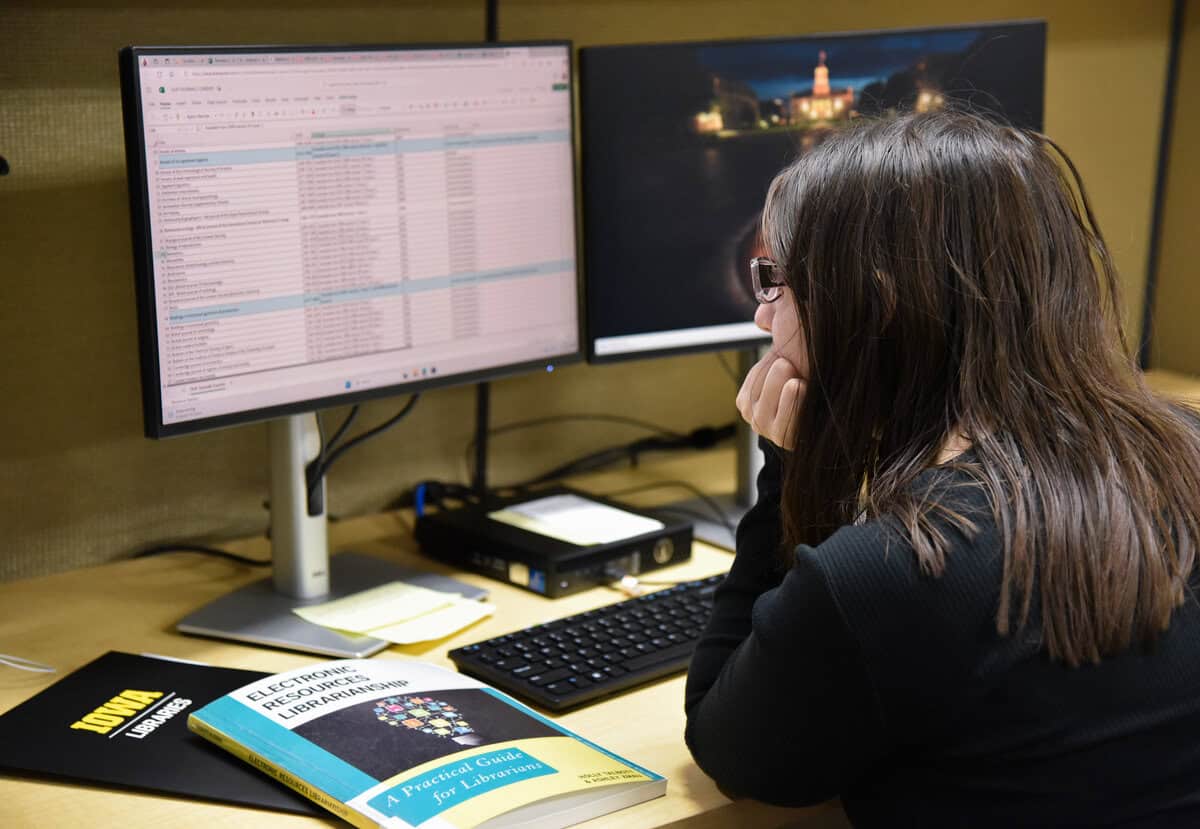
Now, Eleanor works with Julie Gaida, electronic resources librarian, as a practicum student in acquisitions and e-resources. The Acquisitions Department purchases resources in all formats for the Libraries to build and maintain collections that meet current and future teaching and research needs. Julie has already seen Eleanor’s meaningful impact in the department.
“Her enthusiasm for learning and her ability to quickly grasp complex concepts inherent within electronic resources work has been remarkable,” explains Julie. “Her strong work ethic, progress, and contributions have been nothing short of impressive.”
After graduation, Eleanor hopes to continue working in academic libraries. She is especially interested in liaison and instruction roles. Read the following questions and answers with Eleanor to get to know her, in her own words.
Q: What attracted you to the University of Iowa? A: I am from Des Moines, Iowa. I chose to come back to the state for my MLIS because I feel passionate about fostering scholarship, empowering students, and advocating for libraries in our state.
Q: What do you enjoy about working at the Libraries? A: Through my work at the Law Library and my practicums at the Main Library, I’ve gotten to try a little bit of everything in academic librarianship: technical services, user services, instruction, and—currently—e-resources and acquisitions. At this stage in my career, I’m trying to soak up everything that I can. So, I really appreciate the diversity of learning opportunities I’ve been provided. Plus, librarians are some of the nicest co-workers out there!
Q: How has working at the Libraries impacted you, either personally or professionally? A: Working at the Libraries provides me with the real-world experience essential for landing a job in my field. The working librarians here are an invaluable resource for my professional development.
Q: What has been your favorite class at Iowa so far? A: I got my first taste of the world of acquisitions in SLIS: 6345 Stewardship of Information and Collections. This class made me realize that collection development and management aren’t as intimidating as I thought, and it paved the way for me to do my current practicum in acquisitions and e-resources.
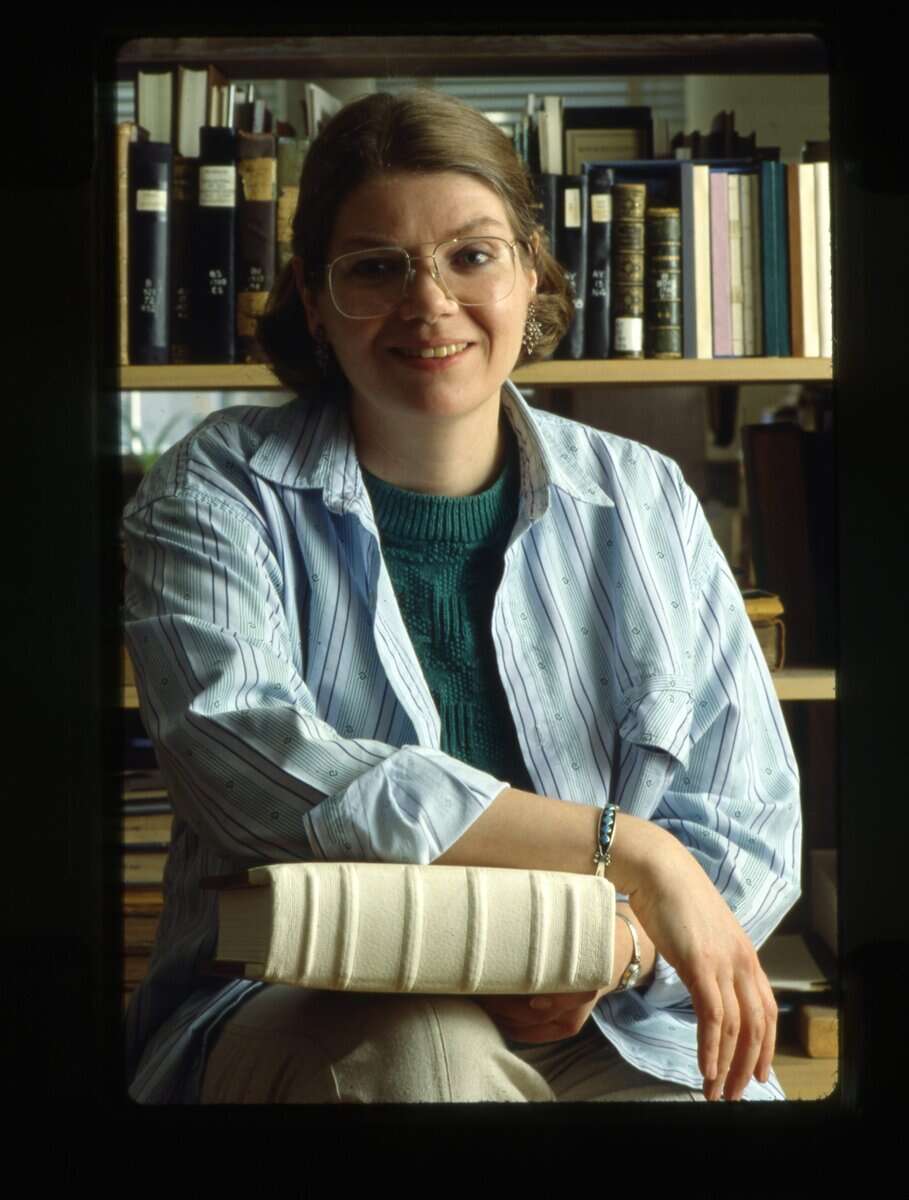
We are saddened by the news of Pamela Spitzmueller passing on March 13, 2025. Pam was the University of Iowa Libraries’ second conservator, serving from 1989–1999.
After leaving Iowa, Pam was the chief conservator for Special Collections in the Harvard University and College Libraries where she directed the Special Collections Conservation Lab in the Weissman Preservation Center until she retired. Pam also spent time at the Library of Congress and the Newberry Library in Chicago.
Pam Spitzmueller served as the University of Iowa Libraries’ second conservator from 1989–1999.
Pam’s inquisitive nature is well known by the staff, interns, and students who worked with her. It is said that Pam’s classes, workshops, or tutorials were about asking questions and “trying things out.” She inspired investigation that required making and specifically making models. Pam’s creative work was largely inspired by historical structures, and she was constantly experimenting. Her artist book work and conservation work merged, creating hypothetical books with “what if?” elements that continue to delight and amuse.
Inside the University of Iowa Librariesis your look behind-the-scenes to meet the people and discover the stories making our organization unique and valuable. From cutting-edge databases to rare books, join us to explore a world of research, preservation, and discovery that fosters student success through countless touchpoints.
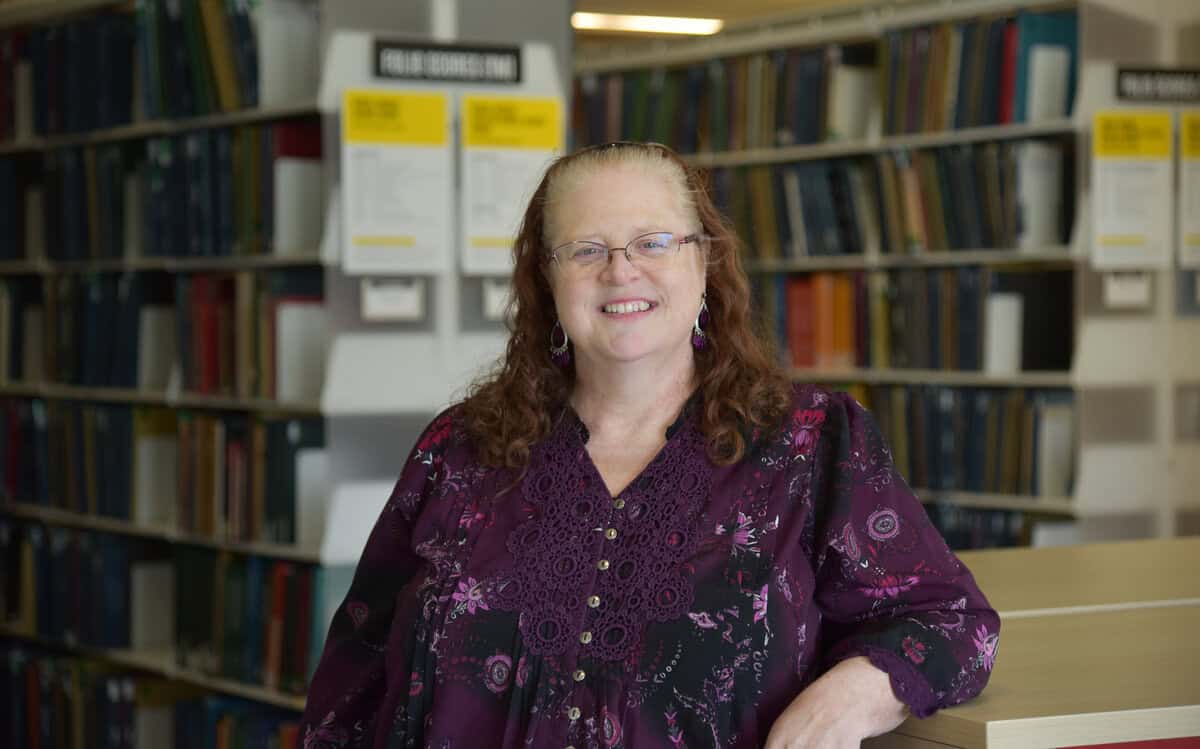
Christine Bellomy is a library cataloger by day and a musician by night (and weekends). Christine has worked her way up through a variety of positions at the University of Iowa Libraries. Beginning as a cataloging student worker in 1989, Christine was later hired as a library assistant II in 2000. With a Master of Library Information Science and a doctorate in clarinet performance and pedagogy, Christine has become a library assistant IV with a music cataloging emphasis in Cataloging, Metadata, and Digitization.
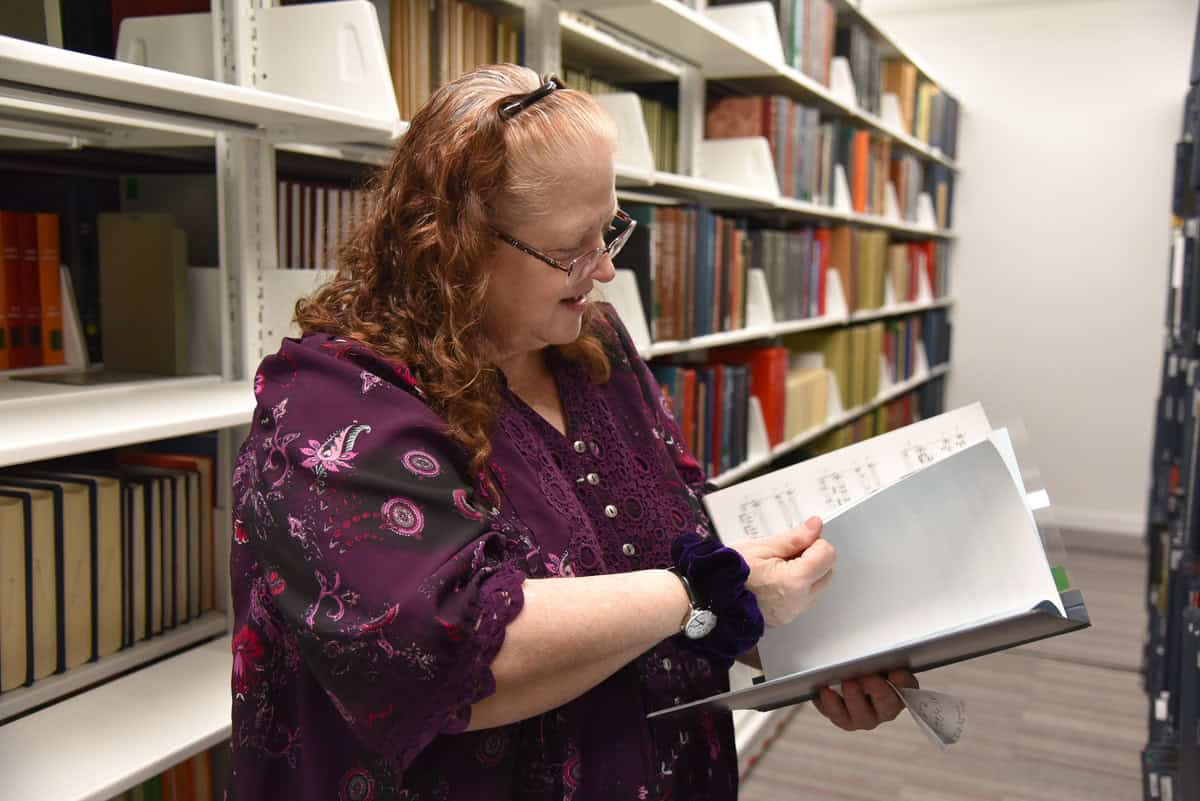
Christine’s work is all about making it easy for students, staff, and faculty to find the information they need. She works behind-the-scenes cataloging materials for the Rita Benton Music Library, including music scores, books, CDs, and DVDs. This can be recording titles, authors, composers, etc. of each material correctly and uniformly. It can also be assigning call numbers and subject headings to materials. This labeling and organizing ensures that users can find what they need with an easy search, can distinguish between different pieces with the same or similar titles (e.g., “sonata” or “symphony”), and, finally, can easily locate physical materials in the Libraries.
Although her work at the Libraries is behind-the-scenes, Christine thrives in front of an audience. She regularly performs with Orchestra Iowa, the Quad City Symphony, and the Cedar Rapids Municipal Band. Her passion for live music is contagious. She promotes their performances both by sharing information with friends and colleagues, and by producing short promotional videos. This is where her creativity and fun-loving nature truly shine. You will see this sense of humor in Christine’s answers below, highlighting some of her favorite materials.
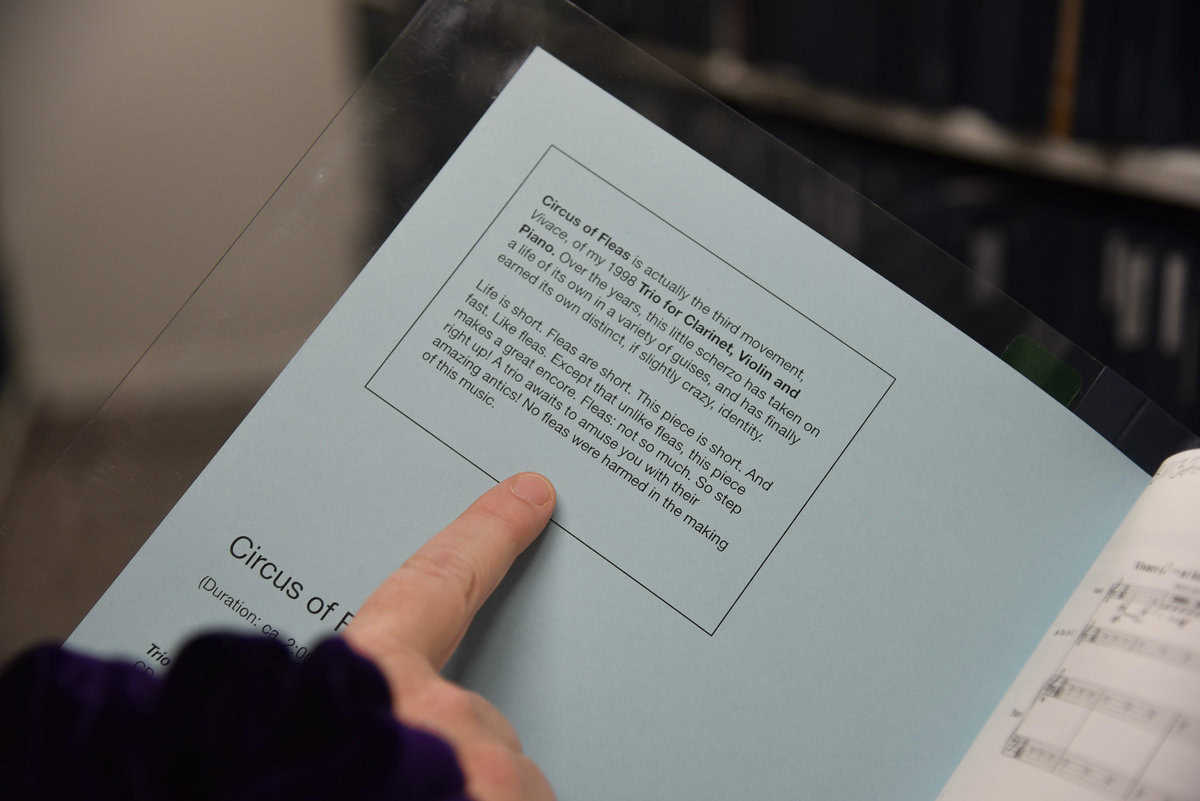
Christine points to composer Alex Shapiro’s note in Circus of Fleas for clarinet, violin and piano.
Q: What might someone find surprising about your work? A: Working in cataloging exposes you to a lot of interesting (and sometimes funny) information and resources. I learned that “skiffle” (a genre of folk music) is a thing from cataloging Skiffle Sensation. I laughed when I cataloged Eat That Frog! Action Workbook. I enjoyed this note from composer Alex Shapiro about Circus of Fleas for clarinet, violin and piano: “Life is short. Fleas are short. This piece is short. And fast. Like fleas. Except that unlike fleas, this piece makes a great encore. Fleas: not so much. So step right up! A trio awaits to amuse you with their amazing antics! No fleas were harmed in the making of this music.”
People might also be surprised that reading books is not part of my job description. Finally, people don’t often realize that library-related information is incorporated into a variety of resources beyond the library catalog to assist students with information retrieval. For example, the University of Iowa School of Music Recordings Archive uses the same authorized forms in its metadata to help people find and distinguish things, such as the difference between John Williams the composer, John Williams the classical guitarist, and John Williams the double bass player or between two different Mozart piano sonatas in C major.
Q: How do you see technology impacting your daily work? A: We are constantly working to improve our catalog and other library resources to make them more user-friendly and linked to additional resources. We attend webinars and conferences to learn more about how improvements in non-library technology can be integrated into our records and resources to help students find materials even beyond the Libraries using metadata and a variety of international standards (such as authorized name forms and other coded data).
Q: What advice would you have for those just embarking on their own careers? A: Explore many different things that interest you. If you have a passion that does not appear to be viable for full-time work, look at possibly related careers that interest you and might allow you to enjoy pursuing both. Be bold and brave and ask questions about things. If there are people you admire, especially in your areas of interest, evaluate what makes them successful and consider contacting them for an interview, lunch, and/or job shadow. You might end up making a connection that benefits your career in addition to learning new things.
Q: Outside of work, what are your other interests? A: I am a clarinetist, playing with Orchestra Iowa, the Quad City Symphony, and the Cedar Rapids Municipal Band. I also teach private clarinet lessons and enjoy performing with my students in a variety of styles and venues. I have fun creating new educational programs for Orchestra Iowa’s Music in the Schools woodwind quintet program (often using resources from the Rita Benton Music Library) and creating “commercials” for Orchestra Iowa. I consult the Rita Benton Music Library and its staff for many things related to my music work (e.g., information about composers, program note research, information about new works and resources, and access to scores). I spend my spare time reading, especially books in a series so I can follow characters, and playing pinochle and other games with friends and family, especially at El Senor Cactus.
Are you concerned about lowering students’ textbook costs? Do you wish you could develop your own course resources to enhance your teaching? If so, you might consider applying for the OpenHawks grant program at the University of Iowa.
Over the last several years, OpenHawks has funded over 70 Open Educational Resources (OER) projects across a broad range of disciplines and saved students nearly $2 million to date. Read more about the OpenHawks projects that received funding in 2024–2025.
What is OpenHawks?
OpenHawks is a campuswide grant program that funds instructor efforts to replace their current textbooks with OER for enhanced student success. This program, funded by the Office of the Provost and UI Libraries, is open to any faculty member or graduate student who teaches for-credit courses and medical residencies at the university. If you are concerned about the cost or quality of your existing textbooks and would like to explore OER, this might be just the program you need. There is a range of awards available, depending on the type of project you’d like to complete. OER can include textbooks, course readings, simulations, games, quizzes, and many other tools or techniques used in education.
Why use OER?
There are many benefits of using OER in your courses, such as:
Reducing costs for students – By using OER, you can help your students save money and reduce financial barriers to education.
Improving student learning outcomes – Studies have shown that students who use OER perform as well or better than those who use traditional textbooks and are more likely to complete their courses.
Tailoring resources to your students’ needs – Because OER are openly licensed, you can amend them, add local examples, even involve your students in editing them.
How to apply for OpenHawks
The program offers five types of grants, ranging from $500 to $10,000, depending on the scope and scale of the OER project.
The application deadline for the 2025–2026 academic year is Friday, April 25, 2025. To apply, you need to complete an online Qualtrics application. You can find more information about the application process, eligibility criteria, and evaluation rubric on the OpenHawks website.
Need help or have questions?
If you are interested in applying for the OpenHawks grant program, or if you have any questions about OER, feel free to contact Scholarly Communications Librarian Mahrya Burnett. Don’t miss this opportunity to join the growing movement of OER at the UI and beyond. Apply for today and make a difference in your teaching and learning!
When the University of Iowa Libraries was established in 1855, its collection consisted of 50 books shelved in a room no larger than a broom closet. Over the past 170 years, the Libraries has developed into its current incarnation: a world-class system with seven campus libraries; a state-of-the-art, high-density print preservation facility; and a museum-quality exhibition gallery.
Undergraduate and graduate students from all disciplines depend on the Libraries for academic and research support—but for the thousands of student employees throughout the years, one of its most impactful offerings is on-the-job learning that sets them up for success.
Carmela Furio, student employee in Special Collections and Archives.
Carmela Furio loves the hands-on nature of their job in the Libraries Special Collections and Archives. As new books arrive at the Libraries, Furio handles them with care, recording relevant attributes for future researchers. The School of Library and Information Science (SLIS) student works as a library support lead supervised by Jenna Silver, processing coordinator archivist.
“I’m grateful for the unique opportunity to process and accession manuscript collections as a student worker,” says Furio. “Be it World War II-era love letters, science fiction fanzines, or 19th-century ephemera, it’s amazing to know the materials I work with will go on to support historical narratives far beyond my time at Iowa.”
When Furio started as a library student employee, they were an undergraduate who had just accepted a place in SLIS after applying during their fourth year at Iowa. Already a frequent user of the Libraries, Furio was drawn to the field of library and information science because of its connection to some of their most deeply held values, including open access and community heritage. But before starting the program, Furio wanted to gain familiarity with the libraries they loved from a new perspective: that of an employee.
Carmela Furio processes materials found in the David Cole Papers (Msc1260).
“It was actually a big worry of mine, not having enough experience before I started my program,” says Furio. “But Special Collections became this wonderful confirmation that library work was for me.”
Furio is one of about 135 students who are employed by the Libraries during any given semester. These student workers fill a variety of roles, and they’re essential to the daily operations of all seven libraries.
“From the Main Library Service Desk to the Annex, our student workers help the Libraries excel as learning environments and community-building spaces,” says John Culshaw, Jack B. King university librarian. “We do all we can—through scholarships, mentorship, and other support—to ensure that they get just as much out of the Libraries as they give.”
The data shows that student library workers feel that support. In fall 2024, half of Libraries student employees were returning to roles they’d had the previous semester, and it’s common for students to continue working for the Libraries throughout their time at the university.
Dr. Lisa Kreber, former student employee at the former Biology Library, which merged into the Sciences Library.
Upon graduation, student library workers also receive their diplomas while wearing Hawkeye old gold honor cords that set them apart as alumni of the Libraries. For many, like Dr. Lisa Kreber (BS ’99), it’s a designation they carry with pride long after they graduate. Kreber is a neuroscientist and multisite director of neurology at the Brain and Spine Institute within Adventist Health in Bakersfield, California. For 25 years, she has dedicated her career to improving results for patients recovering from brain injuries.
“All these years later, I often still think about the job I had working in the Libraries and how that shaped my life,” says Kreber. “It was quite the experience.”
Kreber sought a position in the former Biology Library (which has since been merged into the Sciences Library) immediately upon enrolling at Iowa. At the time, she felt confident about where her path would lead: to medical school, then on to a career as a neurosurgeon or neurologist. Instead, the job offered her something even more precious, revealing new possibilities when her certitude wavered.
Lisa Kreber during her time as a student at the University of Iowa.
“As I took classes, I realized I didn’t like biology as much as I loved psychology and neuroscience,” says Kreber. “My experience in the Biology Library interacting with professors gave me the courage to approach one of my psychology professors, Dr. Mark Blumberg, about becoming a student researcher in his lab.”
Kreber started working with Blumberg while continuing her role at the Libraries. From there, a path began to unfurl before her, including earning a PhD in psychology and neuroscience from the University of Colorado at Boulder.
“I’m not sure I would have decided to pursue a PhD had it not been for my experiences in the Biology Library,” Kreber says. “The conversations I had there influenced me, and I developed a passion for research.”
Kreber is not the only alum whose job in the Libraries led to a calling. James Fitzmaurice, emeritus professor of English at Northern Arizona University and now an Honorary Research Fellow at the University of Sheffield (U.K.), began working at the Art Library in 1967 while pursuing a PhD in English.
James Fitzmaurice, former student employee at the Art Library.
Without a visual arts background, Fitzmaurice was initially nervous that he wouldn’t know enough to help students at the Art Library. But through daily interactions with faculty and students, Fitzmaurice became interested in the intersections of art and literature.
Eventually, the visual arts found their way into his dissertation, which focused on 18th-century emblem books. His research took him deeper into Special Collections and Archives, where he handled volumes whose illustrated contents would become the core of his academic career.
To this day, Fitzmaurice looks back with extreme gratitude at the encouragement he received from his supervisor at the time, art librarian Harlan Sifford.
Author James Fitzmaurice (left) returned to the University of Iowa for a conversation about his young adult novel, Hobgoblin Gennel, moderated by Library and Information Science graduate student Theo Prineas as part of the Iowa City Book Festival in October 2024.
“[Sifford] said, ‘Well, if you’re checking in a book and it looks interesting, if there’s no one around, you should just read it,’” says Fitzmaurice. “Because of that, the visual arts have been extremely important in my understanding of literature throughout my career.”
Kreber, too, remembers the names of her supervisors and the lessons they imparted. “I strive to be a boss like Bob [Lane] and Jeff [Dodd] were to me,” she says. “Supportive, compassionate, and always willing to roll up my sleeves to help my team.”
These meaningful supervisory relationships are crucial in setting employment at the Libraries apart from the more than 7,000 other roles for students on campus. And they’re among the threads that bind generations of the Libraries’ student workers—no matter what else changes at the university or in the field of librarianship.
The Art Library’s Jim Hall, library assistant, takes that legacy seriously. In 2023, the students he supervised expressed their gratitude by nominating him for a campuswide award, UI Student Supervisor of the Year. The Pomerantz Career Center selected Hall for the award from a field of 106 nominees.
According to Hall, acting as an effective supervisor and mentor requires two central values: patience and encouragement.
“I try to impress upon student employees that we appreciate them,” says Hall. “Patricia [Gimenez, director of the Art Library] and I want them to know how important they are to the operation of the library, without laying on any additional pressure. It’s really not possible to be too patient.”
And that supportive philosophy clearly resonates with students. According to Hall’s nominators, his mentorship provides the knowledge they need for problem solving and he constantly prioritizes their mental health in the workplace.
When student employees eventually move into the wider world—as Kreber and Fitzmaurice as well as Hall’s students have—the impact of the Libraries echoes far beyond campus. That’s why Culshaw has expanded opportunities for students to receive the kind of advanced training and scholarship support that have benefited student library workers through the decades.
“Our student workers remain a part of our community all their lives,” says Culshaw, who started his own career with a job at his undergraduate institution’s library. “They are an important part of the Libraries’ story, just as we hope to be part of theirs.”
Whatever happens, the priorities that will define the Libraries’ next chapter are clear, including support for students like Furio, whose time in Special Collections and Archives has affirmed more than their choice of career.
“I’ve gained so many mentors working here, and for the first time ever I can really see a path ahead where I’m happy and feel like myself,” says Furio.
To learn more about how you can support Libraries’ student employees, including advanced students such as Furio, contact paula.wiley@foriowa.org.
Did your time as a Libraries student worker positively impact your life? Please share your thoughts with us at lib-communication@uiowa.edu for inclusion in a future Bindings.
Love Data Week (Feb. 10–14) is a celebration of data, including data science and data management, held around Valentine’s Day every year. This year’s theme “Whose Data Is It, Anyway?” asks us to examine who owns data and who uses it. So how can the University of Iowa Libraries’ Research Data Services help you year-round?
Get credit for your work
When you share your data through a repository, like our institutional repository Iowa Research Online (IRO), you establish yourself as the creator of the dataset with a preserved record of your work. Repositories preserve and provide access to the data, and provide persistent, unique identifiers (like DOIs) and other information so others can find, understand, and use your data in their own research. Protecting the integrity of the data and enabling others to find and accurately cite your work can broaden your research impact and accelerate research progress. Many funders and publishers encourage or require data sharing.
Data curation adds value
Research Data Services collaborate with researchers to curate their data for sharing in IRO. Data curation encompasses several activities, such as reviewing data files and formats, adding and refining documentation/metadata (e.g., readme files, abstracts, keywords), linking the data to funding sources and publications, and checking for typos and minor errors. These practices go hand in hand with supporting reproducibility and FAIR principles.
A 2023 survey examining data curation across six academic institutions found that 90% of researchers who used curation services had increased confidence in data sharing after the curation process, 97% believe it enhances data sharing, and 96% agreed that data curation is worth the effort (Marsolek et al., 2023).
To learn more about how Research Data Services can provide valuable assistance, please visit our website or contact us.