The Iowa Regents university libraries are proud to announce the upcoming publication of 5 new free, openly-licensed textbooks developed by faculty teams from across our institutions. These textbooks, including topics as diverse as public speaking, Spanish, musicianship, early literacy, and science education, were funded by the Regents Open Educational Resources (OER) Grant Program, a one-time grant supported by the CARES Act Governor’s Emergency Education Relief (GEER) Fund.
We would like to invite you to attend the launch party for these textbooks, scheduled for April 20, 2023 at 4:00pm CST.
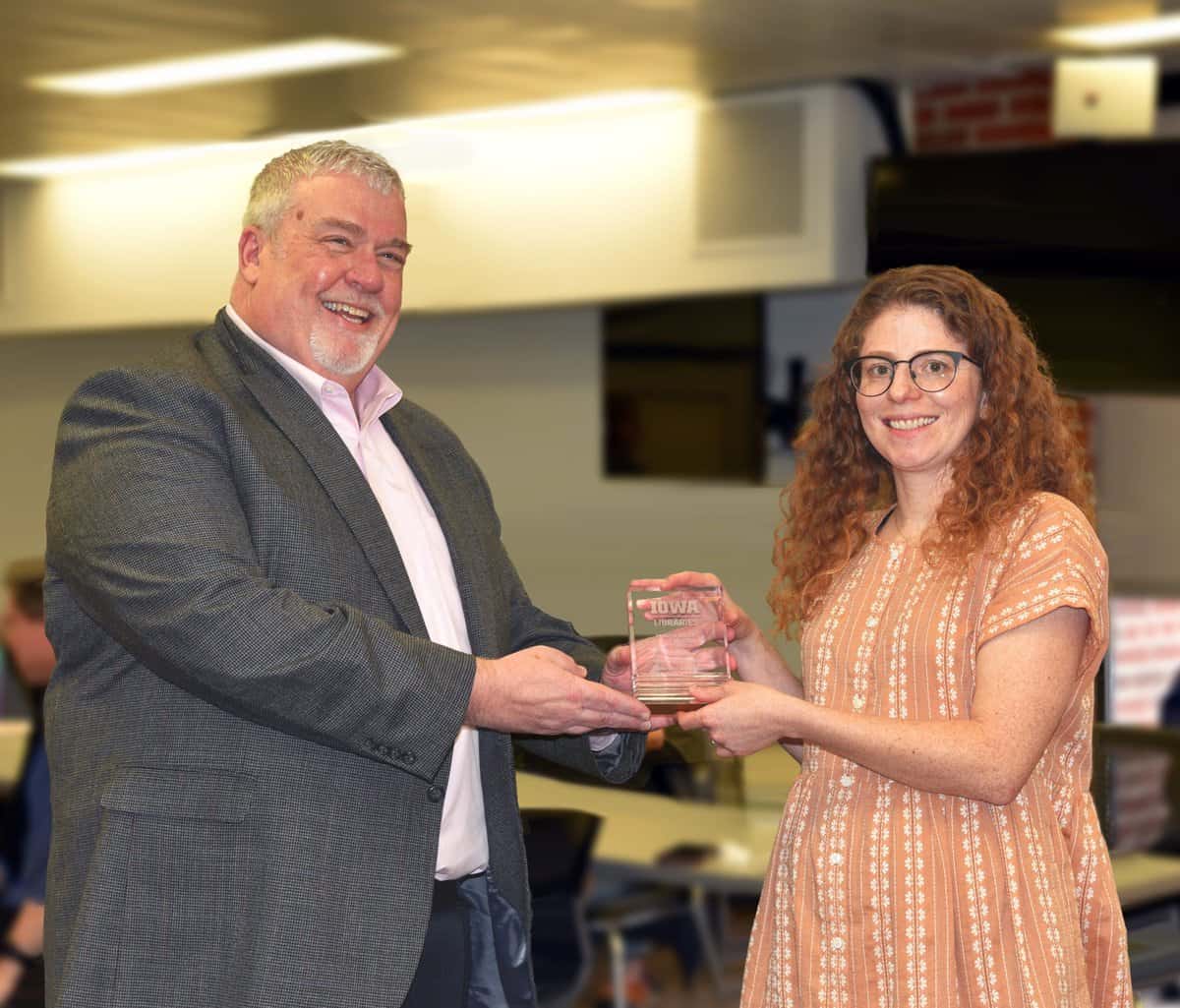
Linda Walton has been awarded the Marcia C. Noyes Award by the Medical Librarians’ Association.
Linda Walton has been recognized with the 2023 Marcia C. Noyes Award, the highest distinction given by the Medical Library Association (MLA). This competitive national award is presented to a nominee with a longstanding and sustained record of excellence in medical librarianship.
Walton’s nomination was supported by colleagues from throughout her distinguished 38-year career as a medical librarian. She has served 16 years at the University of Iowa Libraries and her primary nominator was Janna Lawrence, director of the Hardin Library for the Health Sciences. “A person of utmost practicality, most of Linda’s accomplishments have directly served the needs of health sciences librarians and those we serve,” wrote Lawrence in her nomination letter.
“It is a well-deserved distinction, and the UI Libraries are immensely proud and grateful for Linda’s continuing contributions—not only to us, but to the field of medical librarianship as a whole,” says John Culshaw, Jack B. King university librarian.
Walton’s nominators all emphasize her adaptability, humor, and commitment to problem-solving in an evolving space. These qualities have made her an indispensable contributor to the wider field of medical librarianship, according to Lawrence. By pairing her natural enthusiasm with pragmatism, Walton has garnered millions in grants and contract awards for the institutions she serves.
The criteria for the Marcia C. Noyes Award include utility in the profession, durability of influence on the field, comprehensiveness of achievements, and ethical propriety. Walton’s nominators all attested to her excellence in each category. In his letter of support, University of Arizona Associate Dean Gerald Perry wrote: “Linda has left an indelible mark on health sciences librarianship, and she has done so with a kind and generous heart, and an insightful sense of humor that is always compassionate.”
After earning her Master of Library Science from Indiana University in 1980, Walton began her career as a reference librarian at the Indiana State Library. She took her first step into medical librarianship in 1982, when she became director of the Butler Hospital Library in Providence, RI. Having found her vocation, Walton continued to deepen her commitment to medical librarianship. Over the decades to come, she worked extensively as an associate director and consultant with the Network of the National Library of Medicine (NNLM) across three regions, and took her first roles in higher education at the University of Wisconsin-Madison and Northwestern University.
Walton joined the University of Iowa in 2006 as associate university librarian and director at the Hardin for the Health Sciences. In this role, she worked to advance the interests of Hardin and the UI Libraries by securing approximately $12 million in funding from the NNLM from 2016 to 2021; this funding was later renewed in full through 2026, totaling $24 million. She has repeatedly proven herself to be a nimble problem-solver in the face of unexpected setbacks, including helping the UI Libraries respond to the 2008 flood and serving on the Critical Incident Management Team that guided the Libraries’ response to COVID-19.
In 2018, Walton moved into a new role as associate university librarian for the UI Libraries system as a whole. In this position, she administered the Libraries’ annual collections budget of $16 million and supervised the work of nine directors. Her role in steering Libraries’ operations, particularly during the height of the pandemic, created a more efficient and communicative working environment. In January 2023, Walton transitioned to serving as the associate director of the NNLM for Region 6.
Throughout her long career in medical librarianship, Walton has consistently been entrusted with leadership roles in the NNLM and the MLA, where she has served as a member of the board of directors and as MLA president from 2014 to 2015. Walton’s leadership during a time of organizational and technological transition “set the stage for the entire evolution of the Medical Library Association to where it exists today, as a more inclusive and engaged association,” wrote nominator M.J. Tooey, associate vice provost at the University of Maryland’s Health Sciences and Human Services Library.
From early on, Walton has been an advocate for the implementation of new technologies, including internet resources and e-publications. At the University of Iowa, she has served on technology-focused advisory boards, including the Academic Technologies Advisory Council and the Teaching and Learning Information Technology Executive Team at the Roy J. and Lucille A. Carver College of Medicine.
Walton has presented at multiple nationwide conferences, secured dozens of grants, and authored or co-authored more than 20 publications. Her work in collections management has directly increased the accessibility of crucial medical information at the Hardin Library and beyond. In 2006, the MLA recognized her with the Estelle Brodman Award for Academic Librarian of the Year, a mid-career award for excellence in librarianship. In 2021, Walton was made a Fellow of the MLA, a rare designation offered for “outstanding contributions to health sciences librarianship and to the advancement of the purposes of MLA.” Now, she has received the highest honor the MLA can bestow: the Marcia C. Noyes Award.
Walton will officially receive her award during an MLA online awards ceremony on April 20.
Please stop by the 4th Floor Focus Collection Area (middle of the central corridor – near elevators C&D) of the Main Library to see a curated collection of titles that highlight the celebration of Earth Day 2023. Founded in 1970, Earth Day continues to remind people of our shared planet and our connections to one another. Check out this list of titles and see different ways people from around the world have encountered our world and responded to the challenges of sustaining it and creating opportunities for future generations of all species. Feel free to take a book from the display to check out at the 1st floor service desk. There are many more books on the environment, sustainability, planning, governance and related titles in the UI Libraries collection (InfoHawk+). If you find a book you like you may also want to browse the stacks to see related titles.
Because funding agencies like the National Institutes of Health (NIH) and the National Science Foundation (NSF) now require data management and sharing plans as part of grant applications, researchers tasked with writing these documents may feel at a loss about where to start. Luckily, University of Iowa researchers have support in this process. Not only does Research Data Services at the UI Libraries offer workshops, consultations, and web resources to facilitate the writing of data management and sharing plans, we’re also partnering with DMPTool to offer even more assistance for researchers.
DMPTool is a free, open-source web platform designed specifically to help users write data management and sharing plans. Originally created by eight research institutions (including UCLA, UC San Diego, University of Virginia, and the Smithsonian Institution), DMPTool now has over 300 partners – including the University of Iowa.
Here’s how DMPTool can be useful:
It offers step-by-step instructions. DMPTool walks users through the process of writing their plans with a click-through wizard. It has fill-in fields for the basics, like project title, abstract, and contributors, while also guiding users through describing their data types, standards, and preservation strategies. It even offers example wording someone can use as they craft their plan.
It includes funder-specific templates. Since different granting bodies require different elements in their data management and sharing plans, DMPTool offers templates tailor-made to meet the needs of various funders. In addition to heavy hitters like NIH and NSF, DMPTool also has built-in templates for many other agencies – including the National Oceanic and Atmospheric Administration (NOAA), National Endowment for the Humanities (NEH), United States Geological Survey (USGS), United States Department of Agriculture (USDA), and dozens more.
It integrates local help from the University of Iowa Libraries. Because Iowa is a DMPTool partner institution, our researchers have access to some added features – like the ability to submit your plan directly to a data librarian at the Libraries so you can receive feedback on it. When writing your plan you can also see UI-specific tips by clicking the box under “Select Guidance” in the Project Details tab. If you have questions at any point in the process, DMPTool also includes links to Research Data Services’ email and website at the top of every page. Just ensure you set up your account with your UI email address and these services will automatically be integrated into your dashboard.
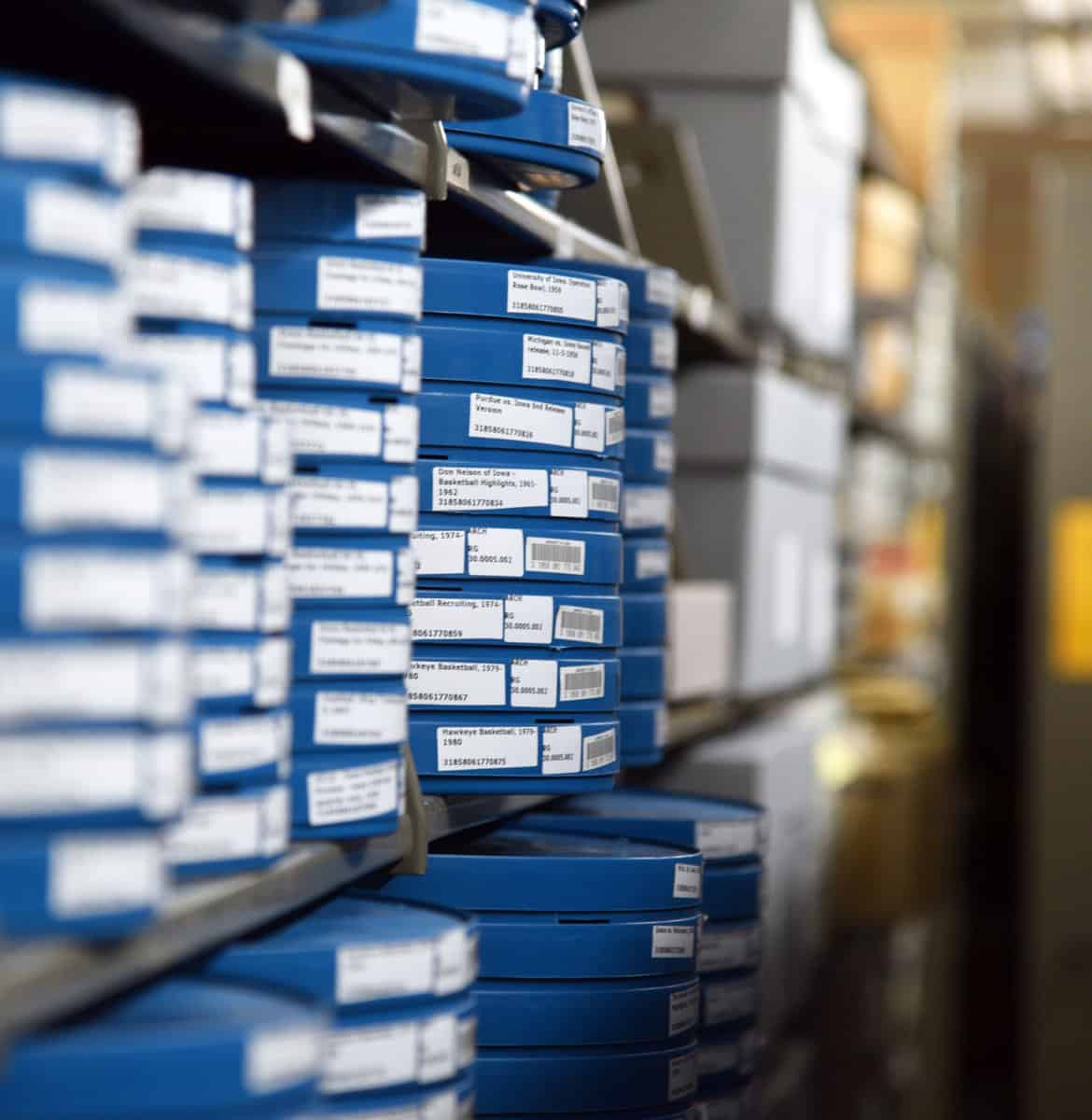
This image demonstrates the damage that can occur when reels are stored away for decades.
From the hardwood to Pasadena and the asphalt track to wrestling mats, now you have an opportunity to help preserve Hawkeye sports history, including the 1959 Rose Bowl, and make it accessible to all through a film digitization project.
The films’ state of degradation is dramatic, especially for the older material, and many of these films don’t have much life left in them. Due to the nature of film, degradation products induce further deterioration. It affects the plastic support, causing it to become acidic, to shrink, and to give off an acetic acid producing a vinegary odor, otherwise known as vinegar syndrome.
The reels in need of restoration cover decades of athletic events.
Projecting an original 16mm film can be risky and ultimately, we will no longer be able to view the originals, so digitization is critical. The digitization process helps create an exact and high-quality duplicate of the original, which can then be accessed online via the Iowa Digital Library.
The initiative is one way for past, present, and future Hawkeye fans to easily re-live memories such as watching the full game of the Hawkeyes prevailing over the California Golden Bears in the 1959 Rose Bowl. Currently, you can only watch highlights of the game thanks to the UI Sportsfilm production “The Evy Era of Iowa Football.”
You can donate to the UI Libraries Special Collections Fund, which will assist with the film digitization project, as part of One Day for Iowa here https://1dayforiowa.org/fa-libraries23.
The library directors of the Big Ten Academic Alliance recently made the decision to sunset the CADRE platform and its associated services due to low usage and continued challenges in resourcing technical support for the platform. As a result, the CADRE platform will be retired on June 30, 2023. Continued access to the CADRE Gateway and its datasets will remain available through that date.
Users will retain full access to existing files through June 30. Please be sure to download by June 30 offline copies of any data and scripts in your Jupyter notebooks to which you’d like to maintain access.
If you have any questions about the transition and how it might affect your research, or need assistance in downloading your data and scripts, please reach out to CADRE or contact Brian Westra, data services librarian.
Every researcher has likely seen Digital Object Identifiers (DOIs) attached to the articles they read, cite, and publish. As unique codes that distinguish a specific research article, dataset, or other digital object, DOIs make it much easier to find and cite the work of other scholars. What you may not know, however, is that DOIs are just one type of persistent identifier (PID). PIDs make your research findable now and in the future, reusable for the long term, and offer new insights into your research.
PIDs, sometimes referred to as persistent digital identifiers (PDIs) or globally unique identifiers (GUIDs) take many different forms. You may have seen an Open Researcher and Contributor ID (ORCID) attached to someone’s email signature, or a Research Resource ID (RRID) in a journal article identifying a specific antibody used in the study, or even an International Standard Book Number (ISBN) in a book you’ve read. All of these are PIDs, but don’t let the alphabet soup of initials intimidate you. In essence, all persistent identifiers have two traits that make them powerful.
The first is the part you see and use: the string of letters and/or numbers that uniquely define an entity (like an article, researcher, dataset, or institution). These codes will not change, will not be reused, and are a major reason finding information is so easy with PIDs. The second part of a PID is behind the scenes: the service that locates the resource (or “resolves” it) if its URL changes, ensuring that people who use the PID can always access what they’re looking for. This means, for instance, that even if the URL for an article changes the DOI never will.
Here’s an example: When a researcher deposits their dataset in the University of Iowa’s institutional repository, Iowa Research Online (IRO), a DOI for the dataset is reserved. A data librarian at UI Libraries will then review and curate the data. When the creator of the dataset gives the green light, IRO will register the dataset, its corresponding metadata, and the DOI with an organization called DataCite, activating the DOI and telling DataCite the landing page for the dataset (i.e., the URL that describes the data and provides access to the files). If IRO reorganized its servers in the future and the URL of the landing page changed, IRO would update this “address change” with DataCite. This ensures that the DOI will still point people to the new, correct URL.
The image below demonstrates how the DOI for a dataset resolves to the specific URL in IRO.
Image adapted from: Nosé, M. (2019). “Practice of research data management in solar-terrestrial physics [PowerPoint Slides]. Institute for Space-Earth Environment Research, Nagoya University. https://slideplayer.com/slide/17406586/
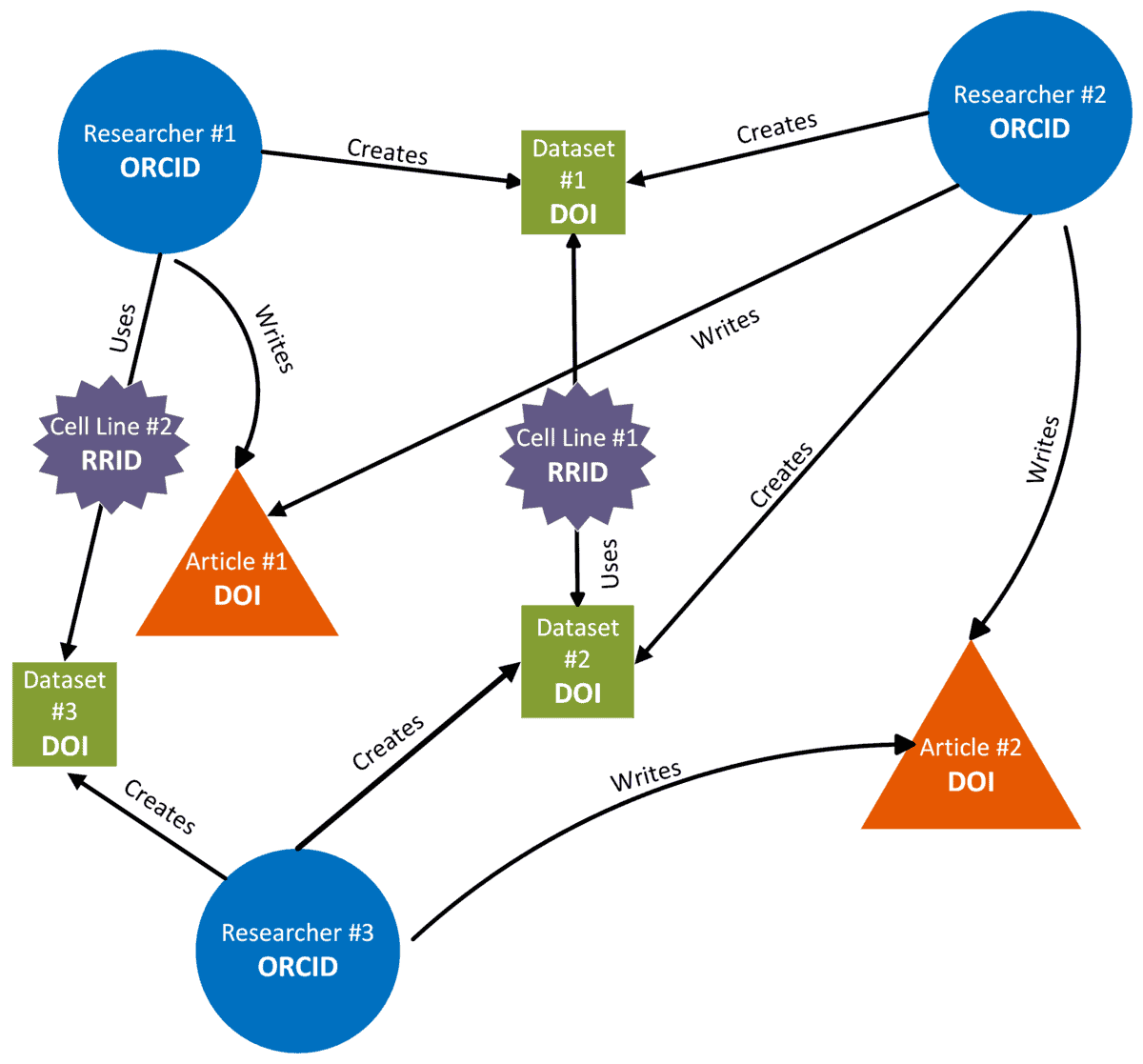
Another important benefit of using persistent identifiers is connection: linking the digital object to everything else that’s associated with it through PIDs, like the people who contributed to the work (through ORCIDs), the places they work (through Research Organization Registry IDs, or RORs), the cell lines they used in the research process (through RRIDs), and articles that use the data (through DOIs).
PIDs thus create a stable network of linked data that makes research outputs more FAIR (Findable, Accessible, Interoperable, and Reusable), helping people find new connections between data, articles, researchers, institutions, and granting bodies. A researcher who finds your dataset might then be curious if you’re the same person who wrote an article on a similar topic they read in a journal. This might lead them to click your ORCID to discover other research you’ve done, pointing them to the DOI of another dataset you’ve published, which they discover they could use for their own project. This discovery was facilitated by PIDs.
The image below offers an example of how PIDs connect these different entities.
You can do a few things to make the most of PIDs and leverage these connections:
Register for an ORCID if you don’t already have one, and use it in your repository deposits, code documentation, CV, personal website, grant applications, and anywhere else you can. It connects others to your research and keeps people from confusing you with another researcher with a similar name. The ORCID system will harvest and connect your research outputs – meaning you don’t have to.
Use RRIDs in your articles if the journal you’re submitting to supports them. The RRID website includes a list of journals that specifically ask for RRIDs (including Cell, Nature, and PLOS One) as well as a list of journals that will include them in articles if the authors add them.
Each of these steps is small and may not seem impactful on its own, but when all researchers do a few small things to enable FAIR data through PIDs, the entire research ecosystem benefits. If you’d like to learn more about repositories like IRO that support PIDs, reach out to Research Data Services in the Scholarly Impact Department of UI Libraries by email or through our website.
Although the term curation (from the Latin “care” or “attention”) might be a practice you associate with historical artifacts or priceless paintings, data curation is a collaborative, value-added process that provides care and attention to a dataset. It helps make data more FAIR (findable, accessible, interoperable, and reusable).
When you deposit your dataset in IRO, a data librarian at the Libraries will work with you to ensure that it is as complete, understandable, and accessible as possible. Data curation is different than peer review; its purpose is to ensure that the data can be found and used, not to judge the scientific methods that went into its creation.
Think of data curation as an investment, and working with a data librarian up front can get you a great return on that investment. It gives you a dataset that’s more valuable to a potential user because it’s easier to find, use, and interpret. This is a service that sets IRO apart from many other repositories, most of which simply don’t have the staff to offer this value-added process.
Depending on the specific dataset, data curation may entail:
checking to ensure all files open properly
reviewing file naming and organization strategies to ensure they’re transparent for future users
identifying proprietary file formats and recommending open alternatives
analyzing documentation, like data dictionaries or README files, to ensure others with knowledge of the discipline can understand them
ensuring tabular data in spreadsheets is clean, organized, and optimized for reuse
Confirming that the dataset has rich and complete metadata attached to it is an essential aspect of data curation. Metadata is something librarians talk about often, and with good reason. It’s the information needed for others to find, understand, and use the data. Different types of metadata – descriptive, administrative, and technical – all add value to your data in different ways, and a data librarian can help ensure the thoroughness of it all.
Descriptive metadata, for instance, is vital for discoverability (i.e., ensuring your data will appear in the results when someone does a relevant search on Google or InfoHawk+, the University of Iowa Libraries’ discovery tool). It includes having a clear and distinct title for the dataset, that all collaborators are named with contact information and ORCIDs (Open Researcher and Contributor IDs) included, and that there is a full abstract.
A data librarian can also help with technical metadata, like specifying the type of software someone needs to open the file, and administrative metadata, such as helping choose the license for the dataset. This information helps a potential user know how to get access to your data and what they can do with it once they do.
If you’d like help with data curation or depositing your data into IRO, Research Data Services is here to help. Contact us by email or visit our website to set up a consultation. If you’re ready to deposit data in IRO, we’ve created a metadata guide and a data deposit guide to walk you through the steps.
University of Iowa researchers are increasingly taking advantage of the university’s institutional repository, Iowa Research Online (IRO), to house their research and creative works. IRO currently holds nearly 115,000 research outputs from Iowa faculty, staff, and students, and has seen more than 12 million downloads of content since 2009. On top of preserving articles, books, conference proceedings, theses, and dissertations, IRO is also an ideal place for researchers to deposit their datasets and code.
IRO provides preservation, access, and curation of your data. Here’s what that means in practice:
Preservation
Your dataset or code will be housed on a secure server for the long term, maintaining it for future use. Despite the perception that digital files never wear out, they can deteriorate. Sometimes this happens due to bit loss – when the binary code that makes up the file degrades as the data is transferred from one place to another – or sometimes because of corrupted files. In other cases, file formats evolve and need to be converted to a different format to enable access and use.
The items in IRO are proactively managed to guard against these situations. Regular fixity checks act as “check-ups” for files to ensure they’re healthy and haven’t changed, multiple copies of the data are archived in different geographic locations in the case of a natural disaster, and corrupted files have self-healing capabilities thanks to the cloud infrastructure that houses them. All of this ensures that the products of your hard work are available now and in the future.
Using open formats for your work also helps with preservation, since these formats – like .sav, .mp3, and .mp4, to name a few – are more likely to remain functional in the future. In fact, using open formats also facilitates another benefit of archiving in IRO, access, since the files don’t require specialized proprietary software to open and use them.
Access
Your dataset will be accessible to researchers all over the world, increasing the reach and impact of your work. This access is made possible by a few key features.
First, all IRO deposits have a metadata record with pertinent information about the dataset – like the title, collaborators, abstract, grant information, dates of data collection, etc. Since all items in the repository are discoverable on Google and are indexed and searchable in InfoHawk+, the University of Iowa Libraries’ discovery tool, robust metadata makes it more likely that your dataset will appear in relevant searches. This is vital for helping others find your work.
Equally important is the stable, persistent URL your dataset will receive. Since the URL won’t change, it eliminates the tedium of identifying and updating broken links on your CV or personal website and makes it easier for you to share your work with others. And if you’re ever curious about the number of views and downloads a dataset receives, the metrics are readily available.
All IRO deposits also receive a digital object identifier (DOI) which makes it easy for others to cite your work when they use it and ensures you get credit when they do. When you deposit your data, you can also link to the DOI of the article or articles where the data is used. Research Data Services in the Scholarly Impact Department at the UI Libraries can even reserve a DOI for your dataset and keep it inactive so you can put the citation in a manuscript during the peer review process. After the article is published, just ask us and we’ll activate it.
Curation
A data librarian at the University of Iowa Libraries will also help curate your data when you deposit it in IRO. In addition to ensuring your file names and organization strategies are understandable to potential users, the librarian can also help you find open formats for your files, look at your documentation, and assist with the all-important metadata record that helps others find your work.
Get Started
Ultimately, depositing your data and code in IRO is a win-win. It helps you preserve your research outputs, disseminate them to increase the influence of your work, and enable scholars the world over to find and use your data and code for their own projects. And now that The National Institutes of Health require that researchers identify appropriate repositories for their data in their Data Management and Sharing Plans, IRO could be the answer – especially if no discipline-specific repositories exist in your field. IRO’s preservation, access, and curation features put it a step above other generalist repositories.
If you want help depositing your data or code in IRO or have questions about choosing a repository, Research Data Services is here to assist you. We have a guide on our website walking you through the steps to upload your content in IRO, do one-on-one consultations, and are available by email, too.
The University of Iowa Libraries is pleased to announce the expansion of the landmark open publishing agreement between the Big Ten Academic Alliance (BTAA) and Wiley. The new three-year agreement, which is effective Jan. 1, 2023, to Dec. 31, 2025, grants University of Iowa faculty, staff, and students access to publish and read in Wiley’s full journal portfolio, including Hindawi’s gold open access portfolio, with no fees, no caps, no limits, no hassle. Authors keep the rights to their own work under a Creative Commons license, making their work immediately open and available to anyone.
UI corresponding authors may publish their articles open access in any journal under the Wiley umbrella at no charge during the term of the agreement. Authors must identify themselves as being affiliated with the university when submitting articles through the Wiley publishing workflow process. Eligible publications:
Have a corresponding author from a BTAA institution;
Are primary research and review articles are primary research and review articles (which may include original articles, case studies, reviews, and short communications);
Are accepted for publication in a Wiley hybrid journal or submitted and accepted to a Wiley gold or Hindawi journal during the term of the agreement (Jan. 1, 2023 to Dec. 31, 2025).