Eye Surgery in the 16th Century
George Bartisch (1535-ca. 1607). Ophthalmodouleia; das is, Augendienst. [Dresen: Matthes Stoeckel], 1583. [28] 274 [83] ll., illus., port.
![George Bartisch (1535-ca. 1607). Ophthalmodouleia; das is, Augendienst. [Dresen: Matthes Stoeckel], 1583. [28] 274 [83] ll., illus., port.](http://blog.lib.uiowa.edu/hardin/files/2007/04/bartisch.jpg) The mere thought of eye surgery without benefit of modern anesthesia is enough to evoke severe shuddering. Yet, for hundreds of years, various operations were performed on the eyes in this manner, including the removal of cataracts, the excision of styes and the complete removal of the eyeball. No clearer picture of sixteenth century ophthalmology exists than that presented in George Bartisch’s Ophthalmodouleia. This fascinating book is generally regarded as the first systematic work on any surgical specialty. Bartisch, lacking the financial resources to attend medical school, pursued a career in surgery (then a separate profession) instead. He eventually developed a substantial practice and was appointed oculist to the elector of Saxony in 1588. Tailoring his book to his fellow practitioners he wrote this important treatise in German rather than in Latin. In it, he provides detailed descriptions of eye injuries, diseases, medications, surgery, wound dressing, and appliances. Here he offers advice on preparing a patient for surgery:
The mere thought of eye surgery without benefit of modern anesthesia is enough to evoke severe shuddering. Yet, for hundreds of years, various operations were performed on the eyes in this manner, including the removal of cataracts, the excision of styes and the complete removal of the eyeball. No clearer picture of sixteenth century ophthalmology exists than that presented in George Bartisch’s Ophthalmodouleia. This fascinating book is generally regarded as the first systematic work on any surgical specialty. Bartisch, lacking the financial resources to attend medical school, pursued a career in surgery (then a separate profession) instead. He eventually developed a substantial practice and was appointed oculist to the elector of Saxony in 1588. Tailoring his book to his fellow practitioners he wrote this important treatise in German rather than in Latin. In it, he provides detailed descriptions of eye injuries, diseases, medications, surgery, wound dressing, and appliances. Here he offers advice on preparing a patient for surgery:
…have him sit down in a special place on a stool or chair which has arm rests on both sides. Bind him with a towel around the body. Tie his arms on the rests with appropriate strips of material. Similarly tie his legs to the legs of the stool. Secure him carefully and fully in his body, arms, hands, and feet so that he can not shift, pull out, or move.
Although Bartisch showed great talent for observation and practicality, he remained a product of his age. In the passage below he offers the following advice:
Wearing the precious opal is useful and of value against all witchcraft of the vision and eyes. Further, the precious hyacinth stone worn on the bare skin and looked at often will be good against witchcraft of the eyes. Similarly when one wears angelica root on his body, that will serve well against all witchcraft.
Most striking, however, are the vivid woodcuts that illustrate eye anatomy as well as contemporary techniques and procedures. Some of the illustrations make use of movable flaps to assist in teaching, a novel technique at the time.
[translated passages from Ophthalmodouleia, an English translation by Donald L. Blanchard, 1996]
Click here for larger images.
For more information about the John Martin Rare Book Room please visit the Web site at http://www.lib.uiowa.edu/hardin/rbr/ or contact Ed Holtum, Assistant Director for Administrative Services and Special Collections, at 319/335-9154 or edwin-holtum@uiowa.edu.
 William Withering was a keen observer of plants and their medicinal uses and had already published a widely respected and comprehensive treatise on “Botanical Arrangement of all the vegetables” when this, his most famous work was printed. A graduate of the University of Edinburgh and later appointed an early physician to General Hospital, he noted the success of a complex herbal folk recipe in the treatment of “dropsy” (cardiac edema). Withering isolated the active component as the dried leaf of the foxglove (Digitalis purpura) which had been used indiscriminately (mostly as a diuretic) for centuries. It was Withering’s careful documentation and analysis of his many cases together with his instructions for preparation and dosage that introduced digitalis as a safe drug for a specific purpose. The book was written not only as a directive but as warning against the over-use of the drug which, of course, remains in use today. The exquisite hand-colored illustration of the foxglove plant included in this copy is in near mint condition.
 Médiate , Paris, 1819.
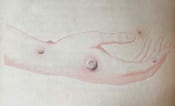 On the basis of an old country tradition that milkmaids who had contracted cowpox (a relatively mild disease) were not susceptible to the dreaded smallpox, Edward Jenner, an English country physician, decided to inject cowpox-infected lymph into a local boy. After the inoculation, the boy was found to be immune to smallpox and Jenner continued his experiments and summarized his finding in this epochal work published in 1798. By 1803 his work had been translated into numerous languages and his method of immunization was taken up with amazing speed, becoming almost universally adopted. The medical historian, Fielding H. Garrison has called Jenner’s work “one of the greatest triumphs in the history of medicine.” It is the foundation of all subsequent work in immunology and virology. [adopted from
 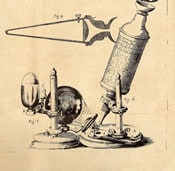 In 1665, Robert Hooke completed one of the most remarkable books of the last four centuries: a collection of drawings and descriptions of everyday objects as viewed through the lenses of a compound microscope. Hooke was curator of experiments for the newly formed Royal Society of London whose membership included the likes of Isaac Newton, Robert Boyle, Christopher Wren, and Thomas Willis; the book was published under the aegis of the Society.
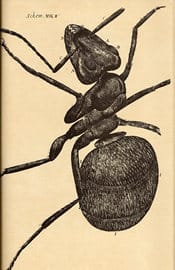 Although Micrographia was not the first work to include microscopic illustrations, it was the first to provide them in quantity and rendered in such meticulous fashion. So accurate were the drawings that a few of them continued to be reprinted in textbooks for the next 200 years! The exquisite copper-plate engravings along with Hooke’s fascinating commentary made the book an instant best-seller among Europe’s intelligentsia. On January 21st, Samuel Pepys, himself an early member of the Royal Soceity, made the following entry in his diary: “Before I went to bed I sat up till two o’clock in my chamber reading of Mr. Hooke’s Microscopicall Observations, the most ingenious book that ever I read in my life.”
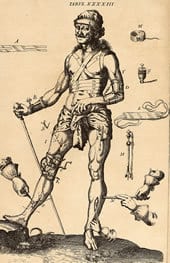 When Johannes Scultetus’s Armamentarium Chirurgicum (“Arsenal of Surgery”) was published, it was hailed as the first treatise on surgery to reflect the newfound rationalism of the 17th Century. While older authors had provided illustrated works on simple operations and devices (see: Hans von Gersdorff’s, Feldtbuch der Wunderartzney), Scultetus looked at the world of surgery afresh in keeping with the “new science” of the age.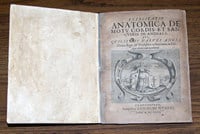
 Harvey had the temerity to claim and demonstrate that blood actually traveled through the body in a circuit—that the same blood that was pumped from the heart, returned to the heart. Harvey measured the volume of blood expelled from the heart and knew that the organs were incapable of absorbing so large an amount of fluid—“Since it all flows past in so short a time, it must be made to flow in a circle.” In making his measurements, Harvey not only proved his thesis but also ushered in the era of experimental physiology. Harvey knew the idea was revolutionary and, “…so strange and undreamed of, that not only do I fear danger to myself from the malice of a few, but I dread lest I have all men as enemies, so much does habit or doctrine once absorbed, driving deeply its roots, become second nature… But now the die is cast; my hope is in the love of truth and in the integrity of intelligence.”