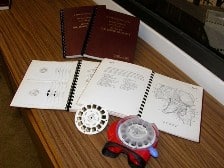
 Visitors to the John Martin Rare Book Room are often bemused when they spot a View-Master resting on one of the bookcases. If you’re under the age of sixty-five you probably owned one of these devices along with several View-Master reels depicting far-off countries, cartoon characters or comic book heroes rendered in 3-D. But why a viewer in the rare book room? In 1962, Dr. David L. Bassett, anatomist from the University of Washington, working with William Gruber, the inventor of the View-Master created the “Stereoscopic Atlas of Human Anatomy” — over 1,500 slides of three-dimensional color images of human dissection. Nearly fifty years later the 25 volume collection remains a marvel of relatively simple technology that still elicits gasps of wonder from viewers as they behold in stark clarity the “in-depth” photographs of body structures and cavities. Each of the slides is accompanied by commentary written by Dr. Bassett (the lone dissector) and a line diagram that labels all of the structures.
 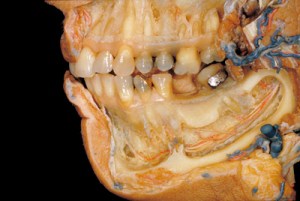 The Hardin Library is fortunate to own a complete set of this amazing work which is beginning to arouse the curiosity of anatomists interested in using high-tech solutions to bring 3-D to desktop computers. In the meantime the marvelous handiwork of Mr. Gruber and Dr. Bassett is at your disposal.
You can read about and view more images of Dr. Bassett’s work here.
MedlinePlus® Debuts Health Information in Multiple Languages

On May 7, 2008, MedlinePlus debuted its new multilingual feature, the first of its kind. MedlinePlus is a service of the National Library of Medicine, and a website dedicated to providing its online visitors with the latest in health information and links to other helpful sites. Seeing a need for medical help online in languages other than English or Spanish, the site now offers its information in over 40 different languages.
The feature was created after new statistics revealed an overwhelming demand for medical help in languages other than English. One such statistic stated that in a 2006 survey, of over 850 hospitals nationwide, 80% treat patients with limited English proficiency. To help combat this language barrier, the site now contains over 2,500 links to information and covers nearly 250 health topics, all in over 40 different languages.
To ensure accuracy and relevance, the site uses its same quality guidelines for its 40 plus new languages that it currently uses for its English and Spanish translations. One such standard is that all information published on their site must be produced by the United States Federal government or a U.S.-based organization. MedlinePlus also ensures that no matter what language its information is being displayed in, all information included on their site is reliable and current.
To visit the MedlinePlus site: http://medlineplus.gov/
Women in Science Book Discussion Group
Women in Science Book Discussion Group this summer at WRAC
This group will focus on women in science, their successes and failures, and the types of experiences they have faced in a male-dominated field. Participants will read and discuss 3 biographies of noted female scientists and 1 book focused on the issues women face in the sciences:
1) Madame Curie: A Biography (Eve Curie)
2) Rosalind Franklin: The Dark Lady of DNA (Brenda Maddox)
3) The Tangled Field: Barbara McClintock’s Search for Patterns of Genetic Control (Nathaniel Comfort)
4) Who’s Afraid of Marie Curie? The Challenges Facing Women in Science and Technology (Linley Erin Hall)
The group will meet on Wednesdays at 7:00 pm at the Women’s Resource and Action Center on the following dates:
June 11
June 25
July 9
July 23
Pre-registration is requested; participants may join at any time. Register at www.uiowa.edu/~wrac/groups/womenscience.htm
History of Medicine Society to Host Annual Banquet, Friday, April 25
The University of Iowa History of Medicine Society will host its annual R. Palmer Howard Dinner, Friday, April 25, 2008. The reception will begin at 6:00 pm followed by the dinner at 7:00 on the 8th floor, Roy Carver Pavilion, UIHC.
The after-dinner speaker will be, Walton O. Schalick, III, Md, PhD, Assistant Professor of Medical History, University of Wisconsin-Madison who will speak on ‘Humanizing’ Disability Care: Pediatrics, Policy and Crippled Children in the US and Europe, 1802-1945. The event is open to the public. Please click here for a reservation form.
Dr. Schalick’s research interests include medieval medicine and pharmacology, the history of children with physical disability in 19th and 20th century Europe and the US, and the practical ethics of pediatric emergency research. His is in great demand as a lecturer and has delivered presentations on four continents. Dr. Schalick is also the recipient of numerous honors, including the William b. Bean Award from the American Osler Society. After completing his undergraduate work at Washington University in St. Louis, Dr. Schalick received his PHD and his MD from Johns Hopkins University.
Rare Morphological Work Added to Rare Book Collection
Recently, the John Martin Rare Book Room acquired a rare copy of Edward Tyson’s 1699 book, Orang-outang, sive, Homo sylvestris, or, The anatomy of a pygmie compared with that of a monkey, an ape, and a man… The book constitutes of the most important works in the history of comparative morphology. 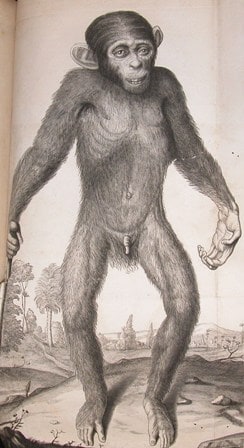
Physician, Edward Tyson, studied at Oxford and Cambridge and was a frequent lecturer on anatomy; he made several important contributions to medicine including the discovery of the sebaceous glands of the corona glandis (“Tyson Glands”). As a hospital administrator, Tyson was responsible for introducing female nurses to Bethlehem Hospital. Tyson’s reputation, however, rests largely with his anatomical studies which, in addition to the present investigation, included the porpoise and the opossum.
The “Orang-Outang” Tyson describes is actually a less than mature male chimpanzee from Angola that died a few months after its arrival in London. Also, his use of the word “Pygmie” denotes a group of small mythical beings whose supposed existence Tyson attributes to sightings of chimpanzees made in antiquity. Tyson’s “Pygmie” is completely unrelated to the name now given to the short-statured groups of people in Central Africa whose existence was unknown to Europeans until the 19th century.
As the first to dissect this species, Tyson noted the great morphological similarity between the animal and humans and termed it “an intermediate link” between ape and man. In doing so, Tyson did not mean to suggest a common lineage or descent but rather was referring to the “links” in the “Great Chain of Being,” the classical conception of a hierarchical universe from the simplest elements through the plants and animals and culminating in humans and finally God.
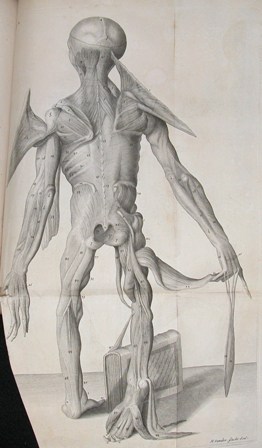
Tyson writes that the animal is “…of a higher degree above any of [the other apes and monkeys] we yet know, and more resembling a man. But at the same time I take him to be wholly a Brute, tho’ in the formation of the of the Body, and in the sensitive or brutal soul, it may be, more resembling a man, than another other anima; so that in this chain of the creation, as in intermediate link between an ape and a man, I would place our Pygmie.” The remarkable plates are executed in a style very similar to those in Vesalius’ Fabrica further underscoring Tyson’s thesis.
The copy in the John Martin Rare Book Room was once owned by William Musgrave (ca 1655-1721), former secretary of the Royal Society, physician, and noted historian. The skeleton of the chimpanzee dissected by Tyson remains on display at The Natural History Museum of London.
For additional images, click on links.
Musculature
Skeleton

Meet Gordana Lenert, our new Biomolecular Sciences Specialist
 Not only is Gordana Lenert new to the Hardin Library staff, her position is also new to our team. The new position liaison for the Biomolecular Sciences, something that her past experience should definitely serve her well in. Although she has never worked at a library before, she is not new to working at universities.
After graduating from the University of Belgrade in the former Yugoslavia, Gordana majored in Molecular Biology and Physiology, and then went on to receive her Masters and Ph.D. in Allergology and Immunology from the University of Belgrade. From there she worked at the Biochemistry Department, Medical School, University of Novi Sad, where she developed her passion for working with students. She and her family moved to Canada after leaving Europe, where she worked as a medical reviewer for Health Canada. After her husband was offered a job at the University, she moved to Iowa City two years ago.
In her free time, Gordana enjoys reading, cooking, gardening and swimming, and has been a volunteer swim-referee for many years. Despite being her first month on the job, she already has major work to do, including planning the curriculum for her new liaison department.
Meet Our New Education and Outreach Librarian- Chris Childs

Chris Childs joined the Hardin Library Staff as Education and Outreach Librarian for Consumer and Public Health in late February. Chris comes to the University of Iowa from the Texas Tech Health Sciences Center at Odessa, where he began his career in health sciences libraries as an assistant director.
While working in Texas, Chris had the opportunity to do some outreach for the university and found that of all his responsibilities, this was his favorite. He is very excited about being part of the Hardin staff and having the opportunity to focus on outreach.
Chris enjoys traveling and has taken many trips across the country, spending most of his time in the National Parks. While he did live in Indiana for a few years, he didn’t have the opportunity to travel and explore this region of the country. He is looking forward to wandering around Iowa and the surrounding states.
Koffel appointed Adjunct Assistant Professor
Jonathan Koffel, Education and Outreach Librarian, has been appointed Adjunct Assistant Professor in the Clinical and Administrative Pharmacy Division of the College of Pharmacy. This is a 3 year appointment.
Jonathan will teach sessions on drug information skills and concepts within College courses (notably the Pharmacy Practice Lab sequence), serve on the College Curriculum Committee, and collaborate with other faculty to ensure that faculty, staff, and students have the information resources and skills necessary to provide the highest level of care.
“Jonathan has quickly become a valuable member of the Pharmacy Practice Lab team as well as the entire College of Pharmacy,” says Jeff Reist, Clinical Assistant Professor and Coordinator of the Pharmacy Practice Lab. “He is a valuable resource and provides excellent instruction to both students and faculty in the area of health informatics and related topics. His intellect and wit make him a respected and popular instructor and is a pleasure to work with on curriculum development and delivery.”
“Iowa Leading the Way: Dr. Ralph Waters and the First Ambulatory Surgery Center”
The public is invited to a University of Iowa History of Medicine talk on “Iowa Leading the Way: Dr. Ralph Waters and the First Ambulatory Surgery Center” at 5:30 p.m. Tuesday, November 27, in Room 401 of the UI Hardin Library for the Health Sciences.
The speaker will be Douglas Merrill, Medical Director, Ambulatory Surgery at the UI Hospitals and Clinics.
Light refreshments will be served. The lecture is part of a series of presentations sponsored by the UI History of Medicine Society.
Merrill will discuss the life and career of Dr. Ralph Waters, who established the world’s first outpatient surgical center in Sioux City, Iowa in 1918. It was the start of a career that would see him invent anesthesia delivery systems whose ilk are still in use today, and to become a founding father of academic anesthesiology in the United States.
While outpatient surgery centers are commonplace today, they were unknown until Waters (“The Wizard of Gilman Terrace”) saw the opportunity to combine his professional qualifications as an anesthesiologist with those of local dentists and surgeons. In doing so, he helped establish anesthesiology as a medical specialty.
Merrill will also speak on the nature of anesthesia and surgery during the early decades of the twentieth century and Water’s later career as the head of the first full-time university department of anesthesia at the University of Wisconsin.
From Oxford to Iowa City — The Desk of Sir William Osler
The next time you visit the Hardin Library, peek into the John Martin Rare Book Room for a glimpse at the antique dark oak desk just inside the entrance. It once belonged to Sir William Osler (1849–1919), unquestionably the most famous English speaking physician of the late 19th and early 20th century. 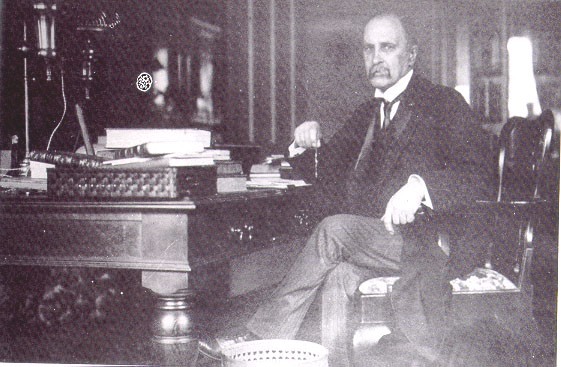
Continue reading “From Oxford to Iowa City — The Desk of Sir William Osler”