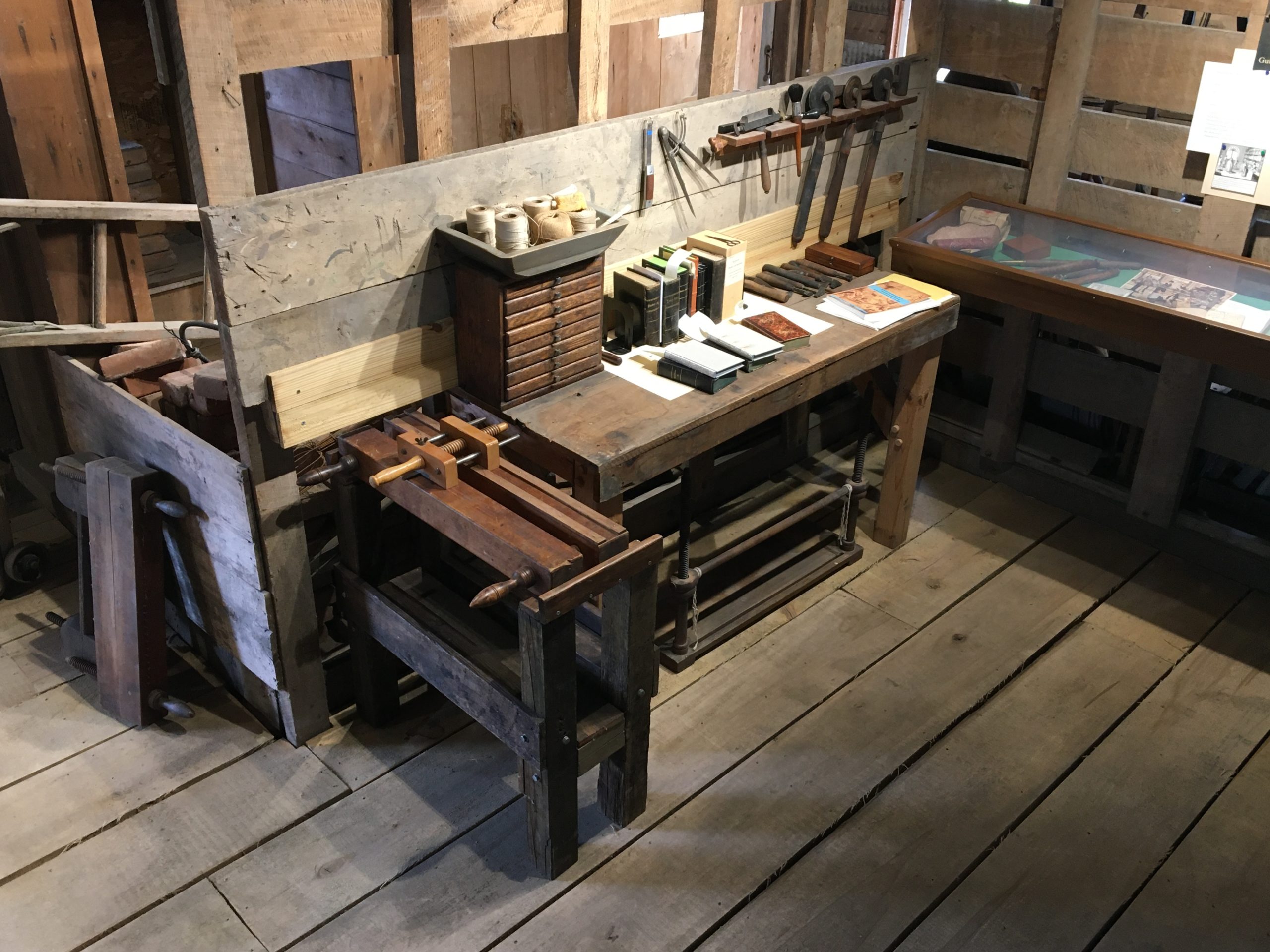
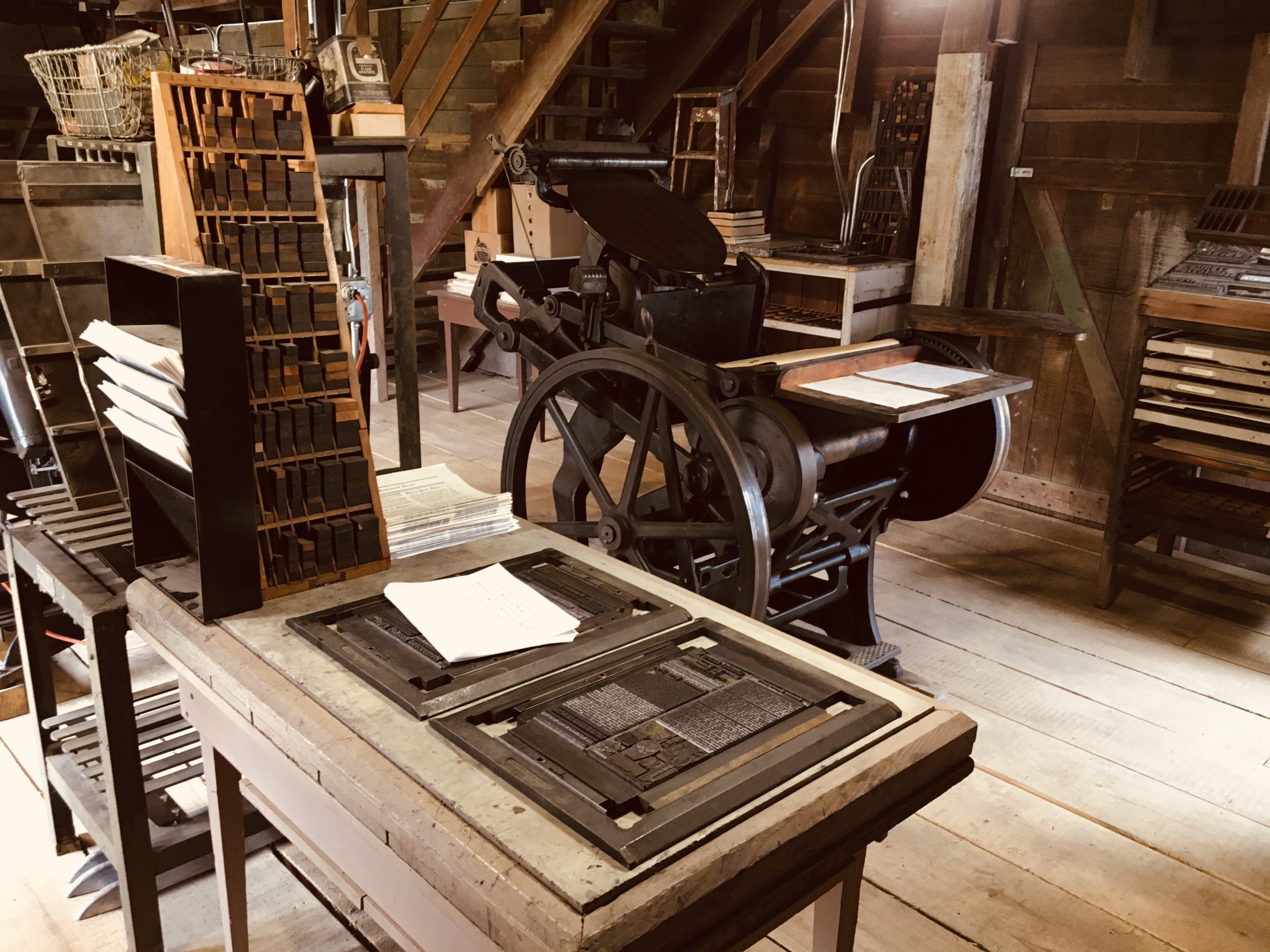
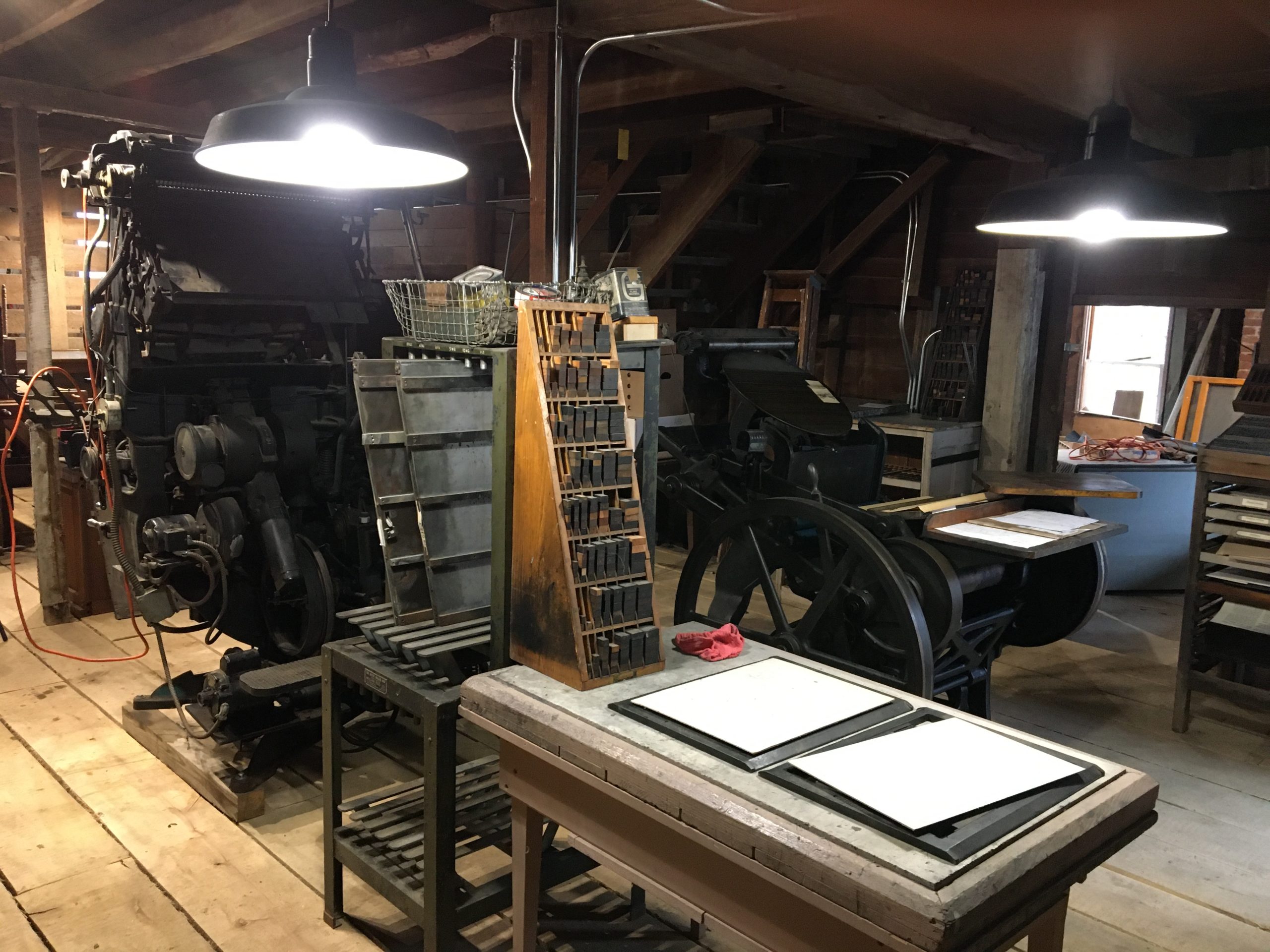
An interpretive exhibit of history of communal book making includes a reconstruction of a printing and binding shop at Middle Amana. This site is opened from 10 to 4 on Saturdays.
Interpretive display on view in Amana Printshop in Middle Amana.
The long and continuing Amana book publishing program aligns with a Protestant dedication to literacy, scriptural interpretation and individual spiritual experience. Book-making was accentuated among communal Inspirationists who believed in the classical mediation of aurality, orality, transcription, fair copy inscription, type composition, printing and binding to capture and “bring to light” spontaneous, entranced instruction of the Werkzueng. These spontaneous messages of spiritual guidance could only be shared by skilled transmission and skilled book making.
Historical platen press with type set up for printing in the Amana Printshop in Middle Amana.
Student participation in this interpretive program is invited. Contact Gary Frost for more information.
An example of the binding discussed below is also available under the title “Replica of the Stonyhurst Gospel” in the Book Model Collection on Iowa Digital Library.
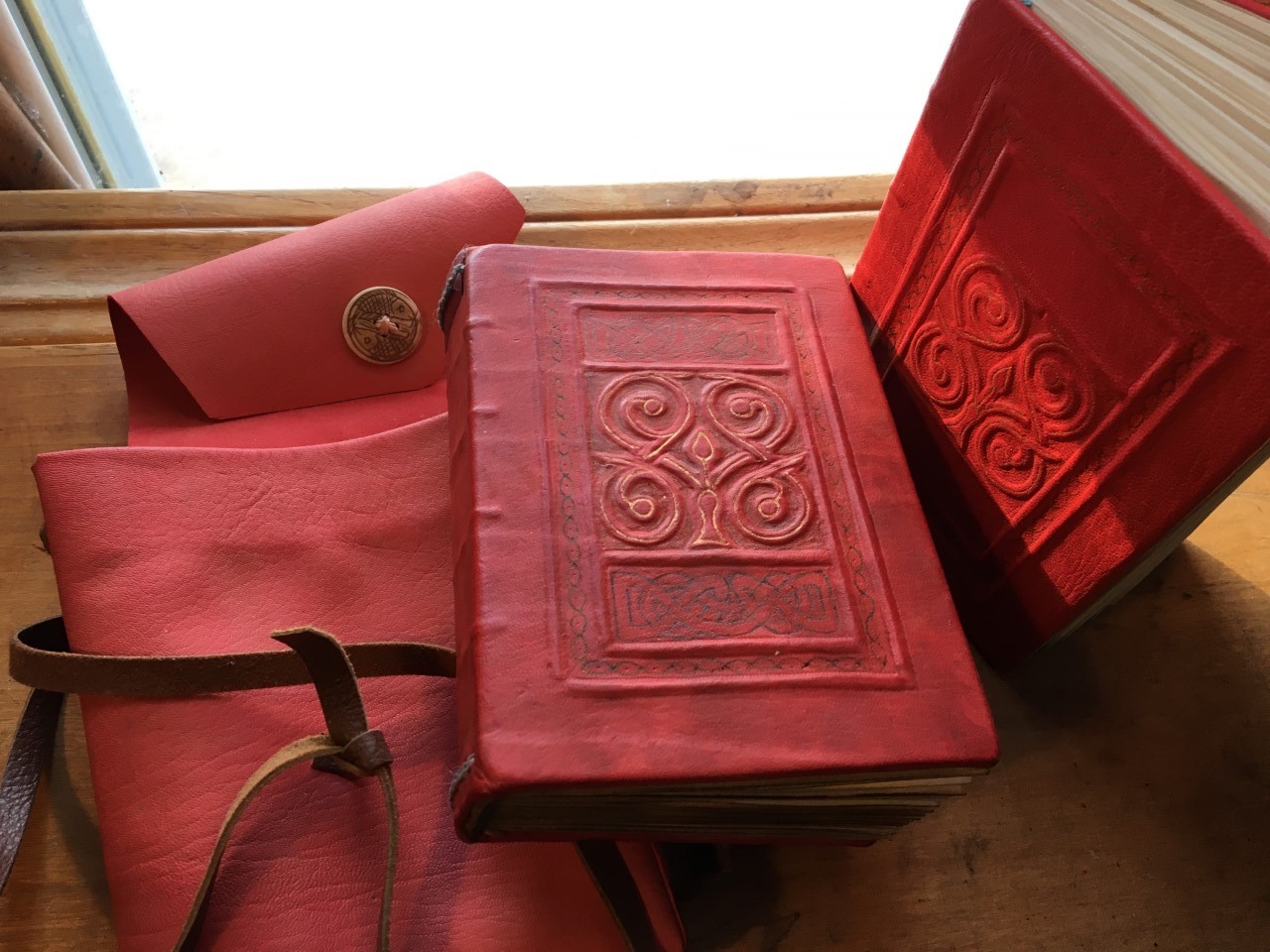
St. Cuthbert Gospel replica created by the author.
Binding description
This small book (137 mm x 95 mm) known as the St. Cuthbert Gospel has witnessed many turbulent eras of English history. It has survived to enjoy modern veneration and security in the British Library. It has experienced many previous eras beginning with its construction (c. 700-c. 730) in a monastic scriptorium at the beginning of the medieval period. During the medieval era it was sequestered in the coffin of St. Cuthbert. The book then miraculously survived turbulence and monastic library destruction of the English Reformation and Counter Reformation. Next the Gospel survived secular turbulences of antiquarian ownership and college librarianship. Only in the twentieth century did the Gospel attract paleographic and book craft study and a more secure future.
The process of replica making of the St. Cuthbert Gospel binding offers its own approach to book craft study since it reenacts methods and suggests insights into monastic book binding methods of late Antiquity. During the Insular period, it is possible to situate the binding in a wide context of influences afforded by monastic exchange, communication and travel. Stylistic, paleographic and technical influences of the book and binding can be attributed to a diversity of Mediterranean cultures. Perennial handcraft methods and expertise are also represented by the Gospel. Timeless craft skill was needed to confront challenges of the binding scale, shape and symmetry.
Craft finesse is needed when working at such a small size. The secondary endbands of the Gospel as worked through the end caps required clean and even piercings less than two mm apart to avoid perforation tearing. The use of a tertiary support stitching at the spine head (and not at the tail) may well represent a reinforcement repair needed to stop end cap tearing during binding. Thinness and beveling of the wooden boards also required close selection and hewing to avoid breakage. Thin thread making required careful fiber selection and spinning. Refined tools and needles were required. A small metal burnisher and stylus was also needed.
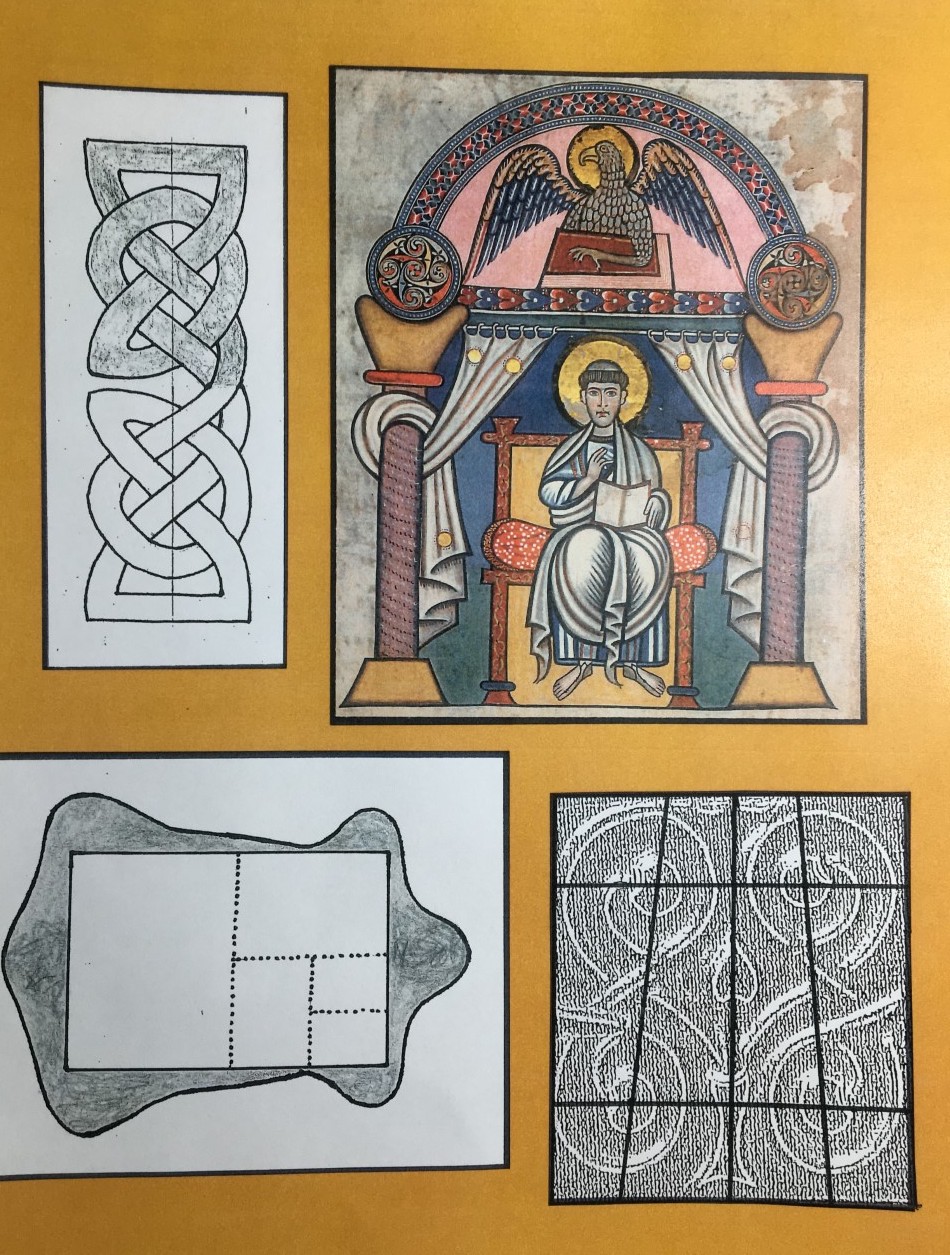
Pages and binding shape must be adapted to the small “pocket” Gospel size. Cutting-out the bi-folios from parchment imposes a squat page shape derived from proportions of the skin. A large service book would require use of a whole skin for each bi-folio of four pages. The next division would provide two bi-folios, then four or then eight bi-folios from subsequent divisions all of which yield the same squat page shape exemplified by the St, Cuthbert Gospel with a height to width ratio of 1.5 : 1. (see illustration) “A striking consistency from one end of the Anglo-Saxon period to the other and from one end of the country to the other.” can actually be explained by characterizing the squat shapes of any bi-folio pages cut from parchment skins.[1]
Another timeless challenge for the binder is symmetry. Various methods are conjectured for impression methods used to produce the Tree of Life motif on the upper board of the St. Cuthbert Gospel. This discussion should start by considering the motif symmetry within a square frame. (see illustration) Whether use of an impression blocking matrix or construction of an underlying raised matrix, both methods would require transfer, modeling and decorating of a deliberate symmetry.[2] The previous proportions of size and shape also interplay with the motif symmetry. A magnificent craft command was needed to render this relief ornament.
Turning to consider the upper of two lacing design panels, Nicholas Pickwoad mentions, “If the intention was to ensure a symmetrical design, it failed.”[3] This remark opens a space for discussion of a potential of an error of error. There are two panels with laced designs. The bottom panel is symmetrical, left and right, both in the mirrored lacing and in color contrast. The top panel is not, neither in the lacing pattern or in the coloring. The twenty first century issue may be that we see the asymmetrical design as deficient.
For the eighth century crafts person design was all earthly performance. The perceptual clue is an odd terminal lacing figure. Three lacing terminals are up right but the left figure of the top panel is twisted. It could have conformed by flipping. The panel design has a different maneuver in space and a different asymmetric is at work. There was once a sense of earthly discrepancy and Heavenly perfection. A nagging discouragement in this life continues. We add anxiety of anxiety. The craft worker in the monastery workshops of Cuthbert and Benedict knew no mechanized uniformity or automated verification. Earthly discrepancy was assimilated as a space where demons interplay.
Author’s notes on the binding.
Binding performance
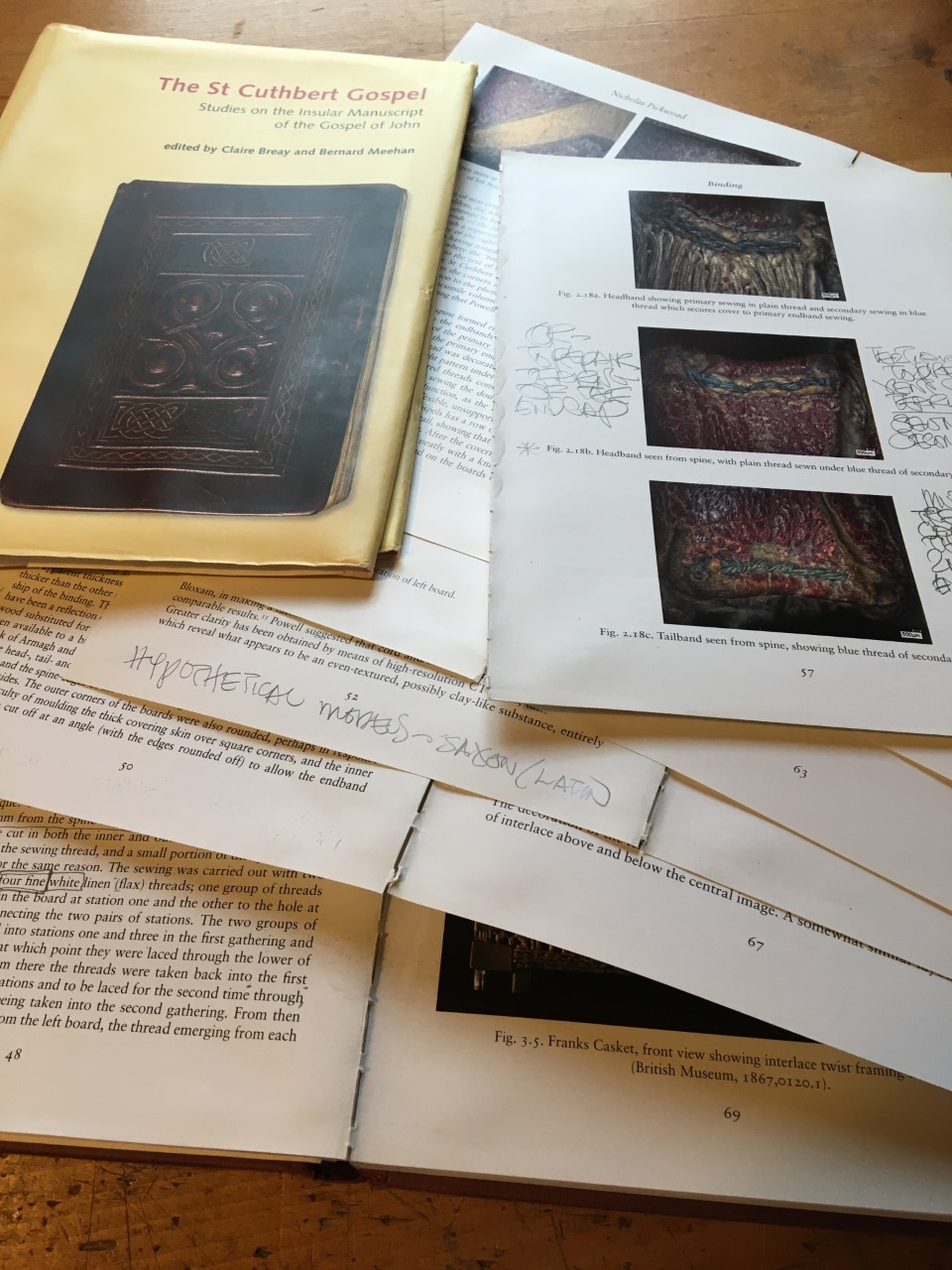
A vindication of the crucial role of binding for book functionality is revealed by comparative performance of St. Cuthbert Gospel and its recent British Library publication of studies of the book.[4] Both have been damaged in use, one by thirteen centuries of turbulent history and the other by a few weeks of reference. The juxtaposition becomes even more bizarre and relevant since the modern reference book provides an anthology of expert studies that still manages a disregard of the character, quality and performance of the Gospel artifact.
The burst bound modern book, “printed in Malta by the Gutenberg Press” is off-set production imposed in “32nds” in orientation of a duplex, color run. The wrong-grain gatherings were notched and adhesively bound but the coated paper stock resisted bonding and reference opening and the bi-folios progressively detach from the injected adhesive. Adding a bit more disconcerting for description of the hand-held original binding is the editorial convention of reference to the “right and the left” cover.[5] Better for binding description would have been Clarkson terms of “upper and lower” cover. Disorienting as well, the modern book provides no one-to-one reproductions; they are all either too large or too small and materially misfit the Gospel. The eighth century book is its own best exemplar.
A replica binding project at least enforces the scale, shape and symmetry of the Gospel artifact. It requires manipulative familiarity and (attempted) performance re-enactment of the work of the monastic craft worker. However, there is glaring technological, methodological and even ontological discrepancy and displacement of a modern view and modern replica.
St. Cuthbert Gospel implication
Today we are presumed to be at an advantage over the challenges faced by the eighth century crafts person. We can easily find spools of microscopically fine and uniform linen thread and all varieties of bookbinding supplies can be ordered on-line. But step away for a moment and see another view. Strategic advantages of intuitive experience and assimilated knowledge are at work with the eighth century craft person. We resort to explanation, diagram and supplied materials to re-enact the Gospel endbanding and are then surprised by inept results. The eighth century crafts person already understood sewn margins, blanket stitch edging and reversed seams and there was an experienced knowledge of such constructions in daily use and responding to daily manipulation. Then add the monk’s mind-set capable of merging rhythmical sewing and reading as meditative equivalents. Such advantages greatly out-maneuver the modern endbander.
Of course, the eighth century crafts person could not visualize an off-set, full color book on coated paper and that same person would be mystified that a modern book could not move and perform in an opened field, console in a forest or quickly respond to touch and grip in a storm without coming apart. Such expectation and perceptivity to making and use of a hand-made book is now unknown and many industrialized bindings can fail field testing.
There is a third thing lurking here. Beyond the St. Cuthbert Gospel and the current anthology of studies on the St. Cuthbert Gospel are the many replica models.[6] The St. Cuthbert Gospel is an irresistible exemplar and a popular project for hand bookbinders. I did see the original of the “Stonyhurst College” Gospel through the glare of the glass display case in London, 1980. I have also handled various replicas of the binding. Memorable was the replica by Martha Little made in the workshop of Roger Powell. Martha’s model included the detached board. Other models known to me include one by Bill Anthony and another by Mark Esser now in the University of Iowa Book Model Collection. I will be very curious to look at these again as soon as I complete my own models of the St. Cuthbert Gospel.
The venerable Gospel is breeding its own replicas. These replicas all commemorate a book craft challenge and the extreme rareness of any surviving early book exemplar. Models of the St. Cuthbert Gospel must also commemorate the early books that have not survived. These lost books were the endless civilian causalities of conflict and dire, destructive interventions. These lost books haunt the one surviving St. Cuthbert Gospel and its melancholy recreations.
02.13.2022/glf
Illustrations: an Anglo-Saxon depiction of the Evangelist John used here to represent a monastic binder; the squat shaped bi-folios cut from a parchment skin with a shape ration tending to 1.5:1; and a diagram of the square symmetrical design of the Gospel Tree of Life ornament.
Endnotes
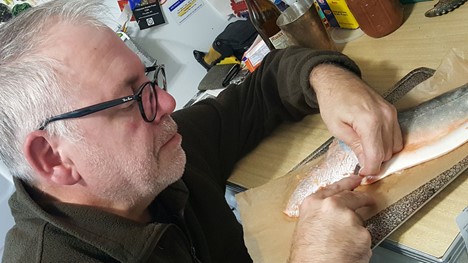
[1]Quote citation, p.14, St. Cuthbert Gospel, 2015. A material explanation lurking behind the shape of papyrus, parchment and paper books is the half-square bi-folio cut from the papyrus roll commodity yielding the half-square, elongated book of late Antiquity, the parchment bi-folio cut-out that produces the squat Mediaeval book shape and the ergonomic of the hand paper mold yielding a rectangular book shape.
[2] The impression matrix described by Nicholas Pickwoad used through leather to counter- form underlying clay is associated with other the Anglo-Saxon use of matrix debossing of metal foils. The issue of the distinction of a positive or negative (read-right vs. read wrong) matrix, hard pressing negative areas or hard debossing of positive areas is not discussed. See St. Cuthbert Gospel, (2015), pp.53-55.
[4]Breay, Claire and Meehan Bernard, editors, The St. Cuthbert Gospel, Studies on the Insular Manuscript of the Gospel of John, The British Library, London, 2015. Before this publication hand bookbinders referred to the Roxburghe Club publication; Brown, Julian B., The Stonyhurst Gospel of St. John, 1969, with a chapter on the technical description of the binding by Roger Powell and Peter Waters.
[5] The “right vs. left” cover boards may be a UK art history convention that are ambivalent when considering the handled three-dimensional George Stout described object.
[6] Michael Burke taught a workshop in which the students make a St. Cuthbert Gospel binding replica. He credits notes from Martha Little who also taught a workshop at PBI in 1994.
The William Anthony Conservation Lecture Series, hosted by the University of Iowa Libraries Conservation Lab, invites Book and Paper Conservators and Bookbinders to share their experience and work with the UI book arts community and beyond. Funded by a generous gift that established the William Anthony Endowment in 1989, it honors our first Library Conservator and the first bookbinding instructor at University of Iowa Center for the Book.
Peter D. Verheyen started down his path as a work-study student in the conservation lab at the Johns Hopkins University’s library, followed by a museum internship and formal apprenticeship in Germany and Switzerland. Returning to the U.S., he worked as a conservator in private practice and academic libraries, also working as a librarian. His research interests focus on the German tradition in bookbinding. He is the translator of Ernst Collin’s Der Pressbengel and completed a bilingual history and bibliography of The Collins: W. Collin, Court Bookbinders & Ernst Collin, the Author of the Pressbengel. Research is shared via his Pressbengel Project blog and in other publications. He founded the Book_Arts-L listserv in 1994 and the Bonefolder e-journal in 2004.
In this talk, Peter D. Verheyen will discuss how he came to discover bookbinding and conservation, and how the relationships he formed and his experiences would intersect to become ongoing and ever-morphing research interests. His bio-/bibliographic work around Ernst Collin and his Pressbengel, his experiments using fish skin in bookbinding, and his investigations into the German binding tradition will illustrate this synergy. This lecture will form an introduction to his specialized workshop for students at the UICB on the history and construction of the German case binding.
In conjunction with the lecture, Verheyen will offer a workshop “The Bradel Binding and its Illustrious History” for UI Conservation Staff and UI Center for the Book Students with funds provided by the Nadia Sophie Seiler Fund.
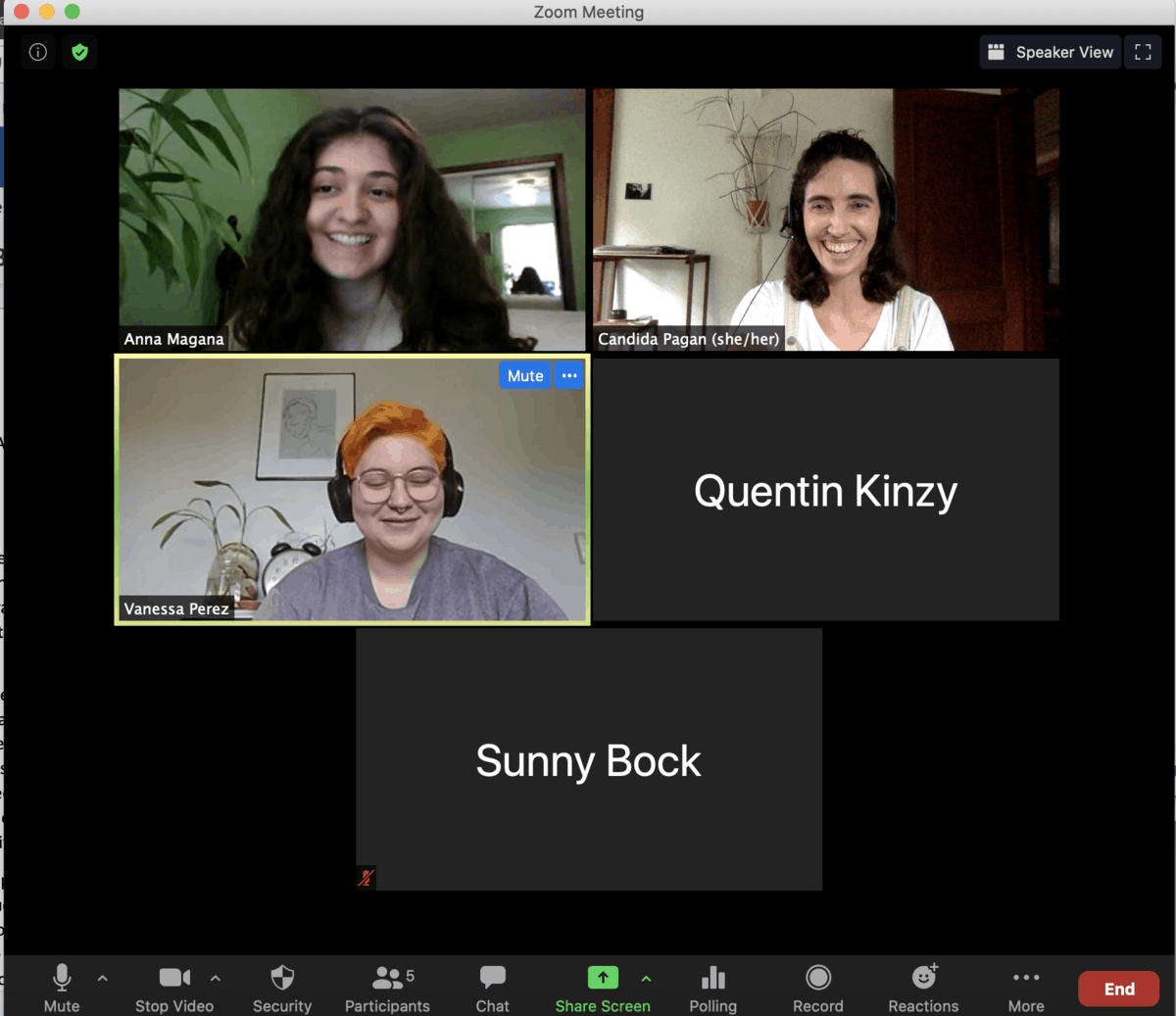
Photo caption: Screenshot of one of our recent weekly Zoom group meetings (clockwise from top right: Anna Magaña, Candida Pagan, Quentin Kinzy, Sunny Bock, Vanessa Perez)
As part time interim Preservation Processing Coordinator in the UI Libraries Preservation Department, one of my main duties is to supervise the student staff who do the day to day marking work for new acquisitions and items that need to be reprocessed for one reason or another. From January to early spring of this year, we became accustomed to working with one another and revised workflows to adjust to the needs of the department. Mid-semester I felt we had reached a smooth operational flow; tending to marking, removing outdated information for remarking, shrink wrapping, preparing items for long term storage as needed, coordinating with circulating book repair to ensure unmarked spines had new titles, unpacking and routing recent returns from the bindery,processing items to get them into or back into circulation in a streamlined manner – it all seemed to be moving in stride. Cue the COVID-19 pandemic.
Justbefore and during the week of Spring Break, several students had intended to take time off and did so. Others intended to work more than usual – and were introduced to a new set of remote tasks. Department staff had quickly compiled several remote work options that could be performed online. With very short notice, the students were informed that they would not be returning to campus after break for classes, or for work. The COVID-19 pandemic response suddenly and necessarily disrupted campus life for the entire UI Community. Preservation student staff included. Like their peers, the students completed their semester online, and those who were able, continued their work for the department in a radically different way, entirely new to them. Four students who have continued to work through the summer share their experiences here. Thank you and cheers to you, Preservation & Conservation student staff for your flexibility, adaptability, and resilience.
Anna
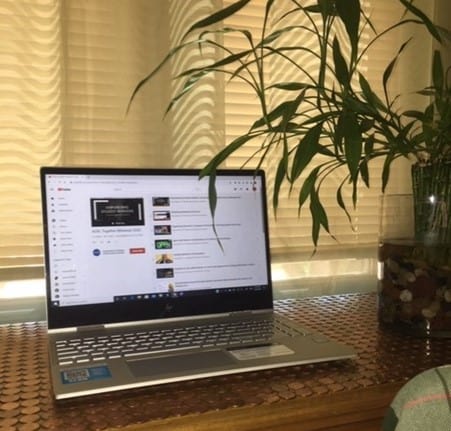
Photo Caption: My setup at home is a lot simpler than at the library; here’s my ‘workstation’ while I look through the ACRL video series.
March of this year started in the way most months start, at least in Iowa City, so I still remember how odd it was to receive an email the Sunday before spring break letting me know not to come in the next day. I’ve been a student employee at the main library for two years now, and the experience has taught me about processes ranging from marking new materials to shrink wrapping old ones. These tasks, while often done alone, can feel collaborative when around my peers who are working on similar things. I also value the quiet but physical nature of doing things like marking books or re-shelving them; it is a nice way to focus my energy on my hands when so much of my schoolwork takes place on a computer.
Needless to say, transitioning to remote work has been an adjustment. With the guidance of my supervisors, I’ve worked on projects like cleaning up digital storage and transcribing archival materials. Admittedly, these tasks have taken some getting used to and it’s been a learning curve; this is to be expected. While I am learning new things, the things I’ve been assigned have been fairly comprehensive. The real adjustment for me comes with training myself to focus on a digital task for an extended period of time while the world feels so off-kilter and non-linear. I think a lot of people have felt the loss of structure that they would normally find in different environments.
While things are odd, I am grateful for the fact that I still have the opportunity to work at a time when so many people do not or cannot do so from the comfort of their homes. I do like to work with my hands, but there are other ways I can do that from home with other activities.The new tasks I’ve been given have also expanded my knowledge of library workings and have given me more appreciation for what goes on behind the scenes. In truth,remote work is a big change, but it is nice to have something to rely on right nowand I am interested to see the what kind of remote projects will supplement our physical work in the fall.
Sunny
Photo caption: Screenshot of transcription page
If I were visited while working at the Main Library (let’s say, back in January), you would have had no problem locating me at a computer, clicking or scanning and surrounded by carts full of books. If I were visited while working remotely now (let’s say, if it were safe), you would still see me sitting at a computer but in a less comfortable chair, without a barcode scanner and its continuous beeping, without a label printer or a barcode duplicator, without a printing station, without an assortment of paper cutting tools, and most noticeably, without any books.As a Student Marking Specialist, my main tasks used to involve working with physical materials and technology, but the transition into entirely remote work on my personal laptop has drastically reimagined my usual workflow and tasks.
In the library, I often encountered old and/or historical materials and books, but I usually didn’t engage with the content within these resources. Early in the transition to remote work, I spent many hours actually readingarchival materials, transcribing the information, then later proofreading these transcriptions. I spent most of my timetranscribing a Midwestern woman’s diary that she kept throughout the early 1910s through the 1940s, and I was struck with the overlookedvalue of local and historical artifacts as I read her entries. I started seeing names of towns in Iowa that I had never heard of, some of which are ghost towns now that you can still visit and see remnants of in some cases. I also began to comprehend the complex yet mundane nature of housewife life in these decades, and the complete restructuring of daily chores due to new technologies.In this way, I felt like I was learning new information while working, which is a very special experience.
One of my favorite parts of working at the library is seeing a wide array of books and their unique covers, but I have rarely followed-up with materials that looked interesting to me. My experience with remote work has reminded me of the value of libraries and how I should utilize my access to thisincredible resource more often once back on campus. There are surprising things to learn in unexpected places, and I’m excited to return to the library with a renewed curiosity of the content of the materials that I process at the library. For now, I’m also extremely grateful to be able to work remotely.
Vanessa
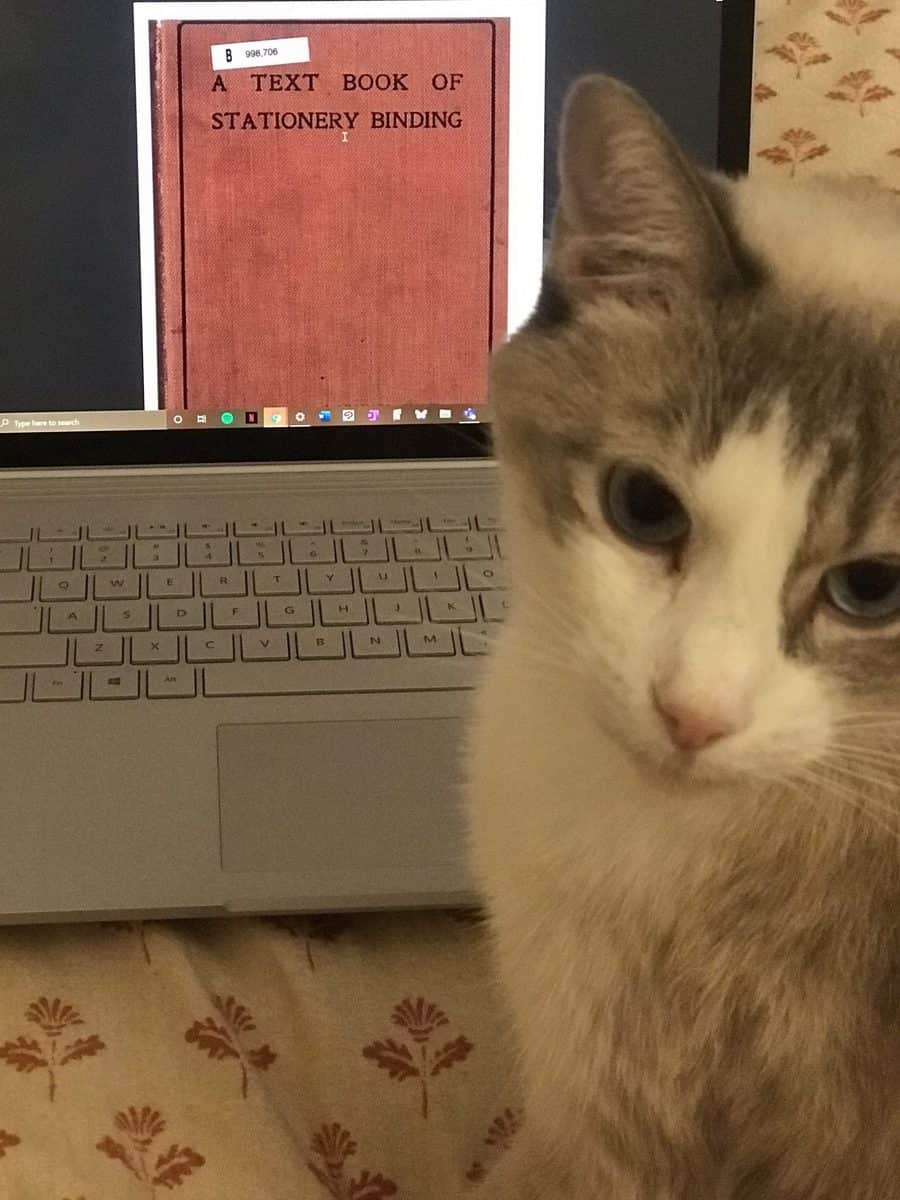
Photo caption: Bones wanted to read A Textbook of Stationery Binding with me
Like many, the shift from the original format of work, classes, and life to our current digital routines has been strange for me. A handful of months ago I would have been stamping, taping, and marking away on books or happily creeping my way through the stacks with a cart full of periodicals to put away. The innate peacefulness of the library is appealing to me and I have always been the kind of person who values being able to work with my hands. Nowadays I spend most of my work time on my laptop.Though the physicality of working in the Main Library was often a big part of why I enjoyed it, the new mode of working is no less interesting. Whereas before I found satisfaction in the straightforward, hands-on tasks, now I engage more with the information that the library contains rather than the books that hold it.
All of thisis not to say that this change has gone perfectly smooth for me. As I have mentioned, I am a very hands-on person– it felt like second nature for me to turn off my brain and tune in to good music or a podcast and after blinking I would have a stack of books marked and ready for the next step in the process. The lack of physical evidence of my work along with operating in my own home at my own pace can make it difficult to focus. The blurring of home and work means I often work at my kitchen table or occasionally sitting in my bedroom with my cat trying his hardest to join in on weekly video calls with coworkers.
Overall, my experience in this new way of working has been good. I’ve learned a lot about myself and what I value in my job, as well as a lot about the digital side to the library and all the historical records we have. While I certainly miss the old functions of my job, I’m glad to have been able to keep connected to my coworkers and look forward to seeing what work looks like as we move toward the fall semester.
Quinn
Between the environment, the hands-on tasks, the coworkers I have come to know, and the library collection I interact with, my job has really come to be one of the most rewarding experiences I have had at the university. Generally, I would walk into work, clock-in, say a quick hello to my coworkers, and grab a stack of books to start on. As a book-lover myself, it felt therapeutic to be both surrounded by books and constantly working with them.
When the shutdowns began, I had the privilege of still being employed by the libraries for the remainder of the spring semester and the summer, but the environment, coworkers, and collections I interacted with throughout the week, as you may expect, drastically changed. Instead of my pre-pandemic routine, I now usually grab a glass of lemonade before sitting down at the laptop in my childhood home to work on checking the archived university websites. I manually compare the archived versions with the live version of the site to check for any glaring differences, as well as click on all the links to make sure that the entire website and its content was correctly preserved.
Although I know the importance of maintaining our digital archives and find them very informative, I cannot tell you how much I miss working directly with books. There’s a certain kind of satisfaction to marking an entire row of books, knowing they could be in the hands of a reader so shortly. Online, most people won’t check the archives of a website from this year until major changes have occurred where someone would want to see the past versions.
I will say that I appreciate the opportunities that these changes have brought. For example, I wasn’t at all aware of the university digital web archivebefore I started working with it, and through this project, Ihave stumbled across work like the Art & Life in Africa website. This sitecompiles information on art from dozens of African cultures and puts the art into context of a piece’s local history and customs. There’s alsoFeminae, an index for content on medieval women, gender, and sexuality.Bothsites wouldmake fantastic resources for any research (as well as just being enjoyable to scroll through), and even though they are easily accessed through the university websites, free of any paywalls, I had no clue they were out there.
That being said, I still miss my previous job and my coworkers. I enjoy our weekly Zoom meetings to discuss any updates or struggles we have with these new tasks, and hopefully one day near in the future we can convene offline.I look forward to the day when healthcare professionals determine that it is safe to return to the libraries. Until then, I will be scouring the digital archives for errors, and hopefully in a few years, someone will find it interesting to look back on the university webpages during the pandemic of 2020.
Photo caption: Bones, our unofficial mascot, prepares to get to work on A Textbook Stationary Binding; photo courtesy of Vanessa Perez
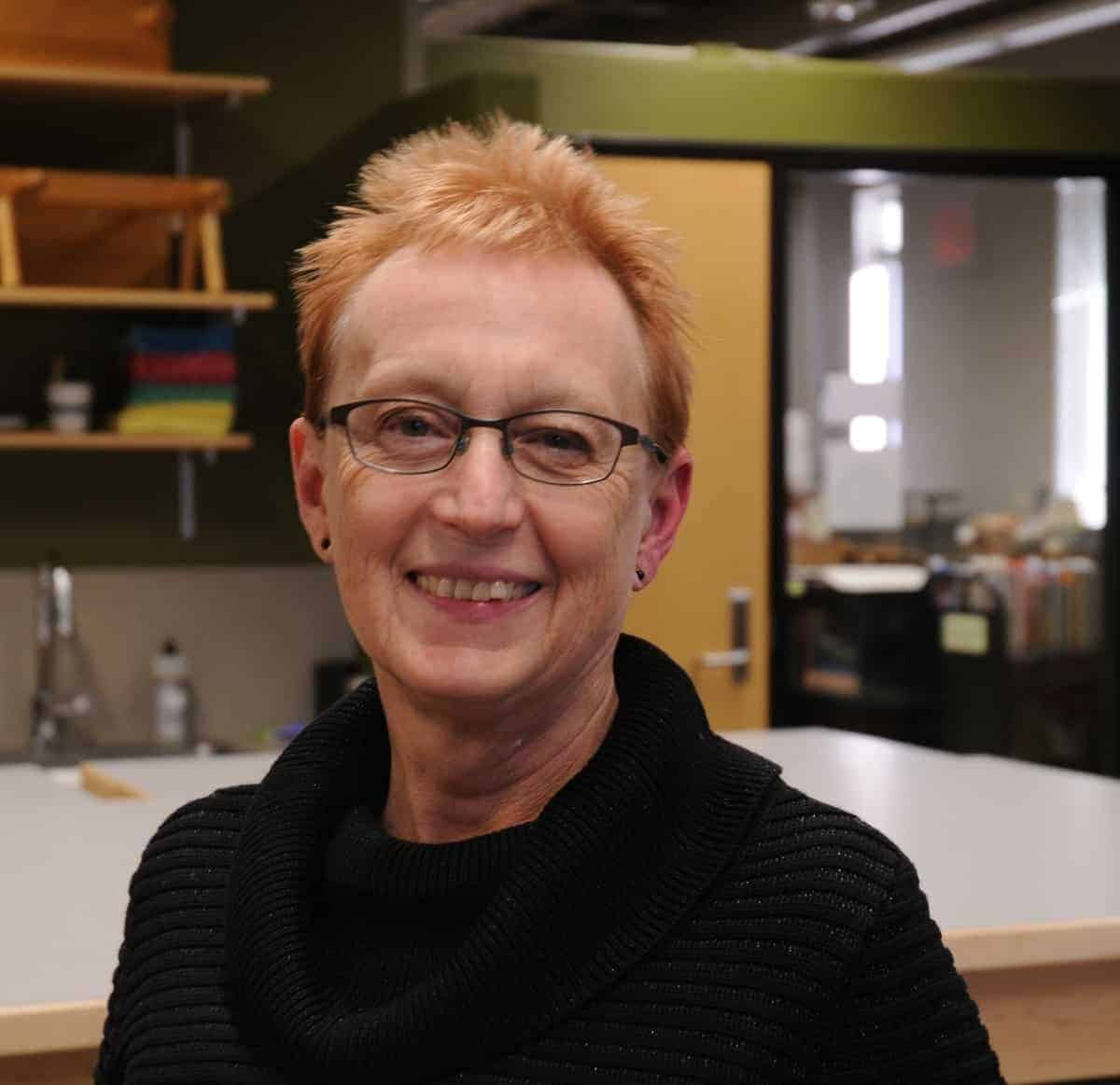
Nancy E. Kraft, Head of Preservation & Conservation, has retired after serving 18 years at the University of Iowa Libraries. Her career has been fruitful, and she plans to stay involved in preservation efforts on a local state level. Nancy has served as a board member for the US Committee of the Blue Shield since 2013, and a member of the International Organization for Standardization (ISO) since 2015. In 2018, she was awarded the Paul Banks and Carolyn Harris Award for excellence in Library Preservation.
Prior to coming to the University of Iowa, Nancy had several different positions that built up her understanding of how a library functions.
“I had a preservation background that made me a good fit here and helped me come up to speed fairly quickly because I had dealt with a disaster within the State Historical Society, so I had real life experience with that. When I first became a librarian, I thought I wanted to be a rare book cataloger so I was a cataloger for a couple years, which I think is really helpful to understand if you’re in preservation.”
Her experience with disaster emergencies proved to be incredibly helpful during the local 2008 floods. Nancy worked to preserve materials in both Cedar Rapids and Iowa City and described the experience as one she’ll never forget. She recalled the way the community came together in Cedar Rapids.
“We weren’t expecting these 200 volunteers to come and help us move stuff out of the basement. No amount of training prepares you for dealing with that… People for years after were still talking about it.” She remembered the jarring visual after the water rose. “We were one of the first ones led into the area and it looked like a war zone. I don’t know how you even get your brains and emotions around that; it was very intense.”
Nancy commented that she felt her biggest contribution during the process was being on site quickly to advise about what could be salvaged; this led to another contribution.
“[Getting there right away] was major and that was the reason that I recommended to the Iowa Preservation and Conservation Consortium that we establish a formalized trained Iowa response group. I realized that if we get there right away we can really make an impact.”
As part of her work with the ISO, she traveled to Berlin early this year to head the U.S. delegation in developing the international standard for emergency preparedness and response.
“I had been the American Libraries Association representative for the US for the National Information Standards Organization that works into the ISO. And I had been on that for four years. When the call came out for volunteers to work on international standards for a disaster response document, I volunteered and was selected… It was really interesting to get to see how different countries are organized to respond to disasters. It was a really good learning experience.”
While her career has involved many large-scale projects, Nancy noted that what she’ll miss the most about the day-to-day of her job is the people. People are what she’s always been passionate about.
“I feel that I really built up a nice conservation lab and we’ve got a nice digitization workflow going. But none of that could happen without staff. So I really like finding ways that staff can be successful and “own” a piece of the department…I’ve always tried to do that. The people make the day-to-day. That’s what made it hard to retire; I can’t take them with me.”
Nancy E. Kraft has retired from the University of Iowa LibrariesKraft assists with separating and rehousing damaged photographsKraft [lower right corner in mask] and others salvage collections after a disasterKraft [center] with ISO group
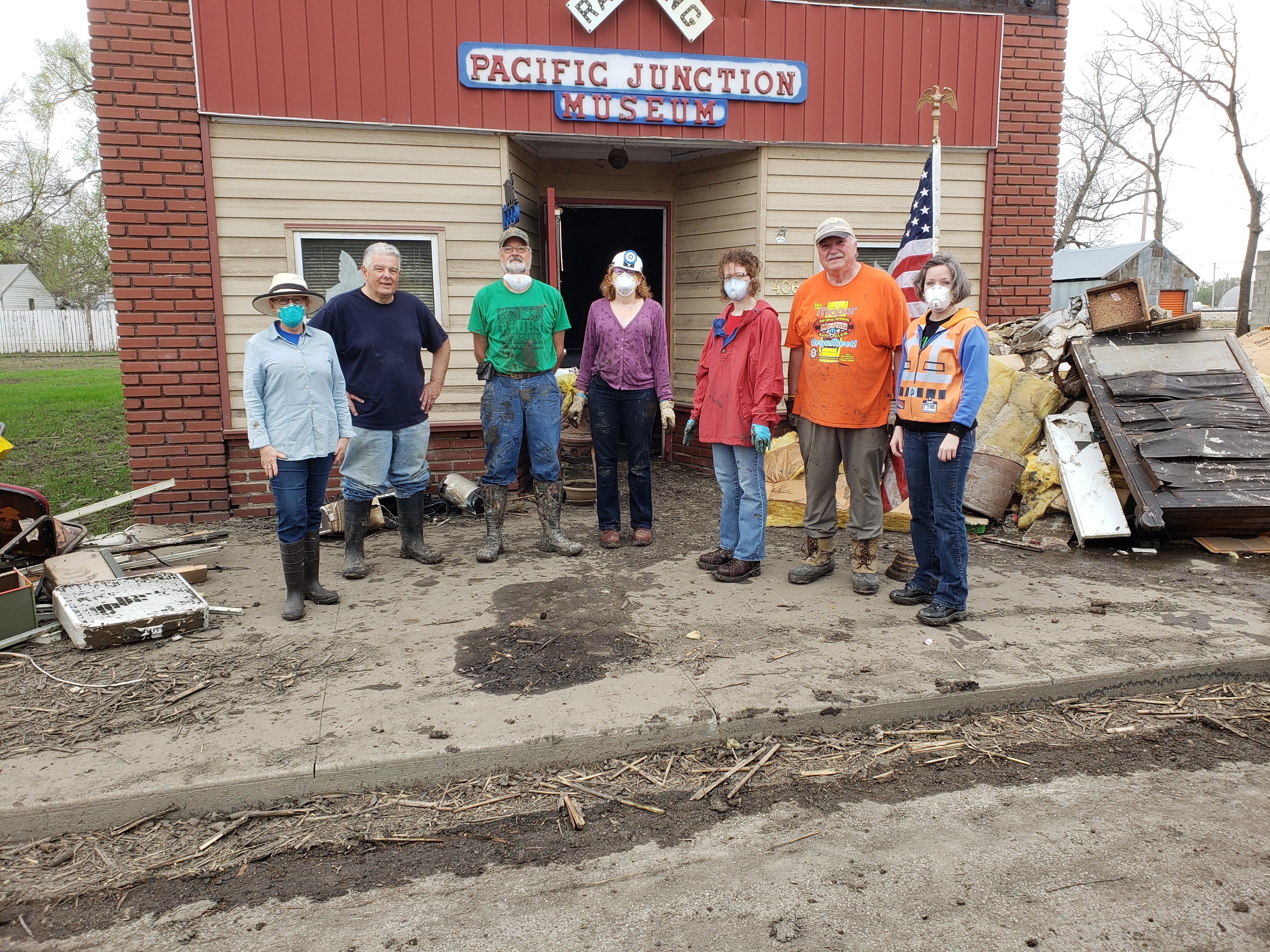
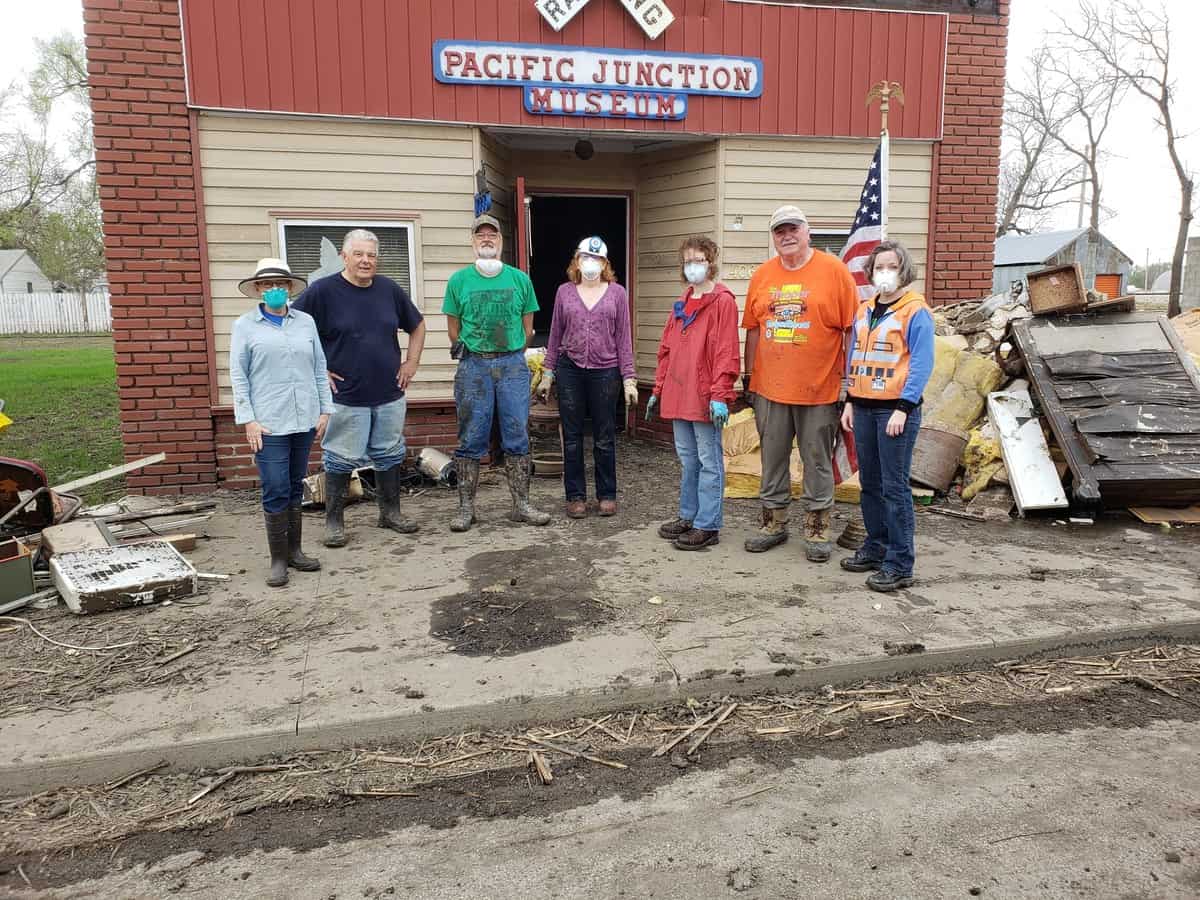
IMALERT members take a group photo in front of the Pacific Junction Railroad Museum.
[ezcol_1third]
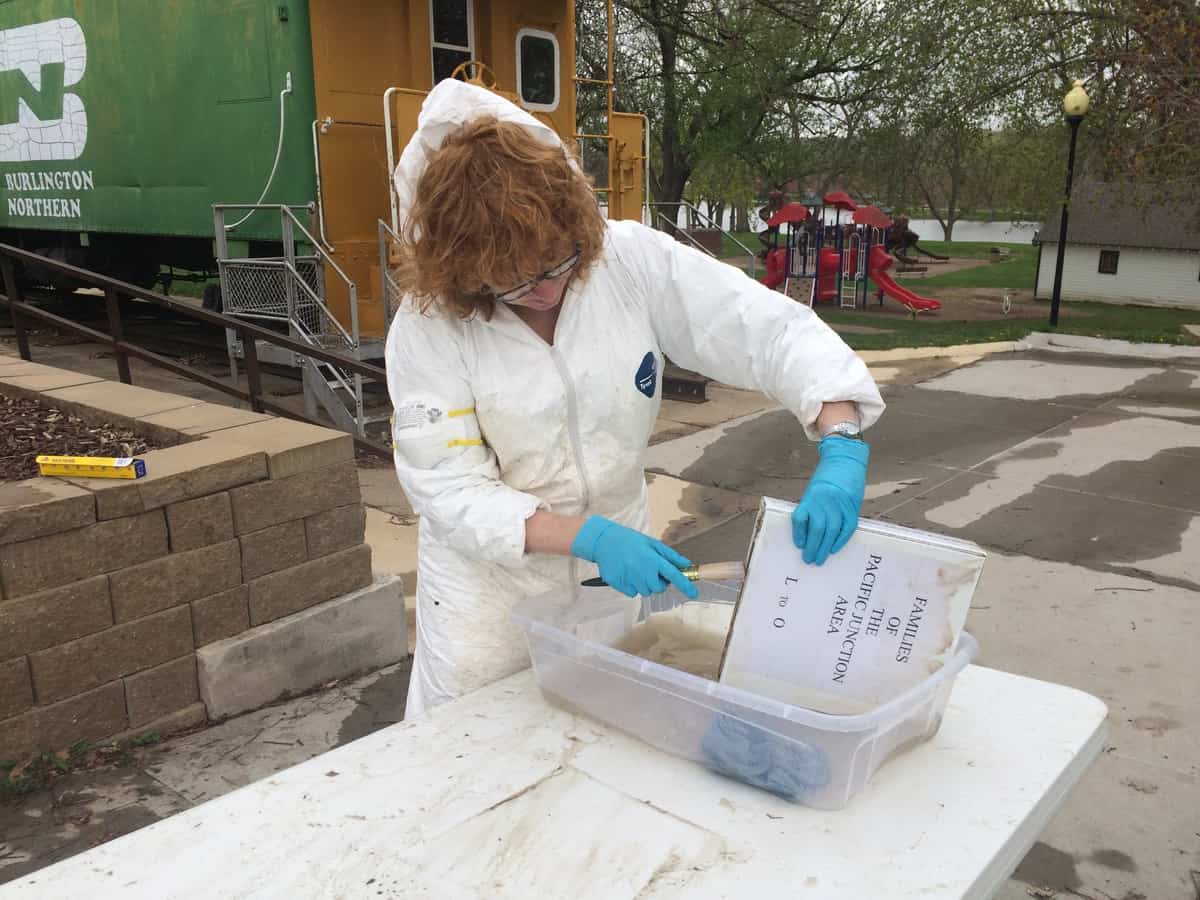
Cindy Opitz cleans a flood-damaged binder
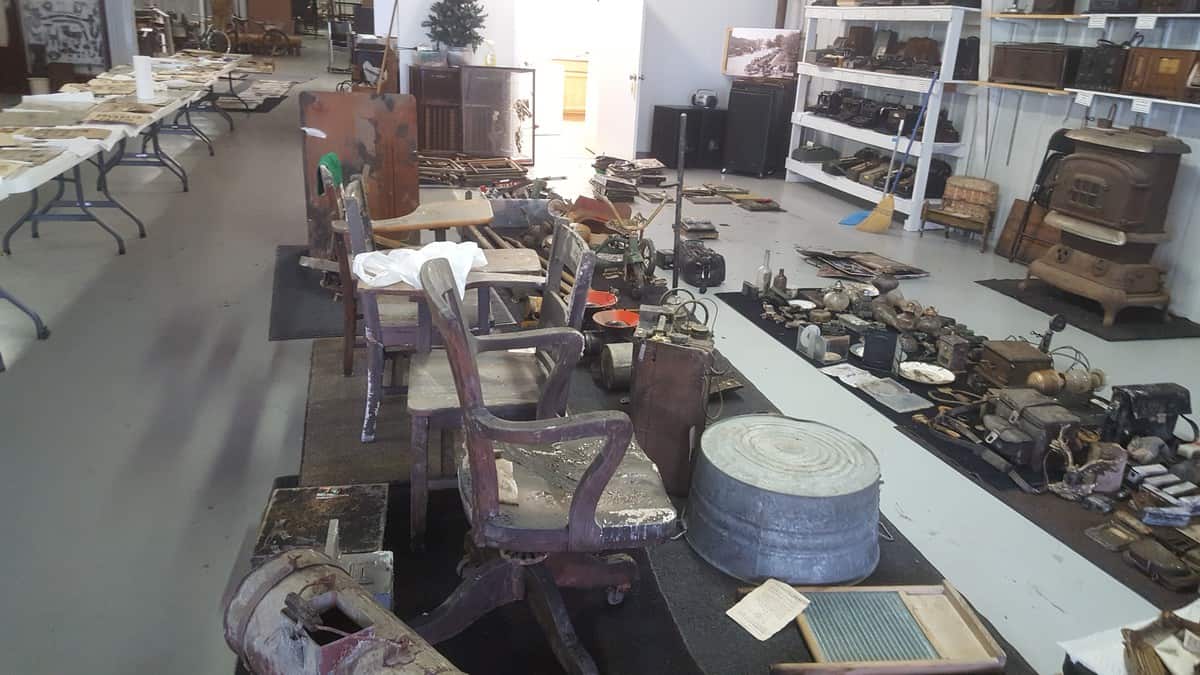
Flood-damaged collections sorted by material type
[/ezcol_1third] [ezcol_2third_end]
On Monday, April 22, Iowa Museums, Archives, Libraries Emergency Response Team (IMALERT) members assisted with the retrieval and salvage of collection items in the flood-damaged Pacific Junction Railroad Museum (PJRM). We could not have had a more “perfect” flood recovery experience. The Mills County Historical Museum Director Steve Hunt from nearby Glenwood had everything well organized.
While the building was still underwater, he assembled a team of a few people available to bring their trucks and assist with rescue efforts. He also obtained supplies and cleared an area in a Mills County Historical Museum building where collections could be stored. Once the water receded, he worked with others to clear out the debris (fallen ceiling tiles, upended office furniture, etc.) so we would be able to get to the collections. He retrieved as many of the photographs as he could and a couple uniforms from the PJRM and City Hall, rinsed and laid them out. He also gave us the go ahead to provide assistance on April 22.
Team members from the University of Iowa – Nancy E Kraft, Cindy Opitz, Tiffany Adrain – joined team member Joy Stortvedt in Shenandoah and caravanned to Glenwood to join Steve and his team. Steve led the way to Pacific Junction as there was only one way in and it was hard to find. We loaded the collections into the trucks and hauled everything to Glenwood where we unloaded, sorted, and laid out the collections by material type. We spent the rest of the day rinsing material as needed. There were several notebooks of research material. Although we think the research material is on a server, we rinsed, wrapped, and stored the notebooks in a freezer. Once Steve has time, he’ll check the online files to identify those that really need to be salvaged
Everything is now stabilized. Material can be worked on as time and resources are available. We’re discussing a possible return for further assistance. The IMALERT has a 24/7 hotline that anyone can call for advice and assistance with collections damaged by disaster large and small. The number is 319-384-3673.
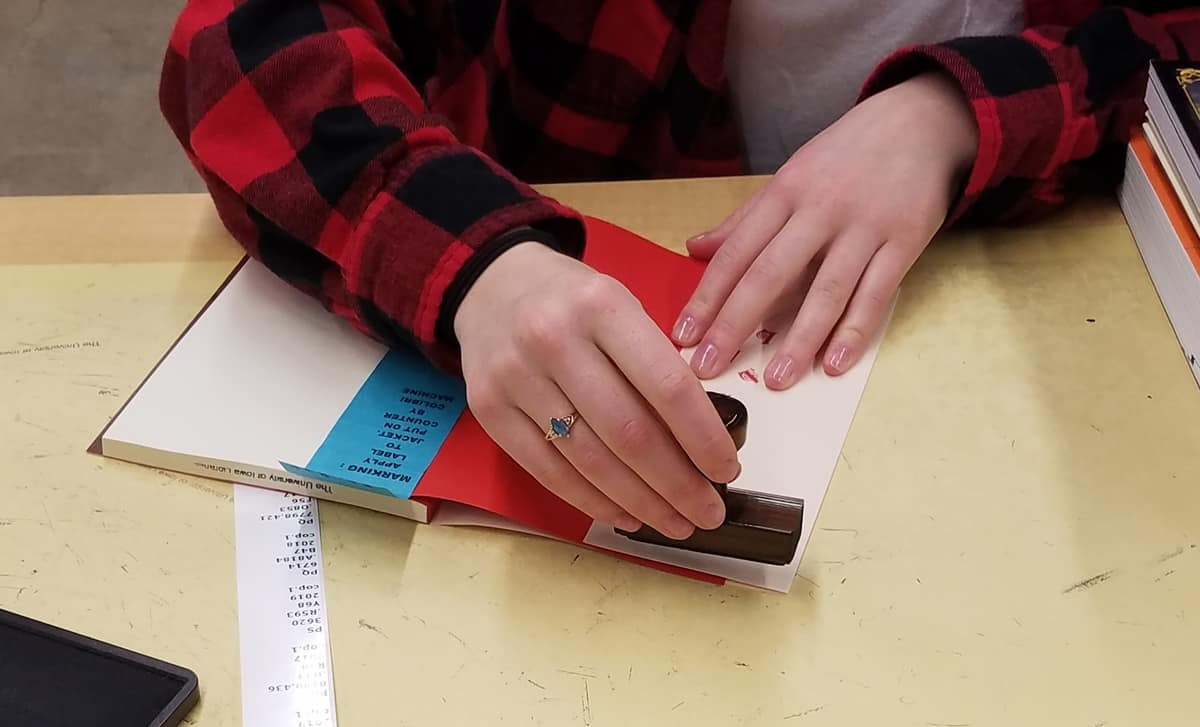
Preservation & Conservation student employee Colleen McFarlane marks a new book before it heads to the shelves for circulation.
[ezcol_2third]
The Preservation & Conservation department employs 19 students in positions ranging from digitization to book repair to conservation. Within the Marking unit, student employees mark new books to prepare them for patron use. We start by property stamping them, then we insert a security device, and mark them with an adhesive call number label. We also work with other media besides books, including CDs and DVDs. Marking students also work on other preservation projects as they arise.
Oftentimes, I work together with other student employees on these projects. This, along with interviewing Preservation and Conservation employees for blog posts, has allowed me to get to know my coworkers. Fostering work relationships allows for successful collaboration and creates a welcoming work environment.
Additionally, finding a balance between work life and school has allowed me to learn valuable time management skills and how to prioritize tasks. Working as a marking student has taught me attention to detail and how to remain focused on the task at hand. I get the chance to try to do my best work with every new book and each new task.
[/ezcol_2third] [ezcol_1third_end]
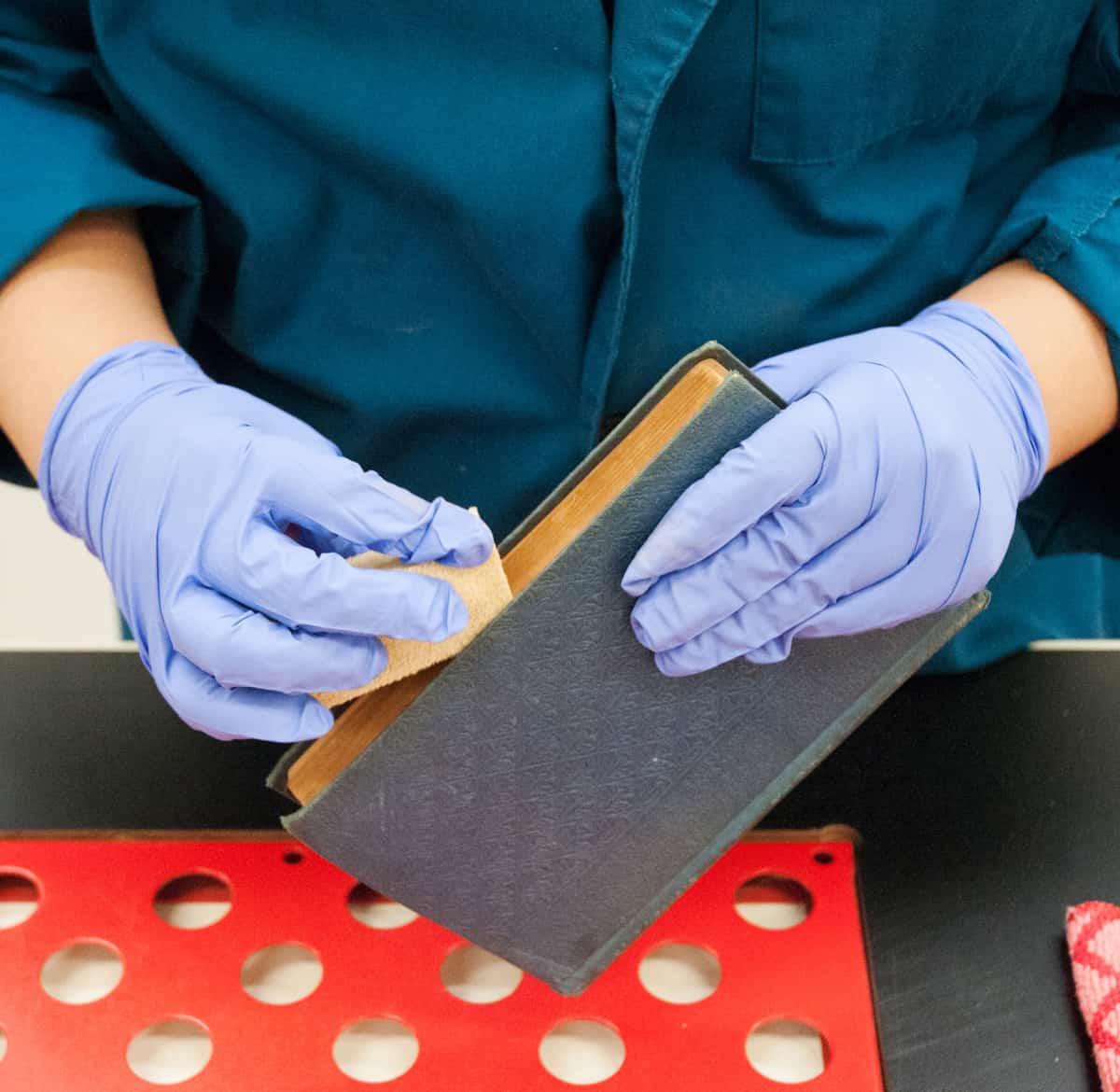
Students in the Marking unit also work on special preservation-related projects and gain experience cleaning and handling fragile materials.
This week is Preservation Week, which is sponsored by the Association for Library Collections & Technical Services (ALCTS), a branch of the American Library Association (ALA). Preservation Week is an opportunity to learn about and take action to preserve collections. The theme for this year’s celebration is “Preserving Your Family History” which emphasizes the importance of preserving the collections of families, individuals, and communities in addition to those in libraries, museums, and archives.
According to the Preservation Week website, “An estimated 1.3 billion items are at risk—in need of treatment to be stable enough for use, or in need of improved enclosures or environment to reduce the risk and rate of damage.”
The 2019 Preservation Week Honorary Chair is Kenyatta D. Berry. Berry is a genealogist with a focus on African American genealogy and slave ancestral research. She will be presenting in one of this year’s webinars. Free webinars from every year since 2010 can be found on the Preservation Week website, including three from our very own Nancy E. Kraft.
The website has other helpful information about taking care of personal media collections such as scrapbooks, home videos, photos, and more. Visit the website to learn more about how to participate in Preservation Week.
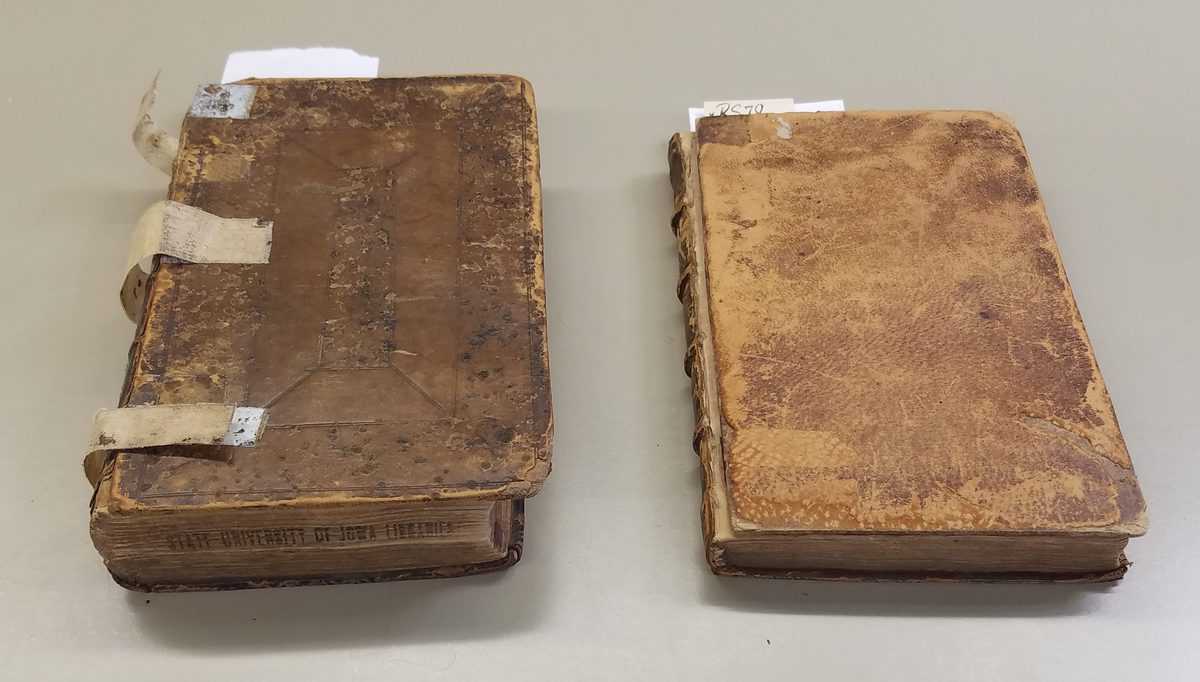
The first book (left) has a front cover that is too large and the second one (right) has a cover that is too light.
[ezcol_1third]
The front cover that came with the first book is both too wide and too tall for the text block.
The mismatched front cover of the first book matches the back cover of the second.
[/ezcol_1third] [ezcol_2third_end]
About a month ago the conservation department received a book for repair from the John Martin Rare Book Room in the Hardin Library for the Health Sciences. Beth Stone, assistant conservator, noticed that the front cover of the book did not match the back cover. It was taller and wider than the text block and the leather did not match the back cover in color or design.
A couple weeks later another book arrived for repair, yet again with a mismatched front cover. Stone immediately recognized the back cover of this second book for the design in the leather – it matched the detached front cover of the first book perfectly. The dimensions were correct, and the sewing supports on the spine of this second book matched up with the front cover from the first.
Unfortunately, the front cover of the second book was not a match for the first book. The cover was too tall, and the leather was a way lighter color than the attached back cover. This means instead of direct swap, there must be a third mystery book involved.
Now, in addition to searching for the missing cover of the first book, the conservation staff has other questions to consider. The two detached front covers both have bookplates from the same owner. One cover also has signatures from other previous owners. Were these covers attached to the proper books when they were signed? Were they switched during ownership or after accession to the library? Since it is important to preserve the history of these books, these questions need to be considered before the conservation department takes further steps to repair these books. [/ezcol_2third_end]
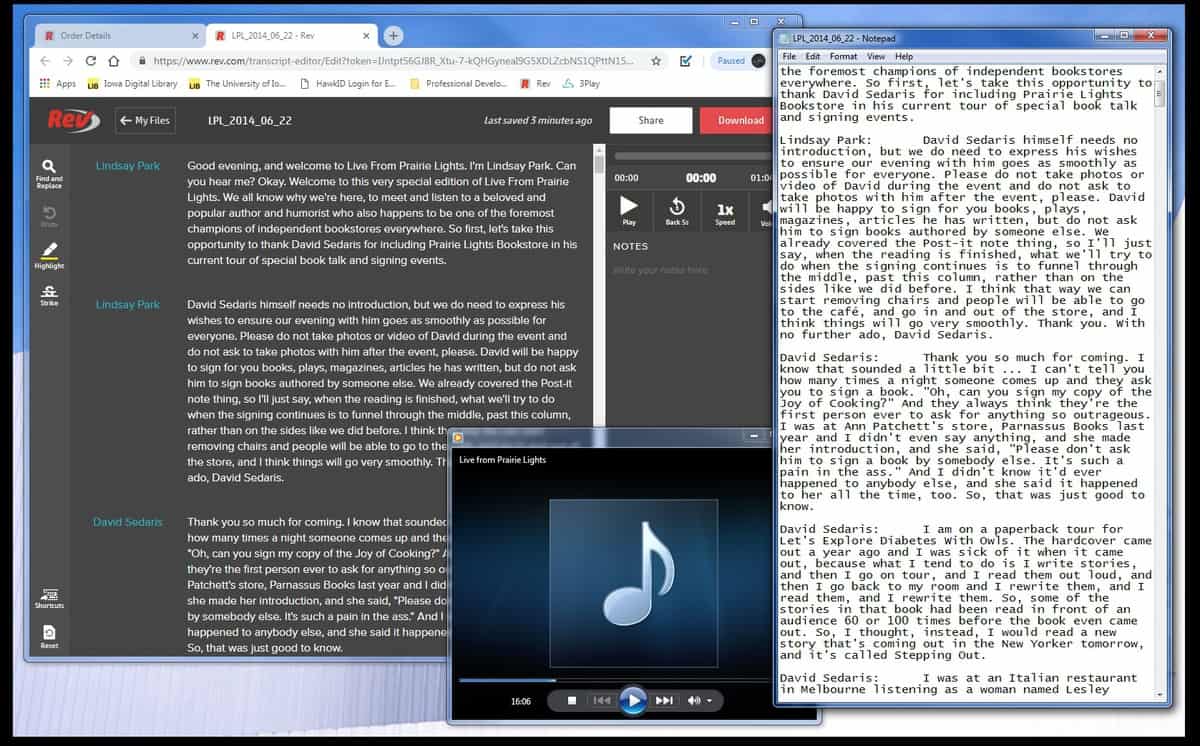
This screenshot shows the Rev transcript of David Sedaris’ Prairie Lights reading alongside the audio file and text editor.
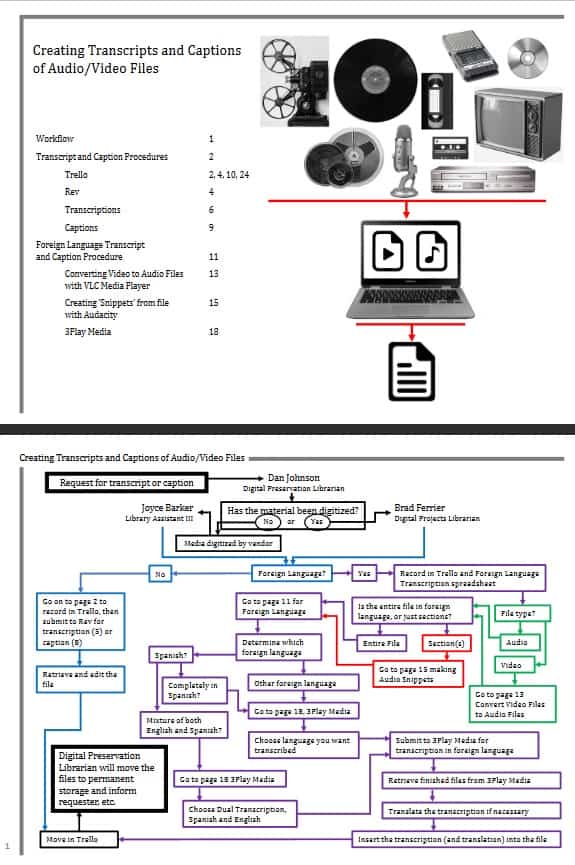
[ezcol_2third] Brad Ferrier, digital projects librarian, coordinates transcription and caption for Audio/Video (A/V) materials in the library’s collection. “Transcription is converting the speech in an audio file into a written plain text document. Caption is converting the speech in a video file into text which is synced and appears on-screen with the video,” Ferrier explains.
Incoming A/V materials are transcribed and captioned by Library Assistant Joyce Barker. Materials already in digital storage are sent to Rev, which is a transcription, caption, and translation service. When the transcripts and captions are returned, Ferrier helps conduct a quality check. Then the materials are sent on to Digital Preservation Librarian Dan Johnson. Johnson puts the transcripts and captions in long-term digital storage and either posts them to the Digital Library or sends them to whoever requested the project.
Ferrier has worked with A/V from Special Collections, University Archives, Iowa Women’s Archive, and the Music Library. As one of his projects, he processed transcripts of readings from the Live from Prairie Lights series, including of David Sedaris’ 2014 reading.
Transcribing/captioning audio and video has many benefits. “In addition to making the material usable for the deaf and hard of hearing, it can aid in understanding for non-native speakers, it can be used in noisy or distracting environments where audio cannot be played,” says Ferrier. This important work also makes the A/V material more searchable. [/ezcol_2third][ezcol_1third_end]
This is a workflow chart that shows the process for creating transcripts and captions for A/V materials.