This series features the work and research of University of Iowa students. The following is written by Noah Jedlicka, a student worker at Special Collections and Archives working on his Master of Arts in classics.
“When in the Course of human events, it becomes necessary for one people to dissolve the political bands which have connected them with another, and to assume among the powers of the earth, the separate and equal station to which the Laws of Nature and of Nature’s God entitle them, a decent respect to the opinions of mankind requires that they should declare the causes which impel them to the separation.”
With this introduction, the world would soon learn the name “The United States of America.” This is the start of the words upon which this nation was founded, written by Thomas Jefferson and the other members of the Committee of Five, who would bring the document before the Second Continental Congress in 1776 and ignite a war that would redefine the status –quo of the world, throwing off the chains of monarchy.
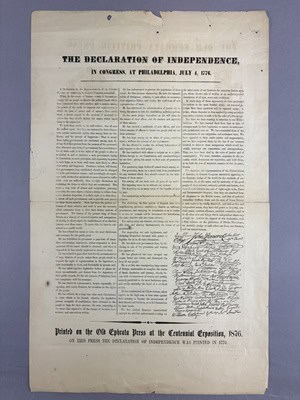
“In every stage of these Oppressions We have Petitioned for Redress in the most humble terms: Our repeated Petitions have been answered only by repeated injury. A Prince, whose character is thus marked by every act which may define a Tyrant, is unfit to be the ruler of a free people.”
In the spring of 1776, the focus in the Second Continental Congress, taking place in Philadelphia, was that of the question of independence. After much debate, the Congress voted to move forward with their national divorce, and the Committee of Five was tasked with drafting their statement to the world. The Committee was made up of Robert Livingston, John Adams, Roger Sherman, Benjamin Franklin, and Thomas Jefferson. Jefferson and Adams, delegates from Virginia and Massachusetts, became the subcommittee to form the draft. Some historical gray areas lie around the role of Adams, and how much he actually edited; however, pretty much all agree that the large majority of the Declaration was written by Jefferson.1
Before heading further back in time to its contemporaries, we’ll stop at another anniversary celebration. This copy of the Declaration was printed on the Old Ephrata Press for the 100th anniversary in 1876. The press had historically been used by Peter Miller, a clergyman of the Seventh-Day Baptist Society, to print versions of the Founding Document in both English and five other languages, sent to other countries after the Revolution.
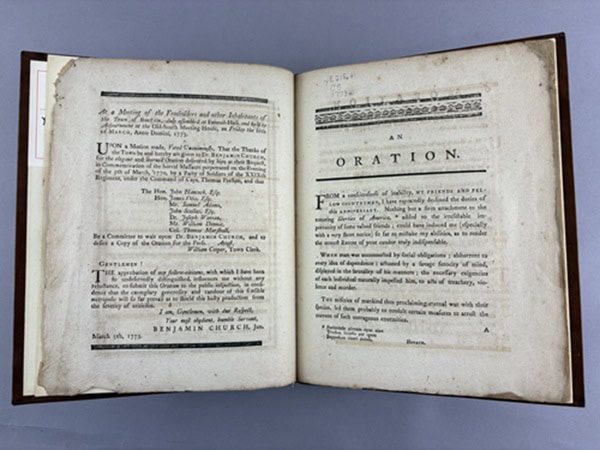
“As in every government there must exist a power superior to the laws, viz. the power that makes those laws, and from which they derive their authority: therefore the liberty of the people is exactly proportioned to the share of the body of the people have in the legislature; and the check placed in the constitution on the executive power.”
Benjamin Church spoke these words on the steps of Faneuil Hall in Boston, just down the street from the Old State House where the Boston Massacre had taken place. Under the command of Thomas Preston, British soldiers were stationed outside of the building on the night of March 5, 1770. A crowd of Americans, dissatisfied with the continued stationing of British troops, began to jeer and mock the troops; when objects began being thrown, the soldiers fired into the crowd, killing five colonists.
This oration was given in 1773 on the third anniversary of the shooting. Benjamin Church, an elected member of the Massachusetts Congress, spoke not only in memory, but also in reason, clearly articulating his perceived faults of the British government and rallying the Revolutionaries through his words.
In time, it would turn out that Church was a British spy, and he would eventually be arrested and jailed. Banished from the new nation, he sailed for the Caribbean, only for his ship to become lost at sea. However, the sentiments he voiced provided both emotional and motivational inspiration for the colonies.
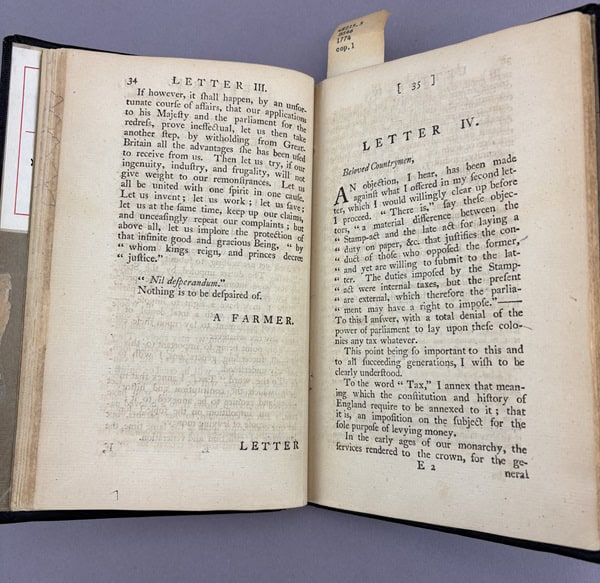
“If the Parliament may lawfully deprive New York of any of her rights, it may deprive any or all the other colonies of their rights; and nothing can possibly so much encourage such attempts as a mutual inattention to the interests of each other. To divide, and thus to destroy, is the first political maxim in attacking those who are powerful by their union.”
Thus begins John Dickinson’s first letter to his fellow colonial subjects, written in 1767. Having been a member of the Stamp Act Congress, Dickinson saw first-hand how the iniquities of Britain’s rule were affecting the colonies. He would write a total of 12 letters over the course of almost two years, with the final being published in 1768. These letters would be printed in a collected edition in Philadelphia, with this edition being printed in 1774, sold for the “price of two shillings.” Predating Thomas Paine’s Common Sense, it would become the de facto text for the early Revolutionaries, read throughout bars and meeting houses across the colonies.
Dickinson’s letters were published without an author, choosing to refer to himself as “A Farmer” — not to be confused with A. (W.) Farmer, Samuel Seabury’s pseudonym for his letters against the Continental Congress. It’s important to note that neither of the two, as it turns out, were farmers when composing their treatises, and probably chose these aliases to seem more in –touch with the wider public.
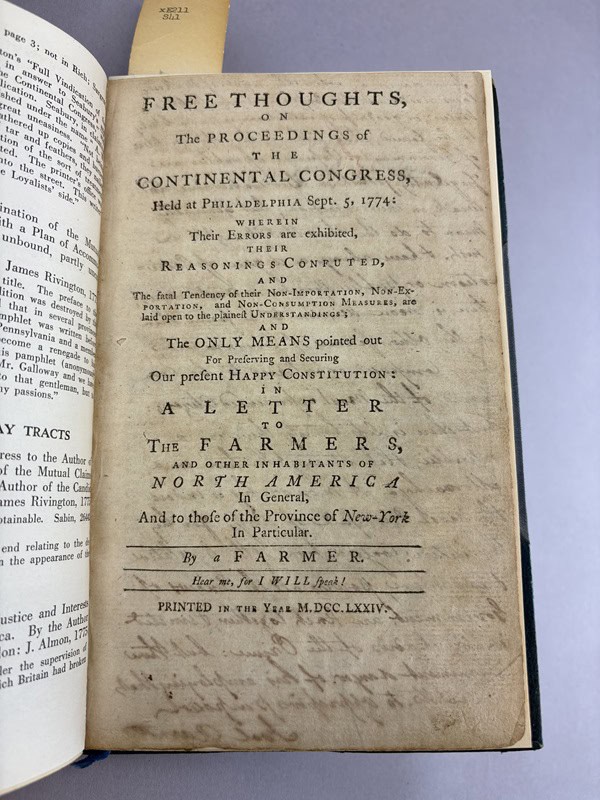
“Hear me, for I WILL speak!”
Speaking of A.W. Farmer, Seabury would write a few different essays opposing the Continental Congress before being arrested and thrown in prison in the fall of 1775. Perhaps his most famous is that of Free Thoughts on the Proceedings of the Continental Congress, Held at Philadelphia Sept. 5, 1774.
In it, Seabury voices many worries and concerns following the American resolution to no longer import goods from Great Britain or any of its colonies. Concerned with the effect on prices, he attempts to lay out different ways the supply chain will be disrupted — and he may have been right. A printed note, at the bottom of page seven, reflects the rising price of feed, having jumped from 10 to 13 shillings between writing to printing.
Following the end of the Revolution, Seabury would continue to live in America and eventually came to support the new government. Rising to the status of Bishop in the Episcopal Church, he would write and publish one of the first prayers for the American Congress.
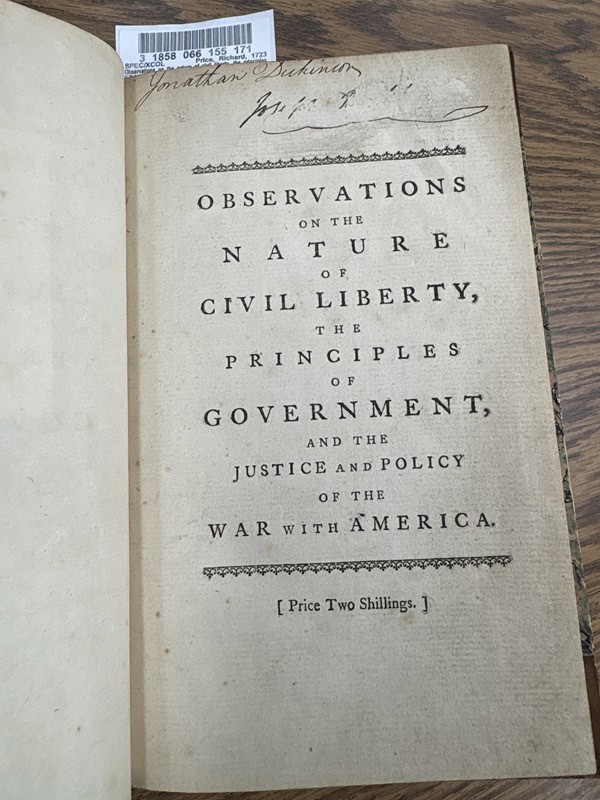
“The following observations on this subject appear to me important, as well as just; and I cannot make myself easy without offering them to the public at the present period, big with events of the last consequence to this kingdom. I do this with reluctance and pain, urged by strong feelings, but at the same time checked by the consciousness that I am likely to deliver sentiments not favourable to the present measures of that government, under which I live, and to which I am a constant and zealous well-wisher.”
Richard Price, writing across the sea in the land of King George III, knew full –well the potential consequences of his actions. In this pamphlet, Observations on the Nature of Civil Liberty, the Principles of Government, and the Justice and Policy of the War with America, published in 1776, Price breaks down the “Nature of Liberty” through four categories: Physical Liberty, Moral Liberty, Religious Liberty, and Civil Liberty.
Perhaps unknowingly making a reference to the future congressional system that would develop in America, Price works through these different forms of liberty on different scales, noting that just as the great state of Britain sat atop the states of the colonies, civil liberty cannot be guaranteed when one state is more powerful than another: “It would, therefore, be a remedy worse than the disease; nor is it possible it should be approved by any mind that has not lost every idea of Civil Liberty,” he said.
Rather, Price supports the idea of representatives in a state assembly, apportioned to the population, as a way to ensure a state “will be still free or self-governed, more or less so in proportion,”, and, in its name, be represented: the very thing King George III refused to give to the colonies and spurred on the conflict.
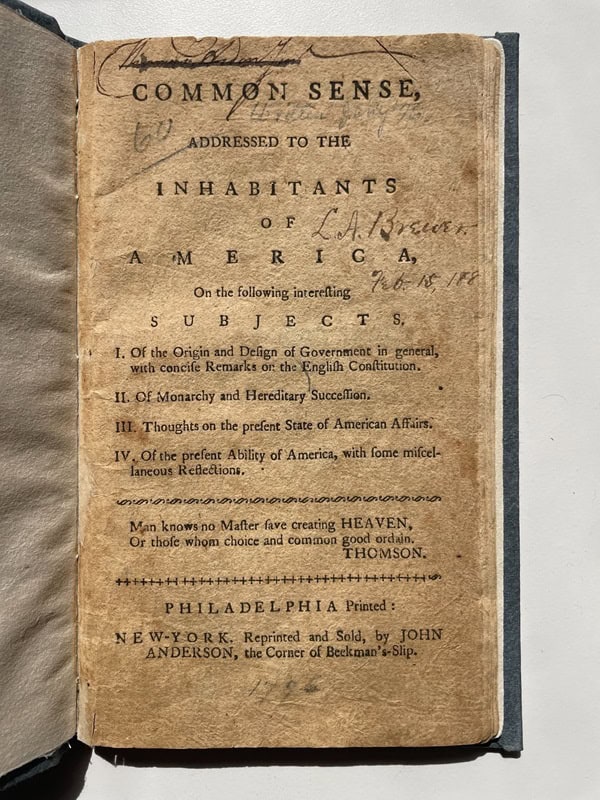
“I have never met with a man, either in England or America, who hath not confessed his opinion, that a separation between the countries, would take place, one time or other.”
Thomas Paine’s Common Sense is perhaps the most well-known of any pamphlet arising from the American Revolution. Written in 1775 and published in 1776, it carried the torch lit by Dickinson seven years earlier. Having been born in England, Paine migrated to America in 1774 and immediately joined the Revolution. Having just lost his business, his job, and separated from his wife, he joined his friend Benjamin Franklin in the colonies, and after a year, began writing Common Sense.
Paine’s monumental essay rails relentlessly against monarchy and tyranny: “But how a race of men came into the world so exalted above the rest, and distinguished like some new species, is worth enquiring into, and whether they are the means of happiness or of misery to mankind.” With inspiration from English preacher John Locke, and echoing both Dickinson and Price above, Paine focuses on natural rights and liberty.
It originally had the working name “Plain Truth” — which is also the name of an essay rebuking Common Sense, written by James Chalmers, a Loyalist and eventual exile of the colonies.
You can view these and other pieces in Special Collections and Archives, located on the third floor of the Main Library, which is open to the public. Still wanting to find ways to mark the 250th anniversary? Stop by the Great American Melting Pot pop-up exhibit on Sept. 10, 2026, from 11 a.m. to 1 p.m. on the first floor of the Main Library. We’ll be celebrating the rich food tapestries that make up these United States.
Notes and Works Cited:
- The old Ephrata printing press on which the declaration of independence was printed, and the original house No. 702 Market Street in which it was actually written by Thomas Jefferson. https://tile.loc.gov/storage-services/service/rbc/rbpe/rbpe16/rbpe160/16000600/16000600.pdf
The Cambridge Companion to the Declaration of Independence, Edited by Mark A. Graber and Michael Zuckert, “The Process of Writing and Procedures for Adopting the Declaration”, Peter Charles Hoffer and Williamjames Hull Hoffer
“Declaration of Independence, Printed on the Old Ephrata Press at the Centennial Exposition, 1876”, Springer FOLIO 342.731 .U52 1876
An oration; delivered March 5th, 1773 : at the request of the inhabitants of the town of Boston; to commemorate the bloody tragedy of the fifth of March, Dr. Benjamin Church, 1770 xE215.4 .C5 1773a
Twelve Letters From a Farmer, John Dickinson xE215.5 .D546 1774
Free Thoughts on the Proceedings of the Continental Congress, Held at Philadelphia Sept. 5, 1774, Samuel Seabury, xE211 .S41
Observations on the Nature of Civil Liberty, the Principles of Government, and the Justice and Policy of the War With America xE211 .P961
Common Sense, Thomas Paine xVAULT E211 .P1455 1776