This series features the work and research of University of Iowa students. The following is written by Noah Jedlicka, a student worker at Special Collections and Archives working on his Master of Arts in Classics.
The University of Iowa has many texts and writings scattered throughout different departments, libraries, and seminar rooms across campus. As the university has only existed for 179 years, the large majority of these texts sit in that time range, with most being published or printed in the 1800s to 1900s. Sitting in a display case in the corner of the lobby of the Department of Classics, however, reside 23 clay tablets, some dating to those 19th and 20th centuries — albeit, BCE.
While they may not look like much, these are instances of writing around 3,000 to 4,000 years old. The tablets are in a variety of shapes and sizes, from quadrilateral parallelograms to a cone, and range from four to eight inches tall. Some, in the many years since they were produced, have seen wear and tear — or, in this case, cracks. They are preserved in small blue boxes, with cotton behind them, and feature a translation of the text.
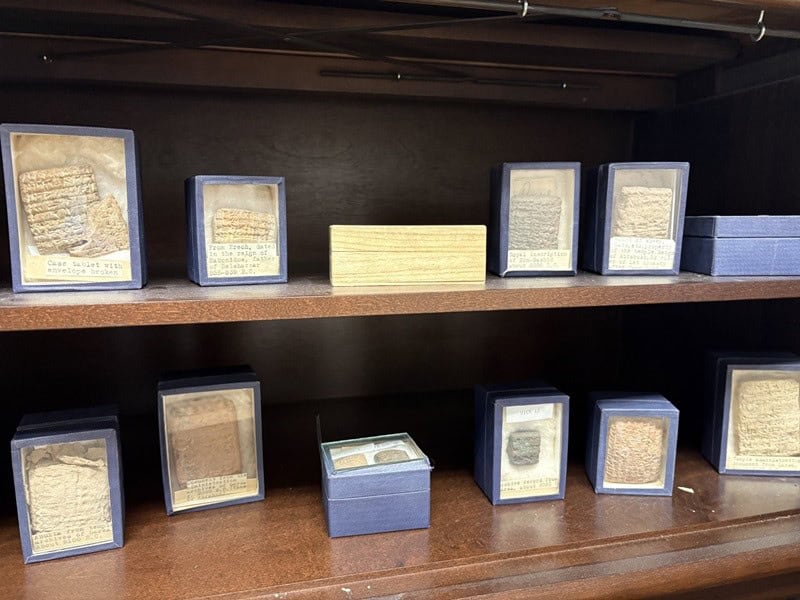
In 1979, a study of the tablets was undertaken by Dr. Francesca Rochberg-Halton and Dr. Paul Zimansky, two researchers out of the University of Chicago. In the study, the first 18 tablets were copied and translated by Rochberg, with Zimansky undertaking the final five:
“The twenty-three tablets, ranging in date from the Ur III period to the reign of Cambyses, can be seen as a representative sample of common legal and economic documents, with the addition of two typical Sin-kasid votive inscriptions,’ and a Sumerian literary tablet. No records exist of how or when this diverse collection came into the possession of the University of Iowa, but the collection conforms in size and character to other groups of tablets sold in the United States in the early decades of the twentieth century. We wish to thank Prof. O. E. Nybakken, curator of the Museum, and Prof. Roger A. Hornsby, Chairman of the Classics Department, for permission to publish these texts. Thanks are also due Prof. Hermann Hunger and Prof. Miguel Civil for their generous assistance. The first eighteen tablets were copied by Rochberg-Halton, and the remaining five by Zimansky.”
As noted above, in the introduction to their research paper, the Department of Classics had no paper trail or known connections to the tablets. However, the University of Iowa Libraries Special Collections and Archives maintains an extremely strong records collection detailing the history of our university, and, as a Classics major, I wondered if the answers were residing there.
Having been born in a digital era, newspapers were not my first thought to explore. However, as I would learn over the course of this project, a wealth of information was recorded daily in these papers — a sort of pseudo-diary for the campus. The university has over 100 years of digitized editions of The Daily Iowan in its archives, and it doesn’t stop there. The archives also include records that go back to 1868, allowing access to the student newspapers that were published preceding the DI. Searching several variations for “cuneiform tablets,” I found an article from Nov. 17, 1916, detailing the collections at the university’s Museum of Art and Archaeology. This article, seen below, asserts that then-President Emeritus Thomas Huston Macbride had acquired the tablets for the museum:
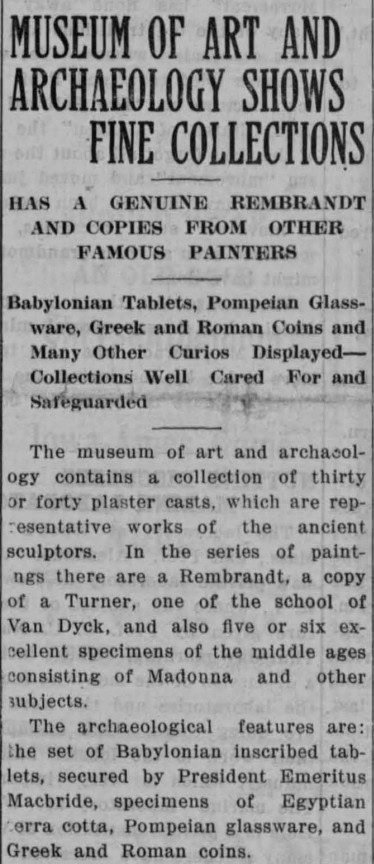
This now-extinct museum was located in 305 Schaeffer Hall. Located directly next door, in room 306, was the Mark Ranney Collection, and the two collections were eventually merged. In 1951, following the opening of the university’s General Library (now known as the Main Library), portions of these collections went different ways to the departments in which they belonged. The Ranney Collection is currently in Special Collections and Archives, with the coins and the tablets housed in the Department of Classics.
President Macbride, for whom the building on campus is named, was hired by the University of Iowa in 1883 as a professor of botany. In 1902, 19 years after arriving at our institution, he was named the head of the Department of Botany, and he would serve in that position until his promotion to university president in 1914. While he would only hold this post for two years, citing age and health as his reasons to step down, his service to the University of Iowa was busy and full.
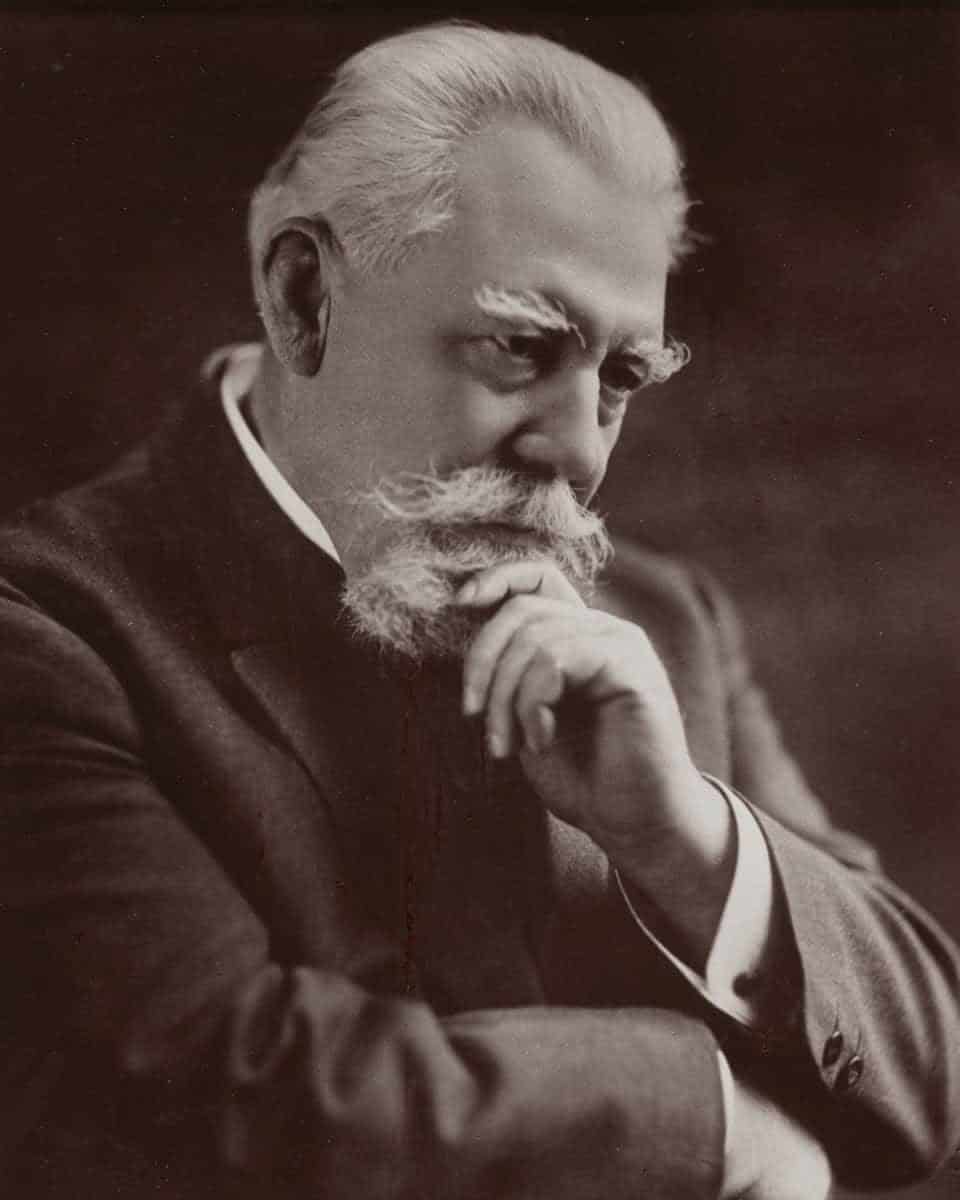
In March 1916, the very year he would resign, Macbride read a book by Dr. Albert T. Clay, titled Miscellaneous Inscriptions in the Yale Babylonian Collection. Macbride was shocked to find that a good many of these tablets contain “simple contracts, such as for the construction of ditches… houses… and land leases.” In a letter to Clay, around that time, Macbride asked for some tablets of that nature to be sent to the university: “In regards to the tablets, I beg to say that I should be very glad if you would select for me about $40 worth.” Clay agreed and began preparing the tablets.
For a short while, it seems that Clay didn’t respond, and this worried Macbride. In a follow-up letter, dated May 27, 1916, he provided a deadline:
“Some time since I was favored with a letter from you, in which you stated that you were making up a little set of tablets for the University, and saying that you would send them in the near future. I made no reply, because I understood that you were proceeding without further advice. Fearing that there may be some misunderstanding, and that you are awaiting a definite order from me, I am writing this morning. I beg to say that we shall be glad to receive the objects which you are setting out for us, and I should be glad to know whether we might have them before the fifteenth of June.”
(The University Archives has a vast collection of correspondence saved from historic individuals related to the University, and a large quantity of Macbride’s survives. The letters quoted above both come from this collection)
Clay would respond three days later, and after a few more letters back and forth, would send 25 tablets to Iowa. The boxes, having been made by Yale and shipped with the tablets, cost $2.50. They arrived on June 7, 1916, clear of the June 15th deadline, and have resided here ever since.
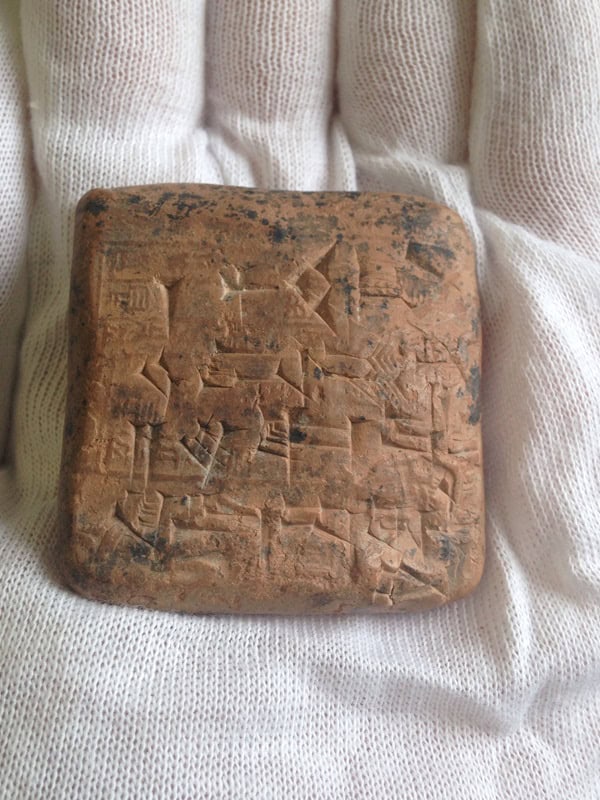
If you’d like to see these tablets, you may have to wait — the Department of Classics is currently merging with Religious Studies and changing spaces. However, Special Collections and Archives also have a tablet in their Smith Miniature Book Collection dating to around the same period, and they are open Monday through Friday, 9 a.m. to 4 p.m.
Works Cited and Further Reading:
Clay, Albert T. 1915. Miscellaneous Inscriptions in the Yale Babylonian Collection. AMS Press.
Daily Iowan. 1916. “Museum of Art and Archaeology Shows Fine Collections.” November 17, 1916, 1. https://dailyiowan.lib.uiowa.edu/DI/1907/di1907-10-06.pdf.
Rochberg-Halton, Francesca, and Paul Zimansky. 1979. “The University of Iowa Cuneiform Tablets.” Journal of Cuneiform Studies 31, no. 3 (July): 127-188. https://doi.org/10.2307/1359823.
“Thomas Huston Macbride (1914-1916).” n.d. In UI Presidents, Main Library Gallery. University of Iowa Libraries. https://www.lib.uiowa.edu/gallery/ui-president/thomas-huston-macbride/.