Have you heard the news? Iowa Research Online (IRO) is new and improved! Staff at the University of Iowa Libraries have been hard at work on a new interface that goes way beyond the traditional institutional repository.
We’re the first institution in the world to go live with Esploro from Ex Libris, a research information management solution. This cutting-edge technology automatically captures the latest works by UI authors and brings it to your fingertips.
IRO collects and showcases the innovative research, scholarship, and creative work produced by the university’s talented faculty, students, and staff. Its purpose is to foster discovery and collaboration as well as demonstrate the impact of teaching and learning in Iowa and beyond.
You can use IRO to:
Get access to the latest UI scholarship on any topic you can imagine.
Browse research units to see what UI colleges, departments, and research centers are up to.
Do you need a data management and sharing plan (DMSP) for your grant proposal? The University of Iowa Libraries Research Data Services can help! Brian Westra, data services librarian, is available to help you create a data management plan in alignment with funding agency requirements. If you have questions about:
Which repository is most appropriate for my data?
What data standards apply to my data?
What metadata should be used?
Are there other agency-specific requirements to include in my plan?
We can help you create a data management plan to support your proposal. Research Data Services monitors funding agency policies and guidance, including the NIH policy.
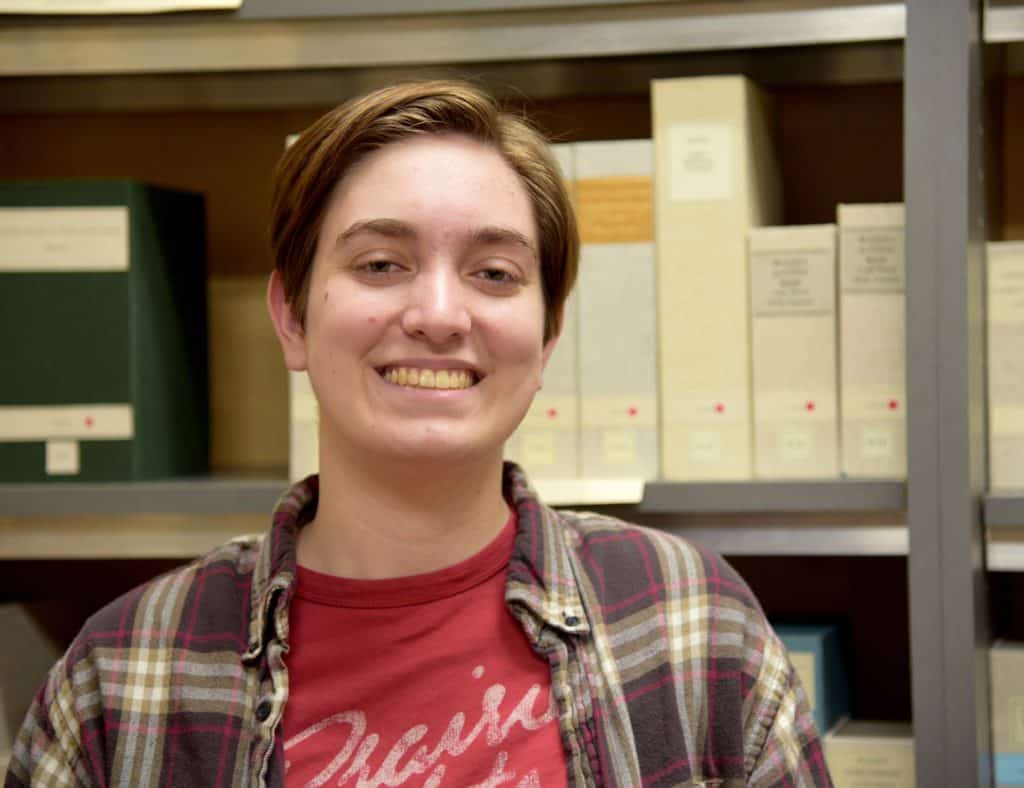
Luke Ayers is a student worker in Conservation and Collections Care.
For One Day for Iowa 2024, we’re highlighting the new University Librarian’s Student Employee Fund, which will create more opportunities for advanced student employees to enhance skills, bolster career-development goals, or pursue special interests. These are students like Luke Ayers, whose job in Conservation and Collections Care at the University of Iowa Libraries has set him on a path toward a career in library science.
Ayers first began working at the UI Main Library two years ago, early in his undergraduate career. Like many incoming students, he wasn’t certain where his career path would lead, and library science wasn’t yet on his list of options. But as Ayers worked closely with the UI Libraries staff, he soon realized that the field was far more expansive than he’d first thought, and he became confident that the School for Library and Information Science (SLIS) Undergrad to Grad program was the next step for him.
Ayers is one of the advanced student employees at the UI Libraries, meaning that his work requires specialized training within his field that can often only be achieved with practical experience outside of the classroom. Because he’s enhancing these skills alongside his degree, Ayers will be especially prepared to succeed after graduation. That’s exactly what these roles are designed to do, and the University Librarian’s Student Employment Fund will enable the Libraries to expand that support to more student employees.
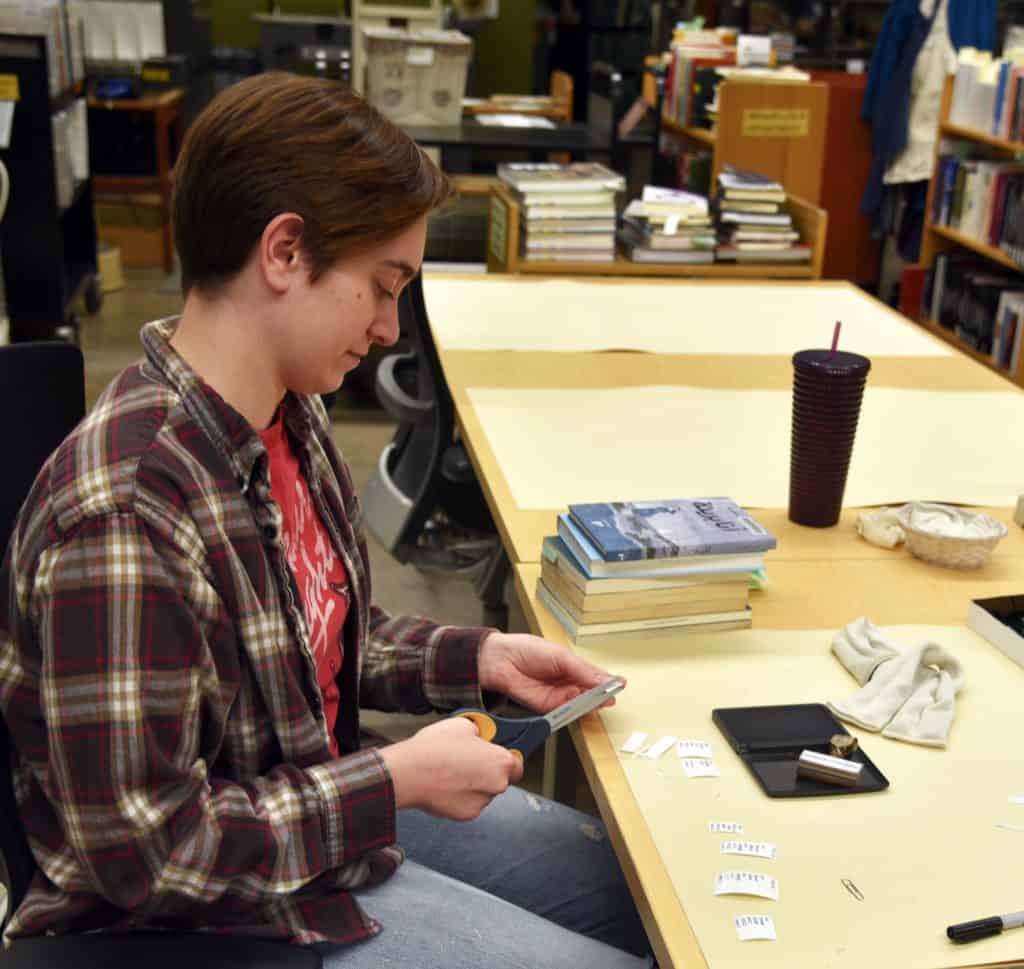
Ayers marks new acquisitions for circulation.
“This fund came about naturally because we observed the creativity and enthusiasm of our student employees,” says Jack B. King University Librarian John Culshaw, who was once a student library worker himself. “So many of them are eager to grow their skillset and apply it to more specific and challenging aspects of library work. The future of libraries and archives really belongs to them, so we’re happy to give them the chance to follow their curiosity.”
On an average day, Ayers spends his time in collections care, marking new acquisitions to prepare them for circulation. It’s satisfying work, he says, to know that he is beginning a book’s journey into the hands of an interested reader. Each book’s edges are stamped with “University of Iowa Libraries,” and the item is officially welcomed into the catalog. Those already reserved go straight to the hold shelf to be picked up by the campus and local communities. Print books are still used heavily by some disciplines even though the majority of Libraries’ resources are digital.
For the past two years, Ayers has been selected for different UI Libraries’ student employee scholarships, the Judy and Mike Greer Scholarship in Memory of Mary E. Greer and a UI Libraries Employee Scholarship, in recognition of his contributions to the department. Ayers says that these scholarships have taken some financial pressure off his undergraduate experience, enabling him to focus on his studies without needing to consider a second job.
Ayers hopes that he’ll have a chance to work on cataloging next, an area that interests him as he looks ahead. “It’s been really cool,” says Ayers. “Getting the job here, I was able to see all the different positions you could have in a library, places where I could fit.”
To support more advanced positions for students like Ayers, consider donating to the One Day for Iowa University Librarian’s Student Employee Fund at https://1dayforiowa.org/24libraries.
The University of Iowa Libraries are pleased to announce a new transformative agreement with Cold Spring Harbor Laboratory Press (CSHLP), an internationally renowned publisher of books, journals, and electronic media in genetics and molecular biology. The agreement includes:
Unlimited open access publishing by UI-affiliated corresponding authors, without payment of open access fees or Article Processing Charges (APCs), in any of the following journals:
To publish open access in CSHLP journals without paying open access fees or APCs, corresponding authors simply submit a manuscript using their UI affiliation and email address—they will be automatically identified as eligible for the agreement.
Through this agreement, UI authors retain copyright of their articles, which are published with Creative Commons CC-BY or CC BY-NC licenses.
Open access publishing helps UI research reach a wider audience because it is free to read and not limited to subscribers. The CSHLP transformative agreement is one of a growing number of open access agreements in which the UI Libraries participates as part of its commitment to support open access. Articles published through this agreement will be added to the UI Libraries Support Open Access collection in Iowa Research Online.
Ramin Roshandel will never forget the first time he stepped into the University of Iowa Rita Benton Music Library. From the beginning, the PhD candidate knew that the library would become a crucial part of his time as a student of music composition pedagogy. Roshandel describes being immediately “overjoyed with the beauty of the space,” and with the friendly staff who work within.
In no time, Roshandel found a source of collegiality and support in the Music Library. After his initial visits, he remembers being pleasantly surprised by spontaneous emails from library assistants Amy McBeth and Christine Burke, who had continued the search for resources that might interest him even after he had left the building. In a library with a vast repository of materials, the staff soon became a welcome source of support. And on occasions when the items Roshandel and his cohort were seeking were unavailable, the Music Library’s director, Katie Buehner, was “extremely cooperative and enthusiastic” about fulfilling requests for acquisitions.
The appreciation is mutual; Buehner has high praise for Roshandel’s contributions to the Music Library. “Ramin requests many excellent scores and other materials for library purchase, and recently, he advised me on the purchase of several monopods/tripods that would pair well with our circulating video recorders,” she said. “He is creative, collaborative, and incredibly kind, and it’s been an immense privilege to have him work and study here at the Music Library.”
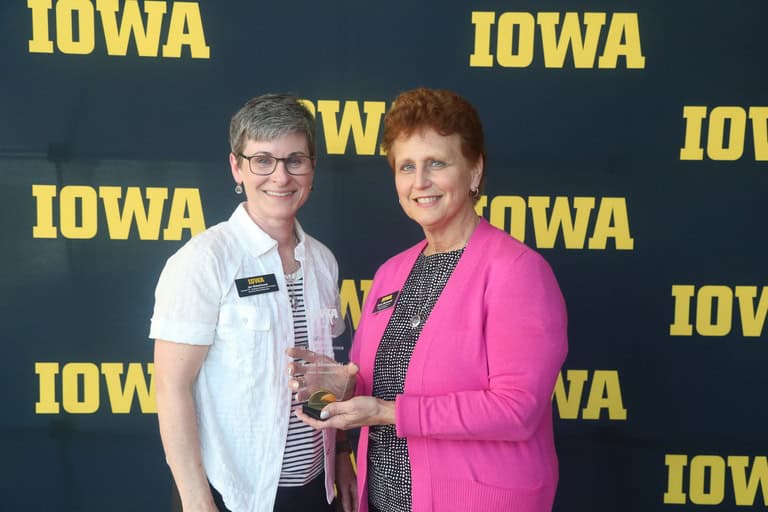
Eventually, Roshandel joined the team at the Music Library himself, bringing the same enthusiasm to his own role. His familiarity with the world of music and the students, faculty, and researchers who frequent the Voxman Music Building have made him particularly adept at helping library users unearth resources that enrich their work. These qualities also recently earned him a Libraries Academic Achievement Award for 2023–24.
Roshandel, who came to Iowa from Iran, earned a bachelor’s and master’s degree at institutions in Tehran. He found that political constraints sometimes limited his research, forcing him to rely heavily on online or electronic resources. The availability of physical media at the university was a welcome change, and the Interlibrary Loan system meant that nothing was out of reach.
“I have been thinking a lot about the importance of physical resources lately…this is because of the ubiquity of ‘online-ness’ in our lives these days, especially social media, and our detachment from the tangible things we can learn from.”
RAMIN ROSHANDEL
“I have been thinking a lot about the importance of physical resources lately,” said Roshandel. “This is because of the ubiquity of ‘online-ness’ in our lives these days, especially social media, and our detachment from the tangible things we can learn from.”
Roshandel expects that the skills and knowledge base he’s developed as a student library employee will continue to serve him in his chosen career. After receiving his doctorate, Roshandel plans to continue to work in academia as an instructor, and his work at the Music Library has helped him to recognize academic libraries’ “significant impact on the teaching and learning process.” After his time as an employee and a patron of the Music Library, he feels well-prepared to guide his students towards library resources.
Interested in hearing Roshandel’s music yourself? He and UI School of Music faculty member Jean-François Charles recently collaborated on a submission to NPR’s Tiny Desk Contest 2024, combining the Persian sētar with live electronics. Their album, Jamshid Jam, was released in 2022.
This photo features the five undergraduate women who integrated Currier Residence Hall in 1946: Virginia Harper, Esther Walls, Nancy Henry, Gwen Davis, Leanne Howard, and Pat Smith. Their story lives on in the Iowa Women’s Archives and in Currier, where a mural commemorates their achievements at the university and beyond.
We are especially fortunate to have Harper’s (furthest right) niece and namesake, Virginia Eichacker, as a member of our Libraries Advancement Council (LAC). To mark the transition from Black History Month into Women’s History Month, we asked Eichacker about what this image and her aunt’s legacy mean to her.
As I look at the picture of the young women who integrated Currier Hall in 1946, the first thing that strikes me was that they were not looking into the camera but at something that appeared to be in the distance. In that same vein, I also noticed their smiles. It seemed they were smiling almost knowingly, aware that this was a significant moment in time…I know that, whatever my aunt was thinking and smiling about when the photographer took this picture, she did not imagine that 75 years later (2021), it would be part of a mural in a room in Currier Residence Hall—which she had been excluded from the year before.
Following her time at the University of Iowa, my aunt spent the next 50 years working to fight racial prejudice as a member of the Fort Madison branch of the NAACP. She was the first Black woman on the State Board of Public Instruction, where she championed the move for multicultural, nonsexist requirements in Iowa’s education.
If you’re looking for a local history of civil rights activism, the University of Iowa Libraries is a vital resource. The Main Library houses the Iowa Women’s Archives (IWA), filled with the papers and records of many remarkable individuals and organizations devoted to the ongoing struggle for civil rights and social justice. My aunt’s papers, the Virginia Harper Papers, are one such collection.
When approached about serving as a member of the LAC, I was honored to devote my energies toward actively championing the Libraries. And I want to encourage everyone to consider supporting the Libraries and the IWA as we close out Black History Month and start Women’s History Month.
I know that if my aunt could see this post, the same smile on her face in the picture 78 years ago would reappear.
Are you looking for a way to enhance your teaching, save your students money, and contribute to the global knowledge commons? If so, consider applying for the OpenHawks grant program at the University of Iowa.
Over the last several years, OpenHawks has funded over 60 Open Educational Resources (OER) projects across a broad range of disciplines and saved students more than $1 million to date. Read more about the OpenHawks projects that received funding in 2023-2024.
What is OpenHawks?
OpenHawks is a campuswide grant program that funds instructor efforts to replace their current textbooks with OER for enhanced student success. This program, funded by the Office of the Provost and UI Libraries, is open to any faculty member or graduate student who teaches for-credit courses and medical residencies at the university. If you are concerned about the cost or quality of your existing textbooks and would like to explore OER, this might be just the program you need. There is a range of awards, from adoption to creation, depending on the type of project you’d like to complete. OER can include textbooks, course readings, simulations, games, quizzes, and many other tools or techniques used in education.
Why use OER?
There are many benefits of using OER in your courses, such as:
Reducing costs for students – By using OER, you can help your students save money and reduce financial barriers to education.
Improving student learning outcomes – Studies have shown that students who use OER perform as well or better than those who use traditional textbooks and are more likely to complete their courses.
Tailoring resources to your students’ needs – Because OER are openly licensed, you can amend them, add local examples, even involve your students in editing them.
How to apply for OpenHawks
The program offers four types of grants, ranging from $500 to $10,000, depending on the scope and scale of the OER project.
The application deadline for the 2024-2025 academic year is Friday, April 26, 2024. To apply, you need to complete an online Qualtrics application. You can find more information about the application process, eligibility criteria, and evaluation rubric on the OpenHawks website.
Need help or have questions?
If you are interested in applying for the OpenHawks grant program, or if you have any questions about OER, feel free to contact Scholarly Communications Librarian Mahrya Burnett at mahrya-burnett@uiowa.edu. Don’t miss this opportunity to join the growing movement of OER at the UI and beyond. Apply for today and make a difference in your teaching and learning!
For one Hawkeye couple, the journey of a thousand miles started at a wobbly table in the Main Library.
Georgia and Harry Mihm of Bettendorf have been happily married for over 50 years.
In the late 1960s, Dr. Harold “Harry” Mihm was pursuing his MD at the University of Iowa Roy J. and Lucille Carver College of Medicine, and Georgia Benda was an undergraduate studying special education. They began as strangers seated at a communal table on the Main Library’s second floor, both intensely focused on their coursework. In fact, one afternoon Harry was so absorbed in the task of annotating his anatomy textbook that he didn’t realize his scribbling was sending a tremor down the table, irritating the young woman a few seats away.
“It was distracting, so I asked him to please quit shaking the table,” says Georgia. They got to talking, and Harry offered her a ride home to keep out of the rain. So begins their origin story, a playful back-and-forth that has lasted a lifetime.
The Mihms’ wedding took place in the fall of 1970.
53 anniversaries and four children later, they’re both glad Georgia spoke up. They were married in 1970, at the beginning of Georgia’s senior year and Harry’s third year of medical school. After graduating from the College of Medicine in 1972 and completing an internship, residency, and fellowship, Harry went on to work as an OB/GYN for 36 years in the Quad Cities area, where the couple made their home. Georgia became an active member of the community and was soon elected to the school board in Bettendorf. She served six terms on the board of the Bettendorf Public Library and was a charter member of the Bettendorf Community Schools Foundation.
Now retired, the Mihms spend half the year in Bettendorf and half in Naples, Florida, a beachside town that boasts a robust community of Iowans. They enjoy spending time with their family, which has grown to include 11 grandchildren and a beloved Schnauzer. This year, Harry and his daughter made a cross-country road trip to Florida with the dog in tow, meeting Georgia in Naples to spare their canine companion a cramped journey under an airplane seat.
The couple’s Iowa love story began at the Main Library.
“We’re Iowans, through and through,” says Harry. “But even Hawkeyes need some sun.”
But it may be that Harry and Georgia’s paths were always meant to cross. As it turned out, they both grew up in Northeastern Iowa, about an hour away from each other. While her mother, aunts, and sister had all attended Clarke College, which was then a women’s school, Georgia broke with tradition by becoming a Hawkeye. At first, this decision was slightly disappointing to her mother; she’d always hoped Georgia would attend Clarke and settle down with a graduate of its brother school, Loras College.
It turned out that her mother had nothing to fear when her daughter moved down to Iowa City in 1967. Georgia started dating Harry and was stunned to learn that he’d earned his bachelor’s degree from Loras. It seems that life had plans of its own, brought to fruition by a fortuitous encounter at the Main Library.
Georgia and Harry have maintained a strong connection to the University of Iowa, and especially its libraries. Next time they visit Iowa City, they’re planning a visit to the building where it all began.
“It’s pretty amazing to think about. So much changes in 50 years, but the character and the culture of the place are the same,” says Georgia. “That’s how it is with us, too. We’ve grown together.”
The table where they sat that day may have been replaced, but the essence of the Main Library’s second floor—its towering stacks illuminated by tall windows—remains. And so do the students, who sit with their textbooks open, pens in hand, each one still on the first page of their own story.
The University of Iowa Libraries is pleased to announce a new read and publish agreement with John Benjamins Publishing Company, an independent academic publisher of books, journals and online resources in linguistics and the language sciences. The agreement includes:
Unlimited open access publishing by UI-affiliated corresponding authors in all John Benjamins active journals and yearbooks, without payment of Article Processing Charges (APCs).
Read access for the university community to selected John Benjamins journals:
To publish open access in John Benjamins journals without paying APCs, corresponding authors simply submit their manuscript using their UI affiliation and email address—they will be automatically identified as eligible for the agreement.
Through this agreement, UI authors retain copyright of their articles, which are published with Creative Commons CC-BY licenses.
Open access publishing helps UI research reach a wider audience because it is free to read and not limited to subscribers. The John Benjamins read and publish agreement is one of a growing number of open access agreements in which the UI Libraries participates as part of its commitment to support open access.
Each year, the University of Iowa Libraries recognizes two graduate student employees for their contributions to the institution and the library or department in which they work. Recipients of an Academic Enrichment Award (AEA) are selected by a committee based on their application essays and the feedback of their supervisors, and winners receive a scholarship of $2,500. The winners for 2023-24 are Jennifer Miller and Ramin Roshandel. Below, Miller and Roshandel spoke to us about their work in the Libraries, what they’ve learned, and how they hope to apply the experience to their future careers.
Jennifer Miller is an MA student in the School of Library and Information Science and an MFA candidate at the Center for the Book. She was selected for her work in Preservation and Collections Care. Originally from Iowa City, the committee expressed appreciation for Miller’s sense of wonder and enthusiasm toward the materials in her care.
How has your work at the Libraries helped you develop important professional skills? How might you use those skills in your future career?
My work in Collections Care has helped me develop the professional skills needed to repair, restore, and preserve books in the circulating collection. In the future, I hope to work as a teacher or an academic librarian (or both) to facilitate research projects rooted in non-circulating items (special collections) including artist’s books and other primary resources.
Has there been anything that surprised you about working in a library?
What has surprised me most about working in a library is the scope of the collection. For example, I recently cleaned and wrapped multiple oversized volumes of the London Times dating from the 1860s to 1900. These daily printed newspapers had been opened flat and bound together with a publisher’s binding. As I prepared them for off-site storage in the Libraries annex, I tried to imagine who read the papers when they first arrived here in Iowa City. Today, we usually think of printed newspapers as ephemeral, but these paper artifacts show the magnitude of printed news that circulated in our society pre-1900. The culture of the time period was reflected in every printed page, and they seem to be quite valuable as primary source research items. Yes, we can probably find digitized copies online, but these provide evidence showing how materially specific our cultural history of news production really was. The paper, the printing, the industry—it is all there in those objects which are now in storage in the annex. Perhaps they are waiting to become part of someone’s future research study.
Ramin Roshandel, a PhD candidate in music composition from Iran, received an AEA award for his work at the Rita Benton Music Library. The committee were impressed by his dedication to his work and his attention to detail, as well as his thoughtful engagement with library users who called on him for assistance.
How has your work at the Libraries helped you develop important professional skills? How might you use those skills in your future career?
Through my work at the Music Library, I have been able to develop a great number of research skillsets. I have been using those skills and will use them in the future both
in my own research as well as in my music composition pedagogy as an instructor.
Has there been anything that surprised you about working in a library?
There have been a couple of things that surprised me at the library, but maybe the most interesting one is, one time when I was looking for a book for a patron, I ran into another book in the stacks: The Canon of the Persian Music, which is the book I studied throughout my undergraduate time. It was, of course, the English version of the book, but finding it there, thousands of miles away, among thousands of other scores and books, was very surprising. It is also interesting that that book is not the only book about Persian music in the Music Library.