Through a display at the Main Library, the Iowa City-Cedar Rapids Alumnae Chapter of Delta Sigma Theta Sorority, Inc., proudly presents, “Delta Women Who Have Served in the Political Arena,” to honor past and present members of the sorority who have served in public office. Members of the 95-year-old organization have labored in various capacities of local, state and federal government.
Political Awareness and Involvement is one of the organization’s Five Point Thrust, and only months after founding the sorority, young Delta women at Howard University participated in the Suffrage Parade on Washington on March 3, 1913. Although Black women suffragists had few allies and their concerns were not on the agenda, Delta women realized that Black women needed the ballot. Asked to march at the rear of the procession, Delta women were not discouraged and marched on Pennsylvania Avenue alongside women representing states, countries, organizations, and colleges. In 2008, Delta women continue to march for freedom and justice!
Delta Sigma Theta Sorority, Inc. is a private, non-profit organization whose purpose is to provide assistance and support through established programs in local communities throughout the world. The Delta Chapter at the University of Iowa will celebrate its 90th anniversary in April 2009. The Iowa City-Cedar Rapids Alumnae chapter is composed of UI alums and current graduate students.
This year due to the closure of the IMU, the Flu Vaccine Clinic will be held in the Main Library in the Second Floor Study Lounge (directly upstairs from the the North Circulation Desk).
The Clinic will be held on TODAY Tuesday, October 28 from 10 a.m. – 4 p.m.
How did librarians manage the natural disasters throughout Eastern Iowa? Please join the School of Library and Information Science for this exciting and informative panel as those in the trenches relay their first-hand knowledge of disaster planning, managing volunteers, preservation efforts at area museums and libraries, and ongoing activities by public and academic libraries to rebuild and recover after the flood.
Tuesday, November 4
Main Library, Second Floor Conference Room (2032)
10:30 a.m. – 12:30 p.m.
Scheduled to speak
Nancy Baker, University Librarian, University of Iowa Libraries
Tamara Glise, Interim Director, Cedar Rapids Public Library
Nancy Kraft, Head, Preservation, UI Libraries
Ruthann McIntyre, Head, UI Music Library
Rijn Templeton, Head, UI Art Library
For more information contact, Patricia Katopol, in the School of Library and Information Science.
In this election season, competing proposals for health reform have again taken center stage. Colin Gordon, the author of Dead on Arrival: The Politics of Health in Twentieth Century America, will place these proposals—and their prospects for success—in historical perspective.
Colin Gordon, Ph.D. is a professor of history at the University of Iowa, specializing in 20th Century U. S. History. For this program, Professor Gordon will provide a brief background on health care policy and its interaction with Presidential politics, prior to facilitating what we hope will be a lively discussion by all those in attendance.
Tuesday, October 28, 2008
5:30 to 6:30 p.m.
Hardin Library for the Health Sciences, Information Commons, 2nd floor
The University of Iowa History of Medicine Society is an informal group of students, faculty, staff, and members of the community sharing an interest in the history of medicine and the health sciences. We present speakers about once a month and, in the spring, host a banquet with a presentation from a well-known medical historian. We have no membership dues and we welcome participants from the University and the general community.
To become a member, simply send an e-mail to either Ed Holtum or Donna Sabin and ask to be placed on our electronic mailing list. In addition to alerting members of forthcoming presentations, the list is also a vehicle for members to communicate matters of interest relating to the history of medicine and the health sciences.
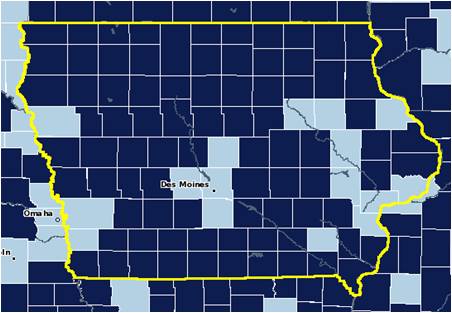
The dark blue indicates that over two-thirds of the households have a home computer.
In your marketing class, you may be developing a marketing plan for a pre-made meals restaurant specializing in vegetarian menus in Chicagoland. How do you learn where the highest percentage of people who purchase Boca Burgers live in Cook County?
Maybe you are working with an elder services agency in Des Moines and would like to provide computer classes for senior citizens across the state, but the question is where would be the best place to hold the classes?
The answer is in Simply Map. SimplyMap is a web-based mapping application that lets you quickly create professional-quality thematic maps and reports, using the thousands of US demographic, business and marketing data variables.
Dark blue indicates counties with a high number of retired people.
What Information Does Simply Map Contain? SimplyMap contains thousands of socio-demographic, business and marketing variables. Data comes from US government sources (Census, Labor Statistics, e.g.), as well as Market and Quality of Life data from EASI Inc., and Dun & Bradstreet “Points of Interest” data.
Most data sets are available down to the block group level, a geographic level used by the Census Bureau that is smaller than zip codes, although there is zip code data also.
What Does Simply Map Do? Maps can be created and saved within the program, then made into Powerpoint slides, added to Word documents, put on the web, etc.
Dark red shows counties with a high number of retired people AND where over two-thirds of the households own a computer.
Custom data tables can be created then exported in Excel spreadsheet format, and can also be downloaded as shapefiles-with-data that can then be put into a desk-top mapping program, such as ESRI’s ArcMap. Maps can then be created in ArcMap from SimplyMap’s shapefiles-with-data, with no need to join the data to existing Arcmap tables.
Who Uses Simply Map?
SimplyMap is of use to those interested in the demographics of large and small geographic areas of the US, e.g., sociologists, political scientists, journalists, business and marketing students and faculty. In addition, the data would be of use to life scientists who need background information for their demographic studies. SimplyMap includes 1980, 1990, and 2000 Census data, adjusted to 2000 census geographies, as well as 2006 and 2007 estimates and 2012 projections. 1970 census data will be available in future, but will not be geographically adjusted.
How Do I Use Simply Map?
This resource is available to individuals affiliated with the University of Iowa. To use SimplyMap, type “simplymap” into the Smart Search box on the Libraries website (if you’re off campus, you’ll need to type in your HawkID and password). You can create a personal workspace by clicking on “Create Personal Workspace” and entering your e-mail address and a password. SimplyMap will then send a confirmation e-mail to your e-mail address – please click on the link in this e-mail to activate your account.
Can I Work on Group Projects in Simply Map?
Yes. All members of your project group can share the same SimplyMap personal workspace and do collaborative work.
Can I Add My Own Data to Simply Map?
Yes. At this point, you should send your geographical-based data set to SimplyMap, and they will put it on the web. In future, users will have the capability to upload their data directly.
For any questions about Simply Map and how to use it, please contact Maps Librarian Mary McInroy in the UI Libraries Map Collection.
If the election this year is anything like 2004, 70 percent of Asian American women and Latinas, and 40 percent of African American women will be missing at the polls on Election Day. Learn how to make this election different.
Touching on the history of suffrage, and featuring interviews with politically active women from a variety of backgrounds, Engage Her!is “a groundbreaking documentary about the importance of mobilizing women voters, particularly women of color from underrepresented groups.”
Join us on October 28. Vote on (or before) November 4.
Co-sponsors: Center for Diversity & Enrichment, Council on the Status of Latinos, Iowa Biosciences Advantage, Iowa Edge, University Libraries, College of Nursing, Women in Science & Engineering, Women’s Resource & Action Center
When the Iowa Department of Transportation begins plans for a new roadway or expansion of a current one, they often review aerial photos to gain a historical perspective of the affected areas. Of course sorting through thousands of photos to find the one that depicts the right area is a very time-consuming task. So photomosaic indices were developed and now the University of Iowa Libraries have added them to the Iowa Digital Library.
These indices and the corresponding photos are often used by geologists and geographers, urban planners and geneologists, attorneys and civil engineers who are researching the previous uses of the land and planning future projects. On the photos themselves, researchers can discern historic building foundations; pre-mechanized farming methods; burial mounds (Office of the State Archaeologist has successfully used the photos for this purpose); old road beds; prior usage of lots for commercial purposes such as gas stations; and stream and river channels that have shifted from either natural or human causes.
The University of Iowa Libraries Map Collection holds over 150,000 aerial photographs of Iowa’s counties from the 1930s to the 1990s. Most of the photos are accompanied by photomosaic indexes that allow researchers to determine specific photos needed for projects.
Photomosaic indices, as well as individual Iowa aerial photographs, are available for public use in the Map Collection. To determine whether a particular photo is available for copying or scanning, please contact the Map Collection staff. Digital versions of some of Iowa’s aerial photos, including photos taken as recently as 2000, can be found on Iowa State University’s Iowa Geographic Map Server.
Though the quality of some of the pre-1955 indexes is poor, we still felt it was an important collection to bring into the Iowa Digital Library, because it gives researchers a place to start their search for more information. Some of pre-1955 paper indexes were obtained from the National Archives (NARA) and are photoreductions of the originals.
The Iowa Digital Library contains more than 175,000 digital objects—photographs, maps, sound recordings and documents—from libraries and archives at University of Iowa and their partnering institutions. The Iowa Digital Library also includes faculty research collections and bibliographic tools (holdings information for some library materials that are not otherwise accessible through the online catalog). Digital collections are coordinated by Digital Library Services, which manages the preservation, delivery, and structure of UI Libraries’ digital content.
There may be as many as 300,000 child soldiers, hopped-up on drugs and wielding AK-47s, in more than fifty conflicts around the world. Ishmael Beah used to be one of them. He is one of the first to tell his story in his own words.
As part of the One Community, One Book project, the UI Libraries will be hosting a discussion of Ishmael Beah’s A Long Way Gone. Though the book tackles a difficult subject, the prose is straightforward and uncomplicated, making this OCOB selection a quick read.
Wednesday, October 22 at 8 p.m.
Second Floor Study Lounge, Main Library (directly upstairs from the North Circulation Desk)
At the age of 12, Ishmael Beah fled attacking rebels in his home country of Sierra Leone during their civil war. Soon he found himself in the army, forced to participate in casual mass slaughter. This horrific life lasted until he was 15, when he was brought to a rehabilitation center sponsored by UNICEF and partnering NGOs. In his late teens, he eventually came to the United States where he remains. Mr. Beah finished high school in the U.S. and earned a bachelor’s degree in political science from Oberlin College. He is now a member of the Human Rights Watch Children’s Rights Division Advisory Committee. He has established a foundation dedicated to helping former child soldiers reintegrate into society and improve their lives.
Starting Thursday, October 23 the Art Library will be closed for flood clean-up procedures. The clean-up is expected to last through Sunday, October 26. Library staff will not be able to retrieve requested materials.
Delivery requests for Art Library materials placed after noon on Wednesday, October 22 will not be processed until Monday, October 27. We expect to resume normal delivery services on the 27th.
If you have questions, please contact the Art Library staff via our email form or by phone at 335-5287.
A new video series presents six unique perspectives on the importance of Open Access to research across the higher education community and beyond. SPARC (the Scholarly Publishing and Academic Resources Coalition) and the Public Library of Science (PLoS), the organizers of the first Open Access Day with Students for FreeCulture, today released the series of one-minute videos capturing why teachers, patient advocates, librarians, students, research funders, and physician scientists are committed to Open Access.
The “Voices of Open Access” series defines Open Access as a fundamental component of a new system for exchanging scholarly research results, where: health is transformed; research outputs are maximized to their fullest extent; efficiencies in the research process enable faster discoveries; the best science is made possible; young people are inspired; access transcends the wealth of the institution; cost savings are realized across the research process; and medical research conducted for the public good is made available to everyone who needs it.
“These short videos vividly bring to life why Open Access matters to a broad range of people,” said Peter Jerram, Chief Executive Officer of PLoS. “From a teacher who used a mouse song to inspire her science class to a major funder of scientific research who believes that it helps scientists make the discoveries we need to improve health. These clips are a much needed resource for this growing international movement which now seeks to recruit even more members of the general public and the scientific community to its cause through Open Access Day, October 14, 2008.”
Added Heather Joseph, Executive Director of SPARC, “This series speaks to the heart of the broad appeal of Open Access; the new opportunities it creates for everyone to benefit from the results of science and scholarship.”
The series introduces:
* Barbara Stebbins, science teacher at Black Pine Circle School in Berkeley
* Mark Walport, Director of the Wellcome Trust, London, U.K.
* Sharon Terry, CEO and President of the Genetic Alliance, Washington, DC
* Ida Sim, Associate Professor and a practicing physician at the University of California, San Francisco
* Diane Graves, University Librarian for Trinity University, San Antonio
* Andre Brown, PhD student, University of Pennsylvania
The series was created by filmmakers Karen Rustad and Matt Agnello.
The videos are available for the public to view, download, and repurpose under a CC-BY license at http://www.vimeo.com/oaday08. They are also available as a single file for viewing at events.
The Voices of Open Access Series is launched in conjunction with the first Open Access Day and the fifth anniversary of the launch of PLoS Biology, the flagship biology journal from the Public Library of Science. Open Access Day 2008 will help to broaden awareness and understanding of Open Access, including recent mandates and emerging policies, within the international higher education community and the general public. The day will center on live broadcast events with leading scientists and will be marked by more than 100 campuses in 20 countries. For details, visit http://www.openaccessday.org.
The Public Library of Science (PLoS) is a nonprofit organization of scientists and physicians committed to making the world’s scientific and medical literature a freely available public resource. Read the FAQs on PLoS and open access, and visit the PLoS blog and Facebook group.
SPARC (Scholarly Publishing and Academic Resources Coalition), with SPARC Europe and SPARC Japan, is an international alliance of more than 800 academic and research libraries working to create a more open system of scholarly communication. SPARC’s advocacy, educational and publisher partnership programs encourage expanded dissemination of research. SPARC is on the Web at http://www.arl.org/sparc.