Skip to content
Skip to main content

SPARC Welcomes You to Open Access Week

Welcome to Open Access Week 2009, from SPARC from Jennifer McLennan on Vimeo.

SPARC (Scholarly Publishing and Academic Resources Coalition of the Association of Research Library, of which the University of Iowa Libraries is a member) is a proud co-organizer of Open Access Week 2009 and is pleased to offer this welcome to the global celebrations, to be held October 19 – 23, 2009. See openaccessweek.org for details. In addition to a welcome and thanks to organizers, partners, and participants, SPARC principals cast the Week in the context of the international movement toward free, open, online, and immediate access to the results of scholarly research. Ideal way to open your week or your session, or to spread the word by email.

(c) Subject to a Creative Commons Attribution 3.0 License

Open Access and the Creative Commons

Editor’s Note: Throughout Open Access Week (Oct 19-23), the UI Libraries will be sharing the views of our UI colleagues on the topic of open access.

In November 2005 Creative Commons published the following conversation with UI Associate Professor, Kembrew McLeod. At the time he had recently published his book “Freedom of Expression®” under a Creative Commons License. 

by Kembrew McLeod, Ph.D., Associate Professor, Communications Studies

Creative Commons (“CC”): How did you come to decide to release your book “Freedom of Expression®” online under a Creative Commons license? How did your publisher respond to your decision?

Kembrew McLeod (”KM”): While working on “Freedom of Expression®”, I always knew I would vigorously try to convince Doubleday/Random House to release a PDF file version of my book under a Creative Commons license although I suspected that Doubleday/Random House’s response would be “no way.” After all, the parent company of Random House is Bertelsmann, the media giant that also owns one of the major labels that is suing downloaders, so I didn’t think they would exactly jump for joy at my proposal.

Then Larry Lessig released his book “Free Culture”, that was published by Penguin books (another media giant publisher) online under a Creative Commons license; it made the news, and eventually it filtered back to my editor, Gerry Howard, who is a truly extraordinary person, and a really cool rock ‘n’ roll dude (not to mention a legend in the editing world). Gerry deserves the credit for getting Random House and its lawyers to go along with the idea. However, I don’t think I ever would have gotten any traction if Larry hadn’t convinced already another major press of the merits of a Creative Commons license.

CC: Have you had any reaction or comments from members of the public about your online release of the book under a Creative Commons license?

KM: It has been a truly gratifying experience to have the PDF version freely available, especially because (with the exception of Japan, where it is being translated for publication), my book “Freedom of Expression®” has no overseas distribution. I have heard from someone at a UN office in Switzerland, who shares my research interests, as well as others from various European, Asian, and African countries. Not coincidentally, soon after the book was released I was invited to speak at a really interesting event to be held this October 14-15, 2005, in Budapest, Hungary, called: “RE:activism: Re-drawing the boundaries of activism in a new media environment.”

CC: You have been selling hardcopies of your book as well. Do you feel that the online release of your book under a Creative Commons license has had any impact on the hardcopy sales?

KM: When I placed the Creative Commons-licensed PDF version online a week after it had been released, Larry Lessig endorsed my book on his blog — providing links to both the free PDF version on my website, and to Amazon. After that, my Amazon ranking (of course, not the most scientific indicator of sales, but an indicator nonetheless) shot way, way up after he posted his recommendation. Honestly, I think I got more publicity from that event than anything else surrounding the release of the book. After all, my book did not receive even a millionth of the promotion muscle of, say, Harry Potter, so the Creative Commons-prompted publicity definitely helped. It also seemed to be a positive karmic act of good faith, given the nature of what I argue in the book.

CC: You are in the process of making a documentary about the second chapter of your book – “Copyright Criminals: This is a Sampling Sport“. You used the Creative Commons ccPublisher tool to upload the video for free hosting at Internet Archive. What was your experience of using the ccPublisher tool?

KM: It was really simple and easy! It took me less than one minute to do it, and I’ve recommended this tool to everyone who has asked about Creative Commons licenses. My co-producer, Ben Franzen, and I had already placed our 10-minute work-in-progress version of Copyright Criminals under a Creative Commons license. But when we remembered that there is free hosting on the Internet Archive for Creative Commons-licensed works, we quickly uploaded it there after we blew through our bandwidth in only 24 hours.

CC: You also had an interesting experience with our ccMixter site and a remix involving your “Copyright Criminals” documentary. Can you tell us about it?

KM: Straight after we made this early version of “Copyright Criminals” available, someone (Pat Chilla the Beat Gorilla) placed an a capella rap on the ccMixter site that starts out, “It’s the copyright criminals/hit you with a blast from the past… .”

Shortly after this track was uploaded, many different remixes appeared that reworked this a capella. To date, there are 9 different remixes. Next time we do another Creative Commons-licensed cut of our work-in-progress (the feature length version won’t be finished until sometime in 2006), we are intending to use Ashwan’s “Chilla Illa Tha Cilla Killa” during the credit sequence.

This is an example of one of those gratifying creative feedback loops that makes Creative Commons so attractive for so many different kinds of people. I am glad it happened.
A Very Brief Introduction to Open Access

 by Peter Suber http://www.earlham.edu/~peters/fos/brief.htm

Open-access (OA) literature is digital, online, free of charge, and free of most copyright and licensing restrictions. What makes it possible is the internet and the consent of the author or copyright-holder.

OA is entirely compatible with peer review, and all the major OA initiatives for scientific and scholarly literature insist on its importance. Just as authors of journal articles donate their labor, so do most journal editors and referees participating in peer review.

OA literature is not free to produce, even if it is less expensive to produce than conventionally published literature. The question is not whether scholarly literature can be made costless, but whether there are better ways to pay the bills than by charging readers and creating access barriers. Business models for paying the bills depend on how OA is delivered.

Open Access or: How I learned to stop worrying . . . ” – Oct 20

Did you know that access to some scholarly journals can cost as much as buying a new car . . . every year? That is a price that UI Libraries cannot afford, but it is a research tool that YOU can’t afford to work without. So what do we do? Open Access: it means more readers, more recognition and more impact for new ideas.

We invite you to join us to hear Molly Kleinman, Special Assistant to the Dean of Libraries at the University of Michigan and a copyright specialist, talk about it: “Open Access or: How I learned to stop worrying and love the Internet” at noon on Tuesday, Oct. 20th in the Bijou at the Iowa Memorial Union. 

This event is part of UI Libraries’ celebration of Open Access Week, October 19-23, 2009. Also that week, we’ll be posting more useful information about open access including our UI colleagues own experiences with open access.

For more information about scholarly communication and your role in creating a
sustainable system, check the Libraries website (www.lib.uiowa.edu/scholarly).

Co-sponsors of this event include the University of Iowa Libraries, Department of Communication Studies, Graduate Student Senate, the UI Center for Human Rights, College of Public Health, Widernet, Executive Council of Graduate and Professional Students, and the Project on the Rhetoric of Inquiry (POROI).

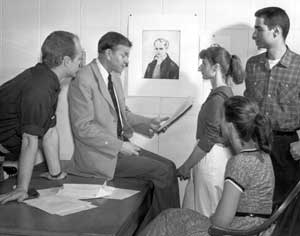
‘The man who brought the literary world to Iowa.’

Frederick W. Kent Collection, University of Iowa Archives

In 2000, Iowa Governor Tom Vilsack declared Oct. 12 to be “Paul Engle Day,” in honor of the Iowa-born poet who served as head of the Writer’s Workshop from 1942 to 1977, helping to develop it from an obscure experimental program to an internationally renowned literary center. Featured here is an audio recording from the first annual Paul Engle Literary Festival, which includes tributes to Engle from International Writing Program Director Christopher Merrill and from novelist Arnost Lustig.

Audio recording: First Annual Paul Engle Literary Festival, The University of Iowa, 2000

Create Open Access Video for the Sparky Awards

Washington, DC – The organizers of the popular Sparky Awards, a contest that recognizes the best new short videos on the value of information sharing, have announced that Pat Aufderheide, Director of the Center for Social Media and professor at American University, and Ben Moskowitz, organizer of the Open Video Alliance and co-founder of the Berkeley Students for Free Culture chapter, will help select the winners of the 2009 international contest. These additions to the judges’ panel reflect how vital the open sharing of information is to both students and faculty, and that the Sparky Awards is a unique forum to bring together stakeholders from across campus to the discussion on access to research.

The third annual Sparky Awards invite contestants to submit videos of two minutes or less that imaginatively portray the benefits of the open, legal exchange of information. The contest is well suited for adoption as a class assignment as well as an opportunity to promote library services, including media services or the information commons, where students can edit video, browse media, work collaboratively, and learn about copyright and balancing features such as fair use. 

Entries in the international Sparky Awards competition must be received before December 6, 2009. To be eligible, videos must be freely available on the Internet and available for use under a Creative Commons License.

“The value of working with students on the legal reuse of online material cannot be understated,” said Aufderheide. “Students are the vanguard of collaborative, participatory remix culture, whose vitality will depend upon a good understanding of copyright. Too often they fear the law, when in fact they can and should use their rights. The Sparky Awards are an excellent way for students to learn by doing and to find the tools and resources available to them on campus. I’m so pleased to participate this year.”

Moskowitz added, “By now, creating video is a basic part of information literacy. The Sparky Awards present a fantastic opportunity for students to share the message of openness and showcase their creative skills. More people have access to video tools than ever before, so this year’s entries are bound to be the best yet.”

The full 2009 judges’ panel represents the breadth of the coalition driving the success of this contest and, with it, conversations on the value of information sharing. Judges include:

  • Nicole Allen, director of the Student PIRGs’ Make Textbooks Affordable campaign
  • Pat Aufderheide, director of the Center for Social Media and professor at American University
  • Adrian Ho, Scholarly Communication Librarian at the University of Western Ontario
  • Rick Johnson, SPARC’s founding Executive Director and now a consultant and senior advisor to SPARC
  • Jennifer McLennan, SPARC’s Communications Director
  • Ben Moskowitz, co-organizer of the Open Video Alliance and founder of the Berkeley Students for Free Culture chapter
  • Mark A. Puente, Director of Diversity Programs at the Association of Research Libraries
  • Jessica Reynoso, Associate Producer for Campus MovieFest
  • Anu Vedantham, Director of the Weigle Information Commons at the University of Pennsylvania Libraries

The international award-winning videos will be announced in conjunction with the January 2010 American Library Association Midwinter Conference in Boston and the Campus MovieFest 2010 Southern Regional Grand Finale. The Grand Prize winner will receive a cash prize of $1,000 along with a Sparky Award statuette, a copy of Apple Final Cut Studio, and an iPod Nano (courtesy of Campus MovieFest). The Runner Up and People’s Choice Award winners will each receive $500 plus a personalized award certificate. At the discretion of the judges, additional Special Merit Awards may be designated.

The 2009 Sparky Awards are sponsored by the Association of College and Research Libraries, the Association of Research Libraries, Campus MovieFest, Penn Libraries, Students for Free Culture, and the Student PIRGs, and organized by SPARC. For details on the contest and tips on organizing a local competition, visit the Sparky Awards Web site at http://www.sparkyawards.org .

Voices of Open Access – Videos

Join us in celebrating Open Access Week, October 19-23, 2009. Check out interviews with a Teacher, Funder, Patient Advocate, Physician Scientist, Librarian and Student who explain why Open Access matters to them.

Brought to you by: Scholarly Publishing and Academic Resources Coalition: sparc.org/ ; Public Library of Science: plos.org/ ; Students for Free Culture: freeculture.org/

Voices of Open Access from Open Access Videos on Vimeo.

Open Access Week – Oct 19-23

To accommodate widespread global interest in the movement toward Open Access to scholarly research results, October 19 – 23, 2009 will mark the first international Open Access Week. The now-annual event, expanded from one day to a full week, presents an opportunity to broaden awareness and understanding of Open Access to research, including access policies from all types of research funders, within the international higher education community and the general public.

Open Access Week builds on the momentum generated by the 120 campuses in 27 countries that celebrated Open Access Day in 2008. Event organizers SPARC (the Scholarly Publishing & Academic Resources Coalition), the Public Library of Science (PLoS), and Students for FreeCulture welcome key new contributors, who will help to enhance and expand the global reach of this popular event in 2009: eIFL.net (Electronic Information for Libraries), OASIS (the Open Access Scholarly Information Sourcebook); and the Open Access Directory (OAD).

“I’m participating in Open Access Week again this year because I want to shed light on the tremendous potential of Open Access,” said Allyson Mower, Scholarly Communications & Copyright Librarian for the University of Utah’s Marriott Library. “People searching for information usually consume whatever is readily available. Open Access ensures that quality information is at people’s fingertips.”

“eIFL.net works to make intellectual outputs of developing and transitional countries more visible and more easily accessible,” added Rima Kupryte, Director of eIFL.net. “We believe that Open Access contributes to improved education, teaching, and research, and accelerates innovations and economical developments in these countries.  Open Access Week is a great opportunity to promote Open Access globally.”

“After the success of last year’s Open Access Day, we’re delighted to be co-organizing the first ever Open Access Week with our fellow collaborators, again in conjunction with the anniversary of one of our flagship journals,” said Peter Jerram, CEO for the Public Library of Science. “We ask our supporters to celebrate the fifth anniversary of PLoS Medicine by spreading the word about Open Access and getting involved in the week.”

“There’s no more certain sign of the momentum behind Open Access to research than an annual, global celebration of this scale,” added Heather Joseph, Executive Director of SPARC. “Occasions like this are the best possible way to attract attention from busy faculty members and administrators, and to demonstrate the widespread appeal of Open Access. It’s SPARC’s pleasure to be working with our partners to realize the event once again this year.”

For more information about Open Access Week and to register, visit http://www.openaccessweek.org.

Not Just Another Pretty Face

Hardin Library’s newest exhibit traces the history of the dubious attempts to divine personality characteristics by analyzing the size, shape, structure and composition of the human head. 

It was Aristotle who coined the term, “physiognomy” to support his own writings and inclinations on the subject. Since that time the notion that character and personality are somehow imprinted in facial features has received considerable attention through a variety of approaches, nearly all of them unsupported by empirical evidence of any kind and many of them used for such nefarious purposes as racial stereotyping and the outright support of bigotry. 

The exhibit is located near the 3rd floor entrance to the library.