During the last couple days of the semester, you’re tired, you’re frustrated and you’re spending WAY too much time searching for information for your paper.
The end of next semester can be better! You can learn how to Find the Good Stuff Fast!
Learn how to DO MORE than just Google for information
Find information resources your professors want
Save yourself the headache of searching – do more finding
Feel more confident in your information/research skills
If this sounds like a better end to the semester, add the course 417:001 Library Research in Context to your fall schedule. In this class, you’ll actually be able to use the information you learn for assignments and projects that you’ll be doing in your major courses. Two for one – now that’s something the University rarely offers you!
So log-on to ISIS and register for one of the following sections of 417:001 before the course closes!
417:001:003 Library Research in Context Subtitle: Find the Good Stuff Fast Instructors: Kristi A Robinson-Bontrager, Ericka A Raber Time & Location: 10:30A – 11:20A W 4037 LIB
417:001:005 Library Research in Context Subtitle: Find the Good Stuff Fast Instructor: Steven F Ostrem Time & Location: 1:30P – 2:20P T 4037 LIB
Or one of the online courses offered this fall:
417:001:EXU Library Research in Context Subtitle: Find the Good Stuff Fast Instructor: Daniel P Gall Time & Location: ARR World Wide Web
417:001:EXV Library Research in Context Subtitle: Find the Good Stuff Fast Instructor: Dave Martin Time & Location: ARR World Wide Web
417:001:EXW Library Research in Context Subtitle: Find the Good Stuff Fast Instructor: Christopher A Childs Time & Location: ARR World Wide Web
The purpose of this irregular electronic newsletter is to bring to readers’ attention some of the many new projects and developments informing the current system of scholarly communication, with emphasis on new products and programs, the open access movement, and other alternative publishing models. Scholarly communication refers to the full range of formal and informal means by which scholars and researchers communicate, from email discussion lists to peer-reviewed publication. In general, authors are seeking to document and share new discoveries with their colleagues, while readers–researchers, students, librarians and others–want access to all the literature relevant to their work.
While the system of scholarly communication exists for the benefit of the world’s research and educational community and the public at large, it faces a multitude of challenges and is undergoing rapid change brought on by technology. To help interested members of the UI community keep up on these challenges and changes we plan to put out 4 issues per year of this newsletter. Please visit our web site, Transforming Scholarly Communication, to find out more about this topic.
This newsletter is designed to reflect the interests of its readers so please forward comments, suggestions and entries to include to karen-fischer@uiowa.edu.
The Iowa City Book Festival presented by the University of Iowa Libraries is pleased to welcome Audrey Niffenegger, author of The Time Traveler’s Wife and Her Fearful Symmetry, and David Rhodes, author of Driftless, to this summer’s book festival July 16-18 in Iowa City.
In The Time Traveler’s Wife (MacAdam/Cage, 2003), Niffenegger initially conceived of the story of a time traveler and his wife as a graphic novel, however as the story progressed the issues of time shifting turned the format into a novel. It is an international best seller, and has been made into a movie starring Rachel McAdams and Eric Bana. Niffenegger’s second novel, Her Fearful Symmetry (Scribner, 2009) opens with twins inheriting their aunt’s London flat adjacent to a cemetery where they find their aunt’s spirit lives on. It is a haunting tale about the complications of love, identity, and sibling rivalry. Niffenegger is currently working on her third novel, The Chinchilla Girl in Exile. She teaches at Columbia College in Chicago.
David Rhodes is a Midwest native. He received an MFA from the Iowa Writers’ Workshop in 1971. Five years later, a motorcycle accident left Rhodes paralyzed from the chest down, bringing his writing career to a temporary halt. In Driftless (Milkweed Editions, 2008), Rhodes returns to the Midwestern landscape he knows so well, offering a fascinating and entirely unsentimental portrait of a town apparently left behind by the march of time. Home to a few hundred people yet absent from state maps, Words, Wisconsin comes richly to life by way of an extraordinary cast of characters.
The Iowa City Book Festival is a three-day celebration of reading, writing and books. The University of Iowa Libraries will host a ticketed pre-festival author dinner on Friday in the North Exhibition Hall of the Main Library. On Saturday, festival activities will be held in Gibson Square outside the UI Main Library’s south entrance on the university campus. It will be a mix of booksellers, a music stage, children’s activities, food vendors, book arts demonstrations and readings and panel discussions. The festival wraps up on Sunday with “A Day in the City of Literature” which will feature authors and book-related activities in businesses throughout Iowa City.
Niffenegger and Rhodes will be part of the Shambaugh Author Series during the festival on Saturday.
For more information on authors and events, volunteering, or participating in the festival go online at http://www.iowacitybookfestival.org/. Any specific questions or comments can be sent to the Iowa City Book Festival’s director, Kristi Bontrager, at kristi-r-bontrager@uiowa.edu.
MYTH: Online services are totally free. TRUTH: Many ostensibly free online services are paid for by advertising that relies on the collection of your personal information, including tracking your information searches.
MYTH: Government surveillance keeps us safe by stopping crime. TRUTH: Surveillance cameras can help solve crimes after the fact, but rarely prevent crimes.
MYTH: My personal data is secure with devices that use radio-frequency identification (RFID) technology, like my transit and ID cards. TRUTH: Without privacy and security standards for RFID technology, RFID tags can be read without your knowledge or consent, gathering sensitive personal data.
MYTH: Only people with something to hide need to worry about privacy. TRUTH: The issue of privacy is not about what an individual has to hide, but what society stands to lose: freedom and control.
MYTH: Privacy costs too much. TRUTH: A similar argument was made about safety in the 1950s, when automakers balked at consumer advocates’ calls for seat belts in cars. The Internet is maturing, and establishing privacy norms is a necessary part of making it a safe, sustainable, environment for information exchange.
MYTH: Privacy standards will impede the free flow of information and make the Web less convenient. TRUTH: The Web has proven to have enormous capacity to adapt technologically. It’s our social and political culture that must evolve to offer some form of self-determination about who is allowed to see what information.
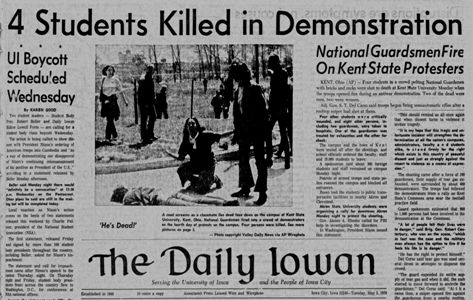
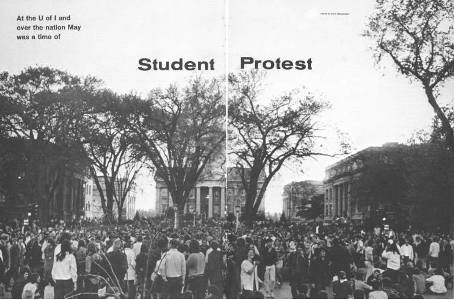
Spring of 1970 was a tumultuous time on college campuses. On April 30, President Richard Nixon announced that U.S forces would invade Cambodia because of the recent communist coup. Students around the country protested this escalation of the Vietnam War. On May 4, the National Guard fired on students at Kent State University, killing 4 and wounding 9 people, which ignited protests all over the country.
Anti-war protests were not new to Iowa City or to elsewhere in Iowa; protests had been occurring throughout the 1960s.
Spring of 1970 was different.
After the Kent State shootings, students marched on the National Guard Armory, broke windows there and also in some downtown businesses. The City Council gave the mayor curfew powers. On May 6 there was a student boycott of classes. That night about 400 people had a “sleep-in” in front of the Old Capitol. That night about 50 people broke into the Old Capitol and set off a smoke bomb. The protestors left voluntarily when asked to do so. Around 2 AM Friday morning President Boyd requested arrest of the students on the Pentacrest by highway patrolmen, but the next day he regretted the mass arrests and said he had received faulty information. On May 8, President Boyd cancelled the 89th annual Governor’s day ROTC observance for the following day. On Friday and Saturday a National Guard helicopter circled the Pentacrest.
In the early morning hours of Saturday, May 9, the Old Armory Temporary (O.A.T.), also known as “Big Pink”, which housed the writing lab, was burned down. This building was located was next to the Old Armory, where the Adler Journalism and Mass Communications building currently is located. O.A.T was said to be at the top of a list of buildings for burning, probably due to its poor condition and was considered a firetrap. The Iowa Alumni Review includes an article about the fire in which the author states: “Only the ends stayed upright. … On the south, Lou Kelly’s Writing lab bearing the sign ‘another mother for peace,’ escaped.” There was a second, smaller fire on Saturday evening in a restroom in the East Hall Annex.
By Sunday morning, President Boyd gave students the option to leave. Classes were not cancelled but students could leave and take the grade they currently had.
Students should not accept everything that is dished out to them. We don’t want to dictate what they should or should not do. However, student demonstrations should remain within the law and good taste without interfering with the university’s primary purpose of instructing students.
During this time there was also a strong ROTC presence on campus.
The 1970 yearbook includes many pictures of the men and women who chose to serve the country in this manner. Their presence on campus and the academic credit they received for their service was called into question by both students and faculty in the spring of 1970, but Boyd said he could not abolish ROTC. The Alumni Review had an article called “ROTC: Alive and well at Iowa” in the December 1969 issue which helps provide a more complete picture of this period in history.
The first ever Choose Privacy Week, May 2 – 8, is a new initiative sponsored by the American Library Association’s (ALA) Office for Intellectual Freedom (OIF) that invites library users into a national conversation about privacy rights in a digital age. The campaign gives libraries the tools they need to educate and engage users, and gives citizens the resources to think critically and make more informed choices about their privacy.
Privacy has long been the cornerstone of library services in America, a freedom that librarians defend every day. For over 50 years, the ALA has defended the rights of library users to read, learn and be curious, because the freedom to read and receive ideas anonymously is at the heart of individual liberty in a democracy.
Prairie Lights and the Iowa City Public Library will co-sponsor Kathryn Stockett reading from her novel The Help from 2-3 p.m. Sunday, May 2 in Room A at ICPL. Doors open at 1 p.m. Space is limited.
Stockett will be signing her book after the reading and copies will be available to purchase through on-site sales from Prairie Lights Bookstore. Signing time will be limited due to Kathryn Stockett’s schedule. Priority will be given to books purchased for the event.
Half the profits from books sold at the event will go towards funding for The Iowa City Book Festival, July 16-18th. For more information about The Book Festival, visit www.iowacitybookfestival.org.
For more information about this event, contact the Iowa City Public Library Fiction Desk at 356-5200, option 4; or e-mail fiction@icpl.org. Contact Prairie Lights Bookstore (Jan Weissmiller) at 319-337-2681.
Nancy Kraft, Head of Preservation at the University of Iowa Libraries, will present two webinars to librarians and other curators across the country through The Association for Library Collections & Technical Services (ALCTS).
Disaster Preparedness and Planning May 12, during Preservation Week (May 9-15) Are you prepared for a disaster to your collection? According to the Heritage Health Index Report issued by Heritage Preservation in partnership with the Institute of Museum and Library Services, 78 percent of us are not prepared, putting more than 1.6 billion items at risk in our libraries in the U.S. Preparedness is of utmost importance in the event of a disaster, large or small. Learn about the fundamentals of emergency planning, which include identifying key players, assessing risks, establishing collection priorities and other preparations for protection of your collections. Kraft discusses tools available for and gives tips on overcoming roadblocks to writing a disaster plan. Lessons learned in this session can be applied to any size institution.
Disaster Response June 9 Once a disaster strikes, the knee-jerk reaction is to rush in and save everything. Rushing in without advance planning puts collections at risk of more damage and staff at risk of injury. This session discusses managing a disaster situation and salvaging collections. Topics covered include: assessment and planning, working with a vendor and volunteers, handling public relations and managing collection salvage. A single-building incident will be used as a case study to illustrate the implementation of a disaster response effort. Lessons learned in this presentation can be applied to disasters large or small no matter the size of the institution.
Kraft is responsible for directing the preservation and conservation of the library collections at the University of Iowa. In 2009 she received the Midwest Archives Conference Presidents’ Award for her extraordinary work following the historic levels of flooding that struck Iowa in the summer of 2008. She is also active in the American Library Association, where she served as 2005-2006 Chair of the Preservation & Reformatting Section of the Association for Library Collections & Technical Services.
For registration information visit the Events & Conferences page on the ALCTS Web site at www.ala.org/alcts. Registration is only $39 for ALCTS members. $49 for non-members, and $99 group rate. All webinars are scheduled for 2 p.m. EDT (1 p.m. CDT, 11 a.m. PDT).
Preservation Week is a joint project of ALCTS, the Library of Congress, and the Institute for Museum and Library Services with contributing support from many other library and museum organizations. Corporate support is provided by Gaylord, Familyarchives.com, and Archival Products. For more information on Preservation Week, visit the Web site at www.preservationweek.org.
ALCTS is a division of the American Library Association.
Congratulations to Political Science Professor Bob Boynton. His New Media in Political Discourse project was selected by Center for Research Libraries to receive the 2010 Primary Source Award for research. CRL gives out just three Primary Source Awards annually, one each for teaching, research, and access.
Boynton studies the use of new media in political discourse. His current research compares micro-blogging (Twitter) with mainstream media coverage for global news events, and Joanna Lee in Digital Library Services worked with Prof. Boynton to build a system that captures live Twitter feeds for data analysis. Support was provided by Chris Clark, head of Desktop Support Services.
The project, which involved collecting Twitter data by constantly running The Archivist, a free tool for harvesting “tweets,” is explained in a poster created by Lee and Boynton.
See the DLS Web site for more on the Libraries’ involvement in this project.
The Emmy Award that Barry Morrow received for writing the 1981 TV movie “Bill” is now on display in the University of Iowa Main Library in the Special Collections on the third floor. Morrow, an award-winning screenwriter who worked at the UI from 1974 to 1981, gave the Emmy to the university earlier this year.
Included as part of the Emmy display is a video loop that contains selected clips from the acclaimed documentary “A Friend Indeed: The Bill Sackter Story,” produced and directed by 1990 UI graduate Lane J. Wyrick. The display is available during the Library’s regular business hours. The film will be shown in its entirety at 7 p.m. on Tuesday, April 13, in Room 1505 of the Seamans Center as part of the second annual Bill Sackter Day. Other Sackter Day festivities will begin at 4:30 p.m. that day at Wild Bill’s Coffee Shop in North Hall on the UI campus.
The special “Bill” Emmy display and video loop in the UI Main Library were made possible in part by gifts to the UI Foundation from Richard S. and Jeanne M. Levitt of Des Moines, Iowa, and Eileen S. Schmidt, of Greenwich, Conn.