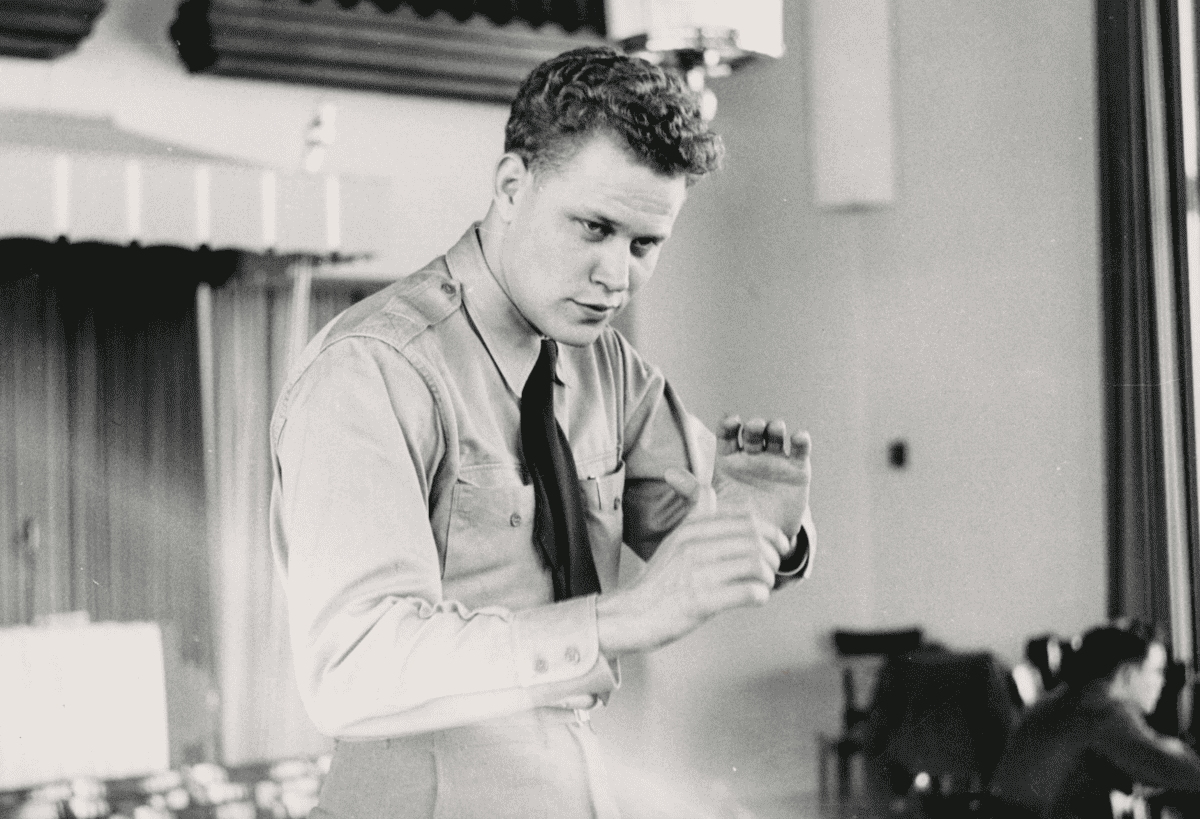
When the University of Iowa Libraries first received James Dixon’s papers in 2021, Katie Buehner knew there was a story waiting to be told about his adventurous international conducting career and lasting impact on orchestras and musicians at home in Iowa.
As director of the Rita Benton Music Library, Buehner worked with Carey Bostian and Miera Kim, close friends of Dixon who generously donated more than 1,200 music scores along with photographs, correspondence, newspaper clippings, and other materials. They offered a fascinating look into the life of one of Iowa’s most influential conductors, who served as longtime director of both the UI Symphony Orchestra and the Quad City Symphony Orchestra.
“I think listening to the stories from people who played under Dixon’s baton really drew me into wanting to know more about him and his philosophy of music-making,” says Buehner. “There’s great admiration for him as a skilled conductor and musician, even if he could be gruff and demanding.”
The collection inspired Buehner to propose an exhibition honoring Dixon’s distinguished career, with a focus on his efforts to build community around music. She sought the perspective of music history scholar Sarah Suhadolnik, an assistant professor of instruction in the UI School of Music, to round out the exhibit’s storytelling and contextualize his efforts in the greater culture of 20th-century American orchestras and society. Together, they curated the Main Library Gallery’s spring 2026 exhibition, Orchestrating Community: The Public Service of Iowa Conductor James Dixon.
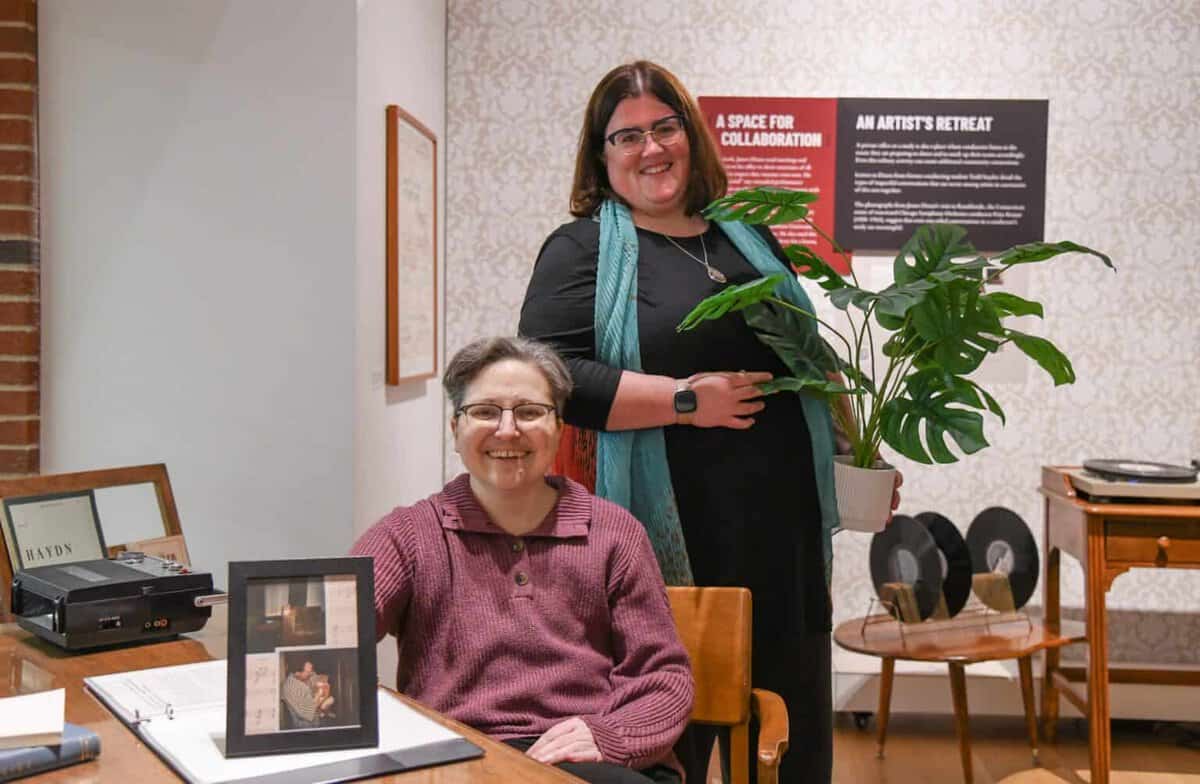
“I always listen with great interest to Katie’s tales of how the library collects the rare items it accumulates. Discussions of the work involved in acquiring the Dixon materials pushed me to develop my ‘Histories of U.S. Orchestras’ graduate seminar,” says Suhadolnik. “When it came time to put the exhibit together, Katie thought my work on the course would prove useful in developing the narrative for the exhibit. It did.”
“Sarah created the community frame for the narrative,” Buehner says, “and it beautifully anchors Dixon’s story and the story of his many orchestras.”
Suhadolnik and Buehner took care to provide a “behind the podium” look at how orchestras of all sizes connect with their communities and become crucial to sustaining them.
“This is a story about Iowa and Iowans,” says Buehner. “While many of the characters in the exhibit travel a great deal to other locations, their roots stay firmly in this community. This is also a story about music and how it brings people together.”
The co-curators also say the exhibit has special meaning for each of them through their own lens: Suhadolnik as a scholar and musician whose research focuses on the history of American orchestras, and Buehner as a librarian and musician who helped bring Dixon’s extensive collection to the Libraries.
“Dixon operated at all times with a tangible vision of what his ensembles contributed to their respective communities,” says Suhadolnik. “I hope visitors left the exhibit with a better appreciation for the arts of all sorts as fundamentally collaborative undertakings.”
“At its most personal to me, the exhibit is an ode to what I fear can get lost in conservatory-style music education. Long hours alone in a practice room can make it hard to feel enmeshed in a larger musical ecosystem,” says Suhadolnik. “The rigors of this type of musical training can undermine a performer’s relationship with prospective listeners, and/or make attending a live performance as part of an audience into a chore.”
“I haven’t seen many exhibits about music, especially centered on classical music stories, and that’s a world I’ve inhabited for decades now,” says Buehner. “It’s very easy to say that classical music or orchestras are passe and not accessible to the average person, but I think this exhibit tells a different story. It shows how orchestras can and are community-rich organizations that connect people with all kinds of music and experiences.”
If you missed it during the spring 2026 semester, view the Orchestrating Community: The Public Service of Iowa Conductor James Dixon exhibit guide, curator highlights, and more on the Main Library Gallery website on the past gallery exhibits page at lib.uiowa.edu/gallery.