Skip to content
Skip to main content

Women’s History Month events, March 21-25

The Iowa Women’s Archives will host events on feminist documentary filmmaking and on the Triangle Factory fire of 1911.

Tuesday, March 22nd, 4:00 p.m., Iowa Women’s Archives, UI Main Library
Award-winning filmmaker Marlene Booth will present a talk entitled “Tell Me a Story: Making and Learning From Documentary Films” on Tuesday, March 22nd. Born and raised in Des Moines, Booth looks back – with clips from her films – on 35 years of filmmaking as a woman, a feminist, and a dyed-in-the-wool Hawkeye. The event will be held in the Iowa Women’s Archives. Reception at 4:00 p.m., followed by presentation from 4:30-5:30 p.m. The Iowa Women’s Archives is located on the 3rd floor of the University of Iowa’s Main Library, just off Burlington and Madison in Iowa City.

Booth, a lecturer in film at the University of Hawaii, has worked in film since 1975, both as an independent and for public television station WGBH-TV in Boston. She has produced and directed several major documentary films screened on PBS, at national and international film festivals, and in classrooms nationwide. Her most recent film, Pidgin: the voice of Hawaii (2009), examines the language spoken by over half of Hawai’i’s people, and confronts issues of language and identity, and who gets to decide what language we speak. Marlene Booth’s visit is sponsored by the UI’s Chief Diversity Office, Law School, History Department, Libraries, and Hillel.

Wednesday, March 23rd at 7:00 p.m. at Hillel
Marlene Booth’s 1999 film “Yidl in the Middle: Growing Up Jewish in Iowa” (1999) explores her Iowa-Jewish roots and uses home movies, period photos, her high school reunion, and interviews, to examine the process of negotiating identity, as an American, a Jew, and a woman. “Yidl in the Middle” will be screened at Hillel (122 E. Market St.) on Wednesday, March 23rd at 7:00 p.m., followed by a question and answer with the director.

Friday, March 25th noon to 1:00 p.m, Room 2032, UI Main Library
We will close women’s history month on Friday, March 25th with “In Memoriam: The Triangle Factory Fire 100th Anniversary,” an event to commemorate the 146 young, immigrant garment workers who lost their lives in this tragedy. Remarks by Professor of History Linda K. Kerber will begin at noon. Dramatic readings by Carol Macvey and UI theater students will follow, with comments by playwright Janet Schlapkohl. This event will take place from noon to 1:00 p.m. in the 2nd floor conference room (2032) of the UI Main Library (Burlington and Madison streets).

For further information call 319-335-5068. All events are free and open to the public.

March 2nd lecture: Black Sorority Activism

“WE STRIVE AND WE DO: 

BLACK SORORITY ACTIVISM AND THE BLACK PUBLIC SPHERE”

Disciplining WomenThe Iowa Women’s Archives kicks off Women’s History Month 2011 with a lecture on Wednesday, March 2nd, by Deborah Elizabeth Whaley,  Assistant Professor of American Studies and African American Studies at the University of Iowa.

Whaley is the author of Disciplining Women: Alpha Kappa Alpha, Black Counterpublics, and the Cultural Politics of Black Sororities, which looks at the role of  the Black sorority in women’s everyday lives, public life, and politics.   Based on ethnographic fieldwork, archival research, oral history, and interpretive readings of popular culture and sorority rituals, the study includes sorority members’ stories of community organizing and of cultural practices and rituals such as step dancing, pledging, and hazing.

Many of the African-American women whose papers are in the Iowa Women’s Archives were members of either Alpha Kappa Alpha or Delta Sigma Theta, so we’ve put up a small exhibit in our reading room of programs and memorabilia of these sororities.

Please join us on Wednesday, March 2, for a reception at 4:00 p.m. and Professor Whaley’s talk at 4:30 p.m.

The Iowa Women’s Archives is located on the 3rd floor of the University of Iowa’s Main Library, just off Burlington and Madison in Iowa City.


The Nutcracker in Cedar Rapids

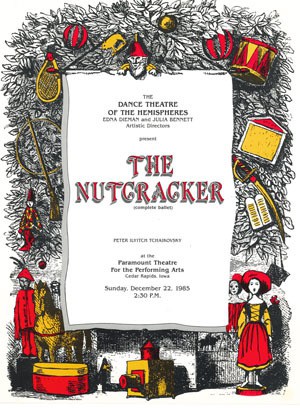
Program and photographs of productions of The Nutcracker from the records of the Dieman-Bennett Dance Theatre of the Hemispheres.

Dancers Edna Dieman and Julia Bennett opened their dance studio in 1951 at a rented room in the Cedar Rapids YWCA.  Ten years later they formed the Dance Theatre of the Hemispheres and built a repertoire in classical ballet, Indian and Spanish dance, tap, jazz, and historical dance.

For more information about the company and its productions, go to

http://www.lib.uiowa.edu/findingaids/IWATitleDetail.aspx?CollectionIdentifier=IWA0265


Program for 1985 performance of The Nutcracker.


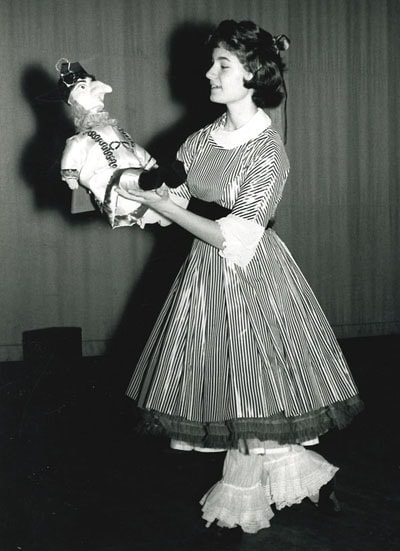
Dancer with the Nutcracker, 1960s?


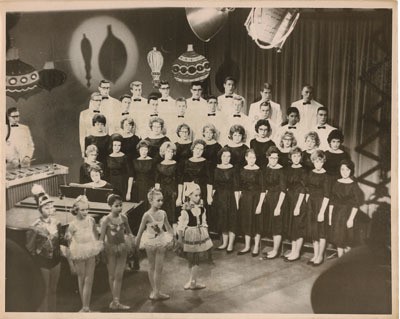
Nutcracker performance with Jefferson choir, 1955

Top Secret Rosies

Secret Rosies

In 1942 a group of female mathematicians helped win a war and usher in the modern computer age.  Top Secret Rosies shares the little known story of a group of female mathematicians who did secret research for the US Army during WWII, a handful of whom went on to serve as the programmers of ENIAC, one of the first electronic computers.

Please join filmmaker LeAnn Erickson for a reception and a screening of her new documentary Top Secret Rosies: The Female Computers of WWII on Monday, December 6th at 6:30 p.m. in 1505 Seamans Center (College of Engineering—across from Old Capitol Town Center).  The film will begin at 7:00 p.m.  The event is free and open to the public.

Winning the Vote

Iowa Suffrage Memorial Commission records, Iowa Women's Archives.

Celebrate Women’s Suffrage!

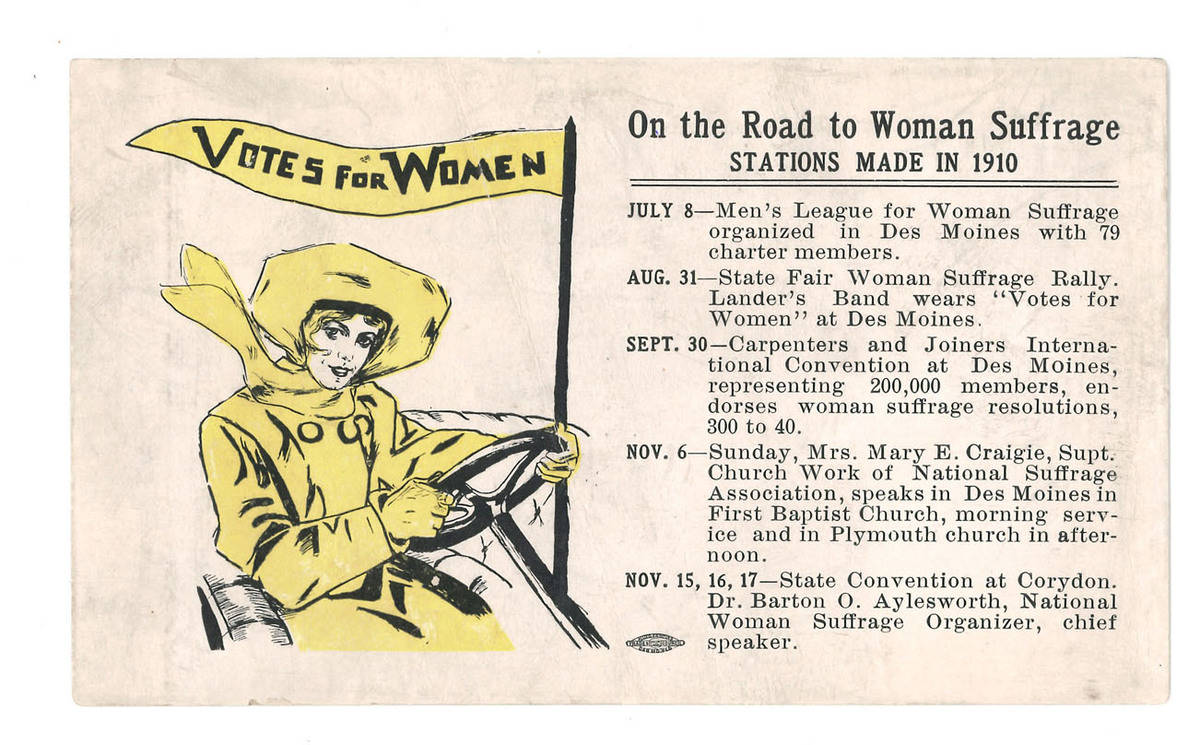
August 26th marks the 90th anniversary of women winning the right to vote in the United States.

Here are a couple of ways to honor those courageous and determined women who fought for the vote:

• Learn about Iowa women’s involvement in the suffrage movement through the exhibit Women’s Suffrage in Iowa: A Sneak Peek of a New Digital Collection.

• Read about an overlooked Iowa suffragist, Annie Savery, in the book Leader and Pariah: Annie Savery and the Campaign for Women’s Rights in Iowa, 1868-1891 by Iowa Women’s Archives founder Louise Noun.  You can purchase the book through the Iowa Women’s Archives.

Online exhibit on LGBTQ life in Iowa City earns honorable mention from OutHistory.org

The Iowa Women’s Archives and University of Iowa Archives Collaborated on the exhibit entitled “LGBTQ Life in Iowa City, Iowa: 1967-2010,” which was entered in the “Since Stonewall Local Histories Contest” hosted by OutHistory.org.

Kären Mason, curator of the Iowa Women’s Archives and David McCartney, University Archivist, curated the exhibit, which was posted along with LGBT histories from across the country on a non-profit website dedicated to uncovering and preserving the history of the modern movement for LGBTQ rights.

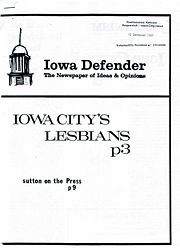
The online exhibit begins with the 1967 publication of The Iowa Defender, which included an article about lesbians in Iowa City. Photo from the Iowa Women’s Archives.

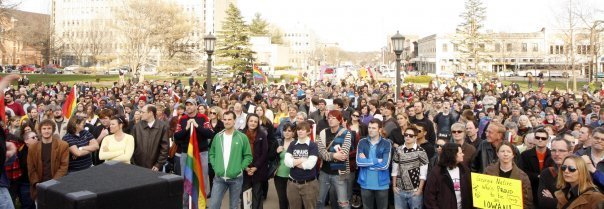
Rally in Iowa City to celebrate Iowa Supreme Court ruling upholding gay marriage, April 3, 2009. Photo by Laurie Haag

The Iowa City exhibit begins in 1967 with The Iowa Defender publishing an article on lesbianism in Iowa City and ends in 2010 with The Iowa City Press-Citizen naming a lesbian couple (Dawn and Jen BarbouRoske) as “Persons of the Year” for their role in challenging Iowa’s defense of marriage law and ushering in same sex marriage in Iowa in 2009. According to OutHistory.org, the exhibits are meant to be “works in progress” that continue to chronicle important events.

The curators used collections from individuals in Iowa City, the University of Iowa Archives and the Iowa Women’s Archives to compile a visual timeline of the history of LGBTQ activism in Iowa City.

Some collections used from the IWA include: Ain’t I a Woman? newsletters, Rusty Barceló papers, Tess Catalano papers, Cherry and Lockwood papers, Common Lives/Lesbian Lives records, Jill Jack papers, Jo Rabenold papers and the Women’s Resource and Action Center records. To find more collections that have materials on lesbian, gay, bisexual and transgender activism, visit: http://www.lib.uiowa.edu/iwa/Topical_holdings_lists/LGBT.html

June 17-19: Women’s & Gender History Conference in Dubuque

The fourth biennial conference of Women and Gender Historians of the Midwest (WGHOM) will be held on June 17, 18 and 19, 2010, at the Town Clock Center for Professional Development of Northeast Iowa Community College in Dubuque, Iowa. 

This conference will bring together scholars, educators, students and the public to explore current issues in women’s and gender history to showcase the academic work of Midwestern and other scholars who focus on women or gender. 

Honoring the conference location in the historic river community of Dubuque, Iowa, the 2010 theme highlights the convergence of scholarship and contemporary pedagogy in all areas of women’s history and related disciplines. 

Dr. Pat Cohen, Department of History, University of California, Santa Barbara will be the keynote speaker. Her address is titled, “An 1850’s Challenge to Traditional Marriage: Mary Gove Nichols and the American ‘Free Love’ Movement.”

Program and further information can be found at: http://department.monm.edu/wghom/

‘Peace by Any Plan’

by Christine Mastalio

1923 scrapbook, Iowa Federation of Women's Clubs

This just in….
We have just processed a large addition to the Iowa Federation of Women’s Club (IFWC) records. The IFWC was founded in 1893 to help women’s clubs from across the state to communicate and collaborate. The Iowa chapter was the first state federation to join the national one—the General Federation of Women’s Clubs (GWFC). By the 1980s, the GFWC was considered the largest and oldest non-denominational women’s organization in the world.
Women in the organization campaigned for literacy, conservation and civic responsibility, but there was also a serious peace movement in the IFWC following World War I.
A county and city federation scrapbook compiled by Blanche Wingate in 1923-1924 (Box 20) reveals how club women actively campaigned for peace in the interwar years.

Selected headlines from the scrapbook read: Peace by Any Plan, Demand Clubwomen; Women Told it Is Their Duty to End Strife; Mrs. Armstrong Urges Women to Advocate Peace; Next War Means Civilization’s End…
Other clippings in this particular scrapbook highlight a Daughters of the America Revolution event, a fashion show and meetings of the executive officers of the club.

IWA Display Celebrates 90 Years of Women’s Suffrage

Student processor Annette Bramstedt just helped finalize a new exhibit in honor of the 90th anniversary of women’s suffrage in the United States (and Iowa).

Bramstedt says working on the exhibit broadened her view of women’ s suffrage—she didn’t realize how much the women of Iowa played a role in national events.

Some highlights of the exhibit include quotes from influential women, photos and a 1920-1945 ledger from the League of Women Voters.

Several IWA collections have material relating to women’s suffrage.
Check out the ones used in the new exhibit:
Iowa Suffrage Memorial Commission records
League of Women Voters of Iowa records
Woman’s Christian Temperance Union records
Genevieve Taylor papers
Jennifer Riggs Cosson papers
Carolyn Campbell Pendray papers

To see the exhibit for yourself, visit the 3rd floor of the Main Library—right outside the Iowa Women’s Archives.

We think it’s a breast pump

Lamaze books, baby bonnet, and early breast pump.

We’ve put up a small exhibit in the Iowa Women’s Archives reading room in conjunction with our upcoming Women’s History Month event about the history of the Lamaze method of natural childbirth.  The exhibit includes several Lamaze books from the 1970s from the papers of Patricia Hillard, a leader in La Leche League International from the 1970s through the 1990s.  Also in the exhibit are a baby bonnet dating from the early 1900s, and an unusual glass breast pump.

The breast pump came to the Iowa Women’s Archives with various artifacts and historical records from the Heritage Room of the University of Iowa College of Nursing.  A tag accompanying the breast pump says that it was purchased in New Orleans in 1750.  If anyone knows how this early breast pump worked, we’d like to hear from you.