Remembering Iowa City’s tornado of 2006 and floods of 2008, via Iowa Digital Library. Here’s hoping for a less extreme 2013…
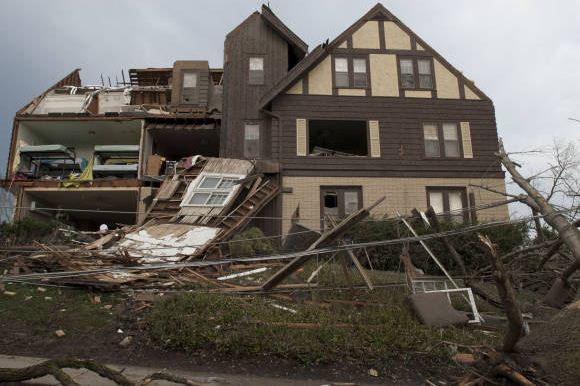
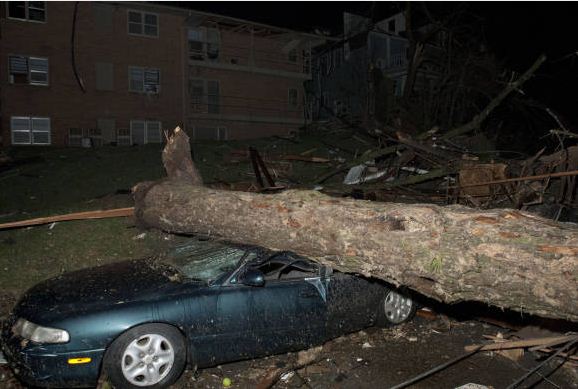
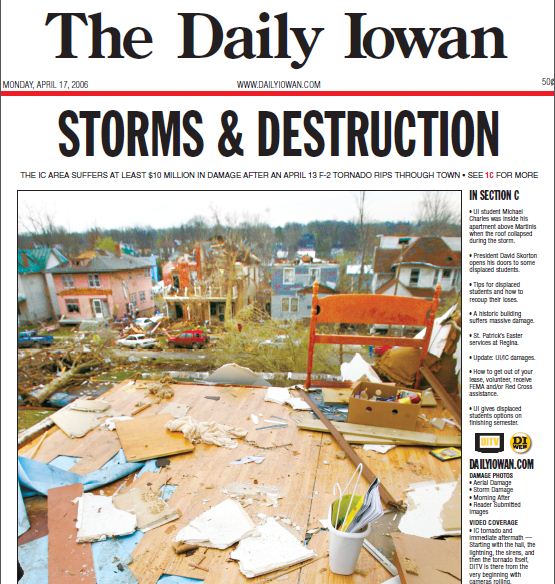
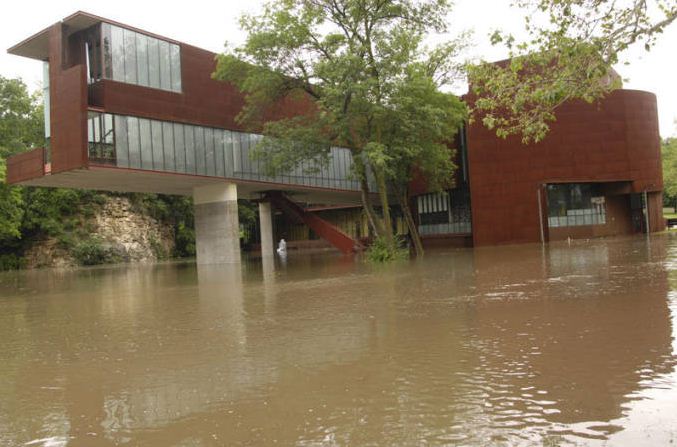
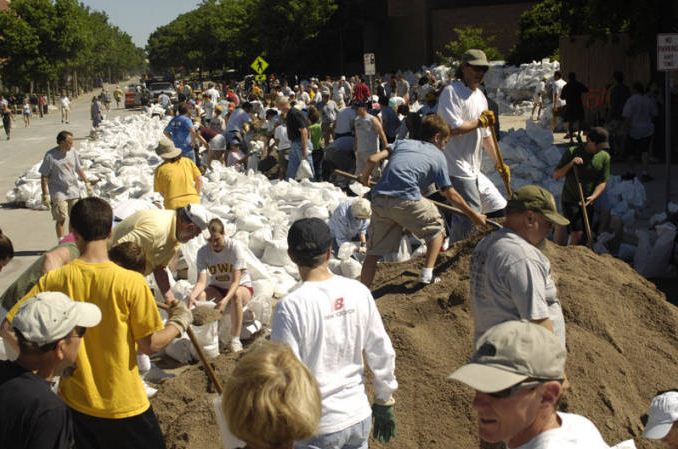
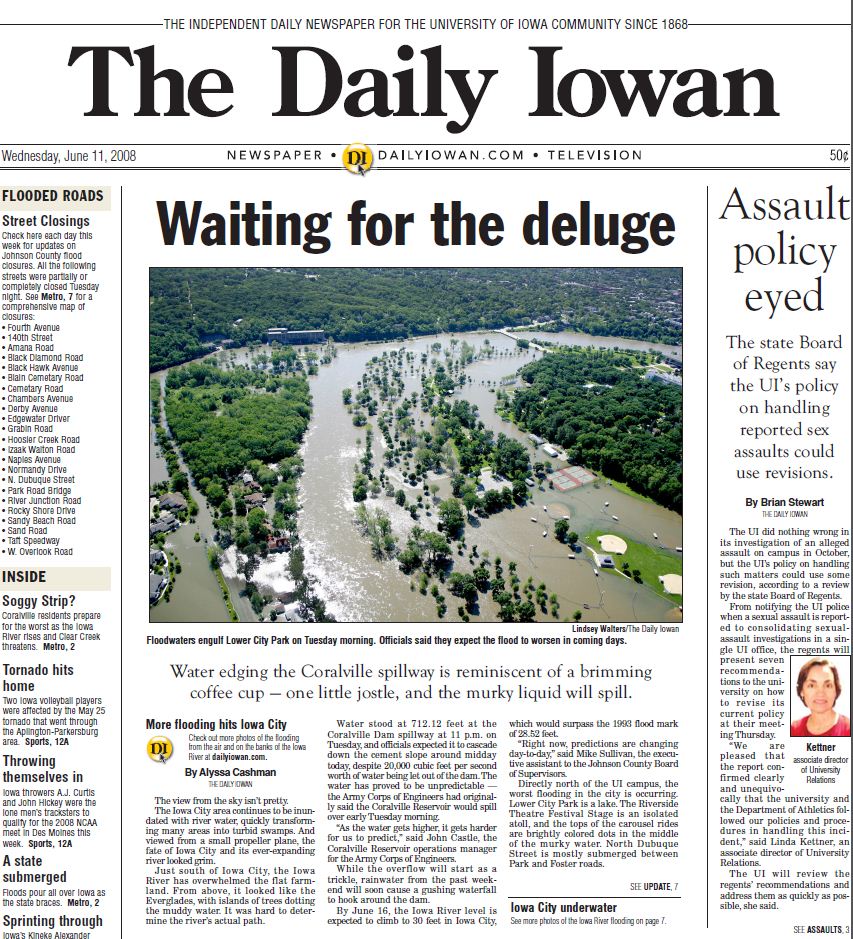
Remembering Iowa City’s tornado of 2006 and floods of 2008, via Iowa Digital Library. Here’s hoping for a less extreme 2013…
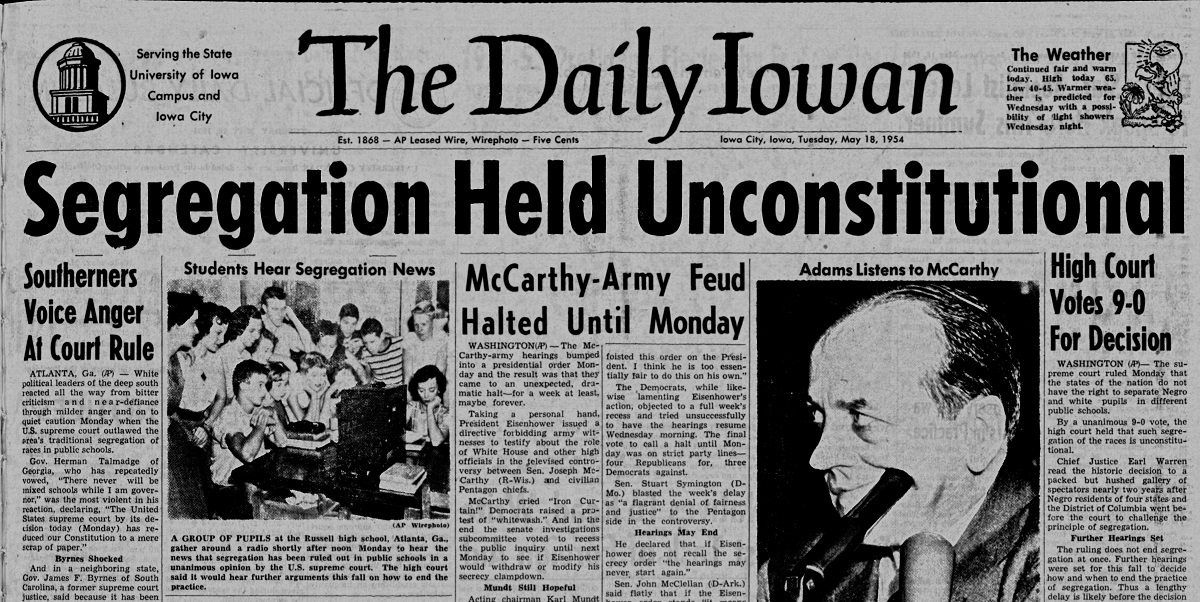
Today is the anniversary of the Supreme Court’s unanimous ruling in the Brown v Board of Education, making separate public schools for black and white students unconstitutional. The Daily Iowan story is in the May 18, 1954 issue.
The ruling did not affect Iowa because segregation of schools had been illegal since 1868.
“Our first public schools were for “white” students only. But in 1868, eighty-six years before Brown versus State Board of Education, Topeka—which struck down separate schools for blacks and whites in 1954—Alexander Clark Sr. successfully sued the City of Muscatine so his daughter, Susan, could attend the white elementary school. This was the same year that Iowa became the first northern state to guarantee black men’s right to vote.”
—Letters to a young Iowan [excerpt], Hal S. Chase
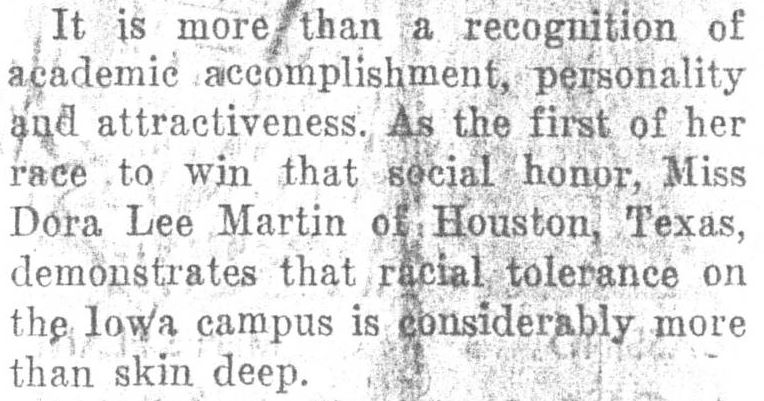 Just one year after the landmark Supreme Court ruling, Iowa students elected an African American woman, Dora Lee Martin, as homecoming queen. This election was touted in state papers as demonstrating tolerance at the University, such as this excerpt from the Sioux City Tribune-Journal.
You can read more about Dora Lee Martin in a previous blog post, Queen of the campus.

New at Iowa Digital Library:
University of Iowa College of Medicine Historical Photographs
digital.lib.uiowa.edu/com
featuring dozens of images documenting the study and practice of medicine at the UI and its surrounding area

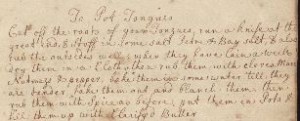
We’ve been in touch with one of our most faithful DIY History transcribers, Roger. He didn’t intend to get so drawn into the project when he first visited our site, but now he admits that “things like eating and mowing get in the way but I’ve managed to blow off most other things cause I’m addicted to this.” Besides transcribing the manuscript pages, at which he has become expert, he likes to monitor the “Recent changes” log, which records all the work done by various contributors, and is accessible to anyone who creates a DIY History account. Like other frequent transcribers, he has an eerie sense of entering the private thoughts of writers long ago: “I keep thinking we’re almost invading something private these people from 200 years ago never expected anyone, but maybe a daughter or grand daughter would ever see their writings. It’s a great look into the “olden” times.” Roger has spent a lot of time transcribing recipes in the Szathmary Culinary Manuscripts and Cookbook collection, and has come across some really harrowing dishes, which make full use of body parts. He knows someone who worked at a meat locker for years, and even she “has no interest at all in the tongue, feet, head or any other questionable parts of meat, like udder. She hated to handle a tongue, no way is she going to eat it.” Ah, how times and palates change. Roger has found a way to multi-task his hobbies: “I use my 46 ” flat screen as my monitor so I can kick back in the lazy boy and start typing and deciphering. I finally decided Sunday I wasn’t able to watch TV and type at the same time and a Nascar race was on. So I did a bit of rearranging so I could watch on the older 27 ” TV while online and if something interesting came up I could jump back on the flat screen to see wrecks or whatever.”
Another of our best transcribers is British; his hobbies include deciphering Minoan Linear A and Mycenaean Linear B, gardening, and fine cooking. He has dedicated himself to transcribing and proofreading the Civil War Diaries and Letters, and sometimes reports to us his discoveries about old American slang and expressions, such as “wooden nutmegs and flannel sausages.”
We love to hear the transcribers’ stories, as they help us share the stories of these old manuscripts.

Now awaiting transcription at our DIY History crowdsourcing site is the late-19th century diary of Belle Robinson, a charming document of a girlhood in Iowa spent playing croquet, attending picnics, making taffy, and going nutting. And like another girl who lived in a little town on the prairie, Belle had literary aspirations. Included in her diary are verses written to amuse school friends, reviews of library books (usually described as “very interesting”), and references to story writing, as in this series of entries from 1876:
Tuesday 15th
Club tonight at Meg’s. I am elected secretary. We are going to have a paper next time like they had in Little Women. I am editor and promised to try and write a kind of dime novel story.
Wednesday 16th
Began story.
Thursday
Am going to a party at Flora McCreery’s, we have slighted them so much lately, that I shall have to go – although I hate to dreadfully.
Friday
Have finished my story. It’s perfectly horrid, “The Gipsy’s Secret” is the name. Went to the party last night & did not get home till twelve oclock. Perfect martyrdom for 4 hours it was. May’s club held here, they are in the other room making an awful noise.
— February 15-18, Belle Robinson diary, 1875-1877
Sadly, Belle died in 1887 at age 25. Had she lived, she would likely have joined her older sister May — fittingly “making an awful noise” with her girlfriends in the above excerpt — who became active in the women’s suffrage movement in Iowa.

Chinua Achebe (1930–2013) never came to Iowa City, so our connection with him in our collection is slight. However, since he recently died and given the importance of his work, I wanted to highlight a few items in our digital collections.

The Esther Walls papers include 3 pictures of him at the Countee Cullen Branch of the New York Public Library in May, 1963. He was part of a black writers panel, moderated by Esther Walls. Other panelists were Louis Lomax, Bill Kelley, John Killens and Leroi Jones.

We of course also have many books written by him; reading his works is the best way to remember his legacy.
From the Szathmary cookbook collection, a rhyming recipe from an 1860 English cookbook:
A Paradise pudding
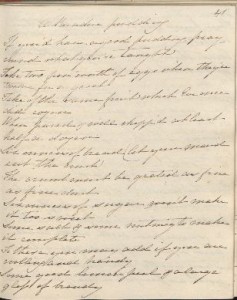
If you’d have a good pudding pray mind what you’re taught
Take two pen ‘sworth of eggs when they’re twelve for a groat
Take of the same fruit which Eve once did cozen
When pared & well chopp’d at least half a dozen
Six ounces of bread (let your maid eat the crust)
The crumb must be grated as fine as fine dust
Six ounces of sugar won’t make it too sweet
Some salt & some nutmeg to make it complete
To these you may add if you are willing and handy
Some good lemon peel & a large glass of brandy

Along with transcribing handwritten diaries and letters, users at our DIY History crowdsourcing site can comment, tag and favorite historic photos at the University of Iowa Libraries’ Flickr site. Most frequently, we receive feedback on factual errors in our metadata, e.g. Flickr user Metaltype noticed an incorrectly identified typesetting machine in this image from the 1950s, while KandyK2013 used hairstyle clues to provide a more accurate date estimate for this 1940s photo of student life at the UI.
But occasionally commenters let us know about a personal connection to one of the photographs. The residence pictured above, with its gables and stained glass windows, is more than just a stately example of 19th-century architecture for user bay.miller, who’s related to the people who built the house. And djgeorge2012, of whom we suspect a family connection to UI baseball player Jim George (pictured below), left a comment with a biographical sketch of the athlete that greatly enhances the research value of the image.
We’d like to increase this type of public engagement through our application for membership in Flickr Commons, where we hope to join the Library of Congress and other institutions in their mission to widen access to and enrich the content of the world’s historic photograph collections.

To celebrate Laura Ingalls Wilder’s birthday — she was born on this day in 1867 — we couldn’t decide whether to churn butter or make a corn-cob doll. So instead we chose to listen to this archived reading by Wendy McClure, and enjoy vicariously her adventures in obsessive Little House on the Prairie fandom.

Wendy McClure reading, Live from Prairie Lights, April 19, 2011 | Virtural Writing University | Iowa Digital Library
Wendy McClure reads from The Wilder Life: My Adventures in the Lost World of Little House on the Prairie. After her mother’s death, Wendy McClure rediscovered Laura Ingalls Wilder’s Little House books. Fascinated with the lifestyle the books evoke, she began a journey to discover Wilder and the culture and the tourism industry that have sprung up around her. This incredibly engaging book chronicles her research into Wilder’s life, literary controversies, and the social history that allowed the books to take on a life of their own. Little House on the Prairie fans will love following the journey of one of their own. Wendy McClure has been writing about her obsessions both online and in print for nearly a decade. In addition to her 2005 memoir, I’m Not the New Me, she is a columnist for BUST Magazine and has contributed to The New York Times Magazine. McClure holds an MFA from the Iowa Writers’ Workshop. She lives in Chicago, where she is senior editor at the children’s book publisher Albert Whitman & Company.
Browse all readings at the Iowa Digital Library’s Virtual Writing University Archive

These transportation-themed (and occasionally offensive, by today’s standards) cards are among the several dozen vintage valentines now featured on our Iowa Digital Library Pinterest site.


