Last week the Alliance of Digital Humanities Organizations notified presenters of their acceptance to its massive annual conference, DH 2017. Held in Montreal this August, the conference brings together digital humanists from around the world to share their work. We’re excited to announce that four Studio staff will be among those UI faculty and staff presenting their work! Here’s a short run-down on who’s presenting and what will be discussed.
Rob Shepard (GIS Specialist) will present his paper on Placing Segregation:
Placing Segregation is a new open access digital project that explores research questions about housing segregation and socioeconomic disparities across nineteenth century American cities through interactive maps and interpretations. Rather than using aggregate data collected at city ward levels to make inferences about past urban geographies, this work has combined city directories and period advertisements with census records to rebuild historical address systems and geolocate every possible family in the 1860 census for the cities of Washington, D.C., Nashville, Tennessee, and, for the 1870 census, the city of Omaha, Nebraska. Mid-nineteenth century census records contain extensive details which were not collected in subsequent decades, so these geolocated individuals provide rich new datasets for historical researchers. This paper introduces core functionality of the digital exhibit (e.g. using the interactive map or its search to access information about individuals) and also explains the process of developing the data and the website.
Together Hannah Scates Kettler (Digital Humanities & Instruction Librarian) and Mark Anderson (Digital Scholarship & Collections Librarian) will present a poster of their work with Spanish & Portuguese Lecturer Julia Oliver Rajan, on a unique bilingual (Spanish and English) digital archive of oral history videos – Coffee Zone: Del cafetal al futuro / From the Coffee Fields to the Future:
Coffee Zone: Del cafetal al futuro/ From the Coffee Fields to the Future documents a vanishing dialect of Spanish spoken in the mountainous coffee growing regions of Puerto Rico. Currently consisting of over 600 short video clips in 16 topical categories, the site can serve as a template for other researchers who are documenting similarly endangered languages or dialects in other parts of the world. The poster will present the progress and challenges of this digital humanities project, how it acts as a resource for scholars and students in a wide variety of disciplines (ecology, horticulture, psychology, and obviously linguistics, just to name a few), and the upcoming features we are working to implement.
Tom Keegan (Head, Digital Scholarship & Publishing Studio) and UI Classics Professor Sarah Bond will share their work on Quotidian Reading: Digitally Mapping Literary and Personal Geographies:
Petronius’ Satyricon and James Joyce’s Ulysses are big books that are too often cast as things to be conquered or “done” rather than encountered as portals to better understanding ourselves and the world in which we live. In this long paper, we offer an alternate approach to reading texts in which the experiential learning advocated for by John Dewey (and often averred by literary theorists) is combined with a host of digital mapping tools, broadly understood. We describe our work in two courses—one in Classics and one in English—as aimed at connecting the content of Petronius’ and Joyce’s novels with the daily lives of our students. In our courses students undertook a kind of “quotidian reading” in which they identified spaces and practices in the novels and relocated those elements in their own lives, sharing their observations through mapping, blogging, and podcasting.
Congratulations to everyone else who will be presenting their findings this summer. We hope to see you there!
It was just over two years ago that DIY History reached its amazing 50,000-page transcription benchmark! This past week we achieved 75,000, and we’d like to take the opportunity to talk a little bit about the elements that have led to this amazing growth.
Expanding across platforms like Twitter has helped us continually make these efforts more accessible, and has allowed for additional crowdsourcing opportunities in classrooms and at other institutions, like the Nova Scotia Archives. Just this past fall, locally and in conjunction with a global transcribing effort, the UI’s Museum of Natural History partnered with WeDigBio for a week-long egg card transcription blitz. In short, these collections are getting to see the light of day in an exciting and participatory manner and we couldn’t be happier with the response.
The Community
Lastly, reaching this milestone wouldn’t be possible without the continued support of the wonderful community of volunteer transcriptionists who help to make these collections come to life by making them available and searchable for researchers and historians. So to them we say thank you, and we hope this sentiment will inspire others to help build the historical record!
The Team
DIY History is made possible by the wonderful team here at the Digital Scholarship & Publishing Studio, specifically by the Studio’s Senior Developer, Matthew Butler, and our Digital Scholarship & Collections Librarian, Mark Anderson.
Zachary Turpin, a PhD candidate in English at the University of Houston (who made international headlines in April 2016 with his discovery of a previously unknown journalistic series by the poet Walt Whitman entitled “Manly Health and Training”) has made another major find: a long-lost, secret novella, also authored by Whitman, entitled Life and Adventures of Jack Engle: an Auto-Biography (A Story of New York at the Present Time). Totaling about 36,000 words, Jack Engle, was published anonymously as a work of serial fiction in six installments in 1852 in the New York Sunday Dispatch, a weekly newspaper edited by Amor J. Williamson and William Burns that regularly published works of serial fiction. Turpin’s incredible find means that Jack Engle, a novella that Whitman never talked about and that no one knew he had written, can now be republished for the first time since 1852 and confidently attributed to Whitman for the first time ever. In the current issue of the online, open access Walt Whitman Quarterly Review (WWQR), Editor Ed Folsom and Managing Editor Stefan Schöberlein have published Jack Engle in full, and the 150-page journal issue also includes an essential and substantial scholarly introduction by Turpin. The University of Iowa Press collaborated with Turpin and the Walt Whitman Quarterly Review to publish a print edition of Jack Engle, including an introduction by Turpin. Hardback and paperback copies of the novel are now available for purchase on the University of Iowa Press website.
The Masthead of the New York Sunday Dispatch. Whitman’s Life and Adventures of Jack Engle was serialized in the weekly newspaper from March 14 to April 18, 1852. Image Courtesy of the Library of Congress.
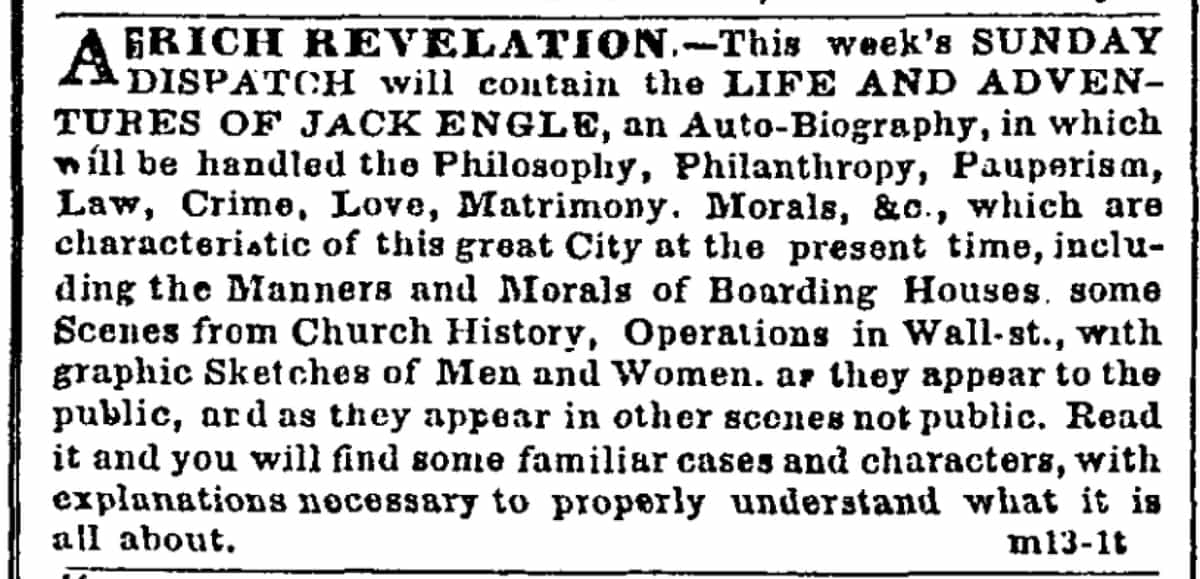
Although the publication of Jack Engle today will certainly receive national and international media attention, its appearance in 1852 was barely advertised, and, as far as we know, there were no reviews of the novella and no other responses from newspaper readers. On March 13, 1852, the day before Jack Engle began its run in the Dispatch, a brief and unremarkable literary notice for the novella was published in three New York newspapers: the Tribune, the Herald, and the Daily Times. The notice promised readers that the following day, the Dispatch would begin publishing the Life and Adventures of Jack Engle, an Auto-Biography, a novella praised in the notice as “A Rich Revelation,” that would deal with “the Philosophy, Philanthropy, Pauperism, Law, Crime, Love, Matrimony, Morals, &c., which are characteristic of this great city at the present time.”
Newspaper notice for Jack Engle, which was published in the Tribune, the Herald, and the Daily Times on March 13, 1852. Image Courtesy of ProQuest and the Walt Whitman Quarterly Review.
This new work of fiction would be printed over the next month from March 14 to April 18, 1852, with a few chapters appearing each week. As Turpin points out in his beautifully written and informative introduction, the novella ran without a byline, and there were no additional advertisements or notices. This is especially striking because Whitman had been a successful fiction writer throughout much of the 1840s. In fact, by 1852 he had published at least 26 short stories, and several of them had appeared in the Democratic Review, one of the era’s most prestigious magazines. He had also written a temperance novel, Franklin Evans, or the Inebriate, a Tale of the Times that had sold 20,000 copies–more than anything else Whitman would publish in his lifetime, including Leaves of Grass. It was only later that Whitman, then known primarily as a novelist and popular fiction writer, would become one of the nation’s favorite poets, and it took nearly 165 years after the original publication of Jack Engle for Turpin to discover the novella and prove conclusively that Whitman authored it.
Jack Engle, which Turpin describes as “a story of coincidence, adventure, and the incompatibility of love and greed” stands as a historic and incredibly important new find. According to University of Iowa Professor and Walt Whitman expert Ed Folsom, Jack Engle is a “momentous” find that “makes us rethink everything we thought we knew about Whitman’s fiction.” After all, it has long been believed that Whitman’s fiction career spanned only seven years–from the publication of his first short story “Death in the School-Room” in the Democratic Review in August 1841 until the printing of “The Shadow and the Light of a Young Man’s Soul” in the Union Magazine in June 1848. After this, Whitman was thought to have given up fiction writing for good and turned to composing poems–a puzzling career move given the success and widespread circulation of his earlier fiction. The publication of “Jack Engle” in 1852 offers evidence that Whitman did not make such a definitive transition from writing short stories to crafting poems with long, prose-like lines. Instead, he continued writing fiction at least into the early 1850s, which nearly coincides with the time he began working on the poems that would later appear in the first edition of Leaves of Grass, published in 1855. As Turpin puts it in his introduction, “Whitman did not give up but began again,” seemingly returning to novel-writing, while also drafting plot outlines and prose fragments. Because of Jack Engle, therefore, instead of seeing Whitman as a fiction writer abruptly shifting to poetry, scholars and readers alike must now imagine him as a writer of poetry and fiction for newspapers and magazines who was not yet sure what shape Leaves of Grass or even the next few years of his writing career would or should take.
Whitman has not traditionally been praised among scholars for his fiction writing ability. Thomas Brasher, editor of The Early Poems and the Fiction, a volume of the Collected Writings of Walt Whitman, said of the early stories that “Whitman had no talent for fiction,” while Emory Holloway, an early Whitman biographer, wrote that many of the poet’s early and melodramatic stories “deserved to die in the age of sighs that gave them birth.” Jack Engle stands in sharp contrast to Whitman’s early fiction even though it clearly drew from some of that writing. As Turpin points out in his introduction, Jack Engle is “some of the better fiction Whitman produced.” The plot and characters in this novella were clearly composed and sketched by a more mature Whitman; he was a far more experienced writer of newspaper fiction by 1852 than he had been when he wrote his short stories a decade earlier. According to Turpin, Whitman drew on several genres of popular fiction while writing Jack Engle, including “sentimentalism, sensationalism, adventure fiction, [and] reform literature,” among other genres. To this list, I would add detective and mystery fiction, as well as epistolary fiction given the number of texts–ranging from letters and wills to gravestones and prison narratives–that advance the central plot. By drawing on all of these genres, Whitman creates a novella that Turpin has called “Dickens Light” and that might also be described as a tale of corruption, misogyny, class division, religion, romance, and male friendship.
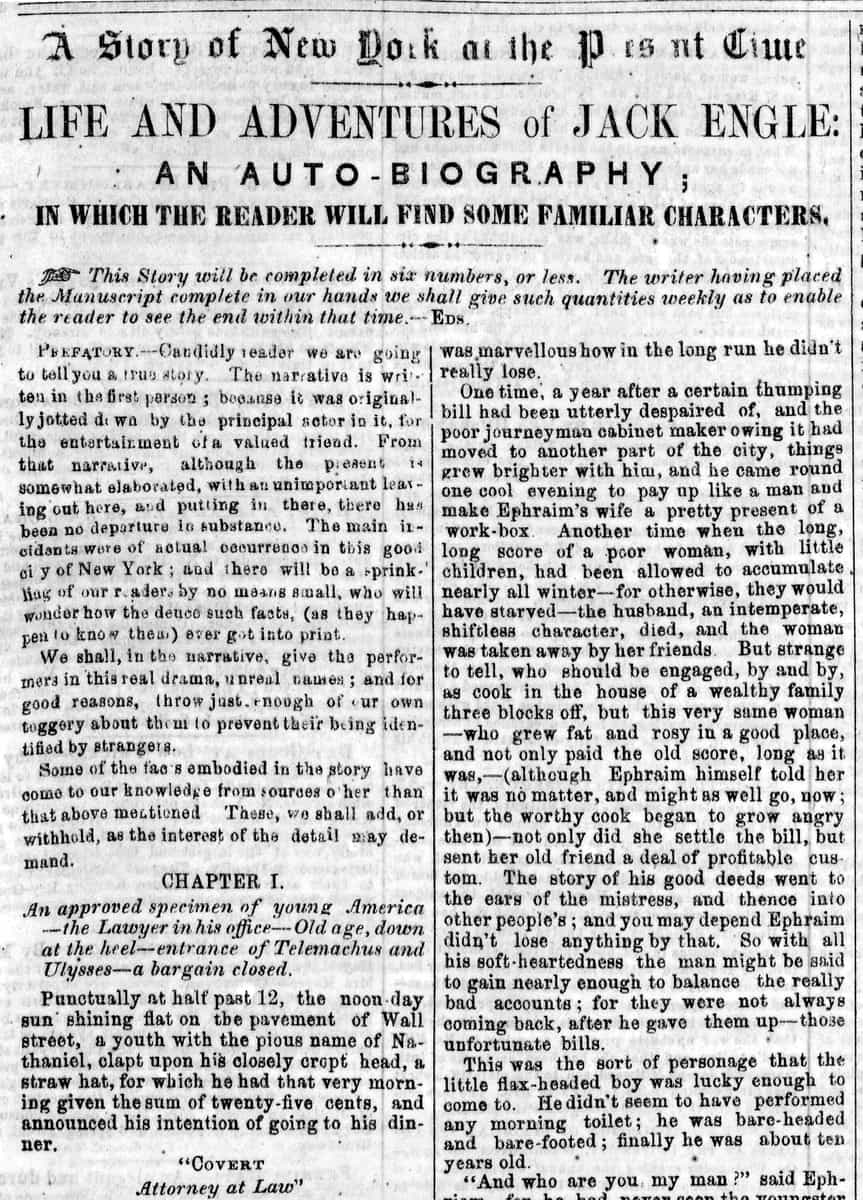
The first chapter of Life and Adventures of Jack Engle, published in the Sunday Dispatch on March 14, 1852. Image Courtesy of the Library of Congress.
Jack Engle follows the adventures of a young orphan in New York who is adopted by Ephraim Foster, a milkman and “purveyor of pork and sausage” near the Bowery and his wife Violet, a woman Whitman describes as having the “breadth of a good sized man” and no knowledge of “what are now called Women’s Rights.” Ephraim urges young Jack to pursue the study of law, which Jack undertakes largely for the sake of pleasing his adoptive father. Soon Jack finds himself employed by “Mr. Covert,” a corrupt and greedy lawyer who “had among the forms of his selfishness, some political ambition.” Covert is also the guardian of a young woman named Martha, and he is constantly scheming to cheat Martha and other beneficiaries out of the inheritance left for them by her imprisoned and dying father. When Jack and Martha meet, they realize they are actually old acquaintances; they become fast friends once again, and Jack longs to help the unhappy young woman. Can Jack and Martha thwart Covert’s attempts to steal her inheritance? Even more importantly, will they be able to keep Martha from falling victim to the lawyer’s sinister and “licentious passions”? Will the identity of Jack Engle’s parents and his family history ever be revealed? The answers to these key questions and many more can only be found by reading the novella in full. Along the way, readers will meet numerous other odd and eccentric characters, including a dancing girl, several individuals of the Quaker faith, some law clerks (one of whom doubles as a detective), a series of night watchmen policing the boundaries of the city, and a dog that, oddly enough, is also called “Jack.” In order to learn the fate of Jack Engle and Martha, readers must follow the action of the story as it moves from a sausage vendor’s shop to the law offices and from the dancing girl’s home to the boat docks under the cover of darkness. The tale’s numerous mysteries are finally resolved and, at the end, the characters can begin to look forward to the future rather than back on their respective pasts.
Even though the air of mystery, the humor, and the impressive cast of characters set Jack Engle apart from Whitman’s earlier fiction, it is hard not to see some similarities between it and his previous writings. Much like the novella’s protagonist Jack Engle, the main characters of Whitman’s short story “The Love of the Four Students” are studying law under the guidance of a lawyer. The character of Violet Foster, Jack’s adoptive mother, is actually taken from “The Fireman’s Dream,” an unfinished piece of fiction that Whitman published in 1844 in the New York Sunday Times and Noah’s Weekly Messenger. Only two chapters of “The Fireman’s Dream” were ever published,” but the description of Violet in Jack Engle is taken, nearly verbatim, from the characterization of Violet Boanes in the earlier work. As Turpin also points out, the villainous lawyer “Mr. Covert” shares his name with an earlier character, “Adam Covert,” another evil lawyer who is murdered as a result of his scheming in “Revenge and Requital,” a tale that was published in 1845, seven years before Jack Engle.
These connections to Whitman’s earlier fiction, combined with both the improved quality of the writing in Jack Engle and the previous success of Franklin Evans, make Whitman’s decision to publish the novella anonymously seem especially perplexing. It would have made sense, after all, for Whitman to attempt to capitalize on the sales figures of Franklin Evans by including his name in a byline with Jack Engle. At the same time, Whitman was not typically silent about the success of his fiction. He once bragged to the editor of the Boston Miscellany that his short stories had been reprinted frequently by newspapers and magazines all over the country, and he was right in his assessment of the widespread circulation of those stories. Even when Whitman attempted to distance himself from his novel and the short stories late in his life, he was particularly vocal in his dismissals of those early works. In 1882, Whitman wrote that he sincerely wished “all those crude and boyish pieces” of fiction he wrote in his youth would drop into “oblivion,” and in 1888 he reportedly referred to Franklin Evans as “damned rot.” But as far as we know he never mentioned Jack Engle at all. There is no known evidence that Whitman ever claimed it or disavowed it. He does not seem to have spoken about it–not even to his family or closest friends–and the only time he wrote about it might well have been the plot outline, including character names that he recorded in his schoolmaster notebook, the document that led Turpin to this amazing find.
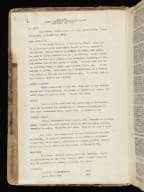
A page from Walt Whitman’s schoolmaster notebook that outlines part of the plot of Jack Engle. Image Courtesy of the Library of Congress.
Whitman’s silence on the subject of Jack Engle–save for the notes about the plot–certainly made Turpin’s work more challenging. But Turpin’s research methodology is worthy of note here because he was able to utilize and move between digital and archival (print) collections to make the find. While prose fragments are not necessarily unusual in Whitman Studies, long lists of plot events and the actions of individual characters are rare. Scholars have long been aware of the schoolmaster notebook and a plot outline that includes the name “Jack Engle,” among others from the novella. Turpin followed the sparse evidence from digitized images of the notebook pages to newspaper databases, where he encountered an announcement for the publication of a novella that promised to detail the life and adventures of “Jack Engle.” Turpin was able to confirm his discovery–matching the plot Whitman outlines to the events of the full novella–with the support of the English Department at the University of Houston and research assistance from the Library of Congress, which holds one of the only–if not the only–series of extant issues of the Sunday Dispatch that printed the installments of Jack Engle. In collaboration with the staff of the Walt Whitman Quarterly Review, Turpin then transcribed and edited the novella for the journal and for the University of Iowa Press’s newly released print edition. With an open access (free) digital edition and a print edition of Jack Engle now available for purchase, the novella will certainly have a new life as readers and fans of Whitman examine this secret, long-lost novella for the first time. The very existence of Jack Engle also suggests that there may be more works of fiction by Whitman waiting to be discovered, and it is my sincere hope that many more rich revelations about the novella and about all of Whitman’s fiction will soon follow.
The Walt Whitman Archive recently published a new digital edition of Whitman’s short fiction. Most people know Whitman as America’s poet and the author of Leaves of Grass, but in the early 1840s, he was a journalist, a newspaper editor, and the author of numerous short stories. Whitman wrote at least twenty-six (and likely more) stories, some of which were published in the United States Magazine and Democratic Review, a prestigious magazine that counted Nathaniel Hawthorne and Edgar Allan Poe among its contributors. As Whitman wrote his fiction, he drew on popular fiction genres of his time, including reform literature, religious and didactic stories, and tales of crime and urban life in New York. His stories are set in taverns, restaurants, boarding houses, graveyards, and schoolrooms. Whitman’s fiction is peopled with determined widows, corrupt lawyers, struggling writers, violent schoolmasters, and unsympathetic fathers. It focuses on respected war heroes, violence and murder, the dangers and consequences of drinking alcohol, and intense, often homoerotic friendships between men.
Whitman’s stories circulated both nationally and internationally during his lifetime, and even though notices about and reviews of his stories are seemingly rare in nineteenth-century newspapers and magazines, those that have been discovered praise both Whitman’s stories and his ability as a fiction writer. Over the last few decades, there has also been a renewed scholarly interest in Whitman’s fiction, particularly with respect to his treatment of race and sexuality in these works. At the same time, although there is a print scholarly edition of Whitman’s fiction–Thomas Brasher’s The Early Poems and the Fiction, a volume of the Collected Writings of Writings of Walt Whitman–it was published in 1963, and the ways in which we read, teach, and understand Whitman’s fiction have changed considerably in the last 54 years. Therefore, it seemed like the right time to create an updated digital edition of Whitman’s fiction for the Walt Whitman Archive.
With the generous support of the National Endowment for the Humanities, my co-editor Nicole Gray (Research Assistant Professor of English, University of Nebraska-Lincoln [UNL]) and I–with assistance from other members of the Whitman Archive staff–selected texts, processed high resolution page images, and used text encoding (TEI/XML) to prepare the edition. Our edition of Whitman’s fiction is unique, not just because it is digital, but because we made the editorial decision to present the fiction as it was originally printed in New York periodicals. Thus, the edition includes the twenty-six known works of fiction by Whitman and scanned images of each page of the stories as they were first printed in newspapers or magazines. Each story is annotated, and these annotations offer definitions for relevant terms, note significant editorial revisions, and provide key contextual information that allow readers to better understand the historical, political, and social contexts within which Whitman was writing. Each story is also accompanied by a headnote; for example, Whitman’s first short story, “Death in the School-Room. A Fact.” (1841) has a corresponding headnote titled, “About ‘Death in the School-Room’” that details the story’s publication history, highlights important themes in the work, and provides evidence of the tale’s positive reception among nineteenth-century readers. The full scholarly introduction to the project, “Introduction to Walt Whitman’s Short Fiction” describes Whitman’s fiction-writing career, makes connections between stories with similar themes, analyzes editorial changes Whitman made to the stories over time, and presents a wealth of new information on the circulation of the stories during his lifetime. The updated bibliography and map allows users of the edition to see how frequently Whitman’s fiction was reprinted and how widely it circulated.
While work on this digital edition took about three years, Whitman’s fiction has long been one of my primary research interests. I read Whitman’s fiction for the first time during the Spring 2005 semester at the University of Iowa in the English Department’s well-known and much-loved graduate seminar course on Walt Whitman taught by Professor Ed Folsom, who also co-directs the Walt Whitman Archive with Professor Kenneth Price (University of Nebraska-Lincoln). At that time, I was still adjusting to graduate school, to being the first person in my immediate family to graduate from college and the only one to attempt to pursue a PhD. Some six months earlier I had moved to Iowa City, traveled nearly one thousand miles from a rural community in northern North Carolina, leaving behind the textile mill and assembly line jobs that many families relied upon, as well as the country stores, and the tree-filled backyards of my youth. I was not yet used to Iowa–to the severe thunderstorms in the summer, the snow that can blanket the ground for weeks at a time in the winter–or to the University itself, which moved to its own unique rhythms: a steady beat of forms to fill out, deadlines to meet, and futures to plan. And in the midst of everything, I can only say, inarticulately at best, that I took great comfort in reading Whitman’s writings and learning about his life that semester: it was in that class and with those texts that I would come to feel most at home. Then, I only knew Whitman as America’s poet and the author of poems like “Song of Myself” and “Calamus.” But from the start, I was fascinated with Whitman’s early career–with Whitman as a young upstart journalist, an editor for the New York Aurora, and a writer of short stories, at a time when he was not much older than the undergraduate students I would soon teach in Rhetoric classes. It was this Whitman–the writer of fiction–I wanted to learn about in spite, or, perhaps, because it was generally accepted, as Thomas Brasher put it in his own edition: “Whitman had no talent for fiction.” And while it is certainly possible to debate the literary merit of the stories, my own research would soon show that Whitman’s fiction was circulated far more extensively in the nineteenth-century than had been previously imagined.
Fast forward to the year 2010 when I was finishing a dissertation about the years Whitman spent at Pfaff’s beer cellar in New York and how the self-proclaimed American bohemian community of artists, writers, and actors that gathered there helped shape Whitman’s third edition of Leaves of Grass (1860). I was searching for quotes from the fiction that showed how Whitman had described barrooms and taverns in his youth to use for my introduction, but what I began to find–in databases of digitized newspapers and magazines–were reprints of Whitman’s short stories. I should clarify that it was quite common in the nineteenth-century for newspapers and magazines to borrow content from one another. Newspaper and magazine editors, for example, often reprinted stories, poems, articles, and recipes that they had taken directly from other books, newspapers, and magazines. So, on one hand, it was not surprising to encounter Whitman’s fiction circulating in numerous newspapers in and beyond his native New York. On the other, in the case of Whitman’s fiction–long believed to have gone unnoticed even in his own time–these reprints had not been documented by previous Whitman biographers and bibliographers. Over the last six years, I have found more than 370 reprints of Whitman’s short stories in newspapers and magazines. More than 250 of these reprints are recorded in a bibliography that was published in the Walt Whitman Quarterly Review in 2013, and the rest are documented in the Whitman Archive’s bibliography, now part of the new fiction edition. This research reveals that Whitman’s fiction was published and presumably read by newspaper and magazine readers from California to Mississippi and from Wisconsin to North Carolina throughout the nineteenth-century. Even more significantly, it reached newspaper readers as far away as Canada, England, and even Tasmania by the mid-1840s, when Whitman was still in his twenties. It is also quite remarkable that even though Whitman wrote these short stories in the 1840s, they were still being reprinted nearly fifty years later in 1892, the year of Whitman’s death and a time when he had gained international fame as a poet.
The number and the geographic range of the reprints of Whitman’s fiction suggest the potential for a considerable readership for his fiction in the nineteenth-century. In fact, if Whitman was known in the 1840s, it would not have been as a poet (although he did publish some early poems), but rather as a writer of fiction for newspapers and magazines. Some of these reprints may even represent his earliest contact with an international readership. Since new details about Whitman’s fiction career continue to emerge, it is an exciting time to be publishing a new digital edition on the Archive. Nicole and I hope that this edition will invite readers who have never before encountered Whitman’s fiction to read these texts for the first time and that it will encourage those who are familiar with them to return and consider them anew. Users of the Archive’s edition will be able to see how Whitman’s fiction engaged with popular 1840s reform movements and how he understood and treated race, gender, and sexuality in these tales. They will be able to explore when, how, and where the fiction circulated and how Whitman himself revisited and revised his stories at various points during his life. They will also have the opportunity to see Whitman not simply as a poet, but as a young fiction-writer with a keen understanding of the literary marketplace and the magazines and newspapers to which he contributed. Finally and, perhaps most importantly, it is my hope that this edition will enable today’s readers to understand Whitman’s fiction as an important chapter in his writing career and that it will encourage them to ask the questions that will lead to new ways of looking at these materials in the future.
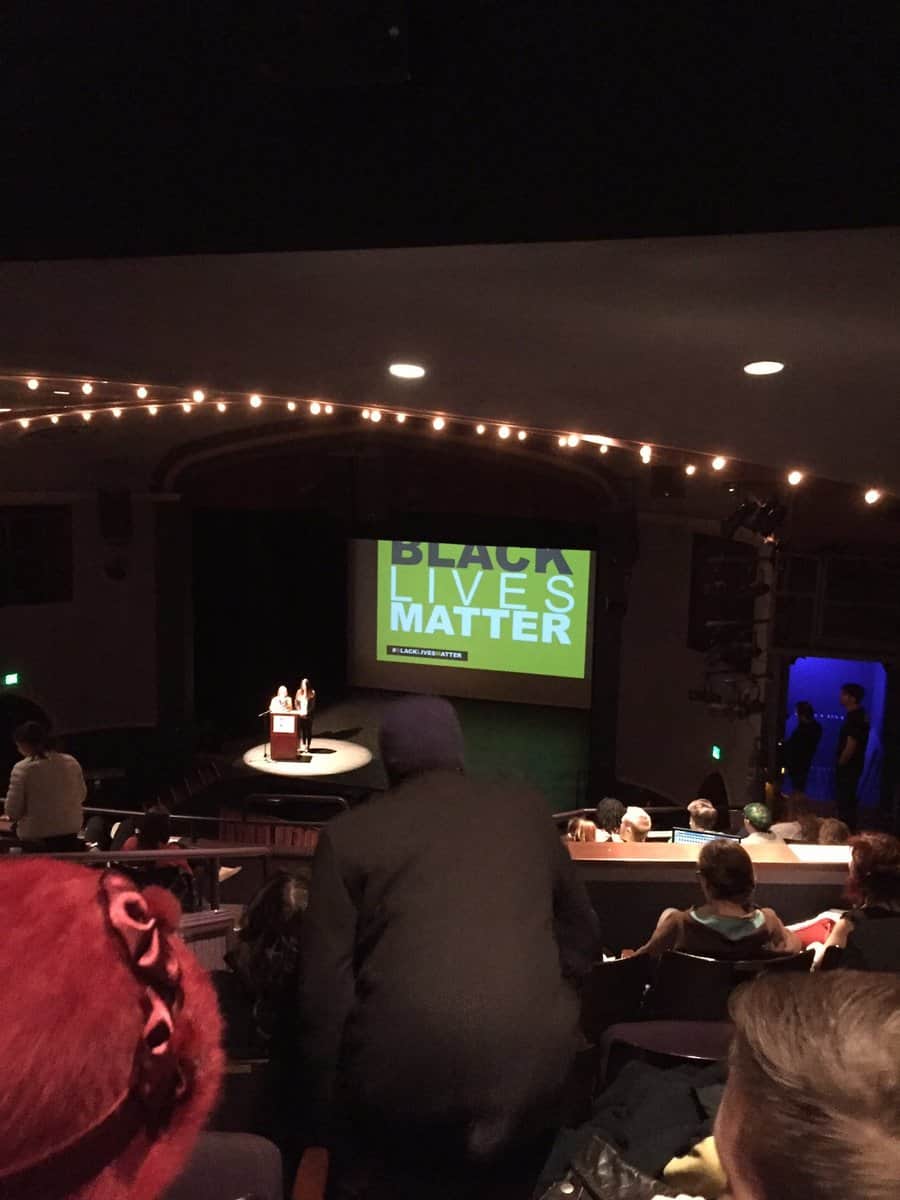
This past week I had the opportunity to attend a lecture at the Englert Theatre featuring Patrisse Cullors, co-founder of the Black Lives Matter movement. Cullors’ activism was, in part, fueled by the final verdict of the State of Florida vs. George Zimmerman case. The controversial trial ended with George Zimmerman being found not guilty on all counts of second degree murder for the fatal shooting of Trayvon Martin. In response, Cullors and others took to social media, proclaiming: “let’s take these three words and let’s start a movement.” The Black Lives Matter movement continues to combat racial injustice and call for the implementation of increased accountability within law enforcement practices. Thoughout her talk, Cullors expressed the importance of organizing at local levels as a means of creating a national and global movement. Her call to action and to the lessons of the past reminded me of two particular instances in Iowa’s past, where bold men and women have spoken out against injustice.
Patrisse Cullors speaking at the Englert Theatre on February 6, 2017.
In 1945, Charles and Ann Toney were refused service in Davenport, Iowa’s Colonial Fountain, a local ice cream parlor. The clerk, Dorothy Baxter, refused to serve them solely based on the color of their skin. Charles Toney, knowing this refusal was in violation of their civil rights, brought the case to court. Toney, a member of the local NAACP chapter, credited his activism to his mother who refused to sit in the segregated section of a movie theater in Clinton, Iowa, the town in which he grew up. After two trials and much deliberation, the court ruled in favor of the Toneys granting them the first ever victory for a civil rights case tried in Davenport. You can read more about the Toneys and their case in George William McDaniel’s, “Trying Iowa’s Civil Rights Act in Davenport: the Case of Charles and Ann Toney.”
Edna Griffin photographs. Iowa Women’s Archives, University of Iowa Libraries.
In 1948, Edna Griffin, a black woman living in Des Moines, tested the boundaries of this legislation by walking into Katz Drug Store. Griffin, her daughter, and two black men sat down to order ice cream sundaes on a hot July day. Though the waitress took their orders, she returned to the table saying that her manager had told her not to serve them. Griffin, aware of her rights, took the case to trial. Several community members infuriated, organized protests and boycotts directed at the discriminatory practices occurring at lunch counters across Des Moines. The case was eventually brought before the Iowa Supreme Court, and in 1949 a civil rights victory was won Griffin’s behalf in the State of Iowa vs. Katz proceeding. More details on Griffin’s story can be found in Noah Lawrence’s,”Since it is my right, I would like to have it: Edna Griffin and the Katz Drug Store Desegregation Movement.”
These stories are two of many archived in the Iowa Digital Library and the Iowa Women’s Archives, and they invite us to look back on our history and the role Iowans have played in defending civil liberties.
Amanda Visconti—then a graduate student at the University of Maryland. http://www.english.umd.edu/news/5523
In 2015, Amanda Visconti did something that many Joyceans had often considered but never fully realized: she invited the public to annotate a public, web-based, and full-text version of James Joyce’s Ulysses (1922). For decades, scholars had struggled with the notoriously irascible Joyce estate and its policing of copyright, access, and articulation where Joyce’s writings were concerned. The past thirty-plus years are littered with wonderful projects—some digital, some not—that bear the strain and scars of policy and litigation.
By 2012, however, Joyce’s novel could now circulate in ways that its author (arguably) had hoped it would. That year, Ulysses exited copyright and returned anew to the welcoming embrace of the public—a public that is its subject; a public for whom it was written; a public that can now in turns, be informed by and inform the text.
When Amanda Visconti, as a graduate student, began work on her project, she entered into a long line of digital projects that sought to remediate aspects of Joyce’s work. Some of these projects were annotative in nature; others sought to echo the experimental aspects of Joyce’s writings. In her excellent whitepaper submitted as part of her doctoral dissertation, Professor Visconti maps out a number of digital treatments of Joyce’s work. So, I won’t rehash those here.
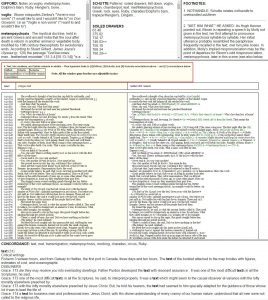
Heyward Ehrlich’s James Joyce Text Machine. Screencap of in-text annotation links with resizeable windows. http://andromeda.rutgers.edu/~ehrlich/jjtm/demo/6index.html
Instead, I want to call attention to her project for its public, digital focus on collaboration and community-building.
There is arguably no work of literature more devoted to the idea and the practice of community than James Joyce’s Ulysses. As early as Dubliners (1914), Joyce was remarking on his own “scrupulous meanness” with respect to that collection’s careful articulation of seeming banality. Joyce’s talent for translating the everyday into prose informs all of his works. And Ulysses, the story of a day in Dublin, so elegantly, so experimentally, so thoroughly captures the pulse and verve of life hiding in plain site, that Joyce boasted to his friend Frank Budgen, “I want…to give a picture of Dublin so complete that if the city one day suddenly disappeared from the face of the earth it could be reconstructed out of my book.” The line is, of course, not literally true—and today, with Dublin having undergone so many transformations, too much physical difference lies between the Dublin of Ulysses and its 21st century iteration. But I don’t think that was Joyce’s point. Joyce is, for me, our most human writer. The picture of Dublin he gives us is one informed by our pettiness, insecurities, and fears just as fully as it is our empathy, charity, and loves. Where we fail to give things a second thought—opening a door, crossing the street, pouring a drink—Joyce follows behind us, gathers up the neglected details of our everyday lives, and relocates them in this human narrative. And by virtue of reading Ulysses, we re-encounter ourselves in the text.
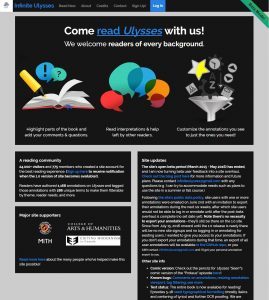
The welcoming front page of Infinite Ulysses. http://www.infiniteulysses.com/
Now, that’s a point I had to make in order to best articulate the value of what Amanda Visconti has done. For years, people have created reading groups around Ulysses and Finnegans Wake. Those texts nearly necessitate and certainly support a multiplicity of perspectives. Joyce’s work both turn upon and turn towards the public. We read them to better know ourselves and in reading them we create or are brought into new communities addressing those texts. Infinite Ulysses stands as one of the most successful public digital projects that attends to the work of literary criticism via annotation while at the same time creating a community around the text.
This summer, J.D. Biersdorfer, writing for the New York Times, mentioned the site in a piece about the rise of digital assistance in reading Joyce’s tome. Biersdorfer referred to the site as “a global community of readers and scholars discussing an online copy of the text together in a mash-up of literary analysis and group therapy.” I have no issue with that assessment. The creation of a vibrant community in which ideas circulate, questions are posed, debates had, and the odd or idiosyncratic view conveyed seems like precisely the picture of humanity Joyce sought to give us.
A dissertation that advances both a critical apparatus for approaching (literary) works while also enacting public use of them marks, to my mind, a turning point in what we can expect from a dissertation. For me, Infinite Ulysses illustrates just how much of Joyce’s work Professor Visconti came to understand while pursuing her degree. The fact that her dissertation reaches beyond the page and into the broader public captures the essence of Joyce’s work in a way few do.
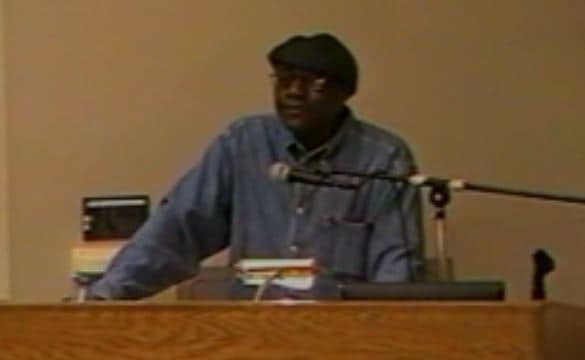
James Alan McPherson taught at the Iowa Writers Workshop beginning in 1981. In 1978, he received a Pulitzer Prize in Fiction for his Elbow Room. In 1981, he read his short story, “There was once a State Called Franklin“, the same year he was named a MacArthur Fellow, and in 1995 he was inducted into the American Academy of Arts and Sciences.
James Alan McPherson lecture, October 11, 2003
The Iowa Digital Library also contains a lecture he presented in 2003 at the Iowa Memorial Union, giving examples of the types of landscapes across the world that have influenced peoples’ thinking and philosophies.
James Alan McPherson died yesterday at the age of 72.
The Madurese folk story project is one component of a larger endeavor of a linguistic analysis of the Madurese language (which has resulted in the publication of a grammar in 2010—A grammar of Madurese and several scholarly papers). The folk tales provide a wealth of examples for linguistic analysis, but more importantly the stories included here promote the Madurese culture, afford the Madurese people an opportunity to reflect on and more deeply appreciate their own language and rich culture, and provide others a chance to learn about one of the major population groups in Indonesia.
Davies is set to embark on a new NSF-funded project in collaboration with faculty at Universitas Pendidikan Indonesia to document the language of the Baduy, a small group whose language and culture are threatened by the encroachment of the modern world. One component of that undertaking will include folk tales and historical narratives like those in the Madurese project.
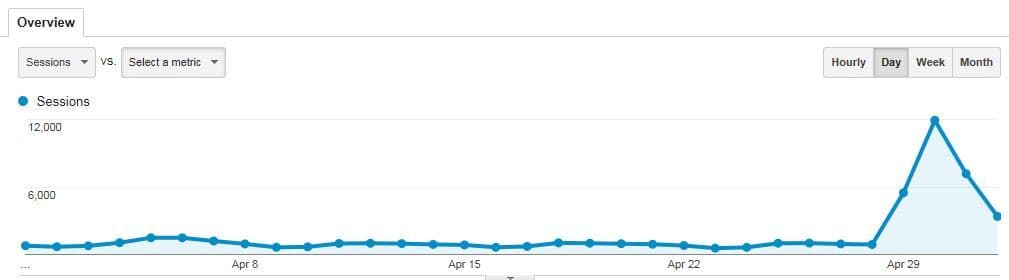
On Friday, the Walt Whitman Quarterly Review (WWQR) published a previously unknown book-length work “Manly Health and Training,” by Walt Whitman, recently discovered by Zachary Turpin. (Read more about it in a previous post.) Minutes after it was published, The New York Times broke the story. (We couldn’t say anything until their story launched at about 10AM, and the editors carefully timed publication to be minutes before the announcement.) From that point forward, we watched as the downloads of the content climbed. And yes, for some of us, this included watching over the weekend because it was very exciting!
The use was obviously high for the journal itself, but the use for our entire repository was massively spiked by this publication; over 91% of the traffic on our entire repository was for Walt Whitman Quarterly Review. This illustrates the typical use of our site from April 1–May 2WWQR.
While the other items in the journal issue did not receive nearly as much use as the Whitman work and the introduction about the work, they received far more use than would be typical. Compare the first 3 days of use for a book review, bibliography, and back matter in this issue with similar items in the previous issue since being published.
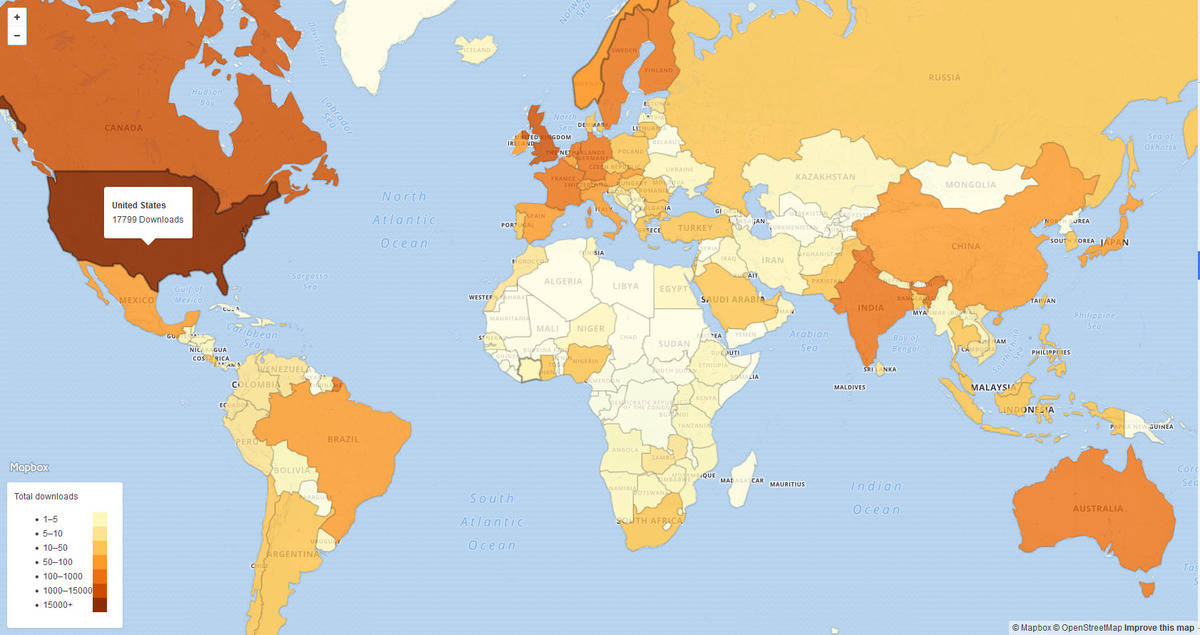
People all over the world downloaded this newly discovered Whitman work. The first image shows downloads of in Walt Whitman Quarterly Review vol 33 issue 3 during the first three days when “Manly Health and Training” was published.
This second map is interactive so you can see the counts by country. We will also periodically update this map with more recent data. [Update – The interactive map now shows the first 7 days of downloads.]
Most people who downloaded the content first went the journal or issue site (10,826 out of 18,234), so it is impossible to know what articles and posts resulted in the most downloads. The numbers below reflect the downloads that occurred when users were coming directly from another publication (i.e. a link to the PDF). I think these numbers are not included in the Google analytics counts because links directly to our PDFs do not appear in Google Analytics.
Google Analytics shows us what sites directed traffic to our site, but do not indicate if people downloaded content. Historically, most of the downloads on our site come from Google (and other search engines). During this 3 day period, traffic to WWQR was largely from all the news sources that had articles. People arrived at the specific issue or the WWQR site as a whole largely from links on referring sites (15,191). Only 584 (of the 22,387 total sessions) came via a search engine. It is unclear where 6,480 sessions originated as the links appear to be direct. This could be links from email, it might be people who have turned tracking off, or it may be people typing in the URL directly.
For more media coverage of the discovery and its publication, follow Stephanie Blalock on Twitter (@StephMBlalock), and for information about articles published in each new issue of WWQR, follow the journal (@WaltWhitmanQR) .
As more news sources pick up on this, we will post updates about the usage.
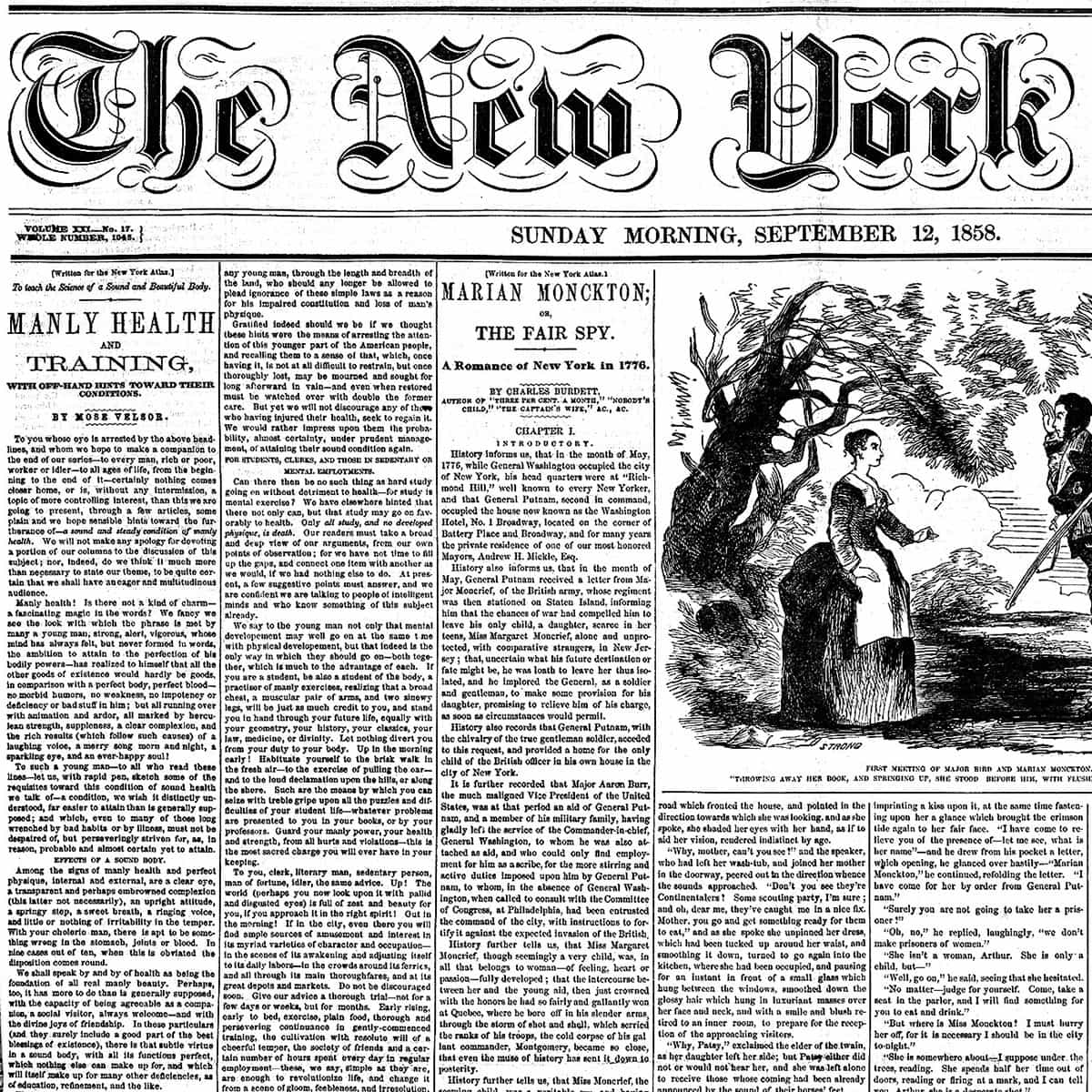
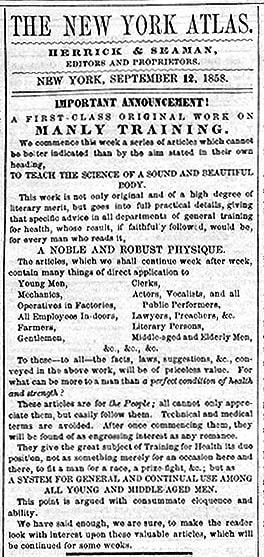
An announcement for Walt Whitman’s “Manly Health and Training,” published in The New York Atlas on September 12, 1858. Image Courtesy of The American Antiquarian Society.
In the third open-access issue of the Walt Whitman Quarterly Review (WWQR)Editor Ed Folsom and Managing Editor Stefan Schöberleinpublish in full a newly discovered book-length work by the poet Walt Whitman entitled “Manly Health and Training.” Zachary Turpin, a PhD candidate in English at the University of Houston, recently discovered “Manly Health and Training,” a previously unknown thirteen-part journalistic series of 47,000 words that originally appeared in the New York Atlas in 1858. Turpin’s important find means that “Manly Health and Training” can now be republished and confidently attributed to Whitman for the first time since 1858. As Turpin points out in the detailed introduction that accompanies “Manly Health and Training” in WWQR, surviving issues of the Atlas are rare today, even on microfilm, and he used one of the few remaining reels containing the newspaper, currently held by the American Antiquarian Society, to find “Manly Health and Training.” The byline for each of the installments lists the author as “Mose Velsor of Brooklyn,” a pen name that Whitman was known to have used occasionally for newspaper articles, and some of the articles from the “Manly Health” series also correspond in subject matter and/or wording with selections from Whitman’s notes on health and the body.
“Manly Health and Training,” which Turpin describes as a long lost “guide to living healthily in America,” stands as a remarkably significant new find. The articles promise to help fill in substantial gaps in the poet’s biography and to change the way we understand Whitman’s writings from this period. “Manly Health and Training” ran in the Atlas beginning on September 12, 1858, and ending the day after Christmas, December 26, 1858. This is approximately two years after the publication of the second edition of Leaves of Grass (1856) by Fowler and Wells—a Brooklyn publishing firm known for their texts on phrenology and physiognomy—and two years before the much-expanded third edition of Leaves of Grass (1860)that saw the addition of the “Calamus” and “Enfans d’Adam” (“Children of Adam”) poems on homoerotic and heterosexual love, respectively. In addition to being published between these two volumes of Leaves of Grass, “Manly Health and Training” (1858) was printed at nearly the same time as Whitman is believed to have been working on a twelve-poem sequence about love between men that he titled “Live Oak, with Moss,” which would become the core of “Calamus.”
In order to create “Manly Love and Training,” according to Turpin, Whitman drew on a number of sources ranging from temperance periodicals to works on science and pseudoscience of the period. The series of articles are shaped by many identifiable aspects of nineteenth-century culture including such topics as phrenology, eugenics, male friendship, sports and sports figures, lecture and oratory, vegetarianism, and other social reform and self-help literature. The articles are remarkable, then, for their wide array of content, but they are equally surprising for what is largely absent: the topics of women’s bodies, health, and training. Such an absence, while perhaps not entirely unexpected, merits further investigation given that on September 16, 1888, Whitman told his friend Horace Traubel that women were among his “sturdiest defenders, upholders” and that Leaves of Grass was “essentially a woman’s book.”
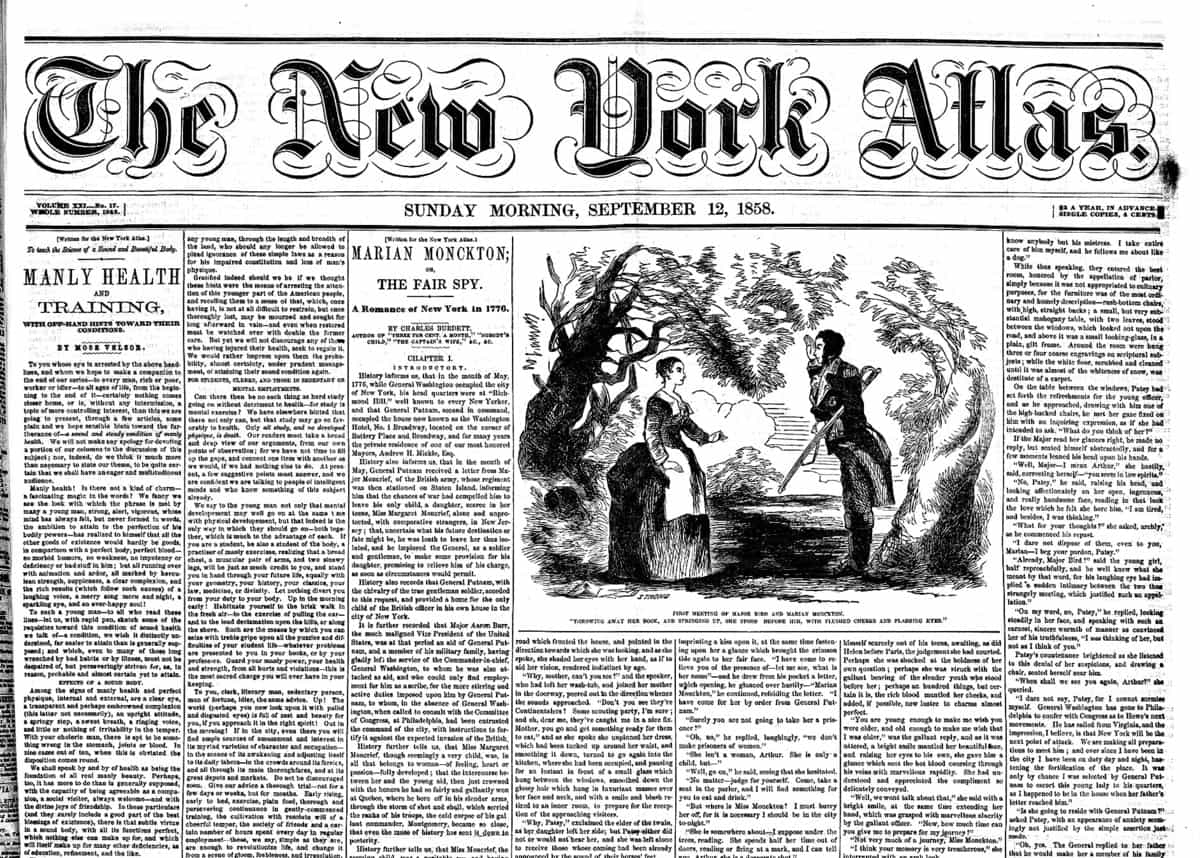
The first installment of Walt Whitman’s “Manly Health and Training” on the front page of The New York Atlas on September 12, 1858. Image Courtesy of the American Antiquarian Society.
Turpin’s discovery of Whitman’s “Manly Health and Training” will certainly shed new light on the poet’s activities in the years following the publication of the articles and leading up to and continuing through the Civil War. If, for example, Whitman advocated a training program that involved exercise and a healthy diet, then why did he choose to spend so much of his time in 1859 and the early 1860s at Pfaff’s, a New York beer cellar and popular American Bohemian hangout, known for its coffee, lager beer, and wine selection, as well as its substantial food offerings? How does Whitman’s interest in leading American men toward sound, muscular, and virile bodies change the way we view Whitman’s seeming need to volunteer in the hospitals of the Civil War, where he would have seen first-hand the devastating injuries—the gaping wounds—in those very bodies he was seeking to guide toward a state of “perfect health”? And what does Whitman’s insistence that the very act of reading is not a “half-sleep” but rather a “gymnast’s struggle” mean for us, as readers of his works, in light of “Manly Health and Training,” with its assessment of prize-fighting and advocacy of exercise?
With the publication of “Manly Health and Training” in WWQR, we can begin to answer these questions and, no doubt, to formulate many others. But Turpin’s find, 158 years after the original publication of Whitman’s articles, should also draw our attention to the fact that even when it comes to well-known authors like Whitman, much remains to be discovered. This is likely true, not just of Whitman, but of many other nineteenth-century writers when our research includes newspapers and magazines. Examining periodicals in print and digital forms, as well as archival research in general, has yielded significant finds in the field of Whitman Studies over the past several years. A new Whitman poem, as well as numerous reprints of his short fiction and reprints of his poetry in periodicals have come to light, and, recently, a letter Whitman wrote for a Civil War Soldier was discovered in the National Archives. Turpin’s find also serves to remind researchers that not all newspapers and magazines from the past are digitized, available, and easily searchable online. In fact, many periodicals are still available only on microfilm and/or in print form. The discoveries we make in the future, then, will depend a great deal on where we look and how we preserve and use archival material in all formats.
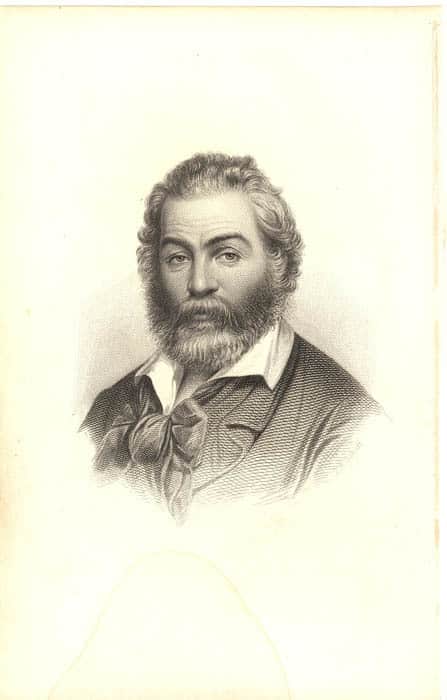
Walt Whitman in 1860, Photographer: Stephen Alonzo Schoff, after an oil portrait by Charles W. Hine, Original Plate in the Charles E. Feinberg Collection, Library of Congress, Image Courtesy of The Walt Whitman Archive
Finally, the publication of “Manly Health and Training” in its entirety in the current WWQR is a noteworthy feat in itself. In October 2015, during open-access week, WWQR, a University of Iowa journal and the international journal of record in Whitman Studies, made the transition from a print journal to an online only, open-access publication with the help and support of the Digital Scholarship and Publishing Studio at the University of Iowa Libraries. This online format, as the editors of the journal make clear in their foreword to the issue, has made possible the publication in full of Whitman’s “Manly Health and Training.” In the journal’s previous print version, printing costs and page limits would have necessitated the careful selection of only a few excerpts from this previously unknown text. One of the many benefits of offering a scholarly journal as an online and open-access resource is that this digital format opens up a range of publishing options and formats not possible in print alone. As a result, the editors can share this newly discovered piece of the poet’s writing with an ever-growing international body of Whitman readers who access his writings via an internet connection. In the future, “Manly Health and Training” will also be available on the Walt Whitman Archive. If, as Whitman wrote in his advertisement for “Manly Health and Training,” he intended this text “for the People,” he almost certainly would have approved. It is my hope that all readers of “Manly Health and Training” will actively engage and even struggle with this piece as Whitman recommended, since it remains for us–the readers–to investigate how Whitman came to write this piece, to trace the origins of these ideas, and to determine how we, in coming to this text some 158 years after its first publication, might make use of it in our own time and in our own ways.