Skip to content
Skip to main content

Grant Wood scrapbooks now online

Grant Wood portrait with brush and dental instrument used for painting, 1940s | Figge Art Museum Grant Wood Digital Collection

The Figge Art Museum and the University of Iowa Libraries are pleased to announce the release of the Grant Wood Digital Collection, http://digital.lib.uiowa.edu/grantwood, in conjunction with the Grant Wood Biennial Symposium 2012, April 13-14, 2012.

This unique digital collection includes more than 12 scrapbooks and albums of news clippings, photographs, postcards, letters, and related ephemera assembled by Grant Wood’s sister, Nan Wood Graham, chronicling her brother’s professional life.

For the first time, scholars, students and the general public will have unprecedented virtual access to the scrapbook materials.  Due to their fragility, access to the actual scrapbooks is simply impossible.

“Nan Wood Graham is one of the most famous faces in the history of art, immortalized in Wood’s iconic painting American Gothic. The materials Graham compiled provide wonderful insight into Wood’s life in Iowa and his development as one of the most famous American artists of the 20th century,” says Figge Art Museum registrar Andrew Wallace.  “It is gratifying to know that, through this digital collection, people around world are able to learn about the life and times of Grant Wood through the words of close friends, family, and fellow artists.”

This digital collection project would not have been possible without the generous assistance of the Henry Luce Foundation American Art Renewal Fund and through additional funding for imaging equipment provided by an anonymous donor.

These materials, along with several hundred artifacts, including the artist’s wire-rimmed glasses, palettes, paint box, and easel, are part of the Figge Art Museum’s Grant Wood Archive. The Archive has provided primary source material for numerous articles, catalogs, and monographs for over 40 years, most recently by R. Tripp Evans for his award-winning 2010 biography Grant Wood: A Life.

Significant Science Fiction Collection comes to the University of Iowa Libraries

Collection encompasses 100 years of material.

The University of Iowa Libraries has acquired a significant collection of pulp magazines, fanzines, and science fiction books owned by the late James L. “Rusty” Hevelin. The collection encompasses nearly one hundred years of material, documenting in great detail the development of science fiction, popular culture, and participatory fan culture in the United States during the twentieth century.

Rusty Hevelin began collecting pulp magazines in the 1930s when they were a popular item on newsstands. Pulps were cheaply produced weekly fiction magazines. They were the training ground for many of the most famous science fiction writers like Ray Bradbury, Isaac Asimov, and Edgar Rice Burroughs.   The collection contains thousands of pulps, ranging from the early Thrilling Wonder Stories, the eclectic Weird Tales, character titles such as The Shadow, The Spider, and Doc Savage, and many examples of mystery, western, and aviation pulps.    “This vast collection of material rarely collected by traditional libraries is a goldmine for teachers and scholars,” said Corey Creekmur, UI Associate Professor of English and Film Studies. “Pulp magazines were central to mid- 20th century American popular culture, but their ephemerality has made them rare and inaccessible for later readers. The arrival of this collection makes Iowa a major archive for future research in this area.”

Fanzines push science fiction genre

Readers of pulps began communicating with one another through the letter columns in each issue, and this back-and-forth exchange soon developed into fanzines, which fans produced on home mimeograph or other printers, and distributed through the mail and at conventions. The collection is particularly rich in the early years of science fiction fanzines, including several titles that Hevelin produced.

Science fiction grew out of the pulps and into mainstream publishing, and the Hevelin collection documents this process in thousands of hardcover and paperback science fiction books. First editions of Ray Bradbury, Arthur C. Clarke, and other writers are included, along with many paperback novels. Together, these materials depict the great diversity of styles in science fiction as the genre evolved.

“The Hevelin collection presents a rare opportunity to study the development of this genre, as seen in many of its most important formats, through the lens of a single collector,” says Greg Prickman, Head of Special Collections & University Archives. “Fans like Rusty weren’t just fanzine writers, or pulp collectors, or science fiction readers, they were all of these things, and Rusty’s collection shows how these materials interact with one another.”

The University of Iowa Libraries is home to internationally significant science fiction collections. Holdings include the Horvat Collection of Science Fiction Fanzines, the Ming Wathne Fanzine Archive Collection, and a growing body of materials resulting from the Fan Culture Preservation Project, a partnership with the Organization for Transformative Works.

Jennifer DeBerg wins Arthur Benton Excellence in Reference Services Professional Development Award

Jennifer DeBerg, Clinical Education Librarian at Hardin Library for the Health Sciences, was awarded the Arthur Benton Excellence in Reference Services Professional Development Award for 2012. Jennifer received kudos from nursing students, research colleagues, faculty and staff in her nomination letter

The award is given biennially to a University Libraries professional staff member who has demonstrated outstanding commitment in providing reference services for the University community. The $1,000 award, made possible by a generous endowment from Dr. Arthur Benton, Professor Emeritus in the Department of Neurology, University of Iowa Hospitals and Clinics, will support a professional development activity related to the advancement of library reference services.

Jennifer is a librarian liaison to Communication Sciences & Disorders, Family Medicine, College of Nursing, Nursing Services and Patient Care, Obstetrics & Gynecology, Orthopaedics & Rehabilitation, Otolaryngology, Pediatrics, Physical Therapy & Rehabilitation Science, and Rehab Therapies & Rehab Counseling.

Annual R. Palmer Howard Dinner : Spot Ward, Crazy Sally, and the Chevalier Taylor: Three Medical Quacks in 18th Century Britain

The University of Iowa History of Medicine Society announces the R. Palmer Howard Dinner for 2012, Friday, April 13, 2012, 6:00-9:30.

Lynda Payne, prof. in Medical Humanities & Bioethics, and History, University of Missouri Kansas City will speak on “Spot Ward, Crazy Sally, and the Chevalier Taylor: Three Medical Quacks in Eighteenth-Century Britain”.

Reception, dinner and lecture will be at the Sheraton Hotel. Make your reservations now but no later than April 6 with Donna Sabin, 319-335-6706, donna-sabin@uiowa.edu Online form (print & mail): http://hosted.lib.uiowa.edu/histmed/index.html. Seats for the lecture only will be available.

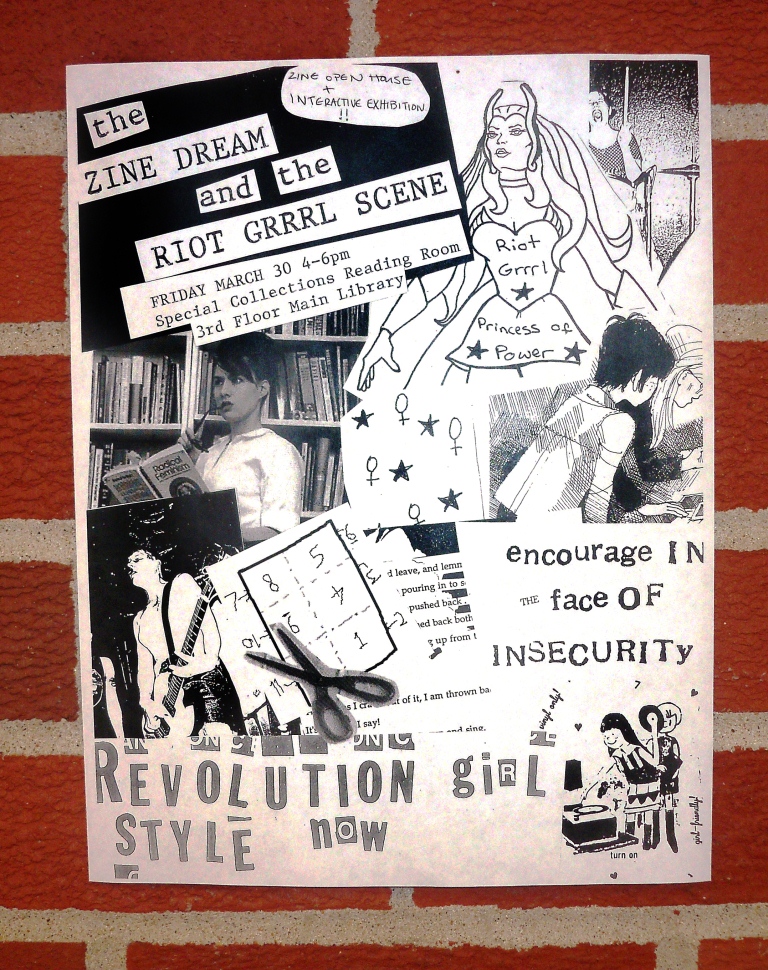
Riot Grrrl: Finding a voice

UI Libraries, Mission Creek Festival host zine open house and interactive exhibition March 30

Riot Grrl

In conjunction with the Mission Creek Festival of music and literature, the Special Collections department at the University of Iowa Libraries will host “The Zine Dream and the Riot Grrrl Scene” from 4 to 6 p.m. Friday, March 30. A cooperative project of librarians, scholars, and zine-makers, this event will highlight the 1990s Riot Grrrl movement and its independent publishing zine culture by exploring the intersection of music, writing, and social issues.

Zines (originally called fanzines) are amateur publications produced noncommercially and designed to circulate among a small number of people sharing similar cultural or social interests. Before the advent of the Internet and the introduction of blogging as a tool of personal and creative expression, zines were an important method of communication among members of subcultures traditionally underrepresented by the mainstream media.

The open house will focus on the Libraries’ collection of zines from the 1990s feminist “riot grrrl” movement that cover topics such as female-driven music, complexities of female identity, and a consciousness of institutional, social and cultural sexism. Riot grrrl zines are also concerned with feminist political and social issues such as discrimination, sexual abuse, eating disorders, and body image. Many zines are marked by stories of intensely personal experiences relating to these issues.

“Just before the rise of the Internet, the Riot Grrrl movement used photocopiers, scissors, glue and the Postal Service as tools to develop a hugely influential social network,” says Kembrew McLeod, associate professor of communication studies and co-organizer of the event. “In doing so, these pioneering feminists carved out an independent media space that challenged the dominant culture.”

Monica Basile, local zine-maker, artist, and doctoral candidate in gender, women’s, and sexuality studies, will curate a browseable selection of zines in the reading room. Attendees will be invited to share their experiences and thoughts in a discussion group on the importance of zines and zine culture. They’ll also have the chance to work on a collaborative zine which will be copied, collated, and shared with all of the contributors.

“As a print phenomenon, a Riot Grrrl zine demands attention be paid to its origins but it is physically turning the page that makes the continued relevance and urgency of the messages so evocative,” says Colleen Theisen, outreach and instruction librarian in Special Collections. “Zine newbies, Riot Grrrls, librarians, zine-makers, students, scholars, punk rockers, writers, community members—all are welcome to touch and turn the pages.”

from IowaNow: http://now.uiowa.edu/2012/03/riot-grrrl-finding-voice
Digital spring awakening

It’s the Spring equinox, and the flowers are bringing us back to life, perennially a cause for celebration as the Iowa Digital Library illustrates.

Bird on hand by Tilly Woodward, 2006 | The Daily Palette Digital Collection
UI dancers, 1910s | Iowa City Town and Campus Scenes
Flower baskets, Lost Nation, Iowa, 1915 | Noble Photographs
Floral postcard, 1910s | Noble Photographs
Scrapbook cover, 1997 | Evelyn Birkby Collection
Equinox by David Whannel, 2008 | The Daily Palette Digital Collection

Sisters, There’s a Women’s Center in Iowa City!

Celebrate the 40th anniversary of the Women’s Resource and Action Center with a piece of cake and a lively discussion of the early days of WRAC and the women’s liberation movement in Iowa City.  Panelists will include Sondra Smith, Gayle Sand, Sandy Pickup, Jill Jack, with Laurie Haag moderating.   

Friday, March 23, 2012
4:00-6:00 p.m.
Iowa Women’s Archives
3rd floor, Main Library, University of Iowa

Celebrate Pi Day (belatedly) at the Libraries on March 19

Pi, Greek letter, is the symbol for the ratio of the circumference of a circle to its diameter. Pi Day is celebrated by math enthusiasts around the world on March 14th. Pi = 3.1415926535…. Pi is used in many different fields and can be seen in our everyday lives. It may be seen in art, structural design, body mobility, navigation, and probability. To celebrate the versatility of this number, the various campus libraries will celebrate at the same time, showing how pi is used in their subject areas.

Due to March 14th being during spring break, the celebration will take place next Monday, March 19th at 3:14 p.m.

Events will be held at the following libraries: Art, Pomerantz Business, Lichtenberger Engineering, Hardin, Main (near the Information Desk), Music, and Sciences. Join us at any of these locations to learn more about pi and have some apple pie bites.

Reach for your rights

In celebration of International Women’s Day, we’re featuring a few of the thousands of artifacts in our Iowa Women’s Archives Digital Collections:

Holy City residents, Bettendorf, Iowa, 1920s | Mujeres Latinas
Basketball practice, 1938 | University of Iowa Physical Education for Women
Betty Ford at the National Republican Convention, Kansas City, 1976 | Iowa Women's Archives Founders
Betty Ford at the National Republican Convention, Kansas City, 1976 | Iowa Women’s Archives Founders
Girls' dance troupe, Roland, Iowa, 1910s | Noble Photographs
Girls’ dance troupe, Roland, Iowa, 1910s | Noble Photographs
Fence climbing, The University of Iowa, 1920s | African American Women in Iowa