
This guest post was written by Katarina Stiller, book and paper conservator at the University of Oregon.
In 2024, one of the John Martin Rare Book Room’s books, Catoptrum microcosmicum (1661), was at the University of Iowa Libraries’ Conservation Lab for examination and stabilization. As a student intern at the time in the Conservation and Collections Care department of the UI Libraries, I had the opportunity to do a complete treatment for this amazing anatomical flap book.
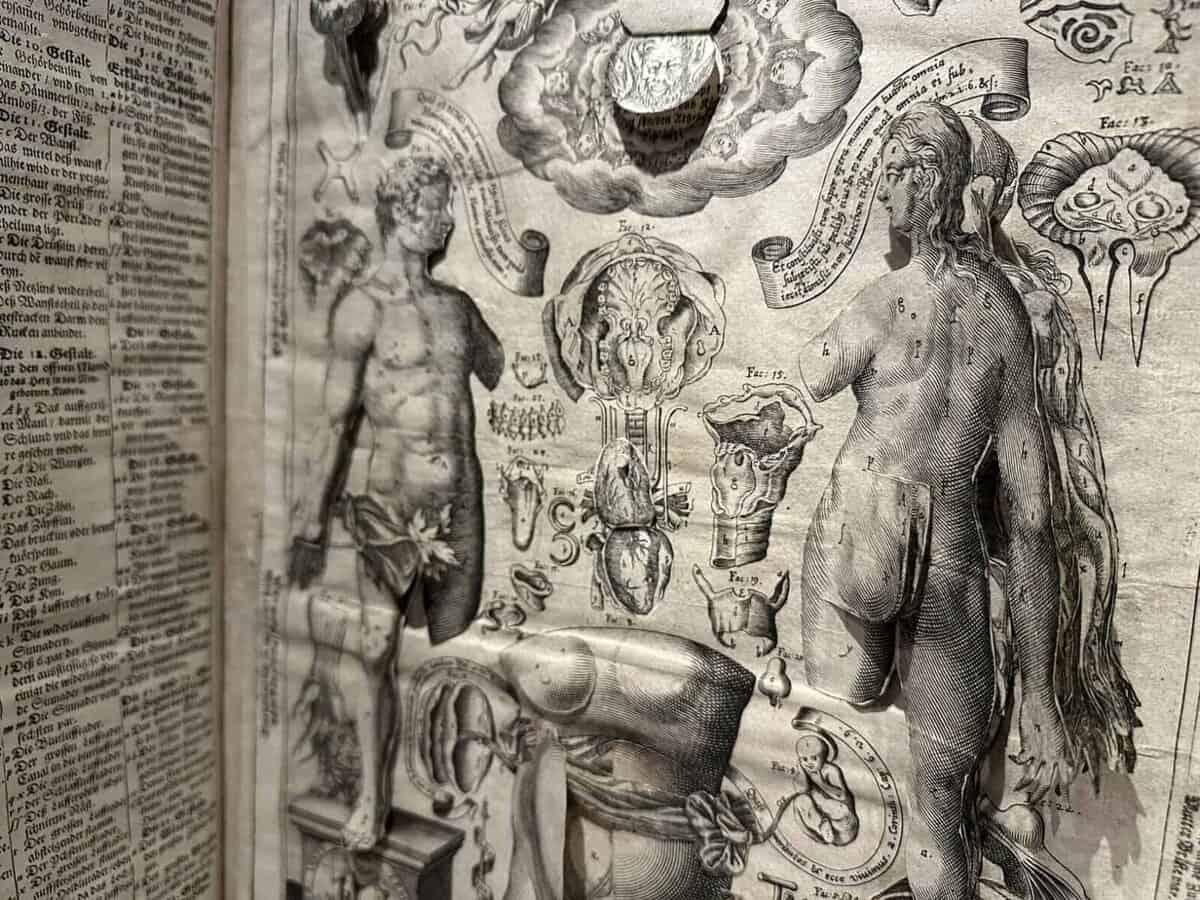
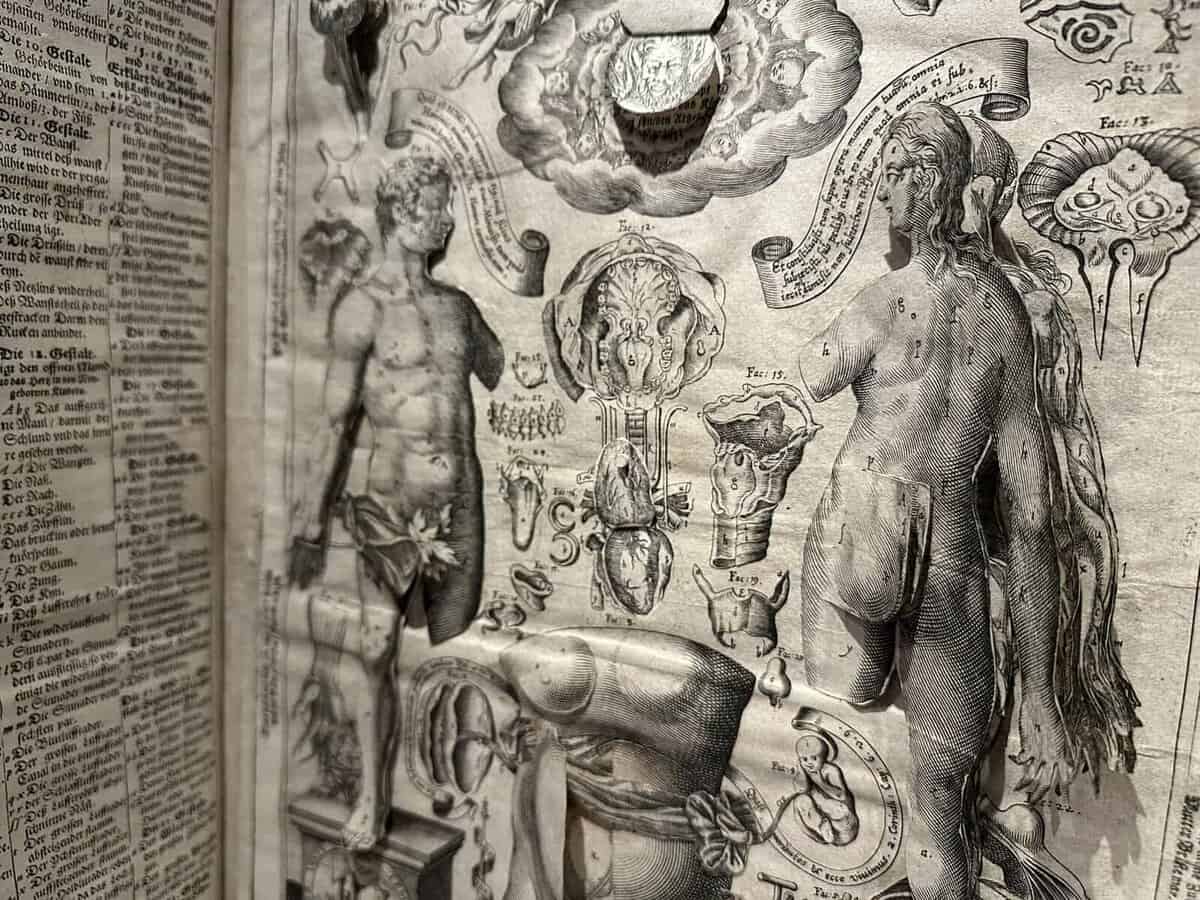
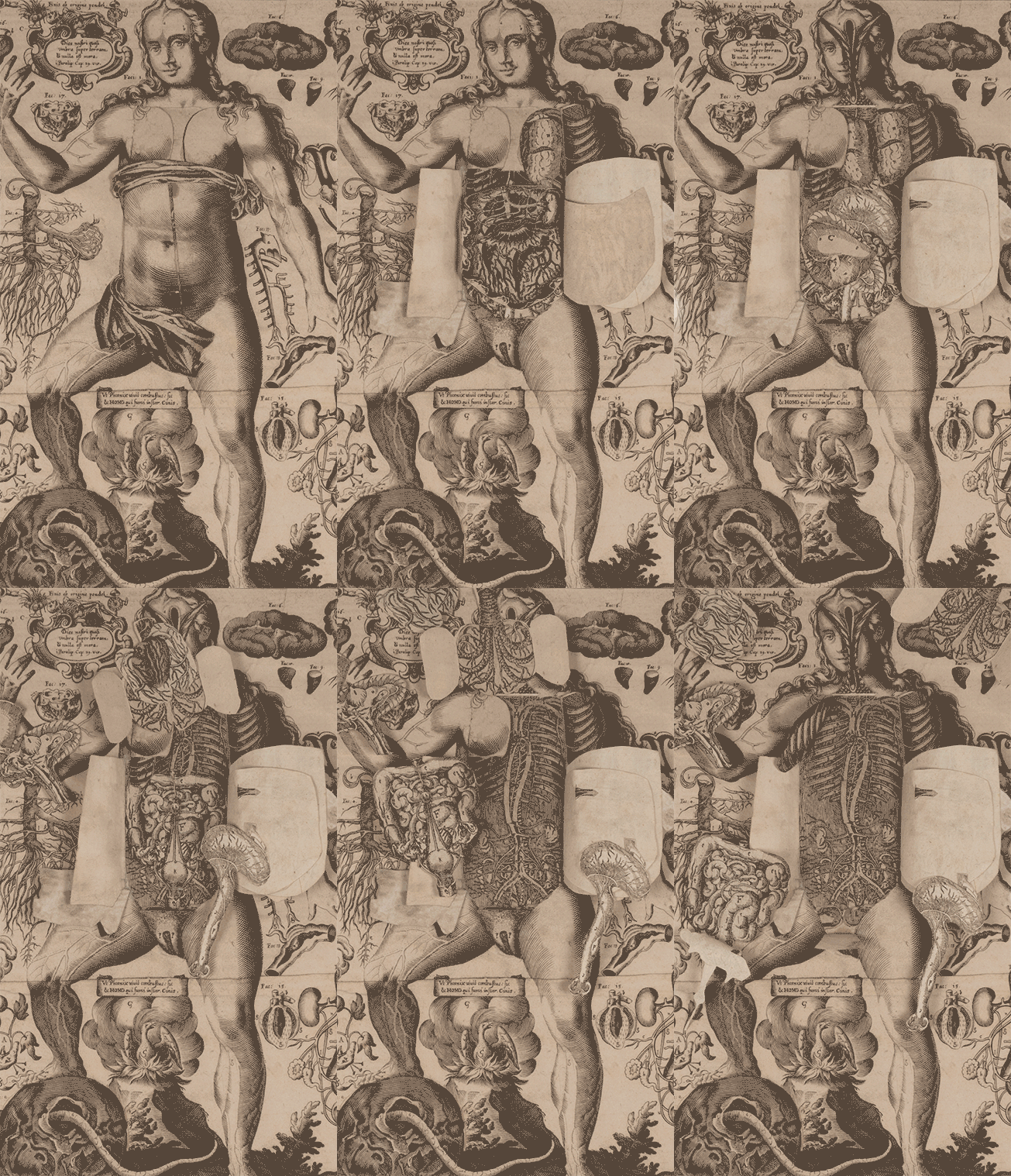
Catoptrum microcosmicum (“The Mirror of the Microcosm”) was the most extensive anatomy book with overlapping flaps of its time. Its title refers to the classical notion of the human body being a microcosm or representation of the universe in miniature. The author, Johann Remmelin, was a town physician in Ulm and later a plague doctor in Augsburg. The engravings were based on Remmelin’s sketches and drawn by the renowned Augsburg artist Lucas Kilian (1579–1637) and engraved by Stephan Michelspacher (active 1613–1619), who also served as the publisher. The book has three plates depicting human anatomy, with flaps and intentionally loose components illustrating individual organs and entire body systems. Having a series of overlapping flaps helped convey the dimensionality of the body, with some areas containing 15 layers.
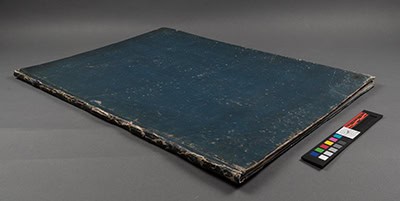
Catoptrum microcosmicum was intended more for the curious layperson rather than for serious academic teaching due to its delicate construction, great expense, and unwieldy size. It was reprinted numerous times in the 17th and 18th centuries in Dutch, French, English, Latin, and German. This particular copy, published in German in 1661, is notable for its blue paper boards binding, which is likely original. The John Martin Rare Book Room also has a 1619 copy with a parchment binding recycled from what was likely a 15th-century incunabulum.
When the book came to the Conservation Lab, it was apparent that it had been heavily used, with abrasions, stains, small tears, and signs of previous repairs throughout the textblock. One of the plates had additional wax and adhesive residues that prevented the opening of some of the flaps. Despite the heavy use, it was remarkably intact, with even the loose organs all accounted for.
A particularly unique feature of this book is that it is still in its original binding, so it was essential for conservation treatment to be minimally interventive. Retaining its signs of use, such as historic repairs, was important to preserve evidence of the book’s past function as a very hands-on object. Presently, this book is also very popular with classes, scholars, and events, so an additional goal of this treatment was to stabilize it for reading room use and to go on display for an upcoming exhibit. Balancing the preservation of original material while enabling continued access is a common consideration in library conservation, resulting in treatment plans unique to each object.
After a thorough examination and the development of a treatment plan, the book was first cleaned with soft brushes and sponges. Stains were reduced via the application of semi-rigid gels. The gels were able to draw out discoloration without introducing much moisture, which could have created new stains.
This is a very controlled treatment approach that allows for in-situ cleaning without disturbing the binding. After cleaning, the flaps were realigned and reinforced with lightweight repair paper.
The book was also extensively photographed, both before and after treatment, to document all changes during the conservation treatment. Additionally, this was an opportunity to record the full movement of the flaps. Part of the longstanding allure of movable books is their ability to convey motion via complex paper engineering and viewer participation, so this treatment was a good opportunity to digitally preserve this. This imaging helps provide another avenue for access to the book’s contents without the need to repeatedly handle each of its delicate components, helping conserve the physical book for generations to come.
The book can now be safely handled and is available for viewing at the Paper Engineering in Art, Science, and Education exhibit, open now in the Main Library Gallery through Dec. 19, 2025.