Each year, the University of Iowa Libraries recognizes graduate student employees for their contributions to the institution and the library or department in which they work. Recipients of an Academic Enrichment Award (AEA) are selected by a committee based on their application essays and the feedback of their supervisors, and winners receive an award of $2,500.
The winners for 2025–26 were Gage Johnson, Obatola Layiwola, Hailee McCormick, and Catie Reynolds.
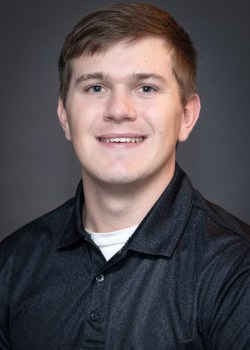
Gage Johnson, from Badger, Iowa, is a student in the Master of Clinical Anatomy program.
Q: How has your work at the Libraries helped you develop important professional skills?
A: Working at the Sciences Library has helped me develop strong communication, organization, and problem-solving skills that I will carry into my future career in podiatric medicine. As one of the first points of contact for students and faculty, I have learned how to listen actively, explain information clearly, and adapt my approach to meet each person’s needs. Managing circulation tasks, equipment, and study spaces has strengthened my attention to detail and taught me to anticipate challenges before they arise, which are skills essential in any clinical environment. These experiences have shaped the way I interact with others and will directly inform how I care for patients, communicate complex information, and build trust in a healthcare setting.
Q: Has there been anything that surprised you about working in a library?
A: Working at the Sciences Library has shown me from the very beginning how deeply my supervisors value students and their well-being. They recognize the stress of balancing academics, work, and personal responsibilities, and consistently go out of their way to support us in any way they can. Their understanding and compassion have made a significant impact on both my undergraduate and graduate experiences, creating an environment where I feel encouraged, respected, and able to grow. I am forever grateful for their guidance and the confidence they have helped me build during my time at the library.
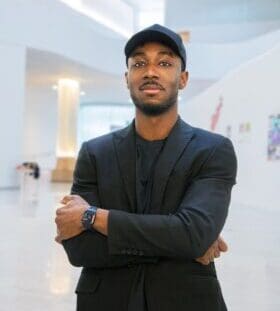
Obatola Layiwola is pursuing an MFA in graphic design with a secondary emphasis in 3D design. He is from Madison, South Dakota.
Q: How has your work at the Libraries helped you develop important professional skills?
A: The projects here have helped develop my creative technology and mentorship skills, which I know will be valuable in both academic and industry settings. A highlight of my learning experience is my contribution to the fall 2025 Paper Engineering in Art, Science, and Education exhibit in the Main Library Gallery. I collaborated with Matthew Butler, Digital Scholarship and Publishing Studio senior developer, and Alyssa Varner, DSPS creative coordinator, to design an interactive screen that merged video production, three-dimensional design, user experience design, and front-end development. This project pushed me to step outside my comfort zone, requiring me to learn and integrate multiple skill sets into one cohesive experience, which has ultimately made me a more resilient designer.
Looking ahead, I plan to teach and apply these skills in collaborative, multidisciplinary environments to develop products, solutions, and experiences that positively impact our community and the country.
A: Has there been anything that surprised you about working in a library?
Q: Working at the DSPS was full of exciting collaborations, networking opportunities, and friendships. Being surrounded by the kind, brilliant, passionate people at the library, who care deeply about their work has been such a pleasurable experience. I am especially grateful for Donna Brooks’ leadership at DSPS for fostering such a space; her kind and encouraging leadership style has taught me empathy, patience, and the value of creating spaces where people feel supported and inspired.
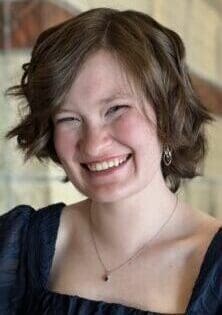
Hailee McCormick from Pleasantville, Iowa, earned a Master of Arts in library and information science with a focus in special collections and archives in May 2026.
Q: How has your work at the Libraries helped you develop important professional skills?
A: My work in the library helped me develop professional skills by giving me vital hands-on experience in the field such as leading classes that come in for visits to Special Collections and Archives or working with our digital repository on ArchivesSpace. I did the work that I hope to be doing in the future under the guidance of staff members that want me to succeed. I’ll use the skills that I have learned while working for the Libraries to make the Special Collections Department that I will be working in a more open and inviting place for people who are hesitant or unfamiliar with special collections and also to work on increasing access to the items housed there.
Q: How has your work at the Libraries helped you develop important professional skills?
A: There have been things that have surprised me about working in a library! I think that the most surprising aspect of library work to me is just how varied all of the reference questions that we receive are. It’s always a treat to get to see what research others are doing and how I am able to help them!
Catie Reynolds earned a Master of Arts in library and information science with a certificate in special collections and archives in May 2026. She considers Rockford, Illinois, her hometown.
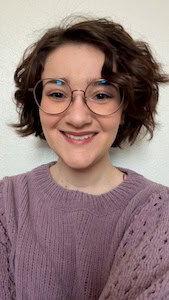
Q: How has your work at the Libraries helped you develop important professional skills?
A: In the two semesters that I worked with Humanities and Social Sciences, I learned how to make research guides, answer reference questions, lead library instruction sessions, contribute to information literacy curriculum, and collaborate with multiple librarians in the department. I had never worked in a library before I started working in the Main Library, but I developed a robust professional skillset that make me a strong applicant for PhD programs and the job market.
Q: Has there been anything that surprised you about working in a library?
A: What surprised me the most about working in a library is the sheer volume of information that is available! Even topics that seem very niche can find support with resources in subject-focused databases or digital collections. It’s amazing how many cultural heritage institutions that contribute to information access. You feel a bit like an information wizard when you find that obscure resource that helps a student complete their research too!