Pietro da Cortona Imgages
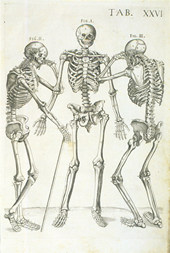 The Hardin Library has recently completed a project that allows a series of early 17th century anatomical images to be viewed from anywhere on the globe. Pietro da Cortona, a noted Italian painter and architect of the high baroque renaissance fashioned a superb series of 27 drawings around 1618 that were later expertly engraved by Luca Ciamberlano. The plates lay unpublished for more than a century until assembled into an atlas and printed in 1741 as Tabulae Anatomicae. The John Martin Rare Book Room at the Hardin Library for the Health Sciences owns a well-preserved copy of the work and recently, the images were scanned at high resolution by staff members of the Information Commons for placement on the World Wide Web. The images can be viewed in varying degrees of magnification so that the viewer can gain an appreciation of the close-up beauty and artistry of the original drawings. The new offering is the second of a series of images to be mounted in this fashion, the first being the magnificent color lithographs of Mascagni’s Anatomia Universa.
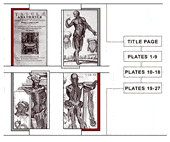 The Web site was designed and developed by Christy Stevens, an Information Commons Graduate Assistant studying Library and Information Science at the University of Iowa. Other contributors to the development of the site include Ed Holtum, Head of the John Martin Rare Book Room; Scott Fiddelke, Digital Media Project Manager; and Jim Duncan, Coordinator, Information Commons & Electronic Services.
You may view the Web site at: http://www.lib.uiowa.edu/hardin/rbr/imaging/cortona/
You may be required to download a small plug-in to view the images.
![Andre Du Laurens (1558-1609). Des mirabili strumas sanandi vi solis Galliae regibus christianissimis divinitus concessa liber unus. Paris: Apud Marcum Orry, 1609. [xv] 307 (misnumbered 293), [18] pp., fold. Plate. 17.5 Limp vellum.](http://blog.lib.uiowa.edu/hardin/files/2007/04/scrofulasm.jpg) During the Middle Ages, tuberculosis of the lymph glands of the neck was very common and was known variously as scrofula, struma, and the “King’s Evil.” For centuries it was believed that the “royal touch” could cure this disease and many English and French monarchs were in the habit of touching their afflicted subjects during major religious holidays. Andre Du Laurens, an anatomist and Paris court physician, was a firm believer in the effectiveness of the “royal touch” and in this work, reports that King Henry IV often touched and healed as many as 1,500 individuals at a time. The work contains a magnificent folding copperplate engraving (displayed here) showing the King touching a number of sufferers who are gathered about him in a circle. The University of Iowa copy has an interesting provenance and can be traced back to Jean Auguste de Thou, its original owner, who died in 1617. [description from Heirs of Hippocrates].
During the Middle Ages, tuberculosis of the lymph glands of the neck was very common and was known variously as scrofula, struma, and the “King’s Evil.” For centuries it was believed that the “royal touch” could cure this disease and many English and French monarchs were in the habit of touching their afflicted subjects during major religious holidays. Andre Du Laurens, an anatomist and Paris court physician, was a firm believer in the effectiveness of the “royal touch” and in this work, reports that King Henry IV often touched and healed as many as 1,500 individuals at a time. The work contains a magnificent folding copperplate engraving (displayed here) showing the King touching a number of sufferers who are gathered about him in a circle. The University of Iowa copy has an interesting provenance and can be traced back to Jean Auguste de Thou, its original owner, who died in 1617. [description from Heirs of Hippocrates].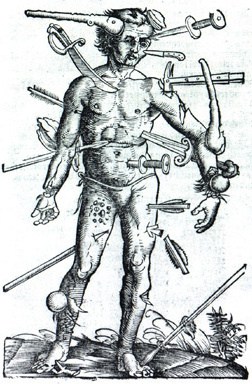 Opening Hans von Gersdorff’s, Feldtbuch der Wunderartzney to this illustration leaves little doubt as to the subject matter at hand. This early, “Field-book of wound surgery” is one of the most important works on 16th century surgery. Gersdorff (1455-1529) was a military surgeon whose writings are based primarily on his own experiences in numerous battles, including the Burgundian War of 1476. “The practical nature of Gersdorff’s book and its fine illustrations caused it to become very popular and it was frequently referred to, widely quoted, and freely plagiarized” (
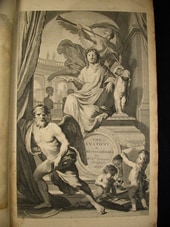 The John Martin Rare Book Room recently acquired the first edition of William Cowper’s The anatomy of humane bodies (1698), one of the most controversial books in the history of medicine. Cowper (1666-1709), a renowned British surgeon and anatomist used copies of the 114 elegant plates already published by Govard Bidloo (1649-1713) in his Anatomia humani corporis (1685). On the frontispiece to his new book, Cowper pasted his own name over Bidloo’s, translated the Latin text into English, corrected some of the descriptions, and sold the book as his own. Cowper argued that the plates were originally published for yet a third author who had already died before Bidloo’s book was published and were, therefore, free for Cowper to use. Bidloo then brought Cowper before the Royal Society where he was forced to defend himself with somewhat mixed results. The John Martin Rare Book room owns both Bidloo’s and Cowper’s works as well as a fascinating rejoinder that Cowper wrote to Bidloo to defend his actions.