Daniel Le Clerc (1652-1728). Histoire de la médecine. Nouvelle ed. Amsterdam: Aux depens de la Compagnie, 1723.
Swiss physician, Daniel Le Clerc was born at Geneva and studied medicine at Montpellier and Paris. He received the M.D. degree at Valencia in 1670 and returned to Geneva to enter private practice. Although successful as a physician, and later as a politician, Le Clerc expended great energy in writing and scholarship. Considered by many authorities to be the father of the history of medicine, Le Clerc is best known for his monumental Histoire de la médicine. The first edition was published in 1696 and, after the second edition had been exhausted, Le Clerc found it expedient to write a third edition, which he updated to the middle of the seventeenth century. Most striking is his inclusion of ten finely executed engravings depicting various personalities associated with medical history.
But she has taen the broken lance,
And washed it from the clotted gore,
And salved the splinter o’er and o’er.
—Sir Walter Scott: Lay of the Last Minstrel—1805
The notion that wounds can be healed from a distance dates back hundreds, perhaps thousands of years and is retained in some folk remedies today.However, the idea reached its zenith in the form ofweapon salve or , Unguentum armariu, the origin of which goes back at least as far as the Swiss physician-iconoclast Paracelsus (1493-1541).The idea was simple:rather than dressing the wound, the physician applies salve to the weapon that caused it while the wound is simply washed and left unattended.Among the many variants of the recipe is the following:
Take skull-mosse, two ounces, mummy, halfe an ounce, mans fat, two ounces, mans blood, halfe an ounce, linseed oyle, two drames, oyle of roses, and bole armoniack, of each one ounce.Mixe them together and make an oybtment:into the which hee puts a stick, depp’d in the blood of the woundd person, and dryed, and bindeth up the wound with a rowler dept every day in the hot urine of the of the wounded person.The annoointing of the weapon hee addes moreover; honey, one ounce, bulls fat, one drame.”
While the treatment appears farcical to the modern mind, there was considerable support among many serious philosophers of the 16th and 17 centuries.Even Francis Bacon (1561—1626), while skeptical, stopped well short of dismissing the idea out of hand.
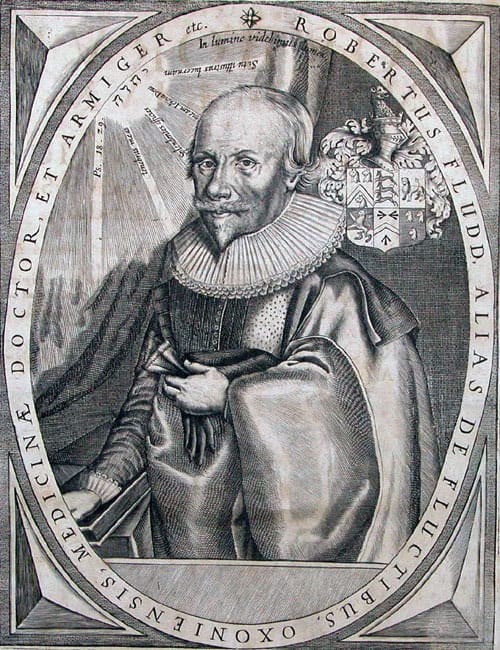
Robert Fludd
The firmest adherent was Robert Fludd (1574-1637), English physician and mystic who explainedthat the salve worked as a resultof the “mystical anatomy of the blood.”
Some of Fludd’s contemporaries pronounced the salve to be nonsensical while others condemned it as the devil’s work.Later writers,most notably, Oliver Wendell Holmes, have suggested that anointing the weapon rather than the woundsimply allowed the tissue the chance to heal naturally.
The weapon salve fell out of favor by the 18th century it but remains as one of the more curious episodes in the history of medicine.
In the sixteenth century the same spirit which inspired Vesalius and others in the field of anatomy served also as the inspiration for the study of flora from actual specimens, culminating in what is certainly the most celebrated and probably the most beautiful herbal ever published, Fuchs’ De historia stirpium commentarii Basel, 1542.
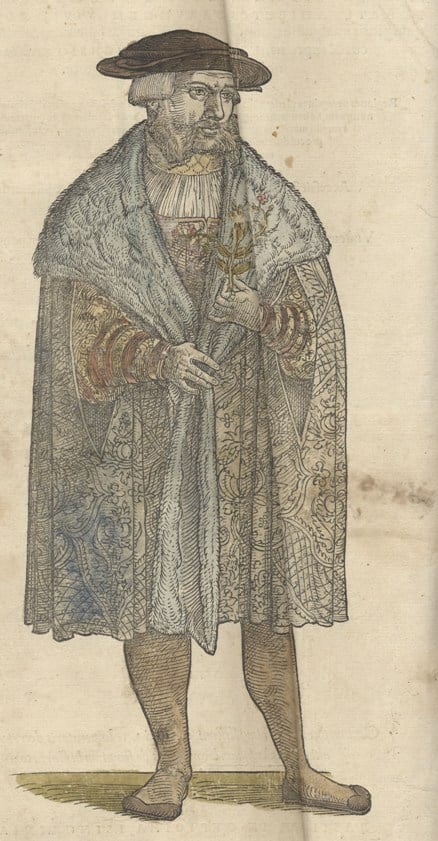
Leonhart Fuchs (1501-1566) was a German physician, professor of medicine at Tübingen, a practicing pharmacologist, a fervid Hippocratist, and writer of numerous works, the most famous of which is his herbal in which he describes 400 German plants as well as 100 foreign ones. The 512 woodcut illustrations are neatly colored by hand in pleasing tones and include a full-page hand-colored woodcut of Fuchs (see left) as well as portraits of the three illustrators, one of the first instances of such a tribute being paid to artists in a printed book(see lower rightl).
This first edition of this lavish herbal is characterized by spacious design and layout, by fine printing, and by the sheer number of illustrations. Its popularity was immediate and it was issued in many subsequent editions and translations, but the first edition was never equaled.
The Libraries now subscribe to Proquest Digital Dissertations, which includes 2.4 million dissertation and theses citations from 1861 to the present day together with 1 million full-text dissertations that are available for download in PDF format. Most U.S. and Canadian dissertations from 1997-present are available as downloadable pdfs.
William Beaumont (1785-1853). Experiments and Observations on the Gastric Juice and the Physiology of Digestion, Plattsburgh, 1833.
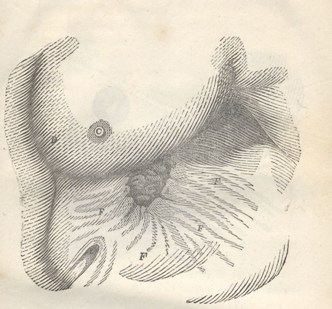
When U.S. Army Surgeon William Beaumont saw the gaping hole in Alex St. Martin’s side, he had every reason to believe the wound was fatal.The 28 year old Canadian voyager was accidentally shot in the stomach by a musket ball at close range.In 1822, on the isolated fur-trading post in Mackinac Island he was given little chance to survive but Beaumont dressed the wound as best he could and his patient held on despite the fist sized fistula that remained on his left side.“I saw him in twenty-five or thirty minutes after the accident occurred, and on examination, found a portion of the lung, as large as a Turkey’s egg, protruding through the external wound, lacerated and burnt; and immediately below this, another protrusion, which, on further examination, proved to be a portion of the stomach, lacerated through all its coats, and pouring out the food he had taken for his breakfast…”After 17 days, St. Martin’s digestion was partially restored but the fistula became permanent.Three years later, now stationed in Fort Niagara with St. Martin employed as his handyman, Beaumont seized upon the opportunity to observe the digestive process as no one had before and, with his patient’s permission,performed various experiments within this living gastric laboratory. Over the next eleven years, Beaumont carried out an assortment of tests, including dangling various kind of foodstuffsin the digestive cavity and pulling them out at intervals to observe and record the results.In 1833, Beaumont published his research in his highly regarded, “Experiments and Observations on the Gastric Juice and the Physiology of Digestion,” now a medical classic and a book that marks the beginning of the field of gastric physiology.St. Martin outlived Beaumont by 27 years, the latter dying from a fall in 1853 and the former dying at the age of 86 in Quebec of “natural causes.”The location of his grave was not revealed until 1962 at which time a plaque was placed nearby, briefly describing his contribution to medical science.
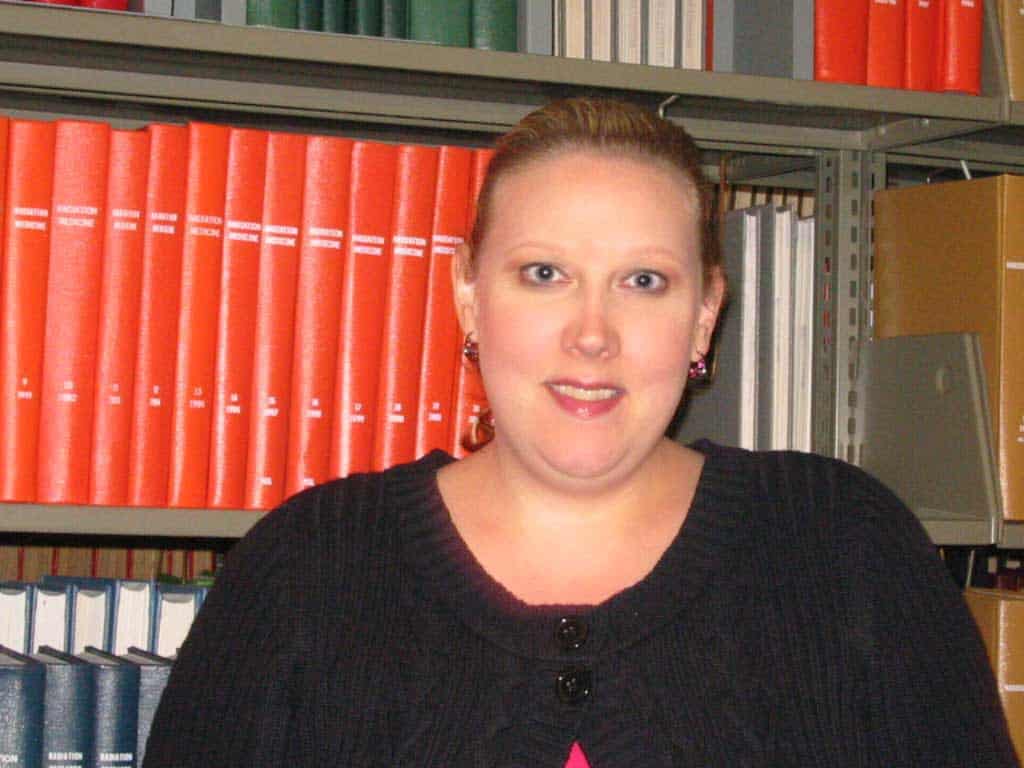
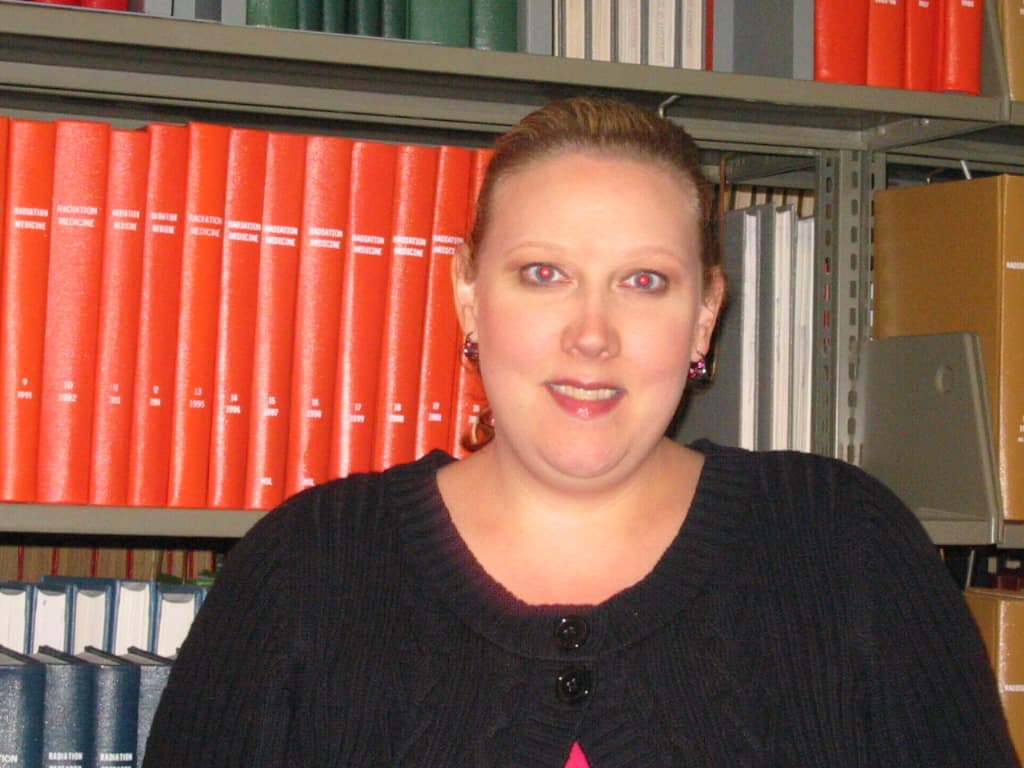
Kelly Thormodson is Hardin Library’s newest staff member! Originally from Fergus Falls, MN, she completed her undergrad studies at North Dakota State University, and then went on to receive her Masters in Library and Information Science from the University of Iowa. Although she is not new to Iowa City and the University of Iowa, she spent her last 10 years working as the Operations Supervisor at the Fred Hutchinson Cancer Research Center in Seattle, WA.
In her role here at Hardin, Kelly works as the Coordinator of Education and Research, which includes coordinating outreach liaisons and reference services. Her interests include reading and movies, and although she is happy to be back at the University of Iowa, she is still on the lookout for a good local winery.
Of Hardin Library’s student employees, five will be graduating this year!
Alexa Groff is graduating with a BA in English. She will be attending graduate school at the University of Iowa in Education.
Adnan Fazal is receiving an MHA is Health Administration. He has already moved to Marshalltown where he is the manager of an Iowa Home Care office.
Elizabeth Nummela receives her MA in Library and Information Science. She is currently seeking a librarian position.
Janice Kim receives a BS in Psychology and is returning home to Korea.
Matt Walleser is graduating with a BA in History and a BA in International Studies. His next move is to Bethlehem, where he plans to work with the Palestinian Community, NGO’s and continue to study Arabic.
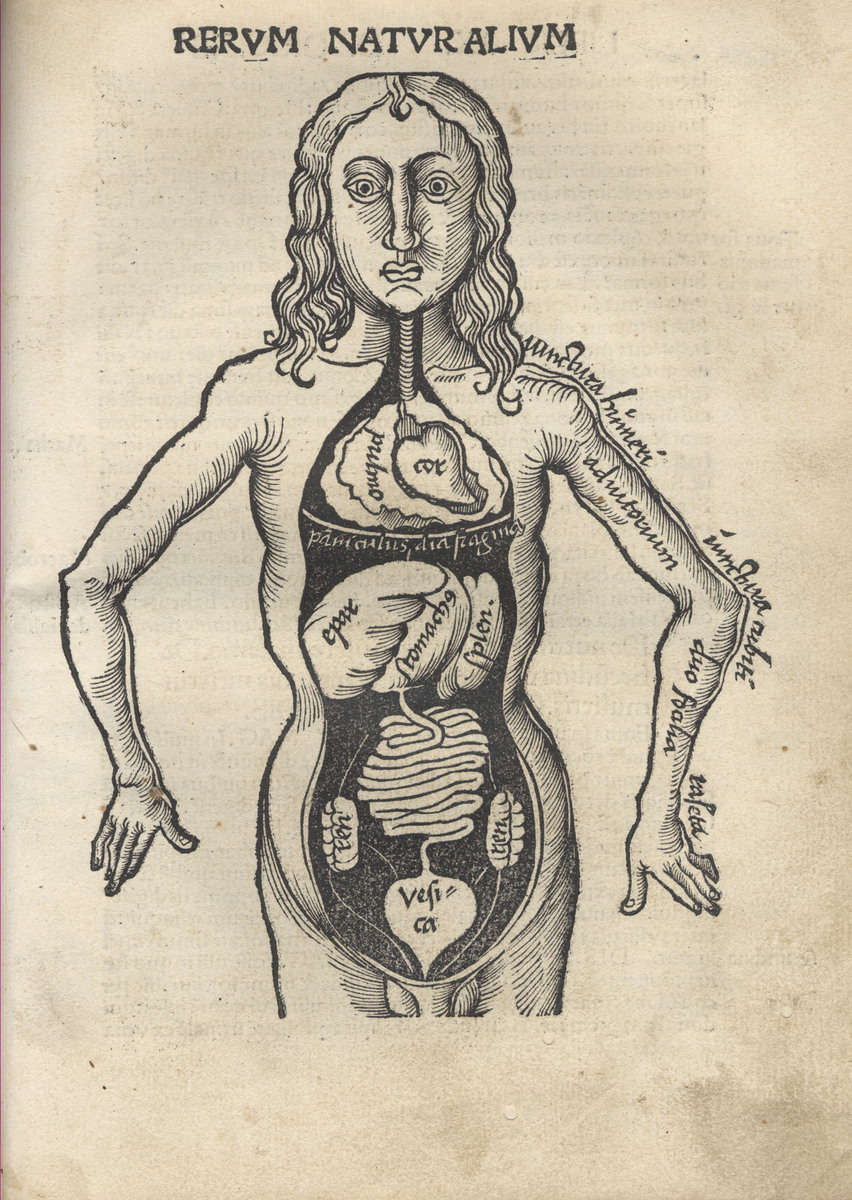
GREGOR REISCH (ca. 1467-1525). Margarita philosophica. 2nd ed., 1504].
Long before there was Google and Britannica, there was Margarita philosophica, which might be called the first modern encyclopedia. Its twelve divisions cover the trivium (grammar, logic and rhetoric), the quadrivium (arithmetic, geometry, music and astronomy), and the natural and moral sciences. Of particular fascination are the many woodcuts which include early music notation, a large folding map of the Eurasian continent and parts of Africa, and astronomical, astrological, and zoological figures.Several of the plates are of great interest to the history of anatomical and medicalillustration, including a man with dissected thoracic and abdominal cavities; two figures of the eye; a phrenological head showing the brain; a lying-in room showing a woman in childbed with infant and midwife; and a mineral spring bath.
Reisch was a Carthusian prior at Freiburg and confessor to Emperor Maximilian I, as well as assistant to Erasmus. Much more could be said of this immensely fascinating book; the music and the map (often missing from copies of all editions) make extremely interesting studies in themselves. The book was very popular, as attested to by its sixteen editions in the seventeenth century. This edition, the second authorized edition, was preceded by the first edition of 1503 and a “pirated” reprinting of the first edition which appeared the month before this second edition.
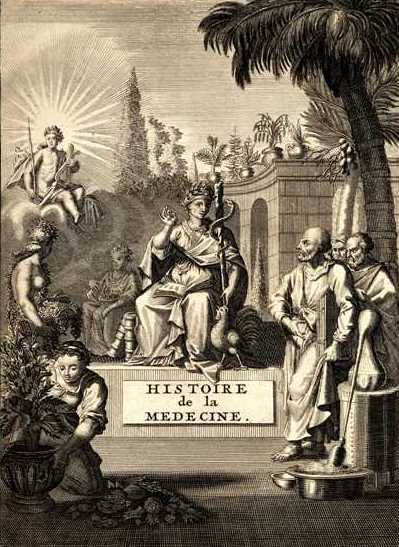 Daniel Le Clerc (1652-1728). Histoire de la médecine. Nouvelle ed. Amsterdam: Aux depens de la Compagnie, 1723.
  Considered by many authorities to be the father of the history of medicine, Le Clerc is best known for his monumental Histoire de la médicine. The first edition was published in 1696 and, after the second edition had been exhausted, Le Clerc found it expedient to write a third edition, which he updated to the middle of the seventeenth century. Most striking is his inclusion of ten finely executed engravings depicting various personalities associated with medical history.