The Main Library Gallery now has new walk-in hours for Summer 2021 and beyond!
Guests from the general public and the University community are welcome to stop by the Gallery any time during open hours. The Main Library no longer requires an Iowa One Card for building entry. No appointments are needed. Please wear a mask until vaccinated, or if experiencing COVID-19 symptoms.
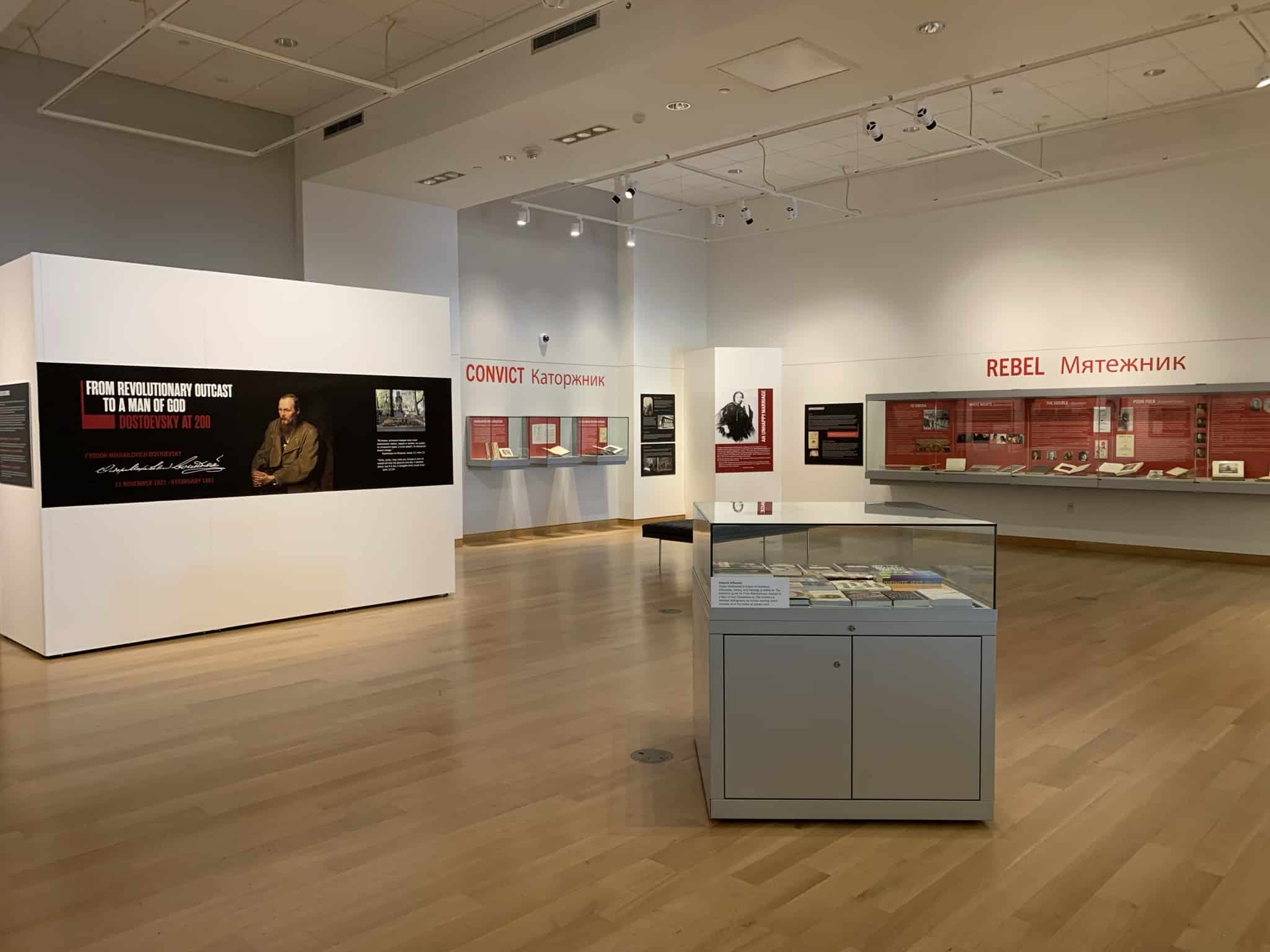
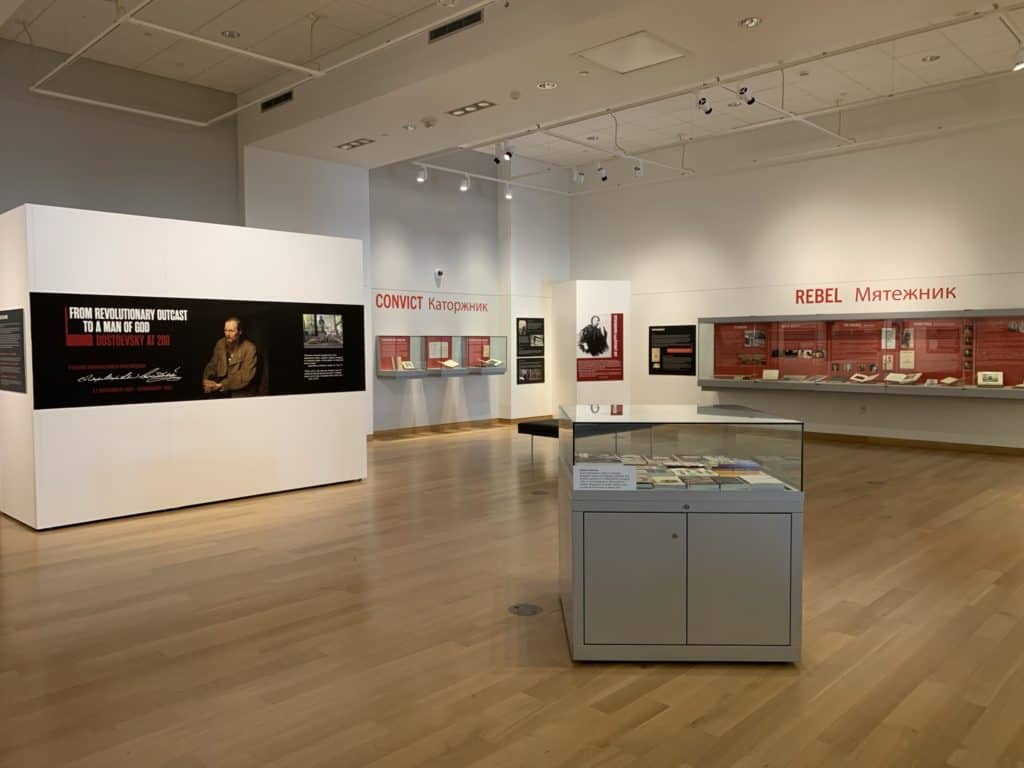
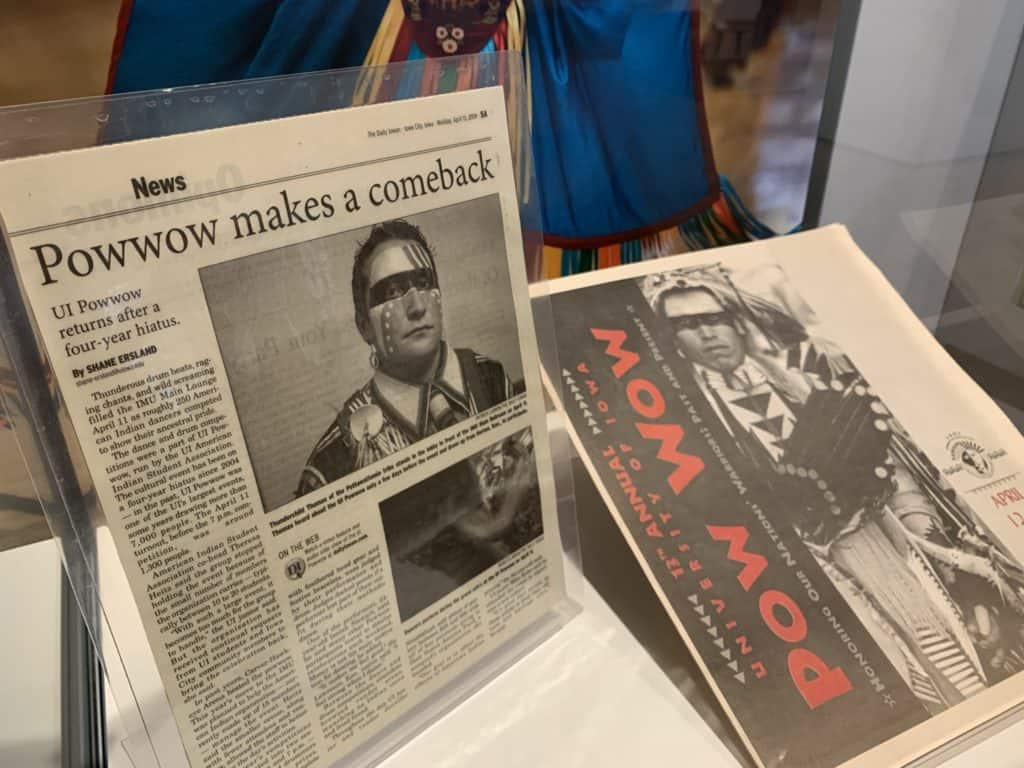
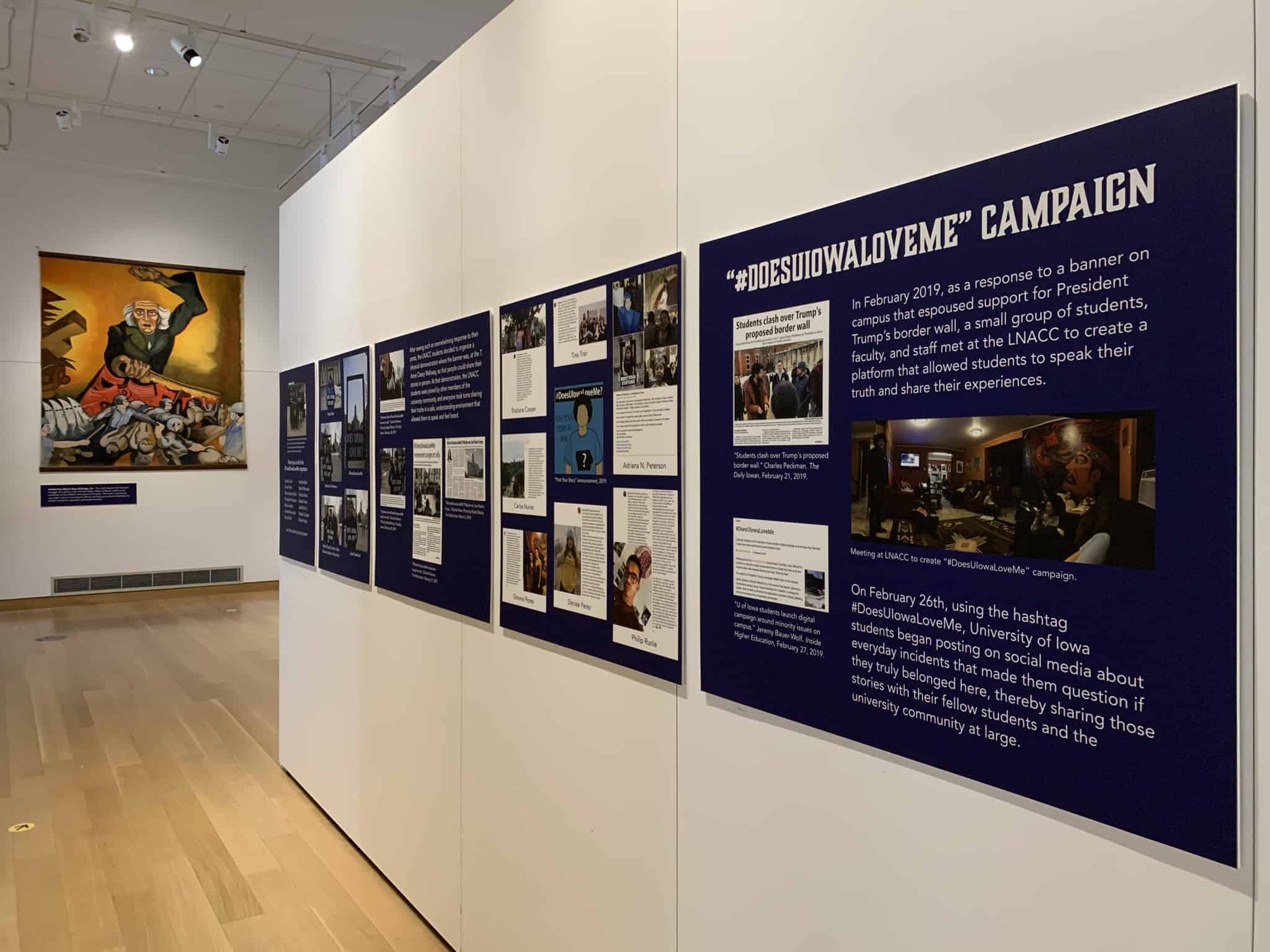
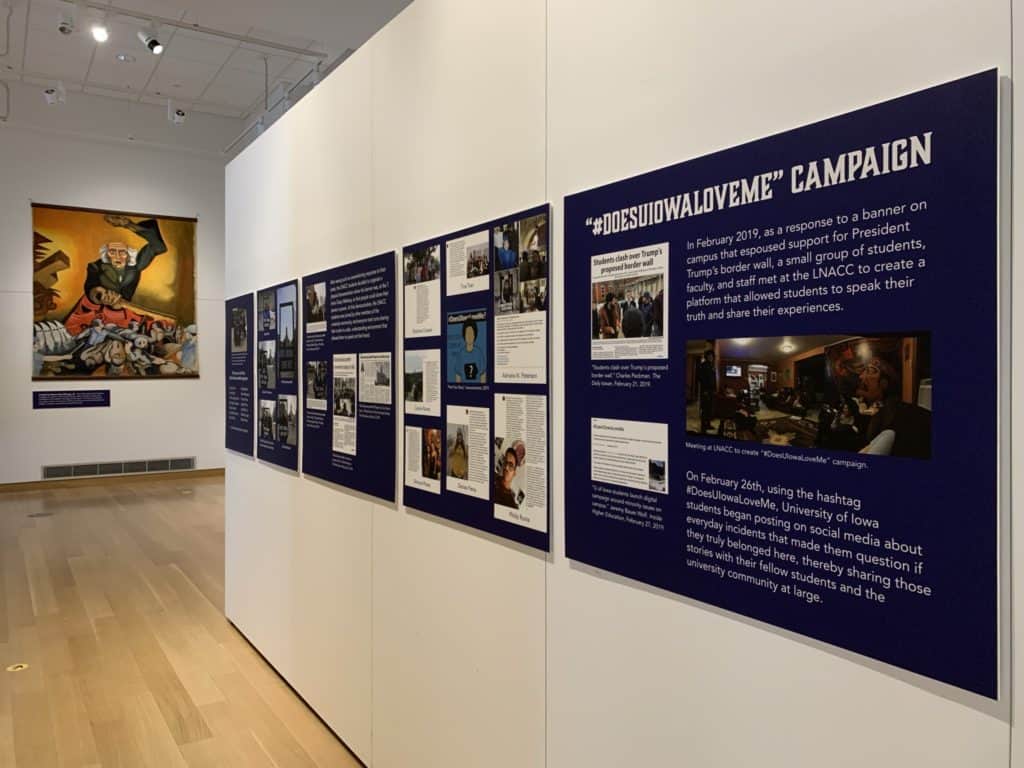
From the Building Our Own Community: 50 Years of the Latino Native American Cultural Center, Founded by Chicano and American Indian Students in 1971 exhibition. Photo: Sara Pinkham.
The University of Iowa Libraries’ Main Library Gallery is now seeking exhibition proposals for Fall 2023, Spring 2024, and Fall 2024. University of Iowa faculty and staff are invited to submit statements of interest between May 28 and July 16, 2021. Proposals from across campus are welcome. Read on to learn more about curating exhibitions in the Main Library Gallery and to find a link to the submission form.
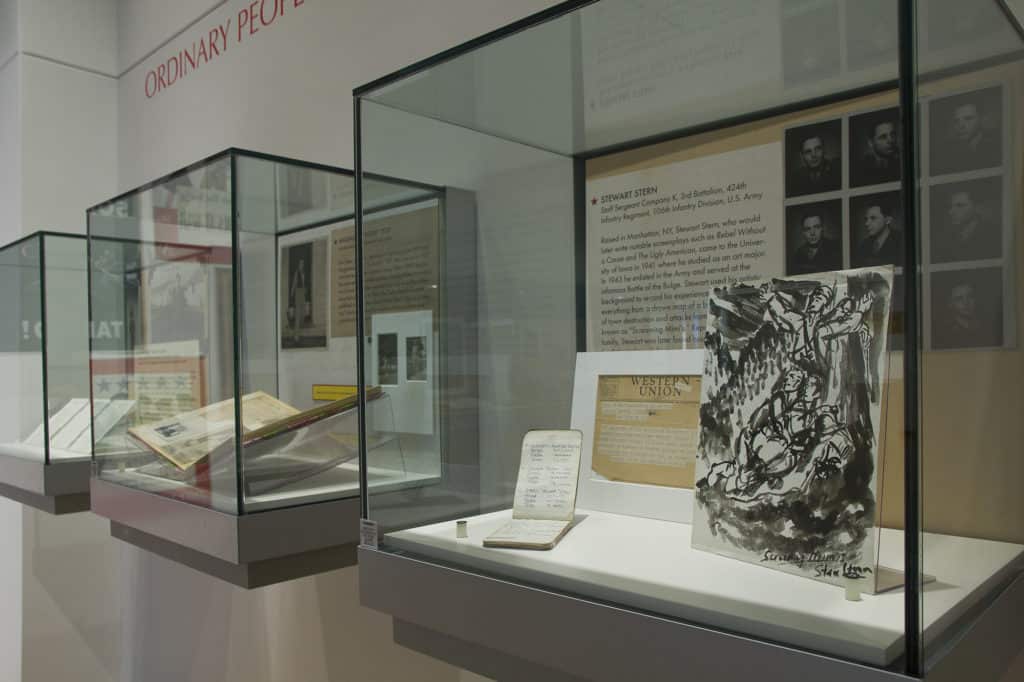
From Stories Worth Telling: Marking Twenty Years of “The Greatest Generation,” co-curated by Elizabeth Riordan & Laura Michelson, 2018.
What is the Main Library Gallery?
The University of Iowa Libraries’ Main Library Gallery is a museum-quality exhibition space located on the ground floor of the Main Library. The Gallery is equipped with temperature and humidity controls, professional grade display cases with alarms, and low light, all of which make it a suitable environment for rare artifacts requiring special display conditions. The facility has the capacity to host exhibition-related public programs for up to 100 guests in person, and the Gallery is a member of the American Alliance of Museums. A key purpose of the Gallery is to showcase UI Libraries collections.
Past Exhibitions:
Exhibits at the Main Library Gallery give the campus community and the general public access to items from the rich collections of the University of Iowa Libraries, including those which are rare and historically significant. Exhibit curators select unique objects, photos, papers, and books from these collections to tell stories about a range of fascinating topics, some of which have included:
the ground-breaking space discoveries of UI professor James Van Allen
Shakespeare’s First Folio, a rare volume of the bard’s plays published only one year after his death
Star Trek memorabilia from the personal collection of Wrath of Khan director Nicholas Meyer
the accomplishments and legacies of African American Hawkeyes
early filmmaking in Iowa as seen through the lens of Frank Brinton
a tribute to Walt Whitman
selections from the Ruth and Marvin Sackner Archive of Concrete and Visual Poetry
a 50th anniversary celebration of the Latino Native American Cultural Center
How is the role of curator defined for the Main Library Gallery?
A guest curator in the Main Library Gallery is someone who assembles a research-based story narrative for the exhibition medium. This storytelling is enhanced by a selection of compelling items from the Libraries collections. In addition to researching for and curating items for the exhibition, people in this role must expect to serve as subject matter experts throughout the duration of an exhibit. This includes some exhibit-related class interaction or instruction, public programming, and serving as a content consultant for exhibit-related videos, social media and blog posts, and other engagement projects being created by Gallery staff to promote an exhibit.
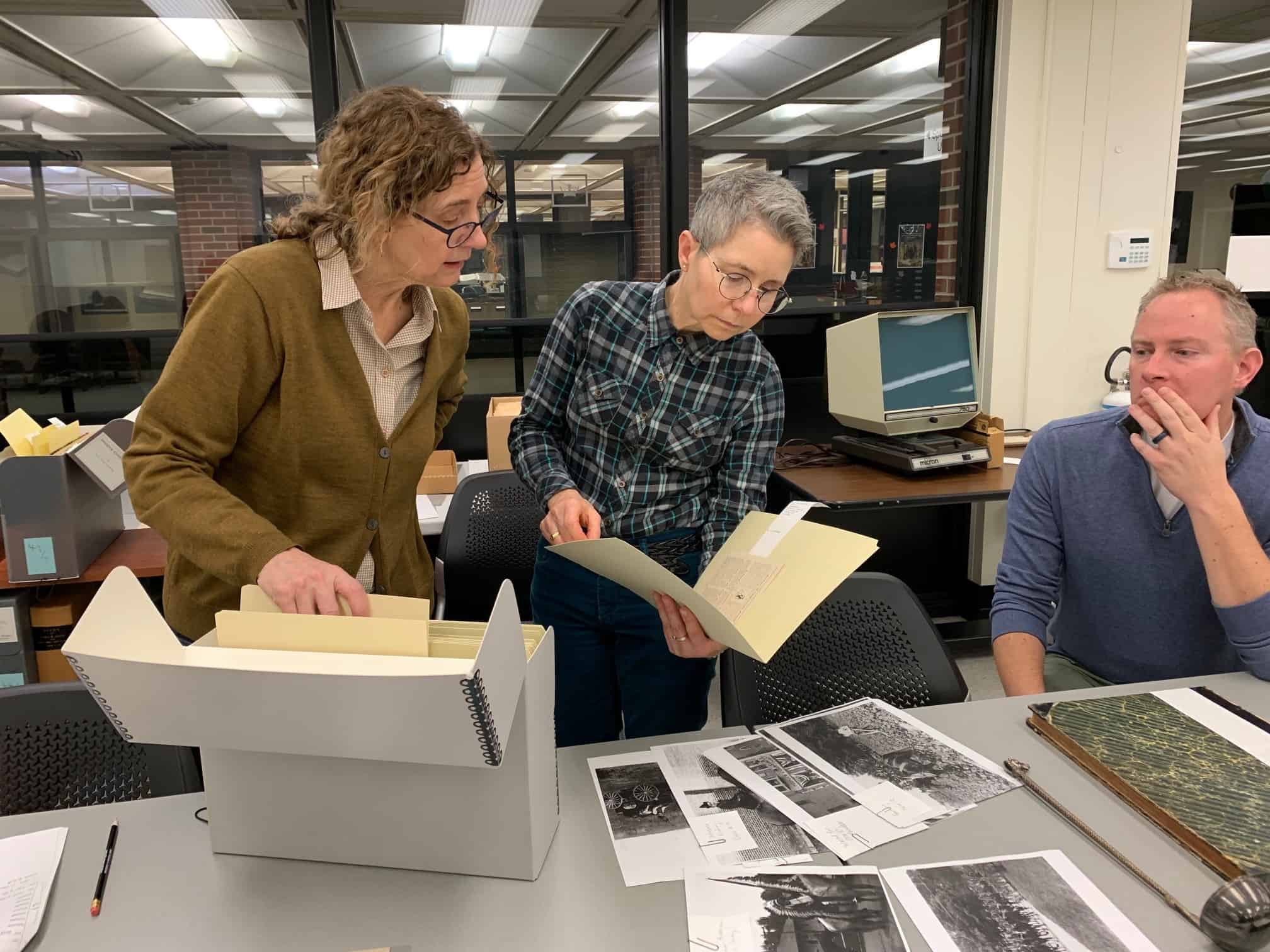
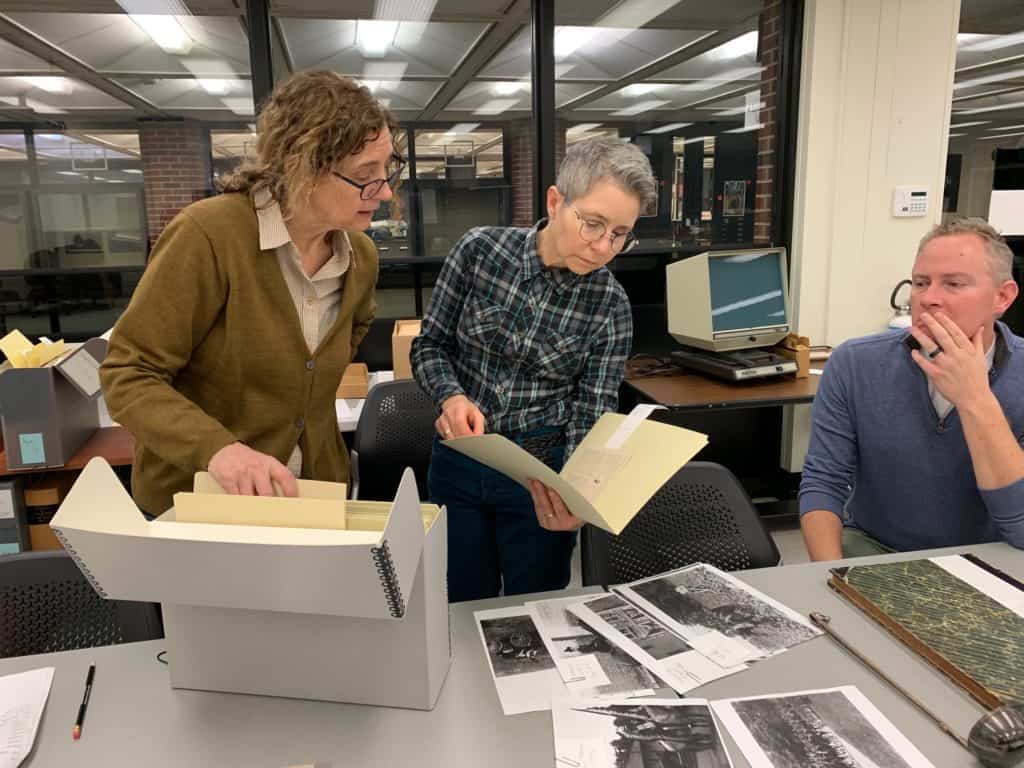
Janet Weaver, Assistant Curator in the Iowa Women’s Archives, assists co-curators Dr. Kim Marra and Mark Anderson as they select items for The Pull of Horses on National and Local Histories and Identities, 2020.
Lead curators should be prepared to devote approximately 15 months to exhibition production: 9 months of moderate work to plan the exhibition, followed by 3 months of intensive work before opening day, and ending with approximately 3 – 5 months of intensive work while the exhibition is open, depending upon the exhibit’s run dates. This includes availability to give guided tours, talks, and other types of exhibit-related programming where possible.
Who can curate an exhibit in the Main Library Gallery?
Faculty and staff of the University of Iowa are eligible to serve as lead curators. Students and community members may be approved as co-curators.
How are exhibitions chosen?
Step I: Potential curators submit an initial statement of interest, after which the Gallery Advisory Team reviews the collected statements. Strong statements are chosen by this team for the next step. Top consideration will be given to exhibition ideas with well-defined themes, learning objectives, potential for community and curricular impact, and which prioritize inclusion. The Gallery Advisory Team is made up of nine UI Libraries staff members, a representative from the Pentacrest Museums, and an Associate University Librarian.
Step II: The initial statements with the strongest themes and highest potential for impact are invited to create and submit a complete exhibition proposal.
Step III: The Gallery Advisory Team reviews and selects the most rounded finalist proposals. Three proposals will be accepted, one each for the following time slots: Fall 2023, Spring 2024, and Fall 2024.
Step IV: Approved guest curators begin working with the Gallery’s exhibition and engagement coordinator. A production calendar will be established.
Can I propose the installation of a traveling exhibition from another organization?
Yes. However, traveling shows must be proposed by a University of Iowa faculty or staff member, as with all exhibits. This faculty or staff member must be willing to serve in a curatorial capacity and provide subject matter expertise for classes and public programming throughout the duration of the exhibition.
The Main Library Gallery is part of the University of Iowa Libraries. Can I curate an exhibition of non-UI Libraries materials?
University of Iowa Libraries materials must play a starring role in Main Library Gallery exhibitions, but may be shown alongside approved items loaned from other institutions, campus GLAM (galleries, libraries, archives, museums) partners, or collectors.
TIMELINE
July 16: Deadline for statements of interest. August 2: Decisions are announced. Finalists are invited to write complete proposals. December 1: Deadline for finalist exhibition proposals. December 17: 2023 – 2024 exhibitions are announced.
Curating an exhibition is a significant time investment, but the exhibit production process will be guided by Gallery staff and a reasonable production calendar. A professional designer, preparator, conservator, and exhibition and engagement coordinator will ensure success.
From Building Our Own Community: 50 Years of the Latino Native American Cultural Center, Founded by Chicano and American Indian Students in 1971. Main Library Gallery, University of Iowa Libraries.
2021 is a milestone year for the Latino Native American Cultural Center (LNACC), which has served as a home away from home for Latinx and Native American students at the University of Iowa since 1971. Anniversary festivities will continue throughout the calendar year as the campus community and alumni celebrate 50 years of the LNACC. The current Main Library Gallery exhibition, curated by librarians Rachel Garza Carreón and Christopher Ortega, will be extended through July 23 to provide more opportunities for visitors to learn about the Center’s history and impact.
The University of Iowa Libraries invites you to online trivia, emcee’d by Andrew’s Bar Exam. Join for eight rounds of general knowledge questions and see if your team triumphs!
Form a team with your family, friends, or colleagues to compete, or compete individually. (Please arrange a secondary method for your team members to communicate outside of the Zoom event to confer on answers. Text, Facebook messenger, Discord, or other conference call apps are all good options.)
No pre-registration is required, though Andrew’s Bar Exam will be accepting donations throughout the duration of the event.
Any donations received will go toward the UI Libraries Student Employee Scholarship Fund. Student employees provide critical staffing for programs and services benefitting the entire UI community. These scholarships are a way to recognize, support, and motivate students in their scholarship, research, and creative work at the University.
Individuals with disabilities are encouraged to attend all University of Iowa–sponsored events. If you are a person with a disability who requires a reasonable accommodation in order to participate in this program, please contact Katie Buehner in advance at (319) 335-3088 or katie-buehner@uiowa.edu.
For those distant to campus, or who would like to experience the latest Main Library Gallery exhibition from home, a virtual tour of Building Our Own Community:50 Years of the Latino Native American Cultural Center, Founded by Chicano and American Indian Students in 1971 is now available online.
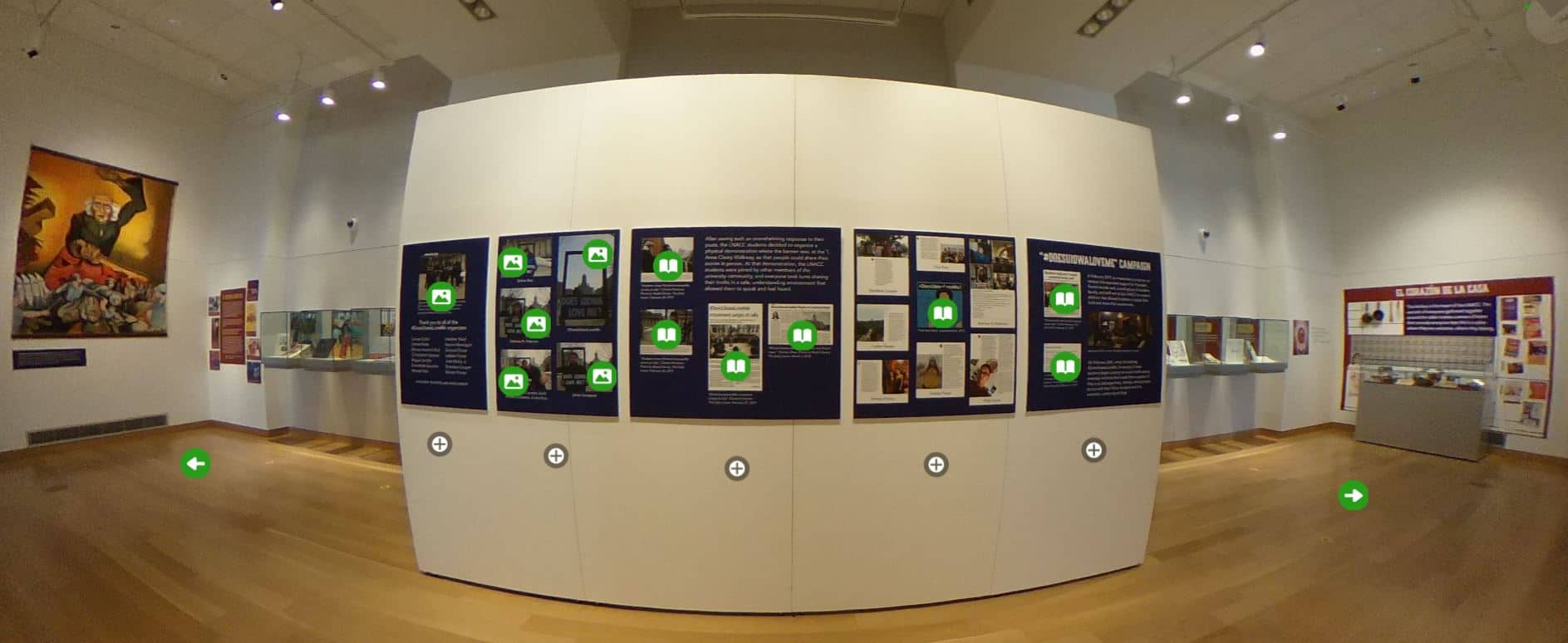
Image featuring the #DoesUIowaLoveMe section of the Building Our Own Community exhibit virtual tour, Main Library Gallery.
The tour features 360° photos of the Main Library Gallery, which allow the viewer to move from area to area. The text panels and the cases containing the items on display are clickable, meaning close-up views of the items are available along with narrative from curators Rachel Garza Carreón and Christopher Ortega.
The exhibition features a large number of carefully selected news articles from The Daily Iowan, all of which are linked to The Daily Iowan Archive and can be read in full with no access restriction.
Many materials are from the Latino Native American Cultural Center Records in the University Archives, digital versions of which can be read or viewed throughout the virtual exhibit or via the Iowa Digital Library. The exhibit also spotlights recent photographs from activism and activities supported by the Latino Native American Cultural Center. A special digital pamphlet containing personal notes from the curators is located near the gallery’s virtual front doors, and is also on the Main Library Gallery website.
An immersive reader option is readily available in each section of the virtual exhibit to read the detailed image descriptions for each piece on display out loud.
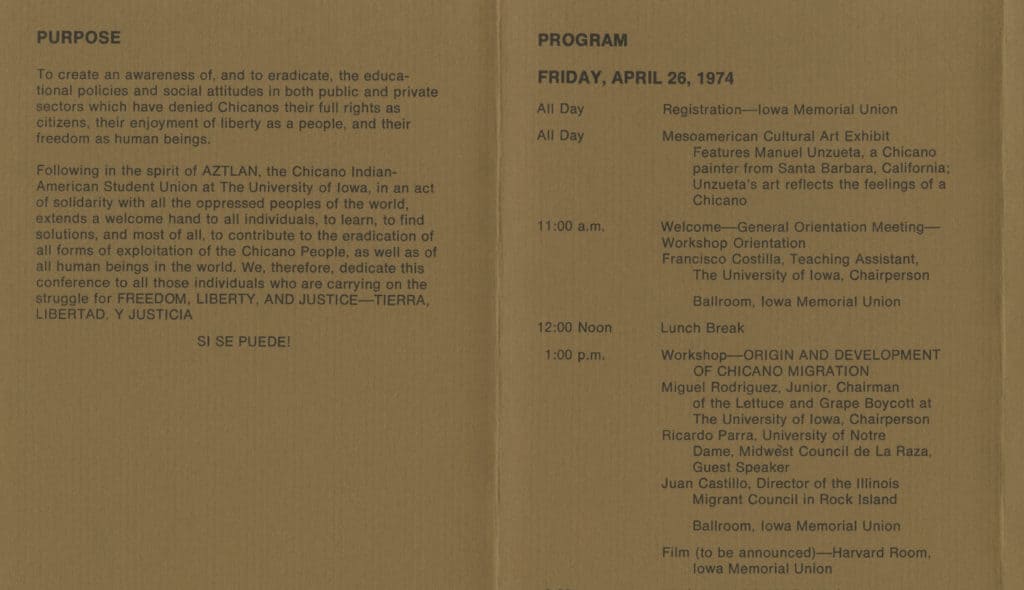
Chicano Conference ’74: Nuestra Realidad program. Latino Native American Cultural Center Digital Collection, Iowa Digital Library.
In April 1974, the Chicano Indian-American Student Union (later the LNACC) at the University of Iowa hosted a two-day series of lectures, workshops, and performances in Iowa City. Chicano Conference ’74 was held in the Iowa Memorial Union. The purpose of the conference was “to create an awareness of, and to eradicate, the educational policies and social attitudes in both public and private sectors which have denied Chicanos their full rights as citizens, their enjoyment of liberty as a people, and their freedom as human beings.” As part of this gathering, an exhibition of art by Manuel Unzueta was presented. Mr. Unzueta, an internationally acclaimed Chicano artist, traveled to Iowa City for the conference from his home in Santa Barbara, California, where his many murals even now continue to inspire conversation and have become an important part of the area’s history.
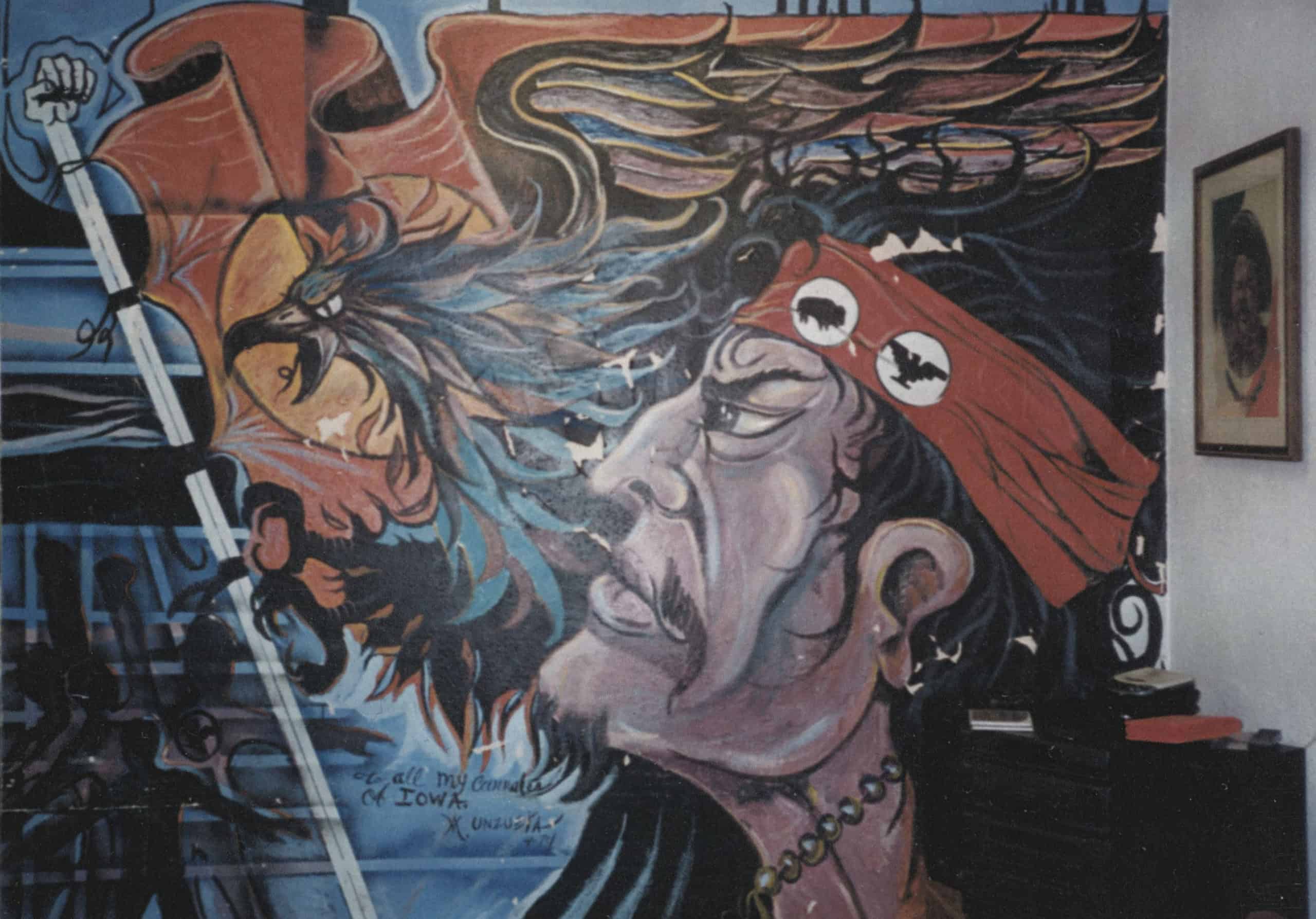
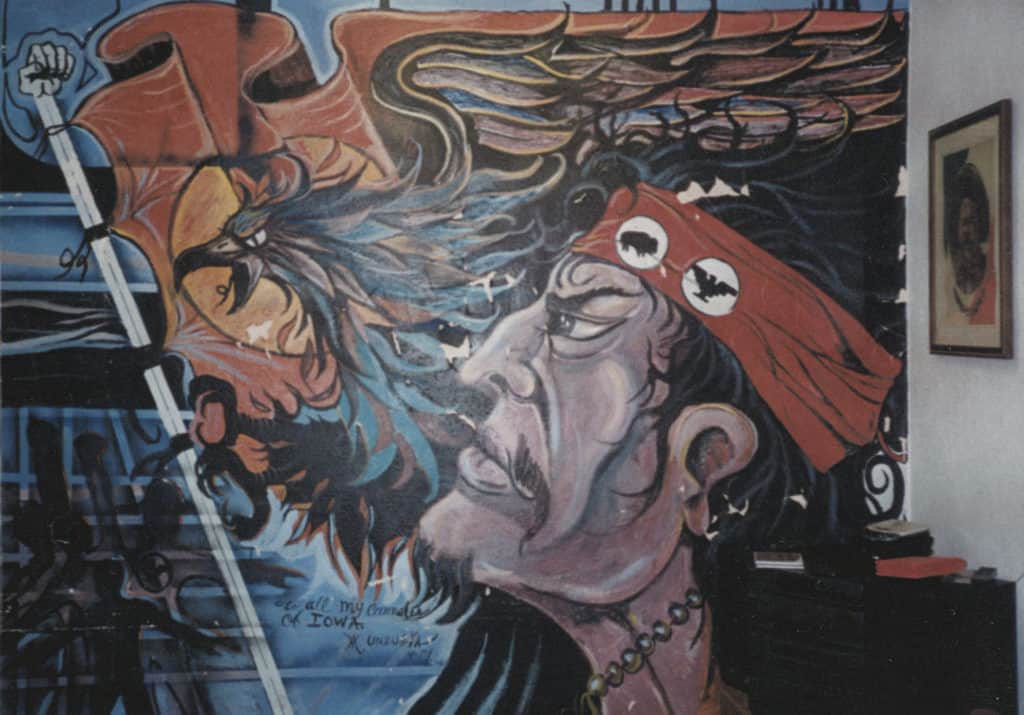
During his stay in Iowa City, Mr. Unzueta visited the LNACC’s new location at 308 Melrose Avenue. He decided to paint a wall mural as a gift to the LNACC.
Original mural by Manuel Unzueta, painted in 1974. Photograph from 1999, Latino Native American Cultural Center Digital Collection, Iowa Digital Library.
According to a Daily Iowan article from 2001, the mural was a “spontaneous product of a lively gathering at the center” in which students had an opportunity to meet with the artist. For years afterward, the mural was an energizing presence. It was the backdrop for crucial conversations, early activism on campus, social events, and community celebrations.
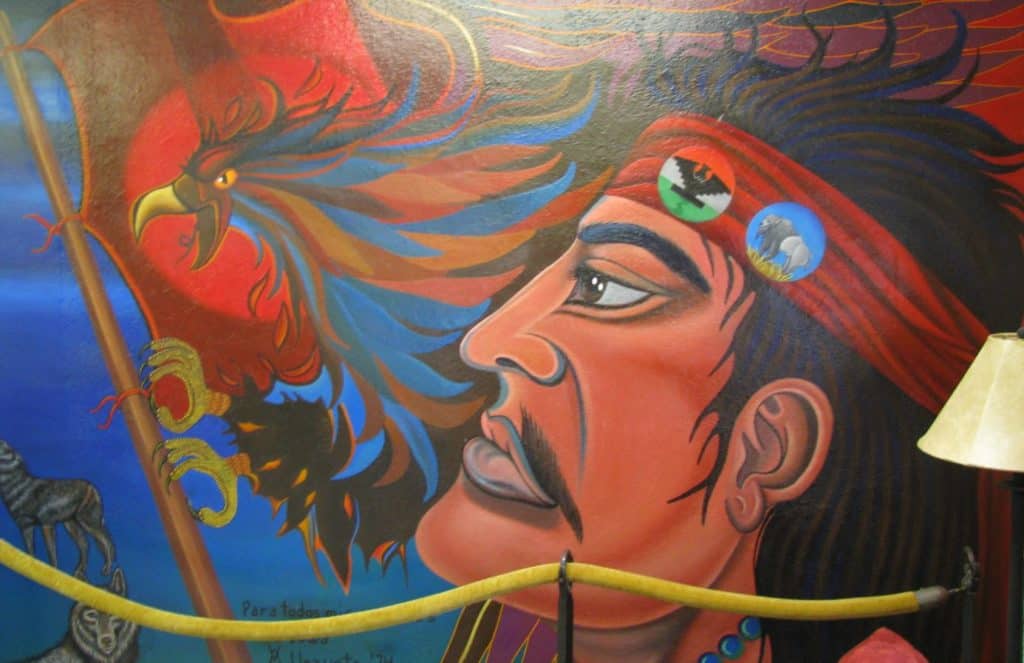
Over time, the mural began to show signs of deterioration. A local Chicano artist was hired in 2001 in an effort to restore it. The resulting changes, however, were polarizing. In the exhibition, Rachel Garza Carreón and Christopher Ortega explain that “these alterations were controversial because some community members felt that they changed the overall tone of the original mural.” During the restoration, “they altered the original in ways that had not been discussed beforehand, including changes in color and the removal of the original artist’s name and dedication (‘To all my carnales of Iowa. M. Unzueta, 1974’).” While many lamented the loss of the original mural, others in the community expressed gratitude to the artist working to improve its condition and help maintain the LNACC.
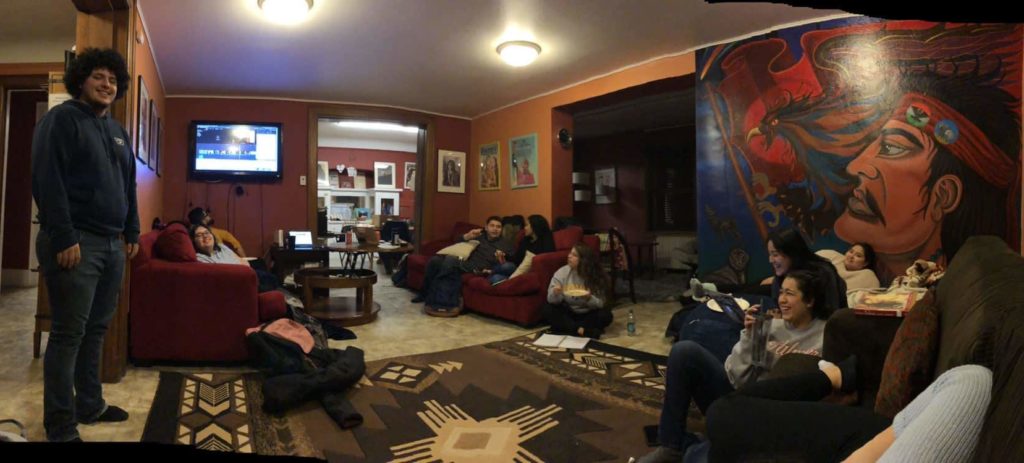
While the mural looks quite different today than it did in 1974, it continues to contribute to the atmosphere of community at the Center. Its story is an important part of LNACC history.
In the Main Library Gallery exhibition, the curators have placed a replica of the original mural in the center of the gallery. If visitors look closely, they will see that it consists of hundreds of photos from the LNACC over the years.
Updated mural, completed in 2001. Latino Native American Cultural Center Digital Collection, Iowa Digital Library.
Students planning the #DoesUIowaLoveMe campaign at the LNACC. Courtesy of the Latino Native American Cultural Center.
Letters to the Editor. (2001). ‘In defense of the original Chicano House mural’ and ‘Support mural work’, The Daily Iowan, 19 July. Available at: https://dailyiowan.lib.uiowa.edu/DI/2001/di2001-07-19.pdf (Accessed: 16 March, 2021, The Daily Iowan Archive).
From the Building Our Own Community: 50 Years of the Latino Native American Cultural Center, Founded by Chicano and American Indian Students in 1971 exhibition.
“El Teatro Zapatista at the University of Iowa was based on El Teatro Campesino, a Chicano guerilla theater troupe created to support Cesar Chavez’ United Farm Workers. In El Teatro Zapatista, actors presented socially-pointed skits, or actos, to radicalize, educate, mobilize, and motivate the target audience to become more involved in issues within their own communities or to question long-held beliefs. The skits also inspired pride in Chicano history and identity.
Along with El Teatro Zapatista, there was also an affiliated student group of baile folklorico dancers called Los Bailadores that also sought to expose audiences to Chicano art, music, and ideals.
These two groups would often work together to help inspire Latino and Native American students in Iowa and its neighboring states to pursue higher education.
The performativity of Los Bailadores and El Teatro Zapatista presented a transformative, living, engaged, multi-purpose, and multi-layered activism within the Chicano Indian American Student Union, and it represented a resistance to negative images of what it meant to be Chicano. Those involved in them were not just presenting a message to their audiences. They were also empowering themselves through creative thought processes that honored their cultural and ethnic identities as well as their political and activist identities.
– Adapted from ‘To Preserve our Heritage and our Identity,’ Sandra Solis”
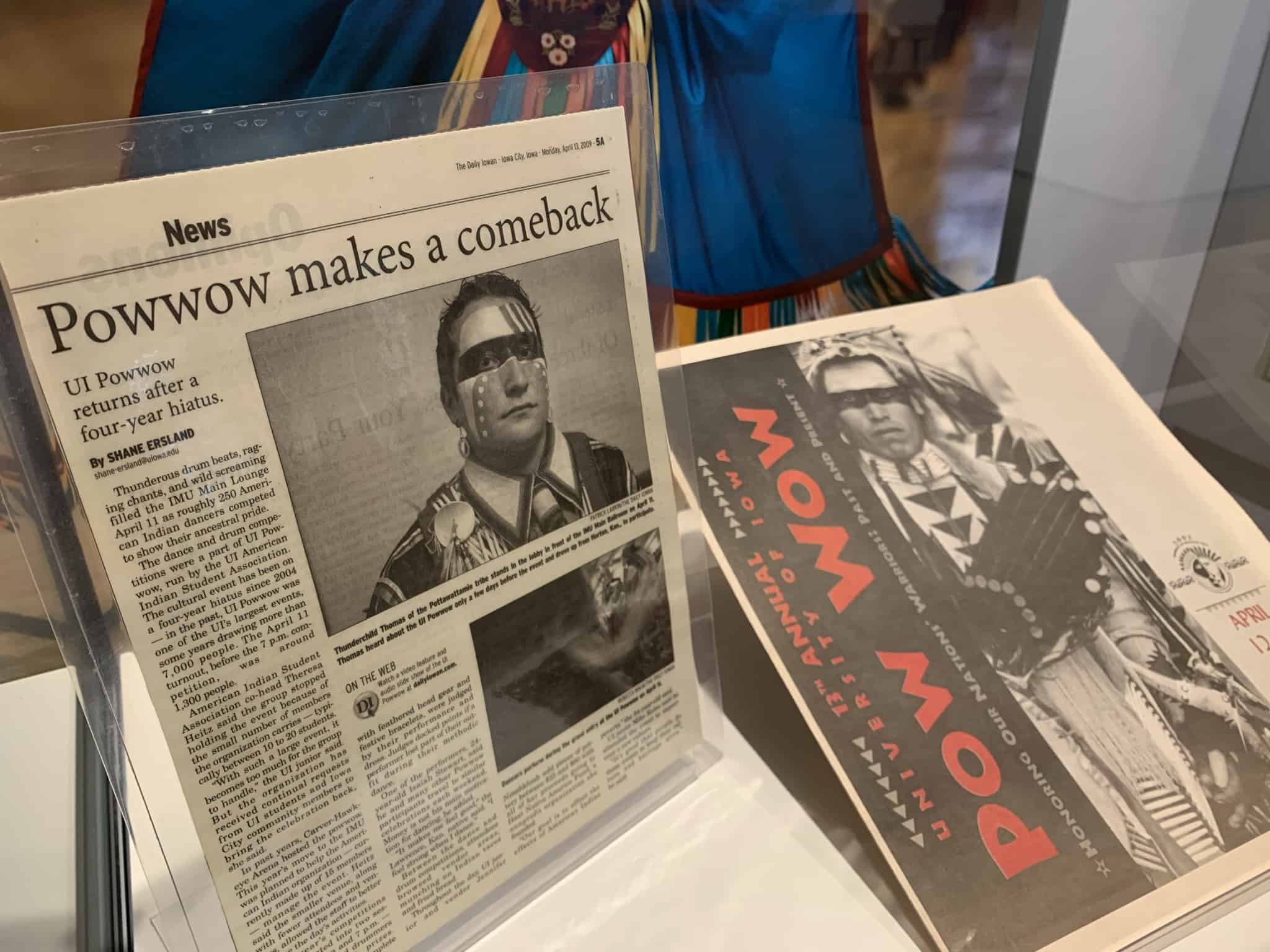
The University Archives holds the Latino Native American Cultural Center Records, which are comprised of several boxes of original scrapbooks, carefully assembled photo albums, newspaper clippings from The Daily Iowan and other local papers, meeting minutes, mementos from events such as powwows and protests, and more. The collection holds a treasure trove of compelling photographs that help tell the story of the LNACC, and the story of Latinx and Native American student struggles and successes at the University of Iowa.
The curators selected several photos for this portion of the exhibition that they felt represented the spirit of El Teatro Zapatista and Los Bailadores in the 1970s and 1980s, some of which are featured here in this blog post. A large canvas painting by Marco Raya, an artist from Chicago whose works were often exhibited at the LNACC, is also on display in the Main Library Gallery. The painting depicts the Chicano struggle for justice in the United States, and was often used in recruitment efforts as a backdrop to student speeches and performances.
To see more photos, and to view the original canvas painting by Marco Raya, visit the exhibition in the Main Library Gallery through June 25, 2021. Find visiting hours and information below.
Recruitment trip, 1970s. Latino Native American Cultural Center Records, University Archives.Recruitment trip guitar performance, 1970s. Latino Native American Cultural Center Records, University Archives.High school performance, 1970s. Latino Native American Cultural Center Records, University Archives. Note the painting by Marco Raya in the background.
Rachel Garza Carreón is the Outreach & Research Librarian at the University of Iowa Libraries. She serves as the subject liaison for Classics, Philosophy, and Religious Studies, and is the UI Libraries liaison to the Latino Native American Cultural Center. Christopher Ortega is an Undergraduate Engagement Librarian at the University of Iowa Libraries. His mission is to support undergraduate success and make students feel welcome and empowered on campus and in the Libraries.
In this Q&A with the curators, they share more about their desire to celebrate the LNACC by creating an exhibit for the University of Iowa Libraries’ Main Library Gallery.
What inspired you to organize an exhibition about the LNACC?
Rachel: “I think many of us have heard the expression about a campus building being ‘the heart of the campus’. I had never felt that way about a building until the LNACC. For many it brings a sense of home to our lives. I want people to understand that the LNACC is not just a physical building. It stands for something because of its history. To me, it is home.”
Christopher Ortega.
Chris: “When I first came to work at the University of Iowa Libraries a year ago, I heard of the LNACC and became interested in learning more about it. I also wanted to learn more about the history of Latinxs here at the University of Iowa. When Rachel approached me with the opportunity to work on this exhibit and learn about both subjects, I was happy to say yes.”
Why is this exhibition so important, and what is the primary message you’d like visitors to come away with?
Rachel: “The LNACC exhibit tells the story of three individuals, Rusty Barceló, Ruth Pushetonequa, and Antonio Zavala, who put it on their shoulders to create a home on campus not only for them, but any other Latinx and Native American who happened to come to the UI. They could have easily put their heads down, because that’s a lot. Instead they said, ‘No, this isn’t right. We should do something about it.’ The courageous actions of these three people still affect the lives of students, staff, and faculty 50 years later. To me, this is a story that needs to be told and one that the University community should know about.”
Chris: “The history of the LNACC and the impact that Latinxs and Native Americans have had on this institution and this community are powerful stories that need to be told and need to be heard.I hope visitors come away from the exhibit better understanding the experiences of Latinx and Native American students past and present here at the University. I hope that increased understanding can also lead visitors to appreciate the necessity of spaces like the LNACC.”
What is a personal favorite item on display in the exhibition?
Rachel: “The wall depicting the original mural composed of images of students, staff, and faculty starting from the 70’s until now holds a place in my heart. I’ve envisioned the wall from the beginning stages of exhibit planning. The image is a powerful representation that the community served by the LNACC and the LNACC are one.”
Chris: “My two favorite items in the exhibit are the original mural, reconstructed with photos from various eras of the LNACC, and the poem ‘Carta de Iowa’ in the Newsletters section. The mural is great because it allows visitors to see an aspect of the LNACC that hasn’t been visible to this extent for over a decade now. I like the poem so much because it’s so heart-wrenchingly honest. It was left purposefully untranslated, and I hope it inspires visitors to ask fellow visitors about what it means and what it makes them feel.”
Two students making dinner, 1990s. Latino Native American Cultural Center.
What has being involved at the LNACC meant to you?
Rachel: “I’ve seen students, staff and faculty come and go through the center for many years. I’ve seen Latinx and Native American students be upset, worried and angry as they prepare to protest the many injustices we face. I’ve also seen these same communities laugh, dance and celebrate our successes. Through it all I have always felt comfortable and safe at the LNACC. For me, having the LNACC reminds me that I wasn’t born here, I didn’t go to school here, but when I am in the LNACC I know that I belong here, too.”
Chris: “I truly appreciate the fact that there is a place on campus con personas que entienden some of the things you might feel here.”
Is there any key advice you’d give to new Latinx and Native American students on campus?
Rachel: “Visit the LNACC. Meet the students in the various groups. Don’t be afraid to go to social events and meet new people. The LNACC is a safe zone. Hopefully it will bring you a sense of home and familiarity as it has for so many students, faculty, and staff in the past.”
Chris: “Look for groups on campus that sound interesting or relevant to you and reach out to them. There are other people here that are going through things similar to those you’re going through, and most likely they’re in or around those groups as well.”
From Building Our Own Community: 50 Years of the Latino Native American Cultural Center, Founded by Chicano and American Indian Students in 1971 in the Main Library Gallery, University of Iowa Libraries.
In 1971, three University of Iowa students, Nancy “Rusty” Barceló, Ruth Pushetonequa, and Antonio Zavala, established what is now the Latino Native American Cultural Center (LNACC) on campus. In 2021, the LNACC is celebrating 50 years of creating community and a home-away-from-home for Latinx and Native American students at the University of Iowa. An exhibition in the Main Library Gallery at the University of Iowa Libraries is now open to share and honor the history of this important cultural house.
“I think many of us have heard the expression about a campus building being ‘the heart of the campus.’ I had never felt that way about a building until the LNACC,” says Rachel Garza Carreón, exhibit co-curator and outreach and research librarian at the University of Iowa Libraries. “For many, it brings a sense of home to our lives.”
“The history of the LNACC and the impact that Latinxs and Native Americans have had on this institution and this community are powerful stories that need to be told and need to be heard,” says Christopher Ortega, exhibit co-curator and undergraduate engagement librarian.
This exhibition, Building Our Own Community: 50 Years of the Latino Native American Cultural Center, Founded by Chicano and American Indian Students in 1971, shares the history of the center in depth. It explores its establishment in the 1970s, campus activism, and the many ways in which the LNACC has supported students over the years. Co-founder Antonio Zavala once said that the LNACC “has provided shelter, friends, music, theater, dance, poetry, books, and many, many discussions that were useful to balance the one-sided education most Chicanos and Native Americans received elsewhere.”
The LNACC continues to be an active advocate, supporter, and resource for Latinx and Native American students at the University of Iowa.
Building Our Own Community: 50 Years of the Latino Native American Cultural Center, Founded by Chicano and American Indian Students in 1971 will be on display in the University of Iowa Libraries Main Library Gallery from February 8 through June 25, 2021. Admission is free.
Visits to the Main Library Gallery by the general public are by appointment only at this time due to COVID-19. Appointments are available Monday through Friday from 9:00 a.m. to 4:00 p.m., and guests must book at least three days in advance. Campus visitors with Iowa One Card access to the Main Library may visit without an appointment Wednesday through Friday between 9:00 a.m. and 5:00 p.m. during walk-in hours.
Guests can visit https://www.lib.uiowa.edu/gallery/ for additional information about the exhibition and about planning a visit. All are welcome, including classes, individuals, and small groups. Masks are required in all campus buildings.
Visit the Exhibition
Spring 2021 Main Library Gallery Hours: UI Campus Community (Students, Staff, Faculty)
Monday: By appointment only Tuesday: By appointment only Wednesday: 9:00 a.m. – 5:00 p.m. (walk-in) Thursday: 9:00 a.m. – 5:00 p.m. (walk-in) Friday: 9:00 a.m. – 5:00 p.m. (walk-in) Saturday: Closed Sunday: Closed
For campus community appointments on Mondays and Tuesdays, or if you are a member of the general public who would like to visit the exhibit, please contact the Main Library Gallery.
Image from the Sackner Archive exhibition virtual tour, Main Library Gallery.
For those who did not get a chance to visit the Sackner Archive exhibition in the Main Library Gallery during the Fall 2020 semester, you’re in luck! The virtual tour of the exhibit is now ready to view.
The tour features 360° photos of the Main Library Gallery, which allow the viewer to move from area to area. The text panels and the cases containing the objects on display are clickable, meaning close-up views of the items are available along with narrative from the curators. Blog articles and videos relating to the works in the exhibit are also included, such as curator commentary and short recordings of a few of the pieces in motion. A clickable exhibition guide is located near the gallery’s virtual front doors, and also on the Main Library Gallery website.
An immersive reader option is readily available in each section of the virtual exhibit to read the detailed image descriptions for each piece on display. Videos with sound include closed captions.