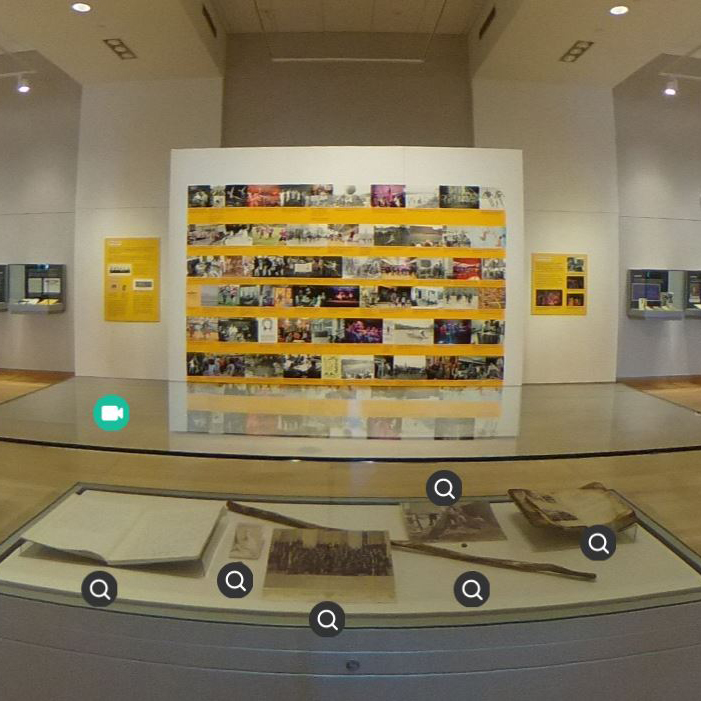
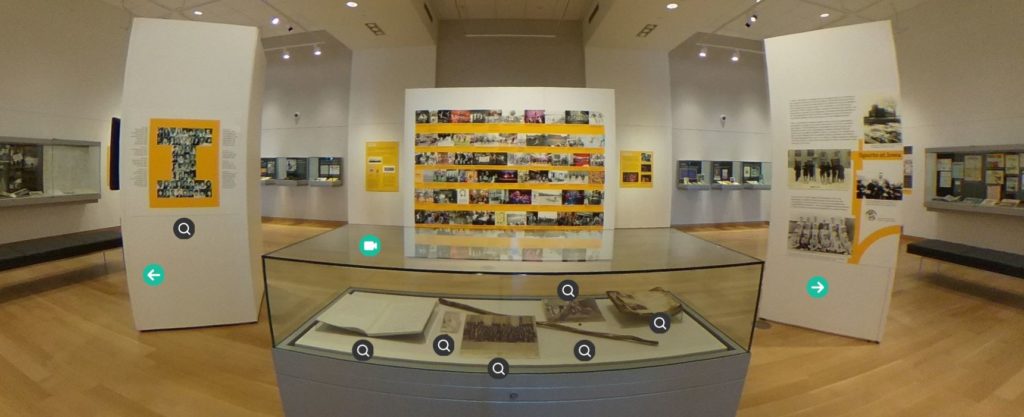
For those distant to campus, or who would like to experience the latest Main Library Gallery exhibition from home, a virtual tour of We Are Hawkeyes: Celebrating 175 Years of Student Life at the University of Iowa is now available online.
From the We Are Hawkeyes: Celebrating 175 Years of Student Life at the University of Iowa virtual tour, Main Library Gallery.
The tour features 360° photos of the Main Library Gallery, which allow the viewer to move from area to area. The text panels and the cases containing the items on display are clickable, meaning close-up views of most objects are available along with insights from co-curators David McCartney, Aiden Bettine, and Denise Anderson.
The exhibition features student life-centered items from the University Archives and the Iowa Women’s Archives in celebration of the University of Iowa’s 175th anniversary. Student publications, protest flyers, Hawkeye sports memorabilia, and much more are included. The virtual exhibition includes videos and links to extra articles and historical context scattered throughout.
To read about the specific items on display in the Main Library Gallery, check out the exhibition guide online. Statements by the co-curators are included.
The oldest university in the state, the University of Iowa was founded on February 25, 1847. Instruction began in the autumn of 1855 with just 124 students. Every student thereafter has left their mark on the university, and campus life today has been shaped by nearly two centuries of student influence.
Over the past 175 years, students at the University of Iowa have amplified their causes through protest and advocacy, they have shared their individuality through student publications and the arts, and they have made countless brilliant contributions to the world in which we live. The Spring 2022 Main Library Gallery exhibition, We Are Hawkeyes: Celebrating 175 Years of Student Life at the University of Iowa, spotlights some of these experiences.
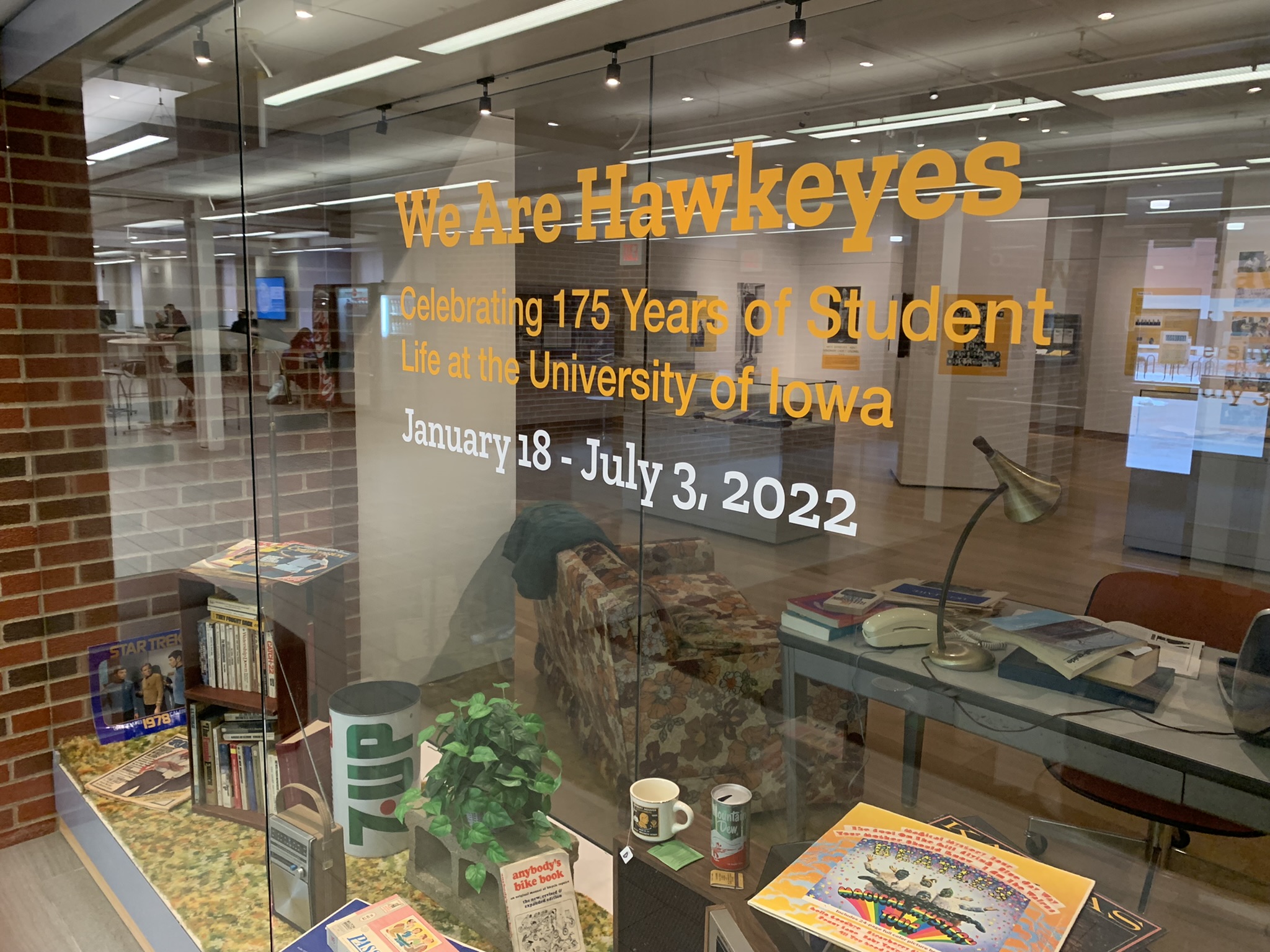
Front display window, Main Library Gallery. Photo/Sara J. Pinkham.
The exhibit was curated by Denise Anderson, Aiden Bettine, and David McCartney of the University Archives at the University of Iowa Libraries. The co-curators carefully selected a variety of items and images both old and new from the University Archives and Iowa Women’s Archives to create a representation of student life over the decades, working on the exhibition together throughout 2021 in preparation for the university’s anniversary year.
“I am grateful for the opportunity to highlight these engaging and diverse student experiences, plucked from the pages of rich University of Iowa history,” said Denise Anderson, archives assistant.
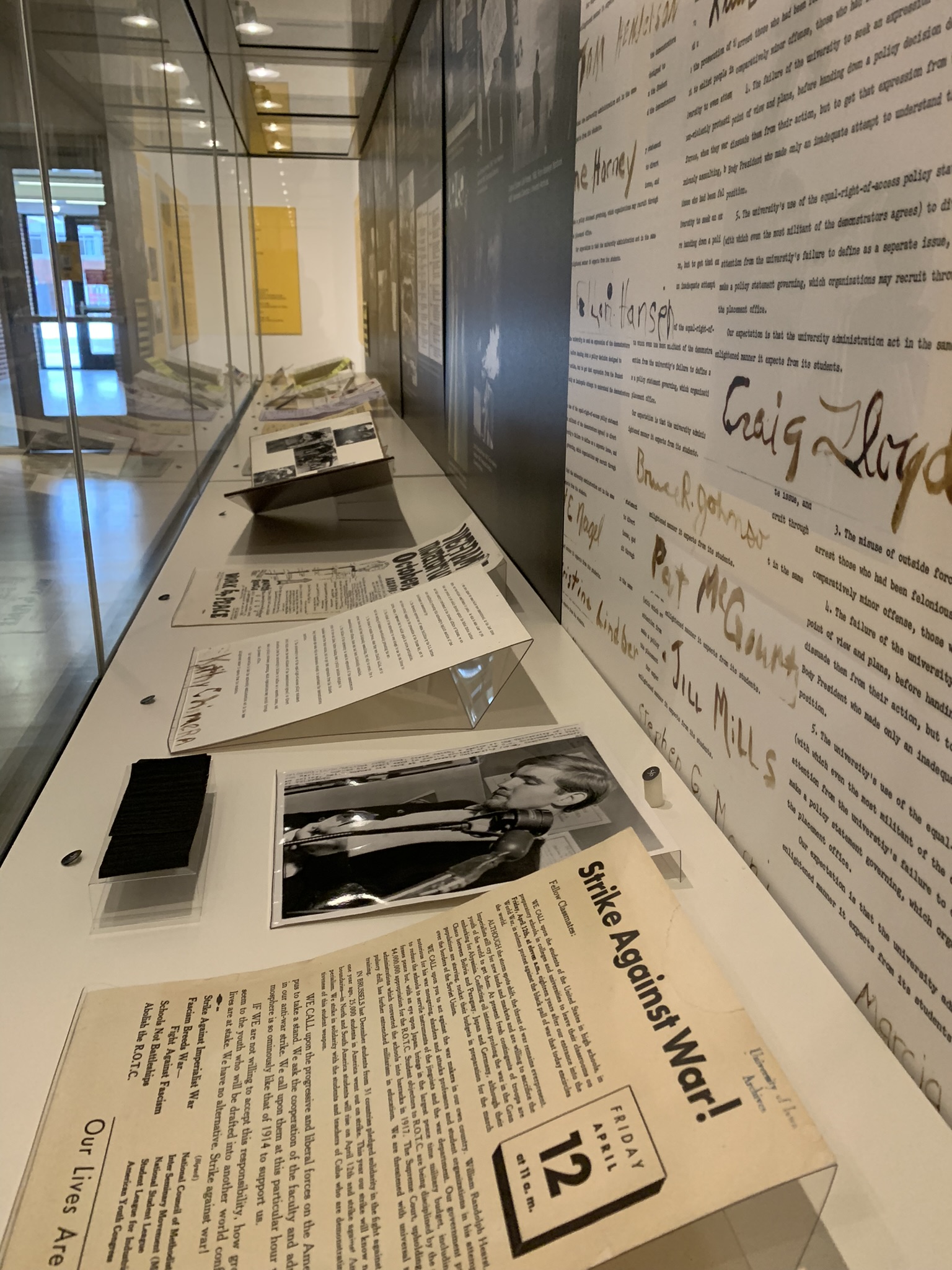
From the “Raising Our Voices” section of the exhibit. Featured items are related to protest on campus over several decades. Photo/Sara J. Pinkham.
“Students are the very core of the University of Iowa. Although students arrive on campus to pursue their higher education, the classroom is only one facet of the student experience,” said Aiden Bettine, community and student life archivist. “Student life on our campus is immersive, enmeshing students in both the Hawkeye community and Iowa City. Some students find their niche when they first step foot on campus and participate in existing student organizations or extracurricular activities. Others have had to carve out space for their identity or their passions.”
“Students are the lifeblood of a university, and student life shapes and informs those who have had the university or college experience,” said David McCartney, university archivist. “We Are Hawkeyes sets out to illustrate that experience in all its flavors, from athletics to academics, from parties to protest. Coming of age in a university setting brings with it a wide range of accumulated knowledge and lessons for life.”
The exhibit explores student-led publications from as early as 1881 with Little Tin God on Wheels and as recently as a 2021 edition of The Daily Iowan. A brief history of Iowa Memorial Union and the university’s military traditions are included, as well as samplings of artifacts from Department of Music and Department of Dance records. Visitors will also find an array of photographs celebrating social life on campus, items from fraternity and sorority collections, ephemera from the university’s earliest years, Iowa sports history, a glimpse into scholarship, an abbreviated visual history of protest on campus between 1910 and 2021, and more. A film reel shows footage including clips from commencements, the Hawkeye Marching Band, a University of Iowa newsreel, the Theatre Department, and protests in the 1960s.
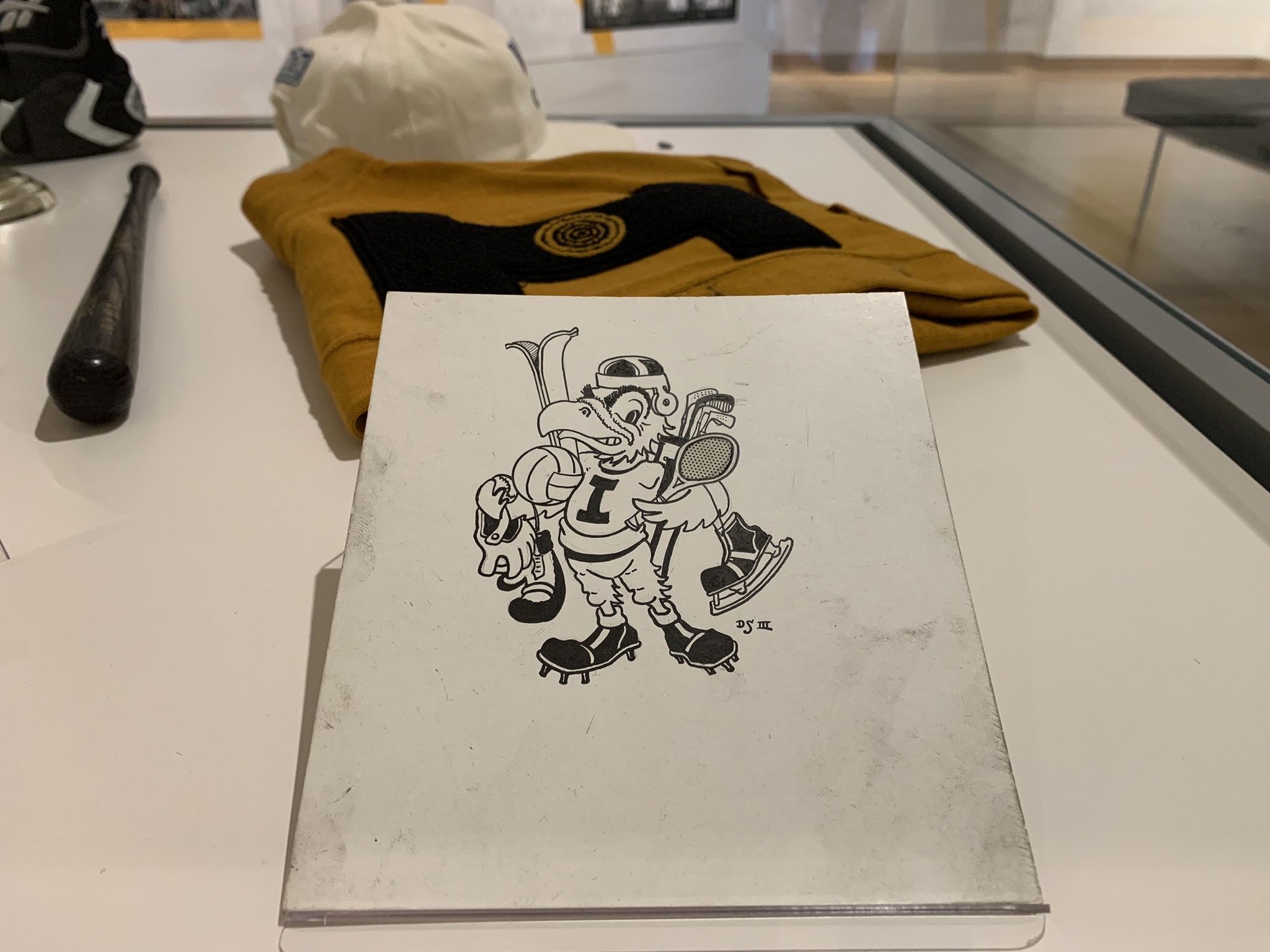
All-Sports Herky, ca. 1949-1952. Dick Spencer III Collection of Herky Pen and Ink Drawings, University Archives, University of Iowa Libraries Special Collections & Archives. Photo/Sara J. Pinkham.
“While not every student’s experience is recounted in this exhibit, we hope visitors to the Main Library Gallery will find something that speaks to their own time on campus – whether during this past year, or generations ago,” said McCartney.
A 1970s-esque dorm room set spills into the gallery from the front display case. A desk, bright orange chair, and floral loveseat invite visitors to take a seat and flip through vintage student newsletters and yearbooks. A typewriter, record player, crate of books, and a lava lamp add to the nostalgia, while plentiful classic records from McCartney’s own personal collection are artfully arranged throughout. The co-curators hope this section of the exhibition will prompt guests to consider what their must-have items were when packing for their freshman year of college.
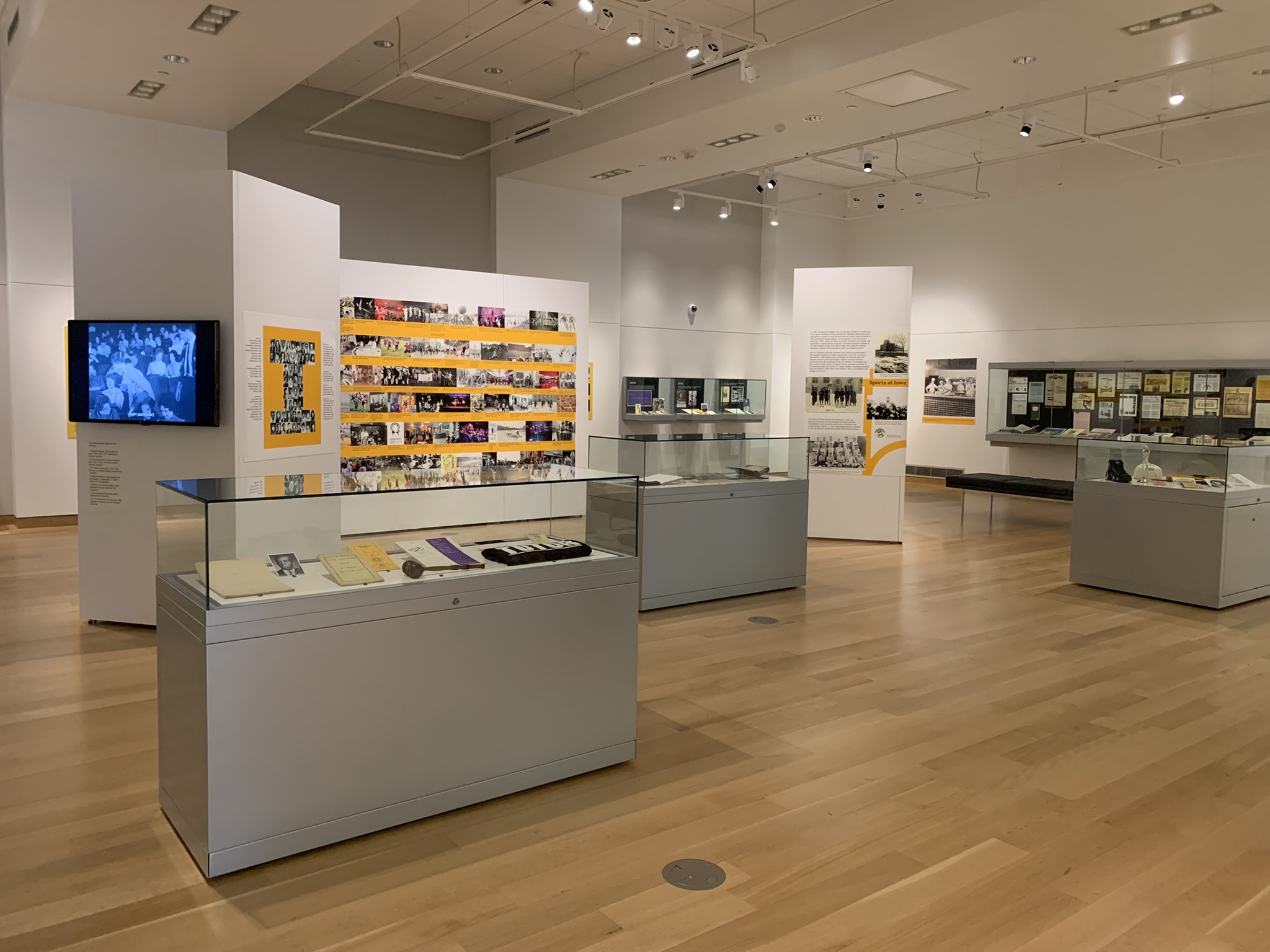
We Are Hawkeyes: Celebrating 175 Years of Student Life at the University of Iowa in the Main Library Gallery, University of Iowa Libraries. Photo/Sara J. Pinkham.
We Are Hawkeyes: Celebrating 175 Years of Student Life at the University of Iowa will be on display in the Main Library Gallery until July 3, 2022. Admission to the Gallery is always free. Visit lib.uiowa.edu/gallery for information about open hours and upcoming events.
In the latest video from the Main Library Gallery, exhibit curator Dr. Anna Barker discusses Fyodor Dostoevsky’s novel The Double and how it has influenced other writers, including Robert Louis Stevenson, Oscar Wilde, and Sylvia Plath. Books featured in the video are from Special Collections & Archives at the University of Iowa Libraries.
Learn more about the Main Library Gallery, University of Iowa Libraries here: lib.uiowa.edu/gallery
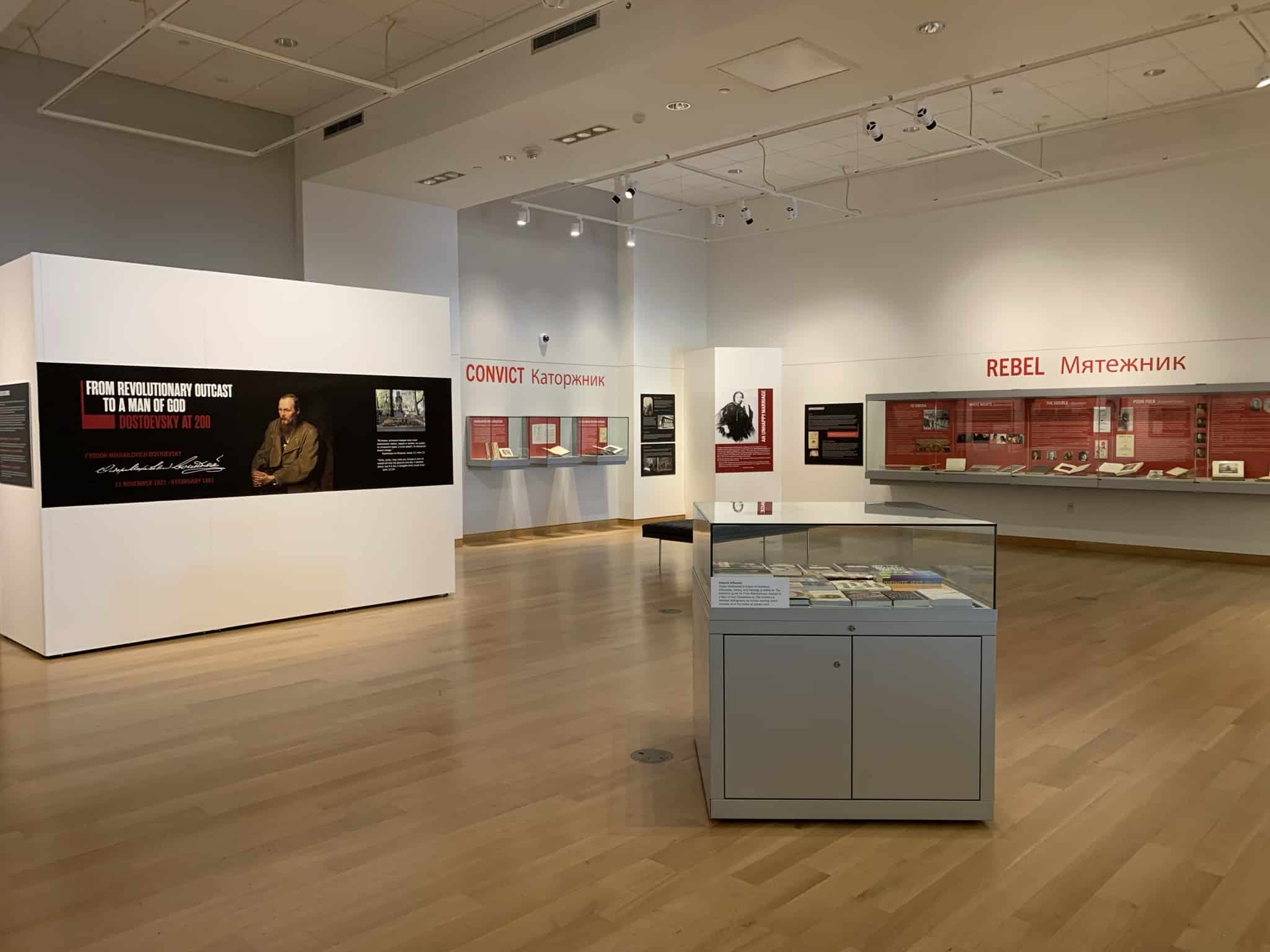
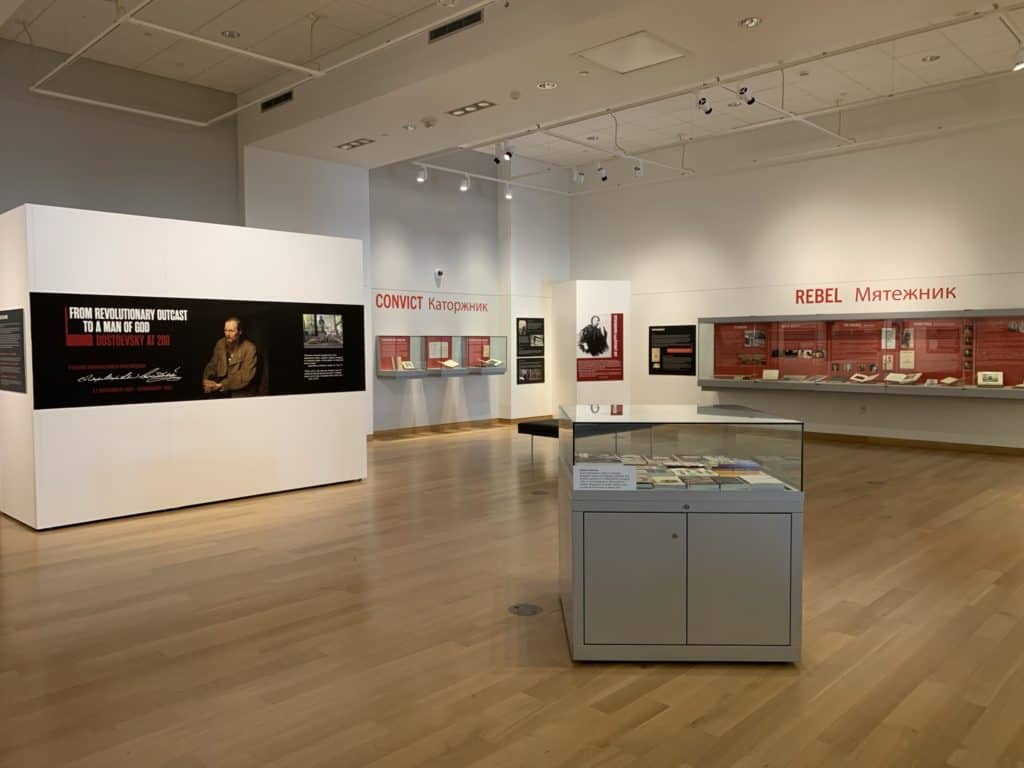
About the exhibit: The Fall 2021 Main Library Gallery exhibition, From Revolutionary Outcast to a Man of God: Dostoevsky at 200, is dedicated to the life and work of the Russian writer Fyodor Dostoevsky (1821-1881). Curated by Dr. Anna Barker, University of Iowa professor of Russian literature, the exhibition covers the entirety of Dostoevsky’s prolific literary career. His youth, his years of exile in Siberia, a period of gambling addiction, and his philosophical and theological teachings are explored in the context of Russian historical events and many of his most famous novels, from Poor Folk to The Brothers Karamazov.
Can a book read in childhood be the inspiration for a lifetime of teaching and European travel? Helen Perry Curtis’s Jean & Company, Unlimited, the charming account of an American girl’s first encounter with Europe, was precisely that for author and historian Laura Gellott.
In 2015, Gellott located Curtis’s three granddaughters. That meeting resulted in the publication of Helen Perry Curtis and the European Trip of a Lifetime. Gellott’s book traces Curtis’s life from its Nebraska roots to New Jersey and New York and across the European continent in the 1930s. She tells the story of the real-life travels behind Jean & Company, Unlimited, a book designated as a Junior Literary Guild Selection in January, 1938.
Laura Gellott is professor emeritus of history at the University of Wisconsin-Parkside (Kenosha), where she taught European history for 30 years. She is a frequent European traveler. She first read Jean & Company, Unlimited, nearly 60 years ago. She has found it to be an ever-reliable guide.
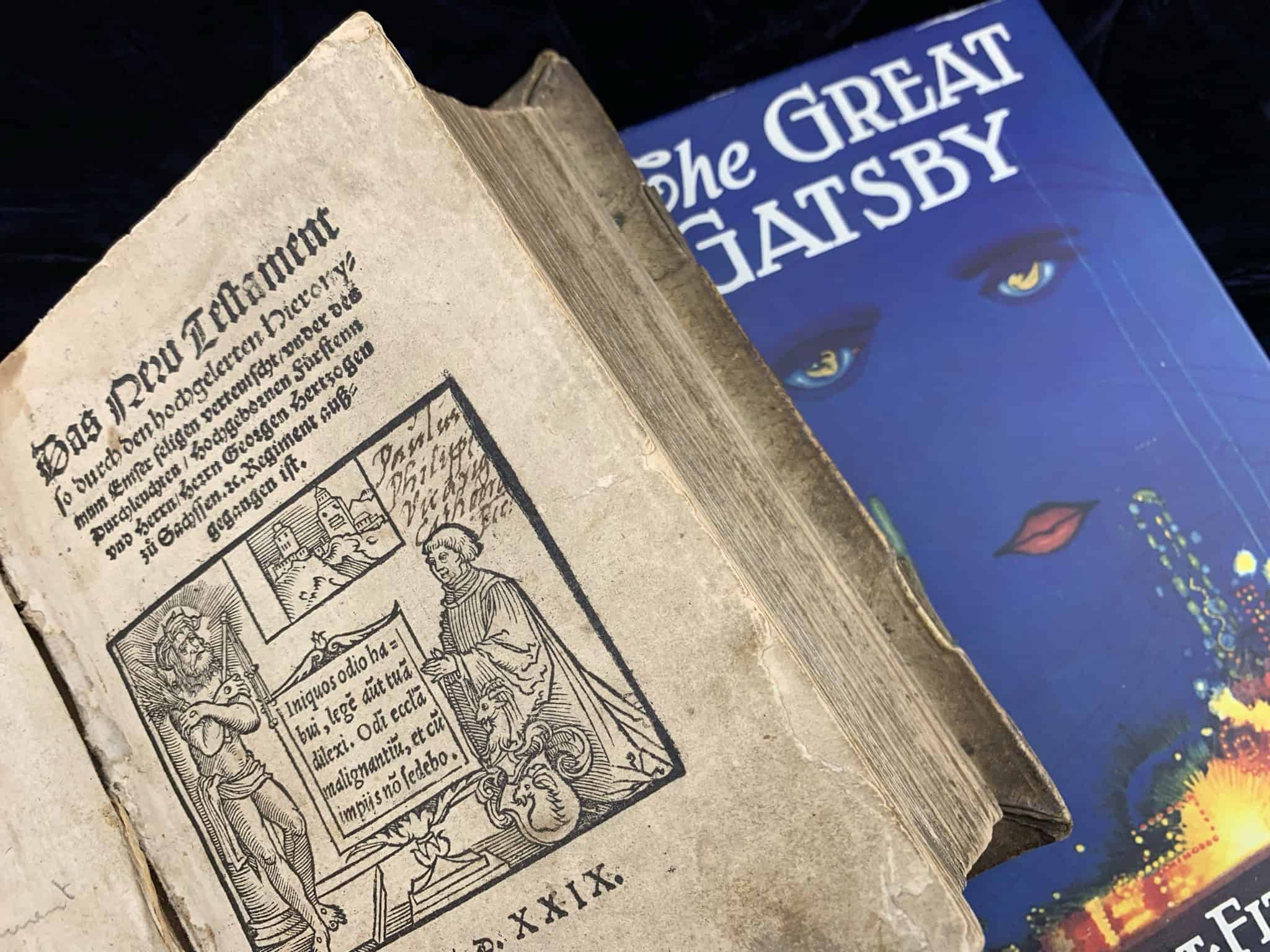
The University of Iowa’s Main Library will be a busy hub of four unique offerings on Saturday, October 23 during this year’s Iowa City Book Festival.
All are welcome to attend an open house in Special Collections & Archives, a talk by guest author Laura Gellott, a guided tour of the Main Library Gallery’s current exhibition about Dostoevsky, and a Riverside Theatre performance of Dostoevsky’s The Grand Inquisitor.
“As our community returns to more in-person gatherings, we thought hosting a small set of events over the course of the afternoon would make it easy for community members to come to the UI’s Main Library and enjoy different types of programming,” says John Culshaw, the UI’s Jack B. King University Librarian. “There’s something for everyone!”
Special Collections & Archives, University of Iowa Libraries. Photo: Sara Pinkham.
About the events
Open House — Reading through the Roarin’ 20s, an open house event, will take place in Special Collections & Archives on the 3rd floor of the Main Library from 1:00 PM – 4:00 PM. Visitors are welcome to drop in any time during event hours to view selected rare books.
“This open house will be fun because we are celebrating the ’20s through books, but not just the 1920s or 2020s,” says Elizabeth Riordan, outreach and engagement librarian for Special Collections & Archives. “We’re looking at books from 1520, 1620, and so forth, to explore book history and literature through the ages. It’s a chance to get up close to history and hear the stories these items have to tell.”
Author Laura Gellott.
Author Talk — At 2:30 PM,guest author Laura Gellott will give a talkin Shambaugh Auditorium inthe Main Library about her new book, Helen Perry Curtis and the European Trip of a Lifetime. As a child, Gellott read Helen Perry Curtis’s Jean & Company, Unlimited, a charming account of an American girl’s first encounter with Europe. The book inspired Gellott—professor emeritus of history at the University of Wisconsin – Parkside (Kenosha)—to pursue a lifetime of teaching and European travel. Gellott’s book traces Helen Perry Curtis’s life from its Nebraska roots to New Jersey and New York and across the European continent in the 1930s. She tells the story of the real-life travels behind Jean & Company. A book signing and light reception will follow Gellot’s talk.
“Given the number of writers and travel aficionados in our community, we thought folks would be interested in Laura Gellott’s journey toward the publication of this book,” says Culshaw.
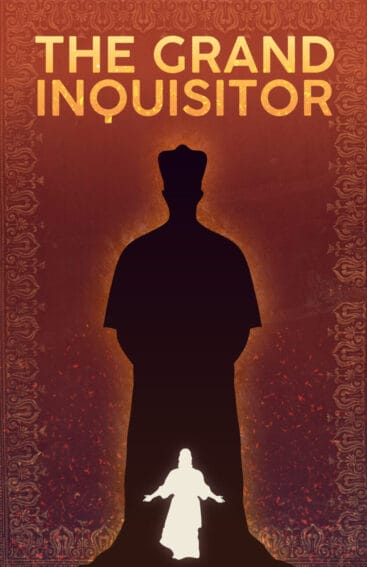
Poster for The Grand Inquisitor. Credit: Riverside Theatre.
Live Performance — Riverside Theatre will be performing The Grand Inquisitor, a short play based upon the most famous chapter of Dostoevsky’s novel The Brothers Karamazov, at 7:30 PM in the Main Library Gallery. Tickets are free but must be reserved ahead of time at RiversideTheatre.org. Information about additional show dates can also be found on the Riverside Theatre website.
“The Book Festival is always a great way for us to share our resources and highlight authors to the community as a whole,” says Culshaw. “As a public institution, community engagement is an important part of the UI and the UI Libraries’ missions. We’re excited to share these unique events with the community.”
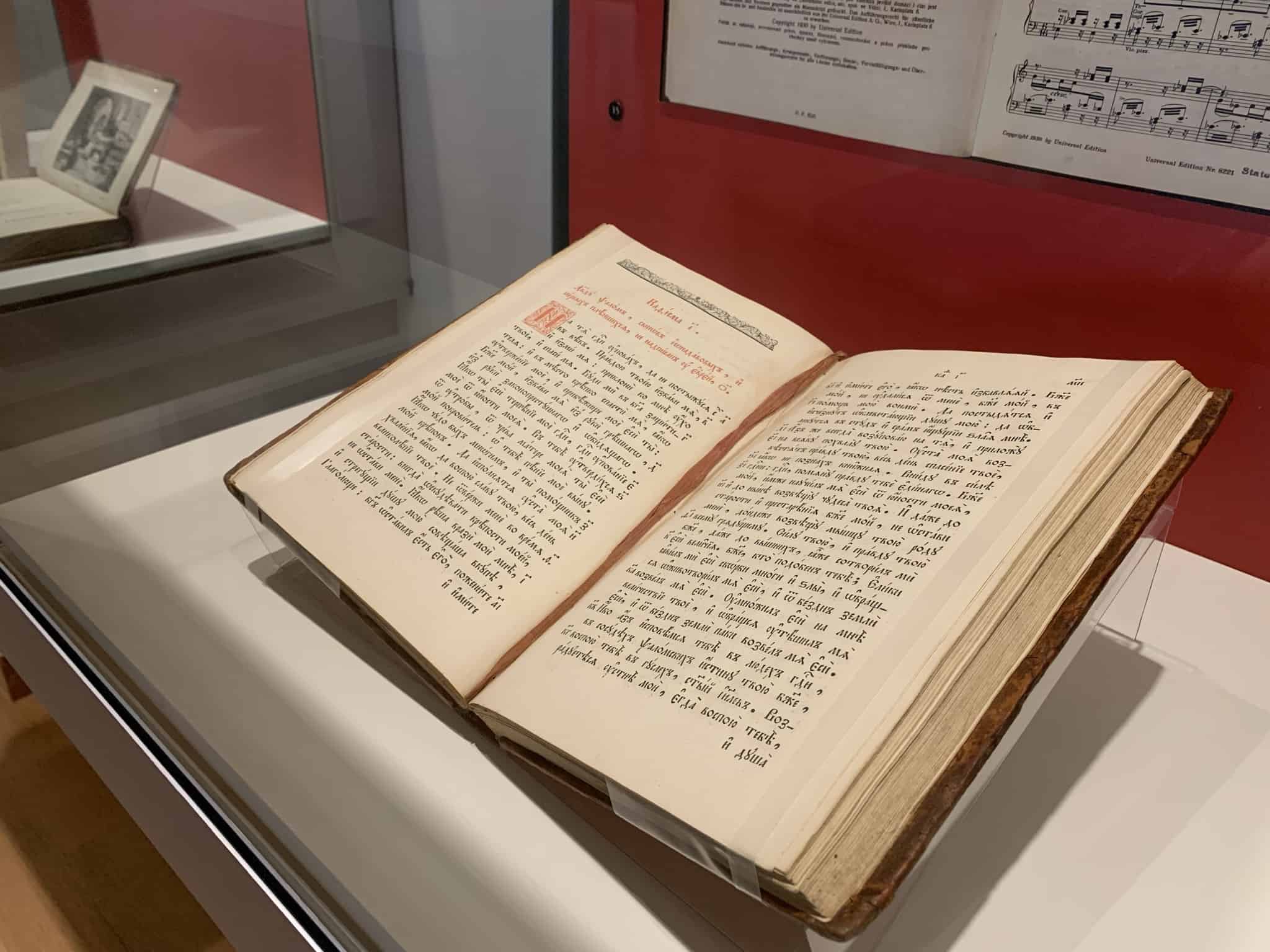
In the exhibit: P︠S︡altirʹ. (Bible. Psalms.) Moskva: Synodalbhaia Tyts, 1851. Russian. [x-Collection, BS1425 C4 1851] Special Collections & Archives, University of Iowa Libraries. Photo/Sara Pinkham.Items selected by guest curators for display in the Main Library Gallery are frequently drawn from Special Collections & Archives. Preparations for exhibitions provide excellent opportunities for rare objects in Special Collections to be examined for conservation needs. Professional care of rare materials is a core specialty of the Conservation and Collections Care department at the University of Iowa Libraries, and Conservation Lab treatments for fragile or damaged materials range from simple to complex.
“We are constantly finding unique gems in our vast collections through use, and one of the ways we do that is through researching for exhibits,” said Giselle Simón, University Conservator. “This is especially exciting because we work with expert curators who really delve into our holdings, revealing items that might go unnoticed. This allows us to care for these items and get them into our focus, with faculty and students. It’s another great way to expand our working knowledge of the collections, to understand the breadth of what we have here at the UI.”
In the case of an 1851 Russian psalter chosen by curator Anna Barker, PhD for the From Revolutionary Outcast to a Man of God: Dostoevsky at 200 exhibition, it was important to remedy the severe deterioration of the spine prior to display.
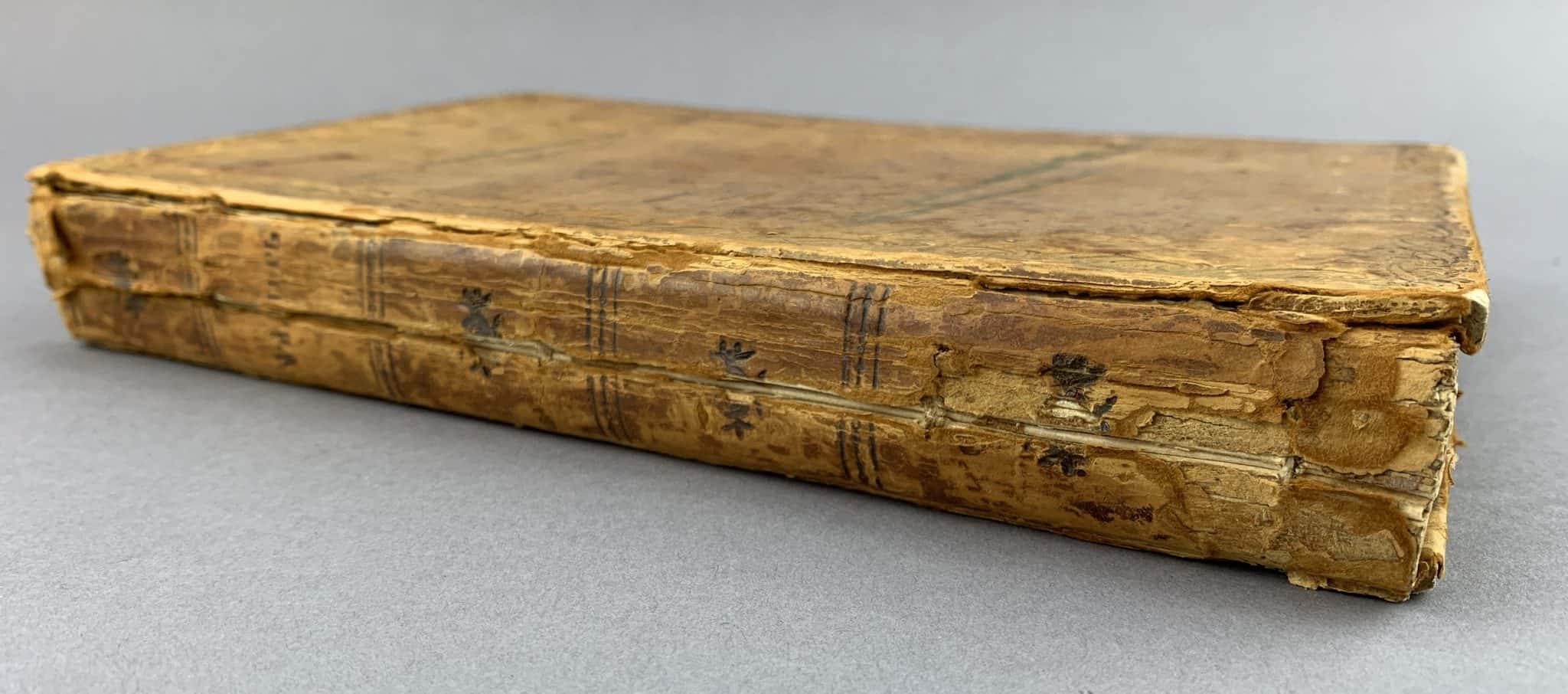
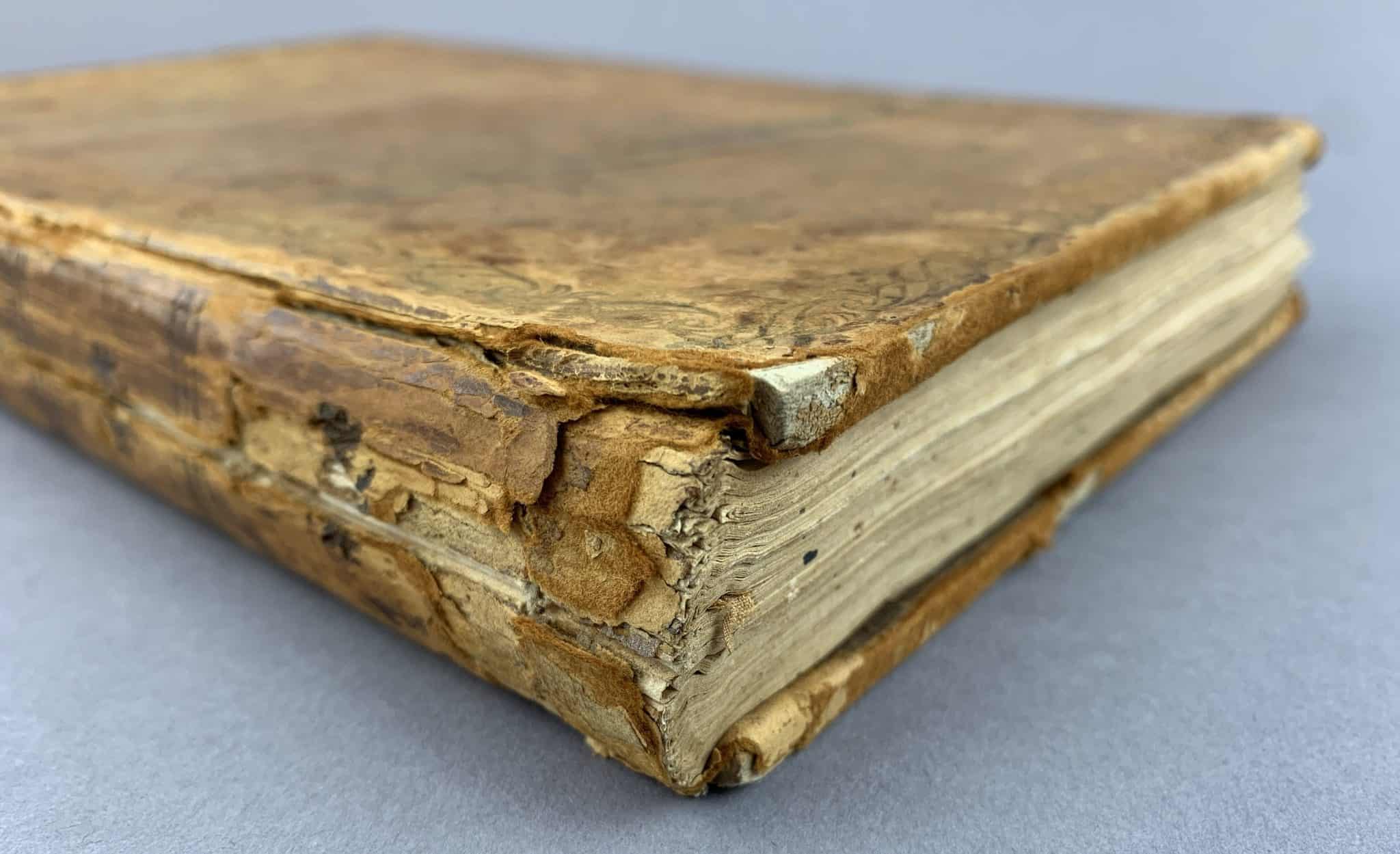
Before treatment: the book’s spine is damaged from several decades of use and it suffers from red rot. Photo/Sara Pinkham.
Bill Voss, conservator technician and exhibits preparator, managed the complex treatment process for this book.
Before treatment: the book’s spine is damaged from several decades of use and it suffers from red rot. Photo/Sara Pinkham.
“For the psalter, the main issue was the degraded quality of the leather, often called red rot,” said Voss. “This is not uncommon for modern leathers from the industrial era, which were tanned using chemical processes rather than traditional vegetable tanning. Because the leather on the spine had degraded and the book was a tight back with the leather directly adhered to the spine, over time the spine began to suffer losses, especially in creases where the book opened sharply.”
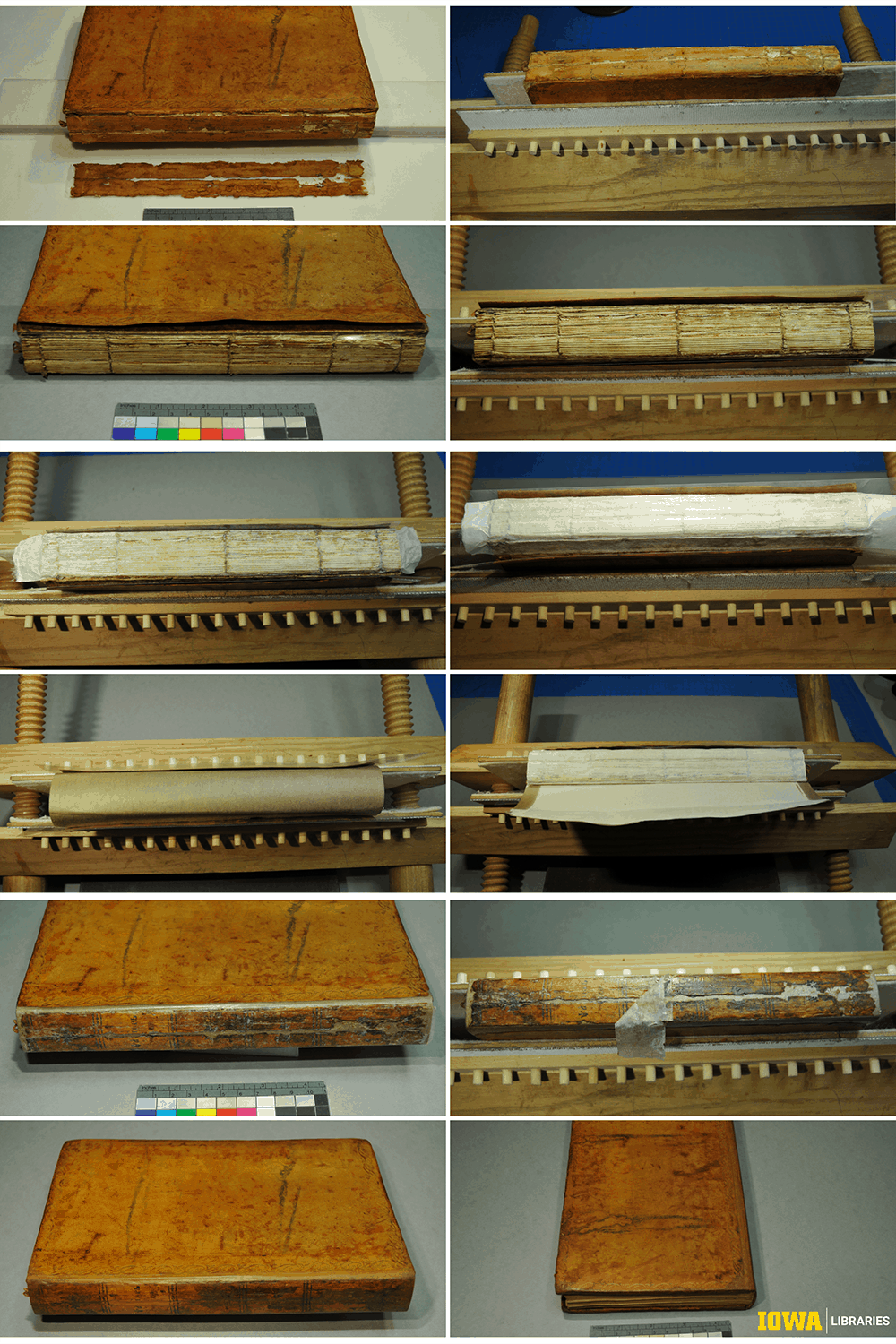
When asked what was most challenging about this treatment, Voss noted that that spine required the most time and intensive repair. “The main challenge was to remove the remaining pieces of the spine intact, after which a new spine piece that stays free of the back when opening was inserted under the original covers. Then the spine was adhered and the edges of the repairs were mended with tissue and toned with acrylic,” he said.
“It seems unusual to have a printed Russian psalter from this time period,” said Simón. The book is remarkable for multiple reasons. “It has its original binding. While worn and abraded, it’s still there.” No repairs had been made to the psalter prior to its emergence as part of the From Revolutionary Outcast to a Man of God: Dostoevsky at 200 exhibit. 170 years after it was originally bound, Voss was the first person to attempt and successfully complete treatment on the book.
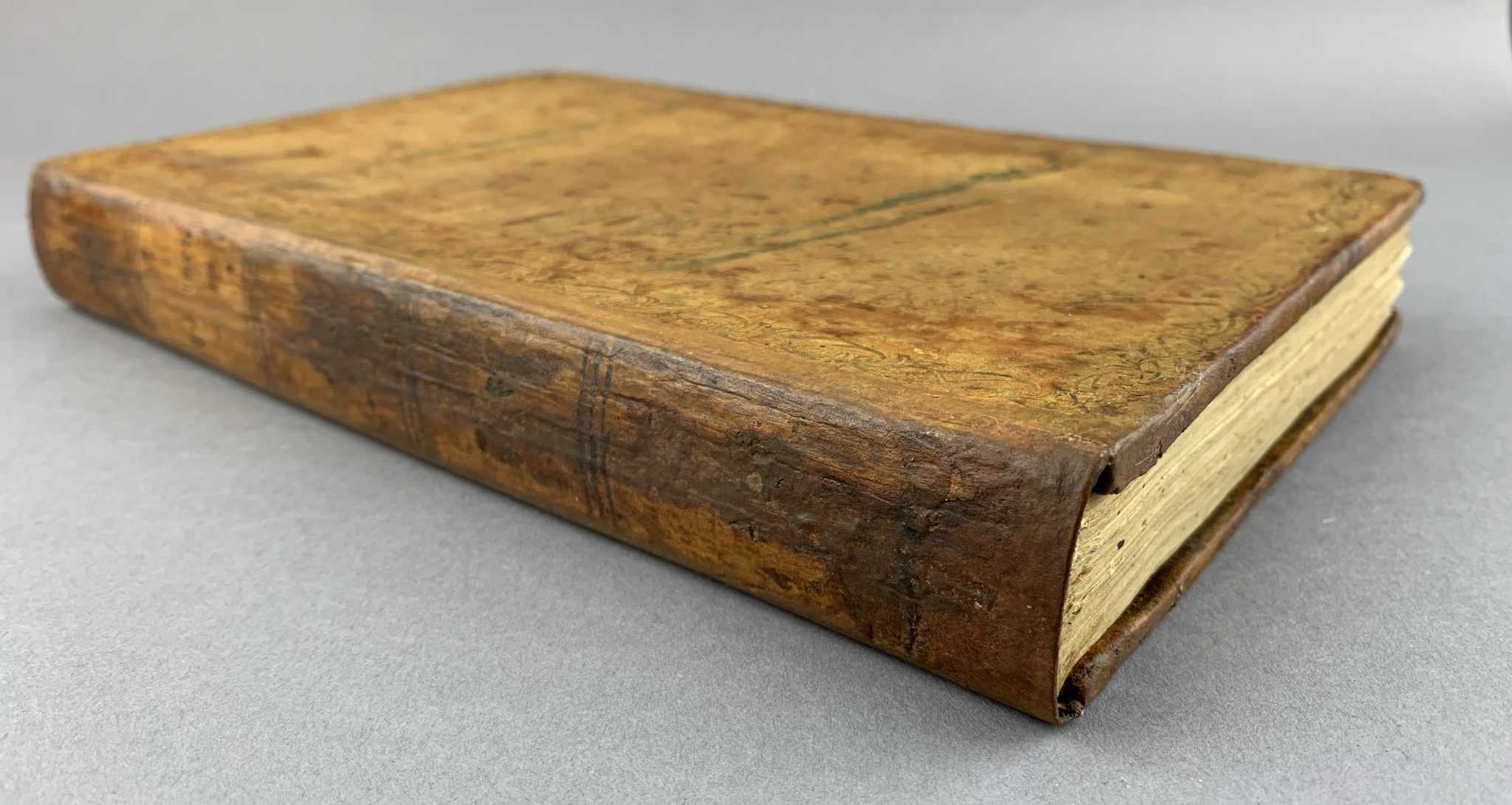
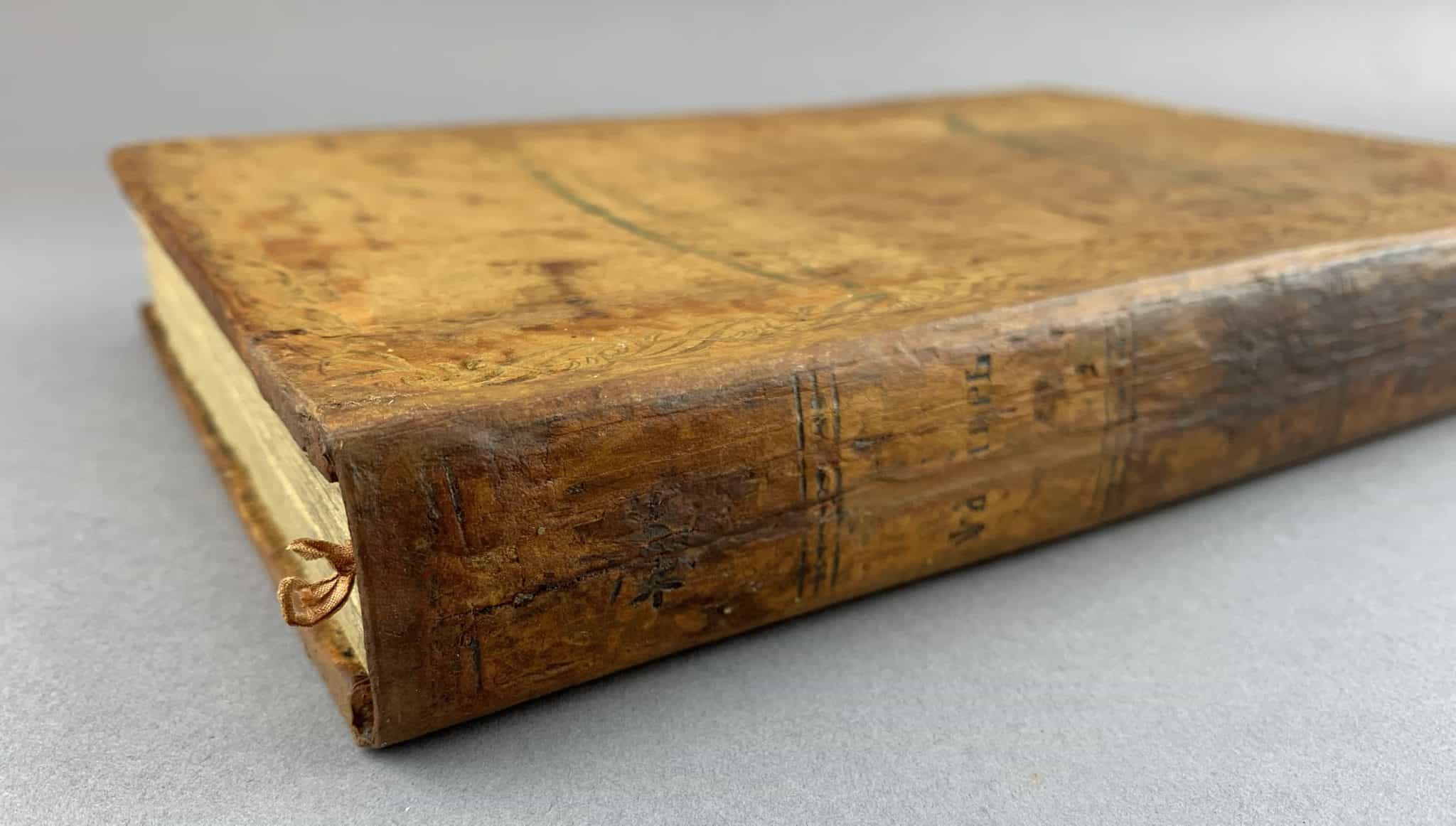
After treatment: the P︠S︡altirʹs spine is repaired and the book’s condition is stable. Photo/Sara Pinkham.After treatment: the P︠S︡altirʹs spine is repaired and the book’s condition is stable. Photo/Sara Pinkham.
Eric Ensley, PhD, Curator of Rare Books & Maps, agreed that this psalter was a unique find in Special Collections & Archives. “This is an interesting book because it is emblematic of the changing society in which it existed,” he said. “The book is printed in kirillitsa, which is a traditional Russian script that mimics the earliest Russian writing and Church Slavonic of much earlier writings. Even in the middle of the nineteenth century, the book would have looked like a relic. By this time, Peter the Great (1672 – 1725) had introduced a much plainer, simpler font known as the Civic Type that could be found in many books and documents. Imperial Russia was a quickly changing place; there existed scientific writings printed in Civic Type alongside psalters like this one printed in archaizing letters.”
Ensley also considered a deeper interpretation of the psalter’s presence in the exhibition in relation to Fyodor Dostoevsky’s work. “In Crime and Punishment we can see a similar story played out where a young man, Rodion Raskolnikov, is out of sorts in the modernizing world he inhabits. Raskolnikov has at its root [the Russian word] ‘raskol,’ that is a ‘cleaving,’ but it’s also the term for the split between the ‘Old Believers’ who followed an earlier version of Orthodox Christianity and those who embraced modernizing reforms. Raskolnikov’s very name suggests one out of place in the modern world, not unlike this book with its liturgical content and appearance from a different period. Indeed, Raskolnikov finds redemption through Christianity and belief at the end of the novel, and it’s not a stretch to imagine the book he and Sonya read looked like this.”
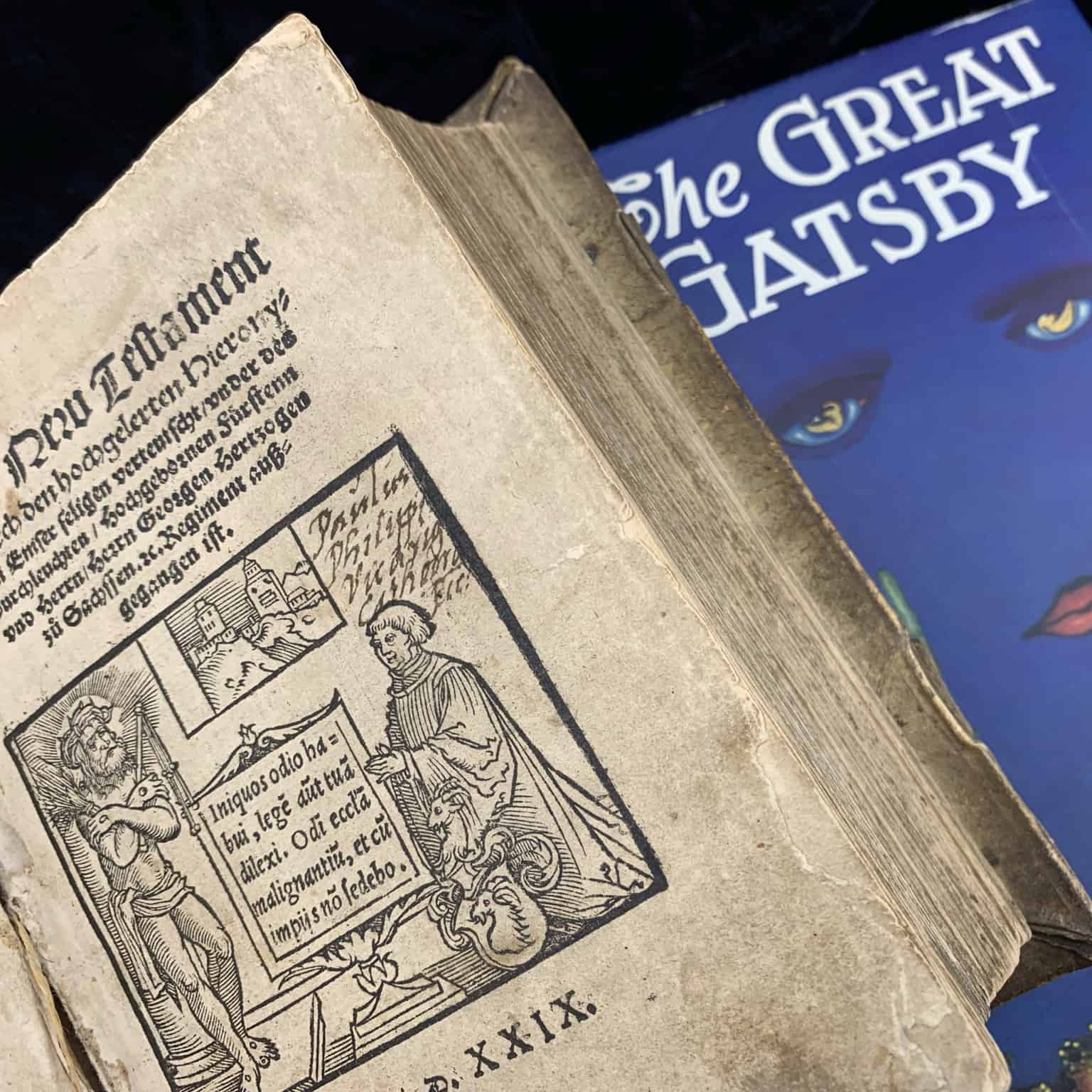
Closeup: P︠S︡altirʹ. (Bible. Psalms.) Moskva: Synodalbhaia Tyts, 1851. Russian. [x-Collection, BS1425 C4 1851] Special Collections & Archives, University of Iowa Libraries. Photo/Sara Pinkham.When asked why this psalter appears in the exhibit, Barker said, “It is representative of Dostoevsky’s deep appreciation of his copy of the New Testament. The New Testamentwas the only book the prisoners in Omsk were allowed to keep, and it was Dostoevsky’s only book companion for the four years his spent in the labor camp. He treasured his copy all his life. Descriptions of Dostoevsky’s copy appear in his novels Notes from the Dead House, Humiliated and Insulted, and Crime and Punishment.” Dostoevsky was sentenced to hard labor, beginning in 1850, for his involvement with a radical group called the Petrashevsky Circle. He was considered a dangerous political prisoner. Text written by Barker for the exhibition states: “This group advocated for greater social freedoms, relaxation of censorship, and abolition of serfdom. Most famously, the group participated in the reading and distribution of a politically charged and banned letter written by the literary critic Vessarion Belinsky to the writer Nikolai Gogol. After this incident, group members were arrested and imprisoned.” This period in Dostoevsky’s life inspired Barker to search Special Collections holdings for a Russian biblical text, resulting in the discovery of this book.
Proper conservation of materials makes it possible for everyone to continue learning from rare and unique books like this Russian psalter. “It is important so that we can not only keep the content alive and well for research, but also the bibliographic information that we get from book structure, paper type, printing style, and all other materials used to publish a book in its time [of origin],” said Simón.
Photos included below, taken by Bill Voss during his conservation of this book, give more insight into the technical process behind its repair.
Documentation of conservation work done on the P︠S︡altirʹ (1851) by Bill Voss in 2021 in the University of Iowa Libraries Conservation Lab. Photos/Bill Voss.
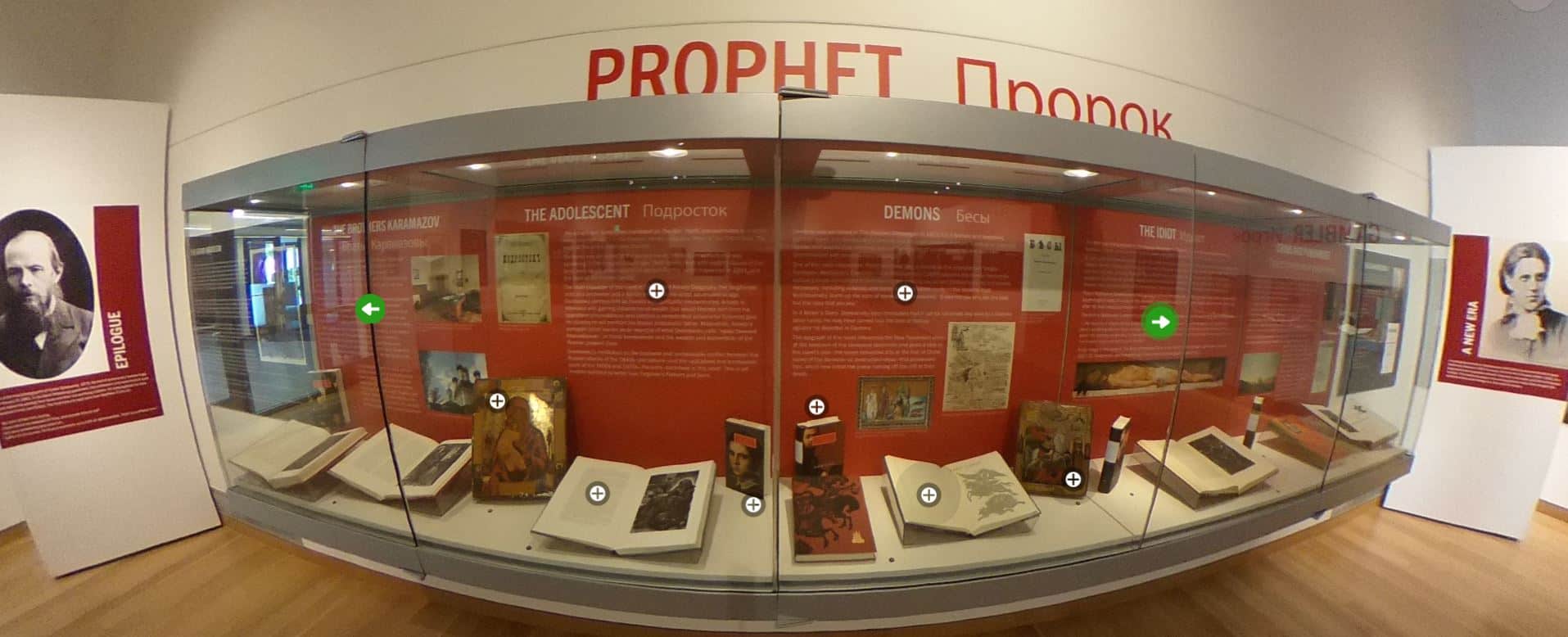
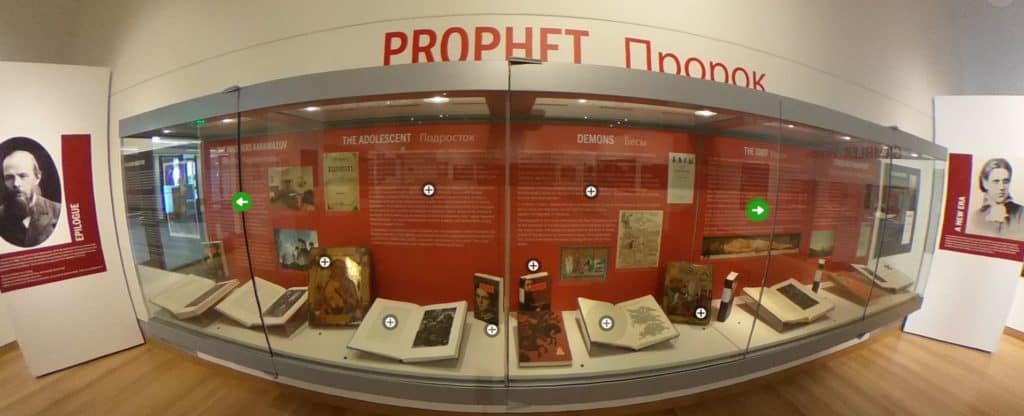
For those distant to campus, or who would like to experience the latest Main Library Gallery exhibition from home, a virtual tour of From Revolutionary Outcast to a Man of God: Dostoevsky at 200 is now available online.
From the Revolutionary Outcast to a Man of God: Dostoevsky at 200 virtual tour, Main Library Gallery.
The tour features 360° photos of the Main Library Gallery, which allow the viewer to move from area to area. The text panels and the cases containing the items on display are clickable, meaning close-up views of most objects are available along with narrative from curator Dr. Anna Barker.
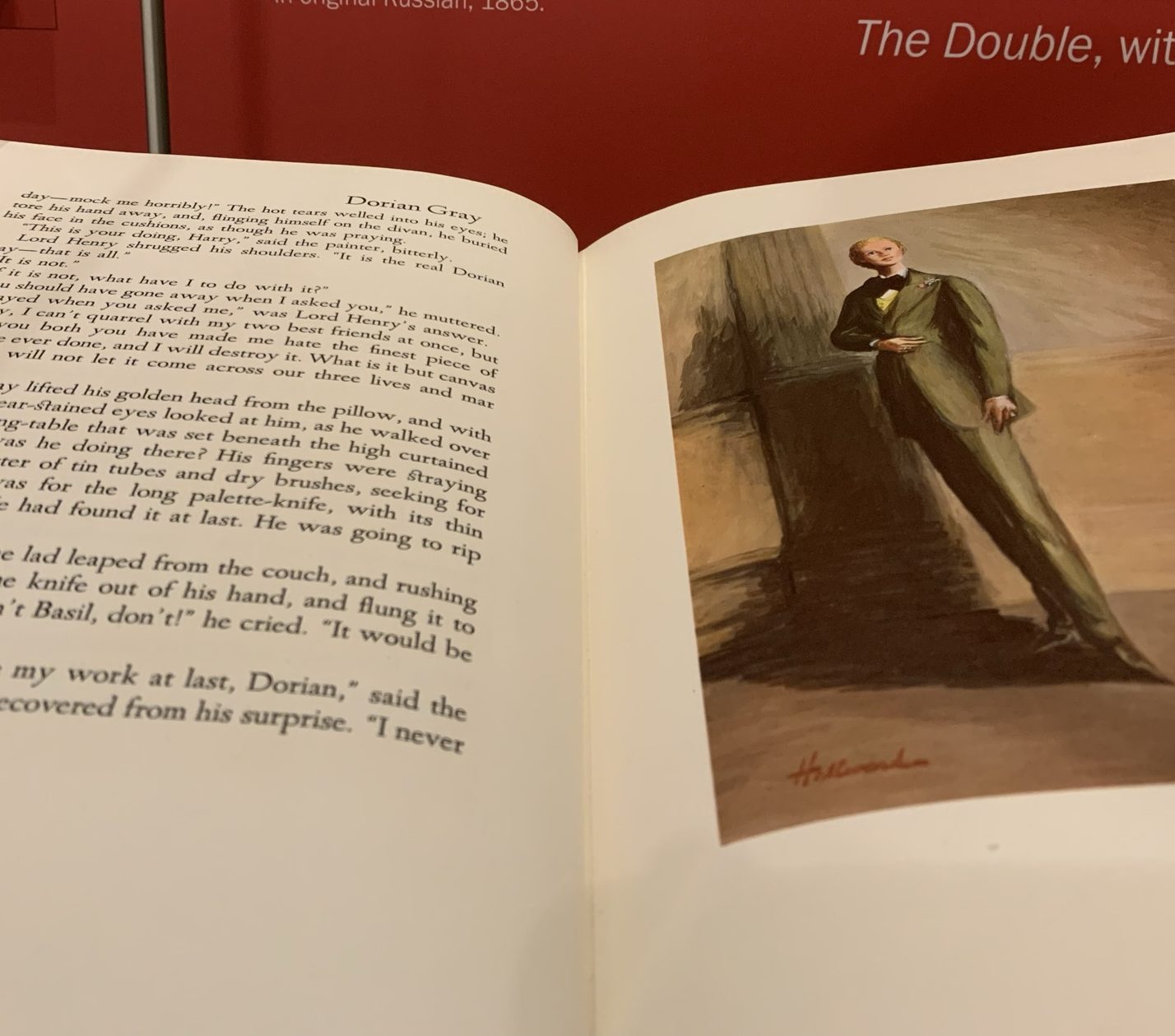
The exhibition features several books from the University of Iowa Libraries Special Collections & Archives, including illustrated limited editions of Dostoevsky novels, 19th century travel books, a 19th century Russian P︠S︡altirʹ (Psalms), and even editions of books by Oscar Wilde, Robert Louis Stevenson, Charles Dickens, George Orwell, Franz Kafka, and Aldous Huxley. These are supplemented by materials from the UI Libraries circulating collection and from the curator’s own collection.
An immersive reader option is readily available in each section of the virtual exhibit to read the detailed image descriptions for each piece on display.
To read about the specific items featured in the exhibit, check out the accessible exhibition guide. It includes an introduction by the curator.
The Fall 2021 exhibition is now open in the Main Library Gallery. From Revolutionary Outcast to a Man of God: Dostoevsky at 200 was curated by Anna Barker, an adjunct assistant professor in the Asian and Slavic Languages and Literature department at the University of Iowa. Her selections and research, coupled with bold exhibit design by University of Iowa Libraries creative coordinator Kalmia Strong, make the life and acclaimed works of Russian writer Fyodor Dostoevsky both tangible and approachable.
A storied literary giant, Fyodor Dostoevsky (1821 – 1881) authored many undisputed classic novels and was writing at the same time as Charles Dickens, Leo Tolstoy, Samuel Clemens, and others. The exhibition examines his inspirations and influence in the world of literature, but it also shares the odyssey of his personal life. In his earlier years he was a daydreaming youth, an aspiring translator, and a champion of freedom and progress. His involvement in the radical Petrashevsky Circle landed him in a Siberian hard labor camp, a difficult circumstance which was the catalyst for many more years of personal struggle and commercial success. Among other things, the exhibition briefly chronicles his marriages, affair, family relationships, gambling addiction, European travels, and his spiritual journey alongside publication of his major works. In his later years he was recognized for his wisdom and literary achievements; at the time, he was hailed as the conscience of the nation. His works are still popular worldwide, and he continues to be celebrated in Russia.
In this Q&A with the curator, Anna Barker explains her interest in creating an exhibition for the University of Iowa Libraries’ Main Library Gallery in collaboration with the Libraries’ exhibit production team.
What inspired you to curate an exhibition about Fyodor Dostoevsky and his work?
Anna: “I love Dostoevsky. Deeply, profoundly, and crushingly. It was not a love at first sight. In my teens and twenties, I was infatuated with Pushkin and Lermontov and Turgenev and Tolstoy and Dumas and Stendhal and Hugo and Goethe. Dostoevsky came later, in my thirties, when the heart learned grief and the mind became weary of doubt. If I could sum up Dostoevsky in one statement, it would be through the words of one of my favorite Dostoevsky characters, Grushenka in The Brothers Karamazov: ‘The world is a good place. We may be bad, but the world is a good place. We are bad and good, both bad and good…’
My students find Dostoevsky’s novels eerily relatable precisely because Dostoevsky, with uncanny and unflinching insight, managed to depict the totality of humanity, never shying away from the horror concealed in the human soul, but always keeping faith in the light.”
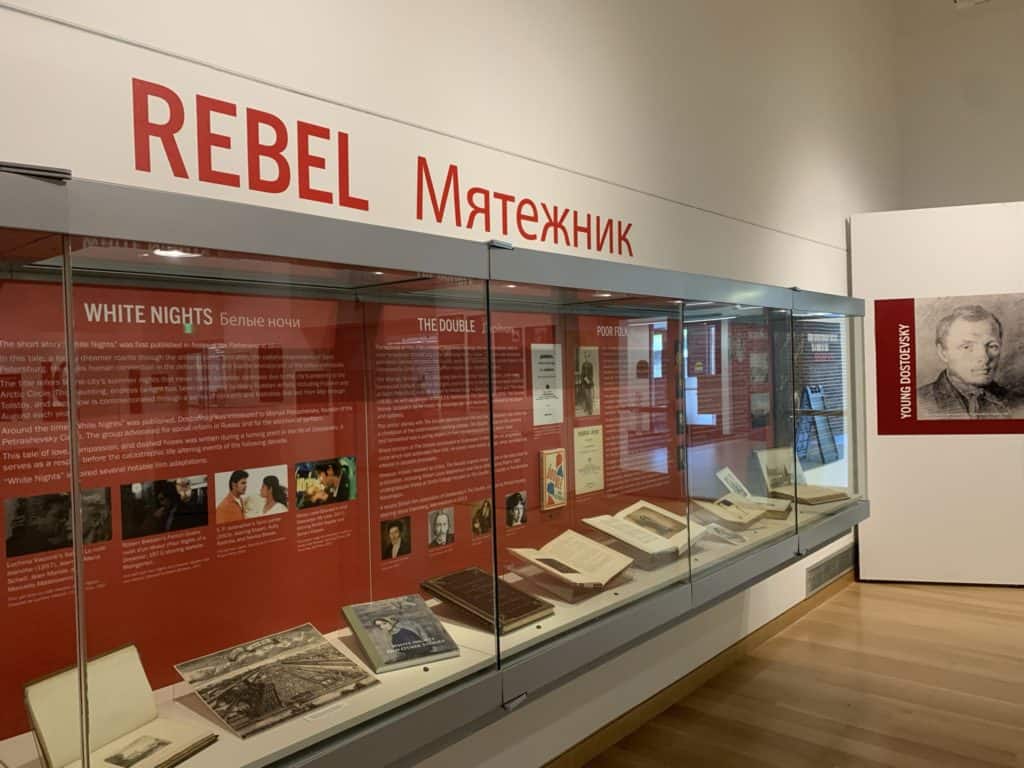
Main Library Gallery, University of Iowa Libraries. From Revolutionary Outcast to a Man of God: Dostoevsky at 200. (Photo/Sara Pinkham)
What do you hope visitors will gain by visiting the exhibit?
Anna: “I hope those who visit the exhibit will gain a greater appreciation of not only the works of Dostoevsky, but of his art in the context of both Russian culture and Western civilization. Other familiar names in the exhibit relate in some way to Dostoevsky, such as Alexander Pushkin, Nikolai Gogol, Robert Louis Stevenson, Oscar Wilde, Sylvia Plath, Leo Tolstoy, Charles Dickens, Franz Kafka, George Orwell, and even Jesse Eisenberg!”
Which items on display are your favorites?
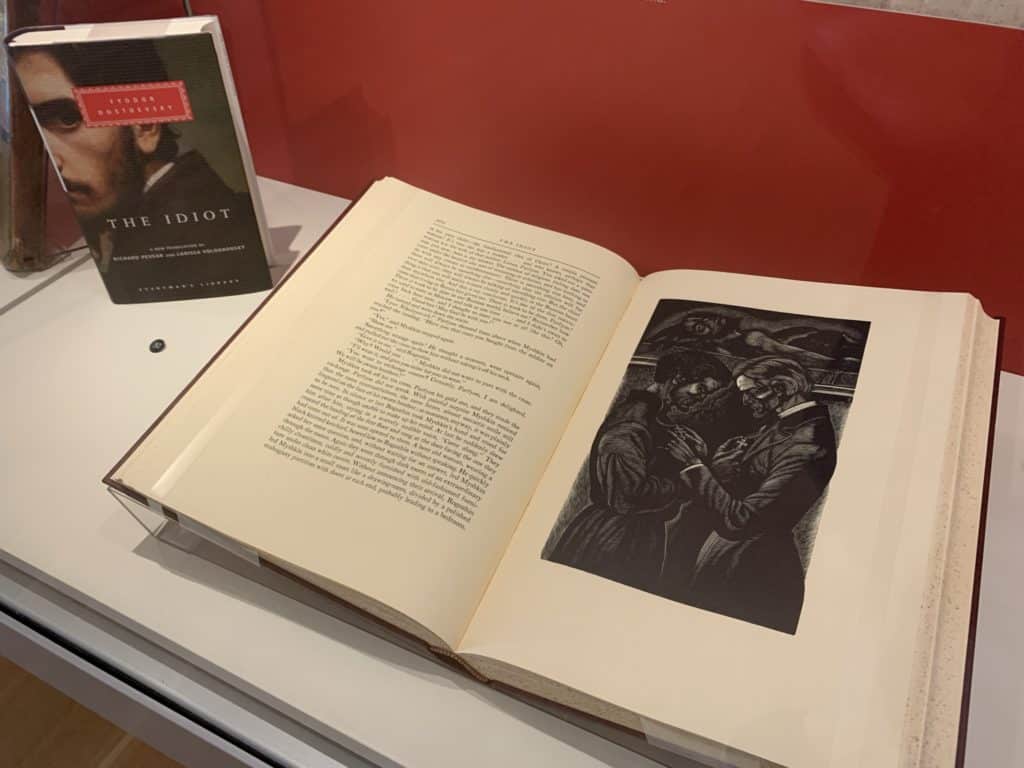
Anna: “All of the novels with illustrations by Fritz Eichenberg – they are fabulous! He really understood the totality of Dostoevsky’s vision. The Russian travel books from Special Collections & Archives add a historical and geographical dimension to the exhibition. I love the Tula samovar and Russian Imperial Porcelain in the front display case because they provide a cozy invitation into the gallery. There are also some invaluable juxtapositions that help unfold the essence of the novels: the Eichenberg illustration from Demons paired with my family’s icon of Saint George and the Dragon, and a reproduction image of The Body of the Dead Christ in the Tomb (1520-22), a work by Hans Holbein the Younger, paired with the Eichenberg illustration from The Idiot which depicts a section of this painting. The exhibit also has a soundtrack which provides visitors with another dimension for appreciating the exhibit. It helps add to the experience of Russian culture.”
For those new to Dostoevsky, which novel would you recommend reading first?
From the exhibition: Dostoevsky, Fyodor. The Idiot. Translation by Constance Garnett. Edited for this edition and with an introduction by Avrahm Yarmolinsky. Illustrated by Fritz Eichenberg. New York: For the Members of the Limited Editions Club, 1956. [x-Collection, FOLIO PG3326 .I3 1956] University of Iowa Special Collections & Archives. (Photo/Sara Pinkham)Anna: “If readers are interested in the totality of Dostoevsky’s artistic and philosophical vision, all of the novels on display in the exhibit – from Poor Folk to The Brothers Karamazov. But that’s a lot of reading! If readers are interested in the final five novels in the exhibit (Crime and Punishment, The Idiot, Demons, The Adolescent, The Brothers Karamazov), please start with Notes from Underground. It serves as the foundation for those novels. Reading Ivan Turgenev’s Fathers and Sons would be fabulous before reading Dostoevsky. It inspired many of Dostoevsky’s ideological musings.”
Which Dostoevsky-related events are you most looking forward to this fall?
Anna: “The screenings of Dostoevsky film adaptations at FilmScene, and The Grand Inquisitor play by Riverside Theatre being performed in the Main Library Gallery!”
From Revolutionary Outcast to a Man of God: Dostoevsky at 200 will be on display in the Main Library Gallery through December 17, 2021. Learn more about the exhibition here.
NOTE: The easiest way to access the Main Library Gallery is via the north entrance of the Main Library.
Guests from the general public and the University community are welcome to stop by the Gallery any time during open hours. No appointments are needed. Classes may occasionally be visiting the gallery during open hours.
The Fall 2021 Main Library Gallery exhibition, From Revolutionary Outcast to a Man of God: Dostoevsky at 200, will open on August 16.
Curated by Dr. Anna Barker, University of Iowa professor of Russian literature, the exhibition is dedicated to the life and work of Russian writer Fyodor Dostoevsky (1821-1881) and covers the entirety of Dostoevsky’s prolific literary career. His youth, his years of exile in Siberia, a period of gambling addiction, and his philosophical and theological teachings are explored in the context of Russian historical events and many of his most famous novels, from Poor Folk to The Brothers Karamazov.
The exhibition contains many items from the University of Iowa Libraries Special Collections & Archives, including several beautifully illustrated special editions of Dostoevsky’s novels; 19th century books about travel; classic novels by Oscar Wilde, Robert Louis Stevenson, and Charles Dickens; and a rare 19th century Russian Psaltir (Psalms).
From Revolutionary Outcast to a Man of God: Dostoevsky at 200 will close on December 17, 2021.
From Revolutionary Outcast to a Man of God: Dostoevsky at 200 in the Main Library Gallery.
The Main Library Gallery now has new walk-in hours for Summer 2021 and beyond!
Guests from the general public and the University community are welcome to stop by the Gallery any time during open hours. The Main Library no longer requires an Iowa One Card for building entry. No appointments are needed. Please wear a mask until vaccinated, or if experiencing COVID-19 symptoms.
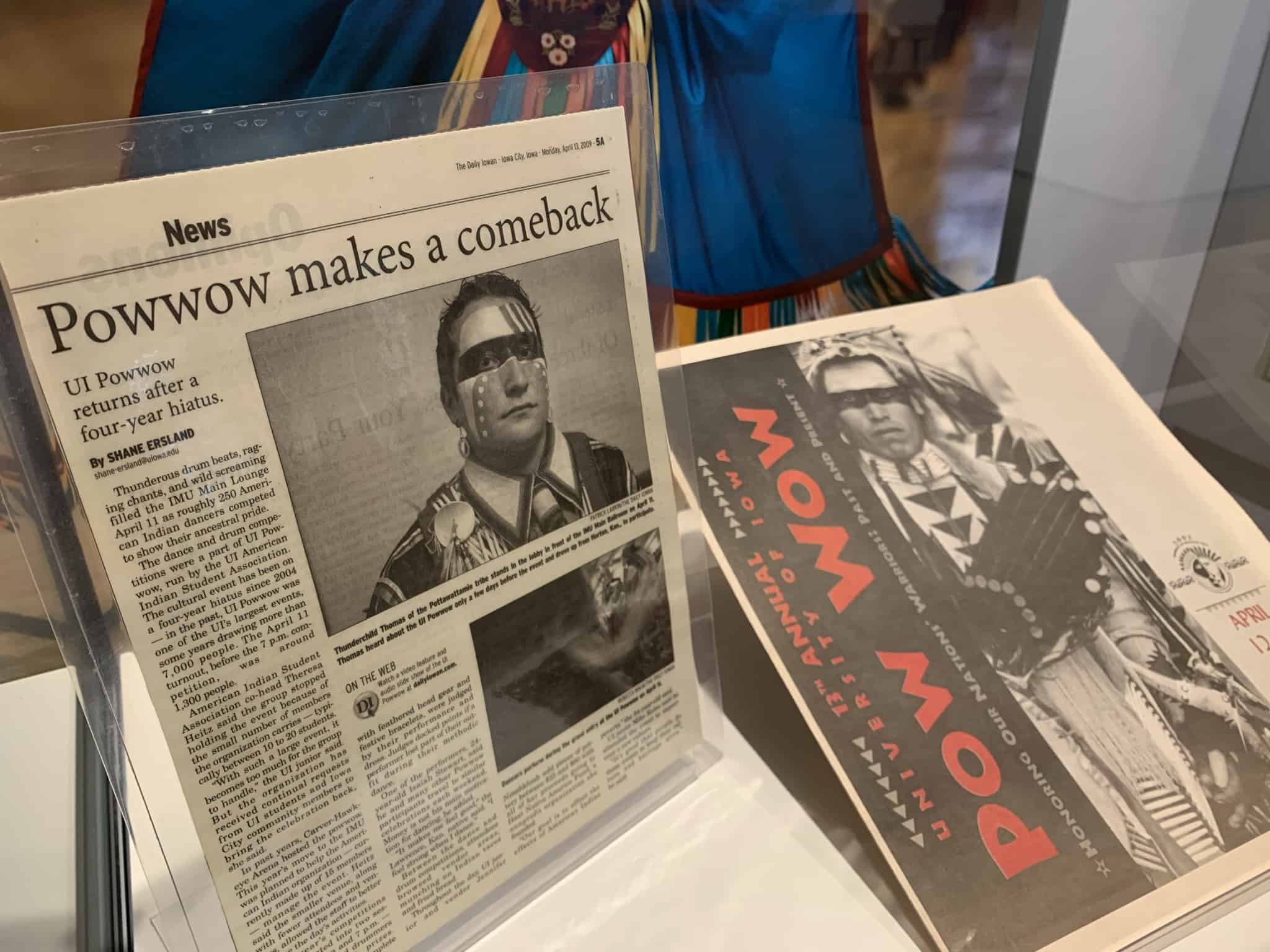
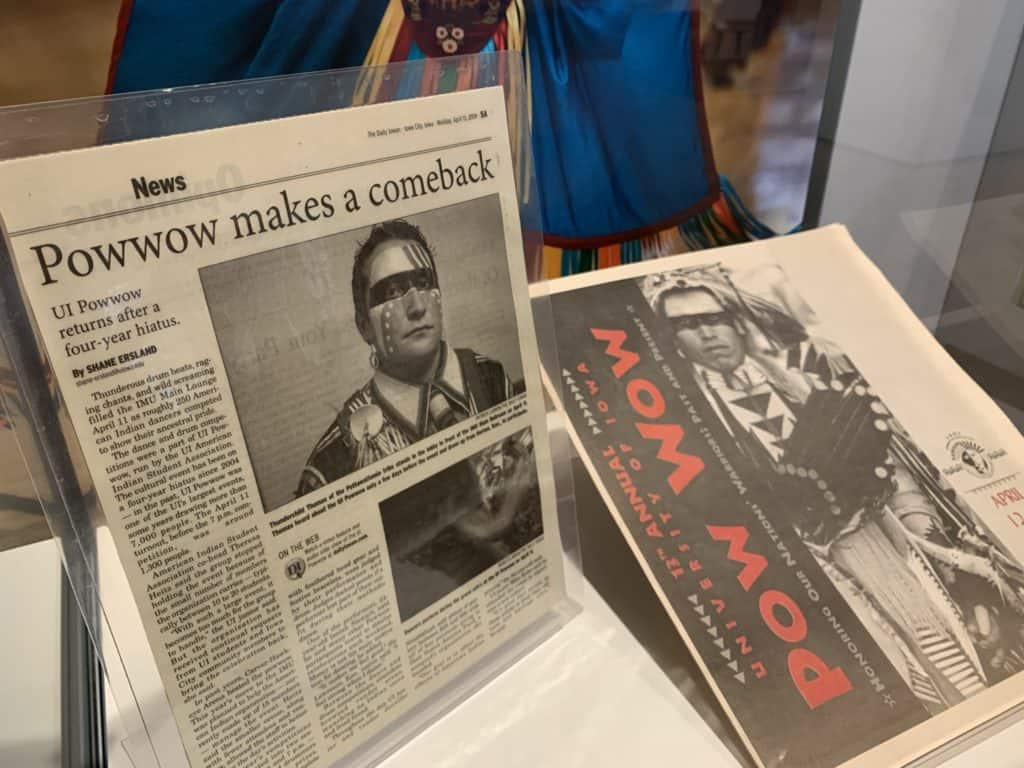
From the Building Our Own Community: 50 Years of the Latino Native American Cultural Center, Founded by Chicano and American Indian Students in 1971 exhibition. Photo: Sara Pinkham.