It’s Been Wonderful Knowing You: Wildlife Conservation and Advocacy Through the Lens of Jay N. “Ding” Darling, the fall 2026 exhibition in the University of Iowa Main Library Gallery, features the work of a Pulitzer Prize-winning cartoonist from Iowa who was a major catalyst for the modern American conservation movement. From original cartoons and photographs to correspondence and natural history specimens, each item on display helps tell the story of Darling’s efforts to save America’s wildlife and natural resources.
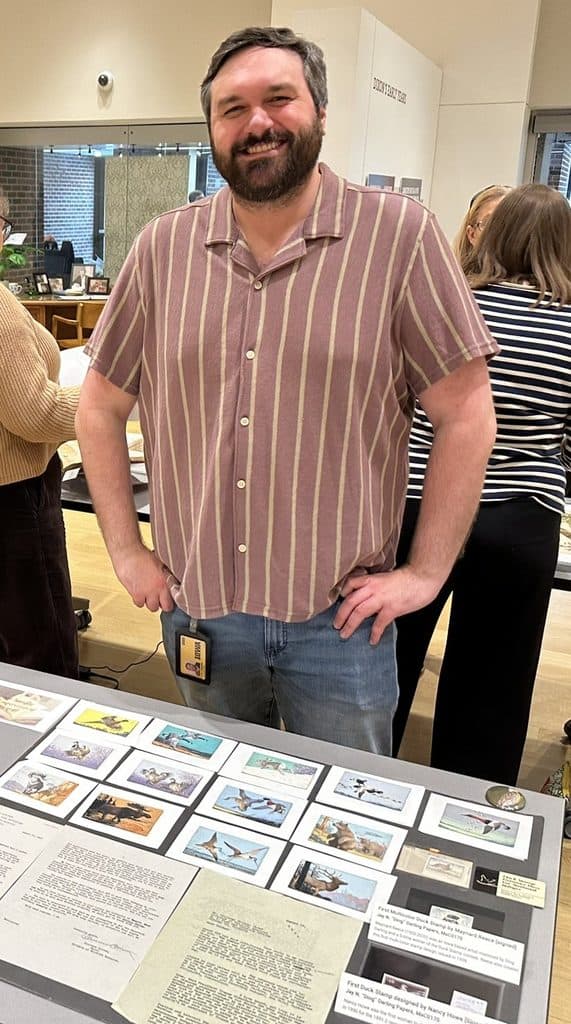
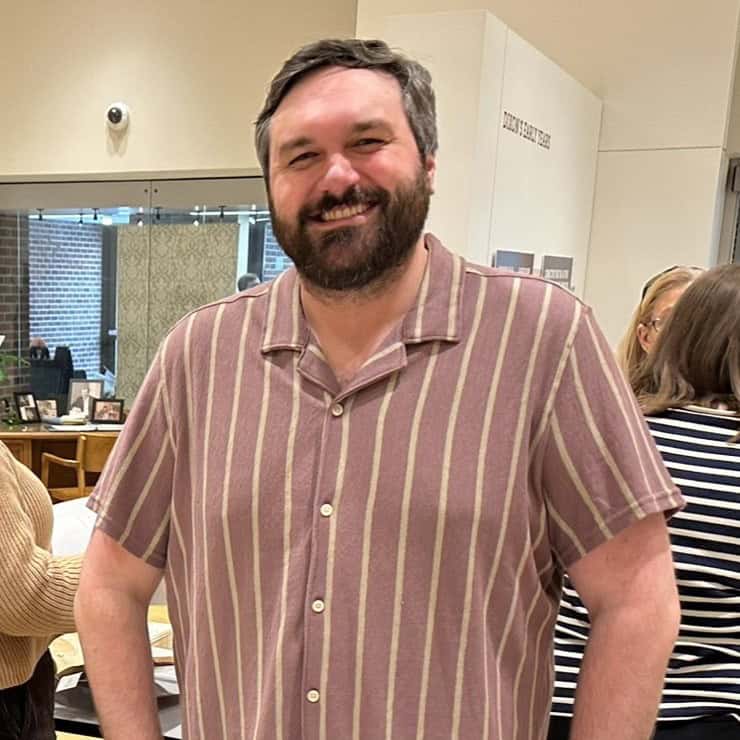
Collin Vandewalle, Sackner Archive project archivist in Special Collections and Archives, co-curated the exhibition with Lindsay Moen, lead public services librarian in the same department. Through his research for the exhibit’s narrative and his time working closely with the Jay N. “Ding” Darling Papers, Vandewalle has gained significant expertise about Darling and his life’s work.
Question: How did you become involved in the exhibition project, and what did you enjoy most about the process?
Answer: I was a graduate student at the University of Iowa’s School of Library and Information Science and worked in Special Collections and Archives as a student lead. I worked specifically with the Darling Papers, so my then-supervisor—and now colleague—Lindsay Moen asked if I wanted to help her curate the Darling exhibit. I eagerly accepted so I could have a chance to apply all the knowledge I had gained about him. My favorite aspect of the process was the chance to tell a story about a side of Darling that not many people know about: his environmental conservation work.
Q: What draws you most to the story of Ding Darling?
A: I was drawn in most by his unwavering and unending zeal to help protect the natural resources of our country. Not many other people can claim they have worked so hard to save native migratory fowl, especially ducks, as Darling did, and I really admire that fervor.
Q: As a curator, researcher, and Iowan, what does this exhibit mean to you personally?
A: I think it is important to tell the stories of prominent Iowans like Ding Darling and highlight the fantastic history this state has had when it comes to environmental conservation causes. It is so important to connect today’s Iowans to our scientific roots and reflect on how we can continue this kind of work in our state. I am proud that I can take all the research I have done and highlight this history through a curated exhibit.
Q: When did you first hear about Ding Darling, and how have you worked with his materials over time?
A: I had my first encounter with Ding Darling’s legacy when I was nine years old on a family trip to Florida. We went to the J.N. “Ding” Darling National Wildlife Refuge, and it was such a fantastic experience that I still remember it vividly 20 years later. I had my second encounter with Darling during my undergraduate experience at Drake University in Des Moines. I worked in the University Archives and Special Collections at the Cowles Library on campus and helped with another Darling exhibit that Drake hosted in 2017. I then worked with his papers for just over three years here at the University of Iowa.
Q: Why is it important to have this exhibit in the Main Library Gallery?
A: I think it is important that the campus community and the broader public gain a better understanding of just how robust the Darling collection is here at the University of Iowa Libraries. It is also amazing that we have the capability to showcase rare materials—like a presidential letter from Franklin Delano Roosevent to Darling, for example—in a safe and professional way through the Main Library Gallery.
Q: What are some of the most surprising things you learned during your research?
A: I was most surprised by just how interconnected Darling was with the politics and culture of his time. It seems like he knew every prominent figure from the turn of the 20th century. He met with Henry Ford, Theodore Roosevelt, Herbert Hoover, Walt Disney, Aldo Leopold, and many more celebrities.
Q: What is your favorite object in the exhibit?
A: My favorite object would be the letter from Franklin Delano Roosevelt (FDR) to Darling where he claimed that Darling had pulled the largest “heist” on the United States Treasury in American history. The letter is an amazing piece of history that highlights the tensions that FDR and Darling had for one another, particularly when it came to funding priorities. One will have to come to the exhibit to learn the context of this surreal letter.
![Letter transcript:
THE WHITE HOUSE
WASHINGTON
July 29, 1935.
Dear Jay:—
As I was saying to the Acting Director of the Budget the other day—”this fellow Darling is the only man in history who got an appropriation through Congress, past the Budget and signed by the President without anybody realizing that the Treasury had been raided.”
You hold an all-time record. In addition to the six million dollars ($6,000,000) you got, the Federal Courts say that the United States Government has a perfect constitutional right to condemn millions of acres for the welfare, health and happiness of ducks, geese, sandpipers, owls and wrens, but has no constitutional right to condemn a few old tenaments [sic] in the slums for the health and happiness of the little boys and girls who will be our citizens of the next generation!
Nevertheless, more power to your arm! Go ahead with the six million dollars ($6,000,000) and talk with me about a month hence in regard to additional lands, if I have any more money left.
As ever yours,
President Roosevelt
Honorable J.N. Darling,
Bureau of Biological Survey,
South Building,
Washington, D.C.](http://blog.lib.uiowa.edu/gallery/files/2026/10/FDR-Letter-July-29_1935-825x1024.png)
Q: What about Darling’s life and work do you hope visitors will take away from their time in the exhibit?
A: I hope they leave the exhibit understanding that even just one person can spark change when it comes to environmental conservation. I hope they can see that Darling set a fantastic precedent on how we, too, can help protect the ducks and other wildlife of Iowa!
Q: The Jay N. “Ding” Darling Papers in Special Collections have recently had some significant updates that make them even more accessible to researchers. What was your role in this project?
A: My main role was making sure the Darling Papers were easier to use and more accessible to the public before the exhibit started. This meant that I rehoused a majority of the collection into newer archival grade boxes that will protect the material far longer into the future. I also spent a great deal of time intellectually reorganizing the finding aid so that researchers will have an easier time finding specific information from this extensive collection.
Q: Is there anything else you would like to share?
A: I want to thank everyone involved in making this exhibit come to life. It was a fantastic experience to co-curate this project at the start of my professional career.
I hope everyone who comes to the exhibit leaves having learned at least one new thing about Darling or wildlife conservation. For those interested in a more in-depth look at Darling, I also worked with recent graduate student Hailee McCormick to create a 150-year timeline that spans Darling’s entire life and the institutions that make up his legacy up to 2026. That will be available online soon.
It’s Been Wonderful Knowing You: Wildlife Conservation and Advocacy Through the Lens of Jay N. “Ding” Darling will be on display through Dec. 18, 2026. The Main Library Gallery is open daily. Learn more about open hours: lib.uiowa.edu/gallery.