The following was compiled by Cecil Campbell, exhibition and engagement student lead for the Main Library Gallery, and features select exhibition text by Sarah Suhadolnik and Katie Buehner.
During his considerable tenure as conductor of the Quad City Symphony Orchestra, James Dixon developed a reputation for programming modern compositions, which occasionally ruffled the feathers of his more traditional-minded audience members. Though he faced some objections, Dixon’s love for the music he conducted ultimately led to a wider appreciation in his audiences for newer or more avant-garde compositions. Amidst the repertory Dixon conducted, the works of Gustav Mahler (1860–1911) figure prominently.
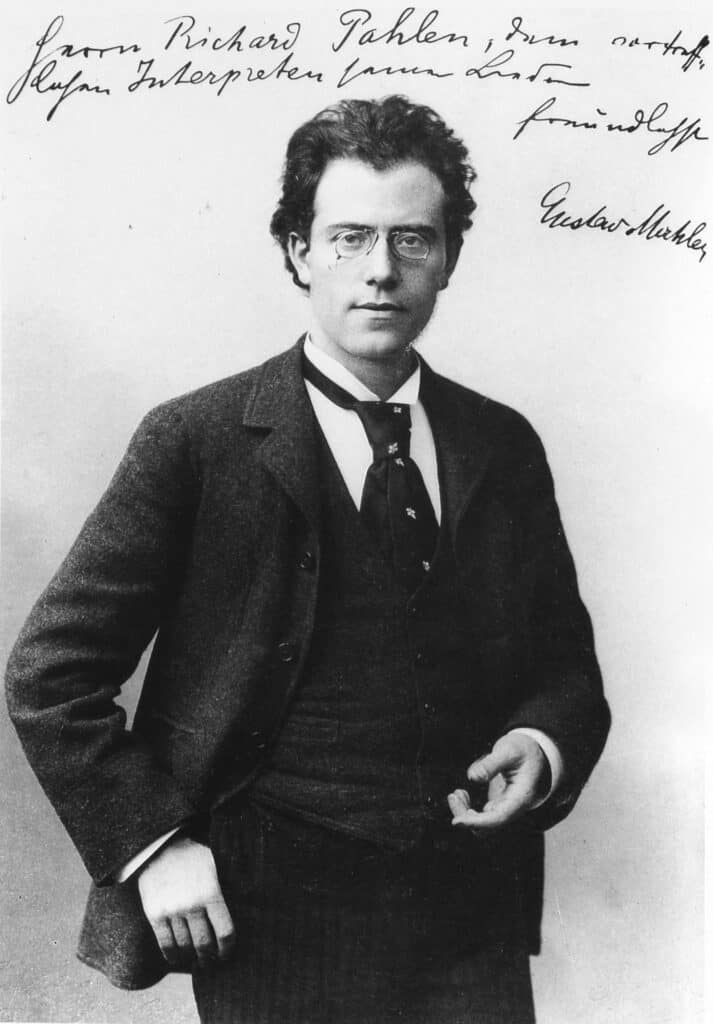
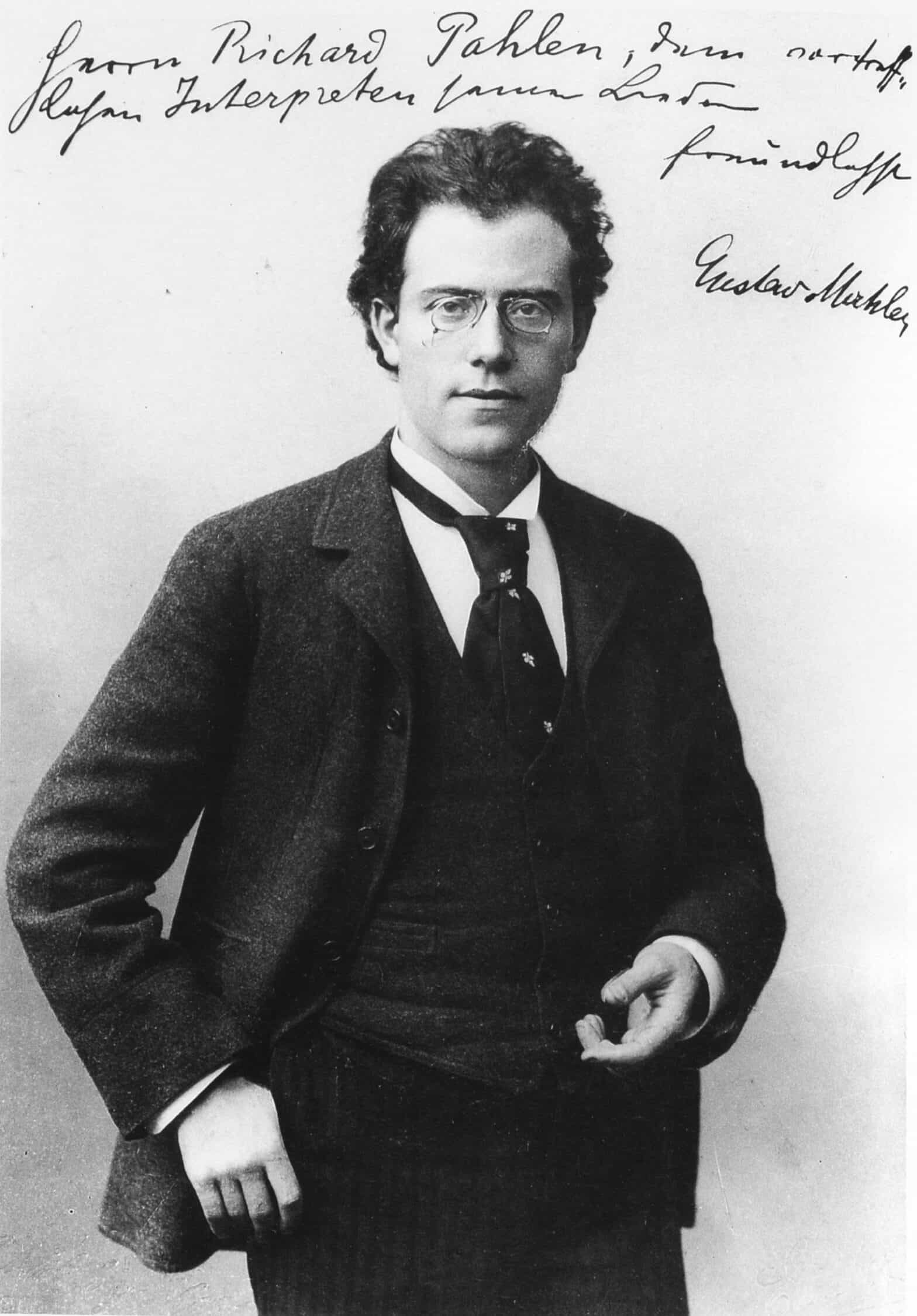
Gustav Mahler was born in Bohemia but spent a great deal of his professional life as a composer and conductor in Vienna. His last few years were spent as the music director of the New York Philharmonic (1909–1911), the longest consistently operating orchestra in the United States. No composer of orchestral music exploited the orchestra’s grandness like Mahler. He composed sprawling symphonic works of such breadth that just one can fill an entire concert program. His nine mammoth symphonies require enormous performing forces (up to 500 musicians for the Eighth Symphony) and often stretch over an hour in length (up to 100 minutes for the Third Symphony), making attempts to keep the composer’s music in the public ear a major event. Fearing such a limited program would result in low ticket sales, the Tri-City (now Quad City) Symphony Orchestra avoided programming a Mahler symphony until 1979, when Dixon conducted Symphony No. 2, “Resurrection,” with Martha Sheil (soprano) and Anne Larson (mezzo-soprano) and choirs from Augustana College joining for the performance. The symphony—nearly an hour and a half long—elicited an awed and intense reaction from the crowd.
In response to James Dixon’s conducting of Mahler’s second symphony, The Sunday Dispatch headline read, “Symphony concert of the decade,” with reviewer Bill McElwain in ecstasy over the “powerfully stunning performance of the Mahler Symphony no. 2.”
Mahler once told another composer, “The symphony must be like the world, it must embrace everything.” His symphonic world included a wide array of musical styles and types, including sound effects evoking natural settings (e.g., birdsong, cowbells, bellowing horns), military marches, folk songs, chorales, funeral dirges, children’s music, and playful musical jokes. To conduct Mahler is to explore, with a complex and wide-ranging sound map, the many places in life where sound and music play a role.
For his last performances with the Quad City Symphony Orchestra—April 9 and 10, 1994, at the Adler Theater in Davenport, Iowa, and Centennial Hall in Rock Island, Illinois—James Dixon selected Symphony No. 5 by Gustav Mahler.
A composer with an incredible legacy and impact, the influence that Mahler had on Dixon comes as no surprise. The choice to perform one of Mahler’s symphonies for his last performance speaks to an open mind and considerable talent.
Learn more about James Dixon and his accomplishments both locally and abroad in the spring 2026 Main Library Gallery exhibit Orchestrating Community: The Public Service of Iowa Conductor James Dixon.