
My digital certificate journey is coming to an end. As I continue to work on my dissertation, I will continue to think about the skills I have learned working with the digital studio team. When I started my project, my goals were: 1. learn to scrape data from posts and comment sections from two main websites: an interactive video-sharing website, Bilibli (https://www.bilibili.com/), and a social media site, Weibo (https://weibo.com/); 2. Organize and clean data to produce manageable spreadsheets for further theme coding; 3. Contribute to a bigger dataset for my dissertation; 4. Feminist preservation and archiving of heavily censored queer feminist content in China. I am currently perfecting the codes and troubleshooting any potential issues. My next step is to organize the data I have collected by making a local web application for easy access on my computer.
I have been thinking about how I should present the results of my digital archive once it is finished. My focus lies on digital publishing accessibility as well as open-access publishing. I have been thinking about how journals function with so many people’s free labour yet are highly inaccessible to the general public. Many journals in my field, media studies and communication, are behind the paywall. People can either access through their universities or pay a hefty fee. The scholars who publish in these journals aren’t paid, and peer reviewers aren’t paid either. These people do the major part of knowledge production, and if they don’t get paid, who gets paid to justify the paywall? Some open-access journals are run by graduate students and are more public-facing, somehow they are considered less rigid research than these punished behind the paywall. I am thinking about the future audience of academic research and the pro and cons of digital publishing. I have already witnessed a movement of Chinese feminist activists self-publish on Internet platforms. They offer incredible knowledge production and community building on feminist activism from their lived experiences and on-the-ground activist work. I think academia has appropriated and even been predatory toward feminist activists’ work and theories. The usual process in academia is scholars interviews activists and studies their activist work. They translate activists on the groundwork into journal publications and books and become the spokesperson and authority of activist work. Academia has this history of appropriating and capitalizing on feminists and activists of colour’s anti-racist work because this is what the system encourages and pushes scholars to do to climb the ivory tower’s ladder. What I am witnessing about this more public-facing digital activist publishing challenges an imbalanced power dynamic between scholars and activists. I think this movement also challenges what scholar-activist entails and the responsibilities of being a scholar-activist, other than an easy label to throw around as a scholar. I am interested to read more about publishing ethics. Moreover, as a teacher, I have been thinking about what types of reading are the best for my students to learn. With the increasing popularity of Internet critical video essays and public opinion pieces that are not only insightful and high quality but entertaining and accessible to the general public, I am questioning the use of academic journals behind the paywall.
Embracing flexibility in my capstone Project
Working on my digital capstone project has been a lesson not only in creating digital exhibits, but in flexibility. During the summer of 2022 I thought that I had developed the perfect plan for a digital capstone. I wanted to do a theatre archiving project using the works of Iowa-born playwright Susan Glaspell. My initial plan was to direct a production using one of her full-length scripts or a series of her one-act plays. I planned to visit UI Special Collections to view their Susan Glaspell papers. My hope was that this research would lead me to primary source documents that I could connect to the production and use to create a digital exhibit about Glaspell’s life and work, featuring a recording of my production and an annotated script.
As you may be able to guess, that project did not happen. During a visit to Special Collections over the summer I realized that the items they had in the Susan Glaspell papers did not fit my needs. I scrapped my idea for this theatre archiving project and spent the Fall 2022 semester trying to think of a new direction for my capstone. During this semester I took Dr. Jennifer Sterling’s Archiving Women’s History course. This class culminated in creating an Omeka exhibit using items from the Iowa Women’s Archives. The scope of my exhibit made it difficult to finish in one semester, so I thought that I could use it as the basis for my capstone project. My class project focused on materials from Catholic women activists within the IWA. I made a new plan to finish this exhibit and use it as a launching point to study other areas of Catholic activism. Unfortunately, I was never able to solidify a plan for how to make that connection. I floundered trying to figure out an angle for this project and left it to languish for a few weeks before turning to Digital Humanities Research and Instruction Librarian Nikki White for help redirecting my project.
At the beginning of the semester, my capstone cohort was told that we might end up changing our entire focus, and that was okay as long as we were exploring how to do digital humanities work. Knowing this gave me the freedom to be able to let go of my second project idea and go back to a focus on theatre archiving. While I scrapped my original plan of using primary sources from the Susan Glaspell papers, I had directed a production in March that involved doing dramaturgical work to understand the historical context of three one-act plays from the early 20th century. With Nikki’s support, I have been working on taking my research and turning it into an Omeka exhibit and LibGuide. This work has given me the opportunity to consider how digital humanities tools can be used to create educational resources that can be used beyond academic institutions. As I work to complete my capstone project, I am focusing on creating something that could be used by educators and theatre practitioners to explore women’s experience as playwrights in early 20th century America. I hope that this project will help inspire others to read and perform scripts that are often overlooked.
Words of Art: Archiving North Liberty Library Artists
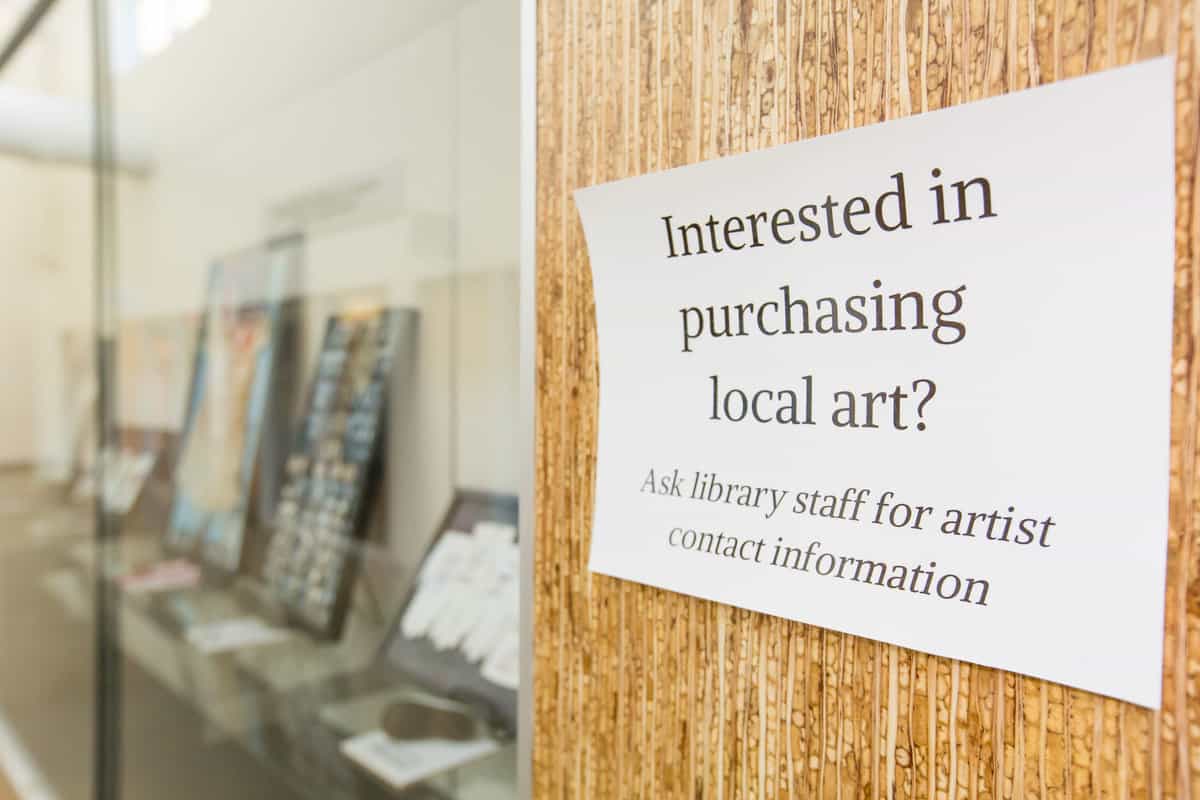
Adding my graduate studies to my already packed schedule was not a decision I came to lightly. In addition to my studies at the University’s School of Library Information and Sciences (SLIS), I’m also employed full-time as a Public Services Librarian. These past two years, fast as they seem in retrospect, was a journey into stepping out of my comfort zone and combining two of my favorite pastimes: creativity and libraries. The project I chose to document for my capstone work is a reflection of this amalgamation: archiving the artists’ works that highlight the walls of my workplace, the North Liberty Library (NLL).
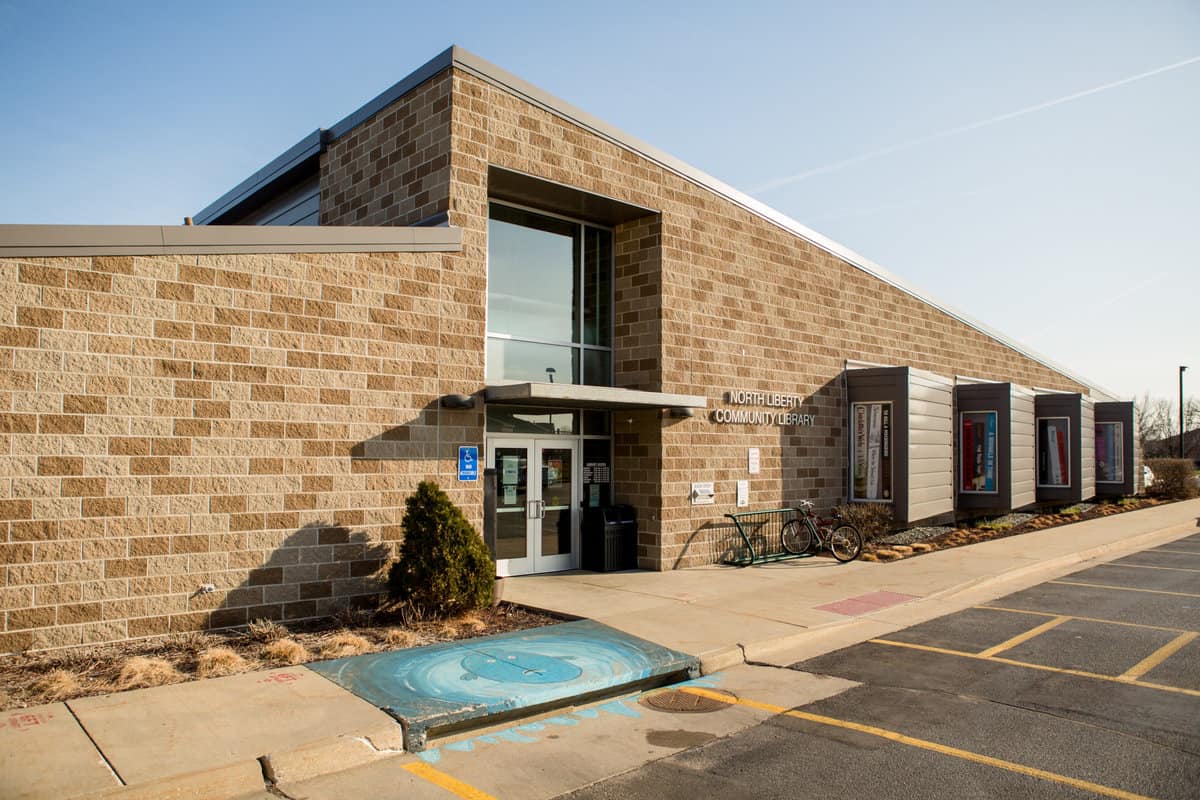
NLL is a rural public library that resides in the heart of North Liberty, Iowa (a 15-minute drive from the University of Iowa campus). Among its many eclectic features for its patrons – including a guinea pig, meeting rooms, and a collection of cake pans for borrowing) – is the art gallery along the library’s corridor wall. This wide space has been home to many local artists over the past decade, giving our community’s creatives a place to showcase their talent and gain new fans. It has been a welcome site for our patrons, some of whom visit us daily. However, we often hear from our featured artists that they wish there was a way for the exhibits to be accessible to those outside of our community. The need for a digital version of art wall sounded like the perfect focus for my capstone project.
I began the planning for this project in January 2023 by connecting with my capstone advisors, Nikki White and Mark Anderson (both with UI Studio). We discussed what a ‘wish list’ for the perfect platform for the exhibit would be and eventually decided upon Omeka. Throughout my SLIS studies, I’ve worked with Omeka so I was very familiar with the flow of the platform. I was also in luck that UI Studio offered their Omeka sandbox site for my use during the semester. This led to a broader discussion with NLL’s IT Director, Chris Nelson. I included him in my second meeting with my capstone advisors a month later, which is when we decided that we would use the sandbox through the semester with plans to upload it to NLL’s server after graduation.

With logistics in place, I went on the hunt for photos of past artists who predated my time at the library. I also helped two new artists to the gallery (Kimberlee Rocca and Gabrielle Williams) with the installation of their works. In addition to our featured artists, I planned to include the everyday artwork we have adorning our library into the archive. My goal with this project is to make this an all0inclusive look at how much art is revered and appreciated with the public library space. I look forward to updating the blog with its results by mid-May.
Mapping Connections in the Zambezi Basin, Southern Africa
I am a History Ph.D. student writing a dissertation that analyzes a migrant community in the Mazoe district of Zimbabwe in Africa. The Capstone project I am working on is a flow map that will become a part of my dissertation. Integral to the dissertation thesis I am developing are discussions of relationships between the communities where the migrants come from and the people of the Mazoe district, which stems from pre-colonial interactions. The migrants I discuss come from districts in Malawi and Mozambique closer to the three countries’ borders. I am mapping the districts migrants come from to show the proximity of the place of origin and destination. Showing the apparentness of the proximity of the districts helps drive the points I am building in my chapters. My discussion hinges upon analyzing connections within the Zambezi River escarpment. The districts and communities I discuss are all part of the Middle Zambezi basin; they are from opposite riverbanks. So, my map shows the Middle Zambezi basin as it cuts across different countries; the Zambezi River acts as an area where borders of the different territories are formed. So, while the migrants can be considered as coming from Malawi and Mozambique, they all come from an area of confluence and have close linguistic, cultural, and economic relations. This information helps to analyze their adjustment and development of migrant culture over time in Mazoe and their interaction with the Mazoe residents.
I made plodding progress in the beginning months of the project timeline because I was working on completing a dissertation chapter and teaching a git course for the first time. However, the flexibility of my adviser Prof Jay Bowen and the Studio capstone experience relieved much pressure. It allowed me to make some meaningful progress bit by bit. I have worked with my adviser to divide the tasks of my project into steps. I had to decide and narrow down on specific districts, look for the best shapefile versions of specific districts, and then look for the best shapefile versions to use. The most significant task for my project is locating shapefiles for the four districts I am working on. The districts I depict on the map are Mazoe in Zimbabwe, Nsanje in Malawi, and Mwanza and Zumbo in Mozambique. The districts are remote, which makes it quite a task to find existing shapefiles. As mentioned, all these districts fall into the middle Zambezi basin and experience similar climate conditions. The next step I worked on was getting acquainted with the Qgis tools and importing my shapefiles on Qgis to develop the flow map.
Tales From Oil Country
As a historian, I sometimes struggle to portray different historical eras as they were experienced by the people who lived in them. Historical analyses reflect the historians’ modern biases, and there has been a conscious effort by the field to provide agency to the sources we study.
This project is part of an effort to allow historical actors to describe their world in their own words. For the Digital Humanities Capstone course, I am developing an audio-drama podcast about life in the Pennsylvania oil boom towns of the mid-to-late 19th century. Colonel Edwin Drake first struck oil in Titusville, Pennsylvania in August of 1850. By the following summer, prospectors were flooding into northwestern Pennsylvania. Reminiscent of the California gold rush, oil boom towns developed all over the region, catering to the needs of the mostly young men who came to the region. Despite being only a few hours from several major cities, these boom towns adopted a frontier mindset. Those who settled the region were resistant to legal codes, democratic elections, and other forms of government intervention.
This podcast seeks to analyze how the people in these oil boom towns viewed the world around them. Many histories of the Pennsylvania oil boom explore the technical aspects of the oil industry but fail to contextualize the lives of their citizens within the mid-to-late 19th century. I have compiled a collection of stories, urban legends, and folktales from the Pennsylvania oil boom. They will be told on the podcast as they would have been told by oilmen and women in the 1800s. I will do my best to contextualize the stories being told, but I want to avoid examining them with a critical historian’s gaze. Other historians have evaluated the truthfulness of some of these tales, but one of the major themes of this podcast is an appreciation for the fact that these stories were (at least partially) true for the people who told them. These stories developed over several decades and help to explain how the people in these towns came to understand the society and natural world around them.
In presenting these tales, I want to bring in multiple storytellers who can add some color to the audio presentation. In addition, I hope to add sound effects and other audio loops to bring the stories to life. My hope is that the studio can provide a podcasting space and the hardware to bring this podcast to life. Senior Developer Matthew Butler is also giving me a crash-course on audio editing, and Digital Humanities Librarian Nikki White has already provided some feedback and advice on the project.
Mining for Medieval Messengers
My dissertation, “Messengers and Messages in Middle English Literature,” examines the under-explored role of messengers in fourteenth-century English romances, where they often prove to be crucial elements of the plot or interesting stand-ins for an authorial function. During my capstone experience, I will be pursuing corpus linguistic investigations, with the help of the Digital Studio’s Nikki White and Matthew Butler, into key words for messengers and messages and their collocations. This is a particularly challenging undertaking given the lack of any spelling standard in Middle English, which makes the number of possible search terms for any key word positively daunting. My capstone project will work towards solving this problem and eventually result in a chapter of the dissertation displaying the value of a Digital Humanities approach to Middle English literature, complete with data visualizations and discussion of process.
The first step in the process was to build a corpus of medieval texts on which I could conduct textual analysis. Due to my dissertation’s focus on medieval English romances, I decided to limit the scope of the corpus to strictly medieval texts written in Middle English, while avoiding those written in Latin, Anglo-Norman, Old-French, and other languages of continental Europe. This decision had the added benefit of narrowing my prospective corpus down into a much more manageable number of texts.
The next challenge was to acquire the text files that would make up my corpus. Based upon my preliminary research, it seemed that the easiest way to build my corpus would be to build a collection of texts on Hathitrust. While most of the texts I needed were likely available on Hathitrust, curating a corpus one individual text at a time proved to be more time-consuming and less intuitive than I had originally imagined. Eventually, I realized that it was likely that someone else had likely already done this work and may even be willing to share—fortunately, I was right.
As luck would have it, the files I needed had already been assembled by one of the most well-known and longest-running digital humanities projects in medieval studies: The Middle English Dictionary project, hosted at the University of Michigan. Nikki White reached out to the project manager, Paul Schaffner, who provided a link to the entire corpus of Middle English Texts. This proved to be a huge breakthrough for the project. Currently I am sorting and ‘cleaning’ the data in preparation for textual analysis. This has involved sorting the files and making sure that there are not duplicate texts in the corpus—for instance, the files included several different versions of Geoffrey Chaucer’s The Canterbury Tales, which could have skewed the data resulting from textual analysis. In order to streamline the process of sorting and cleaning, Matthew Butler helped me to write a script which pulls the metadata from the files and exports it into a CSV file which can be read in Microsoft Excel. Currently, I am about to begin the process of performing textual analysis on the corpus—more on that next time!
Public Digital Humanities Capstone Post #1
I am in my last semester of coursework and currently working on my prospectus, which allows me more time to think about how my dissertation will take shape. In this project, I am developing codes to scrap data on two Chinese websites, Weibo (a social media platform) and Bilibili (a video-sharing platform). I have been using the application Scrappy to create codes for scraping the pages I need. I have been working on developing codes since last summer when I had the Digital Studio’s Summer Fellowship. Right now, I am able to scrap the basic info (usernames, dates, the numbers of reposts, likes, comments, etc.) on Weibo through any time frame, when I set in the configuration based on the key search terms (such as certain hashtags). I am able to save them to an excel sheet. The next step is creating a database to store the information for easier access. Since Bilibili serves a different function than Weibo, the web scraping data are presented a lot differently than Weibo, so I am working on parsing the data to sort out the correct information. When I collect data on Weibo, I use the keyword search on the platform first to screen out the data I aim to get, but for Bilibili, I search the video first, and collect the data in relation to this specific video, such as the comments and other basic information (the date of publication, how many likes, etc.). I am currently working on developing the scraping codes for Bilibili, and there has been a lot of trial and error and testing. Still, I believe I can get there by the end of the semester based on my experience with developing codes for Weibo. Once I intergrade the database with Weibo, I want to integrate it with the Bilibili script. If everything goes smoothly, I plan to make a local web application with all the data I have collected to access all the info using a web app hosted locally on my computer.
My dissertation and research center on feminist Internet culture and digital activism in China. By working on this project, I hope to build a digital archival of feminist actions on different digital platforms that I can use for my analysis in my dissertation. In addition, feminist content online has been increasingly censored and heavily monitored by the Chinese government. By preserving data on digital feminist activism and actions, I aim to contribute to Chinese feminist activists’ efforts to archive fleeting and scattered but historically significant cultural moments.
The Studio is Collaborating on a Number of Project Grants
Over the next few years the Studio will offer its assistance and expertise from staff on the following digital projects. We look forward to working with these scholars on making their research more digital and accessible!
“Principia Mathematica: A Critical Edition”
Landon D.C. Elkind
National Endowment for the Humanities Scholarly Editions Grant
Awarded $281,104 ($142,179 University of Iowa, $42,120 Digital Scholarship & Publishing Studio)
2023-2025
“Understanding the Evolution of Political Campaign Advertisements over the Last Century”
This project is a collaboration between the University of Iowa, Purdue University, University of Oklahoma, and Harvard University.
Bryce Dietrich
National Science Foundation
Awarded $530,000 ($82,000 University of Iowa, $15,000 Digital Scholarship & Publishing Studio)
2023-2025
“The Flint Water Disaster Public Archive”
Louise Seamster
Humanities Without Walls Grand Research Challenge
Awarded $149,707
2023-2025
“Salud, to your Health! Resources for Teaching Health Narratives in English and Spanish”
Kristine Munoz, Daena Goldsmith
National Endowment for the Humanities, Humanities Initiative Grant
Awarded $149,000
2022-2025
“From Data Access to Data Justice: the Flint Water Disaster Public Document Archive”
Louise Seamster
University of Iowa, Office of the Vice President for Research Arts & Humanities Initiative Award
Awarded $30,000
2023
“Dividing the City: Race Restrictions and the Architecture of Segregation”
Colin Gordon, Ashley Howard
The Mellon Foundation
Awarded $400,000
2022-2025
Developing a Community Engaged, Digital Scholarship Practice
At the beginning of the capstone, I wrestled with several queries. I felt lost and unsure about moving ahead with my project, Hobo Archive. I struggled with realigning the project’s relationship with its audiences. I used the majority of my capstone experience to communicate with my co-creators on rewriting and refining our project objectives. Even though we did not directly work on the site, the time allowed us to critically assess what must be done to sustain the project long-term. I ended up drafting many project narratives that both the Studio and my co-creators reviewed. I found this exercise useful for reflecting on what it means to place community at the center of digital scholarship. My co-creators and I shared our concerns with one another and proceeded with a renewed commitment toward the project. In the end, we’re in a better place because of these challenges.
I also began thinking long-term about the project. I ended the semester considering how the project continues to serve its intended community. I relied too much on the project’s digital methodologies and not enough on the historical arguments and interpretation that the community desired. This was largely due to miscommunication between me and my co-creators. I focused too much on the crowdsourced data collection component then on the project’s primary research investigations. My co-creators want Hobo Archive to be “the resource for the researcher and for the inquisitive mind to find everything written about hobo”. They argue that historical argument and interpretation is equally if not more important than the project’s digital methodologies. So, we defined the temporal boundaries of the project and we clarified the differences between the historical and contemporary definitions of the hoboing community. We also outlined what research questions and historical themes are worth pursuing and how the project’s digital components will facilitate this research.
Needless to say, I began the semester feeling very uneasy. However, the capstone experience allowed me the time and autonomy to work out my own issues with what it means to create community engaged digital scholarship. Here is the reality. Community partnerships can be messy and complex. Digital scholarship is inherently collaborative and rarely unfinished. When combined, community engaged digital scholarship is about shared ownership and meaningful human partnerships in more intimate and personalized systems of production. I believe this was the core of my capstone experience. Many thanks to the Digital Studio for supporting me throughout the turbulence this past year!
Pause, Reflect, and Reset: How Can We Best Support Digital Scholarship?
During the National Hobo Convention last month in Britt, IA, I spent three long days spreading the word about the digital archival project that leaders of the hoboing and I have worked on for nearly a year now. This project is called Hobo Archive. Many folks were not familiar with the work we are currently doing, and many had no idea what constituted a digital archive. I paced up and down the hobo jungle in Britt as I spoke with people individually, handed out promotional materials, and gathered a sense of the many different preservation projects that a few hoboes created over the years. An overwhelming majority of the community expressed their enthusiasm and support for the long-term digital preservation of hobo history and culture. We talked about the cultural items they were interested in preserving, the stories they wanted to share, and the potential for utilizing digital technologies to support community participation amongst the hoboes in the writing of their own histories. Clearly, the hoboes are excited about Hobo Archive, which informs me that the archive has the potential to live well past my dissertation. My time at the convention informed my capstone experience this semester, which is largely focused on envisioning what this project might look long-term. I have been thinking a lot about what it means to create self-sustaining, community-driven digital scholarship and it is becoming increasingly clear to me we need to increase our digital scholarship and research capacity to seed and sustain digital projects on a broader scale.
First, there needs to be more support for the creation of graduate-level digital scholarship. We are blessed at the University of Iowa with the Digital Scholarship & Publishing Studio, our incredibly research library, and faulty support for digital scholarship across campus. However, not every university is as fortunate. Furthermore, students need more robust evaluative models of digital work that encourage the pursuit of digital research rather than discourage it. Second, grant-writing should be prioritized more in the humanities. Whether or not graduate students pursue digital research projects, the secrets of success to grant writing are not shared widely enough. Third, we need to have a more open and honest conversation about what scholars need as they pursue their digital research. The answer: more available funding and more institutional/departmental support. Currently, I am grappling with these queries as I sit at a critical juncture with my digital project. I am constantly worried that the absence of funding and resources will either make or break this important work because it is not just for our scholarly pursuits. It is also for the communities we work with as well. I look forward to navigating these challenging aspects of digital scholarship throughout my capstone experience this semester.