For nearly 80 years the site of Susa, Iran was a site rich in archaeological finds. Excavated by the French, the site revealed a plethora of material remains that deeply impacted the art historical canon of the Near East. My project involves looking through the catalogues and isolating the finds that were imported to the site between 5000-323 BCE in an attempt to trace the interactions that brought the material to the site. The goal is to create an Omeka catalogue which will place the imported finds in context with each other for the first time to determine any potential links between objects. Many of these objects were important to kingship ideologies at the site, and by looking at these objects in particular I am hoping to uncover patterns about object acquisition and display at the site through several different empires.
I began the project before the summer fellowship, and the goal of the fellowship was to give me time to finish data entry for the nearly 800 objects that I’ve found to have been imported. My first task was an assessment of what needed to be worked on since it had been some time since I had an opportunity to work on it. I found that my first major task was to add accession number tags to the objects already in the database in order to ease searching for the objects. These accession numbers come from the museums in which they currently reside, and are individual to each object. I had to make them tags because while I had already entered the numbers in a separate field in Dublin Core, they were not searchable which was hindering my progress to complete the entries.
The second thing I did was go through the nearly 31,000 objects in the louvre catalogue in order to make a master list of the finds. This took several days since there were so many objects that I needed to ensure would make the catalogue. Now that the material has been compiled I am able to go through object by object and ensure the objects in my catalogue match with the master list. This makes it easier to add objects that may have inadvertently been left out previously, as well as allow for a secondary check on the data I’ve already entered.
Going forward, I will be going individually through the catalogue and adding data and updating or creating entries as I go. I anticipate this part of the project to take several weeks as there is a great deal of data to be entered in the catalogue and individual entries. Ideally, if I finish the project, I will begin creating maps that correspond to the finds which I hope will eventually combine into an interactive map that will reveal where these objects were originally at the site as well as the object’s accompanying information.
Searching for Sites of Renowned Intermedia Artist in Iowa City
The journey seeking sites and connections to renowned artist Ana Mendieta has been slow but rewarding. As the heat and humidity of summer persist, tainted with a haze of smoke from the millions of acres burning in Canada, I look for Ana’s voice in the present– how the artist would have responded to the earth burning and seeming to cave in on itself, the place that provides the substrate for Ana’s material usage.
Mendieta’s work in Iowa began with exploring self and body– suddenly transforming into questioning this through means of the body of the earth; her Silueta’s began at Old Mans Creek, not far from her home in Iowa City. Integrating vibrant magenta velvet and flowers from off-site, the touch of color and material shaping her body conglomerates a sense of building oneself in the landscape. My quest to return to these sites, so many years later, not only proved difficult because of the shifted landscape but also because of the ownership of the landscape and the absence of how these sites were altered at the seam by Mendieta’s touch.
To follow this quest, I am currently attempting to locate the sites of Mendieta’s performances and video pieces. Some of this work began in downtown Iowa City, then spread to the outskirts of town where her Silueta’s were formed. Her Moffitt Building Piece holds a completely different cityscape than what can be seen of the piece currently on view at the Stanley Museum of Art. This has transformed from an old building that used to be named Moffitt Building, now where the current Iowa City Public Library lives on Linn Street. Another was filmed at Iowa City’s Oakland Cemetery’s famed Black Angel, where Mendieta formed her Silueta on the concrete slab that lay in front of the angel. Landmarks such as these prove distinct in locating. However, as I move deeper into her Silueta’s further enveloped in nature, it is increasingly difficult to find exactly where the work was created.
As I locate more sites, I hope to create an interactive map detailing the site and take special note of the landscape and flora that actively participated in Mendieta’s work. I hope to link this to her pieces so one may take a tour of her work, viewing my documentation of the sites today and her work there. The contrast of the site then, to its altered and present state, speaks to the ephemerality of the artist’s work, how the pieces shifted and changed as a body does, over time and moving through life.
Cointelshow 2.0
With support from the Digital Studio and Publishing Studio, I am continuing work to adapt and remix a play that presents historical research in a provocative and entertaining way. The original play, Cointelshow: A Patriot Act, by L. M. Bogad, explores the workings of counterintelligence programs (COINTELPROs) that the FBI used to “discredit, disrupt,” and otherwise “neutralize” activists of the Civil Rights Movement. My adaptation includes a focus on not just overt repression of social justice movements by the state, but how this repression has adapted over time, and is carried out with cooperation from corporate partners. The remix, Cointelshow 2.0, also includes numerous examples of how this repression has played out in Iowa. My work adapting this play began as Republican-backed legislation, continuing the long tradition of authoritarian repression and appealing to white supremacy, forced me out of a career in education.
Teaching social studies makes obvious how much our individual and national identities are based on our understanding of history. My experiences in the classroom around this help to inform Cointelshow 2.0. During the first week of middle school social studies, I would often give students prompts in order to gauge their understanding of history and society. One particular response was unforgettable, a comic drawn to answer the question “What is America?” The student’s first panel showed a white hand holding a whip, beating a Black man in chains. The second showed a Black man speaking to a crowd, labeled “MLK.” The final panel showed a handshake between two hands – one white, one Black.
The student’s understanding is not uncommon, and while not factually incorrect, the silences it includes are devastating. It is convenient to see our world today as continually rising above injustices of past. Yet, to see history only as an inevitable march toward fairness limits our understanding. More than that, it can, as James Baldwin noted, trap us. If our histories are only those of progress, possibilities for understanding ourselves and how we might move in the world are foreclosed. When our understanding of the past and society disregards the role of structures, systems, or power, it limits us. Such whitewashed histories can limit our imaginations and restrict our action to that which reinforces our current power structure.
Our current power structure is deadly. We find ourselves in a “very dangerous time” where many find it easier to “live in an invented delusional world” than to challenge whitewashed histories and the identities resting on them. In the 2022 collected volume of Bogad’s works, Performing Truth: Works of Radical Memory for Times of Social Amnesia, Bogad invents a name for our landscape, “fasctasia.” Fasctasia is defined not just as classic fascism, but as the “post-truth, racist, xenophobic, and doublethinking media and cultural environment in which nativist, authoritarian movements are nurtured, sustained, and mobilized.” Cointelshow 2.0 attempts to challenge the forces behind fasctasia. This summer I plan to make progress toward the play’s eventual production, editing archival documents, workshopping drafts, and finding potential partners. In an early scene, the audience is addressed,
“Listen, for those of us associated with the University, if you see something, say something.
No thoughtful person can question that the American system is under broad attack. The most disquieting voices joining the chorus of criticism come from perfectly respectable elements of our society: from the college campus, the pulpit, the media…
We’re well aware of what’s going on in departments like African American Studies and Sociology. I think we’d all like to see a little more Papa John and a little less Paulo Freire.”
Here, Special Agent Christian White paraphrases the 1971 Powell Memo, accurately called a blueprint for the corporate takeover of the United States. The agent addresses potential FBI recruits in Cointelshow 2.0. Borrowing heavily from archival sources, this remix examines lesser known, but timely histories of repression. It bounces through time, from the Red Scare, to the late 1960s, to the present, illustrating how the legacies and evolution of repression, white supremacy, and unbridled capitalism misshape so much of our society today.
A pitch black satire and parody, the remix makes clear that the classic Civil Rights Movement did not overturn the Jim Crow order entirely, but rather provoked it to adapt. The promise of the Civil Rights Movement remains unmet, due to investments in policing, uncritical media, white vigilantism, and federal funding shifts. As this adaptation argues, we still live in the white backlash to the 1960’s Civil Rights Movement.
The remix is intended as a primer – both in the sense of introducing historic and present repression, but also as a detonating device which might cause explosive action. It will leave audiences with more questions than answers:
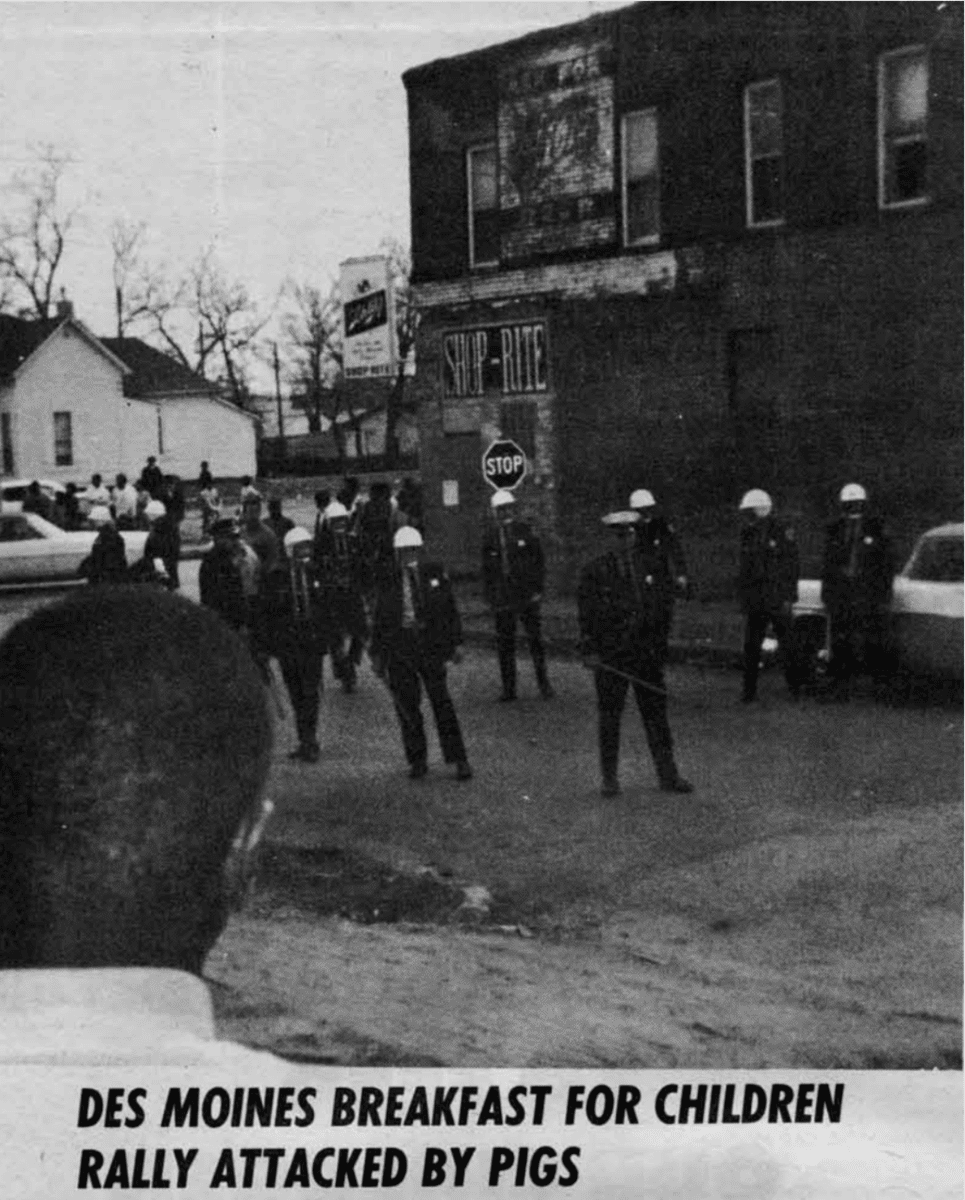
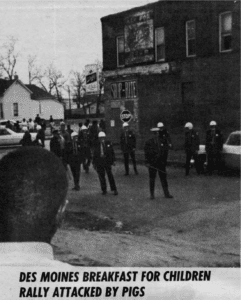
Why did Iowa’s largest police department continually harass the Des Moines Black Panthers even as they led education initiatives like a free breakfast program which served 75-300 children daily?
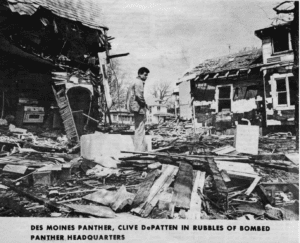
When the Black Panther’s Des Moines headquarters was bombed in 1969, damaging nearly 50 surrounding houses, why did police immediately arrest and pepper spray the victims of the bombing?
How and why did a Des Moines police officer turned FBI provocateur assist in bringing down the American Indian Movement in the 1970s?
In the early 2000s, why were local police and government officials happy to collaborate with TigerSwan, a private security firm with a long history of human rights abuses?
How can we explain the prominent influence of groups like ALEC and the Heritage Foundation today as they effectively undermine our democracy?
Why do we find ourselves in the midst of another Red Scare, with conservative politicians happy to be led by extremists?
Putting the buffoonery and vileness of our carceral and national security state on full display, this adaptation explores concepts already criminalized by the state of Iowa. Be sure to catch these histories before they’re entirely censored by the modern neofascist order.
Photos: Black Panther Magazine, May 19, 1969 [house]; Black Panther Magazine, April 27, 1969 [“pigs”]
Mennonite Colonies in Latin America
As a PhD student in the History Department researching the Low German Mennonite network in Latin America, I am found it pertinent to create an interactive map of the Mennonite colonies throughout Latin America. Working with Jay Bowen, we have begun to create a virtual map with the datasets developed by Dr. le Polain de Waroux on the expansion of Mennonite colonies in Latin America. Dr. le Polain de Waroux, a geographer based out of McGill University, has created massive datasets open sourced for anyone to use on the following websites.
I have already discussed this possibility with Dr. le Polain de Waroux, and he was completely open to the idea. He has even told me that once he returns from vacation by the end of June, he will send me unpublished updates to his datasets that I can include in the virtual map. I think this is something that is very doable that would be incredibly useful for Mennonite historians, sociologists and geographers in addition to Digital Humanities scholars in general.
At first, we input the data into a QGIS mapping software to check if the datasets would function properly. After everything worked well. We input the data into Visual Studio Code. The initial map is now hosted on my Github page. On Visual Studio Code, we are still tweaking the map to include several map leaflets (geographic, openstreetview, political, etc.), adding a time slider, and adding a popup menu of colony demographics. Furthermore, I hope to include links on the popup menus to entries from the Global Anabaptist Mennonite Encyclopedia Online, gameo.org. to each colony to provide an easy source to access to understand each individual colony—for example Fernheim Colony:
The main problem that I have run into this aspect is that about 180 of the 230 colonies have no entries in the encyclopedia. To remedy this lacuna, I emailed the editor of the online encyclopedia, Alf Redekopp, to see if I could send him brief stub articles for each new colony to produce the urls for each colony. I could then include these urls as a hyperlink within the popup menu. To this end, I have created 180 stub articles for the encyclopedia. I am currently waiting for the editor to review these stub articles and publish them in order for me to include their urls in the dataset for each colony. Summer is a busy time for gameo as scholars tend to make updates to it during their summer break.
In the meantime, I still have work to do tweaking the interactive map, but the project is overall making good progress. If all goes well, this project will be completed by the end of the summer and could be hypothetical used in the fall semester for any class concerning migration in Latin America in addition to aiding me in developing my dissertation concerning the Mennonite colonies in Latin America.
Flowers in Concrete
Mary Ellen Solt (1920–2007) was an avant-garde poet from Gilmore City, Iowa. She worked in the concrete style: many of her poems are shaped as flowers or plants. For Solt, though, the flower was not just a thing of beauty: writing amid the cultural upheaval of the sixties and seventies, she found in the flower a complex symbol of political and social struggle, a metaphor for change, and an emblem of hope.
Unfortunately Solt’s poems have largely been forgotten, and today there are no editions of her work in print. The reasons for this are complex. Her legacy has no doubt been shaped by literary historical processes that are systemically misogynistic. But presenting Solt’s work is also a serious creative and technical challenge: many of her poems exist in multiple versions, some hand-drawn by the poet herself and others typeset by a collaborator. An anthology of her poems therefore runs the risk of becoming a hodgepodge, an assortment of scans and photographs rather than a coherent body of work.
This summer I will be working to re-typeset a selection of Solt’s poems, which will be realised as a letterpressed portfolio of prints later in the year. These new versions will not be definitive, however. Rather, they will represent one possible vision of Solt’s work. In her letters and essays, Solt makes it clear that she sees the typographer as a creative collaborator who “performs” her poems, much as a pianist performs the work of a composer. My performances of Solt, played on a keyboard rather than a piano, will bring the poems back together under one roof, but also open the door for others to perform them differently in the future.
I will also be researching Solt’s life and work in two local archives—the University of Iowa’s own Sackner Archive, and the Solt papers at the Lilly Library in Bloomington. Drawing on the poet’s letters, essays, and notes, as well as on my experience of attempting to perform her work anew, I’ll be writing an essay that introduces Solt’s poems and draws attention to the overlooked collaborative relationship between poet and typographer more generally. This essay will be realised as a hand-printed booklet accompanying the poem-prints.
Digital Scholarship & Publishing Studio partners with faculty to map race-restrictive covenants in Greater St. Louis
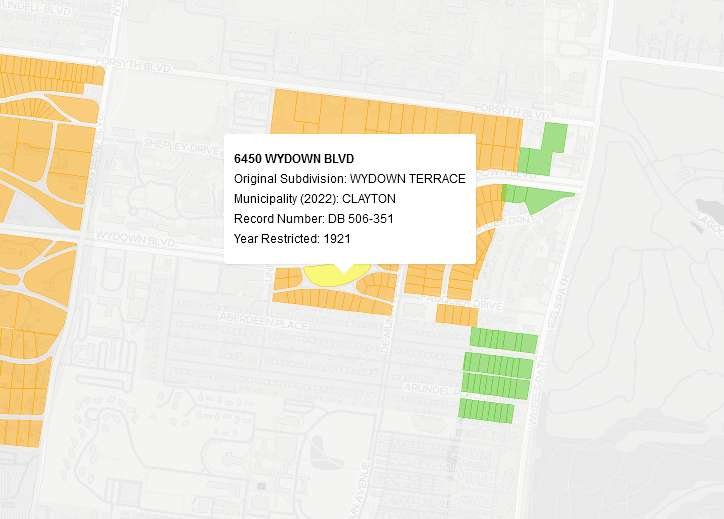
Earlier this year, our Geographic Information Specialist, Jay Bowen, worked with Colin Gordon at the Department of History to visualize his extensive research on racially restrictive covenants impacting residential parcels throughout Greater St. Louis in a new interactive map. With this map, users can explore parcel-by-parcel the historical proliferation of these covenant restrictions from 1870 to 1952, filter by type of covenant, and return the record number for the specific covenant governing each parcel.
The map can be found at the BTAA Geoportal here and on its own site here.
For more information, please see the following blog post from the Big Ten Academic Alliance Geospatial Information Network (BTAA-GIN):
Dividing the City: Race-Restrictive Covenants in St. Louis and St. Louis County
Introducing the Digital Scholarship & Publishing Studio’s 2023 Summer Fellows
The University of Iowa Graduate College and the UI Libraries Digital Scholarship & Publishing Studio are excited to announce that 11 graduate students have been selected for the 2023 Studio Summer Fellowship program. These individuals will soon take part in an 8-week course that provides mentored digital scholarship experience, as well as training in skills and tools they will use as they pursue innovative ways of thinking about and sharing their creative endeavors.
Luke Allan, MFA Student, Center for the Book
Mary Ellen Solt (1920–2007) was an experimental poet born in Gilmore City, Iowa. She worked in the “concrete” style: many of her poems are shaped as flowers and plants. Unfortunately Solt’s poems are now largely forgotten. There are no editions of her work in print, and her writing attracts little scholarly attention. This project seeks to change that by bringing her poems back into print and exploring the possibility of presenting them in digital form.
Gracie Baer, MFA Student, Sculpture and Intermedia
Through the Digital Scholarship and Publishing Fellowship, Gracie Baer wants to support Ana Mendeita’s archive at the University of Iowa and develop an active dedication and archive to the groundbreaking work the artist created in Iowa. Through her search for Ana’s work in Iowa, she has also been immersed in other Intermedia artists’ work– leading her to believe that her quest to learn more about Mendieta’s time in Iowa is also rooted in creating a more conclusive archive of Intermedia.
Kassie Baron, PhD Candidate, History
The “Mill Girl Archive” will serve as an interactive repository of Nineteenth-century writings by and about New England’s female textile mill operatives beginning with one of the primary “mill girl” texts: The Lowell Offering. The Offering was a magazine that published the writing of operatives in Lowell. This digital archive will collect and sort the stories, essays, poems, and editorials from the magazine’s five-year run use by the public, students, and specialists.
Samuel Boucher, PhD Student, History
Samuel plans to spend time this summer creating a map of Mennonite colonies across the world. He also hopes to perform textual analysis across newspapers to see how these communities were perceived through time.
Stevie Delgado, MFA Student, Intermedia
To Kiss the Sun, a namesake that originates from Stevie’s first curated exhibition, is a project that will incorporate 3-D printing, projection mapping, and printed plexiglass through laser cutting to create an interlocking sculpture with refractive images of an anomalous narrative about transitive periods in life, not unlike the rise and fall of the sun. Through experimentation and practical application, Stevie will explore projection mapping as a fractured light source while utilizing varying materials and films to act as screens and as refractive surfaces. The projections will ricochet in sporadic patterns and emulate sun rays through digital means.
Rachael Maxon, PhD Student, Art History
Rachael plans to create an Omeka catalogue of several objects imported to Susa, Iran between 3000-300 BCE to better understand the collective memory of kingship at this site and region more broadly.
Aaron Pang, MFA Candidate, Nonfiction Writing
Over the summer, Aaron plans to work on a podcast exploring the roots of creativity and craft. The goal for the project is to look more into how writers write across across various genres.
Regan Smock, PhD Student, Sociology
Regan’s research interests include social psychology, culture, and emotions. Currently she is working on a project that is exploring how people make every day moral judgments on a subreddit called “Am I the Asshole”.
Greg Wickenkamp, PhD Student, History
Greg will adapt L. M. Bogad’s Cointelshow: A Patriot Act, a play about the FBI’s COINTELPRO. His adaptation will include more focus on Iowa, surveillance capitalism, and the de facto continuation of COINTELPRO repression efforts past the program’s official end in 1971.
PJ Zaborowski, PhD Student, English
PJ plans to spend his time this summer creating a digital component to his dissertation. This work will explore what can be gleaned about the medieval world system through text mining and other avenues.
Elizabeth Zak, PhD Student, Informatics
Elizabeth’s summer project explores the evolution of digital misinformation. By using data mining, textual analysis and temporal analysis, Elizabeth plans to evaluate conspiracy theories’ content, popularity and spread on Twitter.
Behind the scenes: On facing failure and preparing for a new beginning
My digital capstone experience has been a learning experience in the best possible way. That is to say that, while I didn’t accomplish nearly as much as I had hoped to get done, I did learn a great deal which will make my digital humanities work more effective and efficient in the future. Cleaning the data for my future textual analysis proved to be a bigger ordeal than I had anticipated, and we determined pretty quickly that I needed to boost my coding skills before moving on to the next phase of the project.
Early in the project, we decided that I should create an index for all the files which make up the corpus I will be analyzing in the very near future. Given the scope of the project, Nikki and Matthew recommended using Python scripts to extract all the relevant metadata from the files in my corpus. As a coding novice, this was a bit of a daunting task, but one which I relished because it felt like my first foray into “doing digital humanities.” Initially, I struggled a good deal with designing the script. Following the friendly advice of my Studio contacts, I searched through several online code repositories for scripts which would extract the metadata I wanted and output it into a .csv file which could then be turned into a Microsoft Excel spreadsheet. Following several unsuccessful attempts at modifying other people’s code to work on my files, I became frustrated and decided to write my own script from the ground up. Unfortunately, my coding skills were not equal to my ambitions, and I failed again.
In a moment of weakness, I turned to the dark side and asked OpenAI’s ChatGPT what exactly was wrong with my code. After a few hours of dialogue with the notorious artificial intelligence interface, my code issue was fixed. Or so it seemed. My script worked—on about half of the files in my corpus. It turns out that the other half of the files in my corpus were in a vastly different XML format. It seemed easy enough to modify the script ChatGPT had provided me. Surely just a little nip and tuck on the code would see me across the finish line of this crucial first step. Unfortunately, this was not the case, as neither myself nor my AI compatriot seemed up to the task of extracting metadata from these strangely formatted files. After an unsuccessful attempt at workshopping my code with Nikki, we jointly decided it would be in my best interests to say goodbye to my AI buddy and learn the basics of coding in Python myself. It felt a bit like starting over, but it also felt like a fresh start was needed.
I enrolled in a coding tutorial through Linked-In Learning, after balking at the cost of classes provided through Code Academy. These tutorials have helped me to acquire the basic vocabulary and proficiencies I will need for the project ahead. Eventually, Nikki was able to solve my scripting issue, and my index began to take shape. Currently, I am manually adding data to that index—data which cannot be extracted by the script, such as genre, and the approximate date which the texts were written. These categories do not exist in the metadata, and they are also notoriously difficult categories to define with medieval texts which often fit into multiple genres and have no exact “publication date.” Despite my seeming lack of success this semester, I am extremely optimistic about the future of this project. I was fortunate to have been chosen for a Digital Scholarship & Publishing Summer Fellowship, where I will continue the work I’ve done this semester and, hopefully, move on to the textual analysis and data visualization portions of the project.
Migration Mapping Journey: Engaging with digital tools and progressing
For my QGis mapping project, I mapped the migration patterns of the Chewa and Chikunda ethnic groups to Zimbabwe between 1900-1970.
The primary objective of my capstone project was to develop a map that helps illustrate and visualize the argument I make in my dissertation. The map was the best suitable visual mode because it shows the geographical proximity of societies and cultures seemingly distant. Making that appear visually to my readers is very important in my dissertation. I pointed out having made slow progress during the first half of the semester. I had difficulty accessing shape files and understanding some of the Qgis functions. However, that subsided in the second half of the semester. I must say understanding Qgis, taking the time to play around with it, and following YouTube guides, as well as guidance from my advisor, came a long way. Once I figured out all the use cases of Qgis, I could progress much faster and easier.
I have enjoyed working on the project and experimenting with Qgis—the first step in creating the visualization involved locating appropriate shapefiles for the regions covered in my dissertation. I added a vector layer of the map of Africa and then embedded the shapefiles of the Zimbabwe, Mozambique, and Malawi regions. To highlight the names of the districts pertinent to my dissertation, I wrote a function only to display the terms of the selected areas. I also used different colors and levels of opacity for each of the countries as they were not easily distinguishable, particularly to someone unfamiliar with the region.
After finishing the base of my map, I started working on the migration data I had. I wanted to distinguish the places of origin for the migrants to establish which district had the most migrants and which had the least. Doing so helped me to create a scale for my flow arrows. The district with the most migrants got a more prominent indicator, and the district with the least number got the least. I wanted to represent such flow gradients over the years. Currently, I am still working on finalizing my scales for the arrows before I input the flow arrows. These final steps would complete my project. I have mostly enjoyed the flexibility of this project. It is rare, as a grad student, not to be working under pressure, and this is one such project where I could breathe and progress at a pace of my liking, which makes the whole experience unique.
Reflecting on digital publishing accessibility and academic publishing
My digital certificate journey is coming to an end. As I continue to work on my dissertation, I will continue to think about the skills I have learned working with the digital studio team. When I started my project, my goals were: 1. learn to scrape data from posts and comment sections from two main websites: an interactive video-sharing website, Bilibli (https://www.bilibili.com/), and a social media site, Weibo (https://weibo.com/); 2. Organize and clean data to produce manageable spreadsheets for further theme coding; 3. Contribute to a bigger dataset for my dissertation; 4. Feminist preservation and archiving of heavily censored queer feminist content in China. I am currently perfecting the codes and troubleshooting any potential issues. My next step is to organize the data I have collected by making a local web application for easy access on my computer.
I have been thinking about how I should present the results of my digital archive once it is finished. My focus lies on digital publishing accessibility as well as open-access publishing. I have been thinking about how journals function with so many people’s free labour yet are highly inaccessible to the general public. Many journals in my field, media studies and communication, are behind the paywall. People can either access through their universities or pay a hefty fee. The scholars who publish in these journals aren’t paid, and peer reviewers aren’t paid either. These people do the major part of knowledge production, and if they don’t get paid, who gets paid to justify the paywall? Some open-access journals are run by graduate students and are more public-facing, somehow they are considered less rigid research than these punished behind the paywall. I am thinking about the future audience of academic research and the pro and cons of digital publishing. I have already witnessed a movement of Chinese feminist activists self-publish on Internet platforms. They offer incredible knowledge production and community building on feminist activism from their lived experiences and on-the-ground activist work. I think academia has appropriated and even been predatory toward feminist activists’ work and theories. The usual process in academia is scholars interviews activists and studies their activist work. They translate activists on the groundwork into journal publications and books and become the spokesperson and authority of activist work. Academia has this history of appropriating and capitalizing on feminists and activists of colour’s anti-racist work because this is what the system encourages and pushes scholars to do to climb the ivory tower’s ladder. What I am witnessing about this more public-facing digital activist publishing challenges an imbalanced power dynamic between scholars and activists. I think this movement also challenges what scholar-activist entails and the responsibilities of being a scholar-activist, other than an easy label to throw around as a scholar. I am interested to read more about publishing ethics. Moreover, as a teacher, I have been thinking about what types of reading are the best for my students to learn. With the increasing popularity of Internet critical video essays and public opinion pieces that are not only insightful and high quality but entertaining and accessible to the general public, I am questioning the use of academic journals behind the paywall.