Skip to content
Skip to main content

Legacy collections: piling on the content

Last year, a friend of mine gave me several dozen CDs that he did not want to store and take care of any more. Most were albums and artists that I liked and might have bought anyway, but his large, one-time donation saved me that time and expense, and obviously caused my music collection to grow.

To date, a majority of DLS projects have involved reformatting physical library materials to digital, and building new collections one-by-one. While this is an important task for making sought-after materials available online for the first time, DLS is most excited when approached by another department or organization with a large collection of digital content in-hand. These legacy collections consist of previously digitized materials, or are born-digital in the case of digital photographs and electronic texts. In any case, the donor, like my benevolent friend, usually does not want to devote time and energy to storing and administering the content.

Since a primary strategic goal of DLS is to develop a full range of digital resources, and make them available online, we actively seek out these legacy collections. When this collection comes with corresponding metadata relating to the content, it becomes even more valuable to DLS and the Iowa Digital Library. Although, that’s not to say it requires no effort to add to the digital collections already managed by the department. Often, file names need to be altered and metadata “massaged” to match our standards. Editing the materials can take many hours of work, but in the end, many more valuable items can be made publicly available for research and scholarship much sooner than with one-by-one digitization.

Our first experience with these collections came in the form of the Calvin Photographic Collection, nearly 1000 photographs of early Iowa City as well as geological formations across the country, given by the Department of Geosciences, which is still a repository of the original glass plate negatives, but partnered with DLS to make the images available online in perpetuity. Currently, DLS is tweaking several more legacy collections numbering in the tens of thousands. Look for announcements on the blog when these become available.

–Mark F. Anderson
Digital Initiatives Librarian
Love in the stacks

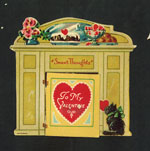
Beneath the calm façade of the Main Library’s exterior, among the dusty book stacks and studious scholars, lies the secret side of the Libraries’ holdings: a seething bed of love, lust, and early 20th-century greeting cards. In our dedication to exposing these hidden collections, Digital Library Services brings you a romantic “Best of” from the stacks — a digital mix tape of artifacts chiefly drawn from the Libraries’ research collections and selected to put you in the mood for Valentine’s Day.

But perhaps you think Valentine’s Day is an ersatz holiday that persecutes the single? As part of the Libraries’ commitment to inclusiveness, we made sure to represent both points of view. Pro-Valentine’s patrons can enjoy images of tennis-playing cherubs and the comically foreign-accented, and accounts of holiday celebrations by Iowa women in the 1940s and 1950s. Those against can peruse the UI Press collection’s tales of discount chocolates and abused cashiers, or the post-WWI (yet sadly relevant today) Valentine’s Day cartoons from political satirist Ding Darling.

Browse the collection here

…and join us for a Valentine’s Day show & tell session, featuring additional artifacts from the Libraries’ research collections, behind-the-scenes info from its curators and archivists, and heart-shaped treats. Feb. 14 at noon, Main Library, room 2032 (second floor, near the south entrance).

–Jen Wolfe
Metadata Librarian

Online public access cARTalog

As with most technological advances, the shift from the card catalog to the online public access catalog (OPAC) didn’t happen overnight. At the UI, there was a decade of overlap during which users who wanted complete access to the Libraries’ holdings had to search both resources — the card catalog for materials published until 1980, the online catalog for materials published after. Library staff made repeated attempts to remedy this problem with in-house projects to convert the card catalog data from print to electronic — a.k.a. “retrospective conversion” or “recon” to those fluent in librarian-ese — but soon revised strategies after recognizing the immensity of the task.

In 1999, a library committee was formed to coordinate outsourcing for the catalog recon initiative. Their duties included: defining the project scope; contacting outsource companies to solicit bids (including an unsuccessful offer from sentimental favorites Electronic Scriptorium, staffed by monks); drawing up specifications; reviewing test data; re-drawing specifications; and helping to oversee day-to-day operations. Four years, 500,000 titles, and $1.5 million later, the project was complete.

The newly comprehensive catalog continued to provide the benefits that the library world had quickly come to rely on from OPACs. For library staff, this meant the liberation of cataloging data from the physical constraints of the 3 x 5 inch card, allowing records with additional information such as table of contents lists, longer summaries, and more subject headings. For users, the advantages included the same increased usability that we in DLS strive to provide for our digital collections: 24-hour access from any location with an Internet connection, enhanced browsing through hyperlinked access points, and increased access through free-text searching. Now, another four years after the recon project ended, we anticipate an even more user-friendly catalog thanks to the Libraries’ recent acquisition of the resource discovery tool Primo, which offers enhancements that include Web 2.0 functionalities such as tagging, rating and reviews.

That said, we were still a little sorry when the Libraries announced the decision to permanently retire the card catalog in early 2005, which is why members of DLS staff assisted in an effort coordinated by the Libraries’ assistant conservator Kristin Baum to rescue as many cards as we could from the recycling bin. The cards were then repurposed to become part of cARTalog, a public art project designed to pay tribute to the card catalog and its place in how many of us experienced libraries and reading. After a year of submissions, programs and exhibits, cARTalog has now found a home in the Iowa Digital Library, where the cards will live on as a permanent, globally accessible art collection.

To learn more about the cARTalog project, see Kristin’s article “The Story in the Cards: Intimacy, Empathy and Reader Response” from book arts e-journal The Bonefolder. The cARTalog digital collection can be viewed here.

— Jen Wolfe
Metadata Librarian

Artists’ statements:

Karina Cutler-Lake [a student at the University of Iowa School of Library and Information Science before switching to the MFA program in Printmaking]: “I can admit this now: I really wasn’t a very good student of library science. I will never be remembered for my scholarship within the program. Our online catalog at the time… was unfriendly and stubborn. The specifics of the LC system stymied me. (I’m a Dewey Girl. All the way.) I just wanted to draw things. That… night class on reference materials really sent me daydreaming. But a walk though the stacks was, and still is, an instant inspirational mood-booster. There are answers in there. You’ve just got to dig them out.”

Mary V. Marsh: “I requested title cards for ‘The story of…’ I wanted to create an endless story. I constructed the book with no beginning or ending. Images from fairy tales suggest the weaving of myth and fiction with truth to tell stories, a cyclical history of humanity.”

Cheryl Jacobson: “I was surprised at how precious these little cards, which at one time helped to find some of my favorite lettering books, were to me and I’m so glad to be able to create some sort of lasting visual tribute to them and the books they located.”

Happy birthday to me!

No, it’s not my actual birthday, but this January marks my first full year as a Digital Initiatives Librarian at The University of Iowa Libraries, and while I served in a couple of short-term roles at UI since 2004 (Map Library Assistant & Statewide Digital Initiatives Specialist for the Iowa Heritage Digital Collections), 2006 was my first year of permanent involvement in the Digital Library Services department.

In addition to completing many digital collections, which have been highlighted in this blog throughout the year, and hiring a terrific group of student assistants that have allowed DLS to ramp up in-house digitization initiatives, my own knowledge has grown in the past year in the areas of mass digitization and moving from projects to programs, as well as specific new skills related to scanning, metadata and digital content management.

In 2006, I was afforded the opportunity to build collaborative relationships with individuals and groups in the community that led to extremely successful digital initiatives: the Iowa City Host Noon Lions Club, the Old Capitol Museum, the School of Art and Art History, the University of Iowa Museum of Art, the Department of Geoscience and College of Dentistry, University of Iowa Press, English Department and others just getting started.

Of course, further collaborations within the library led to outstanding digital collections as well: Special Collections and University Archives, Iowa Women’s Archive, the Information Arcade, John Martin Rare Book Room at Hardin Library, Media Services and Map Collection, just to name a few.

The variety of these projects makes them enjoyable and fulfilling, and perhaps the greatest benefit to me is the amount that I learn just by working with the materials, making me look forward to another great year with DLS in 2007!

–Mark F. Anderson
Digital Initiatives Librarian

Diversity, collections, collaboration

Just in time — barely — for the UI’s celebration of human rights week, DLS is pleased to announce the debut of our African American Women in Iowa Digital Collection. A joint venture between DLS, the Iowa Women’s Archives, and the African American Historical Museum and Cultural Center of Iowa, the project unites the Libraries’ core values of working collaboratively, providing free and open access to collections, and representing diverse perspectives. Please check back often as we continue to build the collection with digitized artifacts from IWA’s African American Women in Iowa holdings.

For more information on the digital collection, see the press release here.

–Jen Wolfe
Metadata Librarian

“Fostering the aspirations”


VII. We strive for excellence in the profession by maintaining and enhancing our own knowledge and skills, by encouraging the professional development of co-workers, and by fostering the aspirations of potential members of the profession.
— from “Code of Ethics of the American Library Association

The first-annual DLS Winter Holiday Student Appreciation Celebration was enjoyed by all, as our student assistants took a break from finals to join us for pizza, cookies, and non-denominational merriment. The party also marked a successful conclusion to an experiment in supersizing our student workforce, up this semester from two members to eight. This 400% increase was initially regarded with more than a little apprehension, but it turns out we needn’t have worried. Our new assistants caught on quickly, and were soon diligently reformatting images, texts, and audio, creating metadata records, and using asset management systems to build and upload digital objects. Once trained, the main challenge was lining up enough work to keep our students busy, since they often completed projects earlier than anticipated.

Along with excellent assistance from Spencer Wilken (Business) and Pamela Olson (Center for the Book), DLS was fortunate enough this semester to employ six students from the UI’s School of Library and Information Science: Charlotte Baldwin, Si-Chi Chin, Junko Kobayashi, Sally Myers, Laura Riskedahl, and Steve Tatum. Their grasp of library science fundamentals frequently streamlined the training process, allowing them to take on complex projects and quickly produce high-quality results.

These students’ association with DLS should prove to be mutually beneficial. As a supplement to the classroom theory that will serve them throughout their careers, their work for the Libraries is providing practical experience that may help land the all-important first job. Such experience is especially valuable in today’s tight job market, with many recent grads complaining that the much-publicized “librarian shortage” hasn’t materialized in enough entry-level positions to go around. Factoring in the relative rarity of digital library experience and the ever-increasing number of institutions wishing to incorporate such services, we expect our assistants will be well positioned to conquer the profession upon graduating.

DLS is grateful for our students’ participation in our mission to support the University’s teaching, research and creative activities. We’re also proud to assist them in beginning their careers in librarianship.

–Jen Wolfe
Metadata Librarian

Child historians / historic children

While freshman students can often seem impossibly young to those of us on the other side of the information desk, library staff took comfort in finding that the packs of youths roaming the UI’s book stacks on Dec. 5 were in fact junior high school students from around the state, on field trips to do research for National History Day. Along with members of the Reference and Instruction department and the Iowa Women’s Archives, DLS spoke at an orientation to introduce these students to some of the Libraries’ resources on this year’s NHD theme, “Triumph & Tragedy in History.” Relevant primary source documents that we highlighted from our Iowa Digital Library and the statewide Iowa Heritage Digital Collections included the Mujeres Latinas collection, the Johnny Bright Story, and the ever-popular WW2 War Dogs collection.

The student historians’ itinerary also included a trip up the hill to visit the Old Capitol Museum’s new permanent exhibit, the Iowa Youth Diaries Project, featuring young Iowans’ diaries dating from 1860 to 1910. DLS assisted with the project by training the museum’s student assistants on digitization and by hosting the online collection, which was created from artifacts provided by the Iowa Women’s Archives and the State Historical Society of Iowa. Below are a few excerpts from our Historic Iowa Children’s Diaries digital collection; for more information about the museum’s Diaries Project, see its UI News Release and a feature from the Dec. 7 issue of The Daily Iowan.

–Jen Wolfe
Metadata Librarian

Apr. 21, 1867 Pa is at court; we expected him back last night, but he has not yet returned. Ma is afraid some accident’s befallen him. Mr. L. was to come with him. We had quite a rarity for dinner: chicken. Spring is now here, and I expect we will soon have plenty of chickens.
At dinner, I spilt water over the table twice, and ma is going to whip me for it, so she says. That sounds funny, does it not? A girl, near fifteen, being whipped for soiling the table cloth, ha ha ha, I cannot refrain from laughter. Friday was Good Friday. How well I remember that day one year ago, it was the day of celebrating Lee’s surrender. But how changed was the morrow. The stores that the day before were trimmed so gay were draped in black and most were mourning for the death of Abraham Lincoln.
Today is Easter. Frankie colored some eggs. I have committed to memory my piece for the examination.
Linnie Hagerman (1852-1934)

Nov. 5, 1872 The Election passed off very quietly here. Grant was reelected to the Presidency. His majority in Iowa was about 53,000. Father did not vote at all. It snowed considerable last night & today also. We have got about 4/5 of corn gathered at Present. Price of corn is 14 x 15 cts.
Oliver Perry Myers (1856-1933)

Aug. 12, 1875 After dinner I practised, dressed myself & went down town to get my shoes. In the evening Nellie had a beau & May wanted to practise so I stayed up stairs & darned my stockings & began to read Mrs. A.D.T. Whitney’s “We Girls.” I like it very much although I have not got very far yet. Tomorrow Barnum’s great Hippodrome exhibit’s here, I guess we will go. The papers say that such a gang of thieves come with it that they have a car all to themselves. Willie Hervey has lent Nellie his pistol loaded & given to her caps. She is going to put in on a chair close to her bed.

Aug. 13, 1875 In spite of the pistol, no burglars came last night. This morning I walked way down to 4th St. with Linn & then went up into the town clock building. I did not get home til noon & was so tired I stayed at home all afternoon. In the evening I went with Mr. C. & Gracie to the circus. Got home at 10 P.M. It was pretty good. I am very tired.
Belle Robinson (1862-1887)

File this under Useful

In response to popular demand for materials in this collection, DLS has completed the digitization of a set of desk catalogs held by Special Collections. What makes these materials particularly important is that the company, The Rand & Leopold Desk Company (previously Northwestern Furniture Company) was a local office amenities manufacturing firm that operated in Burlington, some 80 miles from the University of Iowa, for over 100 years before closing in 1990.

In addition to local appeal, people from as far away as California have contacted Special Collections hoping to make use the information contained in this unique collection of catalogs and other company materials as they appraise, refinish and restore their Rand & Leopold heirlooms.

DLS is particularly interested in digitizing library collections that will allow users to access this kind of information online so that library staff need not make and send new copies to meet every request, especially for collections with high request rates such as this. Through optical character recognition (OCR), the desk catalogs can be searched by model number, name or description.

–Mark F. Anderson
Digital Initiatives Librarian
Being muttonable

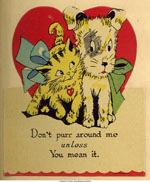
While social gatherings with friends and family can be the most enjoyable part of the holiday season, accepting too many invitations can result in exhausting treks through perilous weather to a seemingly endless round of Thanksgiving, Christmas, and New Year’s parties. However, refusing invitations without offending your would-be host can be tricky, which is why we’re happy to provide this example from the UI Libraries’ Leigh Hunt manuscript collection. As Charles Dickens demonstrates in this 1854 letter to essayist, poet, editor, and political activist Hunt, one strategy for softening the blow is to counter with an invitation of your own:

“No. I won’t come and take tea with you — and I’ll tell you why. If I do, I foresee that that leg of mutton which has never come off, will walk again into the misty future, like a vagrant trotter as it has proved itself to be. Therefore I am non-producible except on this my dunghill. Name your day… I am muttonable at half-past five…”

Additional digitized correspondence from Hunt’s other friends such as Percy Bysshe Shelley, Mary Wollstonecraft Shelley and William Thackeray will soon be forthcoming, thanks to the efforts of library science/book arts student and Olson Fellow Nana Diederichs.

–Jen Wolfe
Metadata Librarian

Lessons learned as a DLS intern

I have been working for many years in the Libraries’ technical services division as a cataloger, and more recently as a supervisor and trainer of other catalogers. As a consequence of supervising and of being involved in an arduous, and apparently never-ending reorganization of technical services, I had begun attempting to take the long view, asking myself what my job might evolve, or devolve, into as a result of such forces as outsourced cataloging, straitened budgets, the introduction of FRBR and metadata schemes other than MARC, the shift of researchers’ attention from the library catalog to the larger and more agile world of the Internet, and the Libraries’ desire to support digitization projects, perhaps at the expense of traditional cataloging operations.

Serendipitously, as I considered my situation the University’s internship program came to my attention and I found a ready-made means to explore other venues for my experience and interests. My proposal to work part-time as in intern in the Libraries’ newly-formed Digital Library Services department was welcomed both by my cataloging supervisor and the DLS staff. Library administration was supportive as well and expedited my request. My aim was to gain some understanding of the many facets of digital library services, and in particular, to focus on the cataloging of digital objects, with the goal of eventually assisting in training and dissemination of such work to other catalogers in technical services.

What has struck me most in the course of my internship is the energy, adaptability and inventiveness of the small DLS staff. The current staff of two, Jennifer Wolfe and Mark Anderson, with support from the former director of DLS and current head of Library Information Technology, Paul Soderdahl, have educated themselves in the technology, best practices, possibilities and pitfalls of digitization projects, have reached out to potential partners within the Libraries and the University, have struggled with problematic software, and have undertaken an astonishing number of projects, given their resources.

I have been patiently introduced to scanning, preservation issues, image editing and storage, metadata principles, practice, and resources, and some of the delicate politics of negotiating with other parties for content to be digitized and published on the Internet. I have been included in departmental meetings, in which issues about collaboration, scalability of tools and projects, and future directions for DLS have been discussed. Most importantly, my work with DLS staff has helped loosen my hold on long-treasured beliefs about cataloging priorities (e.g. perfection and thoroughness of records) and the role of the library catalog in the lives of its users (as opposed to its architects).

–Christine Tade
Intern, Digital Library Services