Skip to content
Skip to main content

Tweeting Civil War diaries

It took some 19th-century journals to drag us into using the 21st-century equivalent, but we’re finally on Twitter. Follow us at UIL-transcripts, or drop by the Civil War Diaries Transcription Project site to read our Tweets and see other enhancements, including newly-added diaries and an improved design (we’re still smarting from the old version being compared on Reddit.com to the Bush-Gore Florida ballot, ouch).

Still can’t get enough? Hear more In Real Life at our presentation this Saturday for the Iowa City Book Festival, or listen to an archived interview with Special Collections Librarian Greg Prickman on Talk of Iowa.

Byron Burford’s work in the UIMA digital catalog

Late yesterday, the University of Iowa Museum of Art announced the passing of Byron Burford, Professor of Art at the University of Iowa for nearly 40 years. He died on Friday, June 17, at the age of 90.

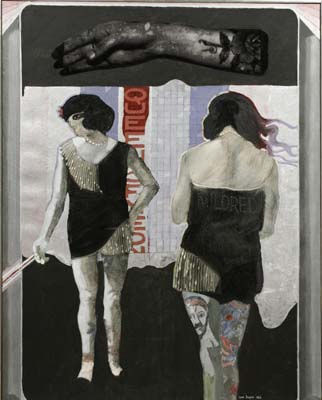
Mildred Two Times, a painting by Byron Burford

According to the UIMA, Buford was originally from Mississippi and came to Iowa City to study with Grant Wood. “After graduating with an MFA in 1947, he became a fixture of local life, known for his jazz performances and as the director of the Great Byron Burford Circus of Artistic Wonders, a collection of motorized canvases that toured the Midwest.”

Buford’s work acquired by the UIMA can be found in the University of Iowa Museum of Art Digital Collection hosted by the Iowa Digital Library.

“Burford’s art is well-represented in major museum collections across the country. The UIMA first collected his work in 1968, with an oil painting from 1948 entitled Harmonica Player or Summer Event. Since then, the museum has acquired 16 additional works by Burford, many of which have proven to be very popular with visitors and staff alike.”

—Nicole Saylor
Head, Digital Library Services

Civil War crowdsourcing project goes viral

Woo, hoo! We’ve been slashdotted.

This is when a popular website (in this case, Reddit.com, an enormous online community where contributors share web content that others may find interesting, enlightening, etc.) links to a smaller site (in this case, our Civil War Diaries transcription project) causing a huge influx of web traffic that overwhelms the site.

Despite the temporary collateral damage caused to the rest of the Iowa Digital Library, we love that the site is getting so much attention. Our staff is busily upping the RAM on the server and doing all they can to accommodate this onslaught of traffic. (One administrator describes the effort as putting a bandaid on a large flesh wound.) Today we’ve had more than 15,000 visits and more than 30,000 page views as of 3 p.m., where typically we might have 1,000. As someone Haiku’d in the Reddit comments:

Reddit the giant
Wants to pet the small website
Squishes it instead

Transcription is an expensive and laborious process, but the Internet allows us to experiment with “crowdsourcing,” or collaborative transcription of manuscript materials, in which members of the general public with time and interest conduct the transcription. We were inspired by crowd-sourcing efforts like Zooniverse, which enlists “citizen scientists” to help transcribe historic data. But unlike such well-heeled efforts, we lacked a stock of computer programmers or specialized software to manage the job. Instead, we opted for the experimental, low-tech route. Our crack webmaster wrote some PHP code that pulled diary pages into the transcription site, she added a form and some navigation, and just like that the site was born. It’s a homegrown solution that requires staff members to check the transcriptions for accuracy and add them manually to the digital collection.

The end result? A more useful and user-friendly resource, allowing full-text searching of the diary entries, along with easier browsing and reading. Now that an actual crowd has found our crowdsourcing project, we’re well on our way to making this goal a reality.

Nicole Saylor
Head, Digital Library Services

Digital humanities director search underway

"Plenty of talent. What they need is a director" (Nov. 20, 1917) Editorial Cartoons of J.N. "Ding" Darling

After a series of digital humanities faculty hires, the University is now seeking an internal candidate to head the new Digital Studio for Public Humanities, to be housed in Main Library. We in DLS are excited about this latest development, and we look forward to building on recent experimental digital project collaborations with faculty members and ITS staff through a more coordinated approach led by the Provost’s Office.

Call for Applications-Director of the Digital Studio for Public Humanities

The University of Iowa invites applications for director of the Digital Studio for Public Humanities that is being developed in conjunction with the “Public Humanities in a Digital World” faculty cluster.  We seek a distinguished, dynamic, and visionary senior University of Iowa faculty member whose experiences—including interdisciplinary collaborations, technological innovations, public engagement, research, and teaching—will help the University launch this exciting new venture.

The Office of the Provost—in collaboration with the Office of the Vice President for Research (OVPR), the University Libraries, Information Technology Services (ITS), and the College of Liberal Arts and Sciences (CLAS)—is already at work creating and staffing the Studio in the Main Library.  The Provost will further support the Studio by providing three years of start-up funding, and the OVPR will offer competitive seed grants for faculty projects.  ITS and the Libraries also offer competitive awards to support imaginative uses of technology for teaching. The successful candidate will have expertise in the digital humanities, success in engaging public audiences, experience in administration, strong evidence of academic leadership, demonstrated ability to work effectively and inclusively with a wide range of constituencies including students, and an established research agenda.

For more information, contact the Office of the Provost.

Stradivari Quartet recordings now available online

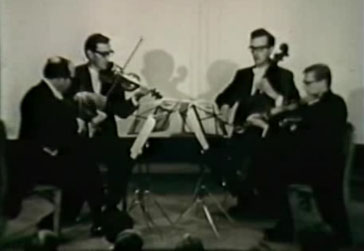
Stradivari Quartet image taken from a 1969 film
The collection includes a film of the Quartet on tour, created and directed and edited by Kaye Finch; producer, Marshall N. Lovrien; photography, Franklin Sindelar. Includes extended portions of Haydn's Quartet in G major, opus 54, no. 1.

Forty-four years after its first public performance, the Stradivari String Quartet now has audio recordings from 1963-1996 publicly available in the Iowa Digital Library at http://digital.lib.uiowa.edu/strad.

The collection is part of the Iowa Sounds Digital Collection, a growing digital repository of audio recordings that documents the musical and cultural heritage of the University of Iowa community.

The quartet made its first public performance with the Stradivarius instruments on May 19, 1967 in Macbride Auditorium in Iowa City.  The Iowa Quartet informally announced its name change on July 21 1969 at the International Music Camp in North Dakota, beginning the concert as the Iowa String Quartet, and ending as the Stradivari String Quartet.

The Quartet takes its name from a set of instruments known as the “Paganini Strads,” which were on loan to them from the Corcoran Gallery of Art in Washington D.C beginning in April 1967. After five years of tours and performances with them, the instruments were returned in the summer of 1972. The Iowa/Stradivari String Quartet was the teaching quartet in residence at the University of Iowa until 1996 when the newly formed Maia Quartet became the new quartet in residence. 

Personnel for the Stradivari String Quartet included:  Violin I – Allen Ohmes; Violin II – John Ferrell, Don Haines; Viola – William Preucil; Cello – Joel Krosnick, Charles Wendt.  Joel Krosknick appears on the earliest recordings from 1964-1966, but was not a member of the quartet when they changed their name to Stradivari.

The online collection was created between October of 2009 and March of 2011 by the University of Iowa Libraries from digitized cassettes and reels from the Rita Benton Music Library collection.

This collection of recordings is the latest edition to the Iowa Digital Library, which features more than 400,000 digital objects created from the holdings of The University of Iowa Libraries and its campus partners. Included are illuminated manuscripts, historical maps, fine art, political cartoons, scholarly works, and more. The University of Iowa Libraries is a strong supporter of new forms of scholarly publishing, digital humanities, data curation, and open/linked data.

—Joseph McKinley
Project lead

Personnel Dates Correlated to Recordings

Years Violin I Violin II Viola Cello
1964-1966 Ohmes Ferrell Preucil Krosnick
1966-1974 Ohmes Ferrell Preucil Wendt
1974-1996 Ohmes Haines Preucil Wendt

Commemorating Civil War sesquicentennial with digital collection & crowdsourcing effort

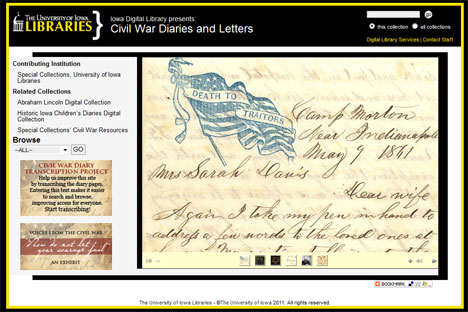
Civil War Diaries and Letters home page

University of Iowa Libraries has launched a new exhibition and digital collection to commemorate the sesquicentennial of the Civil War, and it’s enlisting the help of a few good men and women (well, lots, really) to help make the collection even more accessible and useful.

The exhibition, “‘Now Do Not Let Your Courage Fail’: Voices from the Civil War,” on display at the UI Main Library through July 30, includes letters and diaries from three manuscript collections held by Special Collections & University Archives that offer intriguing perspectives on the war. The experiences of Ferdinand Winslow, an officer in the Union army; Thomas Rescum Sterns, a soldier in the Union army; and Amanda and Mary Shelton, nurses who cared for soldiers through the Christian Commission, bring to life the everyday reality of the conflict.

Accompanying these manuscripts are artifacts from the war, including two Civil War-era quilts from a private collection and a dress worn to a wedding that is on loan from the Kalona Quilt and Textile Museum.

While viewing the exhibition in person, visitors can access digitized versions of the letters and diaries by scanning codes under each piece. This allows viewers to see pages from these collections that are not on display and follow the stories told through the letters.

The digital collection, which was scanned by UI Special Collections & University Archives, is also available online from any computer through the Iowa Digital Library at http://digital.lib.uiowa.edu/cwd.

But the 3,000-plus diaries and letters are digitized images — effectively photographs — that require viewers who want to read them to interpret the handwriting of hundreds of different writers. It also means users cannot search the text for particular wrds or phrases.

To transcribe that much documentation could take decades and thousands of dollars. But UI Libraries is experimenting with “crowdsourcing,” or collaborative transcription of manuscript materials, in which members of the general public with time and interest conduct the transcription and check one another for accuracy in much the same way contributors to Wikipedia help create a collection of data, information and knowledge.

“Crowdsourcing is revolutionizing the study of the humanities by making available to the public and scholars miles of documents that were previously off-limits, difficult to read or unsearchable,” said Nicole Saylor, head of Digital Library Services.

UI Libraries is inviting volunteers to take a few minutes, hours or days to read and help transcribe some of the pages of a Civil War-era diary, which will not only benefit the library and patrons, but give crowdsourcing participants a glimpse into a more personal side of one of American history’s most significant events. To learn more about this opportunity, visit http://digital.lib.uiowa.edu/cwd/transcripts.html

Improved searching of Wallace Collection

We have recently improved the searching of our Henry A Wallace Collection. This enhancement makes finding letters, telegrams, postcards or memorandum much easier.

Wallace Collection homepage

In 1975, Earl M. Rogers and Leslie W. Dunlap published an index to the letters in our microfilm collection as well as to the correspondence in the Franklin D. Roosevelt Library (Micro film 18327) and Library of Congress microfilm collections. The two volumes have been essential to find materials in these collections.

Display of name search

We have converted this print index into a searchable database. The results will link to our digitized materials or to the reel number for the other collections.

When you start typing in the correspondent search box, names will appear, showing the number of results for each name, based on sender or recipient. Select the name you want and press search.

The resulting list includes everything to or from the individual you selected.  The film numbers for the Iowa microfilm link directly to the digitized version.

The results display in date order. You can re-sort the columns by sender, recipient or film number.

Display of search results

You can also search by year or by multiple years.

If you are interested in a specific date, try the general search box, formatting the date with the year first, e.g. 1945-04-12. This top search box also allows you to search by first name or by a last name to get correspondence for everyone with that last name.

This project would not have been possible without our programmer Rajendra Sedhain or our student assistant Lisa Mendenhall.

Try out the great new interface at http://wallace.lib.uiowa.edu/!

Scottish Highlanders

Posing with bass drum, 1948

Local readers may have heard a report on Iowa Public Radio this morning about the Scottish Highlanders, The University of Iowa’s all-female bagpipe band. For those of you who want to know more, several hundred photos of the group can be viewed in the Iowa City Town and Campus Scenes digital collection. For the rest of you, you won’t be able to avoid the Highlanders for long, since the University is planning a weekend of festivities this fall to celebrate the group’s 75th anniversary.

Visiting a children’s hospital, 1957

Performing for Nixon, 1960

Football game half-time show, 1952

Portraits in conversation

The University of Iowa Libraries is pleased to announce the launch of its latest digital collection, Félix de la Concha’s Portraits in Conversation: http://digital.lib.uiowa.edu/felixdelaconcha

De la Concha is a painter who creates multidimensional portrayals of his subjects while conducting and recording interviews about their life, work, and views on art. The collection features Spanish-language interviews with some of the leading cultural figures in Spain, as well as English-language interviews recorded in the U.S., including with writers at The University of Iowa’s International Writing Program.

Spanish-born de la Concha studied at the Facultad de Bellas Artes in Madrid, where he was awarded the prestigious Prix de Rome. His work has been exhibited in museums around the world, with solo exhibitions throughout Europe and the United States. De la Concha lives in Madrid and Iowa City with his wife, poet and University of Iowa professor Ana Merino. The two are close collaborators, with Merino frequently drawing upon de la Concha’s work in her scholarship on the choreography of storytelling.

In 2005 de la Concha embarked on a project to record his portrait sittings with writers and artists. “This series started as a kind of experiment: I wanted to see what kind of portrait would come about if, while I was painting the model, the focus was kept on conversation, and the model’s pose was constrained for only two hours,” he explains. “Each portrait was an unpredictable adventure, both in its conversation and in the painting that resulted.” In 2007 de la Concha began a similar project creating portraits of Holocaust survivors. He has exhibited these works at museums such as the Museo de Arte Contemporáneo in Madrid and the Hood Museum of Art, Dartmouth College.

This collection of de la Concha’s interviews and portraits is the latest edition to the Iowa Digital Library ( http://digital.lib.uiowa.edu ), which features more than 300,000 digital objects created from the holdings of The University of Iowa Libraries and its campus partners. Included are illuminated manuscripts, historical maps, fine art, political cartoons, scholarly works, and more. The University of Iowa Libraries is a staunch supporter of new forms of scholarly publishing, digital humanities, data curation, and open/linked data.

Iowa Geological Survey now online

The University of Iowa Libraries has recently posted the Iowa Geological Survey Annual Report (1893-1941) online.  The annual reports contain information on the topography and geological formations of all of Iowa’s counties, assessments of Iowa’s mineral resources, and reports on Iowa’s water resources.  Whether being used to grow crops in the field, livestock in the pasture, or to harvest minerals from the ground, the physical environment of Iowa has been the lifeblood of Iowa’s economy.  These reports were the first detailed, organized reports on the geology and natural history of Iowa and sometimes included other information like the plant species of the time.  

We anticipate this material will be most useful to educators and other individuals in Iowa and surrounding states.  This digital collection features the full volumes, complete with scans of both the color and the oversized plates.  Some images in this publication may be of lower quality, but there is a collection of exceptional photographs of many parts of Iowa by one of IGSAR’s frequent authors (and former State Geologist), Samuel Calvin.

— Melanie Allsup