Skip to content
Skip to main content

Ephemeral bovine

It’s helpful for Digital Library Services to examine usage statistics about the Iowa Digital Library to see where site traffic comes from and which collections have more or less hits.  Sometimes, it’s just fun to see outside links pointing to unexpected places.  The Springer Printing Ephemera is a digital collectiton containing samples from various printing companies, calendars and political clippings amassed by Iowa City printer John Springer.

Springer Printing Ephemera Digital Collection

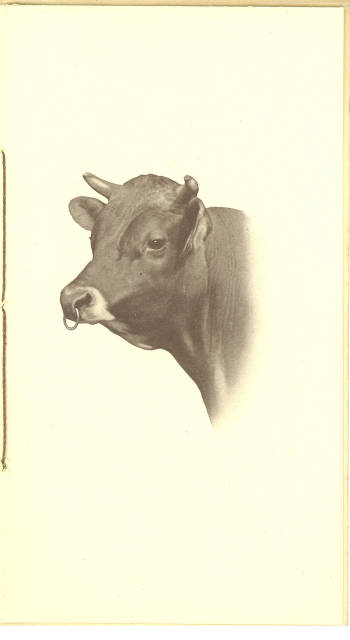
The Libraries are adding each and every piece in the collection, so that it will be a comprehensive surrogate for the archival collection, and a valuable tool for studying the history of printing and typography.  Although not a heavily publicized collection, we noticed that the Design Observer Group picked an image from the Springer Collection for their daily selection of… “things lost on the fringes…ordinary, odd, beautiful things. Esoteric images, old diagrams, typography, cartography — visions of a once promising but now extinct future.”

Seymour cream cowAnd this image of a cow, advertising cream-colored paper from the Seymour Company of New York, made the cut.

–Mark Anderson
Digital Initiatives Librarian

The Libraries announce the 2010 Creative Scholarship Innovation Award winners

The University of Iowa Libraries is pleased to announce the two winners of Creative Scholarship Innovation Awards, aimed at supporting significant digital humanities projects with the potential for national recognition. The award will fund hardware, software, and personnel; additionally, awardees will be paired with a team of librarians and technologists who will work as collaborators to develop the projects. Winners are:

  • Julie Hochstrasser, School of Art & Art History—$8,585 toward hiring a graduate assistant with subject matter expertise to work on a collection of documentary text, bibliography, photographs, and video accumulated during research, including travel to key sites of 17th century global Dutch trade and colonization.
  • William Davies, Linguistics –$2,080 to supplement other award monies toward hiring a graduate assistant with subject matter expertise to caption videos of Madurese storytellers and create a digital collection that includes Davies’ transcription of Madurese with interlinear English and Indonesian translations.

“University of Iowa librarians have a long history of close collaboration to support faculty who incorporate technology into their teaching and research, reaching as far back as the 1992 launch of the Information Arcade®,” said Library Director Nancy Baker. “This award is a continuation of our commitment to supporting digital scholarship.”

In late 2008, the Council on Library and Information Resources released “No Brief Candle: Reconceiving Research Libraries for the 21st Century.”  In this report, Rick Luce, Vice Provost and Director of Libraries at Emory University, notes that the e-research developments initially seen in the science, engineering, technology, and medicine disciplines are now penetrating the social sciences and the humanities.  Luce describes how e-research will profoundly shape the research libraries of tomorrow:  “Instead of simply storing objects of assorted types, researchers need libraries that reflect a Web 2.0 service environment in which communication is continuous and synchronous. This reality introduces significantly greater complexity to digital capture, curation, and preservation.”

To align with emerging e-research trends and the Libraries’ current strategic goals, the Libraries is transforming the Information Arcade space to reflect a renewed focus on faculty support for e-research, including but not limited to support for new forms of scholarly publishing, digital humanities, data curation, and open/linked data. Toward that end, Digital Library Services (DLS), in collaboration with ITS and the VPR’s office, hosted a series of AHI grant preparation workshops in January. DLS has also begun new collaborations with humanists and social scientists on projects ranging from capturing Twitter feeds in support of political science research to hosting peer-reviewed online journals such as the Walt Whitman Quarterly Review.

For more information, please contact Digital Library Services at thestudio@uiowa.edu or call (319) 335-9275.

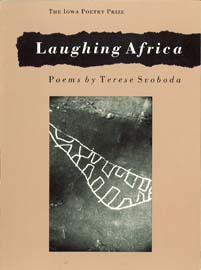
Iowa Poetry Prize added to UI Press collection

Laughing Africa book cover
http://ir.uiowa.edu/uipress_ipp/19/

Iowa Poetry Prize award winners through the year 2000 are now available online at http://ir.uiowa.edu/uipress/

This University of Iowa Press series is the latest addition in a collaborative effort between the Press and the University of Iowa Libraries to provide access to digital versions of books published by the Press. So far, we’ve made 91 titles, including many out of print volumes, fully searchable and freely available to readers and researchers around the world.  

The Prize was first awarded in 1990. Originally called the Edwin Ford Piper Poetry Award, the series was renamed with the 1993 award. Until 2001, the award honored only writers who had already published at least one book of poetry; the award is now open to new writers as well. Books in this series have also won the James Laughlin Award from the Academy of American Poets and the William Carlos Williams Award from the Poetry Society of America.  

Print books may be purchased from the University of Iowa Press.
—Nicole Saylor
Head, Digital Library Services

1970 Student Protests

Spring of 1970 was a tumultuous time on college campuses. On April 30, President Richard Nixon announced that U.S forces would invade Cambodia because of the recent communist coup. Students around the country protested this escalation of the Vietnam War. On May 4, the National Guard fired on students at Kent State University, killing 4 and wounding 9 people, which ignited protests all over the country.
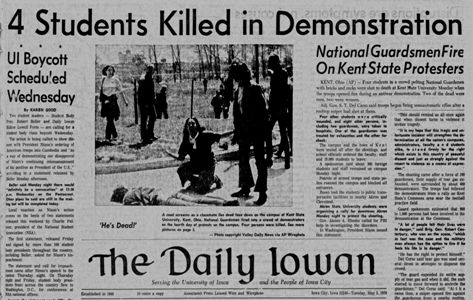
 Daily Iowan front page May 5, 1970

Anti-war protests were not new to Iowa City or to elsewhere in Iowa; protests had been occurring throughout the 1960s.

Iowa City Peace March    Des Moines Protestors in 1966

Spring of 1970 was different.

After the Kent State shootings, students marched on the National Guard Armory, broke windows there and also in some downtown businesses. The City Council gave the mayor curfew powers. On May 6 there was a student boycott of classes. That night about 400 people had a “sleep-in” in front of the Old Capitol.  That night about 50 people broke into the Old Capitol and set off a smoke bomb. The protestors left voluntarily when asked to do so. Around 2 AM Friday morning President Boyd requested arrest of the students on the Pentacrest by highway patrolmen, but the next day he regretted the mass arrests and said he had received faulty information. On May 8, President Boyd cancelled the 89th annual Governor’s day ROTC observance for the following day. On Friday and Saturday a National Guard helicopter circled the Pentacrest.

Map showing location of "big Pink"In the early morning hours of Saturday, May 9, the Old Armory Temporary (O.A.T.), also known as “Big Pink”, which housed the writing lab, was burned down. This building was located was next to the Old Armory, where the Adler Journalism and Mass Communications building currently is located. O.A.T was said to be at the top of a list of buildings for burning, probably due to its poor condition and was considered a firetrap. Fireman controlling "Big Pink" fireThe Iowa Alumni Review includes an article about the fire in which the author states: “Only the ends stayed upright. … On the south, Lou Kelly’s Writing lab bearing the sign ‘another mother for peace,’ escaped.” There was a second, smaller fire on Saturday evening in a restroom in the East Hall Annex.

By Sunday morning, President Boyd gave students the option to leave. Classes were not cancelled but students could leave and take the grade they currently had.

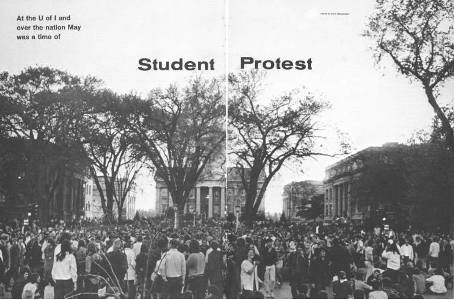
Daily Iowan front page May 11, 1970

Student ProtestsAn account of the May 1970 protests can be read in the June-July issue of the Iowa Alumni Review.

In his autobiography, My Iowa Journey: The Life Story of the University of Iowa’s First African American Professor, Philip Hubbard (University Vice-Provost in 1970) gives an administrator’s perspective of all the protests of the 1960s.  He supported the student’s right to protest and in 1966 stated:

Students should not accept everything that is dished out to them. We don’t want to dictate what they should or should not do. However, student demonstrations should remain within the law and good taste without interfering with the university’s primary purpose of instructing students.

During this time there was also a strong ROTC presence on campus.

ROTC

The 1970 yearbook includes many pictures of the men and women who chose to serve the country in this manner. Their presence on campus and the academic credit they received for their service was called into question by both students and faculty in the spring of 1970, but Boyd said he could not abolish ROTC. The Alumni Review had an article called “ROTC: Alive and well at Iowa” in the December 1969 issue which helps provide a more complete picture of this period in history.

More information about protests at the University of Iowa can be found by consulting the “University Archives Resource guide to Student Protest Movements.”
Boynton project wins national award

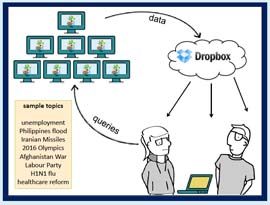
Image from Capturing Tweets: Exploring the Impact of Microblogging poster by Lee & Boynton

Congratulations to Political Science Professor Bob Boynton. His New Media in Political Discourse project was selected by Center for Research Libraries to receive the 2010 Primary Source Award for research. CRL gives out just three Primary Source Awards annually, one each for teaching, research, and access.

Boynton studies the use of new media in political discourse. His current research compares micro-blogging (Twitter) with mainstream media coverage for global news events, and Joanna Lee in Digital Library Services worked with Prof. Boynton to build a system that captures live Twitter feeds for data analysis. Support was provided by Chris Clark, head of Desktop Support Services.

The project, which involved collecting Twitter data by constantly running The Archivist, a free tool for harvesting “tweets,” is explained in a poster created by Lee and Boynton.

See the DLS Web site for more on the Libraries’ involvement in this project.

Walt Whitman Quarterly Review goes digital

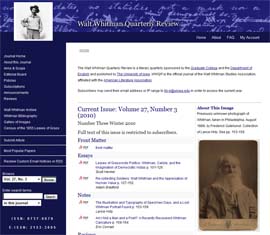
Walt Whitman Quarterly ReviewThe Walt Whitman Quarterly Review (WWQR), a literary quarterly sponsored by the University of Iowa Graduate College and the Department of English, is now available online at http://ir.uiowa.edu/wwqr/. The official journal of the Walt Whitman Studies Association is edited at Iowa by editor Ed Folsom and managing editor Blake Bronson-Bartlett. 

Less than a month after the site’s public launch, The Walt Whitman Recording, has already become the second-most accessed item in Iowa Research Online, the university’s institutional repository. The article, by Folsom, describes the rediscovery of the “tape-recording of what may be an 1889 or 1890 wax-cylinder recording of Walt Whitman reading four lines of his late poem ‘America.'” The audio has gained broad exposure recently in a Levi’s Go Forth commercial.

All journal back issues, beginning with the first volume in 1983, up to one year ago are full-text searchable from the site. Current issues are accessible to subscribers only. The site provides information about subscribing, announcements about Whitman-related matters, access to the searchable bibliography of everything written about Whitman from 1840 to the present, and up-to-date information on the census of the 1855 edition of Leaves of Grass. Soon, articles will also be available through bibliographic entries in the Walt Whitman Archive

WWQR is the latest journal to be added to Iowa Research Online, a dynamic archive of the research produced by faculty, researchers, and students, from published articles in peer-reviewed journals to presentations, theses, dissertations, and unpublished papers. WWQR is among four locally published e-journals hosted by the University of Iowa Libraries, with an additional two currently in production. To find out more about the Libraries support for locally journal publishing, see the Libraries e-journal hosting information. As with all efforts related to Iowa Research Online, this project was part of a broader Libraries initiative to support the transformation of scholarly communications.

—Nicole Saylor
Head, Digital Library Services

Pioneering artist Eve Drewelowe featured in digital archive

The life and work of painter Eve Drewelowe (1899-1988) are celebrated in a new digital collection created by the University of Iowa Libraries and the School of Art and Art History. This pioneering artist, who in 1924 received the UI’s first Master’s degree in studio arts, is the focus of the Eve Drewelowe Digital Collection, available online at http://digital.lib.uiowa.edu/drewelowe .

To unveil the digital collection and to celebrate women’s history month, the UI Libraries will host a reception from 4:00 to 5:00 p.m. on Wednesday, March 3, 2010, in the North Exhibition Hall of the Main Library. Joni Kinsey, Curator of the Drewelowe art collection, will speak briefly on the artist’s work and the significance of the collection.

In addition to her pioneering role as an artist trained in a university and a college of liberal arts, Drewelowe represents another “uniquely American phenomenon,” according to UI School of Art and Art History Professor Wallace Tomasini:

[A] farmer’s daughter in a sparsely populated agricultural area, far removed from great urban art centers, can indulge in her desire to become an artist; can enjoy the benefits of an education which introduces her to the literature, the history and the art of the great civilizations of the world, and can have the freedom to be an individual, to be independent and to do the unusual. From the beginning, Eve Drewelowe was a rebel, a challenger of complacency and the expected role career model for women. [from the book Eve Drewelowe. University of Iowa School of Art and Art History, 1988.]

Read the full press release:
http://www.news-releases.uiowa.edu/2010/February/021510drewelowe.html

XOXO, Digital Library Services

cupid

University of Iowa student with bow and arrow, mid-1920s

Whether you are single, happily attached, or somewhere in between, we in Digital Library Services offer you a historical perspective of that sometimes treacherous holiday lurking just around the corner: St. Valentine’s Day.

My Heart Pants

“My heart pants 4 u, ” Aug. 1, 1907

The February 14, 1961 Daily Iowan reminds readers to send a card to their favorite boy or girl because “Valentine’s Day does make for that special feeling.”

The Daily Iowan Valentine reminder

Daily Iowan, Feb. 14, 1961

A Vidette-Reporter article from 1891 tells a freshman student’s cautionary tale about the last valentine he ever sent. (Spoiler alert! After choosing the wrong card, he finds himself hiding in the mud under his intended sweetheart’s front porch.)

Pansies Valentine

“I send you my love and a pansy smile, ” Jan. 27, 1921

And who wouldn’t love a slice of Pink February Pie?

Pink Februrary Pie recipe

Up a country lane scrapbook, vol. 06: Jan. 1, 1974 – Dec. 25, 1978

Enjoy more romantic artifacts: http://digital.lib.uiowa.edu/valentines

–Joanna Lee
Digital Projects Librarian

Seeding digital humanities: UI Libraries offers start-up funds

Digital Library Services is pleased to invite applications for a total of $10,000 in one-time funds to support innovative research computing in the humanities and social sciences. The goal of the Creative Scholarship Innovation Award is to raise the level of digital scholarship at Iowa by supporting significant projects with the potential for national recognition. The award will fund hardware, software, and personnel; additionally, awardees will be paired with a team of librarians and technologists who will work as collaborators to develop the projects.

The Award is open to faculty researchers in the humanities and social sciences at The University of Iowa; the application deadline is April 2, 2010. Learn more.

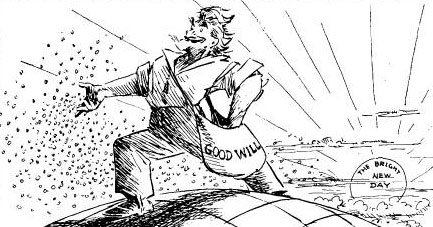
“And some fell…” [detail] by J.N. “Ding” Darling, 1946

Digital Humanities Project Development Workshops

 Arts and humanities researchers interested in collaborating with campus technologists and librarians to develop innovative technology project proposals for the upcoming Arts & Humanities Initiative (AHI) grant cycle are encouraged to attend one of two workshops. While project consultations are geared toward AHI applicants, any researcher interested in getting a digital project off the ground is encouraged to attend.

Thursday, Jan. 21—1:30-2:15 at the Information Arcade, Main Library

Friday, Jan. 29—1:30-2:15 at the Information Arcade, Main Library

Please register for a workshop at http://survey.uiowa.edu/wsb.dll/848/ahiwkshp.htm

Digital specialists from the Libraries, ITS, and past AHI winners will discuss digital scholar-ship and examine how researchers, centers, and collaborative projects elsewhere are using technology to enhance their research, and how local scholars might leverage emerging digital humanities tools and resources locally.

The 45-minute workshops will be followed by individual project consultations.

AHI grants are awarded to projects that make a significant impact on scholarship in the proposed field. Proposals for digital arts and humanities projects and projects for which the applicant will seek external grant support are especially encouraged. Application deadline is February 9, 2010. For more details, see http://research.uiowa.edu/ifi//index.php?get=ahi

For more information about the upcoming workshops, please contact Digital Library Services at 335-9275.

–Nicki Saylor
Head, Digital Library Services