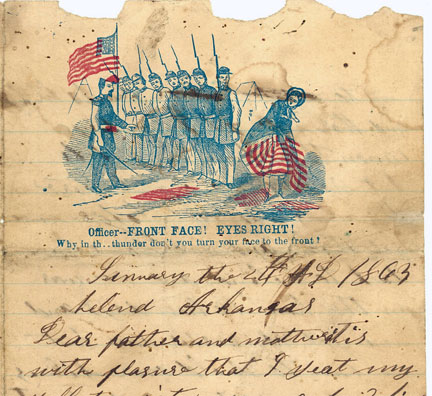
During a war conducted without telephones, Skype, or even reliable mail delivery, Civil War soldiers treasured their letters from home – and lucky for us, because they kept them all their lives and passed them down through their families to us. William Titus Rigby expresses his gratitude to his correspondents eloquently:
“I never received a letter in my life which gave me as much pleasure as these two did. You must remember how we are Situated away from home of course & without any mail for two weeks… when we are not expecting them comes those messages from home. It is a poor comparison to say they came like “Sunbeams in a Shower” It is as though a person completely lost in a dark night Should suddenly recognize the light burning in his own home.”
The University of Iowa Libraries is pleased to announce the release of the Office of the State Archaeologist Photographs Digital Collection: digital.lib.uiowa.edu/osa. This unique digital collection currently includes over 23,000 original photographs and slides from the State Archeological Repository curated by the Office of the State Archaeologist (OSA), the University of Iowa. Digitization is ongoing and will grow the online collection to over 46,000 digital images by the project’s end. These photographs provide critical visual field information on archaeological investigation at 2,023 archaeological sites recorded in the official Iowa Site File. The digitization of this collection will support and enhance the wide range of research and teaching activities offered by OSA staff and will expand access to these valuable historic resources for all Iowa citizens.
Ranging from 1952 to 2007, the photographs document the history of the last half century of archaeological research in Iowa and serve as a record of many of the cultural artifacts associated with many historically significant sites. Fort Atkinson (Winneshiek County), a historic military outpost in the Neutral Ground occupied between 1840 and 1849, Blood Run (Lyon County), the site of one of the largest Oneota villages in Iowa, and Cherokee Sewer (Cherokee County) the site that yielded Iowa’s oldest musical instrument are a few of the historic sites represented in the digital collection.
Digitization of this collection was made possible by a grant from the Historical Resource Development Program (HDRP) of the State Historical Society of Iowa.
The collection is the latest edition in the Iowa Digital Library, which features more than a half million digital objects created from the holdings of the University of Iowa Libraries and its partners. Included are illuminated manuscripts, historical maps, fine art, political cartoons, scholarly works, and more. Digital collections are coordinated by Digital Research & Publishing.
In a Cedar Rapids Gazette article last fall, donor Pamela Lee attributed the choice to house her family papers at the UI to the crowdsourcing effort, describing it as “my Christmas list of everything that I thought should be done with the letters.” Read more, or just jump in and start transcribing, at the links below.
Hands-on experience with Civil War history: The University of Iowa is seeking public help with transcribing Civil War history
Letter after letter, week after week, Sarahett Wilkerson pleaded with her husband.
“I wish you could come home,” she wrote to Jesse Wilkerson, who was drafted in November 1864 to serve with the 13th Iowa Infantry in the Civil War.
After five months alone on the couple’s farm in Hamburg and three months caring for a new baby, Sarahett Wilkerson on April 2, 1865, penned another desperate behest of her husband.
“The baby is three months old day before yesturday,” she wrote, her spelling off on some words. “I want you to send her a name.”
In the letter, among 29 that Wilkerson’s descendants recently donated to the University of Iowa Libraries cataloging Jesse Skinner Wilkerson’s Civil War experience, his wife updates the 33-year-old soldier on their children and how much they miss him…
Pamela Lee, 60, of Pullman, Wash., is the great-great-great granddaughter of Jesse Wilkerson and said her family gave the documents to the UI as a way of preserving the material and making it relevant…
“We are so happy that the letters are back in Iowa,” Lee said. “It’s exactly where they should be.”
Carl Menzer broadcasting at the University of Iowa, ca. 1925-1930
A recent post at the Smithsonian’s Paleofutures blog — “A history of the future that never was” — cites the University of Iowa’s W9XK as the first American university station to broadcast TV. Read about this failed experiment to bring free education to the masses below.
Predictions for Educational TV in the 1930s
Today most universities offer online courses that allow students to study and take tests without physically being on campus, but in the 1930s the distance learning technology of the future was television.
Both radio and television were initially envisioned as methods for point-to-point communication, but once radio broadcasting became mainstream in the 1920s universities saw the potential of the medium to reach a broad audience with educational programming. This was especially true in rural farming communities where long distance commuting to a university was out of the question.
Universities in the U.S. may have been at the forefront of experimenting with radio broadcasting, but frankly, they weren’t great at attracting sizable audiences. As Douglas B. Craig explains in his book Fireside Politics, “many university stations [of the 1920s] began operations with high hopes of bringing education to the masses, but soon faltered as broadcasting costs increased, audiences diminished, and professors demonstrated that lecture-hall brilliance did not always translate into good radio technique. These problems were quickly reflected in an unfavorable allocation of frequency or broadcast times, sending many of these stations into a downward spiral to oblivion.”…
Experiments in television brought universities that had failed at radio a fresh start, but it was still unclear as to whether these technologies should be used for narrowly targeted or broadcast purposes. In 1933, the University of Iowa became the first American university to broadcast TV. The first public demonstration of television in the state had occurred just two years earlier at the 1931 Iowa State Fair, and there was tremendous excitement by scientists at the University of Iowa to see what it could accomplish…
In an interview on NPR May 29, Professor J. David Hacker was interviewed about his census data research which leads him to posit that the accepted estimate for number of Civil War casualties is too low, and instead should be roughly 750,000. This is an enormous number, but to truly convey the magnitude of the tragedy and its impact on the country, Hacker points out that the population of the U.S. in the 1860s was about 10 times less than it is now, so that an equivalent war loss today would be 7.5 million deaths. Reading our Civil War diaries and letters with this in mind, we marvel that any of our writers lived to return to their families, and we are grateful that both the survivors and those who lost their lives took the time to make a record of their experience. Imagine the anxiety of those back home, waiting for the next mail, and wondering if they would ever see their loved ones again.
George Shearer, Union soldier, 1863 | Civil War Diaries and Letters