We recently added the back content of Little Village magazine in our repository, which will ensure this important local title will remain widely accessible (http://ir.uiowa.edu/littlevillage/). Many of the contributors are current or past University of Iowa faculty, students and employees.
Several months ago, Little Village staff contacted the University Archives to scan back issues of the magazine. Our Digital Preservation Librarian advised the LV volunteer regarding the digitization. DRP staff then advised another LV volunteer on the data needed to upload the items. This was a very successful collaboration with LV, especially from my perspective since they did so much of the work!
Our site includes all the issues, from July 2001 to the current issue (Sept./Oct. 2012). Each issue can be downloaded as a PDF or can be viewed on screen. Each of the covers displays, making the issues easily browsed. You can search the back issues on our site, or you can use Iowa City Public Library’s Local News Index to find articles of interest.
We hope you enjoy looking at the last decade of Iowa City news and arts.
Each fall tens of thousands of people cheer their beloved Iowa Hawkeyes in the football stadium that bears the name of Iowa’s only Heisman trophy winner: Nile Kinnick Jr. Standing only 5’8” tall, Kinnick was a giant among men, a champion athlete and scholar who gave his life for his country serving in World War II.
A new digital collection from the University of Iowa Libraries bringing together letters, newspaper clippings, and photos of Nile Kinnick is now online: digital.lib.uiowa.edu/kinnick. These materials tell the story of one of the UI’s greatest football legends.
Included in the collection is the text of Kinnick’s Heisman trophy acceptance speech. Whitney Martin, a reporter covering the Heisman ceremony for the Associated Press, described the scene as “several hundred men and women rose and cheered and whistled…You realized the ovation wasn’t alone for Nile Kinnick, the outstanding college football player of the year. It was also for Nile Kinnick, typifying everything admirable in American youth.”
The Nile Kinnick Collection is the latest addition to the Iowa Digital Library, which features more than half a million digital objects created from the holdings of the UI Libraries and its campus partners. Included are illuminated manuscripts, historical maps, fine art, political cartoons, scholarly works, audio and video recordings, and more.
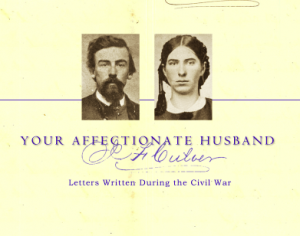
The University of Iowa Libraries launched an experiment this morning by publishing online the first in a series of letters written by Civil War solder Joseph F. Culver to his wife Mary. The idea, hatched in Special Collections where the original letters are housed, is to web publish this series of Civil War-era correspondence exactly 150 years to the exact day each letter was written.
The U.S. Civil War Sesquicentennial has provided a national context to expose our Civil War holdings to a broad public. This effort to re-issue the Culver letters on a blog has given Digital Research & Publishing a chance to experiment with a few web publishing tools, including Google Maps, the WordPress SIMILE timeline, first developed at MIT, as well as a WordPress plug-in to manage footnotes. At the Libraries, we are always on the lookout for new ways to publish, promote and preserve the academic and historic record. We hope you enjoy our latest experiment.
—Nicole Saylor
Head, Digital Research & Publishing
Unless we have rain and that very soon the corn crop in this state will be almost a complete failure … The last rain that we have had to amount to any thing or wet the ground more than to lay the dust fell last April. So you may judge for your self whether we need any rain in Iowa. The women say if we do not get rain that there will be no “inyens nor beens, nor potatoes,” if that be so we will have to live without the vegetable matter, over which they do the principal superintending – the women I believe generally “boss” the affairs in the garden, and I suppose they have a right so to do …
Esther eating corn, early 1900s | Iowa Women's Archives Images
“It’s always the uninvited guests…,” editorial cartoon by Ding Darling, Aug. 27, 1936 | Editorial Cartoons of J.N. “Ding” Darling
Recent temperatures in the 100s here in Iowa have us cowering in our climate-controlled offices, but a browse through past heat waves documented in the Iowa Digital Library helps to put things in perspective. Worst of these was the summer of 1936, the hottest on record, marking the end of the Dust Bowl years. A July 16th Daily Iowan story put heat-related fatalities in those pre-air-conditioning days at 3,500; according to government figures, the death toll rose to 5,000 by the end of the summer.
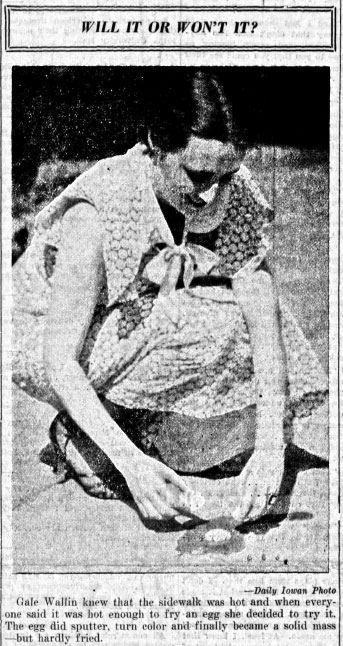
Despite the heat, some Iowa Citians still found the strength to indulge their intellectual curiosity, as shown in this D.I. investigation of whether it really is hot enough to fry an egg on the sidewalk. (Answer: Not really.)
“Will it or won’t it?” The Daily Iowan, July 10, 1936 | The Daily Iowan Historic Newspapers
As of July 15, 2012, Iowa Research Online has had over 1,000,000 download of items. This means there have been 1,000,000 uses of University of Iowa faculty, staff and student created or supported content in the just over 3.5 years since IRO launched (January, 2009). More than half of this use occurred in the last 12 months.
In a twelve-page letter from soldier Sam Clark to his sweetheart Tillie Wise back in Iowa, a paean to the power of correspondence to lift the spirits of the troops:
“I do think it does Soldiers the most good of any other race of beings to get letters. If you could only see them gather around when the camp mail is being distributed, each one trying to be the nearest to the mail man whoes province it is to distribute, and should any of them happen to receive more than one letter on the same day it is more than the mind can digest, until the excitement produces a kind of reaction on their mental digestive organs. It seems to me that I can go through camp after the mail has been disbursed, and by the fallen chops and broad grins, I think I can point out nearly every man who has been fortunate enough to receive a “friendly scratch” from the dear ones left behind. Soldiers are with letters
Wise-Clark correspondence, July 11, 1864 | Civil War Diaries and Letters
like gold seekers “If an ounce of diamonds were to fall into their hand every day they would hold out the other hand just as eager for more.” I think that will apply to the Soldiers in regard to receiving letters
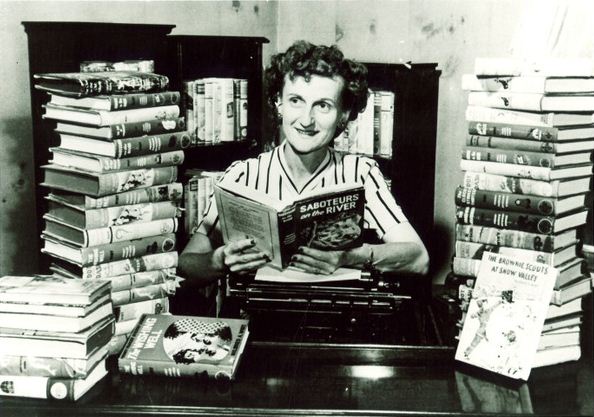
Nancy Drew author Mildred Wirt Benson among her books, Toledo, 1949 | Mildred Wirt Benson Collection
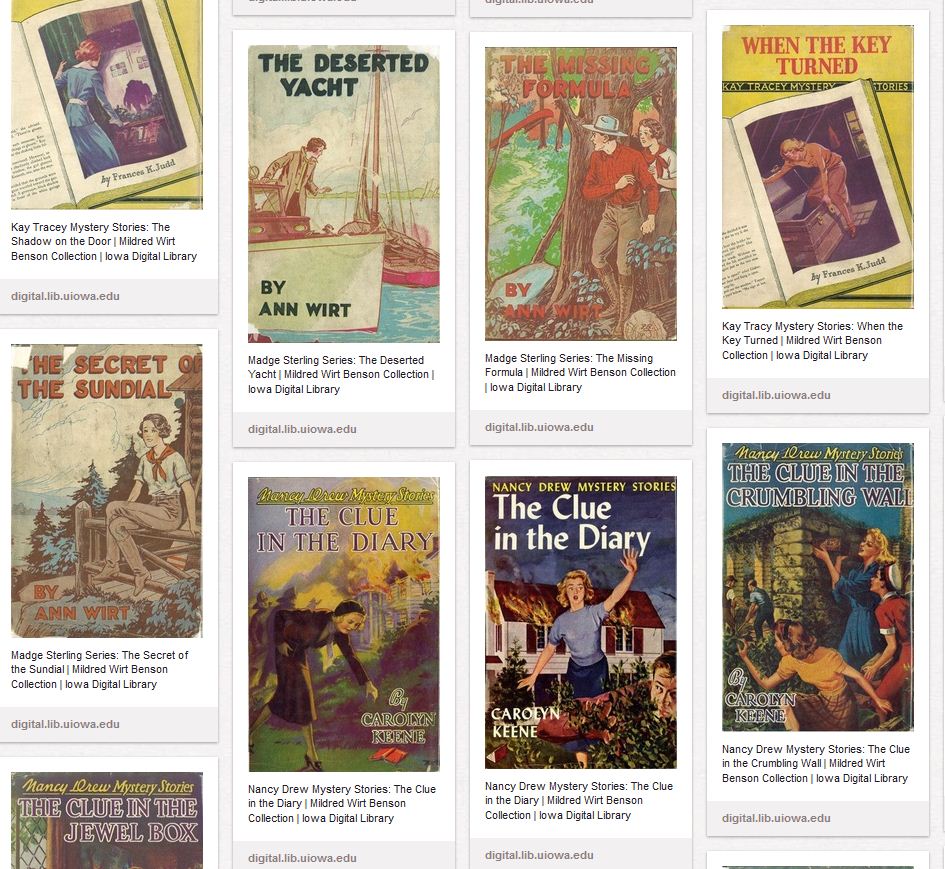
University of Iowa alumna Mildred Wirt Benson — journalist, pilot, amateur archaeologist, ghost writer, and the original author of the Nancy Drew mystery series — was born on this day in 1905. To mark the anniversary, we’re featuring a gallery of her book covers, from the iconic to the unintentionally terrifying, on our Iowa Digital Library Pinterest account. View even more digitized artifacts at the Mildred Wirt Benson Digital Collection.
This week on Twitter, we’ve been featuring 4th of July-related excerpts from the Civil War Diaries and Letters digital collection, as transcribed by our crowdsourcing volunteers. Unfortunately for the soldiers, the holiday typically held business as usual — the fatigue, discomfort, and anxiety of life on the battlefield — mixed in with the occasional historic event.
In contrast are letters from home, detailing 4th of July picnics, concerts, and various other “selebrations.” A favorite, written to Tillie Wise Clark from her niece Bell, is excerpted at length below. While sparing a few lines for her brother Lycurgus, a captain in the 101st Colored Infantry Regiment, Bell shows a preoccupation with parties, dresses, and beaus that’s worthy of Scarlett O’Hara herself.
Brooklyn Sanitary Fair, 1864 | James W. Bollinger Collection
Dear Aunt Tillie,
…Aunt Bell and Jessie went to Winona, [for] a festival of some kind there in the afternoon. I could not go, as I was so fortunate as to get my face poisoned Wednesday, consequently it is about as big as two faces ought to be, with the exception of the eyes, which are uncommonly small. Aunt Bell wants me to get my Photo now, but I do not think twould be pretty so I will not follow her advice…
Curgus is coming home in July, and perhaps when he goes back will come by Winona. Seems to me I’ll be kinder glad to see him, wish mother and all the rest of the folks would come with him. I rather think from the way he writes, he has a notion of joining the regulars. I don’t want him to, dear knows, but of course he will do as he likes.
By the way I have been to Deer Park. Went Wednesday last in a buggy or carriage with nineteen others. Had ever so much fun, Colvins, all but Herve McCartys, Wilsons, Grays, and some others, made quite a respectable load. “Nely” Colvin and I were on the seat with the driver, Frank McCarty. Aunt Bell did not go. Consequently there were but about three I was acquainted with, didnt have any introductions either, but I don’t care. Enjoyed myself the best kind. The folks from about Uncle Abner have not gone yet, I may get to go again, possibly.
I had almost forgotten to tell you I have such a very pretty new dress, not quite made yet. I just know I will get a beau the fourth of July, as I’m most determined to wear it. Am going to get a hat this week also if I can find any thing in Winona or Lostant pretty enough for me to wear, know I’ll look awful handsome if my face should happen not to get well. Guess I will get a letter from somebody this week, wouldn’t you like to see it. I’m getting anxious myself. The cherries are turning red, will have pies of them this week, Grandmother says, the strawberries are all gone, were not very many in the first place…
Much love to all the folks, and please look over all errors.

 We recently added the back content of Little Village magazine in our repository, which will ensure this important local title will remain widely accessible (http://ir.uiowa.edu/littlevillage/). Many of the contributors are current or past University of Iowa faculty, students and employees.