When Dr. Jennifer Sterling set out to create the fall 2024 Main Library Gallery exhibit, Hawkeye Histories | Sporting Stories, she chose to include a handful of scrapbooks from the Iowa Women’s Archives and the University Archives at the University of Iowa Libraries. These items add a personal touch to the exhibition, showing how Hawkeye student-athletes perceived their own endeavors. Here, we break down what makes scrapbooks such lively additions to the archives.
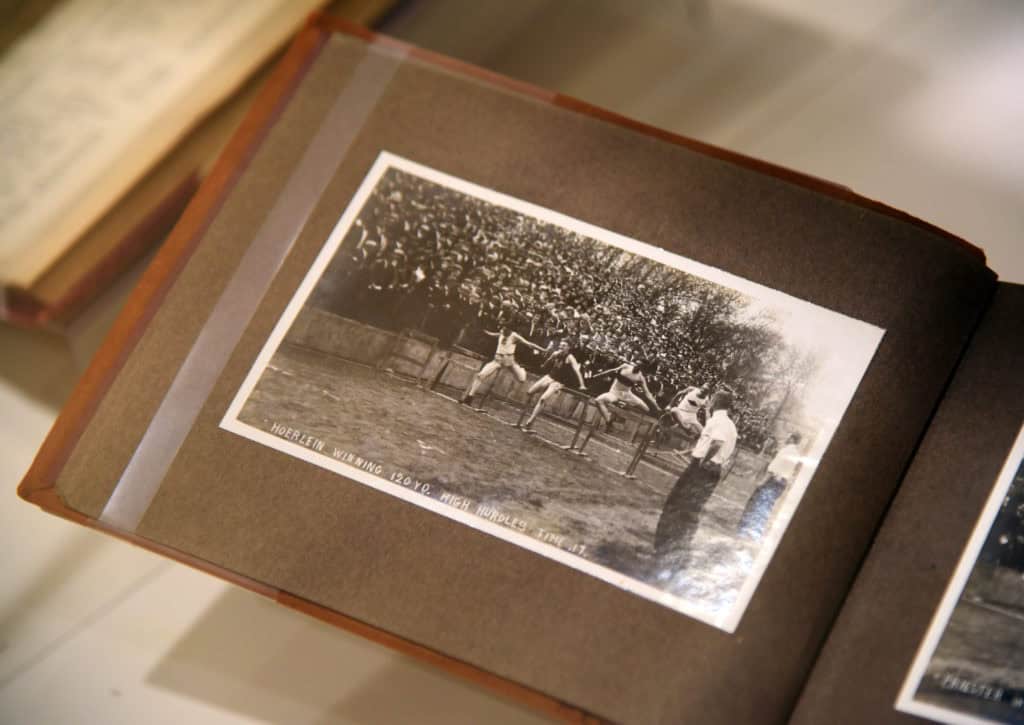
Julius Hecker’s scrapbook is a favorite of Matrice Young, student life archivist, who says “most photographs…get their own wonder.” [RG30.0001.034]
Julius Hecker’s scrapbook is a favorite of Matrice Young, student life archivist, who says “most photographs…get their own wonder.” [RG30.0001.034]
Julius Hecker’s scrapbook is a favorite of Matrice Young, student life archivist, who says “most photographs…get their own wonder.” [RG30.0001.034]
What is an athletic scrapbook?
An athlete’s scrapbook may contain items like photographs, newspaper clippings, team rosters, and keepsakes like ribbons and miniature pennants. Handwritten notes, captions, and long-lost inside jokes can also be found among these pages.
Because they were so deliberately arranged by their creators, scrapbooks are almost exhibitions unto themselves. The way pages are arranged offers additional opportunities for athletes’ accomplishments to shine, showing which moments received top billing. Matrice Young, student life archivist, says that her favorite scrapbook in the exhibit belongs to Julius Hecker (BA ’12). “I like that most photographs get their own page, and as such, get their own wonder,” Young says.
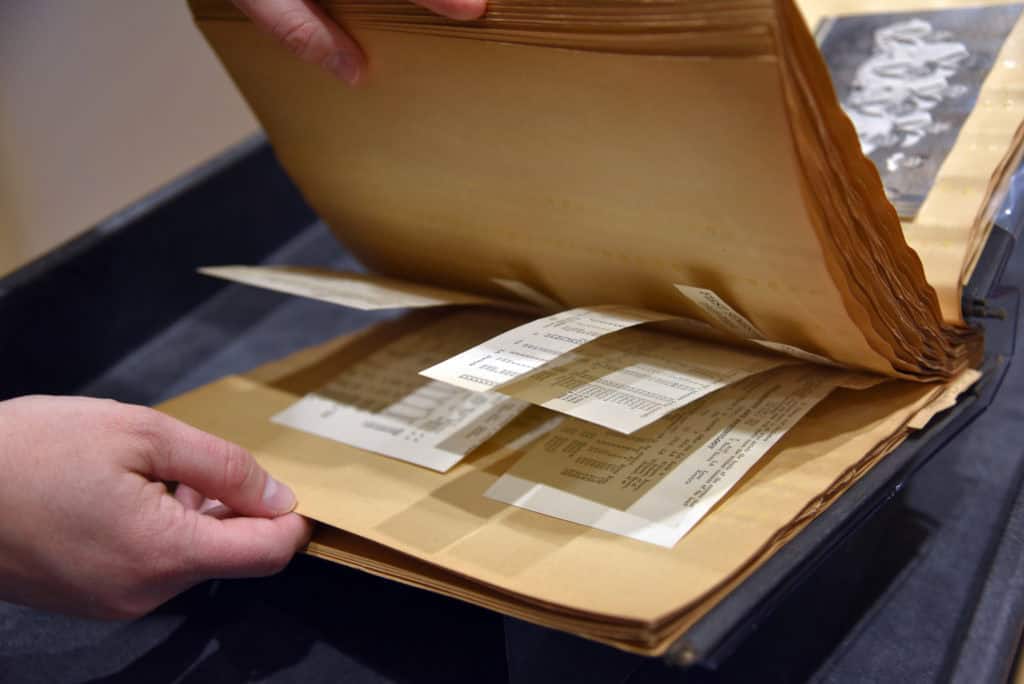
Scrapbooks like this one from the IWA’s Department of Physical Education Records contain a wide variety of materials, creating an almost three-dimensional effect. [IWA0106]
Scrapbooks like this one from the IWA’s Department of Physical Education Records contain a wide variety of materials, creating an almost three-dimensional effect. [IWA0106]
Scrapbooks like this one from the IWA’s Department of Physical Education Records contain a wide variety of materials, creating an almost three-dimensional effect. [IWA0106]
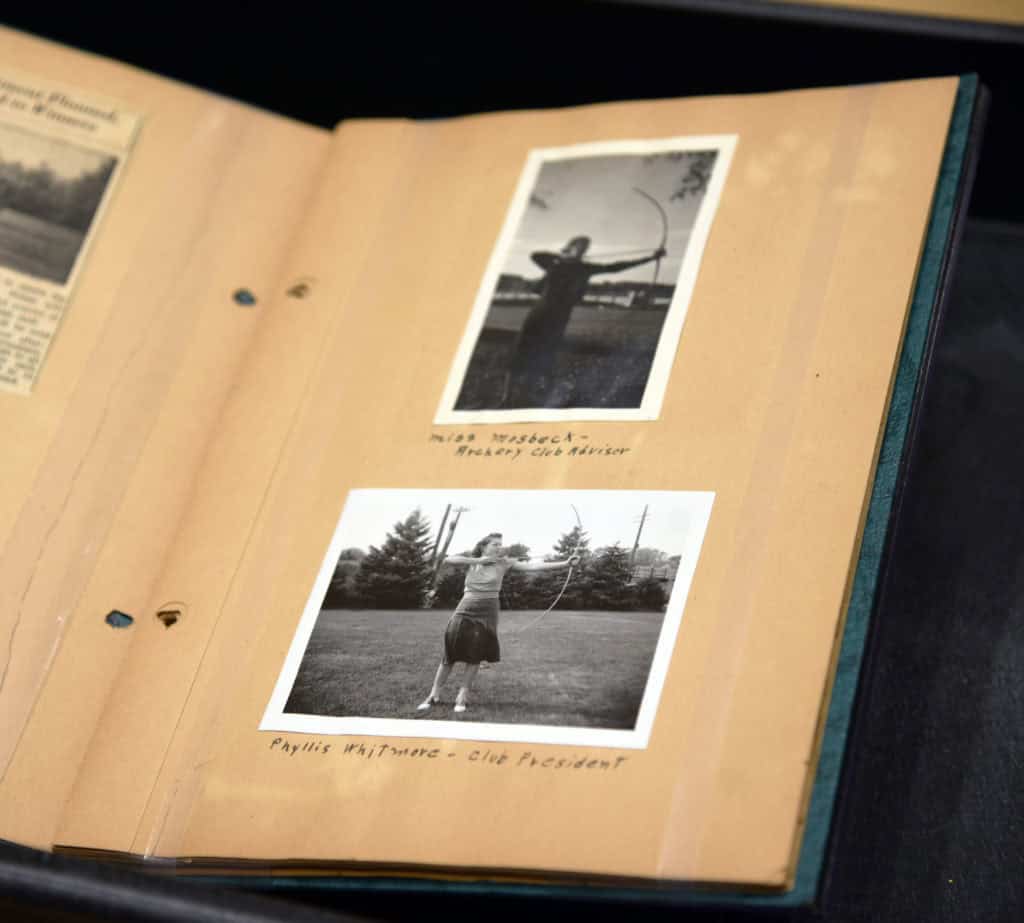
This scrapbook was curated by the Archery Club during the 1940s—a rare coeducational sport. [IWA0106]
This scrapbook was curated by the Archery Club during the 1940s—a rare coeducational sport. [IWA0106]
This scrapbook was curated by the Archery Club during the 1940s—a rare coeducational sport. [IWA0106]
Filling the margins
Scrapbooks offer unique insight into how their makers viewed the subject matter in real time. By arranging images, text, and other significant materials on the page, scrapbookers were engaging in a small-scale curation of their contemporary world. “[Scrapbooks] reflect what was important to their creators and what they thought was important to preserve,” says Sterling.
Sterling likes to draw visitors’ attention to the Archery Club scrapbook, which offers a rare look at a coeducational sport during the 1940s. In its pages, men and women compete against one another, practice together, and belong to the same team.
Long before Title IX began to address inequality in university athletics, members of women’s teams were already at work documenting their own stories. Women’s club sports like fencing had particularly comprehensive scrapbooks, which Sterling says has helped to keep their memories alive. “The histories we are able to tell about early women’s sports at Iowa are largely due to the detailed documentation the association and their clubs maintained, and the Iowa Women’s Archives’ (IWA) careful preservation of them.”
Taking a page out of their book
Anna Holland, associate curator for the IWA, hopes that today’s students will take inspiration from the scrapbooks of the past, even if their curation takes a different (likely digital) form. “I hope that current students will move with intention to save what matters to them so we will all have it to look back on in the future.”
Football is threaded into the University of Iowa’s DNA, and the importance of that connection is never clearer than during the height of football season. The sport also forms a crucial throughline in this semester’s Main Library Gallery exhibition, Hawkeye Histories | Sporting Stories, curated by Dr. Jennifer Sterling of the Department of American Studies and the School of Journalism and Mass Communication.
“There are so many football histories to tell,” says Sterling. “It is Iowa’s oldest continuous sport, the first sport at Iowa to begin the process of African American desegregation, and it has been a fan favorite on campus since its late-1800s inception.”
Below, we offer a closer look at three of the football histories included in the exhibition.
Game-time decisions
Handbook, 1915. Board in Control of Athletics Records [RG28.0003.005].
Handbook, 1915. Board in Control of Athletics Records [RG28.0003.005].
Handbook, 1915. Board in Control of Athletics Records [RG28.0003.005].
The official history of Hawkeye football began in the 1880s. During those first few decades, the team played the majority of its games against other in-state institutions. But as football’s popularity spiked nationwide, so did the number of serious injuries endured by players. There was a clear need for regulation to mitigate the safety risks of the contact sport, and multiple Midwestern universities joined together in 1896 to form the organization that would become the Big Ten Conference. The University of Iowa signed on in 1899 and joined the National Collegiate Athletic Association (NCAA) in the process. By joining these regulatory bodies, Iowa became a leader in shaping the longevity of football as an intercollegiate sport.
In 1902, the university established its Board in Control of Athletics, a committee charged with ensuring that Iowa Athletics adhered to the standards set forth by the NCAA. Hawkeye Histories | Sporting Stories contains original copies of the handbooks used to regulate multiple sports, including football, at Iowa.
Putting football on the map
Data compiled from the Iowa Letterwinners Club and University of Iowa Athletics, first seasons through 2022–23. Research and data entry: Jennifer Sterling, Olivia Baier, Maria Copozzi, students from Spring 2024 SPST 1847 Hawkeye Nation class. Mapping and visualization: Digital Scholarship and Publishing Studio.
These two heat maps use aggregated data to tell a story about the reach of Iowa football’s reputation. The map on the left shows the hometowns of players from Iowa football’s beginnings in 1880 to the building momentum of the mid-20th century. The map on the right offers the same data for the years 1950–2022. By placing these two maps side by side, we can see the emergence of a trend: while the first Iowa football players were overwhelmingly from Iowa, today’s players are increasingly coming to us from locations across the country.
Beyond household names
Hawkeye Yearbook, 1930. Yearbooks Collection [RG02.0010.001], University Archives.
While the exhibition features items and stories related to some of Iowa’s best-known players like Nile Kinnick and Duke Slater, it also devotes much-needed attention to athletes whose names are less familiar to today’s fans. Among them is Mayes McLain, a member of the Cherokee Nation who transferred from the Haskell Institute (now called Haskell Indian Nations University) in Kansas to play at Iowa during the 1928 season. He received an “I” letter, but his career at Iowa was cut short when the conference ruled that he had already met the three-year limit for players.
According to Sterling, “[McLain’s] history is also intertwined with the cusp of regulatory changes in intercollegiate athletics, which left him unfairly targeted and his playing days at Iowa shortened.”
The Main Library Gallery’s fall 2024 exhibition, Hawkeye Histories | Sporting Stories, uses materials from the archives to offer a fresh perspective on Iowa athletics from the 1800s to the present.
The free exhibition opened to the public on Monday, Aug. 26, and was curated by Dr. Jennifer Sterling, lecturer in sport media and culture within the Department of American Studies and the School of Journalism and Mass Communication. Over the course of her first 10 years at the university, Sterling noticed that while its reputation for athletic excellence is widespread, the narratives that make Iowa truly remarkable can be lost under the roar of the crowd. And, as with so many aspects of popular culture, academics who study sports have often had to argue for their merit as a scholarly subject.
“Sport is so embedded in our institutional and individual cultures that we often don’t take a closer look,” says Sterling.
This exhibition aims to help visitors do just that. Hawkeye Histories | Sporting Stories refreshes visitors’ understanding of sports history by placing Iowa’s sporting milestones in their historic and cultural contexts. Each generation of Hawkeye student-athletes and coaches has moved the starting line forward for those who came after them. In many cases, that has meant breaking down barriers to social progress on and off the field, from the integration of sports teams to the increased attention paid to women’s sports.
The exhibition does display items and information connected to some of the university’s biggest names —players and coaches like Duke Slater, Nile Kinnick, Caitlin Clark, and Christine Grant — but it also amplifies the experiences and achievements of the Hawkeye athletes not every fan will know.
“The exhibit is meant to be contextual rather than myopic—to situate Iowa’s sports histories in relation to each other and broader issues, movements, and policies rather than narrating stand-alone stories,” says Sterling.
The narrative that emerges is one of Iowa athletes with record-breaking ability and the courage to lead by example—not only experiencing history’s impact, but shaping it, too.
The exhibition is free and open to the public and will conclude following the end of the semester on Thursday, Dec. 19.
The Main Library Gallery is located near the north lobby entrance to the Main Library (125 W. Washington St.)
Open seven days a week. For detailed hours and holiday information, visit our website.
Exhibition runs from Aug. 26 to Dec. 19
Curated by Dr. Jennifer Sterling, Department of American Studies and the School of Journalism and Mass Communication
Free and open to all
This is the Board in Control of Athletics Handbook for the University of Iowa, then known as the State University of Iowa, from 1915. As the popularity of collegiate athletics began to increase at the turn of the century, so did the number of regulations designed to standardize fair play.
Board in Control of Athletics Records [RG28.0003.005], University Archives.
Throughout her career, the record-breaking women’s softball coach Gayle Blevins racked up NCAA titles. These signed softballs commemorate wins throughout her career, which took her to the University of Iowa from 1988 to 2010.
University of Iowa Women’s Softball Records [IWA1046], Iowa Women’s Archives.
Data can also be a powerful storytelling tool. These maps show the geographic origins of Iowa men’s football players between 1950 and 2022.
Data compiled from the Iowa Letterwinners Club and University of Iowa Athletics, first seasons through 2022-2023. Research and data entry: Jennifer Sterling, Olivia Baier, Maria Copozzi, students from Spring 2024 SPST 1847 Hawkeye Nation class. Mapping and visualization: Digital Scholarship and Publishing Studio.
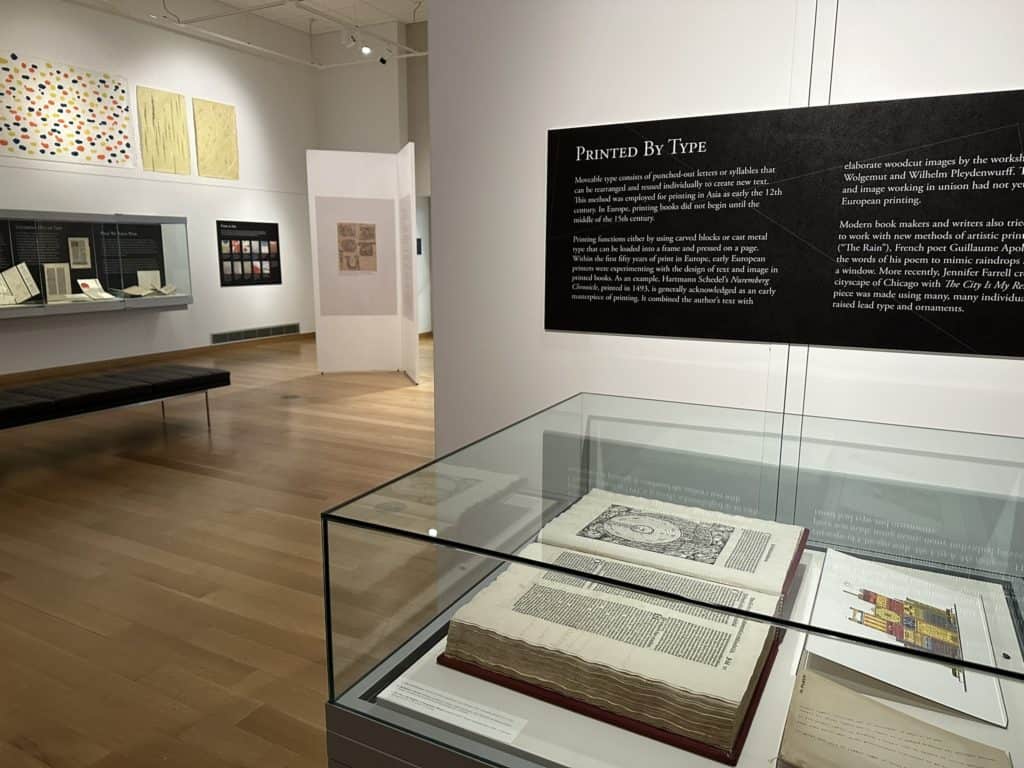
The spring 2024 Main Library Gallery exhibition, Making the Book, Past and Present, is an experience featuring global book art and rare books from Special Collections and Archives at the University of Iowa Libraries. Classes and community visitors have enjoyed visiting in person this semester, and now the exhibit is available to view online.
The virtual tour is a self-paced journey through the exhibition. It features 360° photos of the Main Library Gallery, which allow the viewer to move from area to area. The exhibit text and the items on display are clickable, meaning close-up views of many objects are available along with insights from co-curators Eric Ensley and Emily Martin. Short videos and links to additional educational content are also included.
To read about the specific items on display in the Main Library Gallery for Making the Book, Past and Present, check out the exhibition guide online. To see the virtual version of this exhibit in full screen, click the full screen icon in the lower right corner of the tour preview above, or visit the exhibit here.
More about this exhibit: Making the Book, Past and Present explores the intersections of history, art, and practicality. What can we learn by placing books, materials, and makers from the Middle Ages through today in conversation with one another? Many techniques and materials common centuries ago still inspire contemporary book artists and bookbinders.
Curated by Eric Ensley and Emily Martin, this exhibition features a global selection of rare historic books and modern book art. From medieval manuscripts and early modern works to recent book sculptures, pop-ups, and books that move, these Special Collections and Archives materials shown together make a visual feast representing the strong connection between books and makers past and present.
Books have the extraordinary power to turn their stewards into time travelers. A roughly sewn leather cover on a medieval book or a centuries-old doodle can reveal a lot about a book’s owner and its use. Minuscule notes scribbled in the margins of a plague-year calendar can hold weightier sway over today’s post-pandemic imaginations. A delicate handwritten book of recipes for everything from medical tinctures and elixirs to inks and imitation port wine lends some insight into 19th century conventional wisdom.
Contemporary book artists often look to the past for inspiration. Historic books offer a bouquet of fonts, typesettings, bindings, paper textures, and uses for makers to explore. Ancient techniques like Coptic binding, where pages are stitched together between cover boards with the spine left open, might inspire a modern book artist to use this style. Medieval blackletter, or Gothic script, might appear on a newly hand-calligraphed work. The creative potential is infinite.
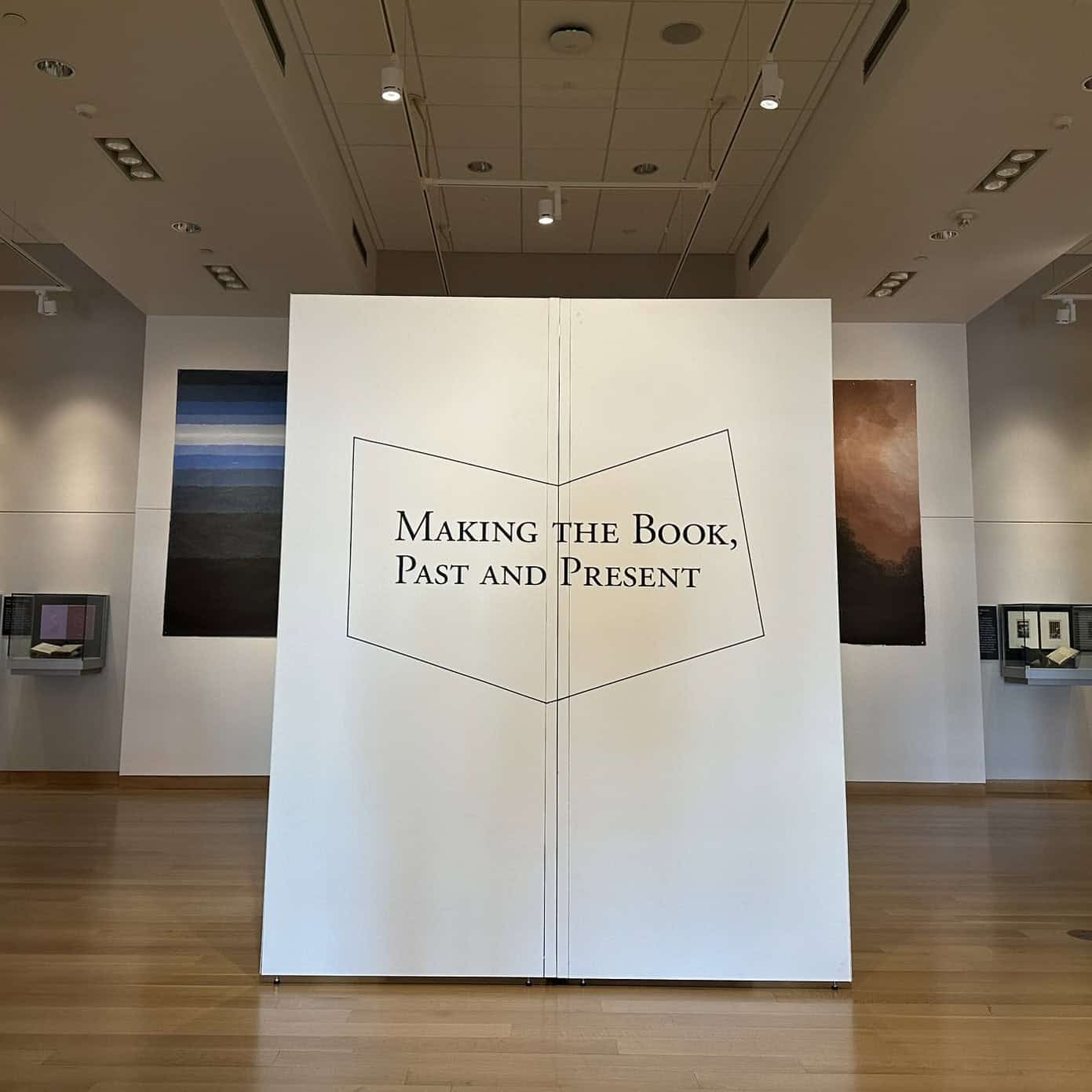
The spring 2024 Main Library Gallery exhibition Making the Book, Past and Present, takes a closer look at ways in which historic and modern books communicate across time. It explores the intersections of history, art, and practicality by placing books, materials, and makers from the Middle Ages through today in conversation with one another.
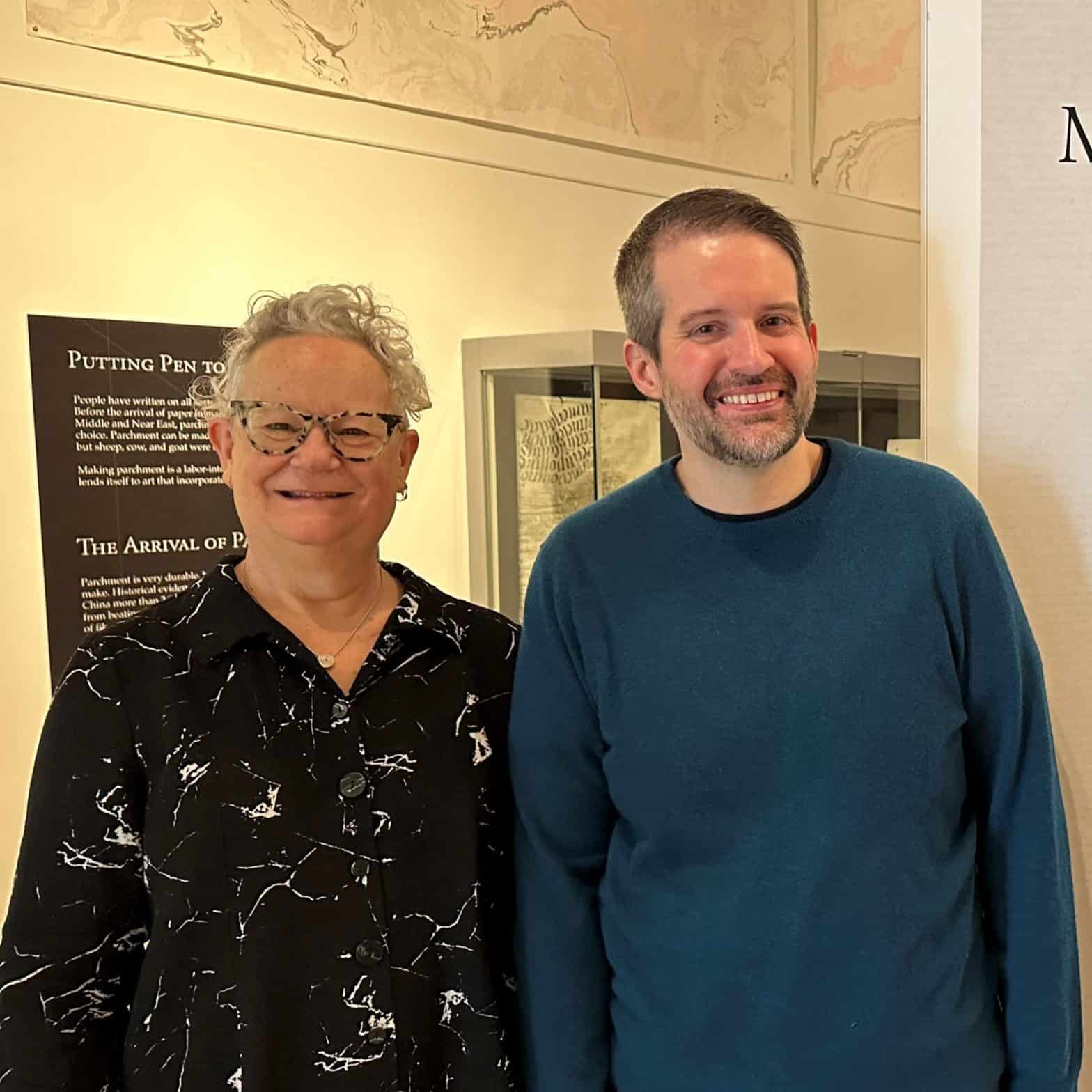
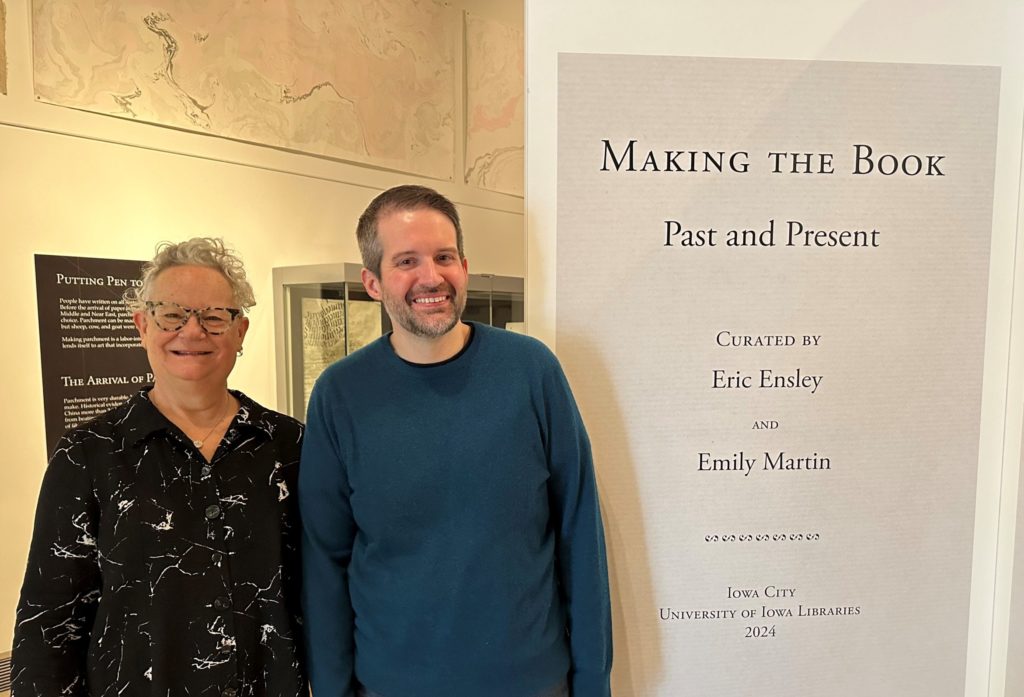
Emily Martin and Eric Ensley in the Main Library Gallery. Photo: Sara J. Pinkham.
Curated by an expert medievalist and a celebrated book artist, the exhibition is a well-rounded selection of new and old books, limited editions, and one-of-a-kind objects. Co-curators Eric Ensley and Emily Martin worked together for a couple of years to decide which items to place in the exhibit and how to tell the story of history’s influence on today’s book and paper artists.
Ensley and Martin answered some questions about their experience curating the exhibition:
Q: What inspired you to curate an exhibition on this topic?
Martin: I liked the idea of a deeper dive into the vastness of the Special Collections holdings. I am not a librarian and do not get to explore the collections as a part of my job. I relished pairing up with Eric as my co-explorer. I research rare books and other makers’ artists books while working on my own projects, and I hope by having this exhibit I will help make the resources more visible to others.
Ensley: I don’t think I would have curated this exhibit at any other institution. It’s been eye opening to see the work of so many makers and artists alongside the vibrant scholarly community that studies book history on this campus. Both groups have quite a bit to learn from one another, and so I began to think about what sort of conversations items in our collection might have.
This exhibit is about conversations between groups, namely those who study the history of books and those who make them today. Too often these groups have been walled off from one another, but it’s a testament to our campus community that this is not true here.
Q: What are some of your favorite objects in the exhibit, and why?
Martin: I have just begun to acquaint myself with the Marvin and Ruth Sackner Archive of Concrete and Visual Poetry. Getting to see in person the pages of A Humument by Tom Phillips from that collection is fabulous. Another favorite is the Ladies Typographic Union calendar. The calendar was printed annually for 15 years by students, alumni, and faculty of the University of Iowa Center for the Book. Each calendar has a unique appearance and was created collectively by the participants.
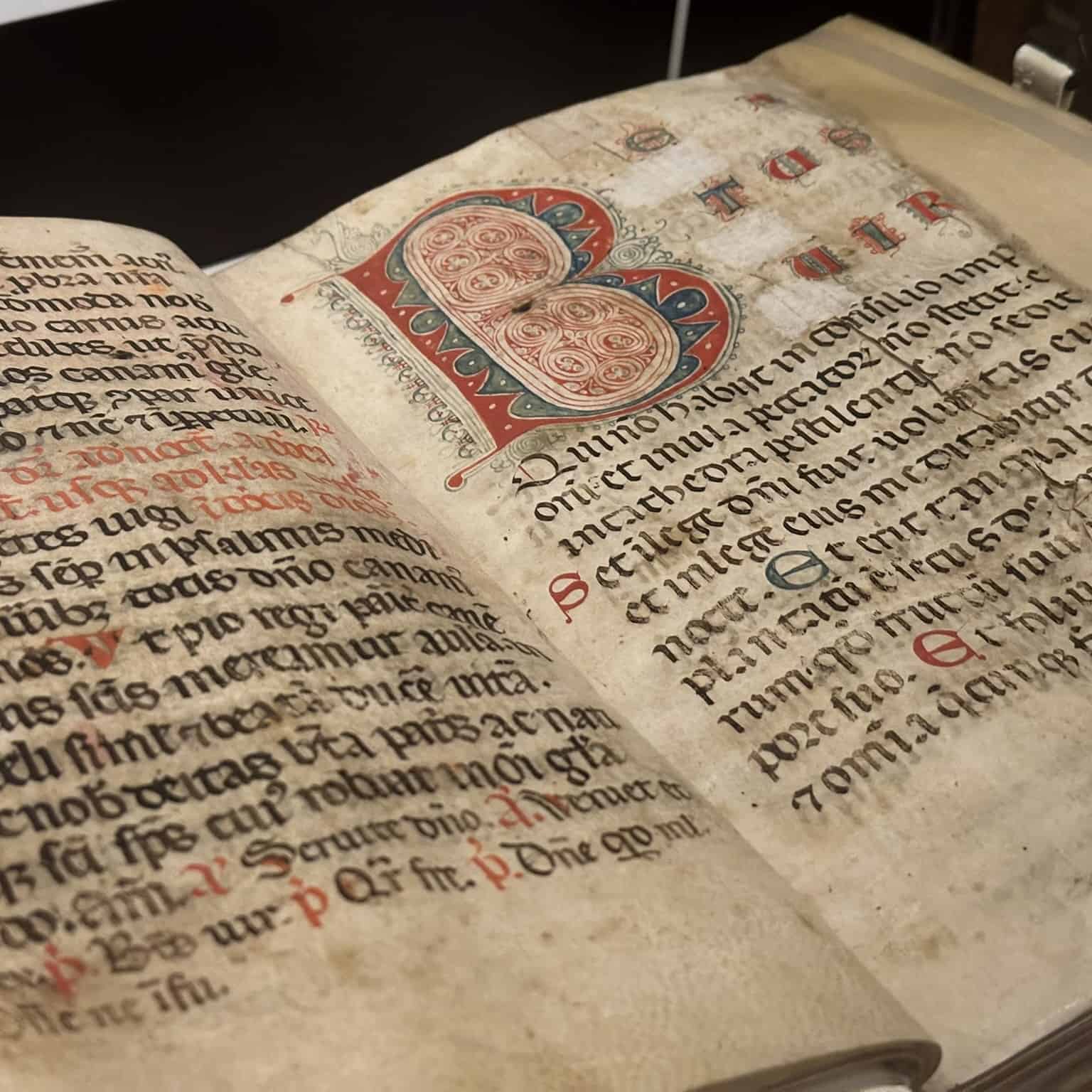
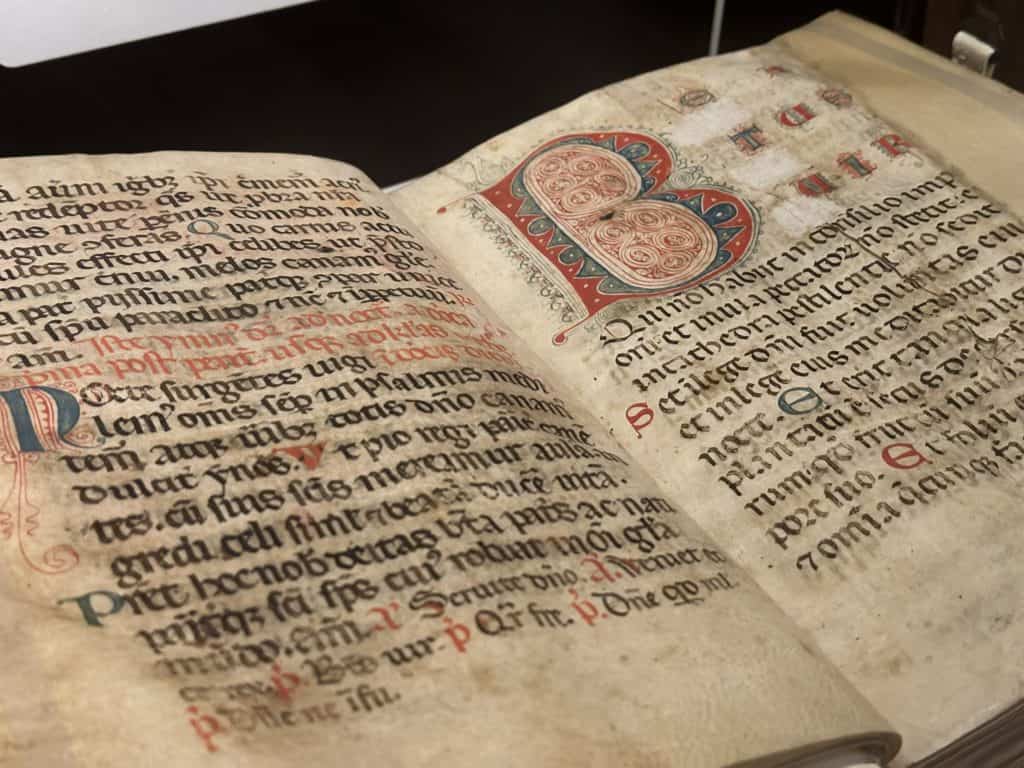
Ensley: There are too many to point to! I’m enamored with Jan Sobota’s The Old Book, which looks like a forest spirit living in a binding in the Gallery and staring out at you. I’m very fond of the medieval psalter (Psalterium cum Antiphonis, 15th c.) on display with its modern repairs alongside expert decorative lettering. The meeting of old and new in that manuscript is fantastic. I’m also taken with the colorful modern papers hanging in the gallery made by local and international artists—they’re testament to the lasting power of this artistic form.
Stara Kniha (Old Book). Jan Sobota. Dallas: Jan Sobota, 1980-1998. x-Collection. Special Collections & Archives, University of Iowa Libraries. Photo: Sara J. Pinkham.
Q: Is there anything especially unique about the juxtapositions you have made within the exhibit?
Martin: What I particularly enjoy about the many juxtapositions we have made in the exhibit is the kind of “choose your own adventure” we’ve created by showing so many aspects of book and paper arts. Books and objects are grouped in a variety of ways, structure, materials, intent, content, function.
Ensley: I don’t believe you’re likely to see many of these juxtapositions anywhere else. Some pairings of material are jarring—for example, illustrations of dissected bodies presented in a medieval book alongside a contemporary artist’s book fits this bill. However, some early and modern books are speaking in the same vernacular. Tom Phillips’ A Humument asks us to consider how words construct humans and how they’re constantly shifting. Likewise, the early medieval devotional author Maurus Rabanus saw power in words to focus human effort on the divine—Tom and Maurus could never have a conversation in person, but I believe if they could have, it certainly would have been fascinating.
Q: What do you like about having this exhibit in the Main Library Gallery on campus?
Martin: The Main Library Gallery has great access and visibility with its location on the first floor at a main entrance. It presents itself rather than people having to know to look for it.
Ensley: The accessibility the first-floor gallery provides is wonderful. This means that this exhibit can serve so many different types of communities, from students to community members. Likewise, somewhat counterintuitively, it’s nice that this space is not necessarily just a destination space. There’s a good chance people will decide to pop into the exhibit because they saw it on their lunchbreak or while picking up some books for a class. I think the infiltration of art and history into everyday life is a big benefit of such a space.
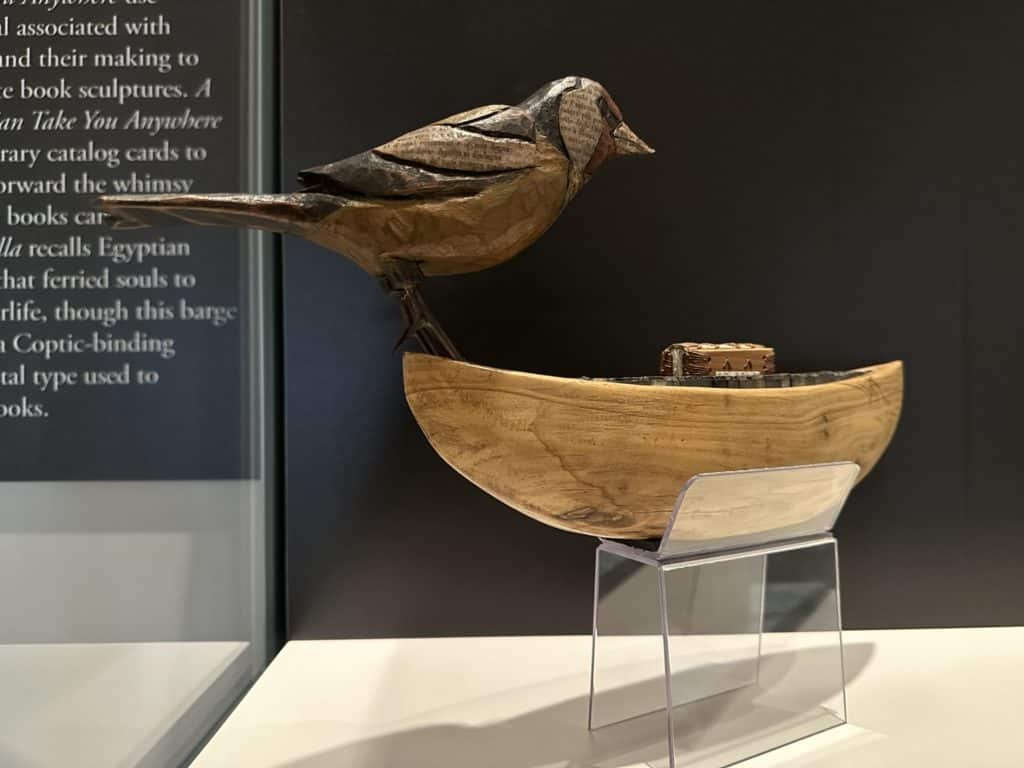
Sentinella. Daniel Essig. Asheville, North Carolina: Daniel Essig, 2013. x-Collection Oblong [N7433.4.E88 S45 2013]. Special Collections & Archives, University of Iowa Libraries. Photo: Sara J. Pinkham.
Q: What do you hope visitors will take away from their time in the exhibit?
Martin: I hope visitors will take away an appreciation of the range and versatility of the book arts and its continued relevance in current times.
Ensley: First and foremost, I hope they enjoy the visuals of this exhibit. The colors, craft, and fine details on display are incredible and bring me joy. Then, I hope visitors will ask what books say about the long history of humanity. What do we share with the past, and what has changed? I think, with many of these pairs, there’s a sense that history is simultaneously so very close to us and far away. We care about many of the same things that ancient makers did, but it’s never quite identical from one period to the next.
Each and every one of these objects is available for use in Special Collections and Archives once the exhibition ends. There’s so much that we couldn’t quite make fit in the gallery, and I hope folks will come up to the third floor to see all the other objects we have that tell the story of humanity, too.
From Making the Book, Past and Present in the Main Library Gallery, University of Iowa Libraries. Photo: Sara J. Pinkham.
Visit lib.uiowa.edu/gallery for open hours and updates about free exhibit-related events. The Main Library Gallery is open daily and all are welcome.Plus, find short videos of select books in the exhibition on the UI Libraries YouTube channel.
The tour features 360° photos of the Main Library Gallery, which allow the viewer to move from area to area. The text panels and the items on display are clickable, meaning close-up views of many objects are available along with insights from co-curators Jen Knights and Brad Ferrier.
To read about the specific items on display in the Main Library Gallery for this exhibition, check out the exhibition guide online. To see the virtual version of this exhibit in full screen, click the full screen icon in the lower right corner of the tour preview above, or visit the exhibit here.
More about this exhibit: Hey Buddy, I’m Bill tells the story of Bill Sackter, the namesake of Wild Bill’s (formerly Wild Bill’s Coffee Shop) in the University of Iowa School of Social Work. From his early life in Minneapolis to his 44-year institutionalization for an intellectual disability to his years of friends and fame in Iowa City, the exhibit shares a glimpse into Bill’s life and legacy. The exhibit also acknowledges some of Iowa’s own history with institutionalization and progress with disability rights, and places Bill’s story in the context of the historic treatment of people with disabilities. The exhibit not only tells how Bill’s life embodied the disability practices and perspectives of his time, but also how the national prominence of his life story helped America make progress toward better understanding and treatment of people with disabilities.
The exhibition features artifacts, documents, and ephemera from Bill’s life.
A new exhibition in the Main Library Gallery this spring showcases a global selection of rare historic books and modern book art.
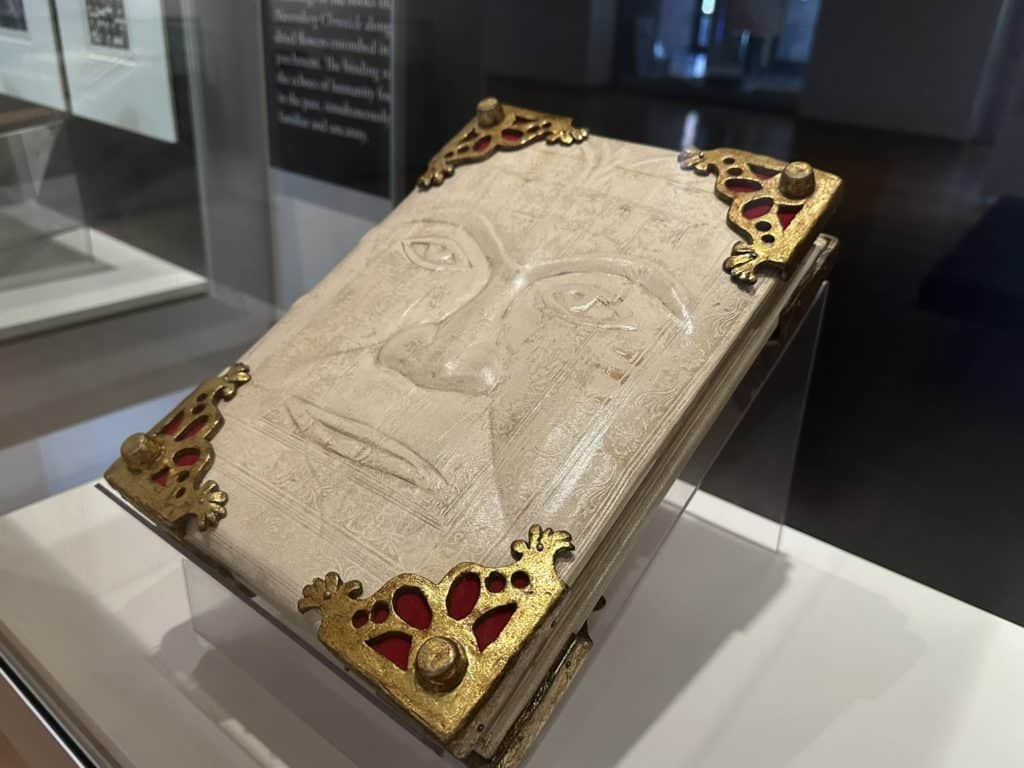
Psalterium cum Antiphonis, late 15th century. Rebound and treated in the University of Iowa Libraries Conservation Lab by William Anthony in 1985. Medieval Manuscripts [xMMs.Ps3]. Special Collections & Archives, University of Iowa Libraries. Photo: Sara J. Pinkham.
Making the Book, Past and Presentexplores the intersections of history, art, and practicality through items from Special Collections & Archives at the University of Iowa Libraries. The exhibition asks what we can learn from placing books, materials, and makers from the Middle Ages through today in conversation with one another.
From medieval manuscripts and early modern works to recent book sculptures, pop-ups, and books that move, these carefully curated materials shown together are a visual feast representing the strong connection between books and makers past and present.
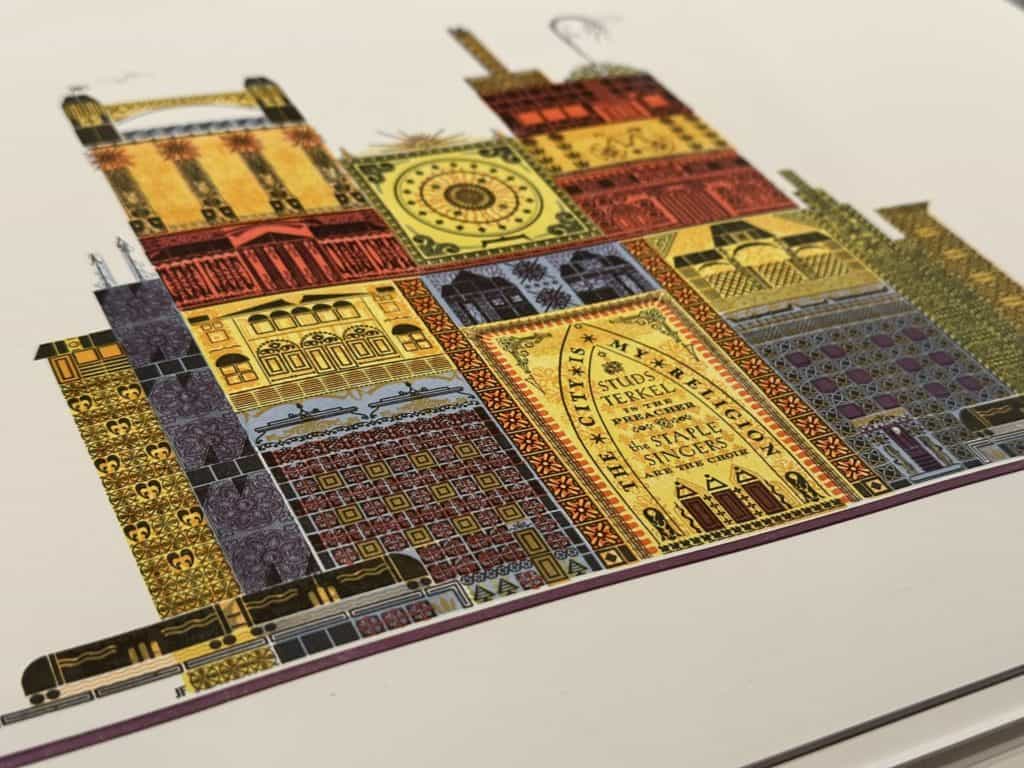
Detail from The City is My Religion: A Typographic Memoir. Jennifer Farrell. Chicago: Starshaped Press, 2020. x-Collection Oblong [FOLIO N7433.4.F3677 C58 2020]. Special Collections & Archives, University of Iowa Libraries. Photo: Sara J. Pinkham.
Making the Book, Past and Present was curated by Eric Ensley, curator of rare books and maps at the University of Iowa Libraries Special Collections & Archives, and Emily Martin, adjunct assistant professor of bookbinding and book arts at the University of Iowa Center for the Book.
This exhibition will be on display in the Main Library Gallery through June 28, 2024. The Main Library Gallery is located on the first floor of the Main Library and is open daily. Please visit lib.uiowa.edu/gallery for all open hours and updates about free exhibit-related events. Admission is free and all are welcome.
By Sara J. Pinkham, exhibition and engagement coordinator, Main Library Gallery
The fall 2023 Main Library Gallery exhibition, Hey Buddy, I’m Bill, shares the story of Bill Sackter, an Iowa City legend and advocate for people with intellectual disabilities.
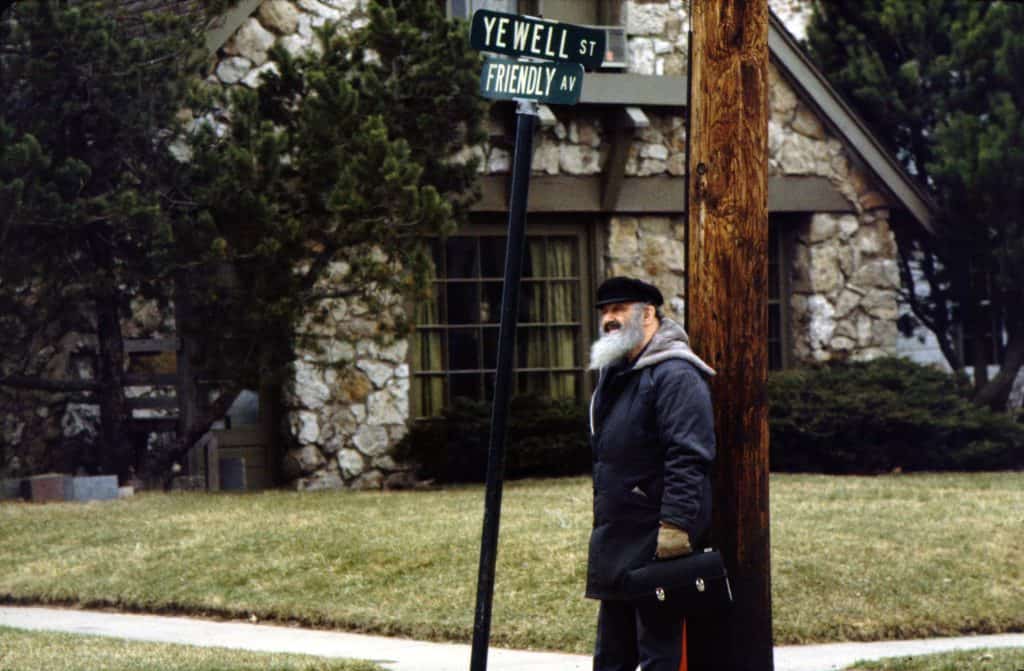
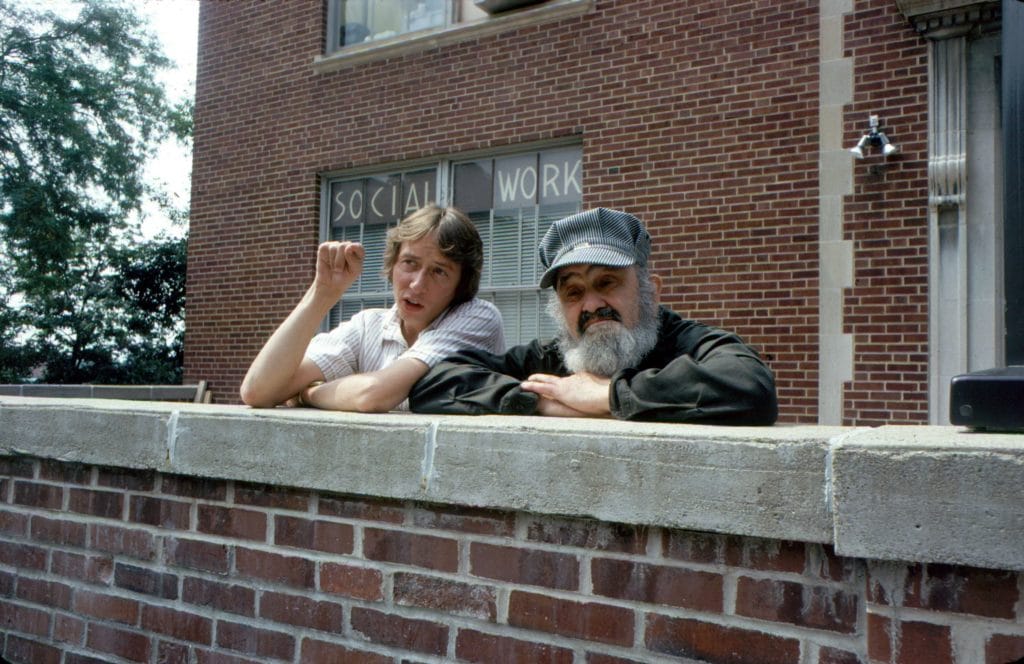
Bill Sackter stands at the corner of Friendly Ave. and Yewell St. in the Lucas Farms Neighborhood of Iowa City, 1970s. Photo: Barry Morrow.
Curated by Jen Knights, marketing and communications manager for Performing Arts at Iowa in the College of Liberal Arts and Sciences, and Brad Ferrier, digital projects librarian in Special Collections and Archives at the University of Iowa Libraries, the exhibit is a chronological exploration featuring many personal belongings from his life. The narrative places Bill’s experiences within the context of disability rights and the historic treatment of people with disabilities.
Who was Bill?
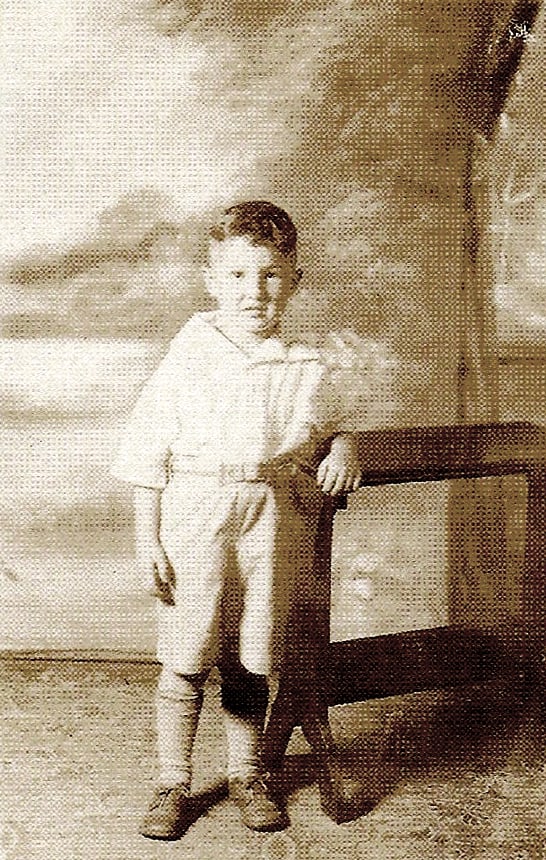
Bill Sackter in 1920 at age 7. Courtesy of Lane Wyrick.
Bill was born 110 years ago, in 1913, to Ukrainian Jewish immigrants Samuel and Mary Sackter in Saint Paul, Minnesota. The couple later owned a small neighborhood grocery store on the north side of Minneapolis. After his father’s untimely death in 1920 at age 34, Bill had difficulties in school and his mother struggled to manage the grocery store as well as run a household and care for three children. At the urging of his school, the State of Minnesota evaluated Bill using the primitive tests available at the time and determined him to have severe intellectual limitations. With his father gone, the state decided to remove Bill from his home and place him into the “State School for Feeble-Minded and Epileptics” in Faribault. His mother petitioned to have him released, but Bill was ultimately institutionalized at Faribault for 44 years. He never saw his mother or two sisters again.
In the mid-1960s, Bill was released from Faribault and allowed to live on his own as a ward of the state. Having spent most of his life as an inmate, he was not prepared for life outside the institution. He went back to Minneapolis as a ward of the state and, for about a decade, drifted from place to place working odd jobs. While working as a dish washer at the Minikahda Club, his life changed for the better when he met Beverly Morrow, who was working at the club as a waitress. Bev and her husband Barry became good friends with Bill, and Barry was later awarded guardianship of Bill. The couple brought Bill with them to Iowa City when Barry was offered a job at the University of Iowa School of Social Work.
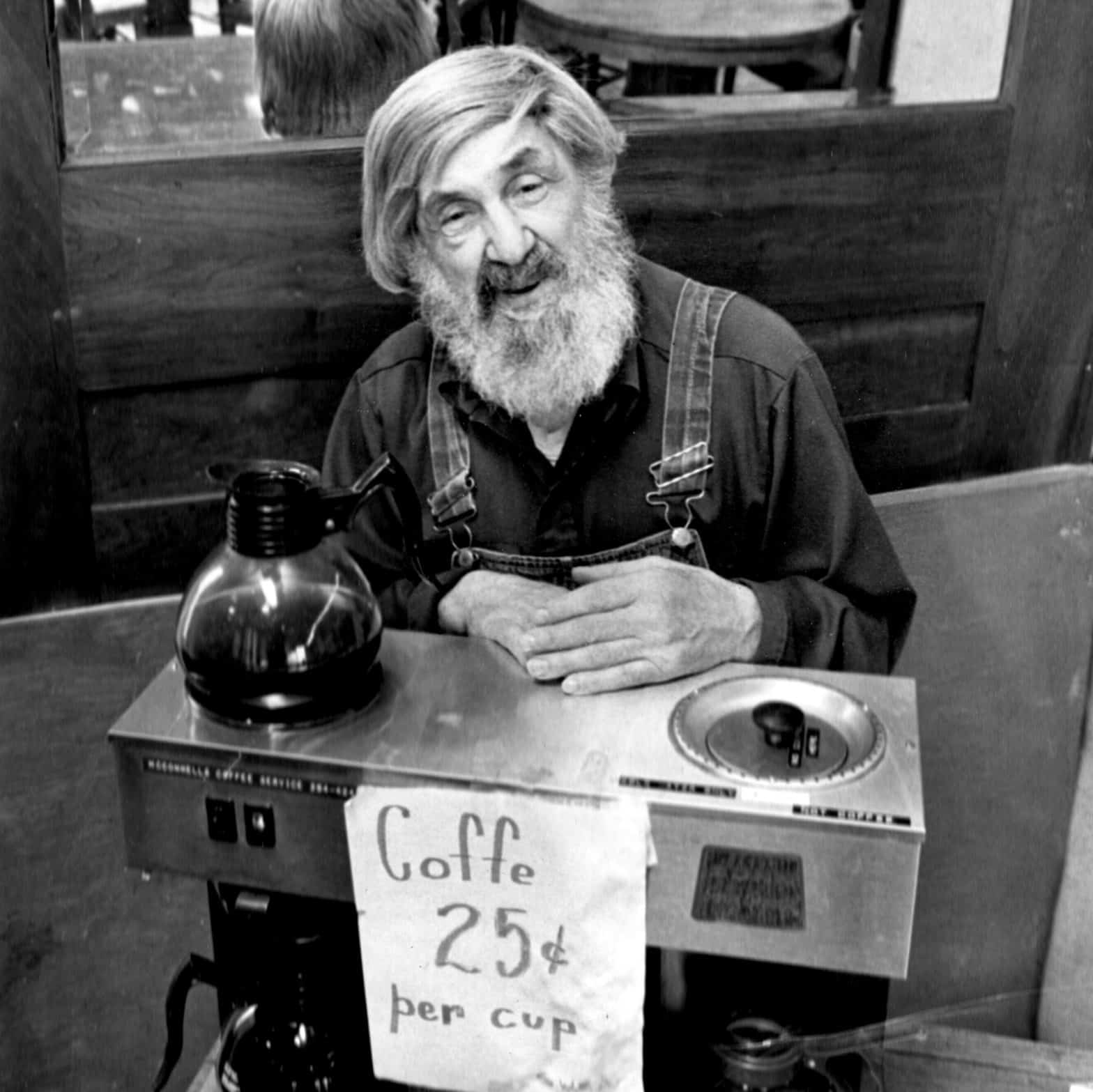
Bill quickly became a friend to everyone he met in Iowa City. “If you ain’t got a buddy, what do you got?” was one of Bill’s key philosophies. Despite everything he had endured before meeting the Morrows, his goals in life were to bring joy to others and to be happy. Even in the dismal conditions at Faribault he had been able to find purpose in helping to care for others at the institution. “When I could make people happy, it made me happy,” Bill once said.
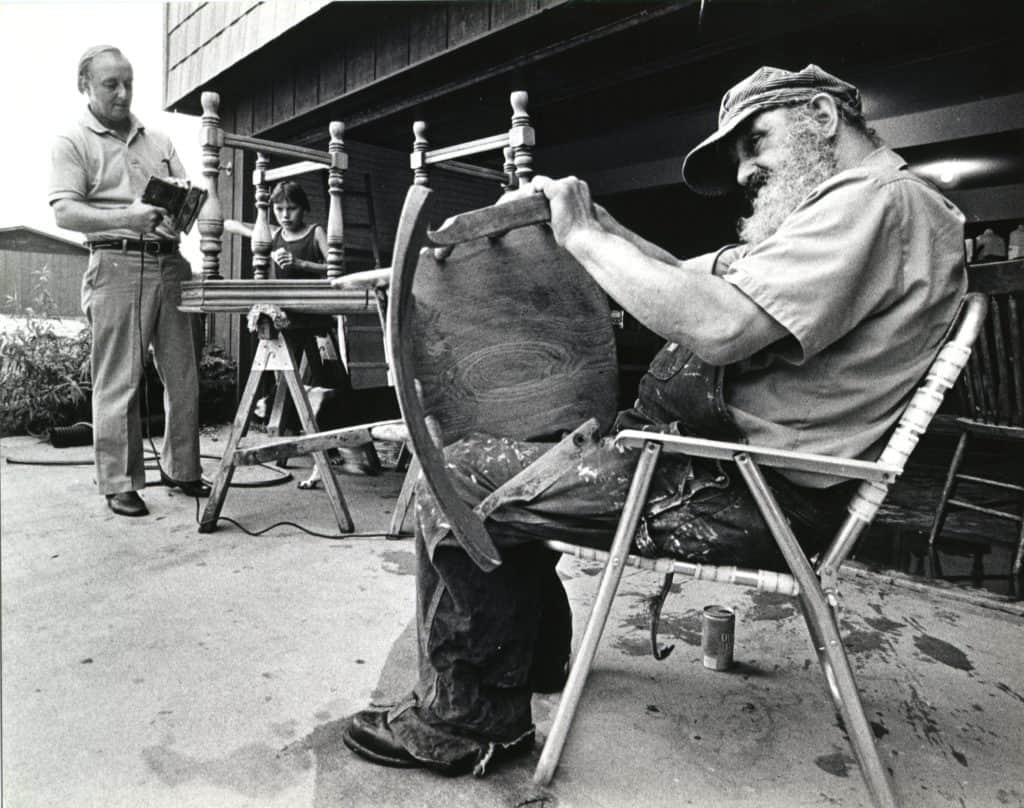
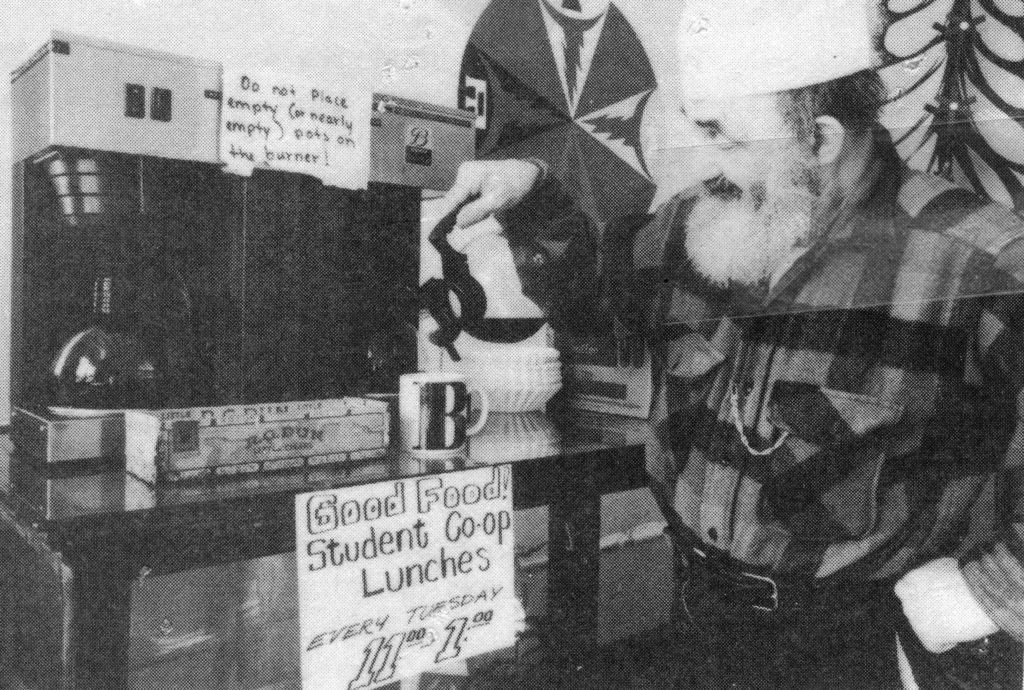
Tom and Bill refinishing furniture, 1970s. Photo: Barry Morrow.Bill pouring coffee at Wild Bill’s, 1970s. Courtesy: Lane Wyrick.
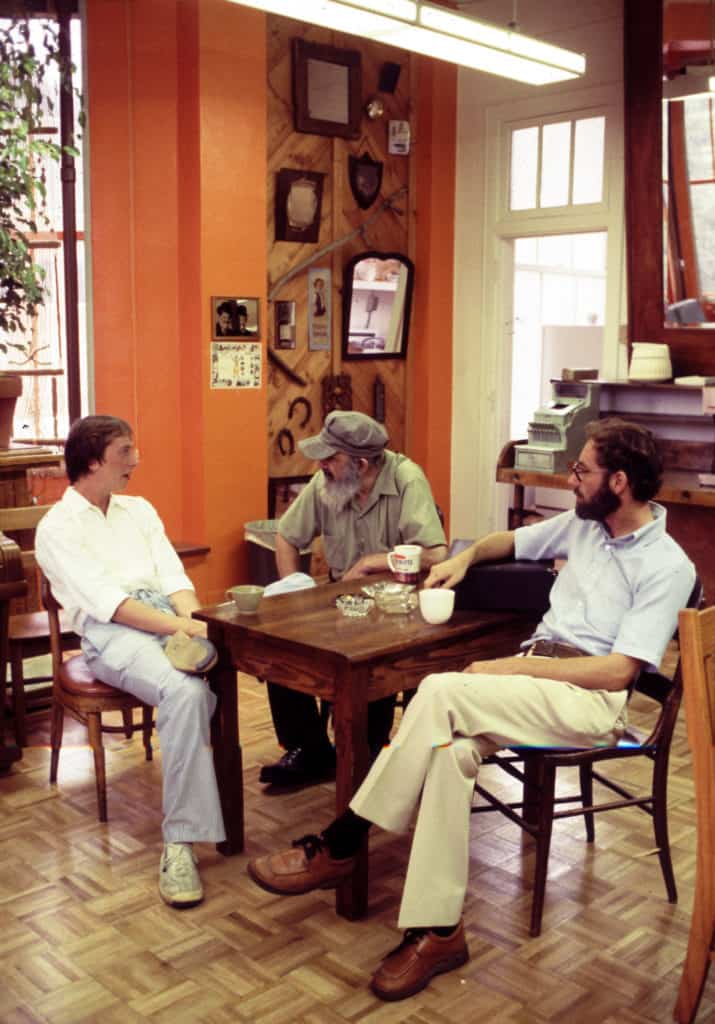
Tom Walz, director of the School of Social Work at the time (1973-78), hired Bill as a developmental disabilities consultant. Eventually Bill became locally famous for his role as the proprietor of Wild Bill’s Coffee Shop, located in North Hall, as well as his talent on the harmonica and his kindness to children. His personal business card also styled him as a “clinical optimist.”
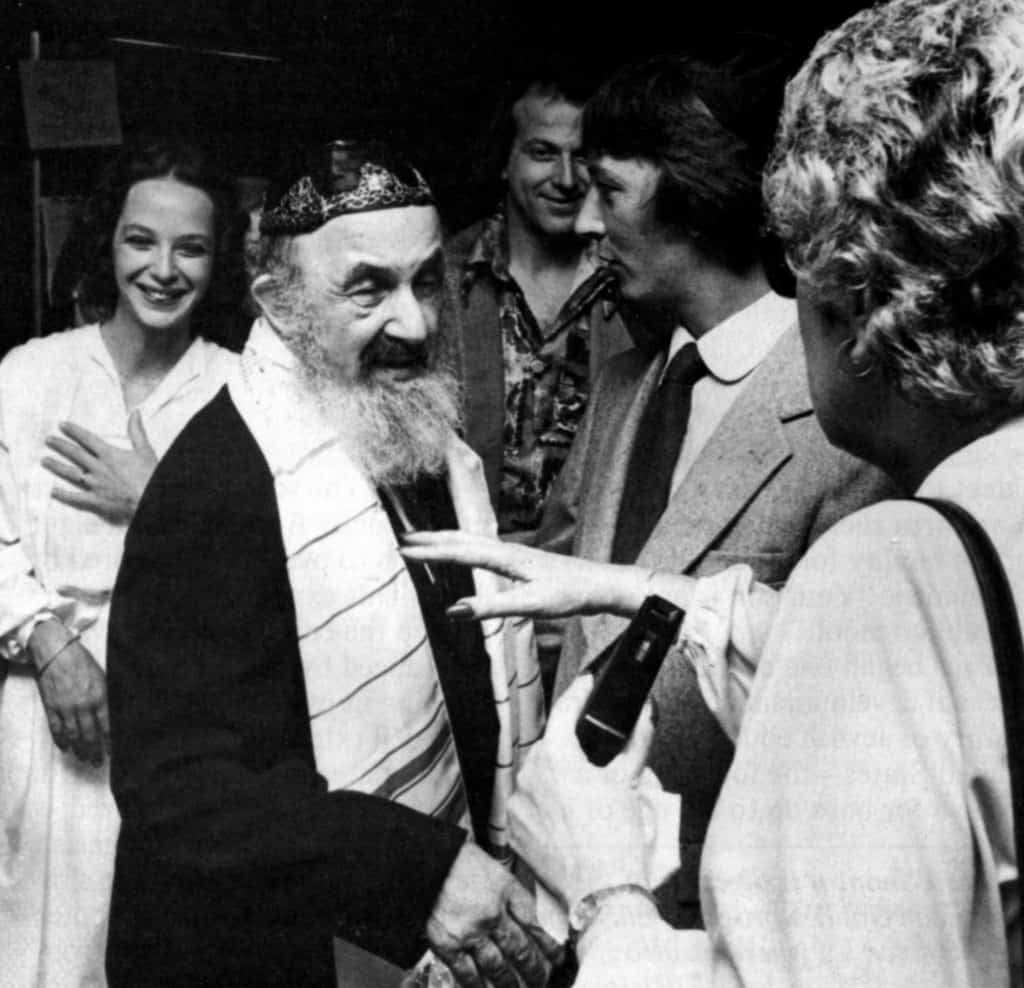
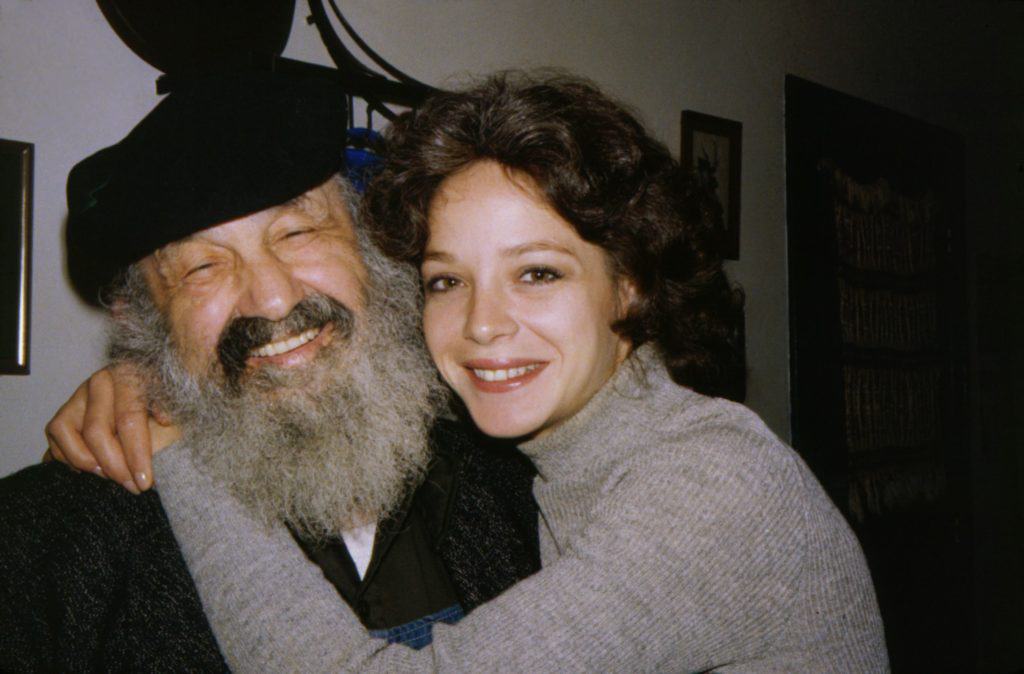
Bill Sackter surrounded by friends at his bar mitzvah, which was celebrated at Iowa Hillel in 1979. In the background: Bev Morrow, Jack Doepke, and Barry Morrow. Photo: Drake Hokanson.
Many community members still remember Bill fondly. After he found out about his Jewish heritage, he began attending services at Agudas Achim Congregation in Iowa City. “People are given Hebrew names along with their English names usually at birth, but Bill didn’t know his Hebrew name,” said Rabbi Jeff Portman. “So, we called him Simcha – which means ‘happiness,’ since he was a very upbeat, positive person despite his tough life.”
Bill celebrated his bar mitzvah at age 66. “In lieu of a sermon that a bar mitzvah kid would make, Bill thanked everyone and played his harmonica,” said Portman.
Barry Morrow wrote a screenplay about Bill’s life, Bill, which was produced as a television movie in 1981 starring Mickey Rooney and Dennis Quaid. The Emmy- and Golden Globe-winning film catapulted Bill into the national spotlight, making him an even stronger advocate for people with intellectual disabilities. A sequel film, Bill: On His Own, aired in 1983. In the foreword to Tom Walz’s 1998 book The Unlikely Celebrity, Morrow credits Bill with being the “catalyst of at least one career. I didn’t plan to become a screenwriter. I just met Bill Sackter.”
Bill Sackter passed away peacefully at home in Iowa City in 1983.
“We hope to teach a new generation of people about Bill Sackter’s story with this exhibit,” said co-curator Jen Knights, who previously worked in the School of Social Work.
“It is important to tell his story again,” said co-curator Brad Ferrier. “There are fewer and fewer people who know the name ‘Bill Sackter.’ This exhibit will hopefully introduce, or reintroduce, Bill to a community that he had a tremendous influence on.”
Bill Sackter with Clay Morrow, 1970s. Photo: Barry Morrow.Barry with Bill by North Hall, 1970s. Photo: Barry Morrow.
Items on display in the exhibition are from collections in the University Archives, the Iowa Women’s Archives, from the School of Social Work, and from friends of Bill Sackter, including Barry and Bev Morrow. From photos and letters to Bill’s signature overalls and Morrow’s Emmy, the exhibit contains a wide variety of artifacts and ephemera.
“There’s so much we can never know about Bill Sackter,” said Knights. “What we have learned about him and who he was can’t entirely fit in this room—but, with this exhibit, we hope we can give people the sense that everybody’s story matters.”
Hey Buddy, I’m Bill is display in the Main Library Gallery through Dec. 19, 2023. A virtual version of the exhibit will be available later this fall.
Visit lib.uiowa.edu/gallery for updates about free exhibit-related events. All are welcome.
By Sara J. Pinkham, exhibition and engagement coordinator, Main Library Gallery
The story of Bill Sackter is familiar to many who have lived in Iowa City for a long time. Perhaps some will remember buying a cup of coffee from him at Wild Bill’s Coffee Shop in North Hall in the University of Iowa School of Social Work. Others might recall reading about him in the local paper, seeing him at synagogue, greeting him at the bus stop, or watching the two television movies inspired by his life.
The fall 2023 Main Library Gallery exhibit serves both as an introduction for people who never had the opportunity to meet Bill, and as a celebration of this Iowa City legend for those who were fortunate enough to cross paths with him.
Bill was a man who endured many years institutionalized in Minnesota for an intellectual disability. Despite this treatment, he brought joy and kindness with him wherever he went after finding his freedom and settling in Iowa City. Hey Buddy, I’m Billshares a glimpse into Bill’s life and legacy while also acknowledging some of Iowa’s own history with institutionalization and disability rights.
The exhibition will be open through Dec. 19, 2023, and was curated by Jen Knights and Brad Ferrier. Knights is the marketing and communications manager for Performing Arts at Iowa in the College of Liberal Arts and Sciences, and Ferrier is a digital projects librarian in Special Collections and Archives at the University of Iowa Libraries.
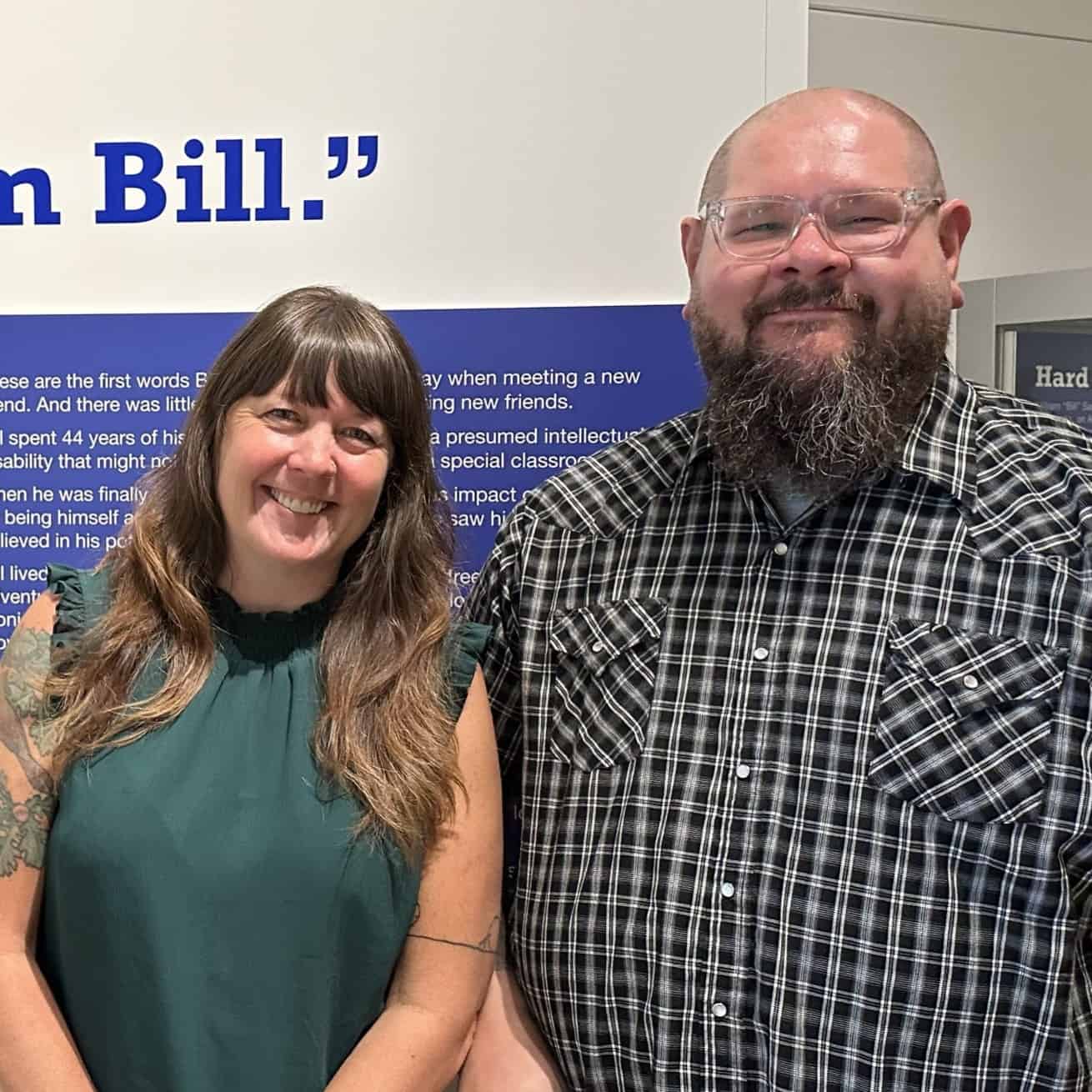
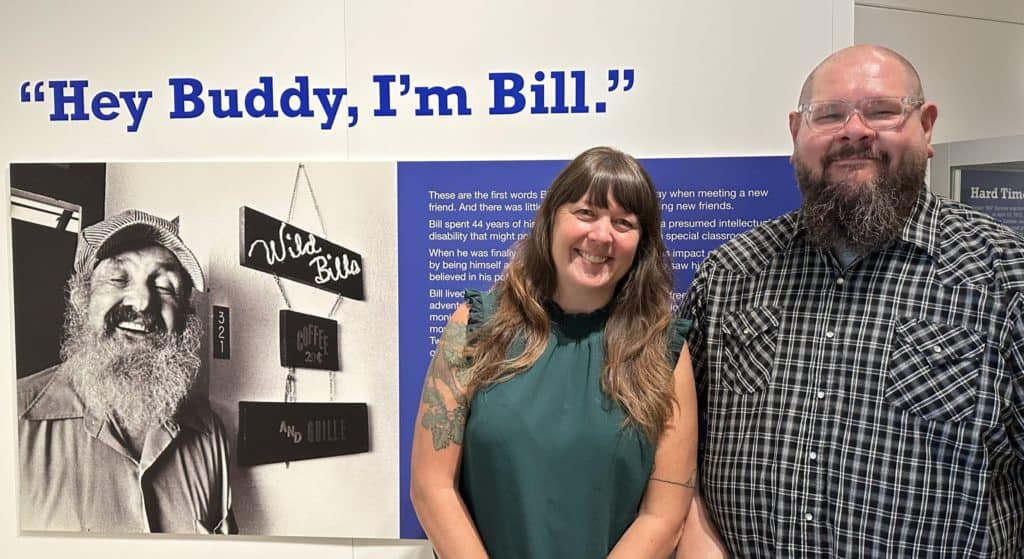
Jen Knights and Brad Ferrier in the Main Library Gallery on the opening day of Hey Buddy, I’m Bill on August 21, 2023. Photo: Sara Pinkham.
Both answered some questions about their experience curating the exhibit:
Q: Why is it important to have an exhibit featuring Bill Sackter?
Knights: We hope to teach a new generation of people about Bill Sackter’s story. It is not only an important part of the history of the University of Iowa and our national leadership in the area of disability, but also as a demonstration of the power of writing and storytelling and how stories can shift perspectives, expand understanding and empathy, and truly make a difference on a large scale. In this case, the Emmy- and Golden Globe-winning film Bill, written by Barry Morrow, a former staff member at the UI School of Social Work.
Barry and his wife, Bev, both played very important roles in Bill’s life. They are the people who befriended Bill in Minneapolis, made him a part of their family, and moved him to Iowa City with them, where he thrived. Their time together inspired Barry to write the teleplay for the eponymous television movie, which started Barry’s career in Hollywood and brought Bill into the national spotlight.
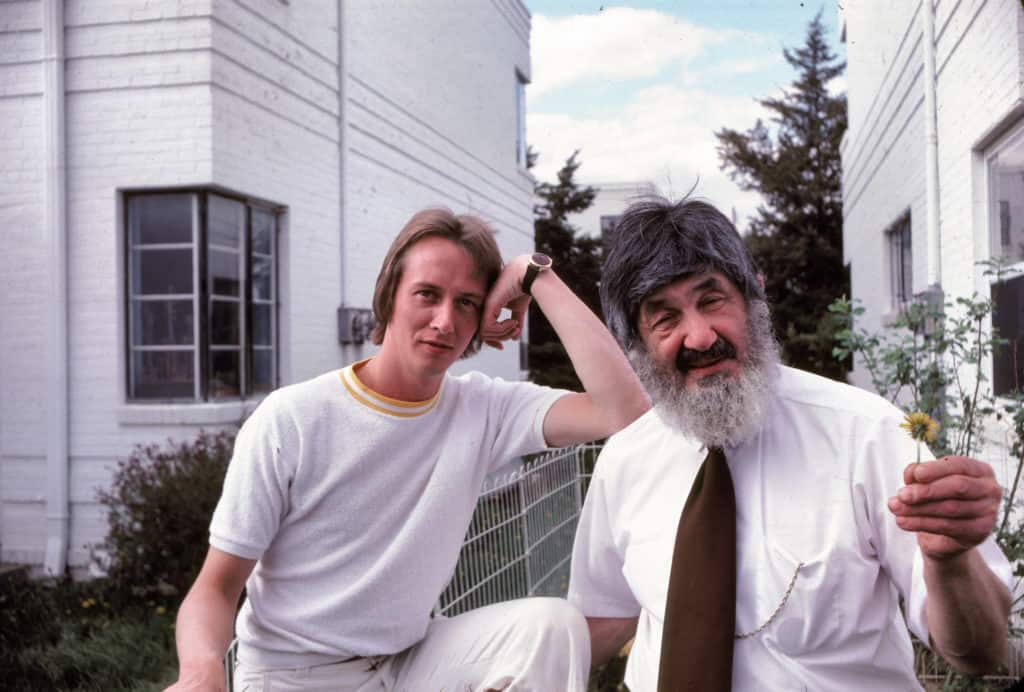
Barry Morrow and Bill Sackter, 1970s. Photo: Barry Morrow.Bill Sackter and Bev Morrow, 1970s. Photo: Barry Morrow.
Ferrier: When Bill died in 1983, I was only 6 years old. I did not know about Bill Sackter while I was growing up in Indiana, nor had I seen the movie Bill on TV. When I arrived at the University of Iowa in 2010 to pursue a graduate degree from the School of Library and Information Science, I came across Wild Bill’s, a coffee shop in North Hall. I would occasionally visit the coffee shop while taking classes at the University of Iowa Center for the Book and noticed the photographs of Bill on the wall.
I did not really get to know the story of Bill until after graduating, after having my stroke (shortly after graduation), and after I started working at the University of Iowa Libraries. I became involved in disability awareness and advocacy on campus and had a chance to see a screening of A Friend Indeed at Wild Bill’s, hosted by Jen. From that documentary, I began to understand the significance of Bill and the impact he had on those who knew him, and the impact that he still has today.
It is important to tell his story again. There are fewer and fewer people who know the story of Bill Sackter. This exhibit will hopefully introduce, or reintroduce, Bill to a community that he had–and still has–a tremendous influence on.
Q: What inspired you to co-curate an exhibition for the University of Iowa Libraries?
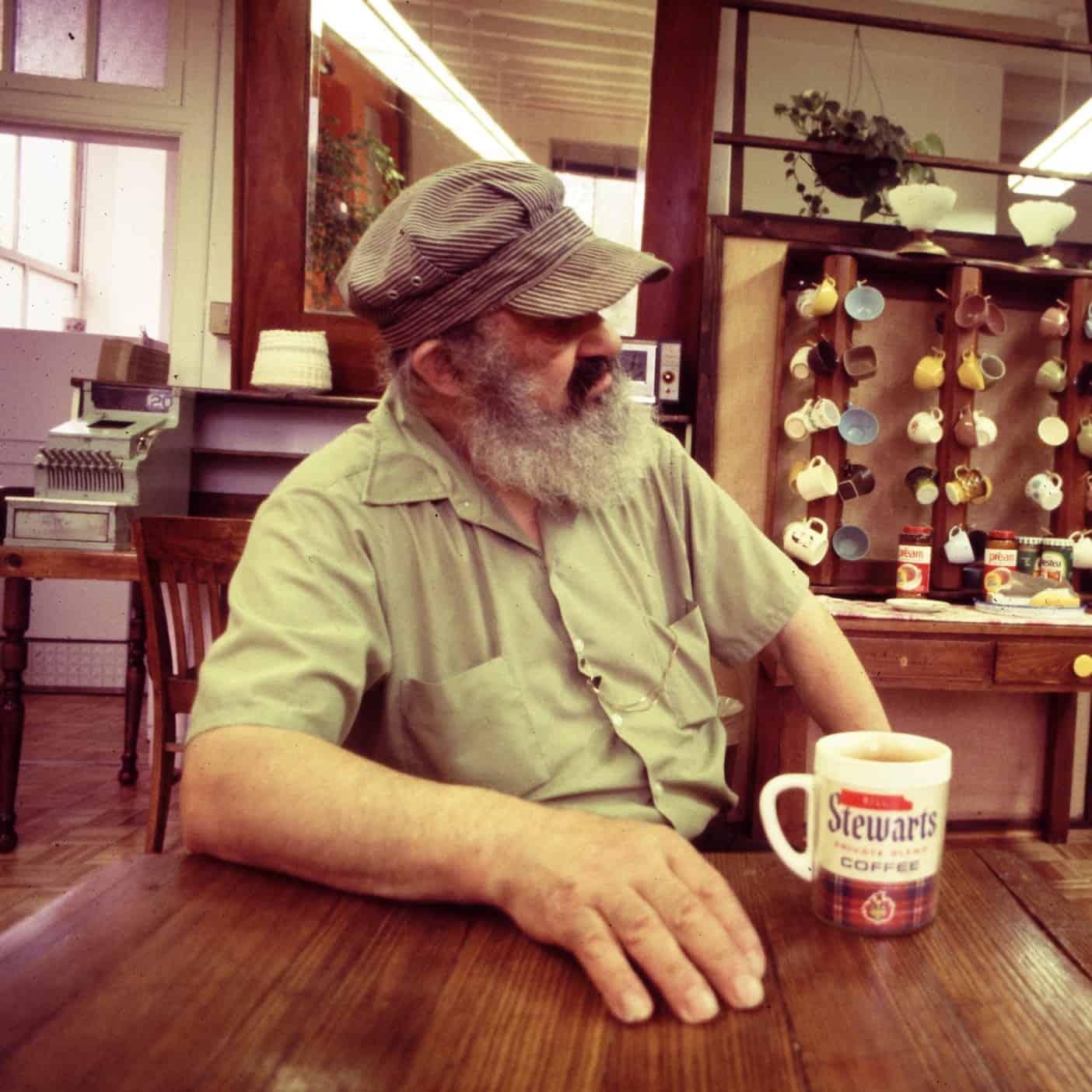
Barry Morrow, Bill Sackter, and Rabbi Jeff Portman (close friend and later guardian to Bill) enjoying coffee together in Wild Bill’s Coffee Shop, 1970s. Photo: Barry Morrow.
Knights:Prior to my current role in Performing Arts at Iowa, I worked at the School of Social Work. I was the staff person overseeing the management of Wild Bill’s in 2020, the year the coffee shop closed. The School of Social Work team made the decision to change the format of Wild Bill’s (which is still open as a learning lab and classroom) because of the pandemic, and also because of progress. People with disabilities are now much more integrated into community spaces, and social work students no longer need a sheltered, dedicated environment where they can interact with people with disabilities. We continued to change with the times, and we shifted to honor our own strategic priorities and best practices.
As we pivoted, we realized that it’s an important moment to tell Bill’s story to a wider audience again, and to preserve his legacy to teach new generations about the impact his life had in the world. We have people in our community who still remember Bill and have their own stories to tell, and we have young people and newer community members who have never heard about him. And we have this treasure trove of artifacts and writings and photos that need to be preserved, catalogued, and kept safe so that Bill—and all of his “buddies”—will not be forgotten. This is when I decided to submit an exhibit proposal to the Main Library Gallery.
Ferrier: I take very little credit for curating this exhibit. Jen drafted and submitted the proposal for the exhibit and then asked me if I would like to be a part of it. I said yes, without hesitation. This was a tremendous opportunity because I–in fact, neither one of us–had curated an exhibit before. Jen, having worked at the School of Social Work, was more familiar with Bill’s story. I focused on the other parts of the exhibit: how Bill’s story would have happened if he had grown up in Iowa, and how disability and advocacy have changed and expanded over the years.
Q: What are some of the most surprising things you learned during your research for the exhibit?
Knights: It’s amazing how many people still feel so much love for Bill Sackter, even 40 years after his passing. He was only here in Iowa City for eight years, but people (especially if they were here during those years) still light up when you mention his name. I want to share some of that love with those who didn’t get the chance to know Bill—and capture some of the magic by getting people to tell their stories!
Ferrier: It really surprised me that so much of this disability-related history happened not so long ago. For instance, the last of the “Ugly Laws” in the United States, which were designed to keep people with visible disabilities from appearing in public, were repealed in 1974. Disability rights advocate Judy Heumann led a group of demonstrators in the occupation of a federal office in San Francisco in 1977—the year I was born. The Americans with Disabilities Act was signed into law in 1990—right before I went into high school. These things only happened in the last 50 years.
Q: What are some of your favorite objects on display in the exhibit?
Knights: I’m so excited about the beauty bar going into the exhibit. It is such an iconic and beloved piece that people remember from Wild Bill’s in North Hall, and we are so lucky that the School of Social Work was willing to loan it to us for the exhibit. The beauty bar is an old cosmetics counter from the historic Mott’s Drug Store in downtown Iowa City and dates to the 1940s. At Wild Bill’s, it was used as a check-out counter for awhile and most recently was used to display School of Social Work merchandise for sale. I actually don’t know the story of how it came to be part of the coffee shop, so maybe someone who visits will be able to share that story with us!
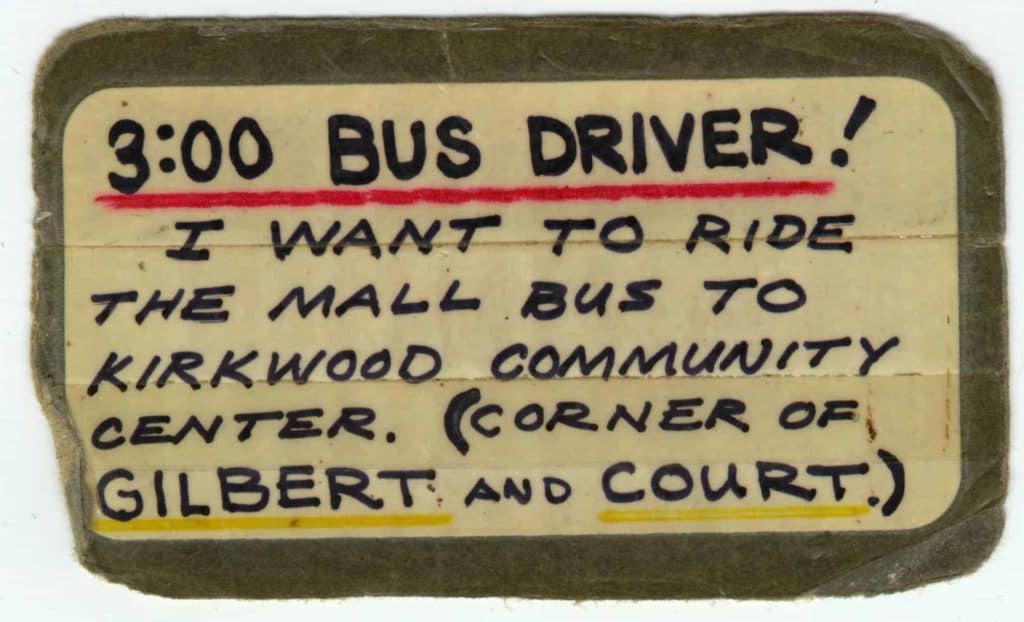
From the William “Bill” Sackter Papers [msc1028], Special Collections & Archives, University of Iowa Libraries.
Ferrier: There are several notes the size of business cards that Bill had for Iowa City bus drivers. The notes explained the route, times, and stops that Bill would need to take on certain days. The notes are all small enough to fit into a pocket. They are well-worn after being carried and handled daily by Bill. I have heard stories of Bill sometimes getting off the bus at the wrong stop, so perhaps they didn’t always do what they were meant to. Or maybe that was why they were made by one of Bill’s buddies, such as Mae Driscoll, Rabbi Jeff Portman, or another treasured friend.
Q: What do you hope visitors will take away from their time in the exhibit?
Knights: I hope that people will leave with a feeling of belonging and inclusion—not just feeling included and valued themselves, but also ready to share that with others. To be like Bill, who loved everyone and tried his best and wanted to make people smile. To be like Barry and Bev Morrow, and Bill’s many other buddies, who accepted and loved Bill just as he was and helped make space for him. To tell stories and find common ground and have genuine care for one another.
There’s so much we can never know about Bill Sackter. What we have learned about him and who he was can’t fit in this one exhibit, but we hope we can give people the sense that everybody’s story matters.
Q: Do you have any advice for people with disabilities on campus?
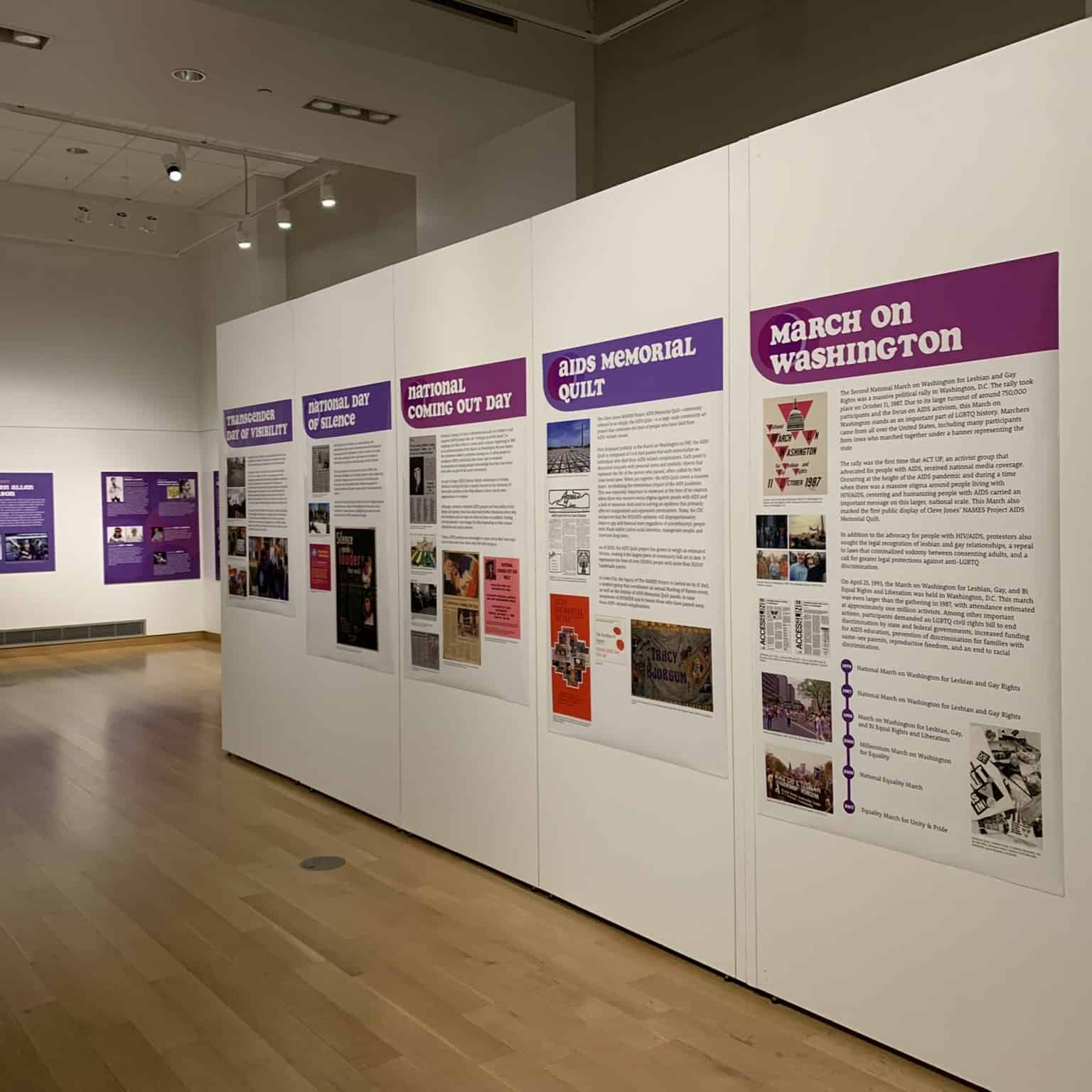
While Out & About: Queer Life in Iowa City will be on display in the Main Library Gallery through June 30 this year, the virtual version is now available to view online into the foreseeable future.
The tour features 360° photos of the Main Library Gallery, which allow the viewer to move from area to area and get a feel for the space. The text panels and the items on display are clickable, meaning close-up views of most objects are available along with insights from the curatorial team.
Curated by Madde Hoberg with Aiden Bettine, Out & About: Queer Life in Iowa City is an exhibition about some of the many LGBTQ+ people and organizations in Iowa City’s history. Across the decades, queer folks in Iowa City and at the University of Iowa have created spaces in which to gather, to find support, and build community. The exhibit invites exploration of the diverse and complex history of LGBTQ life through an Iowa City lens.
Documents, photos, artifacts, and ephemera from local archives help recount stories from the recent past about queer student groups, local businesses and organizations, and publications. Materials on display in the exhibition are from the University Archives and Iowa Women’s Archives in Special Collections & Archives at the University of Iowa Libraries, from the LGBTQ Iowa Archives & Library in Iowa City, and from community members.