[google-map-v3 width=”400″ height=”300″ zoom=”12″ maptype=”hybrid” mapalign=”right” directionhint=”false” language=”default” poweredby=”false” maptypecontrol=”false” pancontrol=”false” zoomcontrol=”true” scalecontrol=”falso” streetviewcontrol=”false” scrollwheelcontrol=”false” addmarkermashupbubble=”false” addmarkerlist=”36.167783; -86.778365{}1-default.png” bubbleautopan=”true” showbike=”false” showtraffic=”false” showpanoramio=”false”]
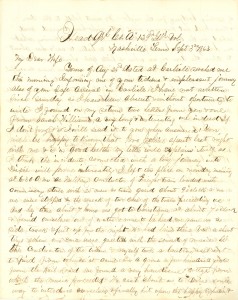
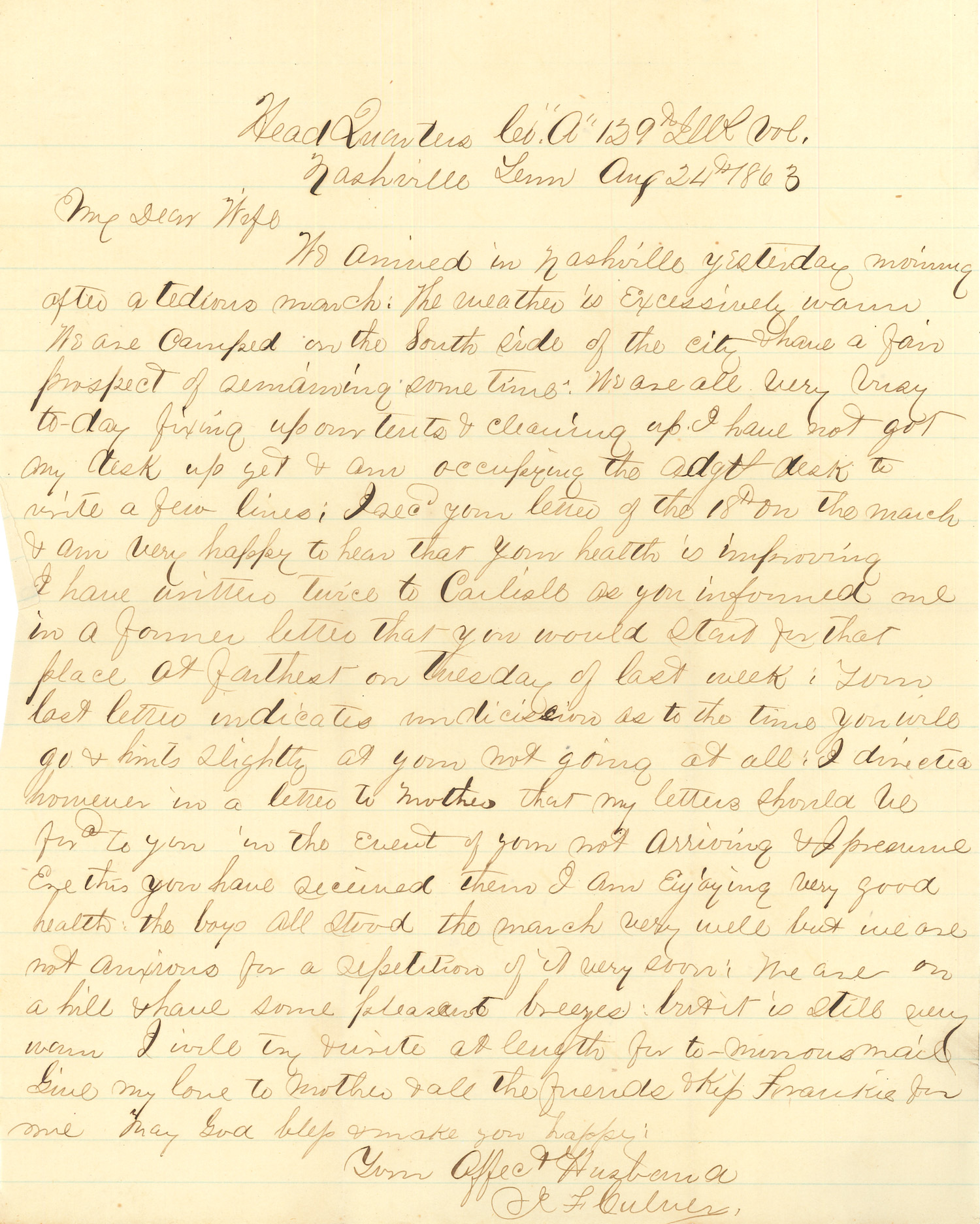
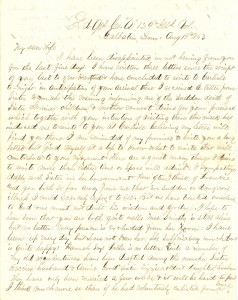
Head Quarters, Co. “A” 129th Ills. Vol.
Nashville, Tenn., Aug. 27th 1863
My Dear Wife
I have not had the pleasure of hearing from you since our arrival here, but hope very soon to be made happy by a letter. I am in the enjoyment of excellent health. Our duty thus far has been very pleasant. ((On reaching Nashville, Colonel Case of the 129th Illinois reported to Maj. Gen. Gordon Granger, who was charged with responsibility of protecting the Army of the Cumberland’s depots and lines of communication. General Granger assigned the 129th Illinois to the 2d Brigade of Brig. Gen. Robert S. Granger’s Third Division of the Reserve Corps, and the men were turned to pitching tents, between Fort Negley and the Murfreesboro Pike, near the southeastern outskirts of the city. O.R., Ser. I, Vol. XXX, pt. III, pp. 37, 372; Grunert, History of the 129th Illinois, p. 34.)) I went out on Picket on Monday [the 24th] & had a very pleasant time. Our post was in a very pleasant grove quite near a house, the ladies of which supplied us with some fine music, both instrumental & vocal.
We made an exchange of Arms yesterday & have all new guns (rifled). ((Col. Case on May 30, 1863 had notified General Paine that the regiment’s caliber .69 muskets were obsolete. These weapons, manufactured more than 30 years before, had been altered from flintlock to percussion, and could not “be relied upon except at close quarters.” While they “would do a great deal of execution at one hundred yards if directed upon troops en masse,” at ranges in excess of 150 yards they were “very uncertain even in the hands of good marksmen, if fired upon an enemy deployed as skirmishers.” At a range of 300 yards, they were practically worthless. If the regiment
were attacked by “an inferior force” armed with Springfield rifle musket, the “only
salvation would be to advance rapidly upon the enemy in his own chosen position, and come at close quarters at once.” Case to Paine, May 30, 1863, Regimental Papers, 129th Illinois, NA.
When no action was taken on this request, Colonel Case on July 27 addressed a communication to General Gordon Granger. Besides repeating his former arguments, he pointed out that the caliber .69 muskets were “constantly getting out of repair,” and he had been “compelled to turn over so many as broken and damaged that we have not enough now to arm our men. ” Case to Granger, July 27, 1863, Regimental Papers, 129th Illinois, NA.)) Continue reading →

 [google-map-v3 width=”400″ height=”300″ zoom=”12″ maptype=”hybrid” mapalign=”right” directionhint=”false” language=”default” poweredby=”false” maptypecontrol=”false” pancontrol=”false” zoomcontrol=”true” scalecontrol=”falso” streetviewcontrol=”false” scrollwheelcontrol=”false” addmarkermashupbubble=”false” addmarkerlist=”36.167783; -86.778365{}1-default.png” bubbleautopan=”true” showbike=”false” showtraffic=”false” showpanoramio=”false”]



 Subscribe via RSS
 Subscribe via Email