Skip to content
Skip to main content

More Wet Books

Thursday, February 19, 2009
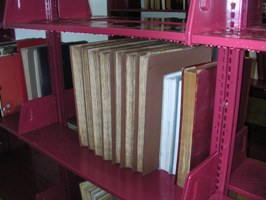
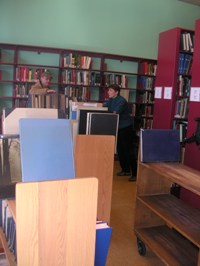
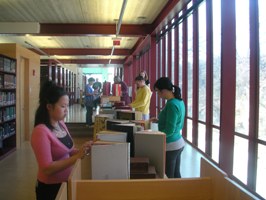
The Art Librarian called early this morning informing us that a pipe had burst, soaking the oversize art book collection. The good news was that they had caught the water break early and that it was clean water. The bad news was that a majority of the books had clay-coated pages (glossy like a magazine) and if they dried before we could separate the pages the books would become bricks –never to be opened again. We estimated that about 2,400 books were wet.


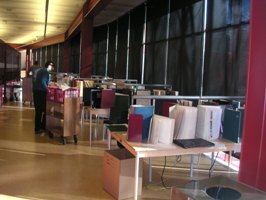
We were over with an assessment team by 9:15 AM. Staff arrived shortly after that with needed supplies and the work began. We began pulling books out and setting them up for air drying. It didn’t take long to figure out that we would not be able to air dry all the wet books.

The Art Librarian, Rijn Templeton, selected the most valuable books for us to air dry while I called in a freezer truck and supplies to box up the remainder of the books. We sent out a call for volunteers to assist. Help poured in all day (excuse the pun). By 3:45 PM we had 165 volumes dried, 296 still air drying, and around 1,800 volumes packed in boxes and on the freezer truck. Special kudos to Kim Carpenter, Art Library Assistant, for acting quickly when he discovered the leak.

Volunteer Begins Working File Project

Wednesday, February 11, 2009

Our publicity has been paying off! Marilyn Maynard, a local Iowa Citian, read about our recovery efforts in the Press Citizen and thought she might be able to contribute. She is currently working on a project designed to clean and copy the working files for the African American Museum.

The files were in a large filing cabinet and are dirty and warped with water damage. Our volunteers will be dry cleaning them with eraser crumbs to prepare them for photocopying. The folders are being replaced and the information hand copied onto the new folders. 

This is a large scale project and would possibly have been dropped if it wasn’t for the help of volunteers like Marilyn simply because it would be too expensive. The fact that we have people willing to take on some of these projects allows the museums to put their money to use in other places and makes it possible to save more of these collections than we would have otherwise. 

Some other workflows we hope to get going with our volunteers are cleaning, flattening, and rehousing newspapers from the Czech Slovak Museum and cleaning, and rehousing court dockets for the Johnson County Historical Society. 

Disaster Planning E-Forum a Success!

Wednesday, February 11, 2009

Walter Cybulski, Preservation Librarian at the National Library of Medicine, and I led a two-day e-forum lsitserv discussion on disaster planning and response. We weren’t really sure how it would work but were willing to give it a try. It was exhausting but well worth it. 

We shared sites for resources; discussed mutual aid agreements, “disaster response” exercises for training, and tips on dealing with a disaster; had lots of ideas and pointed to templates for crafting a disaster response plan; talked about how to deal with water leaks and the virtues of cleaning or not cleaning mud from books before packing up; pondered whether to store record album covers and discs together or separately; had a rather lively discussion about mold clean up; and identified funding for recovery and working with FEMA as an area that needed further action at the national level.

We had 549 subscribers and posted close to 100 emails. The e-forum was free and sponsored by the Association for Library Collections and Technical Services, a division of the American Library Association.

For the archives of this discussion go to: http://lists.ala.org/sympa, click on ALCTS (spelled out) under the ALA Division heading, then choose alcts-eforum@ala.org

Saving Working Files Conundrum

Friday, February 6, 2009

Susan Kuecker, African America Museum curator, would like to save her working files. These files have all her research for various researcher requests, grant applications, and projects, collected over eight years. Most of this information is not in her computer. Since most of the items in the files are not unique, she can’t justify spending a lot of money on recovery.

Since the material is not unique, our working premis is that we’ll clean the items good enough to make a photocopy replacement, flattening only when necessary. Our best guess is that there are about 6,000 pages. When I first priced this proposed project out using a conservation lab technician’s time, the price tag was around $24,000. Then I tried the same scenario using student workers. The price tag was $12,000. Still too high. A little light bulb went off — we are interviewing volunteers. Perfect!

After a brief discussion with Susan, we arrived at a plan whereby the AAMI will supply us with replacement folders and photocopy paper and we’ll use a combination of students and volunteers to process the files. Any exceptions (unique brochures, newspaper articles, photographs) will be separated out for a later project. New price tag is under $900. Very acceptable to all!

We’ve begun pulling the material out of the file drawers and putting them into boxes for volunteers to work on. The file drawers are going back to the AAMI. They hope to be able to clean the drawers and repaint for re-use.

Soaking LP Covers Works Sometimes

Wednesday, February 4, 2009

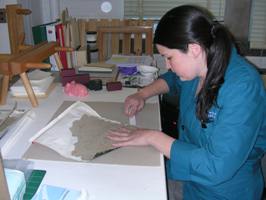
The covers of the LP records in the Czech Slovak Collection come in different formats and conditions of which some are worse than others. Then there are those few that are exceptionally awful. This is an example of a double disc set in which the inner images fused together in the water, like the pages of a book.  I had to peel away all the layers of the cardboard that I could without damaging the cover images and it all came apart except the very inner facing images. I couldn’t separate these mechanically so I put the whole thing into a tray of warm water and photo flo using sheets of remay cut to size as a transfer support. I left it to soak for a few minutes until I was sure the water had completely saturated the paper. I then took a teflon lifter and the pages came right apart. There was a piece that got stuck and came away which you can see in the photo but after I had dried and flattened the cover I was able to mend it and put the piece back where it belonged. The image was dried open, flat between two blotters beneath weight. 

Making progress with LP covers

Monday, February 2, 2009

The process we have been using to clean and prepare the LP covers to be rehoused with their respective 33 1/3s has turned out to have a lot more steps than we thought. We have been removing the image from flood saturated cardboard which is warped, discolored, and in some cases has a strong flood-ooze odor.

The moisture introduced during the cleaning process can warp the already warped paper and it is necessary to flatten each image. To do this, even more moisture is added in the form of misting water from a sprayer to the back side of each image. This relaxes the paper which is then put in between blotter paper and pressed in a large nipping press. The blotter paper absorbs the excess moisture and the pressure of the press flattens the images. I have been doing these in batches since it is possible to put a large stack in the press at one time. 

Though this is a lengthy process it is necessary to bring the covers as close to the original condition as possible. These images are inserted into a polyethylene sleeve along with a three flap enclosure to hold the record. 

Not all of the covers have been so cooperative. Some are so soundly adhered to the cardboard that it needs to be peeled off from the back. We are still working out the most efficient way to do this. Now that we have a system sketched out it will start going more quickly.  It’s satisfying to see a box of finished covers put together. We’re definitely making progress!

African American Objects Ready to Go Home

Friday, January 30, 2009

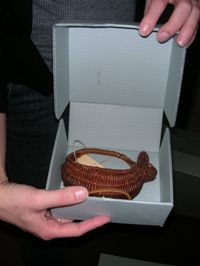
On Tuesday February 3, 2009,  we will be returning the first finished round of artifacts to the African American Museum. This will include baskets, gourds, feathered fans, sandals, a beaded necklace, a syrup tin, a box of buttons from a local dry cleaner and many other objects. It will be a landmark in the progress we have been making. With so many projects happening simultaneously it is nice to be able to see what we have accomplished so far and to be able to send these artifacts home to their museum.

Boxing Up African American Objects

Thursday, January 29, 2009

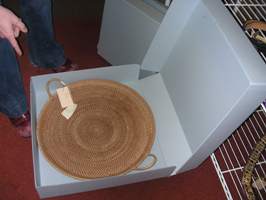
Since all the cleaned items will be off to their home, I am taking today and tomorrow to box them up for travel, and also future protection. It is so pleasing to see these items we have lived with snuggled in new boxes, waiting to be picked up. Making the clamshell boxes out of the blue board is also a nice break from what seems like constant cleaning. Some of the items, like the feathered fans, will share housing, but the baskets will be happiest in sturdy boxes by themselves. It will help us, with space (and hopefully the African American Museum, too, that’s the idea), as we can stack boxes, but not items. This was Nancy’s idea, after noticing that the items that had been properly housed prior to the flood fared much better than unhoused, or ill housed, items. 

Protective Boxes for Art Books

Wednesday, January 28, 2009

In 2007, School of Library and Information Science Preservation students Laura Guth, Sally Myers, and Kris Wiley prepared a preservation plan for the oversize collection of about 550 books at the University of Iowa Art Library. The plan called for sending a small number of items to Book Repair each week. In addition to any repair work, those items needing additional support and protection were to be sent on to the Conservation Lab. We implemented this plan late 2007.

Since making boxes of this size is hard on the hands and elbows, Linda Lundy makes only 1-2 a week. This means that we make slow but steady progress on this project. LInda has constructed 76 boxes so far.

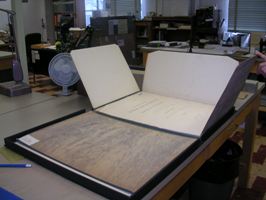
Even though the Art Library is closed due to damage to the building during the June floods, staff are still retrieving for patron use. During these trips to the Art Library, items from the oversized area are pulled and forwarded to preservation. One piece sent over was: fNA280.W54 Atlas, Die Archaische Poros-Architekure der Akropolis zu Athen. The piece measured 17 3/8” wide by 23 ½” long. By the time the box was made, it measured 18 3/8” wide by 25” long. The preservation box enclosure will protect the piece from further damage by light, moisture and dust and will keep the piece sitting straight on the shelf.

Washing Music Library LPs

Friday, January 23, 2009

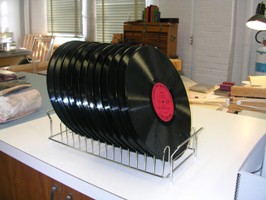
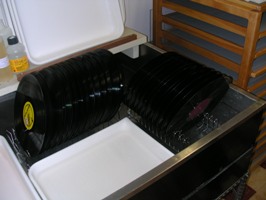
Librarian Anne Shelley brought down a box of soon to be digitized LPs with the request that we clean them. We were happy to do so, as it would give us a chance to make sure that our dish drainer could convert itself into an LP drying rack. I set up the sink with two trays, one with water and a bit of photoflo for washing and a second “water only tray” for rinsing. I removed the LPs from their jackets and swabbed the labels to make sure that none would run in the water–only two seemed ready to run. I then quickly dipped the LPs in the wash, brushing them gently with a soft (tsukemawashibake) brush, one that we normally use for paste linings. I then propped them on the drying rack, perfectly sized for an LP, and let them dry for a short period. Next, I brushed them dry with a microfiber brush designed for vinyl records. Each record then got slipped back into its cover, with a new polyethelene sleeve for protection. This should remove any dust and greasy fingerprints from the surface that might otherwise interfere with the digitization.