Skip to content
Skip to main content

An Ailing Herbal Comes to Conservation Lab

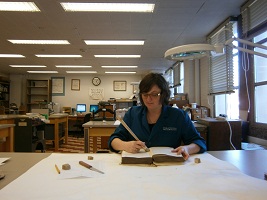
This book first came to the attention of Martin Rare Book Librarian Donna Hirst when a patron requested to see some of the herbals in the collection. The poor book had been overlooked, though at one time it appears to have seen a lot if use. Or maybe just a lot of neglect. Donna Hirst sent this to the lab for Conservator Emeritus Gary Frost to shore up. While Gary treats this book and gets it to a more handleable condition, I will shadow him and attempt to discover a little bit about this book—where it may have been bound, how typical of an example it is, its condition and what is to be done about it.

The book is a 1626  Frankfurt imprint of Pier Andrea Mattioli’s herbal, originally written in Italian nearly 75 years earlier as a commentary on Diosordies’ De Materia Medica. In 1556 an illustrated edition was published and began to be translated into other languages and widely published. An herbal is a book on plants usually with visual and written descriptions, as well as medicinal, horticultural, and preparatory information.  This particular book is large and has color illustrations, but without much notation.

As you can see from the following images, the book has a rather sorry appearance. The spine has gone concave and is partly exposed. The alum taw (the book covering material) is soiled and has torn along the board edges. Part of the rear board is long missing. The spine liners of parchment are curling away and one of the endbands is gone. Many interior pages are ripped, soiled and have large losses, especially in the first and last few signatures.

Although the initial reaction may be one of disgust or sorrow for the book’s condition, it seems to be the original binding and the condition itself can reveal much about the book’s history. Stay tuned!

Mini Ornaments Upon a Holiday Tree

The holiday tree with all its creative ornaments
The holiday tree with all its creative ornaments!
This time of year is full of spirit and creativity. We like to indulge ourselves with fun, small projects like the Conservation Holiday Ornaments. All these ornaments were made within our department by Jody Beenk, Lucy David, Dan Essig, Bill Voss, Susan Hanson, Bu Wilson, Cynthia Mosier and other conservation workers.

awl/pin tool
tiny awl/pin tool measuring at 1 3/4" x1/4"
Longlink Ornament
Longlink Ornament: 1 1/4" x 1 5/16"
We have mastered miniature books, long stitch bindings, tools, boxes, etc. We hope you enjoy looking at these as much as we had making them. Happy Holidays!

four mini books
(from left to right): Leather Bound; 1 5/16" x 1 1/8", Shrink Wrap; 1 3/4" x1 5/16", Blue binding; 1 3/8" x1 3/16", Longlink again.
Clamshell boxes open and spread out on table
First clamshell box: 2 7/8" x1 3/16" x1 1/6", open length=4 7/16" - Second clamshell box: 2 1/4" x2" x1 3/8", open length=5 3/8"
Two wood bounded books
wooden board with Ethiopian binding: 1 7/16" x 1", Ethiopian wooden board book, with mouse teeth enclosure and mica window: 1 1/2" x 13/16"

Moving out of 5th floor

Room 5065 Typewriting
Our storage in the old typewriting room.
Have you ever wondered what was in room 5065 “staff office” with the classification of the word typewriting across the door? Well, today is your lucky day. The room use to be a work space where PhD candidates’ dissertations were typed. Furthermore, this was our storage space for the items being recovered from the flood.
empty shelf in storage room
Finally the shelf is empty!
More empty storage space
Another empty storage space completed.

These shelves were piled with storage containers carrying anything from books to objects from The African American Museum of Iowa, The National Czech & Slovak Museum, and The Johnson County Historical Society. While it could be overwhelming imagining this space full; we are ecstatic to confirm that nothing pertaining to our department dwells there. You can breathe again and take in some of these pictures showing the unhabituated space.

Linda Lundy’s Incredible Boxes

Linda Lundy, a conservation staff member, has just finished over 300 beautiful, small boxes for book storage use. These boxes were made to hold a variety of small books for the university’s main collection; anywhere from poems to storybooks, even spanish to english translation dictionaries. The boxes were measured and designed specifically for shelving within the Heinz road facility. They measured at about 5″ wide and 6″ in height. Some books were smaller in size than the box size, so fillers were made for these specific circumstances. They were each labeled with the title of the book and sent to marking to make the call numbers. Linda was able to make 22 boxes within a day; the project took around one month to complete.

Linda Lundy showing off her completed boxes.

Odor Reduction for Books in Storage

The National Czech and Slovak Museum and Libraries have a vast collection of books damaged in the flood. Most of their collection is currently in storage in Cedar Rapids awaiting treatment. We recently received a box of books that was pretty smelly. In order to help curb the smell we developed a new way to use an odor reducer that we have been using for some time in the lab.

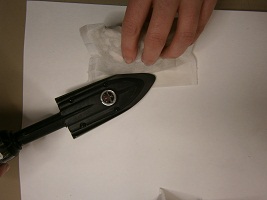
sealing with a tacking iron
A Technician seals the tea bag with the tacking iron.
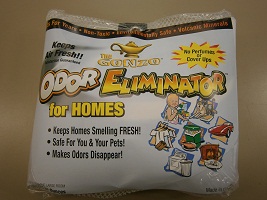
Gonzo Odor Eliminator
Large bag of Gonzo Odor Eliminator ready to be opened.

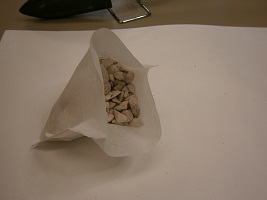
The Gonzo Odor Eliminator comes in large bags, too big to fit into boxes filled with books.  We decided to make smaller packages of the rocks to be able to place an odor eliminator into each box of books.  We ordered large heat-sealable tea bags and set to work.  Each package of Odor Eliminator was opened and poured into approximately 12 tea bags.  Each bag was then sealed with a tacking iron.  Once sealed the bags were placed into the boxes of books to help reduce the “flood smell” on the books.

Smaller odor reducing package
Gonzo Odor Eliminator in an open tea bag.

Good-bye Caitlin, Hello Kathleen

Kathleen Tandy working
New Flood Recovery Conservation Technician Tandy Working

Good-bye Caitlin, Hello Kathleen

Caitlin Moore, our Flood Recovery Conservation Technician, is moving on to the National Personnel Records Center in St. Louis.  We are sad to see her go but are so thankful for all the work she has done for the past three years. Good Luck, Caitlin!

We welcome Kathleen Tandy to fill Caitlin’s position as the Flood Recovery Conservation Technician. Kathleen comes to us from the State Historical Society of Iowa where she was working on conserving Civil War Muster Rolls for the State of Iowa.  Welcome Kathleen!

Disaster Response Practice

Friday, May 27, 2011

The best way to be prepared is to practice. As school children we have practice drills on how to respond to a fire alarm. Constant practice turns into a habit. We all know how to respond to a fire alarm without even thinking.

Today we had a disaster response practice drill. Each team had to assess the situation, plan for the response, and then rescue and pack the items. The practice was the aftermath of a “tornado” that left books, CDs, and photographs in mud along with snakes and fish.

We practiced safety, organized supplies, determined what materials should not be saved, rinsed and packed the books for freezing, and rinsed CDs and photographs and set out for air drying.

Your Aunt’s Dinner Party

Thursday, May 26, 2011

What would you do if your aunt called you two days before her dinner party and informed you that due to a fire in her kitchen she wanted you to host her party at your house? OceanTeacher Academy students used this scenario to practice their disaster planning skills. We all have had to deal with “disasters” in our life and as a result have developed skills that can be helpful when dealing with a disaster to our library or museum collection. Questions the students had to resolve were: what was the goal in resolving the dinner disaster, how was the dinner going to be handled, what steps would be involved in holding the dinner, how would they get the food and other resources needed, and who was going to pay for the dinner?

Of the four groups, no two had the same solution. Each approach to responding to the disaster was different but creative and resulted in a successful dinner party.

Flattening A Book

Wednesday, May 25, 2011

Salvaging damaged books can be very time consuming, especially if they don’t dry flat. Today Caitlin Moore demonstrated how to flatten a book. First you lightly mist a page, using a mister that sprays a very fine mist, interleave with a blank piece of paper every few pages, put a board over the book, and put a weight on the board. One must make sure that the board is slightly larger than the book.

Preparing for Disasters

Tuesday, May 24, 2011

An important part of preparing for disasters is to practice and experiment before a disaster. An excellent drill is to get books wet in clean tap water and then air dry them. Get a broad range of books wet and see what happens as they dry. A couple of the books that we worked on at OceanTeacher Academy got so wet and heavy that the text block started to tear away from the cover. When that happens, it’s best to separate the text from the cover and dry separately.

Another book had pages that started to stick together. Using a simple beveled kitchen tool with rounded corners was used to separate the pages. The tool was gently inserted between the pages and then gently wiggled to separate the pages.

Sometimes a word was lost when a tiny piece of the page stuck to the other page. With just a word lost here and there, it was still easy to read the text. However, an important consideration is to think about how long one should spend on a book. Is the book worth spending 2-3 hours, separating each page? Or can it easily be replaced?

Since we are simulating a disaster, we are using tools easily at hand and not tools from a conservation lab