Skip to content
Skip to main content

Busy Summer

Wednesday, August 15, 2012

Change was a foot this summer in the UI Libraries Conservation Lab.  We started the summer by starting to pack up our lab space in preparation for our move to the 5thfloor of the library.  It was a long, sometimes sad process but we knew that moving to a new clean space would be worth it.

Old Conservation Lab


Saying goodbye to our old space turned out not to be that hard when we were finally able to see our new space on the 5th floor.  It is clean and bright and we were able to lay out the space in a very cohesive manner.

Model Collection
Model Collection


My favorite spot in the new lab is the model collection and meeting area.  There is a great table to sit at with the entire conservation model collection at your fingertips!


If you are interested in seeing the new space stop on up to the 5th floor and follow the signs.

TGIF Sorta’

Friday, May 25, 2012

Instructor demonstrating how to make a four flap enclosureThe time at OceanTeacher Academy flew by and it is already Friday! We had a great group of students who stayed engaged and worked hard. In the afternoon, Caitlin demonstrated several things including how to make a four flap enclosure and a simple archival paper wrap as options for providing protection for rare books. Since budgets are always tight no matter the size of library and none of the libraries had direct access to a conservation lab we spent our time learning how to provide basic protection with limited materials and staff time.
Student standing in front of a cameragiving power point presentationThe students worked all week on a preservation plan and gave formal presentations at the end of the week. A written plan was also turned in to the instructors. These written plans will be reviewed by the instructors with follow up comments, used by the students to begin discussions with their management and as a starting point for possible grant proposals. The plans had short and long term goals with many goals requiring little money. Many students identified a need for better shelving practices, cleaning and handling procedures and repair of cracks in walls and foundations. Long range plans included a desire for air conditioning and improved scanning equipment.

Caitlin and I look forward to hearing about the student successes and challenges as they begin implementing preservation practices in their libraries. We are glad to have the weekend in front of us but will miss our new and renewed acquaintances as we head back home.

Protecting Fragile Material

Students are using awls to make sewing station holes for stitchingThursday, May 24, 2012

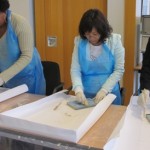
We spent the morning at OceanTeacher Academy practicing stitching single-signature pamphlets into binders and making pockets. Pamphlet binders and pockets are both good ways to protect vulnerable material. We used both commercial and homemade binder covers for our pamphlets. A pocket can be used to keep a CD, pamphlet, map or other loose material with a book. A pocket attached to a folder can also be used to protect an item, particularly pamphlets that are too fragile to stitch in a binder or items too thick to include in a book. Pamphlet binders and pockets are inexpensive ways to protect fragile material.Student is measuring paper to make a pocket to insert into a book

Visiting the National Archives in Bruges

Wednesday, May 23, 2012

OTA students listening to Archivist Luc Janssens in the new facility Today we visited the National Archives in Bruges at their old facility and the new facility that they will move into this August. Archivist Luc Janssens talked about how he organized the archives collection by size in order to maximize the shelving space. There are four different height and width sizes of shelving. He also mapped the collection areas on an architectural floor plan so that the movers can move the boxes and shelve them for him. He has to very careful that the boxes get on the correct shelf so he can find the boxes back again.New compact shelving in the new buildingBoxes are organized  by size
The depth of the firewall can be seen over the head of the architect leaning against the firewall
In order to reduce the chances of fire getting into the archive collections, he requested that a fire wall be built that will withstand fire for one hour. The depth of the fire wall can be seen behind the architects who came to visit with us during the tour of the new facility.

Luc also should us an example of safely displaying a book that needs special handling. Each book that needed special support was set out on a pillow.
A large book is resting on a pillow

Dual tracks: Book Repair and Preservation Planning

Tuesday, May 22, 2012
Student is attaching a loose page in a book using document repair tapeDuring our week at OceanTeacher Academy, we are learning the basics of book repair for circulating collectons and preservation planning. Today we learned about mending page tears and tipping in loose pages. We stressed that these mends are for circulating collections only and not for special collections or rare books. The goal of simple mends for circulating collections is to extend the life of the book so it can continue to circulate until the book wears out. We used transparent, thin, flexible mending tissue.

We also continued to work on a preservation plan for each library. Students are discussing and recording preservation needs for collections, equipment and building. After each lecture, they review their recorded needs and make additions and/or corrections. By the end of the week they will each have a preservation plan. Today the students got into groups and shared ideas for filling out the various needs forms.

Students are sitting at a table discussing preservation needsStudents are sitting by a window discussing preservation needsStudents are discussing preservation needs and recording on the computer

OceanTeacher Academy Preservation Course

Monday, May 21, 2012

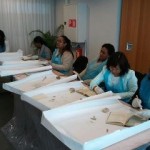
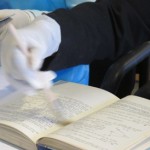
Students dry cleaning books using erasures and other techniques Our first day at OceanTeacher Academy (http://classroom.oceanteacher.org/) Preservation of Books and Other Media was very productive in spite of students and teachers suffering from jet lag and the challenge of understanding each other. The students are from Ghana, Vietnam, Seychelles, Cuba, Namibia, Latvia, Ukraine, Latvia, Jamaica, Kenya, Mauritius, and Pakistan. We spent most of the day covering preservation basics and working on preservation plans for each library. Caitlin Moore concluded the day with a demonstration on how to clean a book using a vacuum cleaner, various erasers and eraser crumbs. And then the students practiced the various dry cleaning methods working on books that had dirt, soot, and pencil markings in them. To keep the dirt and soot contained, each student created a little work area using plain white paper.

It’s a small world

Friday, May 18, 2012

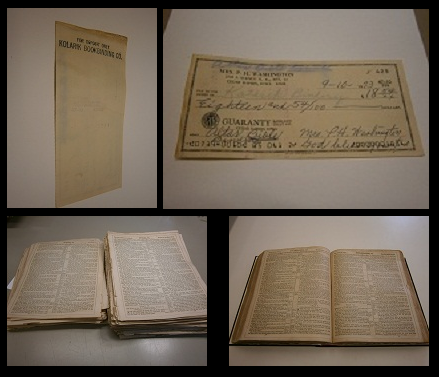
AAMI Bible with Kolarik Bindery Check
I always love when things come together to remind us how small the world really is.  I have been working on a Bible from the African American Museum of Iowa that was damaged in the flood. The Bible was in pretty bad shape.  The binding had totally failed and it was basically just a stack of sheets.  I cleaned every page and then consulted Gary for next step.  He suggested jogging each page together and gluing using the double fan method so that the Bible could be bound once again.

As I was cleaning the sheets a cancelled check to the Kolarik Bindery fell out of the pages.  It was a check to have the Bible rebound in 1973.  This was significant to me as most of the Kolarik bindery equipment was donated to the UI Center for the Book to help establish a central location for students to study bookbinding.

While thinking about how great it was to have a book bound at the Kolarik Bindery as I was working on a book for the National Czech & Slovak Museum & Library, I looked down at the treatment sheet and was amazed to see that the author’s last name was Kolarik.  Suddenly it all came together – Kolarik is a Czech name.

So while working on a book for the African American Museum of Iowa, I was connected to the Kolarik Bindery and the UI Center for the Book as well as to the National Czech & Slovak Museum & Library!

Johnson County Record Books

Wednesday, May 9, 2012

We have conserved a number of record books from the Flood of 2008 for the Johnson County Historical Society.  Most of them have been pretty straight forward in the treatment that was needed.  We were so close to being finished with all of the record books when we came across a record book that hadn’t been sewn, but needed to be rebound.

This meant we needed to double-fan or perfect bind the book.  This process uses adhesive to keep all the pages together.  It is the process used to bind most paperback books on the market today.  It is a fairly simple process but the sheer size of the record book made it a little difficult.

The record book all glued up.

The record book in question is 18″ tall, 12″ wide and 3″ thick, too big to fit into any of our lying presses! Bill and I jogged the textblock together and using all four of our hands clamped the book together.  I then glued the textblock together and lined the spine.  We could then move onto casing the book in.

The record book rebound

Andrea’s Awesome Flood Recovery Video

Thursday, May 3, 2012

A Still from Andrea's Video

Recovering from a flood can take years and can be overwhelming if you don’t have help. Luckily the National Czech & Slovak Museum & Library and the University of Iowa Libraries have lots of excellent help. The UI Libraries Conservation Lab continues to act as a flood recovery lab for the area museums impacted by the Flood of 2008. Many students workers and volunteers are assisting in the recovery of the NCSML books. We have sorted out the books into “rare” and “general”. The rare items receive full conservation treatment. To save time, money, and have an attractive book to put back on the shelf, we have developed a special workflow. The text block is taken out of the covers, cleaned, flattened, and edges trimmed slightly. The text block is sent off to a commercial bindery. If the cover or jacket has information or interesting artwork, the cover or jacket is sent along with the book. The cover image is digitized and used to make a new cover. Student worker, Andrea Kohashi, has explained the process in her video:

http://www.youtube.com/embed/kFtpG5wvYXY

Hinge Tightening

Hinge Tightening or Tightening in Case

This treatment should be performed when the hinge(s) of a book are loose but not separated. Do not use this treatment if the cover cloth is torn at the joint.

Hinge needing treatment


The materials needed for this treatment are:
Knitting needle
PVA in a bottle
Waxed paper
Press and pressing boards

1. Gently hold open the hinge to be tightened.
2. Insert the knitting needle into the PVA bottle, coating it evenly with a thin layer of adhesive.
3. Insert the adhesive coated needle into hinge, then pull it back out slowly, rotating it to dispense the adhesive. Perform this step at the head and tail of each hinge as needed.

Apply adhesive using a knitting needle


5. Place a sheet of waxed paper between the cover and end sheet at the hinge and close the book.
6. Use a bone folder to reset the joint.

Resetting the hinge with a bone folder


7. Press the book between edged boards.

Submitted by Brad M Ferrier